

- Industry Size (2026)
- USD 0.3 Bn
- Forecast (2036)
- USD 1.4 Bn
- CAGR (2026 to 2036)
- 16.6%
Electrostatic-Spray Optimized Crop Protection Additive Market Forecast and Outlook 2026 to 2036
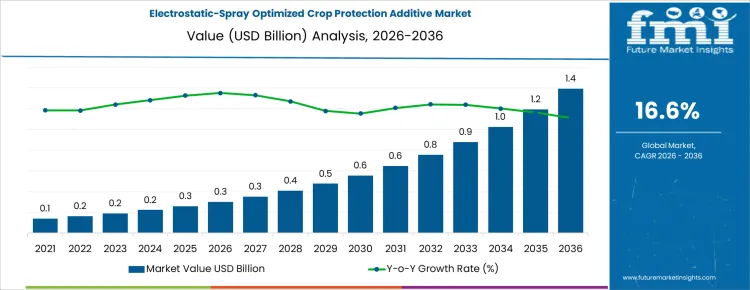
The global electrostatic-spray optimized crop protection additive market is expected to grow from USD 0.3 billion in 2026 to USD 1.4 billion by 2036, at a 16.6% CAGR. This market is driven by the increasing adoption of precision agriculture and electrostatic spraying technologies, which enhance agrochemical application efficiency by reducing chemical use, minimizing drift, and improving crop coverage. The use of specialized additives, such as charge-stabilizing deposition enhancers, ensures uniform coverage and better droplet adherence, which enhances the efficacy of pesticides, fungicides, and herbicides, particularly in challenging terrains or complex crop canopies.
Quick Stats for Electrostatic-Spray Optimized Crop Protection Additive Market
- Electrostatic-Spray Optimized Crop Protection Additive Market Value (2026): USD 0.3 billion
- Electrostatic-Spray Optimized Crop Protection Additive Market Forecast Value (2036): USD 1.4 billion
- Electrostatic-Spray Optimized Crop Protection Additive Market Forecast CAGR: 16.6%
- Leading Additive Function Type in Electrostatic-Spray Optimized Crop Protection Additive Market: Charge-Stabilizing Deposition Enhancers
- Key Growth Regions in Electrostatic-Spray Optimized Crop Protection Additive Market: USA, Brazil, China, Australia, Spain
- Key Players in Electrostatic-Spray Optimized Crop Protection Additive Market: Micron Group, Spectrum Electrostatic Sprayers, ESS Agri Additives, Electrostatic Spraying Systems Inc., Spraytec AgroSolutions
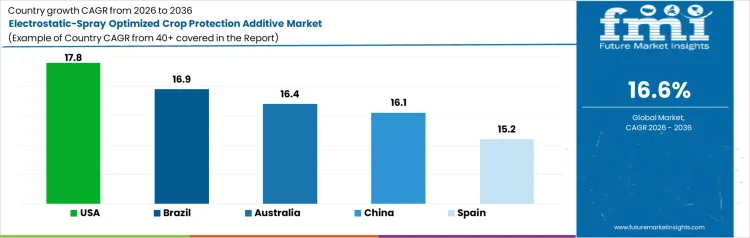
Electrostatic-spray optimized crop protection additive market is expanding rapidly, with the USA leading at 17.8% CAGR, fueled by the growing need for efficient, sustainable crop protection solutions in large-scale farming operations. Brazil follows at 16.9% CAGR, supported by its expansive agricultural base and the increasing demand for eco-friendly farming practices. China and Australia also experience strong growth at 16.1% and 16.4% CAGR, respectively, due to the adoption of smart farming practices and the drive for improved agricultural productivity. Spain grows at 15.2% CAGR, supported by its focus on enhancing crop yields and minimizing the environmental impact of farming. These regions are embracing electrostatic spray technologies to enhance pest control while reducing agrochemical usage.
Electrostatic‑Spray Optimized Crop Protection Additive Market Key Takeaways
| Metric | Value |
|---|---|
| Industry Value (2026) | USD 0.3 billion |
| Forecast Value (2036) | USD 1.4 billion |
| Forecast CAGR (2026-2036) | 16.6% |
How is the Global Electrostatic-Spray Optimized Crop Protection Additive Sector Advancing?
The global electrostatic-spray optimized crop protection additive market is expanding quickly as growers adopt precision application technologies that improve agrochemical efficiency and reduce waste. Electrostatic spray systems apply charged droplets that adhere more effectively to plant surfaces including undersides of leaves and complex canopies enhancing coverage and uptake of crop protection actives. Traditional spray applications can suffer from drift and uneven deposition, which reduce efficacy and increase input costs. Additives formulated specifically for electrostatic systems optimize droplet charge and stability, enabling more uniform coverage with lower volumes of product and less environmental impact.
Demand for these specialized additives is rising alongside the adoption of electrostatic sprayers in row crops, specialty horticulture, and high value production systems where uniform protection and cost efficiency are critical. Advances in formulation science have improved compatibility with a range of herbicides, fungicides, and insecticides while ensuring that charged droplets maintain their electrical properties through the spray process. This has helped growers improve spray performance under diverse field conditions and integrate electrostatic technology into broader crop protection programs that emphasize sustainability and precision input management.
The market is expected to continue its strong growth as precision agriculture tools such as GPS guidance, field mapping, and real time sensor data are increasingly combined with optimized application chemistries. Challenges such as the need for education on electrostatic system use, investment in compatible equipment, and ensuring consistent additive performance across different spray platforms may influence adoption. Nonetheless, the focus on reducing chemical use, lowering drift, and improving target efficacy will sustain demand for electrostatic spray optimized crop protection additives worldwide.
What is the Segment-Wise Analysis for the Global Electrostatic-Spray Optimized Crop Protection Additive Market?
The global electrostatic-spray optimized crop protection additive market is segmented by additive function type and application compatibility. Charge-stabilizing deposition enhancers lead the market with a 37% share, ensuring even and stable spray coverage. Other significant additives include drift-reduction & droplet uniformity agents, leaf-adhesion & wrap-around polymers, and conductivity & spray-charge modifiers. In terms of application compatibility, electrostatic boom sprayers hold the largest share at 34%, followed by electrostatic UAV / drone sprayers, air-assisted orchard & vineyard sprayers, and handheld & backpack electrostatic units.
How Do Charge-Stabilizing Deposition Enhancers Lead the Global Electrostatic-Spray Optimized Crop Protection Additive Market?
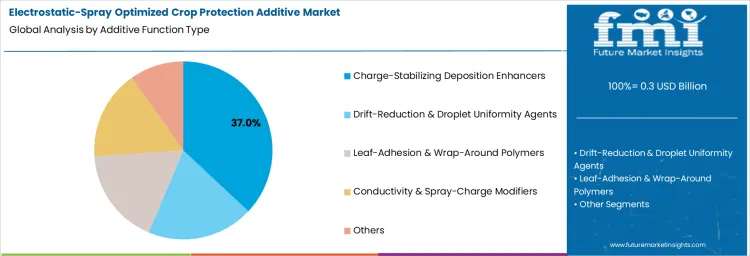
Charge-stabilizing deposition enhancers hold a 37% share in the global electrostatic-spray optimized crop protection additive market due to their critical role in ensuring uniform deposition and reducing spray drift. These enhancers stabilize the electrostatic charge, allowing for more consistent application of agrochemicals while preventing wastage and ensuring better coverage. This is particularly beneficial for large-scale applications, where achieving even distribution of sprays is essential. Charge-stabilizing additives enhance the overall efficiency of electrostatic spraying systems, ensuring better pest and disease control with fewer chemicals, thus driving their leadership in the market.
Why Do Electrostatic Boom Sprayers Hold the Largest Market Share in the Global Electrostatic-Spray Additive Market?
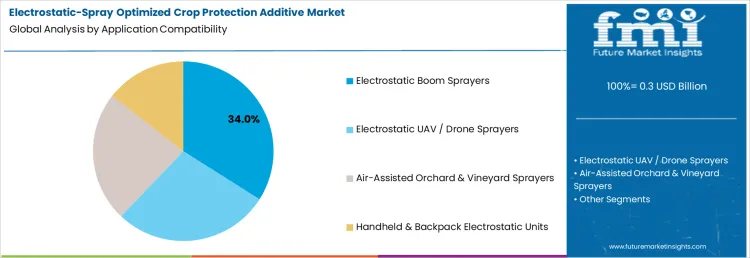
Electrostatic boom sprayers hold the largest share of 34% in the global electrostatic-spray optimized crop protection additive market due to their widespread use in large-scale crop spraying operations. These sprayers are highly efficient in applying agrochemicals over large areas, ensuring uniform distribution with minimal drift. The use of electrostatic technology helps improve spray retention on the target crop, enhancing the effectiveness of crop protection products while reducing environmental impact. As farmers increasingly adopt advanced spraying systems to optimize pesticide use, electrostatic boom sprayers continue to dominate the market, offering improved coverage and precision.
How Are Electrostatic Technologies Reshaping Crop Protection?
The electrostatic-spray optimized crop protection additive market is shaped by growers’ increasing focus on efficiency, coverage quality, and reduced chemical waste. Electrostatic spraying imparts an electrical charge to spray droplets so they are attracted to plant surfaces, wrapping around leaves and stems for more uniform deposition. This technology greatly improves coverage, especially on dense canopies, uneven terrain, and high value crops. Additives formulated specifically for electrostatic systems enhance charge retention, droplet formation, and adherence, enabling growers to achieve better pest control outcomes with lower input volumes.
What Challenges Are Influencing Uptake of Electrostatic Additives?
Challenges include equipment compatibility, operator training, and formulation complexity. Effective electrostatic spraying requires compatible sprayers and properly calibrated systems; mismatches between additive chemistries and spray hardware can undermine performance. Growers must also learn how to integrate electrostatic programs into their crop protection schedules, including timing, rates, and environmental considerations. Some additives optimized for electrostatic use may have higher upfront costs than conventional adjuvants, which can deter adoption in price sensitive operations. Finally, inconsistent regulatory frameworks for advanced application technologies across regions complicate broader implementation.
What Innovations Are Advancing the Electrostatic Spray Additive Market?
Innovation in this market focuses on chemistries that improve droplet charge stability, spray retention, and active ingredient compatibility across a broader range of agrochemicals. Next generation electrostatic additives combine surfactants, spreaders, and charge enhancers to deliver consistent performance across diverse spray conditions. Integration with digital sprayer controls and real time monitoring tools enables growers to optimize spray patterns and chemical deposition. Manufacturers are also developing bio-based and low toxicity additive options that align with sustainability goals. Partnerships between additive developers, application equipment manufacturers, and agronomy advisors are accelerating field validated solutions that make electrostatic spraying more accessible and effective.
What is the Growth Outlook for the Electrostatic-Spray Optimized Crop Protection Additive Market by Country?
| Country | CAGR (%) |
|---|---|
| USA | 17.8% |
| Brazil | 16.9% |
| China | 16.1% |
| Australia | 16.4% |
| Spain | 15.2% |
The electrostatic-spray optimized crop protection additive market is experiencing strong growth, with the USA leading at a 17.8% CAGR, driven by the increasing adoption of precision farming technologies and the demand for more efficient crop protection solutions. Brazil follows with 16.9%, supported by its vast agricultural sector and the need for optimized pesticide and herbicide use. China’s market grows at 16.1%, driven by the rising demand for smart farming practices and the need for more efficient pest control solutions. Australia’s market grows at 16.4%, fueled by the increasing adoption of electrostatic spraying technologies to improve crop protection in a wide range of agricultural crops. Spain’s market grows at 15.2%, supported by the country’s focus on improving crop yield and sustainability in farming.
Why is the USA Leading in the Electrostatic-Spray Optimized Crop Protection Additive Market?
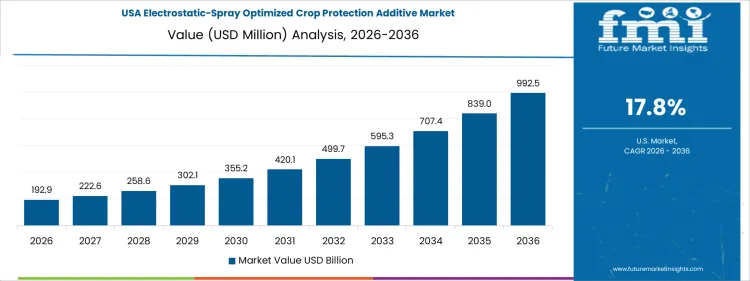
The USA’s electrostatic-spray optimized crop protection additive market is growing at 17.8%, driven by the increasing adoption of precision agriculture technologies and the need for efficient and environmentally responsible crop protection solutions. Electrostatic spraying offers a highly efficient way to apply crop protection products, as it ensures better coverage and adherence, reducing the amount of chemicals required and improving effectiveness. In the USA’s large agricultural sector, particularly in row crops like corn and soybeans, the demand for more sustainable and targeted pesticide and herbicide application methods is rising. The regulatory push for reducing chemical use in farming and improving sustainability practices is accelerating the adoption of electrostatic-spray optimized additives. With the focus on improving farming efficiency and minimizing environmental impact, the market for these additives is expected to grow rapidly in the USA.
What is Driving the Growth of the Electrostatic-Spray Optimized Crop Protection Additive Market in Brazil?
Brazil’s electrostatic-spray optimized crop protection additive market is growing at 16.9%, driven by the country’s large-scale agricultural industry and the increasing need for efficient crop protection solutions. As Brazil remains one of the world’s largest agricultural producers, particularly in soybeans, sugarcane, and coffee, the demand for more effective pest and disease control methods is rising. Electrostatic spraying allows for more precise application of agrochemicals, improving efficiency and reducing waste. Additionally, Brazil’s growing focus on sustainability in agriculture is pushing farmers toward adopting more eco-friendly and efficient crop protection technologies. With the increasing need to manage large-scale crops while minimizing the environmental footprint of farming practices, the market for electrostatic-spray optimized additives is expected to grow steadily in Brazil.
How is the Electrostatic-Spray Optimized Crop Protection Additive Market Expanding in China?
China’s electrostatic-spray optimized crop protection additive market is growing at 16.1%, supported by the country’s expanding agricultural sector and its focus on increasing crop yield and sustainability. As one of the largest producers of agricultural products, China is increasingly adopting smart farming practices, including precision spraying technologies that improve the application of crop protection chemicals. Electrostatic spraying improves the efficiency of pesticide and herbicide application, reducing the amount of chemicals needed and ensuring better crop coverage. With China’s focus on food security, environmental concerns, and improving agricultural productivity, the demand for electrostatic-spray optimized additives is rising. As technology adoption continues to grow and the need for sustainable farming practices increases, China’s market for these additives is expected to expand.
What is Contributing to the Growth of the Electrostatic-Spray Optimized Crop Protection Additive Market in Australia?
Australia’s electrostatic-spray optimized crop protection additive market is growing at 16.4%, driven by the country’s increasing adoption of advanced agricultural technologies and the need for more efficient pest and disease control solutions. Electrostatic spraying technologies allow Australian farmers to reduce agrochemical use, improve pesticide and herbicide adherence, and ensure better crop protection in a wide range of crops, including wheat, barley, and cotton. With Australia’s focus on sustainable farming practices and the need to optimize inputs in its large agricultural sector, the demand for electrostatic-spray optimized additives is increasing. As farmers seek to improve crop yield and reduce environmental impact, the adoption of these technologies is expected to rise. The market for electrostatic-spray optimized additives is poised for continued growth as Australia focuses on improving farm productivity and sustainability.
What is Driving the Growth of the Electrostatic-Spray Optimized Crop Protection Additive Market in Spain?
Spain’s electrostatic-spray optimized crop protection additive market is growing at 15.2%, supported by the country’s emphasis on improving crop yield and sustainability in agriculture. Spain has a diverse agricultural sector, particularly in fruit and vegetable production, which is susceptible to pests and diseases. Electrostatic spraying ensures more efficient agrochemical application, improving pest control while reducing the amount of chemicals used. With Spain’s growing focus on sustainable farming practices and minimizing agrochemical use, electrostatic-spray optimized additives are becoming an essential tool for farmers. The increasing need for precision farming solutions and improved agricultural productivity is driving the demand for these technologies in Spain. As the agricultural sector continues to modernize and adopt more sustainable practices, the market for electrostatic-spray optimized crop protection additives is expected to continue expanding.
How Is Competition Shaping the Electrostatic-Spray Optimized Crop Protection Additive Market?
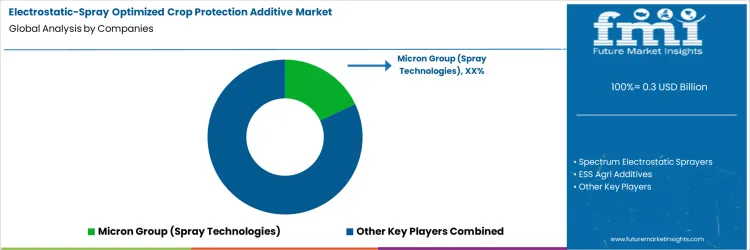
In the electrostatic-spray optimized crop protection additive market competition is driven by additives that enhance spray performance across multiple application platforms. Charge stabilizing deposition enhancers are positioned with brochures that emphasize improved attraction of charged droplets to plant surfaces, especially when paired with electrostatic boom sprayers. Technical highlights include enhanced uniformity, reduced rebound, and improved efficacy at lower application volumes. Drift reduction and droplet uniformity agents are marketed for compatibility with electrostatic UAV / drone sprayers, with product literature showing benefits in reducing off target movement and maximizing canopy coverage in aerial operations.
Leaf adhesion and wrap around polymers are described with performance data that illustrates superior retention on complex leaf geometries. These additives are featured in brochures tailored to air assisted orchard & vineyard sprayers, where wrap around action and canopy penetration are critical. Conductivity and spray charge modifiers are promoted with guidance on tuning electrostatic systems, and are shown to support stable charge generation in handheld & backpack electrostatic units used in specialty crops or targeted pest scenarios. Other additive types are presented with niche benefits such as compatibility with biologicals or enhanced rainfastness, and are aligned in brochures with specific recommendations for equipment type and crop conditions.
Key Players in Electrostatic-Spray Optimized Crop Protection Additive Market
- Micron Group (Spray Technologies)
- Spectrum Electrostatic Sprayers
- ESS Agri Additives
- Electrostatic Spraying Systems Inc. (ESSI - Additives Division)
- Spraytec AgroSolutions
Scope of Report
| Items | Values |
|---|---|
| Quantitative Units (2026) | USD billion |
| Additive Function Type | Charge-Stabilizing Deposition Enhancers, Drift-Reduction & Droplet Uniformity Agents, Leaf-Adhesion & Wrap-Around Polymers, Conductivity & Spray-Charge Modifiers |
| Application Compatibility | Electrostatic Boom Sprayers, Electrostatic UAV / Drone Sprayers, Air-Assisted Orchard & Vineyard Sprayers, Handheld & Backpack Electrostatic Units |
| Regions Covered | Asia Pacific, Europe, North America, Latin America, Middle East & Africa |
| Countries Covered | USA, China, Japan, South Korea, India, Australia & New Zealand, ASEAN, Germany, UK, France, Italy, Spain, Nordic, BENELUX, Brazil, Chile, Mexico, Saudi Arabia, Other GCC Countries, Turkiye, South Africa, Other African Union |
| Key Companies Profiled | Micron Group (Spray Technologies), Spectrum Electrostatic Sprayers, ESS Agri Additives, Electrostatic Spraying Systems Inc. (ESSI-Additives Division), Spraytec AgroSolutions |
| Additional Attributes | Dollar sales by additive function type, application compatibility, and region; regional CAGR and growth outlook; distribution channels including sprayer manufacturers and agrochemical service providers; innovation trends in electrostatic-spray optimized formulations; competitive positioning of global vs regional suppliers. |
Electrostatic-Spray Optimized Crop Protection Additive Market by Segments
Additive Function Type
- Charge-Stabilizing Deposition Enhancers
- Drift-Reduction & Droplet Uniformity Agents
- Leaf-Adhesion & Wrap-Around Polymers
- Conductivity & Spray-Charge Modifiers
- Others
Application Compatibility
- Electrostatic Boom Sprayers
- Electrostatic UAV / Drone Sprayers
- Air-Assisted Orchard & Vineyard Sprayers
- Handheld & Backpack Electrostatic Units
Region
- Asia Pacific
- China
- Japan
- South Korea
- India
- Australia & New Zealand
- ASEAN
- Rest of Asia Pacific
- Europe
- Germany
- United Kingdom
- France
- Italy
- Spain
- Nordic
- BENELUX
- Rest of Europe
- North America
- United States
- Canada
- Mexico
- Latin America
- Brazil
- Chile
- Rest of Latin America
- Middle East & Africa
- Kingdom of Saudi Arabia
- Other GCC Countries
- Turkiye
- South Africa
- Other African Union
- Rest of Middle East & Africa
Frequently Asked Questions
How big is the electrostatic-spray optimized crop protection additive market in 2026?
The global electrostatic-spray optimized crop protection additive market is estimated to be valued at USD 0.3 billion in 2026.
What will be the size of electrostatic-spray optimized crop protection additive market in 2036?
The market size for the electrostatic-spray optimized crop protection additive market is projected to reach USD 1.4 billion by 2036.
How much will be the electrostatic-spray optimized crop protection additive market growth between 2026 and 2036?
The electrostatic-spray optimized crop protection additive market is expected to grow at a 16.6% CAGR between 2026 and 2036.
What are the key product types in the electrostatic-spray optimized crop protection additive market?
The key product types in electrostatic-spray optimized crop protection additive market are charge-stabilizing deposition enhancers, drift-reduction & droplet uniformity agents, leaf-adhesion & wrap-around polymers, conductivity & spray-charge modifiers and others.
Which application compatibility segment to contribute significant share in the electrostatic-spray optimized crop protection additive market in 2026?
In terms of application compatibility, electrostatic boom sprayers segment to command 34.0% share in the electrostatic-spray optimized crop protection additive market in 2026.
Preview the report firsthand - request a free sample
Get SampleGet the brochure for pricing and purchase details.
Get PDFTable of Content
- Executive Summary
- Global Market Outlook
- Demand-side Trends
- Supply-side Trends
- Technology Roadmap Analysis
- Analysis and Recommendations
- Market Overview
- Market Coverage / Taxonomy
- Market Definition / Scope / Limitations
- Market Background
- Market Dynamics
- Drivers
- Restraints
- Opportunity
- Trends
- Scenario Forecast
- Demand in Optimistic Scenario
- Demand in Likely Scenario
- Demand in Conservative Scenario
- Opportunity Map Analysis
- Product Life Cycle Analysis
- Supply Chain Analysis
- Investment Feasibility Matrix
- Value Chain Analysis
- PESTLE and Porter’s Analysis
- Regulatory Landscape
- Regional Parent Market Outlook
- Production and Consumption Statistics
- Import and Export Statistics
- Market Dynamics
- Global Market Analysis 2021 to 2025 and Forecast, 2026 to 2036
- Historical Market Size Value (USD Million) Analysis, 2021 to 2025
- Current and Future Market Size Value (USD Million) Projections, 2026 to 2036
- Y-o-Y Growth Trend Analysis
- Absolute $ Opportunity Analysis
- Global Market Pricing Analysis 2021 to 2025 and Forecast 2026 to 2036
- Global Market Analysis 2021 to 2025 and Forecast 2026 to 2036, By Additive Function Type
- Introduction / Key Findings
- Historical Market Size Value (USD Million) Analysis By Additive Function Type , 2021 to 2025
- Current and Future Market Size Value (USD Million) Analysis and Forecast By Additive Function Type , 2026 to 2036
- Charge-Stabilizing Deposition Enhancers
- Drift-Reduction & Droplet Uniformity Agents
- Leaf-Adhesion & Wrap-Around Polymers
- Conductivity & Spray-Charge Modifiers
- Others
- Y-o-Y Growth Trend Analysis By Additive Function Type , 2021 to 2025
- Absolute $ Opportunity Analysis By Additive Function Type , 2026 to 2036
- Global Market Analysis 2021 to 2025 and Forecast 2026 to 2036, By Application Compatibility
- Introduction / Key Findings
- Historical Market Size Value (USD Million) Analysis By Application Compatibility, 2021 to 2025
- Current and Future Market Size Value (USD Million) Analysis and Forecast By Application Compatibility, 2026 to 2036
- Electrostatic Boom Sprayers
- Electrostatic UAV / Drone Sprayers
- Air-Assisted Orchard & Vineyard Sprayers
- Handheld & Backpack Electrostatic Value (USD Million)s
- Y-o-Y Growth Trend Analysis By Application Compatibility, 2021 to 2025
- Absolute $ Opportunity Analysis By Application Compatibility, 2026 to 2036
- Global Market Analysis 2021 to 2025 and Forecast 2026 to 2036, By Region
- Introduction
- Historical Market Size Value (USD Million) Analysis By Region, 2021 to 2025
- Current Market Size Value (USD Million) Analysis and Forecast By Region, 2026 to 2036
- North America
- Latin America
- Western Europe
- Eastern Europe
- East Asia
- South Asia and Pacific
- Middle East & Africa
- Market Attractiveness Analysis By Region
- North America Market Analysis 2021 to 2025 and Forecast 2026 to 2036, By Country
- Historical Market Size Value (USD Million) Trend Analysis By Market Taxonomy, 2021 to 2025
- Market Size Value (USD Million) Forecast By Market Taxonomy, 2026 to 2036
- By Country
- USA
- Canada
- Mexico
- By Additive Function Type
- By Application Compatibility
- By Country
- Market Attractiveness Analysis
- By Country
- By Additive Function Type
- By Application Compatibility
- Key Takeaways
- Latin America Market Analysis 2021 to 2025 and Forecast 2026 to 2036, By Country
- Historical Market Size Value (USD Million) Trend Analysis By Market Taxonomy, 2021 to 2025
- Market Size Value (USD Million) Forecast By Market Taxonomy, 2026 to 2036
- By Country
- Brazil
- Chile
- Rest of Latin America
- By Additive Function Type
- By Application Compatibility
- By Country
- Market Attractiveness Analysis
- By Country
- By Additive Function Type
- By Application Compatibility
- Key Takeaways
- Western Europe Market Analysis 2021 to 2025 and Forecast 2026 to 2036, By Country
- Historical Market Size Value (USD Million) Trend Analysis By Market Taxonomy, 2021 to 2025
- Market Size Value (USD Million) Forecast By Market Taxonomy, 2026 to 2036
- By Country
- Germany
- UK
- Italy
- Spain
- France
- Nordic
- BENELUX
- Rest of Western Europe
- By Additive Function Type
- By Application Compatibility
- By Country
- Market Attractiveness Analysis
- By Country
- By Additive Function Type
- By Application Compatibility
- Key Takeaways
- Eastern Europe Market Analysis 2021 to 2025 and Forecast 2026 to 2036, By Country
- Historical Market Size Value (USD Million) Trend Analysis By Market Taxonomy, 2021 to 2025
- Market Size Value (USD Million) Forecast By Market Taxonomy, 2026 to 2036
- By Country
- Russia
- Poland
- Hungary
- Balkan & Baltic
- Rest of Eastern Europe
- By Additive Function Type
- By Application Compatibility
- By Country
- Market Attractiveness Analysis
- By Country
- By Additive Function Type
- By Application Compatibility
- Key Takeaways
- East Asia Market Analysis 2021 to 2025 and Forecast 2026 to 2036, By Country
- Historical Market Size Value (USD Million) Trend Analysis By Market Taxonomy, 2021 to 2025
- Market Size Value (USD Million) Forecast By Market Taxonomy, 2026 to 2036
- By Country
- China
- Japan
- South Korea
- By Additive Function Type
- By Application Compatibility
- By Country
- Market Attractiveness Analysis
- By Country
- By Additive Function Type
- By Application Compatibility
- Key Takeaways
- South Asia and Pacific Market Analysis 2021 to 2025 and Forecast 2026 to 2036, By Country
- Historical Market Size Value (USD Million) Trend Analysis By Market Taxonomy, 2021 to 2025
- Market Size Value (USD Million) Forecast By Market Taxonomy, 2026 to 2036
- By Country
- India
- ASEAN
- Australia & New Zealand
- Rest of South Asia and Pacific
- By Additive Function Type
- By Application Compatibility
- By Country
- Market Attractiveness Analysis
- By Country
- By Additive Function Type
- By Application Compatibility
- Key Takeaways
- Middle East & Africa Market Analysis 2021 to 2025 and Forecast 2026 to 2036, By Country
- Historical Market Size Value (USD Million) Trend Analysis By Market Taxonomy, 2021 to 2025
- Market Size Value (USD Million) Forecast By Market Taxonomy, 2026 to 2036
- By Country
- Kingdom of Saudi Arabia
- Other GCC Countries
- Turkiye
- South Africa
- Other African Union
- Rest of Middle East & Africa
- By Additive Function Type
- By Application Compatibility
- By Country
- Market Attractiveness Analysis
- By Country
- By Additive Function Type
- By Application Compatibility
- Key Takeaways
- Key Countries Market Analysis
- USA
- Pricing Analysis
- Market Share Analysis, 2025
- By Additive Function Type
- By Application Compatibility
- Canada
- Pricing Analysis
- Market Share Analysis, 2025
- By Additive Function Type
- By Application Compatibility
- Mexico
- Pricing Analysis
- Market Share Analysis, 2025
- By Additive Function Type
- By Application Compatibility
- Brazil
- Pricing Analysis
- Market Share Analysis, 2025
- By Additive Function Type
- By Application Compatibility
- Chile
- Pricing Analysis
- Market Share Analysis, 2025
- By Additive Function Type
- By Application Compatibility
- Germany
- Pricing Analysis
- Market Share Analysis, 2025
- By Additive Function Type
- By Application Compatibility
- UK
- Pricing Analysis
- Market Share Analysis, 2025
- By Additive Function Type
- By Application Compatibility
- Italy
- Pricing Analysis
- Market Share Analysis, 2025
- By Additive Function Type
- By Application Compatibility
- Spain
- Pricing Analysis
- Market Share Analysis, 2025
- By Additive Function Type
- By Application Compatibility
- France
- Pricing Analysis
- Market Share Analysis, 2025
- By Additive Function Type
- By Application Compatibility
- India
- Pricing Analysis
- Market Share Analysis, 2025
- By Additive Function Type
- By Application Compatibility
- ASEAN
- Pricing Analysis
- Market Share Analysis, 2025
- By Additive Function Type
- By Application Compatibility
- Australia & New Zealand
- Pricing Analysis
- Market Share Analysis, 2025
- By Additive Function Type
- By Application Compatibility
- China
- Pricing Analysis
- Market Share Analysis, 2025
- By Additive Function Type
- By Application Compatibility
- Japan
- Pricing Analysis
- Market Share Analysis, 2025
- By Additive Function Type
- By Application Compatibility
- South Korea
- Pricing Analysis
- Market Share Analysis, 2025
- By Additive Function Type
- By Application Compatibility
- Russia
- Pricing Analysis
- Market Share Analysis, 2025
- By Additive Function Type
- By Application Compatibility
- Poland
- Pricing Analysis
- Market Share Analysis, 2025
- By Additive Function Type
- By Application Compatibility
- Hungary
- Pricing Analysis
- Market Share Analysis, 2025
- By Additive Function Type
- By Application Compatibility
- Kingdom of Saudi Arabia
- Pricing Analysis
- Market Share Analysis, 2025
- By Additive Function Type
- By Application Compatibility
- Turkiye
- Pricing Analysis
- Market Share Analysis, 2025
- By Additive Function Type
- By Application Compatibility
- South Africa
- Pricing Analysis
- Market Share Analysis, 2025
- By Additive Function Type
- By Application Compatibility
- USA
- Market Structure Analysis
- Competition Dashboard
- Competition Benchmarking
- Market Share Analysis of Top Players
- By Regional
- By Additive Function Type
- By Application Compatibility
- Competition Analysis
- Competition Deep Dive
- Micron Group (Spray Technologies)
- Overview
- Product Portfolio
- Profitability by Market Segments (Product/Age /Sales Channel/Region)
- Sales Footprint
- Strategy Overview
- Marketing Strategy
- Product Strategy
- Channel Strategy
- Spectrum Electrostatic Sprayers
- ESS Agri Additives
- Electrostatic Spraying Systems Inc. (ESSI – Additives Division)
- Spraytec AgroSolutions
- Micron Group (Spray Technologies)
- Competition Deep Dive
- Assumptions & Acronyms Used
- Research Methodology


