

- Market Size (2026)
- USD 252.0 Mn
- Forecast (2036)
- USD 549.1 Mn
- CAGR (2026 to 2036)
- 8.1%
Marine-Olive Collagen Hybrid Nutricosmetic Systems Market Size, Market Forecast and Outlook By FMI
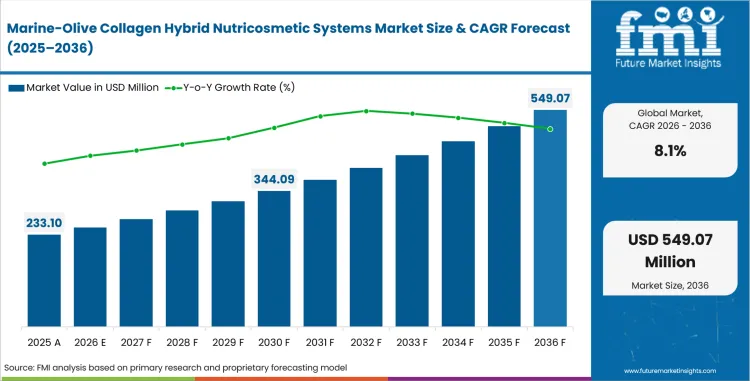
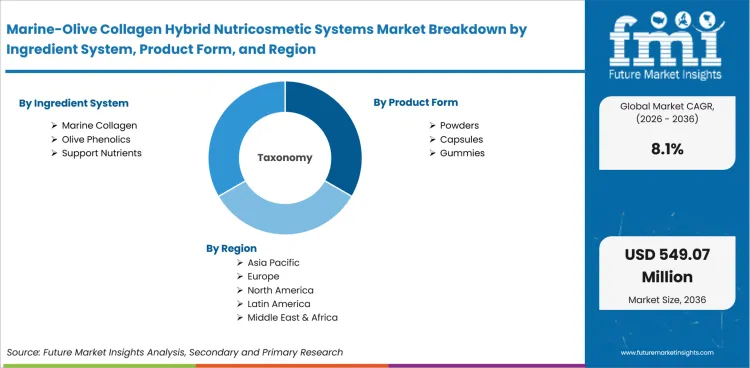
Marine-olive collagen hybrid nutricosmetic systems market was valued at USD 233.1 million in 2025 and is expected to reach USD 252.0 million in 2026. Industry is forecast to rise to USD 549.1 million by 2036 at 8.1% CAGR during the forecast period. By consumer group, adult women segment is expected to account for 52.4% share in 2026. Marine collagen is anticipated to account for 47.3% share of ingredient system demand in 2026.
Key Takeaways, Market Size, and Forecast
- Marine-olive collagen hybrid nutricosmetic systems market stood at USD 233.1 million in 2025.
- By 2036, the industry is forecast to reach USD 549.1 million.
- Industry value is expected to advance at 8.1% CAGR during the forecast period.
- Market revenue is predicted to add USD 297.1 million in incremental opportunity from 2026 to 2036.
- Adult women are expected to represent 52.4% share of consumer group demand in 2026.
- Marine collagen is anticipated to account for 47.3% share of ingredient system demand in 2026.
- China is forecast at 9.4% CAGR and India at 9.1% CAGR during the forecast period.
Summary of the Marine-Olive Collagen Hybrid Nutricosmetic Systems Market
- Demand and Growth Drivers
- Beauty brands need formulas with a clearer story because plain collagen products face price pressure online.
- Marine peptides support skin care claims in a familiar way for daily supplement users.
- Olive phenolics add a natural ingredient angle that works well with premium beauty nutrition.
- Product and Segment View
- Powders work well because they can carry collagen and olive phenolics in one serving.
- Capsules suit users who prefer simple daily intake without mixing a drink.
- Liquid shots can attract premium users if brands control taste and protect active content.
- Geography and Competitive Outlook
- China and India support faster adoption as online wellness retail makes beauty supplements easier to sell.
- The United States and Europe need stronger claim proof because supplement labels face closer review.
- Suppliers with tested collagen peptides and standardized olive extracts can win better brand trust.
- Analyst Opinion
- Nandini Roy Choudhury, Principal Consultant at Future Market Insights says, “Marine-olive collagen hybrid systems are becoming more important in beauty nutrition. Brands need marine peptides with mild taste and olive antioxidants with verified content. Clear label claims are important because supplement rules are strict. Suppliers with dose proof and clean sourcing records will be preferred for premium beauty products.”
- Marine-Olive Collagen Hybrid Nutricosmetic Systems Market Value Analysis
- The marine-olive collagen hybrid nutricosmetic systems market is moving from plain collagen supplements into more defined beauty nutrition formulas.
- Value is supported by brands that want collagen peptides and olive antioxidants in one daily skin support product.
- Marine collagen adds value because it is already familiar in beauty supplements and works well in powders.
- Olive phenolics improve product positioning by adding antioxidant support and a Mediterranean ingredient story.
- Demand is further supported by premium beauty brands that need clean sourcing records and simple label claims.
Marine-olive collagen systems are shifting toward smaller beauty formats as suppliers reduce serving size pressure. Weishardt introduced Naticol® x3Peptide with at least 25% tripeptides and 1200 Da molecular weight, giving formulators more room to add olive hydroxytyrosol or flavor systems without making sachets and capsules bulky. Regulatory proof is becoming more important for olive antioxidants in collagen drinks. FDA closed GRN 1182 with no questions in February 2025 and listed hydroxytyrosol use at 5 mg per serving in ready-to-drink beverages and vegetable juices. Sourcing proof is becoming a stronger purchase filter as hybrid nutricosmetic systems enter premium retail. In April 2025, Rousselot received Upcycled Certified® status for its Peptan® collagen peptides, supporting brands that need stronger source records for premium collagen-olive formulations.
Marine-Olive Collagen Hybrid Nutricosmetic Systems Market Definition
The marine-olive collagen hybrid nutricosmetic systems market refers to ingestible beauty products that combine marine collagen peptides with olive-derived phenolic antioxidants. These systems are used in daily skin nutrition formats such as powders and capsules, with claims focused on hydration or healthy aging support. The market is defined by formulas that use both active groups together, since collagen supports skin structure and olive phenolics support antioxidant positioning.
Marine-Olive Collagen Hybrid Nutricosmetic Systems Market Inclusions
Market scope covers marine-olive collagen hybrid nutricosmetic systems categorized by ingredient system, including marine collagen peptides, olive phenolics, blended actives, and support nutrients; product form, including powders, capsules, gummies, liquid shots, and soft chews; beauty positioning, including skin hydration, wrinkle care, hair strength, nail support, and healthy aging; sales channel, including online retail, pharmacies, beauty stores, practitioner sales, and brand websites; and consumer group, including adult women, active adults, mature consumers, premium wellness users, and men’s grooming consumers. The scope also includes ingestible beauty systems in which marine collagen peptides and olive-derived antioxidants work together as a single skin-support formula. Revenue scope covers 2026 to 2036. The key stakeholders include collagen peptide suppliers, olive extract producers, nutricosmetic brands, supplement manufacturers, contract formulators, beauty retailers, pharmacies, online wellness platforms, testing laboratories, regulatory authorities, and ingredient certification bodies.
Marine-Olive Collagen Hybrid Nutricosmetic Systems Market Exclusions
Plain collagen powders are excluded when they do not include olive-derived actives. Topical creams and serums are also outside the scope unless they are sold with an ingestible product as part of one beauty routine. Masks, pharmaceutical wound-care collagen and injectable collagen products are excluded because they do not fit the ingestible nutricosmetic focus. Olive oil food products are not included unless they contain standardized phenolics and are positioned for beauty nutrition.
Marine-Olive Collagen Hybrid Nutricosmetic Systems Market Research Methodology
- Primary Research: FMI analysts reviewed collagen peptide suppliers and olive phenolic extract producers. Feedback was checked with contract formulators and beauty nutrition brand owners.
- Desk Research: Public data from FAO and International Olive Council were reviewed. FDA and EFSA evidence supported claim and ingredient proof checks.
- Market Sizing and Forecasting: Market size was estimated by checking formula count and likely active dosage. Finished product pricing and channel mix were used for forecast validation.
- Data Validation: Forecast checks compared collagen ingredient activity and olive phenolic supply. Supplement claim rules and premium beauty nutrition launches were reviewed across key countries.
Why is the Marine-Olive Collagen Hybrid Nutricosmetic Systems Market Growing?
- Beauty brands need more distinctive ingestible formulas as plain collagen supplements face wider price pressure online.
- Marine peptides give a recognized skin-health active. Olive phenolics create antioxidant differentiation based on Mediterranean sourcing.
- Supplement claim checks raise demand for systems built with documented dose and ingredient identity. Compliant label language supports launch approval.
Hybrid demand is rising as beauty-from-within brands need clearer proof than plain collagen powders can offer. FDA guidance updated in October 2024 explains dietary supplement products and ingredients under a framework separate from conventional foods and drugs. Regulatory separation makes structure and function wording important for skin hydration and wrinkle-support labels. Brands working in nutricosmetics need ingredient identity records and measured phenolic levels before launch.
Marine peptide sourcing gives the market a clearer supply story compared with bovine-only beauty systems. FAO’s 2024 fisheries review reported 92.3 million tonnes of capture fisheries output in 2022 with 81.0 million tonnes from marine waters. Fish skin and by-product use support collagen recovery without relying only on land-animal inputs. Demand for marine collagen works best in premium formulas once taste control and documentation support repeat daily use.
Market Segmentation Analysis
- Marine collagen is expected to lead ingredient system demand in 2026 with 47.3% share.
- Powders are expected to lead product form demand in 2026 with 36.8% share.
- Skin hydration is anticipated to account for 34.2% share of beauty positioning demand in 2026.
- Online retail is expected to lead sales channel demand in 2026 with 41.6% share.
- Adult women are forecast to represent 52.4% share of consumer group demand in 2026.
The market for marine-olive collagen hybrid nutricosmetic systems is divided into five primary segment groups based on ingredient system, product form, beauty positioning, sales channel and consumer group. Ingredient system covers marine collagen and olive phenolics. Blended actives and support nutrients complete the ingredient view. Product form includes powders and capsules. Gummies, liquid shots and soft chews complete the format view. Beauty positioning covers skin hydration and wrinkle care. Hair strength, nail support and healthy aging complete claim positioning. Sales channel covers online retail and pharmacies. Beauty stores, practitioner sales and brand websites complete access routes. Consumer group covers adult women and active adults. Mature consumers, premium wellness users and men’s grooming complete the demand view.
Insights into Marine-Olive Collagen Hybrid Nutricosmetic Systems Market by Ingredient System
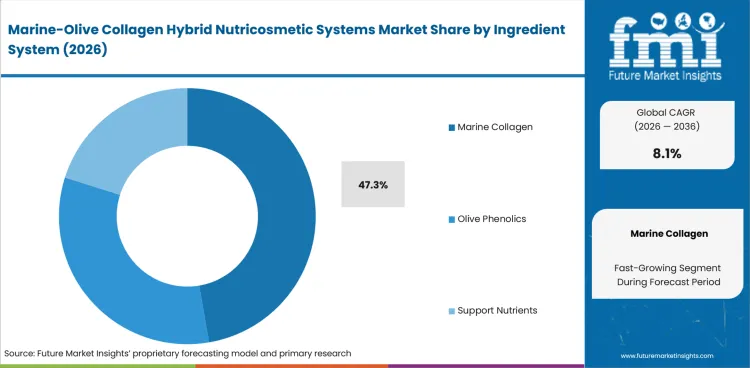
- Marine collagen is expected to lead ingredient system demand in 2026 with 47.3% share.
- Beauty brands prefer marine collagen because it is easy to explain to consumers and fits daily skin support products.
Insights into Marine-Olive Collagen Hybrid Nutricosmetic Systems Market by Product Form
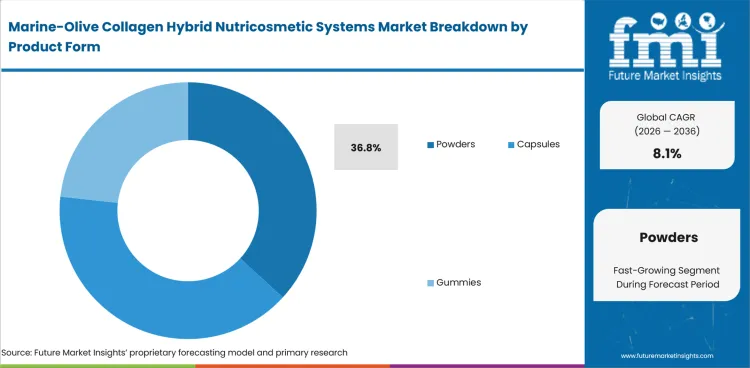
- Powders are expected to lead product form demand in 2026 with 36.8% share.
- Powder formats are useful because one serving can include collagen and olive phenolics without making the product difficult to take.
Insights into Marine-Olive Collagen Hybrid Nutricosmetic Systems Market by Beauty Positioning
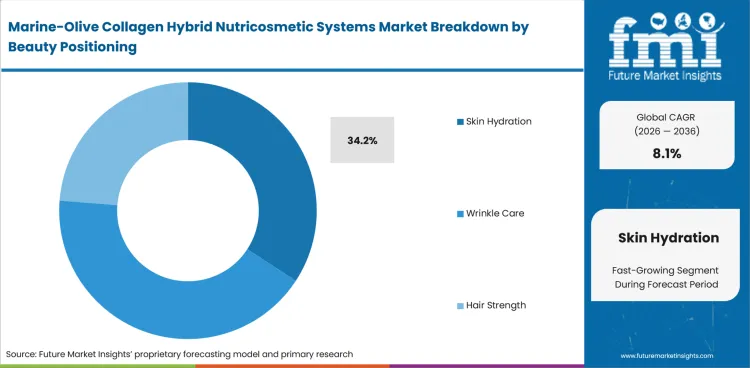
- Skin hydration is expected to lead beauty positioning demand in 2026 with 34.2% share.
- The segment fits nutricosmetics because consumers can understand daily skin hydration support more easily than complex beauty claims.
Insights into Marine-Olive Collagen Hybrid Nutricosmetic Systems Market by Sales Channel
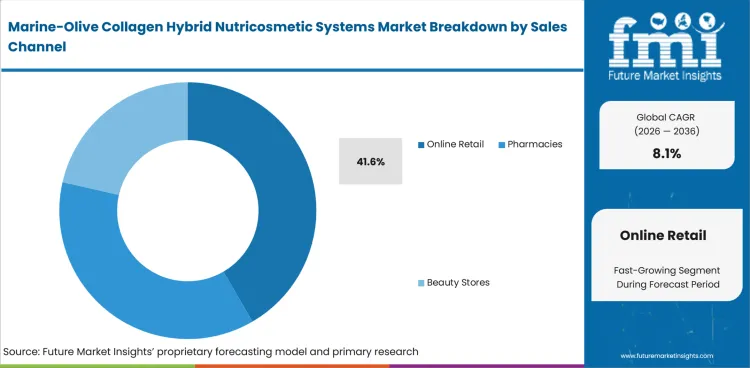
- Online retail is expected to lead sales channel demand in 2026 with 41.6% share.
- Online stores give brands enough space to explain nutricosmetic ingredients and guide repeat purchases.
Insights into Marine-Olive Collagen Hybrid Nutricosmetic Systems Market by Consumer Group
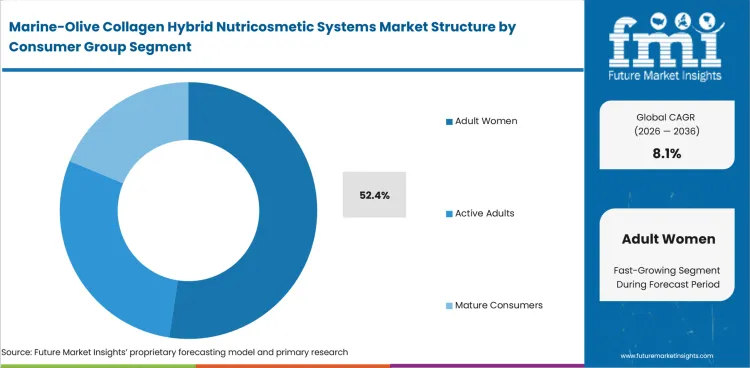
- Adult women are expected to lead consumer group demand in 2026 with 52.4% share.
- The group is important because skin hydration and wrinkle care are common reasons for using beauty supplements.
Marine-Olive Collagen Hybrid Nutricosmetic Systems Market Drivers, Restraints, and Opportunities
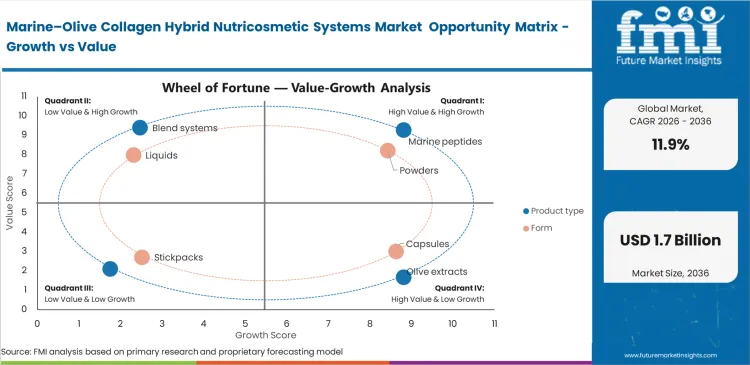
- Proof-backed beauty supplement formats keep marine peptide and olive phenolic pairing active as brands need clearer skin hydration claims.
- Marine taste and olive phenolic bitterness can reduce repeat use if brands do not solve flavor and dose stability.
- Upcycled fish-derived collagen and standardized olive extracts create supplier differentiation for premium beauty nutrition brands.
Demand for beauty-from-within products is supported by brands seeking clearer proof for daily skin nutrition products. FDA guidance updated in October 2024 explains dietary supplement products under a framework separate from conventional foods and drugs. Brands working in nutricosmetics need ingredient identity records and measured phenolic levels before launch. Suppliers with collagen dose data and olive phenolic testing can support faster product approval.
Beauty Application and Ingredient Proof Analysis
Application demand is strongest when collagen and olive phenolics support a clear skin-care use. Marine peptides give brands a familiar active for skin hydration. Olive antioxidants add a Mediterranean ingredient story without changing the daily supplement format. Demand for marine collagen works best in premium formulas once taste control and documentation support repeat use. Brand owners now compare ingredient proof with flavor performance before finalizing powder or shot formats.
Format and Supply Analysis
Format choice depends on dose size and taste control. Powders can carry gram-level collagen and measured olive phenolics in one serving. Liquid shots need stronger masking as marine notes and olive bitterness can affect repeat use. Fish skins and olive processing residues create a better source story for premium systems. Suppliers with clean records can support marine collagen-based products and olive phenolic blends with less approval friction.
Supplier Differentiation and Hybrid System Analysis
Supplier differentiation is moving toward proof and clean extraction. Nitta Gelatin said in February 2025 that its India unit received approval to expand production facilities in Kerala. According to company, peptide capacity is expected to rise from 600 MT per year to 1,150 MT per year. Added collagen peptide capacity can support beauty supplement makers seeking reliable powder and capsule inputs.
Olive phenolic proof completes the hybrid system. Euromed states that Mediteanox is an olive fruit extract standardized to hydroxytyrosol and produced through a water-only extraction process. The company lists nutricosmetics and skin beauty among its use areas. Such proof matters for nutricosmetic ingredients as brands combine marine peptides with olive phenolics for premium beauty products.
Analysis of Marine-Olive Collagen Hybrid Nutricosmetic Systems Market by Key Countries
.webp "Top Country Growth Comparison Marine Olive Collagen Hybrid Nutricosmetic Systems Market Cagr (2026 2036)")
| Country | CAGR |
|---|---|
| United States | 7.8% |
| China | 9.4% |
| India | 9.1% |
| Germany | 7.2% |
| France | 7.5% |
| Japan | 7.0% |
| South Korea | 8.3% |
Source: Future Market Insights.
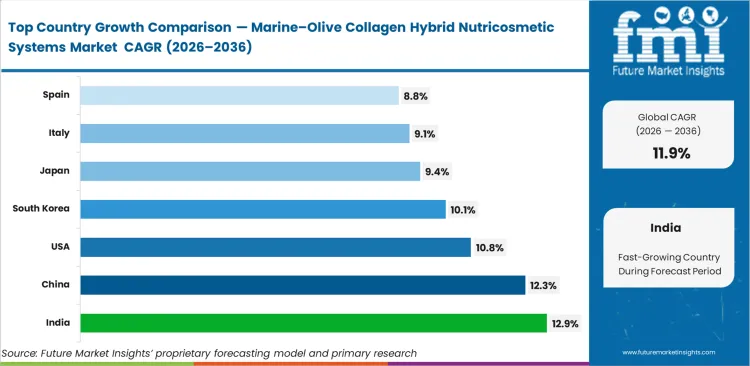
Marine-Olive Collagen Hybrid Nutricosmetic Systems Market CAGR Analysis by Country
- China is forecast to record 9.4% CAGR between 2026 and 2036 as filing discipline and beauty e-commerce support premium hybrid systems.
- India is expected to expand at 9.1% CAGR during the forecast period as supplement rules and online wellness retail improve access.
- South Korea benefits from beauty routine depth, with demand expected to rise at 8.3% CAGR by 2036.
- The United States is forecast at 7.8% CAGR as supplement use is mature and FDA claim review keeps brand wording disciplined.
- France is expected to reach 7.5% CAGR by 2036 as olive ingredient familiarity and beauty nutrition brands support premium formulas.
- Germany is anticipated to advance at 7.2% CAGR by 2036 as EU claim caution favors better documented blends.
- During the forecast period, Japan is expected to register 7.0% CAGR as functional food systems create a disciplined path for beauty nutrition claims.
- Global marine-olive collagen hybrid nutricosmetic systems demand is forecast to rise at 8.1% CAGR from 2026 to 2036.
Demand Outlook for Marine-Olive Collagen Hybrid Nutricosmetic Systems Market in the United States
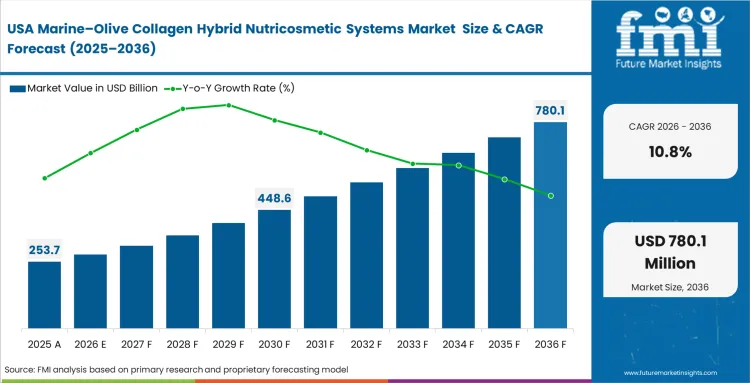
The United States is expected to expand at 7.8% CAGR by 2036 as supplement use and direct-to-consumer beauty brands support hybrid formulas. Council for Responsible Nutrition’s 2024 survey reported about 75.0% of American adults use dietary supplements. High supplement familiarity reduces education cost for USA nutricosmetics. FDA claim wording keeps brand owners careful, so marine-olive systems work best once labels avoid drug-like skin repair promises.
- Supplement use is already common, which makes collagen beauty products easier to explain.
- Online beauty and wellness stores support repeat purchases through subscriptions and product education.
- FDA review keeps brands focused on skin support wording and ingredient proof.
Sales Analysis of Marine-Olive Collagen Hybrid Nutricosmetic Systems Market in China
Beauty supplement purchases in China are moving through regulated health-food channels and online platforms. The market is forecast to rise at 9.4% CAGR during the forecast period as brands face tighter checks for functional ingredients. China’s State Administration for Market Regulation issued GB/T 22249-2024 for lycopene determination in health foods in December 2024 with implementation from July 2025. Hybrid collagen systems need the same testing discipline once olive phenolics enter beauty claims.
- Health-food standards make ingredient testing important for premium collagen-olive systems.
- Online beauty platforms support product education for hybrid ingestible formats.
- Stick packs and powders suit daily beauty routines and help brands explain active dosage.
Demand Outlook for Marine-Olive Collagen Hybrid Nutricosmetic Systems Market in India
India’s premium urban consumers are trying collagen blends and antioxidant formats through online wellness channels. The country’s outlook points to 9.1% CAGR by 2036 as nutraceutical brands expand beauty nutrition ranges. Press Information Bureau reported in November 2024 on nutraceutical exporters covered under the RoDTEP scheme. Export support improves interest in compliant nutraceutical manufacturing under FSSAI oversight. Marine-olive systems suit premium demand once brands solve price and taste barriers.
- Premium wellness consumers are trying collagen powders and beauty supplements through online channels.
- Nutraceutical production capacity can support capsules and sachet formats for local brands.
- Brands need smaller packs and clear claims to reach consumers beyond premium online buyers.
Opportunity Analysis of Marine-Olive Collagen Hybrid Nutricosmetic Systems Market in Germany
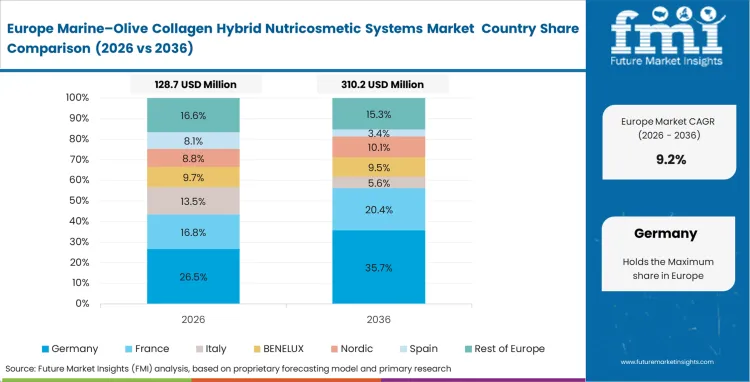
German consumers and retailers prefer supplement products with better documentation. Clear source proof and tested ingredient content support confidence in premium nutricosmetics. Germany is projected at 7.2% CAGR by 2036 as retailers keep focus on measured claims and careful sourcing. German Nutrition Society published updated food-based dietary guidance in 2024 with sustainability and habitual diet considered in the method. Hybrid systems can earn shelf access if brands explain marine origin and olive phenolic dose simply.
- Retailers prefer products with clear source records and tested ingredient content.
- Consumers respond well to supplement formats with simple claims and transparent sourcing.
- Pharmacies and online wellness stores support higher trust for skin-focused nutrition products.
Sales Analysis of Marine-Olive Collagen Hybrid Nutricosmetic Systems Market in France
France has a strong beauty retail culture and clear familiarity with natural actives. Nutricosmetic brands can use marine collagen as the core beauty active and olive antioxidants as a Mediterranean ingredient story. The market in France is expected to record 7.5% CAGR by 2036 as premium beauty nutrition gets stronger shelf support. Marine-olive blends can work well when brands keep claims simple and sensory quality high.
- Ingestible skin care has better acceptance due to the country’s strong beauty retail base.
- Mediterranean ingredient stories make olive phenolics easier for consumers to understand.
- Powders and shots can support higher pricing when taste and dose proof are clear.
Future Outlook for Marine-Olive Collagen Hybrid Nutricosmetic Systems Market in Japan
Functional food filings and beauty-from-within routines support disciplined product claims in Japan. Consumer Affairs Agency oversight of food additives and health claims keeps scientific explanation important for packaged nutrition. Japan is forecast to advance at 7.0% CAGR during the forecast period as brands use clear dosage and careful wording. Sachets and drinks suit daily routines. Taste quality decides repeat use.
- Functional food rules make dosage clarity and wording important for beauty supplement brands.
- Sachets and drinks match consumer habits around convenient health products.
- Low-odor collagen and balanced olive notes are needed for repeat purchase.
Future Outlook for Marine-Olive Collagen Hybrid Nutricosmetic Systems Market in South Korea
K-beauty brands are expanding ingestible skin-care formats as consumers already follow daily beauty routines. South Korea is anticipated to advance at 8.3% CAGR by 2036, supported by stick packs and drinks that match local beauty habits. Health functional food labeling systems require clear product identity and functional content. Ingredient proof is important before collagen-olive systems can move into premium ranges.
- Beauty consumers are already familiar with skin-care routines, which supports ingestible formats.
- Stick packs and drinks suit daily use and make collagen dosing easier to follow.
- Local brands can adapt marine-olive systems for nearby Asian beauty markets.
Competitive Landscape and Strategic Positioning
- Marine collagen suppliers stand out with taste processing. Phenolic standardization and claim-ready documentation decide premium supply positions.
- Collagen suppliers win by offering clinical files and formulation support. Consistent peptide profiles protect repeat supply positions.
- Olive extract specialists stand out with hydroxytyrosol standardization and solvent-clean extraction routes.
- Entry barriers include sensory stability and claim control. Contaminant testing and multi-active dose proof increase qualification work.
Competitive positioning is increasingly defined by verifiable performance. Added collagen peptide capacity can support supplement manufacturers seeking reliable supply for beauty-from-within powders and capsules Suppliers that can demonstrate consistent peptide quality and scalable production capacity are better placed to secure long-term partnerships with supplement manufacturers
Competitive advantage is also connected to dual-ingredient validation, where both marine peptides and olive phenolics are backed by measurable composition and formulation compatibility. On the other side of the hybrid system, olive phenolic suppliers play a critical role in reinforcing product differentiation through standardized antioxidant content and clean extraction methods. Euromed’s Mediteanox, a hydroxytyrosol-standardized olive fruit extract produced through water-only extraction, illustrates the type of ingredient proof required to compete in premium nutricosmetic ingredients.
Key Companies in the Marine-Olive Collagen Hybrid Nutricosmetic Systems Market
- Collagen Peptide Specialists: Darling Ingredients Inc. through Rousselot and GELITA AG lead on peptide source and clinical support.
- Nitta Gelatin Inc. and Weishardt Group focus on peptide design and marine supply. Tessenderlo Group through PB Leiner supports collagen peptide scale.
- Olive Phenolic Specialists: Euromed S.A. and Solabia Nutrition support hybrid systems through standardized olive extract platforms and botanical ingredient know-how.
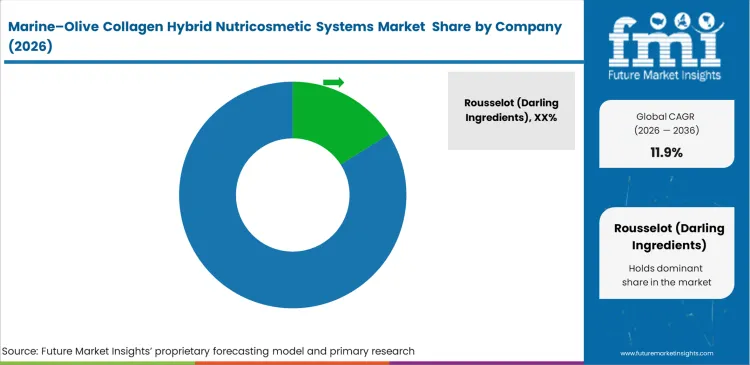
- Leading Participant: Darling Ingredients Inc. through Rousselot is estimated to hold 12.8% share of supplier participation in 2026 due to Peptan scale and global customer reach.
Competitive Benchmarking: Marine-Olive Collagen Hybrid Nutricosmetic Systems Market
| Company | Marine Peptide Depth | Phenolic Pairing Readiness | Beauty Claim Support | Geographic Footprint |
|---|---|---|---|---|
| Darling Ingredients Inc. (Rousselot) | High | Medium | High | Global with Europe and USA depth |
| GELITA AG | High | Medium | High | Global with German production depth |
| Nitta Gelatin Inc. | High | Medium | Medium | Asia and North America centered |
| Weishardt Group | High | Low | Medium | Europe centered with marine focus |
| Tessenderlo Group (PB Leiner) | High | Medium | Medium | Europe and Americas network |
| Euromed S.A. | Low | High | Medium | Europe centered botanical extracts |
| Solabia Nutrition | Low | High | Medium | Europe and global ingredient reach |
Source: Future Market Insights competitive analysis, 2026.
Key Developments in Marine-Olive Collagen Hybrid Nutricosmetic Systems Market
- In April 2025, GELITA reported new clinical evidence for VERISOL collagen peptides, with results tied to skin hydration, elasticity and wrinkle reduction.
- In April 2025, Rousselot received Upcycled Certified status for its Peptan collagen peptides range.
Key Players in the Marine-Olive Collagen Hybrid Nutricosmetic Systems Market
Major Collagen Ingredient Players
- Darling Ingredients Inc. (Rousselot)
- GELITA AG
- Nitta Gelatin Inc.
- Weishardt Group
- Tessenderlo Group (PB Leiner)
Olive Extract and Botanical Players
- Euromed S.A.
- Solabia Nutrition
Report Scope and Coverage
| Parameter | Details |
|---|---|
| Quantitative Units | USD 252.0 million to USD 549.1 million at 8.1% CAGR |
| Market Definition | Ingestible beauty systems combining marine collagen peptides with olive-derived phenolic antioxidants for skin and healthy aging support |
| Segments Covered | Ingredient system, product form, beauty positioning, sales channel, consumer group, and region |
| Ingredient System | Marine collagen, olive phenolics, blended actives, and support nutrients |
| Product Form | Powders, capsules, gummies, liquid shots, and soft chews |
| Beauty Positioning | Skin hydration, wrinkle care, hair strength, nail support, and healthy aging |
| Sales Channel | Online retail, pharmacies, beauty stores, practitioner sales, and brand websites |
| Consumer Group | Adult women, active adults, mature consumers, premium wellness users, and men’s grooming consumers |
| Regions Covered | North America, Latin America, Western Europe, Eastern Europe, East Asia, South Asia and Pacific, Middle East and Africa |
| Countries Covered | United States, China, India, Germany, France, Japan, South Korea, and more than 30.0 countries |
| Key Companies Profiled | Darling Ingredients Inc. (Rousselot), GELITA AG, Nitta Gelatin Inc., Weishardt Group, Tessenderlo Group (PB Leiner), Euromed S.A., and Solabia Nutrition |
| Forecast Period | 2026 to 2036 |
| Approach | Hybrid bottom-up and top-down method using collagen peptide dosage, olive phenolic input checks, finished product pricing, channel mix, claim rules, and supplier activity |
Source: Future Market Insights.
Marine-Olive Collagen Hybrid Nutricosmetic Systems Market Breakdown by Core Segments and Region
Marine-Olive Collagen Hybrid Nutricosmetic Systems Market Segmented by Ingredient System
- Marine collagen
- Olive phenolics
- Blended actives
- Support nutrients
Marine-Olive Collagen Hybrid Nutricosmetic Systems Market Segmented by Product Form
- Powders
- Capsules
- Gummies
- Liquid shots
- Soft chews
Marine-Olive Collagen Hybrid Nutricosmetic Systems Market Segmented by Beauty Positioning
- Skin hydration
- Wrinkle care
- Hair strength
- Nail support
- Healthy aging
Marine-Olive Collagen Hybrid Nutricosmetic Systems Market Segmented by Sales Channel
- Online retail
- Pharmacies
- Beauty stores
- Practitioner sales
- Brand websites
Marine-Olive Collagen Hybrid Nutricosmetic Systems Market Segmented by Consumer Group
- Adult women
- Active adults
- Mature consumers
- Premium wellness
- Men’s grooming
Marine-Olive Collagen Hybrid Nutricosmetic Systems Market Segmented by Region
- North America
- Latin America
- Western Europe
- Eastern Europe
- East Asia
- South Asia and Pacific
- Middle East and Africa
Research Sources and Bibliography
- Council for Responsible Nutrition. (2024, October 29). CRN survey shows consistent supplement usage with increase of specialty product use over time. Council for Responsible Nutrition.
- European Commission. (2025, August 20). Commission Regulation (EU) No 432/2012 establishing a list of permitted health claims made on foods, other than those referring to the reduction of disease risk and to children’s development and health: Consolidated text. EUR-Lex.
- Euromed. (n.d.). Olive fruit extract - Mediteanox®. Euromed.
- Food and Agriculture Organization of the United Nations. (2024, June 7). FAO report: Global fisheries and aquaculture production reaches a new record high. FAO.
- GELITA AG. (2025, April 22). VERISOL®: Confirmed to elevate skin hydration and elasticity, while reducing wrinkles. GELITA.
- German Nutrition Society. (2024). Food-based dietary guidelines for Germany. DGE.
- Nitta Gelatin. (2025, February 2). Nitta Gelatin India announces production expansion. Nitta Gelatin.
- Nitta Gelatin India Limited. (n.d.). The ground breaking ceremony (Bhoomi Pooja) of Nitta Gelatin India Ltd (NGIL)’s collagen peptide expansion project. Nitta Gelatin India Limited.
- Press Information Bureau. (2024, November 7). India’s nutraceutical industry poised for global growth with supportive initiatives. Government of India.
- Rousselot. (2025, April 24). Rousselot granted Upcycled Certified® status for Peptan® collagen peptides range. Darling Ingredients.
- State Administration for Market Regulation. (2024, December 31). GB/T 22249-2024: Determination of lycopene in health foods. National Public Service Platform for Standards.
- USA Food and Drug Administration. (2024, October 1). Dietary supplements. FDA.
- USA Food and Drug Administration. (2025, February 12). GRAS notice No. GRN 001182: Agency response letter for hydroxytyrosol. FDA.
- Weishardt. (n.d.). Naticol® x3Peptide - The first tripeptide collagen in Europe. Naticol.
This Report Addresses
- What was the marine-olive collagen hybrid nutricosmetic systems market size in 2025?
- How much revenue is expected by 2036?
- What CAGR is forecast from 2026 to 2036?
- Which ingredient system is expected to account for the leading 2026 share?
- Which product form is forecast to hold the main 2026 position?
- Which consumer group is expected to account for the leading 2026 share?
- Which countries are forecast to grow faster than the global average?
- How do claim rules and ingredient proof affect premium product launches?
- Which companies are active in collagen peptide and olive phenolic supply?
- What methodology supports the market values and segment shares?
Frequently Asked Questions
What is the marine-olive collagen hybrid nutricosmetic systems market size in 2026?
Marine-olive collagen hybrid nutricosmetic systems market is expected to reach USD 252.0 million in 2026, supported by premium beauty supplement launches and hybrid active positioning.
What is the expected market value by 2036?
Market revenue is forecast to reach USD 549.1 million by 2036 as collagen peptide systems add olive phenolic differentiation in daily beauty routines.
What CAGR is forecast from 2026 to 2036?
Demand is expected to advance at 8.1% CAGR from 2026 to 2036 as beauty brands use documented peptide dose and antioxidant positioning.
Which ingredient system is expected to lead in 2026?
Marine collagen is anticipated to account for 47.3% share of ingredient system demand in 2026 due to peptide familiarity and skin-health positioning.
Which product form is expected to lead in 2026?
Powders are expected to account for 36.8% share of product form demand in 2026 as measured scoops can carry active peptide loads.
Which country is forecast to move faster in the market?
China is expected to record 9.4% CAGR by 2036 as regulated health-food channels and premium beauty e-commerce support hybrid nutricosmetic systems.
What is the main restraint for suppliers?
Taste control and compliant claim wording create the main restraint as marine peptides and olive phenolics need careful formulation.
Who are key active suppliers?
Active suppliers include Darling Ingredients Inc. through Rousselot and GELITA AG. Nitta Gelatin Inc. and Weishardt Group complete the peptide list. Euromed S.A. and Solabia Nutrition complete the olive phenolic list.
Preview the report firsthand - request a free sample
Get SampleGet the brochure for pricing and purchase details.
Get PDFTable of Content
- Executive Summary
- Global Market Outlook
- Demand-side Trends
- Supply-side Trends
- Technology Roadmap Analysis
- Analysis and Recommendations
- Market Overview
- Market Coverage / Taxonomy
- Market Definition / Scope / Limitations
- Research Methodology
- Chapter Orientation
- Analytical Lens and Working Hypotheses
- Market Structure, Signals, and Trend Drivers
- Benchmarking and Cross-market Comparability
- Market Sizing, Forecasting, and Opportunity Mapping
- Research Design and Evidence Framework
- Desk Research Programme (Secondary Evidence)
- Company Annual and Sustainability Reports
- Peer-reviewed Journals and Academic Literature
- Corporate Websites, Product Literature, and Technical Notes
- Earnings Decks and Investor Briefings
- Statutory Filings and Regulatory Disclosures
- Technical White Papers and Standards Notes
- Trade Journals, Industry Magazines, and Analyst Briefs
- Conference Proceedings, Webinars, and Seminar Materials
- Government Statistics Portals and Public Data Releases
- Press Releases and Reputable Media Coverage
- Specialist Newsletters and Curated Briefings
- Sector Databases and Reference Repositories
- FMI Internal Proprietary Databases and Historical Market Datasets
- Subscription Datasets and Paid Sources
- Social Channels, Communities, and Digital Listening Inputs
- Additional Desk Sources
- Expert Input and Fieldwork (Primary Evidence)
- Primary Modes
- Qualitative Interviews and Expert Elicitation
- Quantitative Surveys and Structured Data Capture
- Blended Approach
- Why Primary Evidence is Used
- Field Techniques
- Interviews
- Surveys
- Focus Groups
- Observational and In-context Research
- Social and Community Interactions
- Stakeholder Universe Engaged
- C-suite Leaders
- Board Members
- Presidents and Vice Presidents
- R&D and Innovation Heads
- Technical Specialists
- Domain Subject-matter Experts
- Scientists
- Physicians and Other Healthcare Professionals
- Governance, Ethics, and Data Stewardship
- Research Ethics
- Data Integrity and Handling
- Primary Modes
- Tooling, Models, and Reference Databases
- Desk Research Programme (Secondary Evidence)
- Data Engineering and Model Build
- Data Acquisition and Ingestion
- Cleaning, Normalisation, and Verification
- Synthesis, Triangulation, and Analysis
- Quality Assurance and Audit Trail
- Market Background
- Market Dynamics
- Drivers
- Restraints
- Opportunity
- Trends
- Scenario Forecast
- Demand in Optimistic Scenario
- Demand in Likely Scenario
- Demand in Conservative Scenario
- Opportunity Map Analysis
- Product Life Cycle Analysis
- Supply Chain Analysis
- Investment Feasibility Matrix
- Value Chain Analysis
- PESTLE and Porter’s Analysis
- Regulatory Landscape
- Regional Parent Market Outlook
- Production and Consumption Statistics
- Import and Export Statistics
- Market Dynamics
- Global Market Analysis 2021 to 2025 and Forecast, 2026 to 2036
- Historical Market Size Value (USD Million) Analysis, 2021 to 2025
- Current and Future Market Size Value (USD Million) Projections, 2026 to 2036
- Y-o-Y Growth Trend Analysis
- Absolute $ Opportunity Analysis
- Global Market Pricing Analysis 2021 to 2025 and Forecast 2026 to 2036
- Global Market Analysis 2021 to 2025 and Forecast 2026 to 2036, By Ingredient System
- Introduction / Key Findings
- Historical Market Size Value (USD Million) Analysis By Ingredient System , 2021 to 2025
- Current and Future Market Size Value (USD Million) Analysis and Forecast By Ingredient System , 2026 to 2036
- Marine Collagen
- Olive Phenolics
- Support Nutrients
- Marine Collagen
- Y-o-Y Growth Trend Analysis By Ingredient System , 2021 to 2025
- Absolute $ Opportunity Analysis By Ingredient System , 2026 to 2036
- Global Market Analysis 2021 to 2025 and Forecast 2026 to 2036, By Product Form
- Introduction / Key Findings
- Historical Market Size Value (USD Million) Analysis By Product Form, 2021 to 2025
- Current and Future Market Size Value (USD Million) Analysis and Forecast By Product Form, 2026 to 2036
- Powders
- Capsules
- Gummies
- Powders
- Y-o-Y Growth Trend Analysis By Product Form, 2021 to 2025
- Absolute $ Opportunity Analysis By Product Form, 2026 to 2036
- Global Market Analysis 2021 to 2025 and Forecast 2026 to 2036, By Beauty Positioning
- Introduction / Key Findings
- Historical Market Size Value (USD Million) Analysis By Beauty Positioning, 2021 to 2025
- Current and Future Market Size Value (USD Million) Analysis and Forecast By Beauty Positioning, 2026 to 2036
- Skin Hydration
- Wrinkle Care
- Hair Strength
- Skin Hydration
- Y-o-Y Growth Trend Analysis By Beauty Positioning, 2021 to 2025
- Absolute $ Opportunity Analysis By Beauty Positioning, 2026 to 2036
- Global Market Analysis 2021 to 2025 and Forecast 2026 to 2036, By Sales Channel
- Introduction / Key Findings
- Historical Market Size Value (USD Million) Analysis By Sales Channel, 2021 to 2025
- Current and Future Market Size Value (USD Million) Analysis and Forecast By Sales Channel, 2026 to 2036
- Online Retail
- Pharmacies
- Beauty Stores
- Online Retail
- Y-o-Y Growth Trend Analysis By Sales Channel, 2021 to 2025
- Absolute $ Opportunity Analysis By Sales Channel, 2026 to 2036
- Global Market Analysis 2021 to 2025 and Forecast 2026 to 2036, By Consumer Group
- Introduction / Key Findings
- Historical Market Size Value (USD Million) Analysis By Consumer Group, 2021 to 2025
- Current and Future Market Size Value (USD Million) Analysis and Forecast By Consumer Group, 2026 to 2036
- Adult Women
- Active Adults
- Mature Consumers
- Adult Women
- Y-o-Y Growth Trend Analysis By Consumer Group, 2021 to 2025
- Absolute $ Opportunity Analysis By Consumer Group, 2026 to 2036
- Global Market Analysis 2021 to 2025 and Forecast 2026 to 2036, By Region
- Introduction
- Historical Market Size Value (USD Million) Analysis By Region, 2021 to 2025
- Current Market Size Value (USD Million) Analysis and Forecast By Region, 2026 to 2036
- North America
- Latin America
- Western Europe
- Eastern Europe
- East Asia
- South Asia and Pacific
- Middle East & Africa
- Market Attractiveness Analysis By Region
- North America Market Analysis 2021 to 2025 and Forecast 2026 to 2036, By Country
- Historical Market Size Value (USD Million) Trend Analysis By Market Taxonomy, 2021 to 2025
- Market Size Value (USD Million) Forecast By Market Taxonomy, 2026 to 2036
- By Country
- USA
- Canada
- Mexico
- By Ingredient System
- By Product Form
- By Beauty Positioning
- By Sales Channel
- By Consumer Group
- By Country
- Market Attractiveness Analysis
- By Country
- By Ingredient System
- By Product Form
- By Beauty Positioning
- By Sales Channel
- By Consumer Group
- Key Takeaways
- Latin America Market Analysis 2021 to 2025 and Forecast 2026 to 2036, By Country
- Historical Market Size Value (USD Million) Trend Analysis By Market Taxonomy, 2021 to 2025
- Market Size Value (USD Million) Forecast By Market Taxonomy, 2026 to 2036
- By Country
- Brazil
- Chile
- Rest of Latin America
- By Ingredient System
- By Product Form
- By Beauty Positioning
- By Sales Channel
- By Consumer Group
- By Country
- Market Attractiveness Analysis
- By Country
- By Ingredient System
- By Product Form
- By Beauty Positioning
- By Sales Channel
- By Consumer Group
- Key Takeaways
- Western Europe Market Analysis 2021 to 2025 and Forecast 2026 to 2036, By Country
- Historical Market Size Value (USD Million) Trend Analysis By Market Taxonomy, 2021 to 2025
- Market Size Value (USD Million) Forecast By Market Taxonomy, 2026 to 2036
- By Country
- Germany
- UK
- Italy
- Spain
- France
- Nordic
- BENELUX
- Rest of Western Europe
- By Ingredient System
- By Product Form
- By Beauty Positioning
- By Sales Channel
- By Consumer Group
- By Country
- Market Attractiveness Analysis
- By Country
- By Ingredient System
- By Product Form
- By Beauty Positioning
- By Sales Channel
- By Consumer Group
- Key Takeaways
- Eastern Europe Market Analysis 2021 to 2025 and Forecast 2026 to 2036, By Country
- Historical Market Size Value (USD Million) Trend Analysis By Market Taxonomy, 2021 to 2025
- Market Size Value (USD Million) Forecast By Market Taxonomy, 2026 to 2036
- By Country
- Russia
- Poland
- Hungary
- Balkan & Baltic
- Rest of Eastern Europe
- By Ingredient System
- By Product Form
- By Beauty Positioning
- By Sales Channel
- By Consumer Group
- By Country
- Market Attractiveness Analysis
- By Country
- By Ingredient System
- By Product Form
- By Beauty Positioning
- By Sales Channel
- By Consumer Group
- Key Takeaways
- East Asia Market Analysis 2021 to 2025 and Forecast 2026 to 2036, By Country
- Historical Market Size Value (USD Million) Trend Analysis By Market Taxonomy, 2021 to 2025
- Market Size Value (USD Million) Forecast By Market Taxonomy, 2026 to 2036
- By Country
- China
- Japan
- South Korea
- By Ingredient System
- By Product Form
- By Beauty Positioning
- By Sales Channel
- By Consumer Group
- By Country
- Market Attractiveness Analysis
- By Country
- By Ingredient System
- By Product Form
- By Beauty Positioning
- By Sales Channel
- By Consumer Group
- Key Takeaways
- South Asia and Pacific Market Analysis 2021 to 2025 and Forecast 2026 to 2036, By Country
- Historical Market Size Value (USD Million) Trend Analysis By Market Taxonomy, 2021 to 2025
- Market Size Value (USD Million) Forecast By Market Taxonomy, 2026 to 2036
- By Country
- India
- ASEAN
- Australia & New Zealand
- Rest of South Asia and Pacific
- By Ingredient System
- By Product Form
- By Beauty Positioning
- By Sales Channel
- By Consumer Group
- By Country
- Market Attractiveness Analysis
- By Country
- By Ingredient System
- By Product Form
- By Beauty Positioning
- By Sales Channel
- By Consumer Group
- Key Takeaways
- Middle East & Africa Market Analysis 2021 to 2025 and Forecast 2026 to 2036, By Country
- Historical Market Size Value (USD Million) Trend Analysis By Market Taxonomy, 2021 to 2025
- Market Size Value (USD Million) Forecast By Market Taxonomy, 2026 to 2036
- By Country
- Kingdom of Saudi Arabia
- Other GCC Countries
- Turkiye
- South Africa
- Other African Union
- Rest of Middle East & Africa
- By Ingredient System
- By Product Form
- By Beauty Positioning
- By Sales Channel
- By Consumer Group
- By Country
- Market Attractiveness Analysis
- By Country
- By Ingredient System
- By Product Form
- By Beauty Positioning
- By Sales Channel
- By Consumer Group
- Key Takeaways
- Key Countries Market Analysis
- USA
- Pricing Analysis
- Market Share Analysis, 2025
- By Ingredient System
- By Product Form
- By Beauty Positioning
- By Sales Channel
- By Consumer Group
- Canada
- Pricing Analysis
- Market Share Analysis, 2025
- By Ingredient System
- By Product Form
- By Beauty Positioning
- By Sales Channel
- By Consumer Group
- Mexico
- Pricing Analysis
- Market Share Analysis, 2025
- By Ingredient System
- By Product Form
- By Beauty Positioning
- By Sales Channel
- By Consumer Group
- Brazil
- Pricing Analysis
- Market Share Analysis, 2025
- By Ingredient System
- By Product Form
- By Beauty Positioning
- By Sales Channel
- By Consumer Group
- Chile
- Pricing Analysis
- Market Share Analysis, 2025
- By Ingredient System
- By Product Form
- By Beauty Positioning
- By Sales Channel
- By Consumer Group
- Germany
- Pricing Analysis
- Market Share Analysis, 2025
- By Ingredient System
- By Product Form
- By Beauty Positioning
- By Sales Channel
- By Consumer Group
- UK
- Pricing Analysis
- Market Share Analysis, 2025
- By Ingredient System
- By Product Form
- By Beauty Positioning
- By Sales Channel
- By Consumer Group
- Italy
- Pricing Analysis
- Market Share Analysis, 2025
- By Ingredient System
- By Product Form
- By Beauty Positioning
- By Sales Channel
- By Consumer Group
- Spain
- Pricing Analysis
- Market Share Analysis, 2025
- By Ingredient System
- By Product Form
- By Beauty Positioning
- By Sales Channel
- By Consumer Group
- France
- Pricing Analysis
- Market Share Analysis, 2025
- By Ingredient System
- By Product Form
- By Beauty Positioning
- By Sales Channel
- By Consumer Group
- India
- Pricing Analysis
- Market Share Analysis, 2025
- By Ingredient System
- By Product Form
- By Beauty Positioning
- By Sales Channel
- By Consumer Group
- ASEAN
- Pricing Analysis
- Market Share Analysis, 2025
- By Ingredient System
- By Product Form
- By Beauty Positioning
- By Sales Channel
- By Consumer Group
- Australia & New Zealand
- Pricing Analysis
- Market Share Analysis, 2025
- By Ingredient System
- By Product Form
- By Beauty Positioning
- By Sales Channel
- By Consumer Group
- China
- Pricing Analysis
- Market Share Analysis, 2025
- By Ingredient System
- By Product Form
- By Beauty Positioning
- By Sales Channel
- By Consumer Group
- Japan
- Pricing Analysis
- Market Share Analysis, 2025
- By Ingredient System
- By Product Form
- By Beauty Positioning
- By Sales Channel
- By Consumer Group
- South Korea
- Pricing Analysis
- Market Share Analysis, 2025
- By Ingredient System
- By Product Form
- By Beauty Positioning
- By Sales Channel
- By Consumer Group
- Russia
- Pricing Analysis
- Market Share Analysis, 2025
- By Ingredient System
- By Product Form
- By Beauty Positioning
- By Sales Channel
- By Consumer Group
- Poland
- Pricing Analysis
- Market Share Analysis, 2025
- By Ingredient System
- By Product Form
- By Beauty Positioning
- By Sales Channel
- By Consumer Group
- Hungary
- Pricing Analysis
- Market Share Analysis, 2025
- By Ingredient System
- By Product Form
- By Beauty Positioning
- By Sales Channel
- By Consumer Group
- Kingdom of Saudi Arabia
- Pricing Analysis
- Market Share Analysis, 2025
- By Ingredient System
- By Product Form
- By Beauty Positioning
- By Sales Channel
- By Consumer Group
- Turkiye
- Pricing Analysis
- Market Share Analysis, 2025
- By Ingredient System
- By Product Form
- By Beauty Positioning
- By Sales Channel
- By Consumer Group
- South Africa
- Pricing Analysis
- Market Share Analysis, 2025
- By Ingredient System
- By Product Form
- By Beauty Positioning
- By Sales Channel
- By Consumer Group
- USA
- Market Structure Analysis
- Competition Dashboard
- Competition Benchmarking
- Market Share Analysis of Top Players
- By Regional
- By Ingredient System
- By Product Form
- By Beauty Positioning
- By Sales Channel
- By Consumer Group
- Competition Analysis
- Competition Deep Dive
- Darling Ingredients Inc. (Rousselot)
- Overview
- Product Portfolio
- Profitability by Market Segments (Product/Age /Sales Channel/Region)
- Sales Footprint
- Strategy Overview
- Marketing Strategy
- Product Strategy
- Channel Strategy
- GELITA AG
- Nitta Gelatin Inc.
- Weishardt Group
- Tessenderlo Group (PB Leiner)
- Darling Ingredients Inc. (Rousselot)
- Competition Deep Dive
- Assumptions & Acronyms Used


