

- Industry Size (2026)
- USD 1180 Mn
- Forecast (2036)
- USD 3860 Mn
- CAGR (2026 to 2036)
- 12.6%
Universal Closures Compatible with PCR Content Market Forecast and Outlook 2026 to 2036
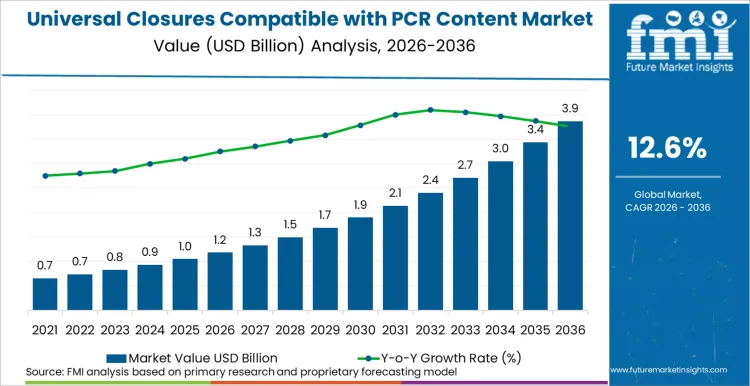
Universal closures compatible with PCR content market revenue is projected to total USD 1,180 million in 2026, increasing to USD 3,860 million by 2036, at a CAGR of 12.6%. FMI analysis indicates the market is undergoing a fundamental shift from offering PCR-compatible versions as premium options to making them compliance-mandated standards. The 2026-2027 period will be defined by the industrialization of high-PCR content blends (exceeding 50%) for sensitive applications like dairy and juices, requiring breakthroughs in odor management and contaminant filtration to meet food-grade standards.
Growth is anchored in the global legislative push for circular packaging. In December 2025, the European Commission adopted delegated acts under the Packaging and Packaging Waste Regulation (PPWR), setting binding 2028 and 2030 targets for minimum recycled content in all plastic packaging, explicitly including closures. This policy directly stimulates capital investment in advanced washing, sorting, and compounding lines dedicated to producing food-contact authorized PCR polyolefins for closure manufacturing.
AptarGroup continues to position closures and dispensing systems as a core pillar of its sustainability roadmap, with R&D activity during 2024-2025 increasingly focused on compatibility with high post-consumer recycled (PCR) content. Rather than announcing discrete, brand-specific PCR cap launches, the company has emphasized modular design optimization, lightweighting, and material tuning across its beverage and dispensing closure platforms. These efforts are intended to ensure functional parity, particularly in torque retention, seal integrity, and opening performance, when closures are paired with bottles incorporating elevated levels of recycled HDPE or PP.
ALPLA has made recycling capacity expansion a central element of its long-term circular economy strategy, with publicly stated objectives to significantly increase the share of recycled content used across its packaging components by 2030. During 2024-2025, the company communicated plans to double its installed and planned recycling capacity, encompassing rPET and rHDPE streams, to secure reliable access to high-quality PCR feedstock. These investments underpin ALPLA’s ability to internally supply recycled materials for bottles, closures, and associated packaging systems.
Silgan Holdings continues to advance high-PCR closure solutions across its dispensing and screw-closure portfolios, with products containing up to ~98% post-consumer recycled polypropylene already commercialized for personal care, home care, and select food applications. The company’s development focus centers on material formulation, process stability, and color consistency, critical factors when integrating recycled polymers into precision-molded closures. Rather than relying on acquisitions to build this capability, Silgan has emphasized internal material expertise and supplier collaboration.
Summary of Universal Closures Compatible with PCR Content Market
What is the Long-Term Growth Outlook for the Universal Closures Compatible with PCR Content Market?
FMI projects the global universal closures compatible with PCR content market to expand from USD 1,180 million in 2026 to USD 3,860 million by 2036, registering a 12.6% CAGR.
FMI Research Approach: This projection is derived from FMI's proprietary forecasting framework integrating analysis of global packaging regulations, brand owner sustainability pledges, PCR feedstock availability forecasts, and primary interviews with packaging converters and brand owners across key regions.
How do FMI Analysts Expect the Market to Evolve Structurally?
FMI analysts anticipate a transition from a market offering limited, often downgraded PCR-compatible options to a diverse landscape of performance-engineered closure systems. This evolution is driven by brand owners' need for application-specific solutions that do not compromise on shelf appeal or functionality.
FMI Research Approach: Insights are informed by analysis of patent filings related to PCR processing and closure design, brand owner roadmaps for sustainable packaging, and material validation data from joint development agreements between closure manufacturers and global FMCG companies.
Which Geographies Command the Largest Share?
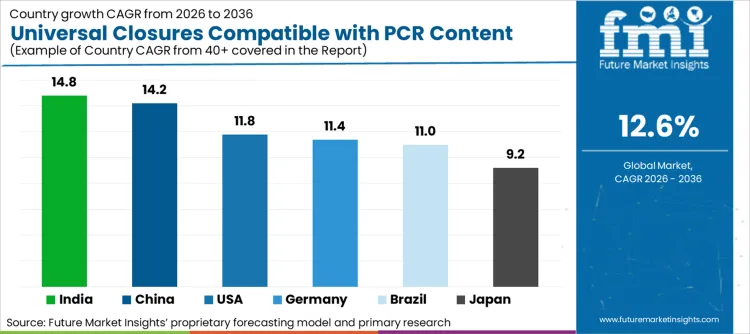
India leads in growth rate, advancing at an estimated 14.8% CAGR, driven by its stringent and rapidly implemented EPR rules and a booming, price-sensitive FMCG sector. China follows with a 14.2% CAGR, supported by its Double Carbon policy and its role as the world's mass packaging manufacturer. The United States shows an 11.8% CAGR, propelled by state-level recycled content laws and corporate sustainability mandates from large brand owners.
Germany and Brazil represent high-value innovation and bio-integration markets, expanding at 11.4% and 11.0% CAGR, respectively. Growth is fueled by the EU's PPWR and Germany's advanced recycling infrastructure, while Brazil's growth is shaped by its integration of bio-based and PCR content.
FMI Research Approach: Country-level forecasts are built using policy analysis of EPR and plastic tax regulations, tracking of FMCG production and consumption trends, analysis of national recycling infrastructure, and primary interviews with regional packaging converters.
What are some Globally Distinct Trends Shaping the Market?
Globally, the market is being shaped by the interplay of regulation, supply chain security, and technological adaptation. The rapid scaling of legislative targets is creating a sudden demand pull for food-grade PCR, while the pursuit of cost-effective compliance is fueling R&D into using lower-quality, mixed-waste PCR streams.
Supply chain regulations, particularly the EU's PPWR and similar laws in Canada and several US states, are accelerating the development of closed-loop systems and strategic partnerships between closure makers, recyclers, and brand owners.
FMI Research Approach: Trend analysis is informed by regulatory tracking across major economies, sustainability reports from global FMCG brands, technology roadmaps from polymer and machinery suppliers, and lifecycle assessment studies of packaging systems.
Universal Closures Compatible with PCR Content Market Key Takeaways
| Metrics | Values |
|---|---|
| Expected Value (2026E) | USD 1,180 million |
| Projected Value (2036F) | USD 3,860 million |
| CAGR (2026-2036) | 12.6% |
Source: Future Market Insights (FMI) analysis, based on proprietary forecasting model and primary research
Why is the Universal Closures Compatible with PCR Content Market Growing?
The legislative landscape is creating non-negotiable demand for PCR-compatible closures. Over 50 jurisdictions worldwide had implemented or proposed plastic taxes or minimum recycled content rules by the end of 2025. The UK Plastic Tax, for instance, charges £210 per tonne on plastic packaging with less than 30% recycled content, making the use of PCR closures an economic imperative rather than a voluntary choice. This has triggered a wave of reformulation projects across the industry to meet these thresholds without compromising performance.
Beyond compliance, major retailers and global FMCG corporations are driving demand through ambitious public commitments. The Consumer Goods Forum's Golden Design Rules and the Ellen MacArthur Foundation's Global Commitment have mobilized over 1,000 organizations to target specific, time-bound goals for recycled content. Closure manufacturers are now engaged in multi-year Joint Development Agreements (JDAs) to create proprietary, brand-specific closure systems that meet these public pledges, locking in long-term, high-volume contracts.
The economics of packaging are being reshaped by EPR fees, which are often modulated based on recyclability and recycled content. A closure designed for easy disassembly from the bottle and made with high PCR content can significantly lower a brand's overall EPR financial burden. In Q1 2026, a study by the European Association of Plastics Recycling (PRE) demonstrated that closures using >50% PCR HDPE could reduce a brand's reported packaging fee by up to 18% under the modulated fees being rolled out across Europe, creating a direct and quantifiable financial incentive for adoption.
How is Universal Closures Compatible with PCR Content Market Segmented?
The universal closures compatible with PCR content market segmentation is defined by the technical challenges of integrating recycled resins into high-speed manufacturing while meeting diverse application needs. The market balances performance requirements across end-use industries with the material science limitations of PCR feedstocks, creating distinct leadership across segments.
How is the Beverage & Personal Care Segment Defining Volume Demand?
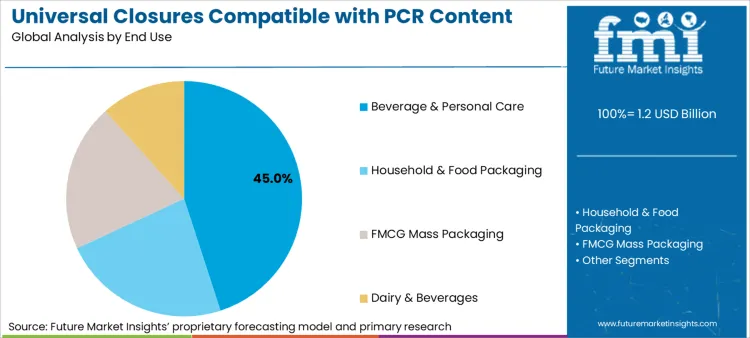
Beverage & personal care end-use commands a leading 45% value share, acting as the primary volume driver for PCR-compatible closures. This dominance is rooted in massive global consumption, high brand-owner sustainability pledges, and the critical need for closures that maintain seal integrity and consumer safety.
In Q4 2025, a consortium of major bottled water and juice brands in Europe announced a unified specification requiring all twist-off caps to contain a minimum of 30% PCR-HDPE by 2027, creating a guaranteed high-volume demand pool for compliant suppliers like ALPLA and Aptar.
Which Closure Type Maintains Dominance in High-Speed Packaging Lines?
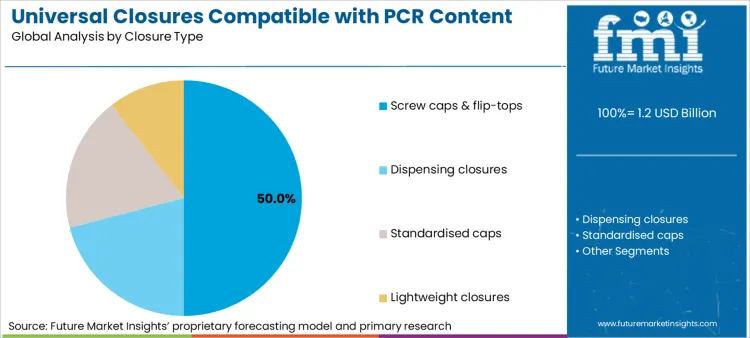
Screw caps & flip-tops hold a dominant 50% share of the closure type segment. Their supremacy is sustained by their universal applicability across billions of rigid plastic bottles for water, soft drinks, and dairy. The technical focus is on engineering these high-volume closures to run seamlessly on existing filling lines at speeds exceeding 2,000 units per minute, despite the variable rheology of PCR resins.
Berry Global's 2026 launch of its EcoTorque series demonstrated that through proprietary polymer blending, screw caps with 50% PCR content could achieve consistent application torque, eliminating production line jams and ensuring seal performance.
What Material Blends are Overcoming PCR Performance Barriers?
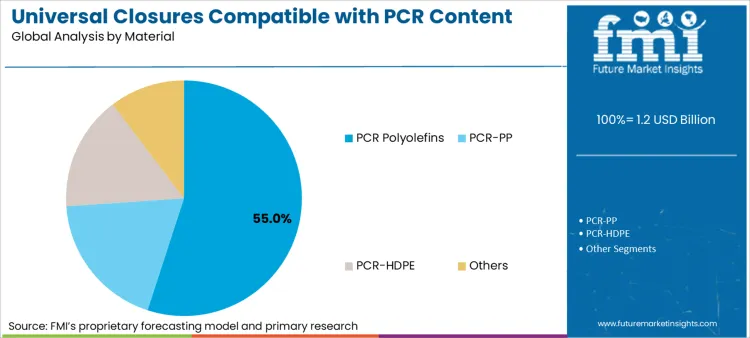
Closures made from PCR-HDPE / PCR-PP blends lead the material segment with a 55% share. This combination leverages PCR-HDPE's stiffness for robust cap bodies and PCR-PP's flexibility and chemical resistance for liners and living hinges in flip-top closures. The key innovation is in advanced compatibilization.
In January 2026, Dow Inc. introduced a new series of polyolefin elastomers specifically designed as compatibilizers for post-consumer polyolefin blends, enabling higher PCR incorporation rates exceeding 60% without sacrificing impact strength or stress-crack resistance, crucial for carbonated beverage caps.
Which Processing Technology is Critical for Manufacturing Efficiency?
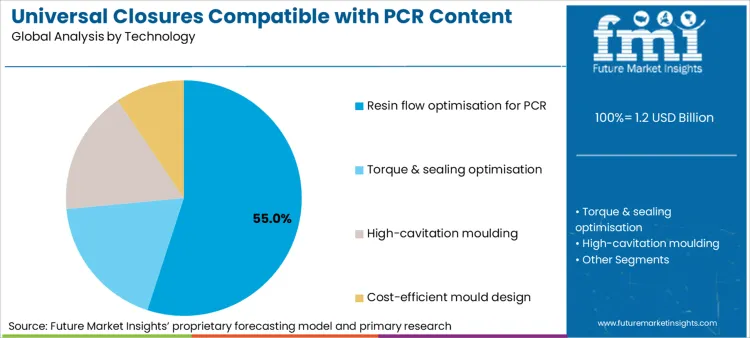
Resin flow optimisation for PCR is the pivotal technology segment, accounting for 55% of focus. The inconsistent melt flow index and potential for micron-level contaminants in PCR streams pose major challenges for high-cavitation moulding tools. This has spurred innovation in dynamic melt filtration and in-mould rheology control systems.
In 2025, Engel and Husky unveiled next-generation injection moulding machines with integrated AI-driven viscosity sensors that adjust screw speed and barrel temperature in real-time to compensate for PCR feedstock variability, reducing scrap rates by up to 15% and ensuring dimensional consistency in high-volume closure production.
What Drivers, Restraints, Opportunities, and Trends Prevail in the Market?
Market expansion is supported by binding legislation. The EU's PPWR mandatory minimum recycled content thresholds, effective from 2028, are prompting brand owners and converters to lock in supply agreements for PCR-compatible closures years in advance. In October 2025, PepsiCo and ALPLA announced a joint development agreement to commercialize a closure for PepsiCo's beverage portfolio using 100% PCR-PP derived from a dedicated, closed-loop collection stream in key European markets.
While demand is robust, the industry faces significant supply and quality constraints for food-grade PCR. Financial disclosures from major recyclers in early 2026 highlighted sustained price volatility and competition for clear, food-authorised HDPE and PP flake. This shortage directly threatens the economic viability and scalability of high-PCR content closures, forcing innovation in using harder-to-process colored or mixed-polymer streams.
Technical innovation is defined by functional integration beyond basic sealing. Aptar's 2026 R&D showcase featured a smart closure for premium juices incorporating PCR-PP. This closure had an integrated, PCR-compatible freshness indicator based on oxygen-absorbing technology molded directly into the liner. This trend moves the closure from a passive seal to an active participant in product preservation and consumer communication, adding value to the PCR component.
The shift toward digital watermarking for accurate sortation represents a disruptive enabling trend. The HolyGrail 2.0 initiative, gaining regulatory support in 2026, promotes digital watermarks on packaging to improve sorting efficiency. Closure manufacturers are now developing molding techniques to incorporate these nearly invisible codes into PCR-based closures. This trend promises to increase the yield and purity of PCR flake in the future, creating a positive feedback loop for closure recyclability.
Analysis of Universal Closures Compatible with PCR Content Market by Key Countries
The following analysis examines the strategic drivers of the PCR-compatible closures market in India (14.8% CAGR), China (14.2%), USA (11.8%), Germany (11.4%), Brazil (11.0%), and Japan (9.2%). Distinct regulatory frameworks, downstream industry demand, and supply chain maturity for PCR feedstocks propel growth in each country.
| Country | CAGR (2026-2036) |
|---|---|
| India | 14.8% |
| China | 14.2% |
| USA | 11.8% |
| Germany | 11.4% |
| Brazil | 11.0% |
| Japan | 9.2% |
Source: Future Market Insights (FMI) analysis, based on proprietary forecasting model and primary research
How are India's EPR Rules Catalyzing a Low-Cost, High-Volume Market?
India is projected to expand at a leading 14.8% CAGR through 2036, driven by the stringent enforcement of its Extended Producer Responsibility (EPR) rules for plastic packaging. The 2025 amendment mandates specific recycled content percentages for rigid packaging, including closures.
This policy favors cost-efficient mould design and lightweighting technologies to integrate PCR into closures for the massive dairy and affordable beverage segments. Companies like Gala Precision are leading with simplified, robust cap designs that maximize the use of often lower-quality domestic PCR flake, meeting both regulatory compliance and extreme cost pressures from local FMCG giants.
What Drives China's Focus on Standardisation and Export-Oriented Scale?
China's 14.2% CAGR growth is fueled by its Double Carbon policy and its role as the global workshop for FMCG mass packaging. The focus is on standardised caps produced via high-cavitation moulding (to achieve unparalleled economies of scale.
Chinese manufacturers like Zhejiang B.I. Packaging are investing in mega-tonnage presses with 128+ cavities to produce billions of uniform PCR-PP closures. This standardized output supplies both domestic brands and global exporters, leveraging integrated supply chains from PCR flake production to final closure manufacturing.
How do State-Level Regulations and Premium Brands Shape Innovation in USA?
The US market, growing at an 11.8% CAGR, is fragmented yet driven by progressive state laws like California’s SB 54 and corporate sustainability goals. This environment demands advanced torque & sealing optimisation technologies (20% share) to ensure that closures with high PCR content perform identically to virgin material closures in premium household, food, and beverage packaging.
Silgan Closures and Berry Global are engaging in deep co-engineering projects with brand owners, developing application-specific PCR polyolefin blends that meet FDA requirements for food contact and maintain exacting performance standards for dispensing closures on cleaning products and personal care items.
Why is Germany the European Hub for High-Quality PCR-HDPE Closure Innovation?
The EU’s single-use plastics directive and the leadership of its premium beverage brands underpin Germany’s 11.4% CAGR. The market demands the highest quality PCR-HDPE (55% material share leadership), with stringent requirements for color consistency, odor neutrality, and material purity to protect brand equity.
German engineering is focused on sophisticated multi-stage filtration and super-clean processing of PCR flake. Machine manufacturers like Arburg and closure producers like ALPLA are collaborating to create "closed-loop" demonstration lines that process used beverage bottle flake directly into new food-grade caps within a single facility, setting the benchmark for circularity in Europe.
How is Brazil's Bioeconomy Influencing PCR Closure Development?
Brazil's market, expanding at an 11.0% CAGR, is uniquely influenced by its robust bioeconomy and sugarcane-based polymer industry. While PCR-HDPE and PCR-PP are growing, there is parallel innovation in hybrid closures that combine PCR with bio-based polymers.
The focus is on developing closure systems compatible with the country's well-established recycling streams for HDPE bottles, while also exploring drop-in bio-attributed solutions to meet the sustainability demands of both local and export-oriented agribusiness packaging.
What Factors Explain Japan's Mature yet Stable Growth Trajectory?
Japan's steady 9.2% CAGR reflects its mature packaging market and sophisticated, quality-focused recycling infrastructure. Growth is driven by continuous incremental improvement in resin flow optimisation for the existing high-efficiency production of PCR-compatible closures.
Japanese companies excel in precision engineering and material purification, focusing on enhancing the performance and aesthetics of PCR closures for the demanding domestic food and beverage market, where even minor defects are unacceptable. The emphasis is on achieving supreme consistency and meeting voluntary, industry-led green packaging goals.
What is the Competition Outlook for Universal Closures Compatible with PCR Content?
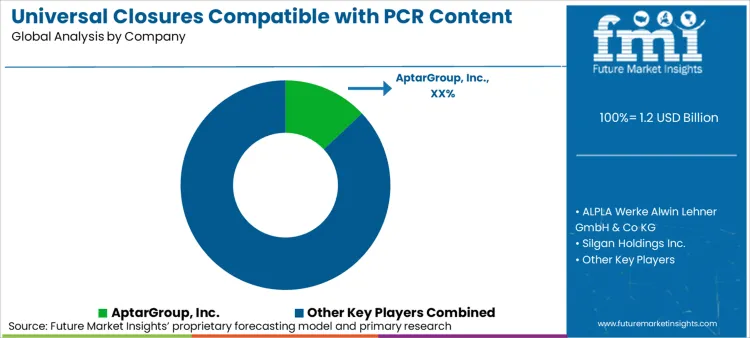
Competitive intensity reflects the strategic importance of securing reliable, high-quality PCR supply and deep technical partnerships with brand owners. The landscape is bifurcating into large-scale integrators who control recycling assets and specialty innovators focused on high-value functional closures. Competition is increasingly based on long-term JDAs where closure suppliers co-invest in dedicated recycling infrastructure or compatibilizer chemistry to secure contracts with global FMCG leaders.
Strategic acquisitions to secure technology and feedstock defined evolution prior to 2025. Berry Global's acquisition of recycler and compounder businesses provided it with vertical integration. Suppliers focused on establishing "qualified" PCR closure systems at major brand owners, often competing on security of supply and consistency rather than just price.
The observable strategic direction for 2026 and beyond is the creation of dedicated "Circular Packaging" business units. Aptar's formation of its "Circular Ventures" division in late 2025 exemplifies this trend, combining closure design, PCR sourcing, and end-of-life recyclability testing into a single customer-facing platform focused exclusively on helping brands meet legislative and ESG targets.
Strategic leadership is shifting toward full-system design for circularity. In early 2026, ALPLA and Borealis inaugurated their joint project ValueCard. This initiative goes beyond selling PCR closures to offering brand owners a full circularity service package, including closure design for recyclability, provision of certified PCR material, and a buy-back guarantee for the post-consumer material, effectively offering a circular subscription model.
Recent Developments:
- AptarGroup, Inc. expanded its portfolio of PCR-compatible beverage closures through ongoing lightweighting and material optimization programs announced during 2024-2025, focusing on tethered and sports closures designed to maintain mechanical performance and sealing integrity when used with high-PCR HDPE bottles in European beverage applications. These developments support compliance with EU recyclability and recycled-content mandates without committing to brand-exclusive PCR cap launches.
- Silgan Holdings Inc., through its dispensing systems division, commercialized dispensing and screw-on closures containing up to ~98% post-consumer recycled polypropylene during 2024-2025, targeting personal care, home care, and selected food applications. The company emphasizes design-for-recycling compatibility, ensuring that high-PCR closures do not interfere with standard HDPE and PP recycling streams, even where formal APR Critical Guidance recognition has not been publicly announced.
- ALPLA Werke Alwin Lehner GmbH & Co KG continued to scale its circular packaging strategy in 2024-2025 by expanding in-house recycling capacity for rHDPE and rPET and validating closure-capable resins derived from both mechanical and advanced recycling routes. These material developments enable ALPLA to supply closure systems compatible with food-grade compliant PCR polyolefins, supporting customer demand for higher recycled content without compromising regulatory or functional performance.
Key Players Profiled
- AptarGroup, Inc.
- ALPLA Werke Alwin Lehner GmbH & Co KG
- Silgan Holdings Inc.
- Berry Global Inc.
- Zhejiang B.I. Packaging Co., Ltd.
- Gala Precision Engineering Ltd.
- Bericap GmbH & Co. KG
- Closure Systems International (CSI)
- Tetra Pak Inc. (for integrated packaging systems)
- United Caps
Market Definition
The universal closures compatible with PCR content market comprises revenue generated from the sale of plastic caps and lids (e.g., screw caps, flip-tops, dispensing closures, sports caps) specifically engineered and manufactured to incorporate significant and guaranteed percentages of PCR polyolefins, primarily HDPE and PP.
These closures must maintain all critical functional performance attributes (seal integrity, application/removal torque, tamper evidence, chemical resistance) and comply with relevant global health and safety standards for their intended end-use (e.g., food contact). The market includes the value of specialized material formulation, compatibilizer technology, and design-for-recycling services essential for successful PCR integration.
Scope of Report
| Items | Values |
|---|---|
| Quantitative Units | USD 1,180 million (2026) |
| Material | PCR-HDPE / PCR-PP, PCR Polyolefins, PCR-PP, PCR-HDPE, Others |
| Closure Type | Screw caps & flip-tops, Dispensing closures, Standardised caps, Lightweight closures, Others |
| End Use | Beverage & Personal Care, Household & Food Packaging, FMCG Mass Packaging, Dairy & Beverages, Others |
| Technology | Resin flow optimisation for PCR, Torque & sealing optimisation, High-cavitation moulding, Cost-efficient mould design, Others |
| Regions Covered | North America, Western Europe, Eastern Europe, East Asia, South Asia & Pacific, Latin America, Middle East & Africa |
| Countries | India, China, USA, Germany, Brazil, Japan and 40+ countries |
Source: Future Market Insights (FMI) analysis, based on proprietary forecasting model and primary research
Universal Closures Compatible with PCR Content Market Key Segments
By Material
- PCR-HDPE/PCR-PP
- PCR Polyolefins
- PCR-PP
- PCR-HDPE
- Others
By Closure Type
- Screw caps & flip-tops
- Dispensing closures
- Standardised caps
- Lightweight closures
- Others
By End Use
- Beverage & Personal Care
- Household & Food Packaging
- FMCG Mass Packaging
- Dairy & Beverages
- Others
By Technology
- Resin flow optimisation for PCR
- Torque & sealing optimisation
- High-cavitation moulding
- Cost-efficient mould design
- Others
By Region
- North America
- Western Europe
- Eastern Europe
- East Asia
- South Asia & Pacific
- Latin America
- Middle East & Africa
Bibliography
- Plastics Recyclers Europe (PRE). (2024). Design for recycling guidelines for polyolefin rigid packaging and closures. Brussels: PRE.
- Organisation for Economic Co-operation and Development (OECD). (2024). Global policy approaches to recycled content mandates in plastic packaging. Paris: OECD Publishing.
- European Plastics Converters (EuPC). (2025). Recycled content integration challenges in injection-moulded packaging components. Brussels: EuPC.
- CEFLEX. (2025). Designing rigid and flexible packaging components for circular material streams. Brussels: Circular Economy for Flexible Packaging.
- Association of Plastic Recyclers (APR). (2024). Critical guidance protocol for HDPE and PP closures with post-consumer recycled content. Washington, DC: APR.
- Food Packaging Forum. (2025). Food-contact safety considerations for recycled polyolefins. Zurich: Food Packaging Forum Foundation.
- World Packaging Organisation (WPO). (2026). Trends in closure systems and circular packaging design. Zurich: WPO.
- Institute of Packaging Professionals (IoPP). (2025). Technical handbook on rigid packaging components and material compatibility. Herndon, VA: IoPP.
Frequently Asked Questions
How big is the universal closures compatible with pcr content market in 2026?
The global universal closures compatible with pcr content market is estimated to be valued at USD 1.2 billion in 2026.
What will be the size of universal closures compatible with pcr content market in 2036?
The market size for the universal closures compatible with pcr content market is projected to reach USD 3.9 billion by 2036.
How much will be the universal closures compatible with pcr content market growth between 2026 and 2036?
The universal closures compatible with pcr content market is expected to grow at a 12.6% CAGR between 2026 and 2036.
What are the key product types in the universal closures compatible with pcr content market?
The key product types in universal closures compatible with pcr content market are beverage & personal care, household & food packaging, fmcg mass packaging and dairy & beverages.
Which closure type segment to contribute significant share in the universal closures compatible with pcr content market in 2026?
In terms of closure type , screw caps & flip-tops segment to command 50.0% share in the universal closures compatible with pcr content market in 2026.
Preview the report firsthand - request a free sample
Get SampleGet the brochure for pricing and purchase details.
Get PDFTable of Content
- Executive Summary
- Global Market Outlook
- Demand-side Trends
- Supply-side Trends
- Technology Roadmap Analysis
- Analysis and Recommendations
- Market Overview
- Market Coverage / Taxonomy
- Market Definition / Scope / Limitations
- Research Methodology
- Chapter Orientation
- Analytical Lens and Working Hypotheses
- Market Structure, Signals, and Trend Drivers
- Benchmarking and Cross-market Comparability
- Market Sizing, Forecasting, and Opportunity Mapping
- Research Design and Evidence Framework
- Desk Research Programme (Secondary Evidence)
- Company Annual and Sustainability Reports
- Peer-reviewed Journals and Academic Literature
- Corporate Websites, Product Literature, and Technical Notes
- Earnings Decks and Investor Briefings
- Statutory Filings and Regulatory Disclosures
- Technical White Papers and Standards Notes
- Trade Journals, Industry Magazines, and Analyst Briefs
- Conference Proceedings, Webinars, and Seminar Materials
- Government Statistics Portals and Public Data Releases
- Press Releases and Reputable Media Coverage
- Specialist Newsletters and Curated Briefings
- Sector Databases and Reference Repositories
- FMI Internal Proprietary Databases and Historical Market Datasets
- Subscription Datasets and Paid Sources
- Social Channels, Communities, and Digital Listening Inputs
- Additional Desk Sources
- Expert Input and Fieldwork (Primary Evidence)
- Primary Modes
- Qualitative Interviews and Expert Elicitation
- Quantitative Surveys and Structured Data Capture
- Blended Approach
- Why Primary Evidence is Used
- Field Techniques
- Interviews
- Surveys
- Focus Groups
- Observational and In-context Research
- Social and Community Interactions
- Stakeholder Universe Engaged
- C-suite Leaders
- Board Members
- Presidents and Vice Presidents
- R&D and Innovation Heads
- Technical Specialists
- Domain Subject-matter Experts
- Scientists
- Physicians and Other Healthcare Professionals
- Governance, Ethics, and Data Stewardship
- Research Ethics
- Data Integrity and Handling
- Primary Modes
- Tooling, Models, and Reference Databases
- Desk Research Programme (Secondary Evidence)
- Data Engineering and Model Build
- Data Acquisition and Ingestion
- Cleaning, Normalisation, and Verification
- Synthesis, Triangulation, and Analysis
- Quality Assurance and Audit Trail
- Market Background
- Market Dynamics
- Drivers
- Restraints
- Opportunity
- Trends
- Scenario Forecast
- Demand in Optimistic Scenario
- Demand in Likely Scenario
- Demand in Conservative Scenario
- Opportunity Map Analysis
- Product Life Cycle Analysis
- Supply Chain Analysis
- Investment Feasibility Matrix
- Value Chain Analysis
- PESTLE and Porter’s Analysis
- Regulatory Landscape
- Regional Parent Market Outlook
- Production and Consumption Statistics
- Import and Export Statistics
- Market Dynamics
- Global Market Analysis 2021 to 2025 and Forecast, 2026 to 2036
- Historical Market Size Value (USD Million) Analysis, 2021 to 2025
- Current and Future Market Size Value (USD Million) Projections, 2026 to 2036
- Y-o-Y Growth Trend Analysis
- Absolute $ Opportunity Analysis
- Global Market Pricing Analysis 2021 to 2025 and Forecast 2026 to 2036
- Global Market Analysis 2021 to 2025 and Forecast 2026 to 2036, By End Use
- Introduction / Key Findings
- Historical Market Size Value (USD Million) Analysis By End Use , 2021 to 2025
- Current and Future Market Size Value (USD Million) Analysis and Forecast By End Use , 2026 to 2036
- Beverage & Personal Care
- Household & Food Packaging
- FMCG Mass Packaging
- Dairy & Beverages
- Beverage & Personal Care
- Y-o-Y Growth Trend Analysis By End Use , 2021 to 2025
- Absolute $ Opportunity Analysis By End Use , 2026 to 2036
- Global Market Analysis 2021 to 2025 and Forecast 2026 to 2036, By Closure Type
- Introduction / Key Findings
- Historical Market Size Value (USD Million) Analysis By Closure Type, 2021 to 2025
- Current and Future Market Size Value (USD Million) Analysis and Forecast By Closure Type, 2026 to 2036
- Screw caps & flip-tops
- Dispensing closures
- Standardised caps
- Lightweight closures
- Screw caps & flip-tops
- Y-o-Y Growth Trend Analysis By Closure Type, 2021 to 2025
- Absolute $ Opportunity Analysis By Closure Type, 2026 to 2036
- Global Market Analysis 2021 to 2025 and Forecast 2026 to 2036, By Material
- Introduction / Key Findings
- Historical Market Size Value (USD Million) Analysis By Material, 2021 to 2025
- Current and Future Market Size Value (USD Million) Analysis and Forecast By Material, 2026 to 2036
- PCR Polyolefins
- PCR-PP
- PCR-HDPE
- Others
- PCR Polyolefins
- Y-o-Y Growth Trend Analysis By Material, 2021 to 2025
- Absolute $ Opportunity Analysis By Material, 2026 to 2036
- Global Market Analysis 2021 to 2025 and Forecast 2026 to 2036, By Technology
- Introduction / Key Findings
- Historical Market Size Value (USD Million) Analysis By Technology, 2021 to 2025
- Current and Future Market Size Value (USD Million) Analysis and Forecast By Technology, 2026 to 2036
- Resin flow optimisation for PCR
- Torque & sealing optimisation
- High-cavitation moulding
- Cost-efficient mould design
- Resin flow optimisation for PCR
- Y-o-Y Growth Trend Analysis By Technology, 2021 to 2025
- Absolute $ Opportunity Analysis By Technology, 2026 to 2036
- Global Market Analysis 2021 to 2025 and Forecast 2026 to 2036, By Region
- Introduction
- Historical Market Size Value (USD Million) Analysis By Region, 2021 to 2025
- Current Market Size Value (USD Million) Analysis and Forecast By Region, 2026 to 2036
- North America
- Latin America
- Western Europe
- Eastern Europe
- East Asia
- South Asia and Pacific
- Middle East & Africa
- Market Attractiveness Analysis By Region
- North America Market Analysis 2021 to 2025 and Forecast 2026 to 2036, By Country
- Historical Market Size Value (USD Million) Trend Analysis By Market Taxonomy, 2021 to 2025
- Market Size Value (USD Million) Forecast By Market Taxonomy, 2026 to 2036
- By Country
- USA
- Canada
- Mexico
- By End Use
- By Closure Type
- By Material
- By Technology
- By Country
- Market Attractiveness Analysis
- By Country
- By End Use
- By Closure Type
- By Material
- By Technology
- Key Takeaways
- Latin America Market Analysis 2021 to 2025 and Forecast 2026 to 2036, By Country
- Historical Market Size Value (USD Million) Trend Analysis By Market Taxonomy, 2021 to 2025
- Market Size Value (USD Million) Forecast By Market Taxonomy, 2026 to 2036
- By Country
- Brazil
- Chile
- Rest of Latin America
- By End Use
- By Closure Type
- By Material
- By Technology
- By Country
- Market Attractiveness Analysis
- By Country
- By End Use
- By Closure Type
- By Material
- By Technology
- Key Takeaways
- Western Europe Market Analysis 2021 to 2025 and Forecast 2026 to 2036, By Country
- Historical Market Size Value (USD Million) Trend Analysis By Market Taxonomy, 2021 to 2025
- Market Size Value (USD Million) Forecast By Market Taxonomy, 2026 to 2036
- By Country
- Germany
- UK
- Italy
- Spain
- France
- Nordic
- BENELUX
- Rest of Western Europe
- By End Use
- By Closure Type
- By Material
- By Technology
- By Country
- Market Attractiveness Analysis
- By Country
- By End Use
- By Closure Type
- By Material
- By Technology
- Key Takeaways
- Eastern Europe Market Analysis 2021 to 2025 and Forecast 2026 to 2036, By Country
- Historical Market Size Value (USD Million) Trend Analysis By Market Taxonomy, 2021 to 2025
- Market Size Value (USD Million) Forecast By Market Taxonomy, 2026 to 2036
- By Country
- Russia
- Poland
- Hungary
- Balkan & Baltic
- Rest of Eastern Europe
- By End Use
- By Closure Type
- By Material
- By Technology
- By Country
- Market Attractiveness Analysis
- By Country
- By End Use
- By Closure Type
- By Material
- By Technology
- Key Takeaways
- East Asia Market Analysis 2021 to 2025 and Forecast 2026 to 2036, By Country
- Historical Market Size Value (USD Million) Trend Analysis By Market Taxonomy, 2021 to 2025
- Market Size Value (USD Million) Forecast By Market Taxonomy, 2026 to 2036
- By Country
- China
- Japan
- South Korea
- By End Use
- By Closure Type
- By Material
- By Technology
- By Country
- Market Attractiveness Analysis
- By Country
- By End Use
- By Closure Type
- By Material
- By Technology
- Key Takeaways
- South Asia and Pacific Market Analysis 2021 to 2025 and Forecast 2026 to 2036, By Country
- Historical Market Size Value (USD Million) Trend Analysis By Market Taxonomy, 2021 to 2025
- Market Size Value (USD Million) Forecast By Market Taxonomy, 2026 to 2036
- By Country
- India
- ASEAN
- Australia & New Zealand
- Rest of South Asia and Pacific
- By End Use
- By Closure Type
- By Material
- By Technology
- By Country
- Market Attractiveness Analysis
- By Country
- By End Use
- By Closure Type
- By Material
- By Technology
- Key Takeaways
- Middle East & Africa Market Analysis 2021 to 2025 and Forecast 2026 to 2036, By Country
- Historical Market Size Value (USD Million) Trend Analysis By Market Taxonomy, 2021 to 2025
- Market Size Value (USD Million) Forecast By Market Taxonomy, 2026 to 2036
- By Country
- Kingdom of Saudi Arabia
- Other GCC Countries
- Turkiye
- South Africa
- Other African Union
- Rest of Middle East & Africa
- By End Use
- By Closure Type
- By Material
- By Technology
- By Country
- Market Attractiveness Analysis
- By Country
- By End Use
- By Closure Type
- By Material
- By Technology
- Key Takeaways
- Key Countries Market Analysis
- USA
- Pricing Analysis
- Market Share Analysis, 2025
- By End Use
- By Closure Type
- By Material
- By Technology
- Canada
- Pricing Analysis
- Market Share Analysis, 2025
- By End Use
- By Closure Type
- By Material
- By Technology
- Mexico
- Pricing Analysis
- Market Share Analysis, 2025
- By End Use
- By Closure Type
- By Material
- By Technology
- Brazil
- Pricing Analysis
- Market Share Analysis, 2025
- By End Use
- By Closure Type
- By Material
- By Technology
- Chile
- Pricing Analysis
- Market Share Analysis, 2025
- By End Use
- By Closure Type
- By Material
- By Technology
- Germany
- Pricing Analysis
- Market Share Analysis, 2025
- By End Use
- By Closure Type
- By Material
- By Technology
- UK
- Pricing Analysis
- Market Share Analysis, 2025
- By End Use
- By Closure Type
- By Material
- By Technology
- Italy
- Pricing Analysis
- Market Share Analysis, 2025
- By End Use
- By Closure Type
- By Material
- By Technology
- Spain
- Pricing Analysis
- Market Share Analysis, 2025
- By End Use
- By Closure Type
- By Material
- By Technology
- France
- Pricing Analysis
- Market Share Analysis, 2025
- By End Use
- By Closure Type
- By Material
- By Technology
- India
- Pricing Analysis
- Market Share Analysis, 2025
- By End Use
- By Closure Type
- By Material
- By Technology
- ASEAN
- Pricing Analysis
- Market Share Analysis, 2025
- By End Use
- By Closure Type
- By Material
- By Technology
- Australia & New Zealand
- Pricing Analysis
- Market Share Analysis, 2025
- By End Use
- By Closure Type
- By Material
- By Technology
- China
- Pricing Analysis
- Market Share Analysis, 2025
- By End Use
- By Closure Type
- By Material
- By Technology
- Japan
- Pricing Analysis
- Market Share Analysis, 2025
- By End Use
- By Closure Type
- By Material
- By Technology
- South Korea
- Pricing Analysis
- Market Share Analysis, 2025
- By End Use
- By Closure Type
- By Material
- By Technology
- Russia
- Pricing Analysis
- Market Share Analysis, 2025
- By End Use
- By Closure Type
- By Material
- By Technology
- Poland
- Pricing Analysis
- Market Share Analysis, 2025
- By End Use
- By Closure Type
- By Material
- By Technology
- Hungary
- Pricing Analysis
- Market Share Analysis, 2025
- By End Use
- By Closure Type
- By Material
- By Technology
- Kingdom of Saudi Arabia
- Pricing Analysis
- Market Share Analysis, 2025
- By End Use
- By Closure Type
- By Material
- By Technology
- Turkiye
- Pricing Analysis
- Market Share Analysis, 2025
- By End Use
- By Closure Type
- By Material
- By Technology
- South Africa
- Pricing Analysis
- Market Share Analysis, 2025
- By End Use
- By Closure Type
- By Material
- By Technology
- USA
- Market Structure Analysis
- Competition Dashboard
- Competition Benchmarking
- Market Share Analysis of Top Players
- By Regional
- By End Use
- By Closure Type
- By Material
- By Technology
- Competition Analysis
- Competition Deep Dive
- AptarGroup, Inc.
- Overview
- Product Portfolio
- Profitability by Market Segments (Product/Age /Sales Channel/Region)
- Sales Footprint
- Strategy Overview
- Marketing Strategy
- Product Strategy
- Channel Strategy
- ALPLA Werke Alwin Lehner GmbH & Co KG
- Silgan Holdings Inc.
- Berry Global Inc.
- Zhejiang B.I. Packaging Co., Ltd.
- AptarGroup, Inc.
- Competition Deep Dive
- Assumptions & Acronyms Used


