

- Industry Size (2026)
- USD 2.3 Bn
- Forecast (2036)
- USD 4.7 Bn
- CAGR (2026 to 2036)
- 8.1%
Electrochromic Glass and Devices Market Size, Market Forecast and Outlook By FMI
The electrochromic glass and devices market was valued at USD 2.2 billion in 2025. The industry is poised to reach USD 2.3 billion in 2026 at a CAGR of 8.1% during the forecast period. Revenue expansion lifts the total opportunity to USD 4.7 billion through 2036 as building developers transition from mechanical shading to adaptive, solid-state light modulation to satisfy tightening urban energy density requirements.
Façade engineering teams are currently moving past the evaluation of smart glazing as a luxury aesthetic, instead treating electrochromic glass as a core functional component of the building’s thermal management system. This shift forces a decision between static solar-control films and dynamic coatings that can respond to real-time irradiance, where the stakes for delay involve being locked into higher operational HVAC costs for the duration of a twenty-year building lifecycle. FMI analysts observe that while the visible tint is the most obvious feature, the true value lies in the reduction of peak cooling loads, which allows for the downsizing of mechanical equipment during the initial construction phase. This structural integration of optical control into building automation ensures that electrochromic materials become a standard specification in high-performance commercial real estate.
Summary of Electrochromic Glass and Devices Market
- Electrochromic Glass and Devices Market Definition
- The market comprises thin-film materials and laminated assemblies that dynamically alter light transmission and heat gain via electrical stimulus. It establishes a functional boundary between traditional static insulation and active, responsive building envelopes that function as an integrated component of energy management systems.
- Demand Drivers in the Market
- Tightening municipal energy performance mandates compel commercial property developers to adopt dynamic glazing to avoid non-compliance penalties.
- The structural shift toward panoramic vehicle roofs requires automotive OEMs to integrate dimmable automotive glass film to maintain cabin thermal comfort.
- Corporate sustainability targets drive facility managers at technology campuses to replace mechanical blinds with switchable glass to maximize natural daylighting.
- Key Segments Analyzed in the FMI Report
- Transition Metal Oxides: Anticipated to hold 50.2% share in 2026, driven by superior UV stability and established magnetron sputtering fabrication pathways.
- Windows: Expected to grab 53.1% share in 2026, serving as the primary revenue generator through large-scale architectural façade contracts.
- Building and Construction: Poised to account for 46.0% of demand in 2026 due to the high volume of flat glass consumed in modern office towers.
- China: Projected for 9.4% compound growth, fueled by state-backed initiatives for near-zero carbon building infrastructure.
- Analyst Opinion at FMI
- Nikhil Kaitwade, Principal Analyst, Chemicals, at FMI, opines, "The market is moving away from the 'innovation' phase into a 'procurement' phase where the primary friction is no longer the technology's reliability, but the industry's ability to integrate power-over-ethernet controls into standard glazing workflows. My research indicates that practitioners who view electrochromic glass as a standalone product rather than a node on a building's digital network often fail to capture the energy savings that justify the initial capital expenditure."
- Strategic Implications / Executive Takeaways
- Facade contractors must invest in electrical integration skills to manage the transition from passive glass installation to active system commissioning.
- Automotive tier-1 suppliers should expand automotive front windshield portfolios to include localized dimming zones for heads-up display optimization.
- Materials providers face a structural requirement to lower deposition costs to remain competitive against emerging low-cost chemical alternatives.
- Methodology
- Primary Research: Interviews with 200+ industry experts across the smart glass value chain.
- Desk Research: Review of over 1,500 trade publications and regulatory filings.
- Market Sizing: Proprietary model anchoring to the total addressable surface area in premium construction.
- Validation: Iterative feedback loops with key market participants.
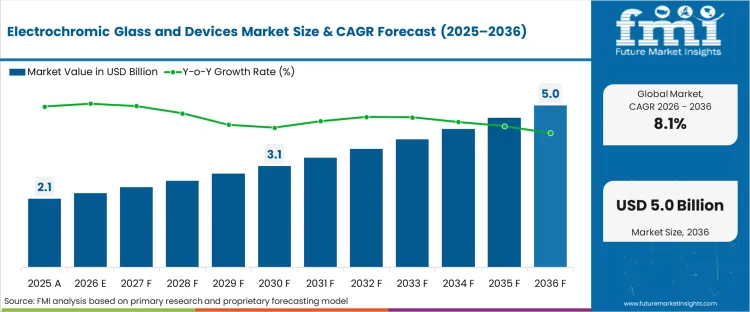
Electrochromic Glass and Devices Market Key Takeaways
| Metric | Details |
|---|---|
| Industry Size (2026) | USD 2.3 billion |
| Industry Value (2036) | USD 4.7 billion |
| CAGR (2026-2036) | 8.1% |
Source: Future Market Insights (FMI) analysis, based on proprietary forecasting model and primary research
Growth becomes self-reinforcing once the manufacturing cost per square meter crosses the threshold where the downsizing of HVAC systems fully offsets the glazing premium. This inflection point is triggered by glass processors adopting high-throughput magnetron sputtering techniques, making the next unit of adoption significantly more accessible than the pilot installations of the previous decade.
China is expected to advance at a 9.4% compound rate through 2036 as national green-building mandates accelerate the adoption of smart glass in Tier-1 commercial hubs. India follows at 9.1%, sustaining growth through a massive expansion in LEED-certified office inventory. South Korea and Japan track at 8.8% and 8.5% respectively, anchored to advanced automotive glass innovation. Germany expands at 7.9% through 2036, while the USA and UK register 7.7% and 7.3% annual growth. The divergence in these rates reflects the stage of the local regulatory calendar, with Asian markets prioritizing new high-performance infrastructure while Western markets focus on high-value institutional retrofits.
Electrochromic Glass and Devices Market Definition
The market encompasses electronically controllable glazing and optical components that utilize reversible electrochemical reactions to modulate light transmission. Unlike passive tinted glass, these devices allow for granular control of solar heat gain and visible light through the application of low-voltage electrical currents. The boundary of this market is defined by the transition from static materials to adaptive, switchable systems that serve as the primary skin for high-efficiency building envelopes and glare-resistant transportation interiors.
Electrochromic Glass and Devices Market Inclusions
This market includes transition metal oxide coatings, viologen-based systems, and conducting polymers integrated into laminated glazing units. It covers the supply of advanced glass specifically engineered for dynamic modulation, along with the specialized control electronics and power management systems required for device operation. Included are applications ranging from self-dimming automotive rearview modules to large-scale architectural window assemblies.
Electrochromic Glass and Devices Market Exclusions
The scope explicitly excludes traditional mechanical shading devices such as roller blinds, louvers, or external shutters. It also omits simple impact resistant glass or architectural flat glass that lacks active electronic switching capabilities. Furthermore, non-electrochromic switchable technologies like standalone thermochromic or photochromic films are excluded unless they are part of a hybrid electrochromic assembly designed for multi-state light control.
Electrochromic Glass and Devices Market Research Methodology
- Primary Research: FMI conducted detailed interviews with façade engineering directors, automotive glazing procurement leads, and materials scientists at major glass manufacturing hubs.
- Desk Research: Analysis involved synthesizing building energy code registries, automotive production databases, and glass manufacturing capacity filings to map global supply-demand balances.
- Market-Sizing and Forecasting: The baseline anchors to the total annual square footage of high-performance glazing specified in commercial and transport projects, triangulated against chemical precursor consumption.
- Data Validation and Update Cycle: Forecasts were cross-validated using independent building permit data and quarterly revenue disclosures from the leading thin-film coating technology providers.
Segmental Analysis
Electrochromic Glass and Devices Market Analysis by Material
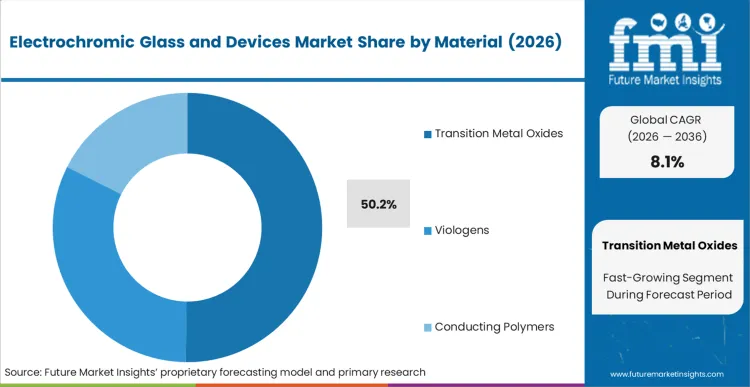
The structural reason transition metal oxides hold a 50.2% share lies in their unparalleled resistance to solar degradation compared to organic alternatives. These materials are not chosen solely for their switching speed; they are specified because a multi-screen super glass façade must maintain performance parity for over twenty years of direct UV exposure. According to FMI’s assessment, the maturity of tungsten oxide-based stacks allows for seamless integration into the high-volume coating lines used by the global glass majors. Façade engineers prioritize this material class because it delivers a predictable coloration state that does not shift over thousands of cycles, ensuring the building’s exterior maintains a uniform aesthetic as the electrochromic and liquid crystal polymer layers respond to environmental triggers.
- Cycle Durability: Crystalline oxide structures withstand repeated ion insertion without lattice breakdown, preventing the hazy degradation that affects polymer-based systems in high-heat environments.
- Sputtering Compatibility: Oxide-based chemistry allows for the use of large-scale industrial coating equipment, enabling manufacturers to produce wide-format panels that match standard architectural glazing dimensions.
- Thermal Performance: The inorganic nature of these films provides an inherent low-emissivity benefit, functioning as a secondary thermal barrier even when the glass is in its clear state.
Electrochromic Glass and Devices Market Analysis by Device Type
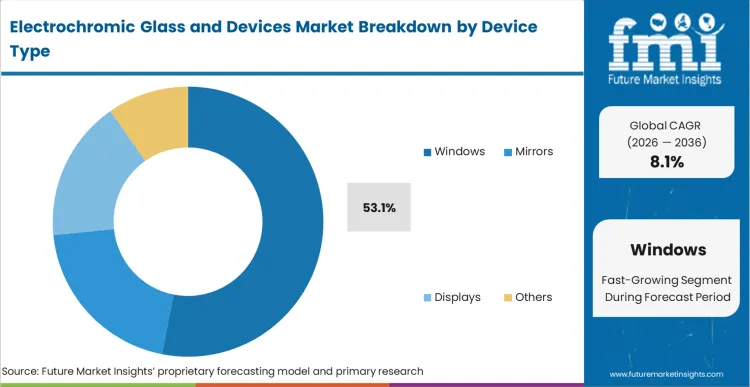
Displacement of traditional mechanical louvers by electronically tintable windows represents a fundamental shift in how architects approach the building envelope. Rather than adding external hardware that requires maintenance and affects the building’s silhouette, developers are now embedding functionality directly into the frameless structural glass balustrade and window assemblies. FMI analysts opine that the 53.1% share held by windows is sustained by the high square-footage requirements of commercial office towers where daylighting is a primary design goal. This segment thrives because it resolves the paradox of wanting floor-to-ceiling glass while needing to control the extreme solar heat gain associated with such designs.
- Automated Response: Integrated sensors allow windows to clear or tint based on sun position, ensuring that interior work environments remain glare-free without manual intervention.
- HVAC Decoupling: Large-scale window installations reduce the peak thermal load on a building, allowing for the specification of smaller, more efficient central cooling plants during construction.
- Maintenance Reduction: By eliminating interior dust-collecting blinds or exterior mechanical fins, facility managers reduce long-term cleaning and repair costs across the building lifecycle.
Electrochromic Glass and Devices Market Analysis by Application
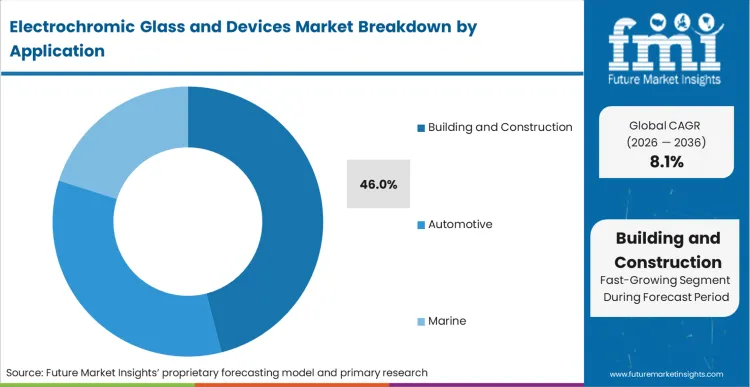
The structural reason building and construction dominates at 46.0% share is the massive surface area involved in modern urban architecture. Procurement directors at global real estate firms are no longer evaluating pdlc film for building or electrochromic glass as an optional upgrade; it is becoming a mandatory tool for achieving "Class A" office ratings. Based on FMI's projections, the integration of these devices into smart windows is driven by the need to maximize leasable floor space near the perimeter of the building, which is often unusable in static-glass structures due to intense afternoon glare and heat.
- Real Estate Valuation: Buildings equipped with adaptive glazing command higher rent premiums due to improved thermal comfort and the "prestige" factor of smart building technology.
- Code Compliance: As urban centers adopt "Zero Carbon" targets, dynamic glazing becomes one of the few viable pathways for meeting strict total-building-energy-consumption limits.
- Occupant Productivity: Maximizing natural light while controlling glare has been shown to improve tenant retention and employee performance, creating a direct economic incentive for developers.
Electrochromic Glass and Devices Market Drivers, Restraints, and Opportunities
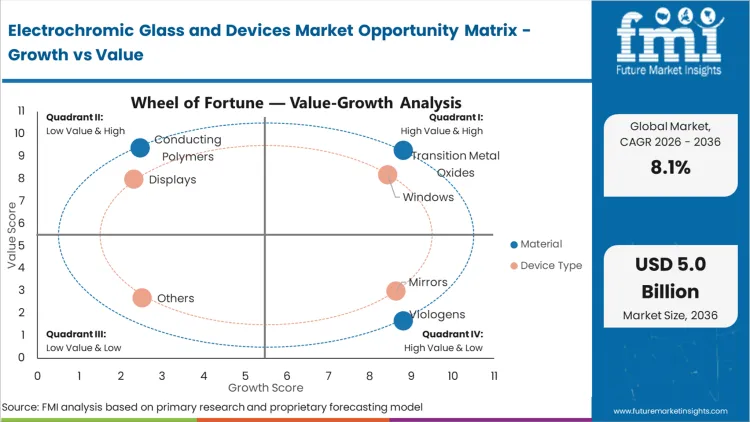
The primary structural driver is the global convergence of building energy codes that penalize static glazing in high-sunlight regions. This forcing condition leaves developers with a choice: reduce the total glass area or adopt dynamic modulation. As procurement leads at institutional investment firms increasingly prioritize ESG metrics, the "energy penalty" of traditional glass becomes a commercial liability. This ensures that demand is not driven by aesthetic preference but by a structural requirement to lower the operational carbon footprint of commercial assets.
The most significant restraint is the high upfront installation cost compared to standard insulated glass units. This friction is not merely the price of the glass, but the organizational complexity of coordinating between glazing contractors and electrical teams during the installation of pdlc film or electrochromic wiring. This "skills gap" in the traditional construction labor force creates a structural bottleneck, where adoption is slowed not by a lack of buyer interest, but by the lack of qualified installers who can commission complex, networked façade systems.
Opportunities in the Electrochromic Glass and Devices Market
- Retrofit Glazing: Emerging thin-film technologies that can be applied to existing window units allow building owners to upgrade performance without a full façade replacement.
- Health-Centric Design: Hospitals and educational institutions represent a growing buyer type seeking to use dynamic light control to regulate circadian rhythms and improve recovery times.
- Transparent Displays: The integration of multi-screen super glass with electrochromic layers opens opportunities for retail signage that can switch from transparent to high-contrast opaque display states.
Regional Analysis
Based on the regional analysis, the Electrochromic Glass and Devices market is segmented into North America, Latin America, Europe, East Asia, South Asia, Oceania, and Middle East & Africa across 40 plus countries.
.webp "Top Country Growth Comparison Electrochromic Glass And Devices Market Cagr (2026 2036)")
| Country | CAGR (2026 to 2036) |
|---|---|
| China | 9.4% |
| India | 9.1% |
| South Korea | 8.8% |
| Japan | 8.5% |
| Germany | 7.9% |
| USA | 7.7% |
| UK | 7.3% |
Source: Future Market Insights (FMI) analysis, based on proprietary forecasting model and primary research
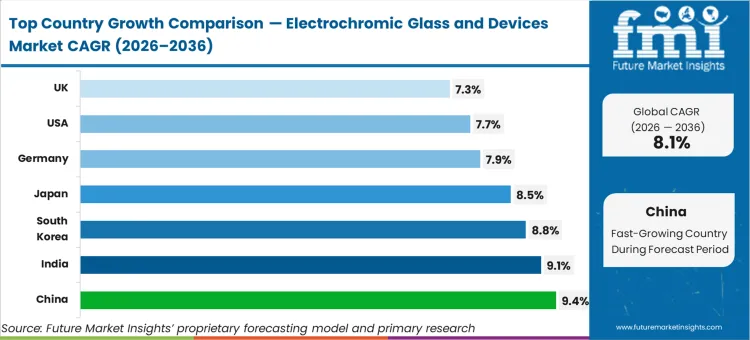
Asia Pacific Electrochromic Glass and Devices Market Analysis
Asia Pacific serves as the global production and adoption engine, where infrastructure-led growth dictates the pace of the market. The region’s dominance is anchored to the concentration of glass manufacturing giants and a relentless urban development pace in China and India. FMI analysts note that the structural lens here is one of "smart city" integration, where electrochromic devices are treated as a foundational layer of the digital urban fabric. This region is also the primary beneficiary of the apac flexible glass supply chain, allowing for the development of curved and specialty electrochromic forms.
- China: China’s state-backed energy efficiency mandates force developers to prioritize high-performance envelopes, resulting in a 9.4% compound annual rate through 2036. The scale of new commercial construction allows Chinese manufacturers to achieve economies of scale that are currently unattainable in Western markets. Commercial developers who adopt these systems early capture a "green premium" in the competitive Shanghai and Beijing office markets.
- India: India's rapid expansion of Grade-A office space in technology hubs sustains a 9.1% CAGR to 2036. The structural driver is the extreme cooling load in tropical urban centers, making dynamic glass a functional necessity rather than a design choice. Developers who delay adoption face significantly higher long-term energy costs as the local power grid pricing fluctuates.
- Japan: Japan’s trajectory is defined by its 8.5% annual expansion, anchored to its status as a global hub for specialty auto glass moldings and mirror technologies. The focus here is on high-precision devices for the automotive and aerospace sectors rather than bulk architectural volume. This positions Japanese firms as the primary providers of high-reliability components for global transportation OEMs.
FMI's report includes additional coverage of emerging markets in Southeast Asia and Oceania. These markets are increasingly adopting Australian building standards that favor high-performance glazing in coastal urban developments.
Europe Electrochromic Glass and Devices Market Analysis
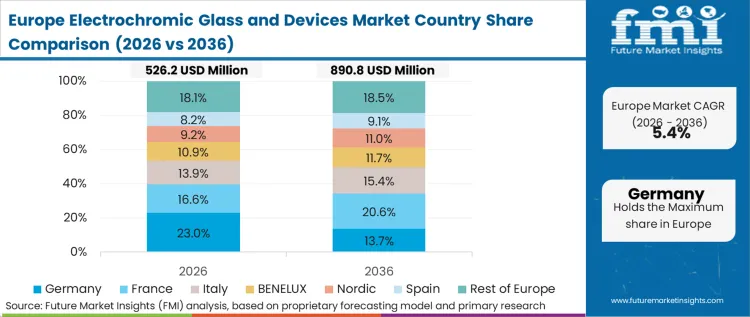
Europe is a policy-led market where the adoption curve is dictated by the European Green Deal and the EPBD recast. The structural dynamic is focused on "Deep Renovation" rather than new construction, as the region’s building stock is relatively mature. FMI analyst assessment suggests that the market is currently in a transition phase where architectural flat glass retrofits are becoming the primary driver for electrochromic demand.
- Germany: The German market's rigorous "Passive House" standards and industrial glass expertise drive a 7.9% compound growth over the forecast period. The structural condition is the high cost of energy and a cultural preference for engineering-led solutions, making the ROI of smart windows highly transparent. Building owners who invest now capture a permanent hedge against future energy price volatility.
- United Kingdom: The UK's focus on high-value London office retrofits supports a 7.3% annual growth to 2036. Sourcing directors in the UK often operate under strict heritage building constraints, where electrochromic glass provides a way to improve performance without altering the external façade of historic structures. Practitioners find that the technology is particularly effective in resolving overheating issues in glass-heavy modern additions.
North America Electrochromic Glass and Devices Market Analysis
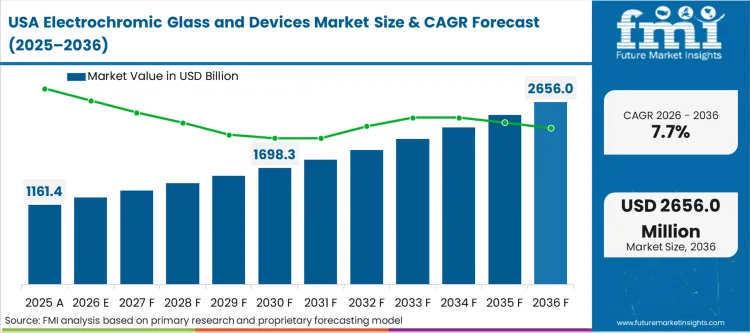
North America operates under a buyer-behavior-led lens, where adoption is driven by large corporate owner-occupiers (such as big tech firms) who use smart glazing to improve workplace wellness. The market is maturing through federal incentives that subsidize the initial cost of energy-saving building materials.
- USA: The United States' 7.7% annual growth is sustained by a combination of the Inflation Reduction Act’s tax credits and a surge in institutional infrastructure spending. Educational and healthcare facility managers are the primary buyers, using dynamic tinting to create better healing and learning environments. Companies that move first in the healthcare sector capture preferred vendor status in massive multi-year hospital expansion programs.
Competitive Aligners for Market Players
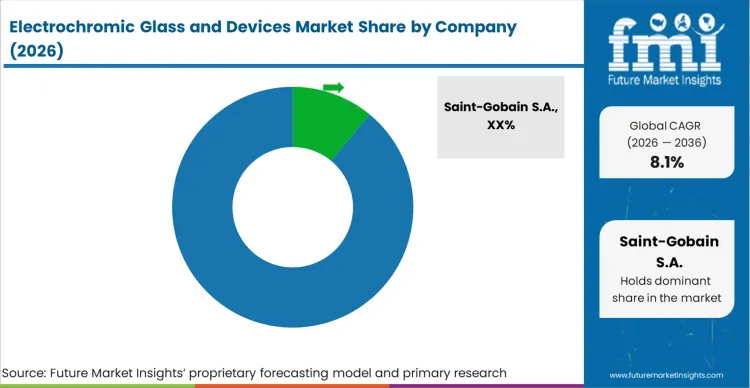
The competitive structure of the electrochromic glass and devices market is moderately concentrated, driven by the immense capital requirements of industrial-scale thin-film deposition. Buyers do not select vendors based on a catalog of features; they choose based on verifiable yield rates and long-term ion-stability data. Leading firms like Saint-Gobain and Gentex maintain their position by owning the entire vertical stack, from chemical formulation to the electronic control logic. This verticality is a structural defense against smaller challengers who must rely on third-party integrators, often resulting in higher failure rates during the commissioning phase.
Challengers entering the space find that they must build more than just a coating capability; they must establish a robust field-engineering team to support onsite installation. Incumbents have spent decades refining the "seal integrity" of their laminated units, a structural advantage that is difficult to replicate through materials science alone. As the market moves toward 2036, we are seeing a shift where glass majors are acquiring specialized electronics firms to ensure their smart glass systems are compatible with the latest building management protocols.
Buyer power is gradually increasing as the number of qualified manufacturers grows, forcing vendors to compete on "total cost of ownership" rather than just unit price. Large-scale tech firms and airport authorities are now demanding ten-year performance guarantees that include the control software uptime, not just the glass tinting. This tension between vendor incentives for recurring service revenue and buyer preferences for "install and forget" hardware will define the competitive landscape through the end of the decade.
Key Players in Electrochromic Glass and Devices Market
- Saint-Gobain S.A.
- Gentex Corporation
- View, Inc.
- Chromogenics AB
- Halio Inc.
- AGC Inc.
- Nippon Sheet Glass Co., Ltd.
- Corning Incorporated
- Pleotint, LLC
- Smartglass International Limited
- Kinestral Technologies, Inc.
Scope of the Report
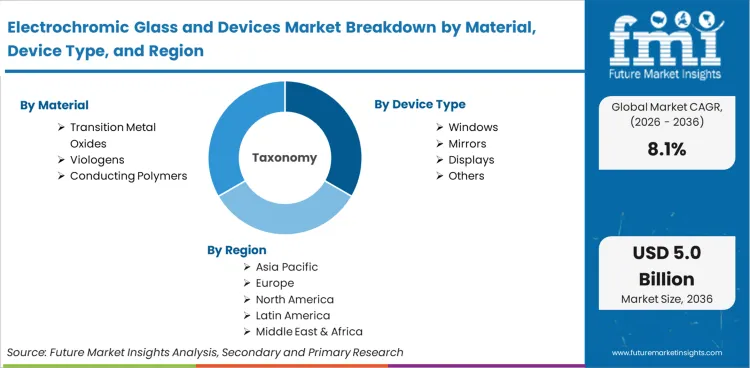
| Metric | Value |
|---|---|
| Quantitative Units | USD 2.3 billion to USD 4.7 billion, at a CAGR of 8.1% |
| Market Definition | Electronically controlled glazing and optical devices that utilize reversible electrochemical reactions to modulate light and heat transmission across architectural and transport applications. |
| Material Segmentation | Transition Metal Oxides, Viologens, Conducting Polymers, Nanocrystal-Based Materials |
| Device Type Segmentation | Windows, Mirrors, Displays, Others |
| Application Segmentation | Automotive, Building and Construction/Smart Windows, Aerospace, Marine, Consumer Electronics, Others |
| Regions Covered | North America, Europe, Asia Pacific, Rest of the World |
| Countries Covered | USA, Germany, France, UK, China, India, Japan, South Korea, and 40 plus countries |
| Key Companies Profiled | Saint-Gobain S.A., Gentex Corporation, View, Inc., Chromogenics AB, Halio Inc., AGC Inc., Nippon Sheet Glass Co., Ltd., Corning Incorporated, Pleotint, LLC, Smartglass International Limited, Kinestral Technologies, Inc. |
| Forecast Period | 2026 to 2036 |
| Approach | Bottom-up analysis of square-footage capacity combined with top-down evaluation of building energy code impacts, validated through interviews with façade engineers and automotive leads. |
Source: Future Market Insights (FMI) analysis, based on proprietary forecasting model and primary research
Electrochromic Glass and Devices Market Analysis by Segments
Material:
- Transition Metal Oxides
- Viologens
- Conducting Polymers
- Nanocrystal-Based Materials
Device Type:
- Windows
- Mirrors
- Displays
- Others
Application:
- Automotive
- Building and Construction/Smart Windows
- Aerospace
- Marine
- Consumer Electronics
- Others
Region:
- North America
- Europe
- Asia-Pacific
- Rest of the World
- Latin America
- Middle East, and Africa
Bibliography
- European Union. (2024, April 24). Directive (EU) 2024/1275 of the European Parliament and of the Council on the energy performance of buildings (recast). EUR-Lex.
- USA Department of Energy. (2024). Low-cost dynamic glazing with custom colors.
- International Energy Agency. (2025). Innovation gaps: Buildings.
- United Nations Economic Commission for Europe. (2024). UN Regulation No. 46: Devices for indirect vision (Revision 7).
- UK Parliament. (2024). Automated Vehicles Act 2024.
- Department of Science and Technology, Government of India. (2024, October 26). Innovative and affordable self-powered smart windows developed by Bengaluru researchers.
This bibliography is provided for reader reference. The full FMI report contains the complete reference list with primary source documentation.
Frequently Asked Questions
How large is the electrochromic glass and devices market in 2026?
The market is estimated to reach USD 2.3 billion in 2026. This figure signals the transition from pilot installations to standardized procurement in Grade-A commercial developments.
What will it be valued at by 2036?
It is projected to reach USD 4.7 billion by 2036. This growth represents the widespread absorption of dynamic glazing into standard building envelopes as static glazing becomes a liability under future energy codes.
What CAGR is projected?
A CAGR of 8.1% is expected between 2026 and 2036. This rate reflects the multi-year cycle of construction planning and the gradual lowering of manufacturing cost barriers for large-format glass.
Which material segment leads?
Transition metal oxides lead with a 50.2% share in 2026. This leadership is driven by the material's inherent UV stability and its ability to be fabricated using the same high-volume sputtering infrastructure as standard high-performance coatings.
Which device type leads?
Electrochromic windows lead the market with a 53.1% share. This is because architectural glazing represents the largest cumulative surface area requiring dynamic solar control to meet building performance targets.
Which application leads?
Building and construction applications lead, accounting for 46.0% of demand. This segment leads because the "energy penalty" for inefficient cooling is highest in the commercial office and institutional building sectors.
What drives rapid growth?
Growth is driven by the structural requirement to reduce HVAC cooling loads in glass-heavy urban architecture. As cities adopt net-zero targets, dynamic glass becomes a mandatory technology for developers to achieve building certification.
What is the primary restraint?
The primary restraint is the "skills gap" between traditional glazing installation and the electrical commissioning required for networked smart glass. This organizational friction often slows adoption more than the technology's cost itself.
Which country grows fastest?
China grows the fastest at 9.4% CAGR. Compared to India's 9.1%, China’s growth is anchored to a more mature state-backed infrastructure program that mandate smart-city technologies in all new government-funded construction.
How does the "Inflection Point" affect the 10-year forecast?
Growth is expected to accelerate toward the middle of the decade as manufacturing scale reduces the price premium. Once the cost of the glass is offset by the savings in smaller HVAC equipment, adoption becomes a default economic decision.
Why is vertical integration critical for competitive success?
Companies that control both the thin-film chemistry and the control electronics offer lower risk to buyers. Failure in smart glass often occurs at the integration layer, making "one-stop" system providers more attractive to large-scale contractors.
What is the role of the "Retrofit" market in the 2036 end-state?
By 2036, we expect a significant portion of demand to come from "peel-and-stick" or secondary glazing retrofits. This allows existing buildings to meet new efficiency standards without the cost of full structural glass replacement.
Preview the report firsthand - request a free sample
Get SampleGet the brochure for pricing and purchase details.
Get PDFTable of Content
- Executive Summary
- Global Market Outlook
- Demand-side Trends
- Supply-side Trends
- Technology Roadmap Analysis
- Analysis and Recommendations
- Market Overview
- Market Coverage / Taxonomy
- Market Definition / Scope / Limitations
- Research Methodology
- Chapter Orientation
- Analytical Lens and Working Hypotheses
- Market Structure, Signals, and Trend Drivers
- Benchmarking and Cross-market Comparability
- Market Sizing, Forecasting, and Opportunity Mapping
- Research Design and Evidence Framework
- Desk Research Programme (Secondary Evidence)
- Company Annual and Sustainability Reports
- Peer-reviewed Journals and Academic Literature
- Corporate Websites, Product Literature, and Technical Notes
- Earnings Decks and Investor Briefings
- Statutory Filings and Regulatory Disclosures
- Technical White Papers and Standards Notes
- Trade Journals, Industry Magazines, and Analyst Briefs
- Conference Proceedings, Webinars, and Seminar Materials
- Government Statistics Portals and Public Data Releases
- Press Releases and Reputable Media Coverage
- Specialist Newsletters and Curated Briefings
- Sector Databases and Reference Repositories
- FMI Internal Proprietary Databases and Historical Market Datasets
- Subscription Datasets and Paid Sources
- Social Channels, Communities, and Digital Listening Inputs
- Additional Desk Sources
- Expert Input and Fieldwork (Primary Evidence)
- Primary Modes
- Qualitative Interviews and Expert Elicitation
- Quantitative Surveys and Structured Data Capture
- Blended Approach
- Why Primary Evidence is Used
- Field Techniques
- Interviews
- Surveys
- Focus Groups
- Observational and In-context Research
- Social and Community Interactions
- Stakeholder Universe Engaged
- C-suite Leaders
- Board Members
- Presidents and Vice Presidents
- R&D and Innovation Heads
- Technical Specialists
- Domain Subject-matter Experts
- Scientists
- Physicians and Other Healthcare Professionals
- Governance, Ethics, and Data Stewardship
- Research Ethics
- Data Integrity and Handling
- Primary Modes
- Tooling, Models, and Reference Databases
- Desk Research Programme (Secondary Evidence)
- Data Engineering and Model Build
- Data Acquisition and Ingestion
- Cleaning, Normalisation, and Verification
- Synthesis, Triangulation, and Analysis
- Quality Assurance and Audit Trail
- Market Background
- Market Dynamics
- Drivers
- Restraints
- Opportunity
- Trends
- Scenario Forecast
- Demand in Optimistic Scenario
- Demand in Likely Scenario
- Demand in Conservative Scenario
- Opportunity Map Analysis
- Product Life Cycle Analysis
- Supply Chain Analysis
- Investment Feasibility Matrix
- Value Chain Analysis
- PESTLE and Porter’s Analysis
- Regulatory Landscape
- Regional Parent Market Outlook
- Production and Consumption Statistics
- Import and Export Statistics
- Market Dynamics
- Global Market Analysis 2021 to 2025 and Forecast, 2026 to 2036
- Historical Market Size Value (USD Million) Analysis, 2021 to 2025
- Current and Future Market Size Value (USD Million) Projections, 2026 to 2036
- Y-o-Y Growth Trend Analysis
- Absolute $ Opportunity Analysis
- Global Market Pricing Analysis 2021 to 2025 and Forecast 2026 to 2036
- Global Market Analysis 2021 to 2025 and Forecast 2026 to 2036, By Material
- Introduction / Key Findings
- Historical Market Size Value (USD Million) Analysis By Material , 2021 to 2025
- Current and Future Market Size Value (USD Million) Analysis and Forecast By Material , 2026 to 2036
- Transition Metal Oxides
- Viologens
- Conducting Polymers
- Transition Metal Oxides
- Y-o-Y Growth Trend Analysis By Material , 2021 to 2025
- Absolute $ Opportunity Analysis By Material , 2026 to 2036
- Global Market Analysis 2021 to 2025 and Forecast 2026 to 2036, By Device Type
- Introduction / Key Findings
- Historical Market Size Value (USD Million) Analysis By Device Type, 2021 to 2025
- Current and Future Market Size Value (USD Million) Analysis and Forecast By Device Type, 2026 to 2036
- Windows
- Mirrors
- Displays
- Others
- Windows
- Y-o-Y Growth Trend Analysis By Device Type, 2021 to 2025
- Absolute $ Opportunity Analysis By Device Type, 2026 to 2036
- Global Market Analysis 2021 to 2025 and Forecast 2026 to 2036, By Application
- Introduction / Key Findings
- Historical Market Size Value (USD Million) Analysis By Application, 2021 to 2025
- Current and Future Market Size Value (USD Million) Analysis and Forecast By Application, 2026 to 2036
- Building and Construction
- Automotive
- Marine
- Building and Construction
- Y-o-Y Growth Trend Analysis By Application, 2021 to 2025
- Absolute $ Opportunity Analysis By Application, 2026 to 2036
- Global Market Analysis 2021 to 2025 and Forecast 2026 to 2036, By Region
- Introduction
- Historical Market Size Value (USD Million) Analysis By Region, 2021 to 2025
- Current Market Size Value (USD Million) Analysis and Forecast By Region, 2026 to 2036
- North America
- Latin America
- Western Europe
- Eastern Europe
- East Asia
- South Asia and Pacific
- Middle East & Africa
- Market Attractiveness Analysis By Region
- North America Market Analysis 2021 to 2025 and Forecast 2026 to 2036, By Country
- Historical Market Size Value (USD Million) Trend Analysis By Market Taxonomy, 2021 to 2025
- Market Size Value (USD Million) Forecast By Market Taxonomy, 2026 to 2036
- By Country
- USA
- Canada
- Mexico
- By Material
- By Device Type
- By Application
- By Country
- Market Attractiveness Analysis
- By Country
- By Material
- By Device Type
- By Application
- Key Takeaways
- Latin America Market Analysis 2021 to 2025 and Forecast 2026 to 2036, By Country
- Historical Market Size Value (USD Million) Trend Analysis By Market Taxonomy, 2021 to 2025
- Market Size Value (USD Million) Forecast By Market Taxonomy, 2026 to 2036
- By Country
- Brazil
- Chile
- Rest of Latin America
- By Material
- By Device Type
- By Application
- By Country
- Market Attractiveness Analysis
- By Country
- By Material
- By Device Type
- By Application
- Key Takeaways
- Western Europe Market Analysis 2021 to 2025 and Forecast 2026 to 2036, By Country
- Historical Market Size Value (USD Million) Trend Analysis By Market Taxonomy, 2021 to 2025
- Market Size Value (USD Million) Forecast By Market Taxonomy, 2026 to 2036
- By Country
- Germany
- UK
- Italy
- Spain
- France
- Nordic
- BENELUX
- Rest of Western Europe
- By Material
- By Device Type
- By Application
- By Country
- Market Attractiveness Analysis
- By Country
- By Material
- By Device Type
- By Application
- Key Takeaways
- Eastern Europe Market Analysis 2021 to 2025 and Forecast 2026 to 2036, By Country
- Historical Market Size Value (USD Million) Trend Analysis By Market Taxonomy, 2021 to 2025
- Market Size Value (USD Million) Forecast By Market Taxonomy, 2026 to 2036
- By Country
- Russia
- Poland
- Hungary
- Balkan & Baltic
- Rest of Eastern Europe
- By Material
- By Device Type
- By Application
- By Country
- Market Attractiveness Analysis
- By Country
- By Material
- By Device Type
- By Application
- Key Takeaways
- East Asia Market Analysis 2021 to 2025 and Forecast 2026 to 2036, By Country
- Historical Market Size Value (USD Million) Trend Analysis By Market Taxonomy, 2021 to 2025
- Market Size Value (USD Million) Forecast By Market Taxonomy, 2026 to 2036
- By Country
- China
- Japan
- South Korea
- By Material
- By Device Type
- By Application
- By Country
- Market Attractiveness Analysis
- By Country
- By Material
- By Device Type
- By Application
- Key Takeaways
- South Asia and Pacific Market Analysis 2021 to 2025 and Forecast 2026 to 2036, By Country
- Historical Market Size Value (USD Million) Trend Analysis By Market Taxonomy, 2021 to 2025
- Market Size Value (USD Million) Forecast By Market Taxonomy, 2026 to 2036
- By Country
- India
- ASEAN
- Australia & New Zealand
- Rest of South Asia and Pacific
- By Material
- By Device Type
- By Application
- By Country
- Market Attractiveness Analysis
- By Country
- By Material
- By Device Type
- By Application
- Key Takeaways
- Middle East & Africa Market Analysis 2021 to 2025 and Forecast 2026 to 2036, By Country
- Historical Market Size Value (USD Million) Trend Analysis By Market Taxonomy, 2021 to 2025
- Market Size Value (USD Million) Forecast By Market Taxonomy, 2026 to 2036
- By Country
- Kingdom of Saudi Arabia
- Other GCC Countries
- Turkiye
- South Africa
- Other African Union
- Rest of Middle East & Africa
- By Material
- By Device Type
- By Application
- By Country
- Market Attractiveness Analysis
- By Country
- By Material
- By Device Type
- By Application
- Key Takeaways
- Key Countries Market Analysis
- USA
- Pricing Analysis
- Market Share Analysis, 2025
- By Material
- By Device Type
- By Application
- Canada
- Pricing Analysis
- Market Share Analysis, 2025
- By Material
- By Device Type
- By Application
- Mexico
- Pricing Analysis
- Market Share Analysis, 2025
- By Material
- By Device Type
- By Application
- Brazil
- Pricing Analysis
- Market Share Analysis, 2025
- By Material
- By Device Type
- By Application
- Chile
- Pricing Analysis
- Market Share Analysis, 2025
- By Material
- By Device Type
- By Application
- Germany
- Pricing Analysis
- Market Share Analysis, 2025
- By Material
- By Device Type
- By Application
- UK
- Pricing Analysis
- Market Share Analysis, 2025
- By Material
- By Device Type
- By Application
- Italy
- Pricing Analysis
- Market Share Analysis, 2025
- By Material
- By Device Type
- By Application
- Spain
- Pricing Analysis
- Market Share Analysis, 2025
- By Material
- By Device Type
- By Application
- France
- Pricing Analysis
- Market Share Analysis, 2025
- By Material
- By Device Type
- By Application
- India
- Pricing Analysis
- Market Share Analysis, 2025
- By Material
- By Device Type
- By Application
- ASEAN
- Pricing Analysis
- Market Share Analysis, 2025
- By Material
- By Device Type
- By Application
- Australia & New Zealand
- Pricing Analysis
- Market Share Analysis, 2025
- By Material
- By Device Type
- By Application
- China
- Pricing Analysis
- Market Share Analysis, 2025
- By Material
- By Device Type
- By Application
- Japan
- Pricing Analysis
- Market Share Analysis, 2025
- By Material
- By Device Type
- By Application
- South Korea
- Pricing Analysis
- Market Share Analysis, 2025
- By Material
- By Device Type
- By Application
- Russia
- Pricing Analysis
- Market Share Analysis, 2025
- By Material
- By Device Type
- By Application
- Poland
- Pricing Analysis
- Market Share Analysis, 2025
- By Material
- By Device Type
- By Application
- Hungary
- Pricing Analysis
- Market Share Analysis, 2025
- By Material
- By Device Type
- By Application
- Kingdom of Saudi Arabia
- Pricing Analysis
- Market Share Analysis, 2025
- By Material
- By Device Type
- By Application
- Turkiye
- Pricing Analysis
- Market Share Analysis, 2025
- By Material
- By Device Type
- By Application
- South Africa
- Pricing Analysis
- Market Share Analysis, 2025
- By Material
- By Device Type
- By Application
- USA
- Market Structure Analysis
- Competition Dashboard
- Competition Benchmarking
- Market Share Analysis of Top Players
- By Regional
- By Material
- By Device Type
- By Application
- Competition Analysis
- Competition Deep Dive
- Saint-Gobain S.A.
- Overview
- Product Portfolio
- Profitability by Market Segments (Product/Age /Sales Channel/Region)
- Sales Footprint
- Strategy Overview
- Marketing Strategy
- Product Strategy
- Channel Strategy
- Gentex Corporation
- View, Inc.
- Chromogenics AB
- Halio Inc.
- AGC Inc.
- Nippon Sheet Glass Co., Ltd.
- Saint-Gobain S.A.
- Competition Deep Dive
- Assumptions & Acronyms Used


