

- Industry Size (2026)
- USD 1.1 Bn
- Forecast (2036)
- USD 2.8 Bn
- CAGR (2026 to 2036)
- 9.8%
Asia Pacific Flexible Glass Market Forecast and Outlook 2026 to 2036
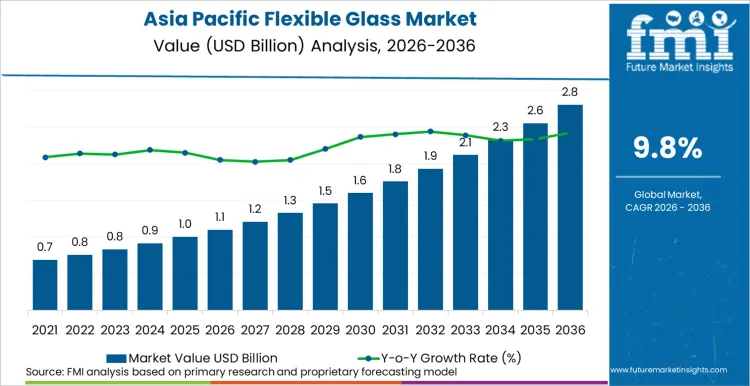
The Asia Pacific flexible glass market is projected to expand from USD 1.1 billion in 2026 to USD 2.8 billion by 2036, registering a 9.8% CAGR over the forecast period. Growth is anchored in foldable and flexible OLED scale-up across China, South Korea, and Japan, where glass suppliers are being qualified against repeatable folding endurance and process yield stability demanded by panel makers and device OEMs.
Supplier investment is converging on ultra-thin cover glass and handling know-how that reduces breakage and micro-defect risk during lamination. SCHOTT positions ultra-thin flexible cover glass as a platform built around foldable durability requirements, with its product leadership emphasizing that foldables moved the category from niche substrates to a high-volume reliability spec. Dr Feng He, SCHOTT Product Manager, stated: ‘With Xensation Flex, SCHOTT is offering ultra-thin glass with exceptional bending performance, enabling durable and scratch-resistant foldable and bendable devices’.
Device qualification signals are tightening around fold-cycle durability as a buying gate. Samsung Display’s verification work with Bureau Veritas frames a 200,000-fold endurance benchmark as a practical reference point for foldable OLED durability testing. Samsung Display EVP Hojung Lee stated: ‘We have proven the outstanding durability of Samsung OLED at a global level, and we will continue to strengthen consumer confidence in OLED by enhancing our collaboration with certified organizations’.
In parallel, Japanese glass suppliers are linking ultra-thin glass to mainstream foldable programs shipped in the region. Nippon Electric Glass disclosed that its DINOREX UTG was adopted in Xiaomi’s MIX Fold 3 and reported 200,000-fold performance with a 1.5mm bending radius for the applied UTG, showing how device programs are pulling glass specs into standardized endurance thresholds. The compliance layer remains non-negotiable for regional electronics supply chains, where substance controls shape coating chemistries and auxiliary materials used in display module stacks, including Japan’s CSCL governance of chemical substances and South Korea’s K-REACH framework that governs registration and evaluation duties for chemicals used in industrial products.
Summary of Asia Pacific Flexible Glass Market
- The Asia Pacific flexible glass market comprises ultra-thin glass substrates and flexible cover glass used in foldable and bendable display stacks, including chemically strengthened UTG and thin flexible glass used with coatings and lamination films in device modules.
- The defined scope is structured under FMI taxonomy across product form, application, and country, excluding plastic-only cover films marketed as glass substitutes and excluding capital equipment revenue for glass melting, float lines, or display fabs.
- The Asia Pacific flexible glass market is projected to grow at a CAGR of 9.8% from 2026 to 2036, expanding from USD 1.1 billion in 2026 to USD 2.8 billion by 2036, reflecting device-led pull-through from foldables, flexible OLED capacity additions, and higher-spec endurance requirements for cover materials.
- The sector is transitioning toward endurance-qualified UTG programs aligned to fold-cycle benchmarks and validated by certified testing partners, tightening qualification cycles for suppliers and raising the value of repeatable yield and defect control.
- Competition is shaped by materials incumbents and specialty glass suppliers that can deliver thinness, bending performance, and stable module handling at scale, supported by OEM validation cycles and multi-year supply frameworks with panel makers.
- China retains the largest regional value share through its scale in flexible AMOLED investment and device assembly ecosystems, while South Korea remains a specification leader through global foldable OLED supply and durability-led qualification practices.
Asia Pacific flexible glass Market Key Takeaways
| Metric | Value |
|---|---|
| Market Size (2026) | USD 1.1 Billion |
| Forecast Value (2036) | USD 2.8 Billion |
| CAGR (2026 to 2036) | 9.8% |
What factors are propelling adoption of Asia Pacific flexible glass?
Foldable OLED scaling in Asia Pacific is converting flexible glass from an engineering option into a procurement requirement, since panel makers and OEMs are tying supplier qualification to repeatable fold endurance and verified durability thresholds. Samsung Display’s certified durability framing around 200,000-fold performance is pushing device brands to specify endurance gates that flow directly into cover glass and UTG selection. On the supply side, Nippon Electric Glass linking DINOREX UTG adoption to Xiaomi’s foldable program tightens the commercial pathway for UTG by tying glass selection to a shipped, named device platform and disclosed fold-cycle performance. China’s flexible AMOLED and high-generation OLED investment cycle, including BOE’s disclosed AMOLED capacity buildout, expands the addressable substrate pull-through by raising the installed base of flexible panels assembled in-region.
How is the Asia Pacific flexible glass market segmented?
The market is segmented by application into consumer electronics, automotive displays, and industrial applications, reflecting how bending-cycle requirements, optical clarity thresholds, and module integration constraints differ by end-use environment and qualification owner.
Why does consumer electronics retain leadership at 68.0% share?
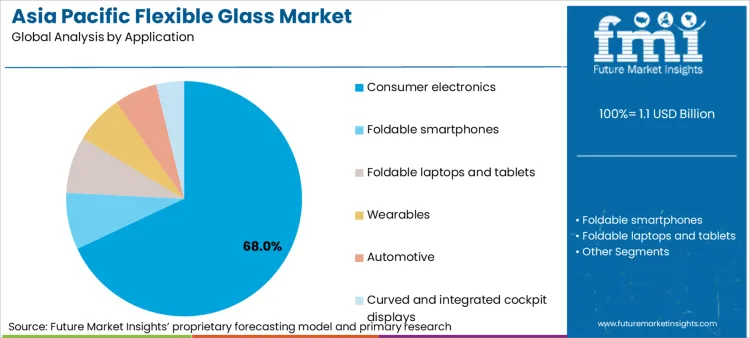
Consumer electronics leads with a 68.0% share because foldable phones and foldable OLED form factors impose the highest-volume, fastest-refresh qualification cycle in the region, forcing UTG and flexible cover glass to be engineered as a repeatable platform rather than a one-off material. Samsung Display’s durability signalling through certified testing partners codifies fold endurance as a buyer gate, raising the value of suppliers that can meet endurance targets while keeping yield stable in lamination and handling. Nippon Electric Glass’ disclosure that DINOREX UTG was adopted in Xiaomi’s MIX Fold 3, with stated 200,000-fold durability and a 1.5mm bending radius for the applied UTG, demonstrates that leading OEM programs are translating endurance and bend radius into named, shipped device requirements, reinforcing scale demand for qualified flexible glass in the smartphone supply chain. China’s scale effect strengthens the segment’s dominance because major panel and device ecosystems are adding flexible AMOLED capacity and expanding downstream assembly options, reducing time-to-scale once a material is qualified. BOE’s disclosed AMOLED manufacturing buildout is a structural signal that flexible displays remain a capex priority, sustaining long-run substrate demand visibility for glass suppliers that can support high-volume quality control.
Why is automotive flexible display adoption expanding from an 18.0% base?
Automotive holds an 18.0% share because cockpit display redesign is moving toward curved and integrated surfaces where optical clarity, scratch resistance, and long-life stability are valued more than extreme bend radius, creating a second demand pool distinct from foldable phones. The segment grows as cockpit architectures consolidate screens into larger continuous surfaces and suppliers industrialize display module reliability under thermal and vibration constraints. AUO’s disclosed smart cockpit direction, with emphasis on integrating displays and interaction surfaces for automotive use cases, reflects how display makers are treating automotive as a premium, multi-year platform category rather than a spillover channel from consumer devices. Japan’s display ecosystem is also aligning toward automotive electronics integration via corporate platform moves. Japan Display’s establishment of an AutoTech company and the framing of automotive as a focus area indicates a structural shift in how Japanese display and materials ecosystems position for in-vehicle demand, which supports flexible and thin glass adoption where durability and optical performance are procurement priorities. As automotive qualification cycles are longer, suppliers that can demonstrate stable durability and supply continuity capture share, supporting sustained CAGR performance from a smaller base.
Why do industrial applications stay niche at 14.0% share despite high value specs?
Industrial applications account for a 14.0% share because use cases are fragmented, qualification is application-owned, and volumes are lower, even when performance specifications are strict. The segment expands where flexible or ultra-thin glass enables form-factor integration without sacrificing surface hardness, chemical resistance, or optical stability, particularly in instrument interfaces, specialty equipment, and high-durability HMI surfaces. Supplier behavior signals the segment’s direction. SCHOTT’s positioning of ultra-thin flexible cover glass around bending performance and scratch resistance highlights that suppliers are building a platform that can spill beyond foldables into other device categories that value durability under repeated flex or handling. The limiting factor remains industrial integration complexity, since many environments require additional coatings, encapsulation, and tailored mechanical stacks that raise conversion cost and extend validation lead times. This keeps share contained while supporting premium pricing and selective adoption in high-spec niches.
What are the key trends and restraints in Asia Pacific flexible glass market?
A dominant trend is the institutionalisation of endurance and durability benchmarks into procurement gates, which tightens supplier selection to those that can validate fold-cycle performance and maintain yield at scale. Samsung Display’s collaboration with certified testing partners to validate durability performance is an example of how verification is shifting from internal lab claims to externally referenced benchmarks that procurement teams can standardise across programs. A second trend is supplier disclosure linking UTG to named foldable platforms, which reduces perceived adoption risk for downstream OEMs. Nippon Electric Glass explicitly tying DINOREX UTG to Xiaomi’s foldable program, with disclosed fold-cycle endurance and bend radius, reflects a market pattern where platform proof points drive faster qualification replication across device portfolios.
A core restraint is manufacturing yield and handling loss as glass thickness drops and bending requirements intensify, since micro-cracks and edge defects become conversion-cost multipliers across lamination, coating, and module assembly steps. The restraint is amplified by chemical compliance and material governance across Asia Pacific supply chains, where chemical registration and restricted substance frameworks constrain coating and adhesive choices used with flexible glass. Japan’s CSCL chemical governance and South Korea’s K-REACH obligations increase compliance work and can elongate qualification when new chemistries are introduced into module stacks.
Country-level outlook for Asia Pacific flexible glass market (2026 to 2036)
Growth rates differ across Asia Pacific because display capex intensity, foldable device mix, and materials qualification ecosystems vary by country. FMI projects China and South Korea to outpace Japan and Taiwan on volume-linked growth, while India grows from a smaller base through electronics manufacturing policy support and ecosystem buildout.
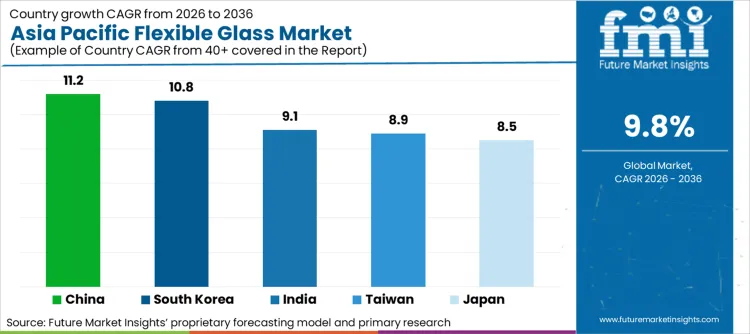
| Country | CAGR (2026 to 2036) |
|---|---|
| China | 11.2% |
| South Korea | 10.8% |
| Japan | 8.5% |
| Taiwan | 8.9% |
| India | 9.1% |
Source: Future Market Insights (FMI) analysis, based on proprietary forecasting model and primary research.
How does China deliver 11.2% CAGR through 2036?
China’s 11.2% CAGR is driven by the scale of its flexible AMOLED investment cycle and the breadth of its device assembly ecosystem, which compresses the time from material qualification to volume deployment. BOE’s disclosed buildout of AMOLED manufacturing capability, including expansion of flexible AMOLED lines and a high-generation AMOLED program, signals that panel makers are still allocating capex toward flexible displays that structurally pull through UTG and thin flexible cover materials. State-aligned industry narratives also indicate upstream localisation momentum in critical display materials and substrates, supporting domestic sourcing and faster iteration loops for glass suppliers operating near panel fabs. China’s foldable smartphone competition among domestic brands sustains rapid model refresh cycles, which increases the number of qualification events per year and raises aggregate demand for endurance-qualified glass solutions. Over 2026 to 2036, this combination of panel capacity, device churn, and supply proximity supports both volume growth and a shift toward higher-value glass programs tied to durability targets.
How does South Korea sustain 10.8% CAGR through 2036?
South Korea’s 10.8% CAGR is built on global leadership in foldable OLED supply and the country’s role as a specification setter for durability expectations that cascade into the region’s procurement standards. Samsung Display’s durability verification posture, framed through collaboration with Bureau Veritas and explicit executive emphasis on durability validation, strengthens South Korea’s influence over endurance benchmarks used by device OEMs sourcing flexible panels. This matters commercially because when Korean panel makers set durability references, the associated cover glass and UTG requirements become repeatable supplier scorecards for projects sold into global OEMs. South Korea also benefits from dense supplier clusters that support precision handling, coating, and lamination learning curves, which reduces yield loss and shortens corrective iteration cycles. Across 2026 to 2036, the market grows as Korean panel makers expand foldable penetration into additional device form factors, increasing the number of programs requiring certified durability and stable high-volume glass conversion.
How does Japan grow at 8.5% CAGR despite a smaller foldable device base?
Japan’s 8.5% CAGR is anchored in specialty materials capability and high-reliability validation pathways that favour premium, endurance-qualified glass programs rather than sheer volume. Nippon Electric Glass’ disclosure that DINOREX UTG was adopted in Xiaomi’s MIX Fold 3, with stated fold endurance and a defined bend radius for the applied UTG, demonstrates Japan’s ability to supply UTG programs that meet commercial device thresholds and compete in flagship platforms. Japan’s broader electronics and semiconductor revitalisation policy direction supports upstream investment into advanced electronics supply chains that sit adjacent to display materials demand, strengthening the ecosystem that enables precision glass processing and quality control. Over 2026 to 2036, Japan’s growth profile is shaped by its positioning in high-spec segments, including automotive electronics and premium devices, where procurement prioritises defect control, durability validation, and long-term supply continuity.
How does Taiwan achieve 8.9% CAGR through its display and electronics manufacturing role?
Taiwan’s 8.9% CAGR is driven by its continuing role in electronics manufacturing, display module integration, and the proximity between panel ecosystems and downstream device assembly that increases pull-through for thin and flexible cover materials. AUO’s publicly stated smart cockpit direction underscores Taiwan’s display ecosystem focus on higher-value display applications, including automotive, where long-life durability and optical stability raise the value of qualified cover materials and thin glass solutions. Taiwan’s position in global electronics supply chains also supports adoption via supplier qualification replication, since once a glass material is qualified for one platform, it can be scaled across contract manufacturing networks that serve multiple brands. Over 2026 to 2036, Taiwan benefits from mix upgrade toward premium applications that value thin, durable cover solutions, even if foldable phone volumes are led elsewhere in the region.
How does India reach 9.1% CAGR from a smaller base?
India’s 9.1% CAGR is supported by policy-driven electronics manufacturing expansion and the gradual buildout of domestic supply chains that reduce import friction for high-value components and materials used in display modules. The Ministry of Electronics and Information Technology’s Production Linked Incentive framework for large-scale electronics manufacturing is designed to accelerate incremental production and expand domestic value-add in electronics manufacturing, which increases the likelihood that more display module work and associated materials sourcing shift into India over the decade. As device assembly scales, procurement for display-related materials becomes more structured, improving the commercial pathway for flexible glass through local qualification capacity, handling standards, and supplier partnerships. India’s growth mechanism is not immediate substitution of China or Korea in UTG leadership, but base expansion in electronics manufacturing that creates new local demand pools for thin cover solutions, especially as foldable devices broaden from premium niches to mid-tier experimentation later in the forecast window.
What is shaping the competitive landscape in Asia Pacific flexible glass?
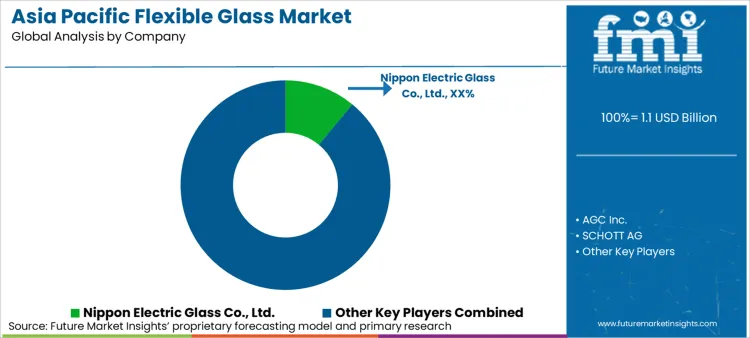
The competitive landscape is defined by materials incumbents and specialty glass suppliers that can convert ultra-thin glass into endurance-qualified programs, supported by repeatable yield control and device-platform validation. In scope are ultra-thin glass substrates and flexible cover glass used in foldable and bendable displays, including chemically strengthened UTG and flexible thin glass cover solutions. Out of scope are plastic-only cover films, rigid display cover glass that is not engineered for flex, and capital equipment sales for glass and display manufacturing.
Leadership is split between suppliers that can prove fold endurance in flagship platforms and those that can scale thin-glass conversion with stable defect rates. Japan’s Nippon Electric Glass strengthens competitive position through disclosed UTG adoption in a shipped foldable device platform, demonstrating commercial qualification at scale. Europe-based SCHOTT competes on ultra-thin flexible cover glass capability positioned for foldables, supplying a performance narrative that matters in Asia Pacific where panel makers and OEMs are setting endurance gates. South Korea influences standards and qualification through panel makers, with Samsung Display’s certified durability stance shaping expectations that suppliers must meet to win programs linked to Korean flexible OLED leadership. China’s scale effect is expressed through flexible AMOLED investment and localized supply chain buildout, increasing the advantage of suppliers that can support fast qualification replication across multiple domestic OEMs.
Recent developments
- In June 2023, Samsung Display announced that its foldable OLED panel durability was verified by Bureau Veritas, framing performance around a 200,000-fold benchmark.
- In August 2023, Nippon Electric Glass disclosed that its DINOREX UTG was adopted in Xiaomi’s MIX Fold 3 and disclosed 200,000-fold performance with a 1.5mm bending radius for the applied UTG.
- In 2020, SCHOTT introduced Xensation Flex as an ultra-thin flexible cover glass positioned for foldable and bendable device use cases.
Key Players
- Nippon Electric Glass Co., Ltd.
- AGC Inc.
- SCHOTT AG
- Corning Incorporated
- Taiwan Glass Industry Corporation
- Xinyi Glass Holdings Limited
- Asahi India Glass Limited (AIS)
- AvanStrate Inc. (NSG Group)
- China Luoyang Float Glass Group (CLFG)
- Tunghsu Optoelectronic Technology Co., Ltd.
What is the Market definition?
The Asia Pacific flexible glass market covers ultra-thin glass substrates and flexible cover glass engineered to withstand bending while maintaining optical transmission and surface durability for display module use. Products include UTG used as cover windows for foldable devices, flexible thin glass used in bendable display stacks, and chemically strengthened thin glass solutions that enable device curvature and folding endurance. The market is defined by functional requirements such as bending radius tolerance, fold-cycle durability, scratch resistance, and compatibility with coatings and lamination processes used in OLED and related display module assemblies across Asia Pacific.
Market inclusion
Included are ultra-thin flexible glass cover materials and substrates used in foldable and bendable displays, including chemically strengthened UTG, flexible thin cover glass, coated flexible glass products, and thin glass supplied as sheets or formats designed for module lamination workflows. Included are sales tied to display module supply chains serving consumer electronics, automotive display modules, and industrial HMI surfaces where thin flexible glass is specified. Included are program-driven supplies validated through disclosed device platform adoption and certified durability benchmarks where available, reflecting procurement requirements in Asia Pacific display ecosystems.
Market exclusion
Excluded are plastic-only cover films and polymer substrates marketed as flexible glass alternatives, rigid cover glass that is not engineered for bending use cases, and standalone coating chemicals sold without flexible glass supply. Excluded are capital equipment revenues for glass melting, float lines, display fab tools, inspection systems, and other manufacturing machinery. Excluded are R&D services, licensing revenues, and consulting services not directly tied to flexible glass product sales. Also excluded are conventional architectural glass and automotive glazing products that do not serve flexible or bendable display module requirements.
Scope of Report
| Items | Values |
|---|---|
| Quantitative Units | USD 1.1 Billion |
| Product Segments | Ultra-thin glass (UTG); Flexible cover glass; Coated flexible glass; Chemically strengthened thin glass |
| Application Segments | Consumer electronics; Automotive displays and cockpits; Industrial and specialty HMI surfaces; Foldable smartphones; Foldable and flexible laptops and tablets; Wearables; In-vehicle displays; Industrial interfaces |
| Core Performance Attributes | Fold-cycle durability; Bend radius tolerance; Optical transmission stability; Scratch resistance; Module lamination compatibility |
| Regions Covered | Asia Pacific |
| Countries Covered | China; South Korea; Japan; Taiwan; India; Rest of Asia Pacific |
| Key Companies Profiled | Nippon Electric Glass; AGC; SCHOTT; Corning; Taiwan Glass; Xinyi Glass; Asahi India Glass; AvanStrate; CLFG; Tunghsu Optoelectronic |
| Additional Attributes | Revenue analysis by application; tracking of fold-cycle durability benchmarks and device-platform validation; assessment of flexible AMOLED capacity expansion as demand pull-through; review of chemical compliance constraints affecting coatings and lamination stacks under Japan CSCL and Korea K-REACH; competitive positioning based on platform adoption signals, endurance validation, and ability to scale yield-stable ultra-thin glass supply. |
Asia Pacific Flexible Glass Market by Key Segments
By Product Type
- Ultra-thin glass (UTG)
- Flexible cover glass
- Coated flexible glass
- Chemically strengthened thin glass
By Application
- Consumer electronics
- Foldable smartphones
- Foldable laptops and tablets
- Wearables
- Automotive
- Curved and integrated cockpit displays
- Center stack and instrument cluster displays
- Industrial
- Specialty HMI surfaces
- Instrument interfaces
By Country
- China
- South Korea
- Japan
- Taiwan
- India
- Rest of Asia Pacific
Bibliography
- BOE Technology Group Co., Ltd. (n.d.). AMOLED manufacturing and production lines (Corporate information and disclosures).
- Japan Display Inc. (2020, October 1). Japan Display establishes a new company, AutoTech, for the automotive business.
- Korea Legislation Research Institute. (n.d.). Act on the Registration and Evaluation of Chemicals (K-REACH).
- Ministry of Economy, Trade and Industry. (n.d.). Chemical Substances Control Law (CSCL).
- Nippon Electric Glass Co., Ltd. (2023, August 15). DINOREX UTG, a new ultra-thin glass for foldable devices, adopted in Xiaomi MIX Fold 3.
- Samsung Display. (2023, June 1). Samsung Display foldable OLED durability verified by Bureau Veritas.
- SCHOTT AG. (2020). Xensation Flex: Ultra-thin flexible cover glass for foldable and bendable devices.
Frequently Asked Questions
How big is the Asia Pacific flexible glass market in 2026 and 2036?
The Asia Pacific flexible glass market is valued at USD 1.1 billion in 2026 and is projected to reach USD 2.8 billion by 2036.
What is the growth outlook for the Asia Pacific flexible glass market over 2026 to 2036?
The market is forecast to expand at a 9.8% CAGR from 2026 to 2036, driven by foldable device scaling and endurance-qualified UTG procurement.
Which application segments drive demand in this market?
Demand is led by consumer electronics with a 68.0% share, followed by automotive at 18.0% and industrial applications at 14.0%.
Which countries grow fastest in Asia Pacific flexible glass over the forecast period?
China leads at 11.2% CAGR, followed by South Korea at 10.8%, India at 9.1%, Taiwan at 8.9%, and Japan at 8.5% through 2036.
What are the main risks and constraints affecting this market?
Key constraints include yield loss and handling defects as thickness falls, longer validation cycles for new coatings and lamination stacks, and chemical compliance burdens under frameworks such as Japan CSCL and South Korea K-REACH that can slow qualification of new materials.
Preview the report firsthand - request a free sample
Get SampleGet the brochure for pricing and purchase details.
Get PDFTable of Content
- Executive Summary
- Global Market Outlook
- Demand-side Trends
- Supply-side Trends
- Technology Roadmap Analysis
- Analysis and Recommendations
- Market Overview
- Market Coverage / Taxonomy
- Market Definition / Scope / Limitations
- Research Methodology
- Chapter Orientation
- Analytical Lens and Working Hypotheses
- Market Structure, Signals, and Trend Drivers
- Benchmarking and Cross-market Comparability
- Market Sizing, Forecasting, and Opportunity Mapping
- Research Design and Evidence Framework
- Desk Research Programme (Secondary Evidence)
- Company Annual and Sustainability Reports
- Peer-reviewed Journals and Academic Literature
- Corporate Websites, Product Literature, and Technical Notes
- Earnings Decks and Investor Briefings
- Statutory Filings and Regulatory Disclosures
- Technical White Papers and Standards Notes
- Trade Journals, Industry Magazines, and Analyst Briefs
- Conference Proceedings, Webinars, and Seminar Materials
- Government Statistics Portals and Public Data Releases
- Press Releases and Reputable Media Coverage
- Specialist Newsletters and Curated Briefings
- Sector Databases and Reference Repositories
- FMI Internal Proprietary Databases and Historical Market Datasets
- Subscription Datasets and Paid Sources
- Social Channels, Communities, and Digital Listening Inputs
- Additional Desk Sources
- Expert Input and Fieldwork (Primary Evidence)
- Primary Modes
- Qualitative Interviews and Expert Elicitation
- Quantitative Surveys and Structured Data Capture
- Blended Approach
- Why Primary Evidence is Used
- Field Techniques
- Interviews
- Surveys
- Focus Groups
- Observational and In-context Research
- Social and Community Interactions
- Stakeholder Universe Engaged
- C-suite Leaders
- Board Members
- Presidents and Vice Presidents
- R&D and Innovation Heads
- Technical Specialists
- Domain Subject-matter Experts
- Scientists
- Physicians and Other Healthcare Professionals
- Governance, Ethics, and Data Stewardship
- Research Ethics
- Data Integrity and Handling
- Primary Modes
- Tooling, Models, and Reference Databases
- Desk Research Programme (Secondary Evidence)
- Data Engineering and Model Build
- Data Acquisition and Ingestion
- Cleaning, Normalisation, and Verification
- Synthesis, Triangulation, and Analysis
- Quality Assurance and Audit Trail
- Market Background
- Market Dynamics
- Drivers
- Restraints
- Opportunity
- Trends
- Scenario Forecast
- Demand in Optimistic Scenario
- Demand in Likely Scenario
- Demand in Conservative Scenario
- Opportunity Map Analysis
- Product Life Cycle Analysis
- Supply Chain Analysis
- Investment Feasibility Matrix
- Value Chain Analysis
- PESTLE and Porter’s Analysis
- Regulatory Landscape
- Regional Parent Market Outlook
- Production and Consumption Statistics
- Import and Export Statistics
- Market Dynamics
- Global Market Analysis 2021 to 2025 and Forecast, 2026 to 2036
- Historical Market Size Value (USD Million) Analysis, 2021 to 2025
- Current and Future Market Size Value (USD Million) Projections, 2026 to 2036
- Y-o-Y Growth Trend Analysis
- Absolute $ Opportunity Analysis
- Global Market Pricing Analysis 2021 to 2025 and Forecast 2026 to 2036
- Global Market Analysis 2021 to 2025 and Forecast 2026 to 2036, By Application
- Introduction / Key Findings
- Historical Market Size Value (USD Million) Analysis By Application , 2021 to 2025
- Current and Future Market Size Value (USD Million) Analysis and Forecast By Application , 2026 to 2036
- Consumer electronics
- Foldable smartphones
- Foldable laptops and tablets
- Wearables
- Automotive
- Curved and integrated cockpit displays
- Consumer electronics
- Y-o-Y Growth Trend Analysis By Application , 2021 to 2025
- Absolute $ Opportunity Analysis By Application , 2026 to 2036
- Global Market Analysis 2021 to 2025 and Forecast 2026 to 2036, By Region
- Introduction
- Historical Market Size Value (USD Million) Analysis By Region, 2021 to 2025
- Current Market Size Value (USD Million) Analysis and Forecast By Region, 2026 to 2036
- North America
- Latin America
- Western Europe
- Eastern Europe
- East Asia
- South Asia and Pacific
- Middle East & Africa
- Market Attractiveness Analysis By Region
- North America Market Analysis 2021 to 2025 and Forecast 2026 to 2036, By Country
- Historical Market Size Value (USD Million) Trend Analysis By Market Taxonomy, 2021 to 2025
- Market Size Value (USD Million) Forecast By Market Taxonomy, 2026 to 2036
- By Country
- USA
- Canada
- Mexico
- By Application
- By Country
- Market Attractiveness Analysis
- By Country
- By Application
- Key Takeaways
- Latin America Market Analysis 2021 to 2025 and Forecast 2026 to 2036, By Country
- Historical Market Size Value (USD Million) Trend Analysis By Market Taxonomy, 2021 to 2025
- Market Size Value (USD Million) Forecast By Market Taxonomy, 2026 to 2036
- By Country
- Brazil
- Chile
- Rest of Latin America
- By Application
- By Country
- Market Attractiveness Analysis
- By Country
- By Application
- Key Takeaways
- Western Europe Market Analysis 2021 to 2025 and Forecast 2026 to 2036, By Country
- Historical Market Size Value (USD Million) Trend Analysis By Market Taxonomy, 2021 to 2025
- Market Size Value (USD Million) Forecast By Market Taxonomy, 2026 to 2036
- By Country
- Germany
- UK
- Italy
- Spain
- France
- Nordic
- BENELUX
- Rest of Western Europe
- By Application
- By Country
- Market Attractiveness Analysis
- By Country
- By Application
- Key Takeaways
- Eastern Europe Market Analysis 2021 to 2025 and Forecast 2026 to 2036, By Country
- Historical Market Size Value (USD Million) Trend Analysis By Market Taxonomy, 2021 to 2025
- Market Size Value (USD Million) Forecast By Market Taxonomy, 2026 to 2036
- By Country
- Russia
- Poland
- Hungary
- Balkan & Baltic
- Rest of Eastern Europe
- By Application
- By Country
- Market Attractiveness Analysis
- By Country
- By Application
- Key Takeaways
- East Asia Market Analysis 2021 to 2025 and Forecast 2026 to 2036, By Country
- Historical Market Size Value (USD Million) Trend Analysis By Market Taxonomy, 2021 to 2025
- Market Size Value (USD Million) Forecast By Market Taxonomy, 2026 to 2036
- By Country
- China
- Japan
- South Korea
- By Application
- By Country
- Market Attractiveness Analysis
- By Country
- By Application
- Key Takeaways
- South Asia and Pacific Market Analysis 2021 to 2025 and Forecast 2026 to 2036, By Country
- Historical Market Size Value (USD Million) Trend Analysis By Market Taxonomy, 2021 to 2025
- Market Size Value (USD Million) Forecast By Market Taxonomy, 2026 to 2036
- By Country
- India
- ASEAN
- Australia & New Zealand
- Rest of South Asia and Pacific
- By Application
- By Country
- Market Attractiveness Analysis
- By Country
- By Application
- Key Takeaways
- Middle East & Africa Market Analysis 2021 to 2025 and Forecast 2026 to 2036, By Country
- Historical Market Size Value (USD Million) Trend Analysis By Market Taxonomy, 2021 to 2025
- Market Size Value (USD Million) Forecast By Market Taxonomy, 2026 to 2036
- By Country
- Kingdom of Saudi Arabia
- Other GCC Countries
- Turkiye
- South Africa
- Other African Union
- Rest of Middle East & Africa
- By Application
- By Country
- Market Attractiveness Analysis
- By Country
- By Application
- Key Takeaways
- Key Countries Market Analysis
- USA
- Pricing Analysis
- Market Share Analysis, 2025
- By Application
- Canada
- Pricing Analysis
- Market Share Analysis, 2025
- By Application
- Mexico
- Pricing Analysis
- Market Share Analysis, 2025
- By Application
- Brazil
- Pricing Analysis
- Market Share Analysis, 2025
- By Application
- Chile
- Pricing Analysis
- Market Share Analysis, 2025
- By Application
- Germany
- Pricing Analysis
- Market Share Analysis, 2025
- By Application
- UK
- Pricing Analysis
- Market Share Analysis, 2025
- By Application
- Italy
- Pricing Analysis
- Market Share Analysis, 2025
- By Application
- Spain
- Pricing Analysis
- Market Share Analysis, 2025
- By Application
- France
- Pricing Analysis
- Market Share Analysis, 2025
- By Application
- India
- Pricing Analysis
- Market Share Analysis, 2025
- By Application
- ASEAN
- Pricing Analysis
- Market Share Analysis, 2025
- By Application
- Australia & New Zealand
- Pricing Analysis
- Market Share Analysis, 2025
- By Application
- China
- Pricing Analysis
- Market Share Analysis, 2025
- By Application
- Japan
- Pricing Analysis
- Market Share Analysis, 2025
- By Application
- South Korea
- Pricing Analysis
- Market Share Analysis, 2025
- By Application
- Russia
- Pricing Analysis
- Market Share Analysis, 2025
- By Application
- Poland
- Pricing Analysis
- Market Share Analysis, 2025
- By Application
- Hungary
- Pricing Analysis
- Market Share Analysis, 2025
- By Application
- Kingdom of Saudi Arabia
- Pricing Analysis
- Market Share Analysis, 2025
- By Application
- Turkiye
- Pricing Analysis
- Market Share Analysis, 2025
- By Application
- South Africa
- Pricing Analysis
- Market Share Analysis, 2025
- By Application
- USA
- Market Structure Analysis
- Competition Dashboard
- Competition Benchmarking
- Market Share Analysis of Top Players
- By Regional
- By Application
- Competition Analysis
- Competition Deep Dive
- Nippon Electric Glass Co., Ltd.
- Overview
- Product Portfolio
- Profitability by Market Segments (Product/Age /Sales Channel/Region)
- Sales Footprint
- Strategy Overview
- Marketing Strategy
- Product Strategy
- Channel Strategy
- AGC Inc.
- SCHOTT AG
- Corning Incorporated
- Taiwan Glass Industry Corporation
- Xinyi Glass Holdings Limited
- Asahi India Glass Limited (AIS)
- Nippon Electric Glass Co., Ltd.
- Competition Deep Dive
- Assumptions & Acronyms Used


