

- Industry Size (2026)
- USD 160.0 Mn
- Forecast (2036)
- USD 246.1 Mn
- CAGR (2026 to 2036)
- 4.4%
Fireproof Aerospace Fastener Coatings Market Forecast and Outlook 2026 to 2036
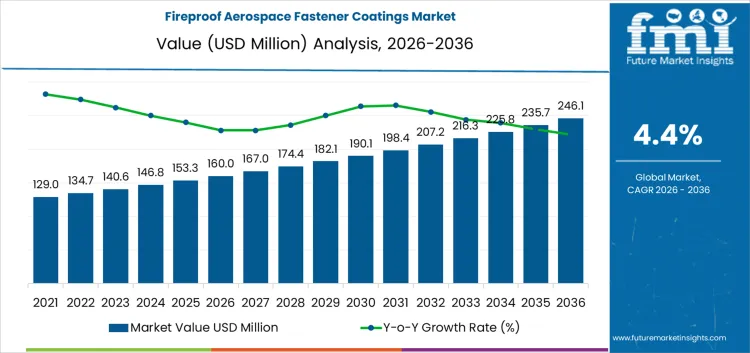
The fireproof aerospace fastener coatings market is likely to be valued at USD 160.0 million in 2026, and reach USD 246.1 million by 2036, at 4.4% CAGR. Value formation is linked to safety-critical coating specifications rather than volume-driven hardware consumption. Coatings are applied to fasteners installed in fire zones where retention of mechanical integrity, controlled torque behavior, and oxidation resistance are required under elevated temperature exposure. Demand concentrates on certified coating systems validated through flame resistance, heat soak, and post-exposure mechanical testing.
Growth is governed by regulatory fire containment requirements, rising operating temperatures in engine-adjacent assemblies, and inspection-led recoating during overhaul cycles. Application scope remains constrained by substrate compatibility, coating thickness control, and platform-specific fire zone definitions, which limit interchangeability across programs. Qualification burden, documentation requirements, and limited aerospace-grade coating capacity reinforce reliance on approved suppliers and controlled processes. Replacement demand follows maintenance schedules rather than discretionary upgrades, sustaining steady expansion aligned with fleet utilization and compliance-driven service activity rather than accelerated aircraft production.
Quick Stats for Fireproof Aerospace Fastener Coatings Market
- Fireproof Aerospace Fastener Coatings Market Value (2026): USD 160.0 million
- Fireproof Aerospace Fastener Coatings Market Forecast Value (2036): USD 246.1 million
- Fireproof Aerospace Fastener Coatings Market Forecast CAGR 2026 to 2036: 4.4%
- Leading Coating Type by Demand Share: High-Temp Anti-Seize & Lubricant Coats
- Fastest-Growing Countries: India, China, Saudi Arabia, USA, France
- Top Players in Global Demand: PPG, AkzoNobel, Henkel, Sherwin-Williams, 3M
Fireproof Aerospace Fastener Coatings Market Key Takeaways
| Metric | Value |
|---|---|
| Market Value (2026) | USD 160.0 million |
| Market Forecast Value (2036) | USD 246.1 million |
| Forecast CAGR 2026 to 2036 | 4.4% |
Why is the Demand for Fireproof Aerospace Fastener Coatings Growing?
Demand for fireproof aerospace fastener coatings is increasing as aircraft manufacturers and maintenance organizations prioritize hardware that maintains structural integrity and safety under elevated temperature conditions experienced during fire exposure and thermal incidents. Fasteners used in critical airframe assemblies, engine mounts, and cabin structural elements must resist oxidation, thermal degradation, and loss of mechanical properties when subjected to high heat from localized fires or extreme environmental variation. Engineered fireproof coatings applied to fasteners enhance resistance to flame, reduce thermal conductivity to metallic substrates, and preserve fatigue life under cyclic thermal stress.
Engineers specify coatings that meet stringent fire resistance criteria and maintain compatibility with substrate materials such as high-grade steels, titanium alloys, and corrosion resistant aluminum to support predictable performance across flight cycles. Procurement teams prioritize suppliers with documented quality management systems, traceability, and certification to aerospace standards because reliable coating performance directly influences hardware durability and compliance with airworthiness requirements.
Growth in advanced aircraft programs, expanded use of composite structures with metallic interfaces, and regulatory emphasis on fire safety testing protocols reinforce uptake of fireproof coatings for aerospace fasteners. Maintenance, repair, and overhaul (MRO) facilities require access to fasteners with certified fireproof coatings that match original engineering specifications to support scheduled inspections and replacement during heavy checks. Advances in high-temperature ceramic and intumescent coating technology improve adhesion, thermal barrier characteristics, and resistance to environmental exposure in service. Coordination between design engineers, coating specialists, and service technicians ensures that coated fasteners maintain mechanical properties and dimensional integrity after application and over extended duty cycles. These technical and safety-critical considerations are contributing to sustained demand growth in the fireproof aerospace fastener coatings market.
How Are the Segments Classified in the Fireproof Aerospace Fastener Coatings Market?
Demand for fireproof aerospace fastener coatings is shaped by thermal exposure severity, fire containment requirements, and compliance with aviation safety standards. Fasteners in high-temperature zones require coatings that maintain functionality during fire events and prolonged heat exposure. Adoption aligns with tighter flammability regulations, increased engine efficiency, and extended maintenance intervals. Coating selection prioritizes thermal stability, lubrication retention, and adhesion to metallic substrates. Segment classification reflects differentiation by coating chemistry, aircraft application zone, and fastener substrate influencing protection effectiveness, inspection frequency, and service reliability across aerospace assemblies.
Which Coating Type Represents the Largest Share of Demand?
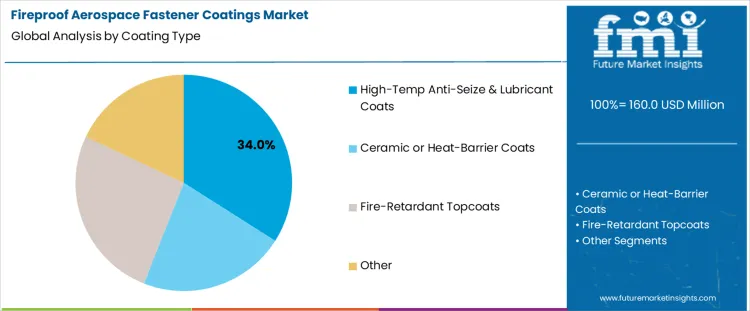
High-temperature anti-seize and lubricant coatings hold 34.0%, representing the largest share among coating types due to combined thermal protection and assembly functionality. These coatings prevent galling and seizure during installation and removal under elevated temperatures. Lubricity retention supports controlled torque application and repeatable preload. Performance stability under thermal cycling aligns with engine-adjacent fastener requirements. Fire-retardant topcoats provide surface protection with limited lubricating properties. Ceramic or heat-barrier coatings offer insulation with higher brittleness. Coating type segmentation reflects preference for multifunctional solutions supporting assembly reliability and fire resistance in high-heat aerospace zones.
Key Points
- Anti-seize coatings maintain lubricity under extreme temperatures.
- Torque control benefits installation and maintenance reliability.
- Other coatings focus on insulation or surface fire resistance.
Which Application Zone Accounts for the Highest Share of Demand?
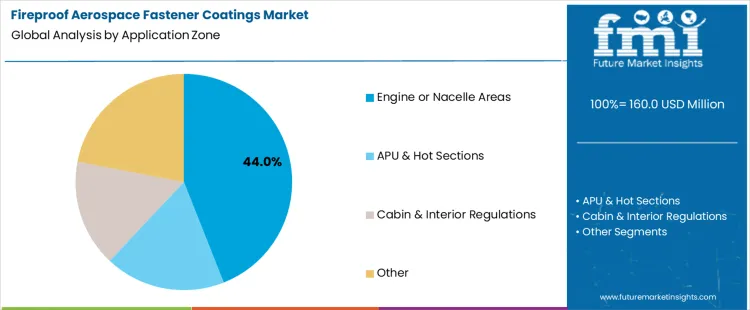
Engine or nacelle areas hold 44.0%, representing the largest share among application zones due to extreme thermal exposure. Fasteners in these zones face continuous heat, vibration, and potential fire scenarios. Coatings support retention of mechanical integrity and accessibility during maintenance. Regulatory scrutiny emphasizes fire containment and material behavior under heat. APU and hot sections apply similar coatings with lower fastener counts. Cabin and interior regulations require fire retardancy with reduced temperature exposure. Application segmentation reflects concentration where heat intensity and safety compliance drive the most demanding coating requirements.
Key Points
- Engine zones experience the highest thermal and fire exposure.
- Coatings preserve fastener functionality during heat events.
- Other zones require fire protection under lower temperatures.
Which Substrate Drives the Largest Share of Demand?
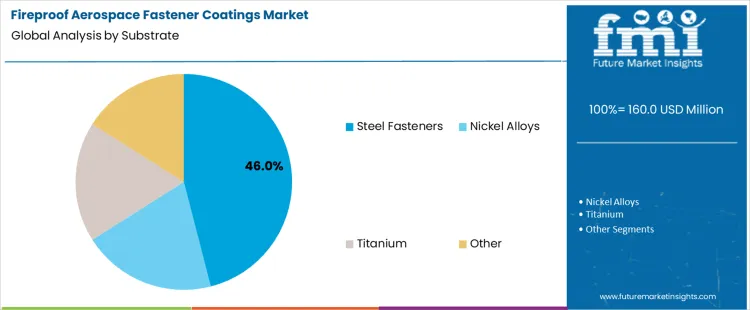
Steel fasteners hold 46.0%, representing the largest share among substrates due to widespread structural use. Steel components require protective coatings to maintain performance under heat and oxidation risk. Compatibility with varied coating chemistries supports broad application. Mechanical strength combined with coating protection suits high-load joints. Nickel alloys operate in extreme temperatures with lower volume. Titanium fasteners prioritize weight reduction with different coating interactions. Substrate segmentation reflects dominance of steel hardware where coating performance enhances thermal resistance, serviceability, and compliance across fire-exposed aerospace assemblies.
Key Points
- Steel fasteners require coatings for heat and oxidation control.
- Broad compatibility supports diverse coating applications.
- Other substrates serve specialized high-temperature or lightweight needs.
What are the Key Dynamics in the Fireproof Aerospace Fastener Coatings Market?
Demand for fireproof aerospace fastener coatings reflects safety-critical requirements to maintain fastener integrity during fire, extreme heat, and thermal runaway events. Adoption concentrates in commercial aircraft, military platforms, engines, nacelles, and auxiliary power unit zones. Global scope aligns with fire containment regulations and survivability standards. Usage centers on intumescent, ceramic-based, and inorganic coatings applied to fasteners exposed to elevated temperature and flame risk.
How do fire containment standards and high-temperature exposure zones shape adoption?
Aircraft certification requires structural joints to retain integrity for defined durations under fire conditions. Demand increases where fasteners are installed near engines, exhaust systems, fuel lines, and electrical power units. Fireproof coatings delay heat transfer, preserve mechanical strength, and prevent fastener seizure during emergency events. Military aircraft and rotorcraft prioritize coatings supporting continued structural integrity under combat or crash-induced fire exposure. Compatibility with titanium, nickel alloys, and steel substrates influences coating selection. Coatings must withstand vibration, torque installation, and environmental cycling without cracking or delamination. Adoption reflects direct linkage between coating performance and regulatory fire resistance compliance rather than corrosion protection alone.
How do coating durability limits, qualification burden, and cost pressure influence market scalability?
Fireproof coatings require extensive flame, heat soak, and mechanical validation, increasing qualification timelines. Demand sensitivity rises where coating application adds cost to already premium fasteners. Thickness control affects thread fit and torque accuracy, increasing process complexity. Coating brittleness under vibration and handling elevates scrap risk. Repair and recoat processes remain limited in field environments. Platform-specific fire zone definitions restrict broad applicability. Supplier capability for aerospace-grade ceramic and intumescent coatings remains limited. Traceability and documentation requirements constrain rapid scaling across parallel aircraft and engine programs.
How Is Demand for Fireproof Aerospace Fastener Coatings Evolving Globally?
Demand for fireproof aerospace fastener coatings is expanding globally due to stricter fire safety certification, higher operating temperatures, and maintenance-led replacement across aircraft fleets. Coatings protect fasteners in engine zones, nacelles, and high-heat structures, supporting flame resistance and material integrity. OEM specifications and airworthiness directives govern coating chemistry and application processes. MRO activity sustains recurring demand aligned with inspection and overhaul schedules. Growth rates in India at 6.0%, China at 5.6%, Saudi Arabia at 4.5%, USA at 3.9%, and France at 3.6% indicate measured expansion driven by lifecycle servicing, defense aviation needs, and compliance intensity rather than rapid aircraft delivery growth.
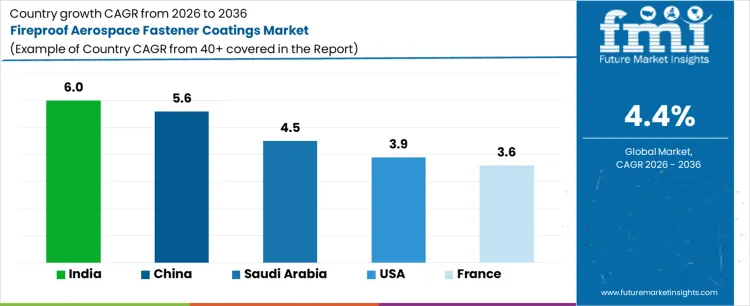
| Country | CAGR (%) |
|---|---|
| India | 6.0% |
| China | 5.6% |
| Saudi Arabia | 4.5% |
| USA | 3.9% |
| France | 3.6% |
What Is Driving Expansion of Fireproof Fastener Coating Demand in India?
Demand for fireproof aerospace fastener coatings in India is growing at a CAGR of 6.0%, supported by expanding MRO throughput and defense aviation programs. Engine-adjacent assemblies and hot-zone structures require certified fire-resistant coatings. Mixed climatic exposure and operational intensity increase refurbishment frequency during heavy checks. Localization initiatives encourage domestic coating capability development under approved processes. Rising fleet utilization elevates scheduled replacement volumes. Growth reflects maintenance intensity, defense requirements, and capability localization rather than acceleration of new aircraft manufacturing.
- Expansion of domestic MRO capacity
- Defense aviation hot-zone applications
- Localization of certified coating processes
- Increased fleet utilization driving replacements
Why Is China Sustaining Growth in Fireproof Aerospace Coating Adoption?
Fireproof aerospace fastener coating demand in China is expanding at a CAGR of 5.6%, driven by indigenous aircraft programs and standardized safety specifications. High-temperature zones specify coatings meeting flame resistance and durability criteria. State-backed manufacturing supports scale application under controlled qualification. Fleet growth increases inspection-driven recoating cycles. Program standardization reinforces approved coating systems. Growth reflects program-led manufacturing scale and lifecycle servicing needs rather than dependence on imported coating solutions.
- Indigenous aircraft program specifications
- High-temperature zone coating requirements
- State-supported qualified application capacity
- Rising maintenance cycles with fleet growth
How Is Saudi Arabia Supporting Demand for Fireproof Fastener Coatings?
Sales of fireproof aerospace fastener coatings in Saudi Arabia are growing at a CAGR of 4.5%, shaped by defense aviation activity and regional MRO specialization. Harsh operating environments increase thermal and fire exposure risk. Maintenance hubs prioritize certified coatings during overhauls. Defense procurement sustains consistent demand for compliant treatments. Strategic partnerships support access to approved materials and processes. Growth reflects maintenance-driven consumption and defense usage rather than large-scale aircraft manufacturing.
- Defense aviation operational requirements
- Harsh thermal operating environments
- Regional MRO overhaul activity
- Approved material and process partnerships
What Factors Are Influencing Fireproof Coating Demand in United States?
Fireproof aerospace fastener coating demand in the United States is expanding at a CAGR of 3.9%, supported by a large installed fleet and stringent certification frameworks. Engine compartments and fire zones require qualified coatings during scheduled maintenance. Extensive MRO networks drive consistent recoating volumes. OEM programs maintain steady specification requirements. Mature qualification processes moderate growth pace. Expansion reflects lifecycle maintenance and compliance adherence rather than rapid increases in aircraft production output.
- Large commercial and military installed base
- Stringent fire safety certification standards
- Extensive scheduled MRO activity
- OEM specification continuity
Why Is France Experiencing Measured Growth in Fireproof Aerospace Fastener Coatings?
Demand for fireproof aerospace fastener coatings in France is growing at a CAGR of 3.6%, driven by established aircraft manufacturing and maintenance ecosystems. Fire-zone assemblies specify coatings ensuring flame resistance and material stability. Civil and defense programs sustain consistent application volumes. Mature supplier networks limit rapid demand shifts. Aftermarket recoating aligns with scheduled overhaul cycles. Growth remains measured, reflecting stable program output and maintenance-led replacement rather than expansion of new aircraft platforms.
- Established aircraft manufacturing programs
- Fire-zone compliance requirements
- Civil and defense aviation continuity
- Overhaul cycle-driven recoating demand
What is the competitive landscape of demand for the fireproof aerospace fastener coatings market globally?
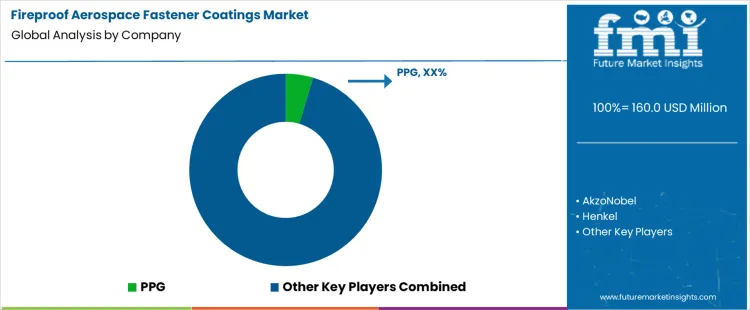
Demand for fireproof aerospace fastener coatings is driven by stringent safety regulations, the need to ensure fire resistance in aerospace applications, and the increasing adoption of lightweight and high-performance materials in aircraft manufacturing. Buyers evaluate coating durability, fire resistance, corrosion protection, ease of application, and compliance with aerospace safety standards. Procurement behavior emphasizes manufacturers that offer coatings with proven fireproof capabilities, long-lasting protection, and the ability to withstand extreme temperatures. Purchasing decisions prioritize suppliers offering advanced coatings that do not compromise fastener performance while providing superior safety and protection. Trend in the market reflects the growing focus on improving fire safety, particularly in commercial and military aircraft, as well as the rise in eco-friendly and low-emission coating technologies.
PPG leads competitive positioning with its advanced fireproof coatings, offering high-performance solutions that meet the strict fire resistance requirements of aerospace manufacturers. AkzoNobel competes with its specialized coatings that provide both fire resistance and corrosion protection, designed for aerospace fasteners and other components. Henkel supports demand with innovative, fire-resistant coating technologies that enhance fastener performance under extreme conditions. Sherwin-Williams participates with a comprehensive range of coatings designed for fireproofing and durability in aerospace applications, focusing on both safety and operational efficiency. 3M provides fireproof aerospace coatings with advanced performance properties, ensuring long-term protection and compliance with industry standards.
Key Players in the Fireproof Aerospace Fastener Coatings Market
- PPG
- AkzoNobel
- Henkel
- Sherwin-Williams
- 3M
- Chemetall (BASF)
- Poeton Industries
- Aalberts Surface Technologies
- Hentzen Coatings
Scope of the Report
| Items | Values |
|---|---|
| Quantitative Units | USD million |
| Coating Type | High-Temp Anti-Seize & Lubricant Coats; Ceramic or Heat-Barrier Coats; Fire-Retardant Topcoats; Other |
| Application Zone | Engine or Nacelle Areas; APU & Hot Sections; Cabin & Interior Regulations; Other |
| Substrate | Steel Fasteners; Nickel Alloys; Titanium; Other |
| Sales Channel | Direct Coating Services; Fastener OEM Bundled; MRO; Other |
| Regions Covered | Asia Pacific, Europe, North America, Latin America, Middle East & Africa |
| Countries Covered | India, China, Saudi Arabia, USA, France, and 40+ countries |
| Key Companies Profiled | PPG; AkzoNobel; Henkel; Sherwin-Williams; 3M; Chemetall (BASF); Poeton Industries; Aalberts Surface Technologies; Hentzen Coatings |
| Additional Attributes | Dollar sales by coating type, application zone, substrate, and sales channel; performance in heat resistance, corrosion protection, and lubricating properties across high-temp anti-seize, ceramic, and fire-retardant topcoats; substrate compatibility for steel, nickel alloys, and titanium fasteners; procurement trends driven by direct coating services, fastener OEM bundling, and MRO demand. |
Fireproof Aerospace Fastener Coatings Market by Segment
Coating Type:
- High-Temp Anti-Seize & Lubricant Coats
- Ceramic or Heat-Barrier Coats
- Fire-Retardant Topcoats
- Other
Application Zone:
- Engine or Nacelle Areas
- APU & Hot Sections
- Cabin & Interior Regulations
- Other
Substrate:
- Steel Fasteners
- Nickel Alloys
- Titanium
- Other
Sales Channel:
- Direct Coating Services
- Fastener OEM Bundled
- MRO
- Other
Region:
- Asia Pacific
- China
- Japan
- South Korea
- India
- Australia & New Zealand
- ASEAN
- Rest of Asia Pacific
- Europe
- Germany
- United Kingdom
- France
- Italy
- Spain
- Nordic
- BENELUX
- Rest of Europe
- North America
- United States
- Canada
- Mexico
- Latin America
- Brazil
- Chile
- Rest of Latin America
- Middle East & Africa
- Kingdom of Saudi Arabia
- Other GCC Countries
- Turkey
- South Africa
- Other African Union
- Rest of Middle East & Africa
Bibliography
- SAE International. (2024). Application, thickness control, and torque effects of high-temperature fastener coatings in aerospace assemblies (SAE Aerospace Recommended Practice). SAE International.
- Federal Aviation Administration. (2023). Advisory Circular AC 20-135: Powerplant installation and fire protection test criteria (Revisions applicable to coated fasteners and fire zones). USA Department of Transportation.
- European Union Aviation Safety Agency. (2024). Certification guidance for fire protection of aircraft structures, components, and fasteners (AMC/GM to CS-25 and CS-E, including fireproof coatings). EASA.
- ASTM International. (2023). Standard test methods for flame resistance, heat soak durability, and adhesion of inorganic and ceramic coatings on aerospace fasteners (ASTM F3306-23). ASTM International.
- National Aeronautics and Space Administration. (2023). Thermal barrier and fire exposure performance of coated metallic fasteners in aerospace propulsion and structural systems (NASA Technical Memorandum). NASA.
Frequently Asked Questions
How big is the fireproof aerospace fastener coatings market in 2026?
The global fireproof aerospace fastener coatings market is estimated to be valued at USD 160.0 million in 2026.
What will be the size of fireproof aerospace fastener coatings market in 2036?
The market size for the fireproof aerospace fastener coatings market is projected to reach USD 246.1 million by 2036.
How much will be the fireproof aerospace fastener coatings market growth between 2026 and 2036?
The fireproof aerospace fastener coatings market is expected to grow at a 4.4% CAGR between 2026 and 2036.
What are the key product types in the fireproof aerospace fastener coatings market?
The key product types in fireproof aerospace fastener coatings market are high-temp anti-seize & lubricant coats, ceramic or heat-barrier coats, fire-retardant topcoats and other.
Which application zone segment to contribute significant share in the fireproof aerospace fastener coatings market in 2026?
In terms of application zone, engine or nacelle areas segment to command 44.0% share in the fireproof aerospace fastener coatings market in 2026.
Preview the report firsthand - request a free sample
Get SampleGet the brochure for pricing and purchase details.
Get PDFTable of Content
- Executive Summary
- Global Market Outlook
- Demand-side Trends
- Supply-side Trends
- Technology Roadmap Analysis
- Analysis and Recommendations
- Market Overview
- Market Coverage / Taxonomy
- Market Definition / Scope / Limitations
- Market Background
- Market Dynamics
- Drivers
- Restraints
- Opportunity
- Trends
- Scenario Forecast
- Demand in Optimistic Scenario
- Demand in Likely Scenario
- Demand in Conservative Scenario
- Opportunity Map Analysis
- Product Life Cycle Analysis
- Supply Chain Analysis
- Investment Feasibility Matrix
- Value Chain Analysis
- PESTLE and Porter’s Analysis
- Regulatory Landscape
- Regional Parent Market Outlook
- Production and Consumption Statistics
- Import and Export Statistics
- Market Dynamics
- Global Market Analysis 2021 to 2025 and Forecast, 2026 to 2036
- Historical Market Size Value (USD Million) Analysis, 2021 to 2025
- Current and Future Market Size Value (USD Million) Projections, 2026 to 2036
- Y-o-Y Growth Trend Analysis
- Absolute $ Opportunity Analysis
- Global Market Pricing Analysis 2021 to 2025 and Forecast 2026 to 2036
- Global Market Analysis 2021 to 2025 and Forecast 2026 to 2036, By Coating Type
- Introduction / Key Findings
- Historical Market Size Value (USD Million) Analysis By Coating Type , 2021 to 2025
- Current and Future Market Size Value (USD Million) Analysis and Forecast By Coating Type , 2026 to 2036
- High-Temp Anti-Seize & Lubricant Coats
- Ceramic or Heat-Barrier Coats
- Fire-Retardant Topcoats
- Other
- High-Temp Anti-Seize & Lubricant Coats
- Y-o-Y Growth Trend Analysis By Coating Type , 2021 to 2025
- Absolute $ Opportunity Analysis By Coating Type , 2026 to 2036
- Global Market Analysis 2021 to 2025 and Forecast 2026 to 2036, By Application Zone
- Introduction / Key Findings
- Historical Market Size Value (USD Million) Analysis By Application Zone, 2021 to 2025
- Current and Future Market Size Value (USD Million) Analysis and Forecast By Application Zone, 2026 to 2036
- Engine or Nacelle Areas
- APU & Hot Sections
- Cabin & Interior Regulations
- Other
- Engine or Nacelle Areas
- Y-o-Y Growth Trend Analysis By Application Zone, 2021 to 2025
- Absolute $ Opportunity Analysis By Application Zone, 2026 to 2036
- Global Market Analysis 2021 to 2025 and Forecast 2026 to 2036, By Substrate
- Introduction / Key Findings
- Historical Market Size Value (USD Million) Analysis By Substrate, 2021 to 2025
- Current and Future Market Size Value (USD Million) Analysis and Forecast By Substrate, 2026 to 2036
- Steel Fasteners
- Nickel Alloys
- Titanium
- Other
- Steel Fasteners
- Y-o-Y Growth Trend Analysis By Substrate, 2021 to 2025
- Absolute $ Opportunity Analysis By Substrate, 2026 to 2036
- Global Market Analysis 2021 to 2025 and Forecast 2026 to 2036, By Sales Channel
- Introduction / Key Findings
- Historical Market Size Value (USD Million) Analysis By Sales Channel, 2021 to 2025
- Current and Future Market Size Value (USD Million) Analysis and Forecast By Sales Channel, 2026 to 2036
- Direct Coating Services
- Fastener OEM Bundled
- MRO
- Other
- Direct Coating Services
- Y-o-Y Growth Trend Analysis By Sales Channel, 2021 to 2025
- Absolute $ Opportunity Analysis By Sales Channel, 2026 to 2036
- Global Market Analysis 2021 to 2025 and Forecast 2026 to 2036, By Region
- Introduction
- Historical Market Size Value (USD Million) Analysis By Region, 2021 to 2025
- Current Market Size Value (USD Million) Analysis and Forecast By Region, 2026 to 2036
- North America
- Latin America
- Western Europe
- Eastern Europe
- East Asia
- South Asia and Pacific
- Middle East & Africa
- Market Attractiveness Analysis By Region
- North America Market Analysis 2021 to 2025 and Forecast 2026 to 2036, By Country
- Historical Market Size Value (USD Million) Trend Analysis By Market Taxonomy, 2021 to 2025
- Market Size Value (USD Million) Forecast By Market Taxonomy, 2026 to 2036
- By Country
- USA
- Canada
- Mexico
- By Coating Type
- By Application Zone
- By Substrate
- By Sales Channel
- By Country
- Market Attractiveness Analysis
- By Country
- By Coating Type
- By Application Zone
- By Substrate
- By Sales Channel
- Key Takeaways
- Latin America Market Analysis 2021 to 2025 and Forecast 2026 to 2036, By Country
- Historical Market Size Value (USD Million) Trend Analysis By Market Taxonomy, 2021 to 2025
- Market Size Value (USD Million) Forecast By Market Taxonomy, 2026 to 2036
- By Country
- Brazil
- Chile
- Rest of Latin America
- By Coating Type
- By Application Zone
- By Substrate
- By Sales Channel
- By Country
- Market Attractiveness Analysis
- By Country
- By Coating Type
- By Application Zone
- By Substrate
- By Sales Channel
- Key Takeaways
- Western Europe Market Analysis 2021 to 2025 and Forecast 2026 to 2036, By Country
- Historical Market Size Value (USD Million) Trend Analysis By Market Taxonomy, 2021 to 2025
- Market Size Value (USD Million) Forecast By Market Taxonomy, 2026 to 2036
- By Country
- Germany
- UK
- Italy
- Spain
- France
- Nordic
- BENELUX
- Rest of Western Europe
- By Coating Type
- By Application Zone
- By Substrate
- By Sales Channel
- By Country
- Market Attractiveness Analysis
- By Country
- By Coating Type
- By Application Zone
- By Substrate
- By Sales Channel
- Key Takeaways
- Eastern Europe Market Analysis 2021 to 2025 and Forecast 2026 to 2036, By Country
- Historical Market Size Value (USD Million) Trend Analysis By Market Taxonomy, 2021 to 2025
- Market Size Value (USD Million) Forecast By Market Taxonomy, 2026 to 2036
- By Country
- Russia
- Poland
- Hungary
- Balkan & Baltic
- Rest of Eastern Europe
- By Coating Type
- By Application Zone
- By Substrate
- By Sales Channel
- By Country
- Market Attractiveness Analysis
- By Country
- By Coating Type
- By Application Zone
- By Substrate
- By Sales Channel
- Key Takeaways
- East Asia Market Analysis 2021 to 2025 and Forecast 2026 to 2036, By Country
- Historical Market Size Value (USD Million) Trend Analysis By Market Taxonomy, 2021 to 2025
- Market Size Value (USD Million) Forecast By Market Taxonomy, 2026 to 2036
- By Country
- China
- Japan
- South Korea
- By Coating Type
- By Application Zone
- By Substrate
- By Sales Channel
- By Country
- Market Attractiveness Analysis
- By Country
- By Coating Type
- By Application Zone
- By Substrate
- By Sales Channel
- Key Takeaways
- South Asia and Pacific Market Analysis 2021 to 2025 and Forecast 2026 to 2036, By Country
- Historical Market Size Value (USD Million) Trend Analysis By Market Taxonomy, 2021 to 2025
- Market Size Value (USD Million) Forecast By Market Taxonomy, 2026 to 2036
- By Country
- India
- ASEAN
- Australia & New Zealand
- Rest of South Asia and Pacific
- By Coating Type
- By Application Zone
- By Substrate
- By Sales Channel
- By Country
- Market Attractiveness Analysis
- By Country
- By Coating Type
- By Application Zone
- By Substrate
- By Sales Channel
- Key Takeaways
- Middle East & Africa Market Analysis 2021 to 2025 and Forecast 2026 to 2036, By Country
- Historical Market Size Value (USD Million) Trend Analysis By Market Taxonomy, 2021 to 2025
- Market Size Value (USD Million) Forecast By Market Taxonomy, 2026 to 2036
- By Country
- Kingdom of Saudi Arabia
- Other GCC Countries
- Turkiye
- South Africa
- Other African Union
- Rest of Middle East & Africa
- By Coating Type
- By Application Zone
- By Substrate
- By Sales Channel
- By Country
- Market Attractiveness Analysis
- By Country
- By Coating Type
- By Application Zone
- By Substrate
- By Sales Channel
- Key Takeaways
- Key Countries Market Analysis
- USA
- Pricing Analysis
- Market Share Analysis, 2025
- By Coating Type
- By Application Zone
- By Substrate
- By Sales Channel
- Canada
- Pricing Analysis
- Market Share Analysis, 2025
- By Coating Type
- By Application Zone
- By Substrate
- By Sales Channel
- Mexico
- Pricing Analysis
- Market Share Analysis, 2025
- By Coating Type
- By Application Zone
- By Substrate
- By Sales Channel
- Brazil
- Pricing Analysis
- Market Share Analysis, 2025
- By Coating Type
- By Application Zone
- By Substrate
- By Sales Channel
- Chile
- Pricing Analysis
- Market Share Analysis, 2025
- By Coating Type
- By Application Zone
- By Substrate
- By Sales Channel
- Germany
- Pricing Analysis
- Market Share Analysis, 2025
- By Coating Type
- By Application Zone
- By Substrate
- By Sales Channel
- UK
- Pricing Analysis
- Market Share Analysis, 2025
- By Coating Type
- By Application Zone
- By Substrate
- By Sales Channel
- Italy
- Pricing Analysis
- Market Share Analysis, 2025
- By Coating Type
- By Application Zone
- By Substrate
- By Sales Channel
- Spain
- Pricing Analysis
- Market Share Analysis, 2025
- By Coating Type
- By Application Zone
- By Substrate
- By Sales Channel
- France
- Pricing Analysis
- Market Share Analysis, 2025
- By Coating Type
- By Application Zone
- By Substrate
- By Sales Channel
- India
- Pricing Analysis
- Market Share Analysis, 2025
- By Coating Type
- By Application Zone
- By Substrate
- By Sales Channel
- ASEAN
- Pricing Analysis
- Market Share Analysis, 2025
- By Coating Type
- By Application Zone
- By Substrate
- By Sales Channel
- Australia & New Zealand
- Pricing Analysis
- Market Share Analysis, 2025
- By Coating Type
- By Application Zone
- By Substrate
- By Sales Channel
- China
- Pricing Analysis
- Market Share Analysis, 2025
- By Coating Type
- By Application Zone
- By Substrate
- By Sales Channel
- Japan
- Pricing Analysis
- Market Share Analysis, 2025
- By Coating Type
- By Application Zone
- By Substrate
- By Sales Channel
- South Korea
- Pricing Analysis
- Market Share Analysis, 2025
- By Coating Type
- By Application Zone
- By Substrate
- By Sales Channel
- Russia
- Pricing Analysis
- Market Share Analysis, 2025
- By Coating Type
- By Application Zone
- By Substrate
- By Sales Channel
- Poland
- Pricing Analysis
- Market Share Analysis, 2025
- By Coating Type
- By Application Zone
- By Substrate
- By Sales Channel
- Hungary
- Pricing Analysis
- Market Share Analysis, 2025
- By Coating Type
- By Application Zone
- By Substrate
- By Sales Channel
- Kingdom of Saudi Arabia
- Pricing Analysis
- Market Share Analysis, 2025
- By Coating Type
- By Application Zone
- By Substrate
- By Sales Channel
- Turkiye
- Pricing Analysis
- Market Share Analysis, 2025
- By Coating Type
- By Application Zone
- By Substrate
- By Sales Channel
- South Africa
- Pricing Analysis
- Market Share Analysis, 2025
- By Coating Type
- By Application Zone
- By Substrate
- By Sales Channel
- USA
- Market Structure Analysis
- Competition Dashboard
- Competition Benchmarking
- Market Share Analysis of Top Players
- By Regional
- By Coating Type
- By Application Zone
- By Substrate
- By Sales Channel
- Competition Analysis
- Competition Deep Dive
- PPG
- Overview
- Product Portfolio
- Profitability by Market Segments (Product/Age /Sales Channel/Region)
- Sales Footprint
- Strategy Overview
- Marketing Strategy
- Product Strategy
- Channel Strategy
- AkzoNobel
- Henkel
- Sherwin-Williams
- 3M
- Chemetall (BASF)
- Poeton Industries
- Aalberts Surface Technologies
- Hentzen Coatings
- PPG
- Competition Deep Dive
- Assumptions & Acronyms Used
- Research Methodology


