

- Industry Size (2026)
- USD 140.0 Mn
- Forecast (2036)
- USD 205.3 Mn
- CAGR (2026 to 2036)
- 3.9%
Serialized and Traceable Aerospace Fastener Kits Market Forecast and Outlook 2026 to 2036
The serialized and traceable aerospace fastener kits market is likely to be valued at USD 140.0 million in 2026, and reach USD 205.3 million by 2036, at 3.9% CAGR. Value creation is driven by compliance intensity and configuration control requirements rather than fastener volume growth. Demand centers on pre-kitted hardware supplied with documented lineage, batch records, and identification protocols supporting airworthiness certification, audit readiness, and lifecycle accountability.
Expansion is governed by regulatory traceability mandates, extended aircraft service lives, and increasing reliance on digital maintenance and quality systems. Adoption remains strongest where installation accuracy, counterfeit risk mitigation, and documentation efficiency outweigh added kitting and data management cost. Scalability is constrained by customization needs, serialization overhead, and system interoperability requirements across OEMs, suppliers, and MROs. Expansion follows maintenance governance and certification ownership patterns, supporting steady uptake aligned with fleet utilization and compliance-led procurement rather than accelerated aircraft production.
Quick Stats for Serialized and Traceable Aerospace Fastener Kits Market
- Serialized and Traceable Aerospace Fastener Kits Market Value (2026): USD 140.0 million
- Serialized and Traceable Aerospace Fastener Kits Market Forecast Value (2036): USD 205.3 million
- Serialized and Traceable Aerospace Fastener Kits Market Forecast CAGR 2026 to 2036: 3.9%
- Leading Kit Type by Demand Share: Line-Fit Assembly Kits
- Fastest-Growing Countries: India, China, Poland, USA, France
- Top Players in Global Demand: Howmet Aerospace, LISI Aerospace, Precision Castparts (PCC), Stanley Engineered Fastening, Böllhoff Group
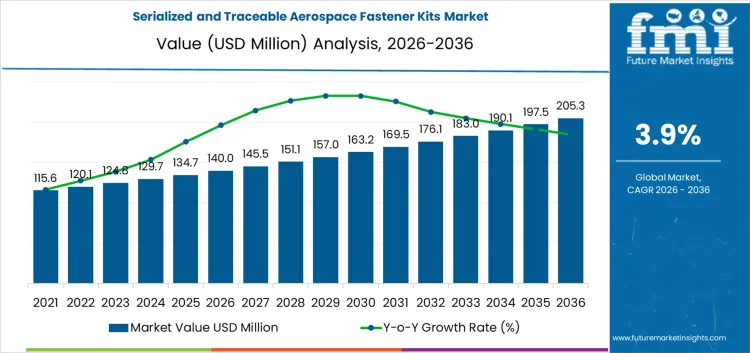
Serialized and Traceable Aerospace Fastener Kits Market Key Takeaways
| Metric | Value |
|---|---|
| Market Value (2026) | USD 140.0 million |
| Market Forecast Value (2036) | USD 205.3 million |
| Forecast CAGR 2026 to 2036 | 3.9% |
Why is the Demand for Serialized and Traceable Aerospace Fastener Kits Growing?
Demand for serialized and traceable aerospace fastener kits is increasing as aircraft manufacturers and maintenance, repair, and overhaul (MRO) operations require hardware with documented lineage and quality assurance to support airworthiness and regulatory compliance. Fasteners used in structural assemblies, flight control surfaces, and critical systems must be sourced with full traceability from raw material batch to installation record because aviation certification standards mandate visibility into production processes, material properties, and inspection outcomes. Serialized kits bundle matched fasteners and corresponding trace data into a cohesive unit, enabling engineers and quality managers to verify torque specifications, heat treatment histories, and supplier quality system adherence before installation. Procurement teams prioritize suppliers that provide certifiable documentation and digital trace records because reliable traceability reduces administrative burden during audits, improves defect investigation workflows, and minimizes risk of installation of incorrect or nonconforming hardware.
Growth in global fleet expansion, extended service life programs, and complexity of modern aircraft architectures reinforces adoption of serialized and traceable fastener kits that align with rigorous maintenance planning and risk management frameworks. MRO facilities rely on certified kits to streamline heavy checks, reduce part mismatches, and support predictive maintenance strategies across commercial, defense, and business aviation platforms. Digital traceability supports integration with maintenance management systems and enhances data integrity for lifecycle records, reducing time spent reconciling disparate documentation sources. These quality-driven and operational continuity requirements are contributing to sustained demand growth in the serialized and traceable aerospace fastener kits market.
How Are the Segments Classified in the Serialized and Traceable Aerospace Fastener Kits Market?
Demand for serialized and traceable aerospace fastener kits is shaped by regulatory compliance, configuration control, and airworthiness documentation requirements. Aircraft programs require verifiable lineage for critical hardware to support audits, maintenance accountability, and incident investigation. Adoption aligns with tighter quality systems, digital recordkeeping, and lifecycle management across production and service phases. Kit selection prioritizes documentation completeness, identification accuracy, and integration with quality systems. Segment classification reflects differentiation by kit purpose, end-user role, and traceability depth influencing control rigor, deployment timing, and record retention practices.
Which Kit Type Represents the Largest Share of Demand?
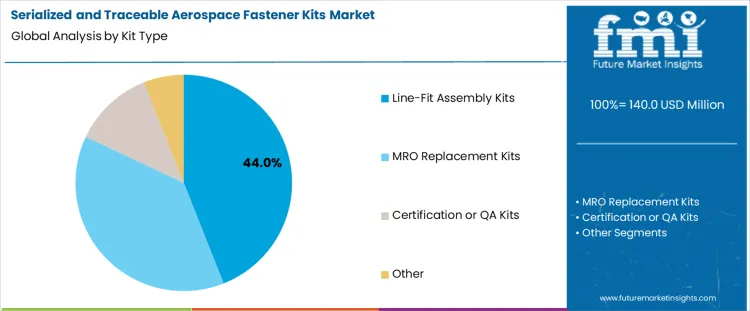
Line-fit assembly kits hold 44.0%, representing the largest share among kit types due to production-scale integration needs. These kits consolidate fasteners by station and build sequence, reducing handling errors and installation delays. Pre-validated contents align with engineering bills and conformity checks. Centralized packaging supports inventory control and configuration accuracy during aircraft assembly. MRO replacement kits address scheduled maintenance with slightly lower volume. Certification or QA kits support audits and sampling activities. Kit type segmentation reflects preference for production-aligned packaging that supports throughput, accuracy, and compliance during initial aircraft assembly.
Key Points
- Line-fit kits align contents with assembly sequences.
- Consolidation reduces handling errors and delays.
- Other kits support maintenance or audit functions.
Which End User Accounts for the Highest Share of Demand?
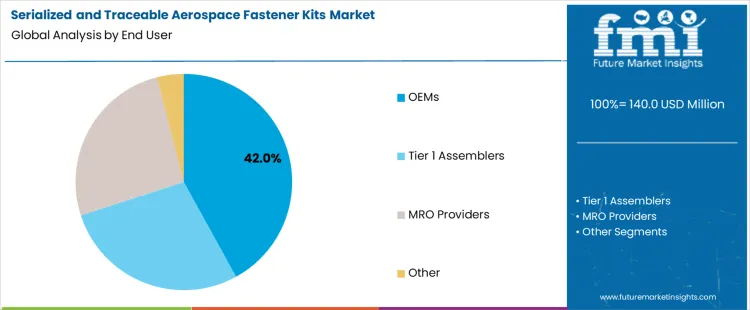
OEMs hold 42.0%, representing the largest share among end users due to responsibility for initial conformity. Original manufacturers require end-to-end traceability to certify aircraft at delivery. Centralized quality systems integrate kit data with build records and compliance documentation. Volume scale supports standardized kit definitions across programs. Tier 1 assemblers use kits for subsystem integration with moderate volume. MRO providers apply kits during maintenance with varying configurations. End-user segmentation reflects concentration where certification ownership and production accountability necessitate comprehensive traceability practices.
Key Points
- OEMs own conformity and delivery certification.
- Centralized systems integrate kit data with build records.
- Other users apply kits for integration or maintenance.
Which Traceability Level Drives the Largest Share of Demand?
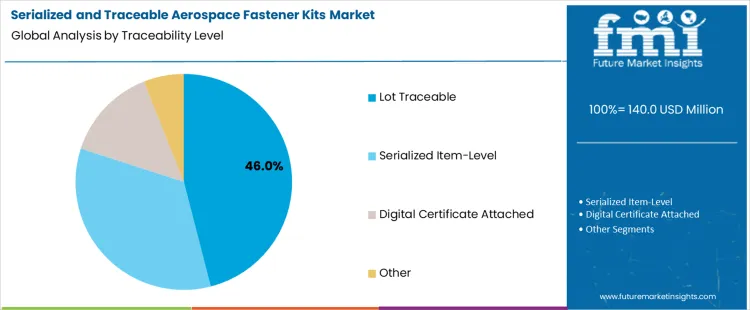
Lot traceable systems hold 46.0%, representing the largest share among traceability levels due to operational practicality. Batch identification provides sufficient control for many applications while limiting administrative burden. Lot records support recalls, audits, and service tracking across defined production runs. Integration with existing quality systems remains straightforward. Serialized item-level tracking offers higher granularity with increased data management. Digital certificates attach documentation with evolving adoption. Traceability level segmentation reflects preference for balanced approaches delivering compliance assurance and manageable data complexity across aerospace fastener deployments.
Key Points
- Lot traceability balances control with data efficiency.
- Batch records support audits and corrective actions.
- Other levels increase granularity with higher complexity.
What are the Key Dynamics in the Serialized and Traceable Aerospace Fastener Kits Market?
Demand for serialized and traceable aerospace fastener kits reflects configuration control and airworthiness documentation requirements across aircraft manufacturing and maintenance. Adoption concentrates in commercial aviation, military programs, space systems, and certified MRO operations. Global scope aligns with regulatory mandates for part traceability and lifecycle accountability. Usage centers on pre-kitted fasteners individually serialized and documented to support installation control, audit readiness, and fleet-wide configuration integrity.
How do regulatory traceability mandates and configuration management practices shape adoption?
Aerospace regulations require full traceability of safety-critical hardware from raw material through installation and removal. Demand increases as programs seek to reduce compliance risk during audits, incident investigations, and service bulletins. Serialized kits ensure each fastener is uniquely identified, logged, and matched to approved drawings and torque records. Production lines adopt kits to prevent part mixing and incorrect substitution at workstations. MROs rely on serialization to track reuse limits, life status, and removal history. Digital integration with manufacturing execution systems and maintenance records supports real-time configuration control. Adoption reflects operational necessity to maintain verifiable part pedigree across long service lives.
How do kitting complexity, cost intensity, and data governance constraints influence market scalability?
Serialization adds marking, inspection, and data management steps that increase unit cost and lead time. Demand sensitivity rises where programs operate under aggressive cost targets or high-volume standard hardware needs. Data accuracy and system integration requirements elevate implementation complexity across suppliers and operators. Kit customization by station and configuration limits standardization benefits. Mark durability must withstand installation and service environments without compromising fastener performance. Handling errors undermine traceability value, increasing process discipline needs. Supplier qualification and IT interoperability remain barriers. Scalability remains constrained to programs prioritizing compliance certainty over lowest unit cost.
How Is Demand for Serialized and Traceable Aerospace Fastener Kits Evolving Globally?
Demand for serialized and traceable aerospace fastener kits is expanding globally due to tighter airworthiness controls, digital maintenance records, and counterfeit risk mitigation. Airlines, OEMs, and MROs require end-to-end traceability to meet audit readiness and regulatory reporting obligations. Kit-based supply reduces installation errors and improves configuration control during assembly and maintenance. Integration with digital logbooks and ERP systems supports lifecycle visibility. Growth rates in India at 5.4%, China at 5.1%, Poland at 4.0%, USA at 3.5%, and France at 3.2% indicate measured expansion driven by compliance intensity, fleet utilization, and maintenance governance rather than accelerated aircraft production.
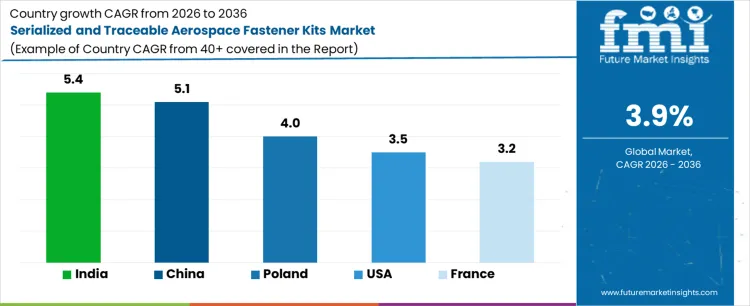
| Country | CAGR (%) |
|---|---|
| India | 5.4% |
| China | 5.1% |
| Poland | 4.0% |
| USA | 3.5% |
| France | 3.2% |
What Is Driving Uptake of Serialized Fastener Kits Across India?
Demand for serialized and traceable aerospace fastener kits in India is growing at a CAGR of 5.4%, supported by expanding MRO activity and compliance-led procurement. Airlines and defense operators prioritize serialized hardware to strengthen audit trails and parts accountability. Mixed climatic exposure increases replacement frequency during heavy checks, favoring pre-kitted, verified components. Localization initiatives encourage approved domestic sourcing with traceability controls. Digital maintenance adoption improves integration of serial data into records. Growth reflects governance requirements and maintenance intensity rather than rapid scaling of airframe assembly.
- Expansion of MRO capacity and audit frequency
- Defense and civil compliance documentation needs
- Localization with approved traceability controls
- Digital maintenance record integration
Why Is China Sustaining Growth in Serialized Fastener Kit Adoption?
Serialized and traceable aerospace fastener kit demand in China is expanding at a CAGR of 5.1%, driven by program standardization and supply chain control. Indigenous aircraft programs specify serialized kits to ensure configuration integrity and lifecycle tracking. State-backed manufacturing supports controlled serialization and data capture. Fleet growth increases inspection-driven replacements managed through kits. System integration with enterprise platforms improves visibility. Growth reflects program governance and servicing discipline rather than dependence on imported kitting solutions.
- Program-level configuration control requirements
- State-supported serialization capability
- Rising maintenance volumes from fleet growth
- Enterprise system integration for traceability
How Are Serialized Aerospace Fastener Kit Sales Developing in Poland?
Sales of serialized and traceable aerospace fastener kits in Poland are growing at a CAGR of 4.0%, shaped by supplier integration within European aerospace programs. Tier suppliers and MROs adopt kits to meet OEM traceability mandates. Export-oriented production emphasizes documentation accuracy and batch control. Skilled labor availability supports compliant kitting operations. Maintenance support for regional fleets contributes incremental demand. Growth reflects supplier compliance alignment and servicing roles rather than expansion of domestic aircraft manufacturing.
- Tier supplier compliance with OEM mandates
- Export-oriented documentation accuracy needs
- Skilled workforce supporting compliant kitting
- Regional MRO replacement activity
What Factors Influence Serialized Fastener Kit Demand in United States?
Serialized and traceable aerospace fastener kit demand in the United States is expanding at a CAGR of 3.5%, supported by mature compliance frameworks and extensive installed fleets. Airlines and MROs standardize kitted hardware to reduce errors and inspection time. Regulatory scrutiny reinforces serialization and chain-of-custody controls. OEM programs maintain steady specification volumes. Digital thread initiatives integrate serial data across maintenance systems. Expansion reflects maintenance governance and risk management rather than acceleration in aircraft output.
- Mature regulatory and audit requirements
- Error reduction through standardized kitting
- Large installed fleet driving replacements
- Digital thread integration for serial data
Why Is France Experiencing Measured Growth in Serialized Fastener Kits?
Demand for serialized and traceable aerospace fastener kits in France is growing at a CAGR of 3.2%, driven by established manufacturing and maintenance practices. OEMs and MROs emphasize traceability for safety-critical assemblies. Civil and defense programs sustain consistent kit usage. Mature supplier ecosystems limit rapid volume shifts. Aftermarket consumption aligns with scheduled maintenance cycles. Growth remains measured, reflecting stable program output and governance-led procurement rather than expansion of new aircraft lines.
- Safety-critical traceability requirements
- Civil and defense program continuity
- Mature supplier and kitting ecosystems
- Maintenance cycle-driven consumption
What is the competitive landscape of demand for the serialized and traceable aerospace fastener kits market globally?
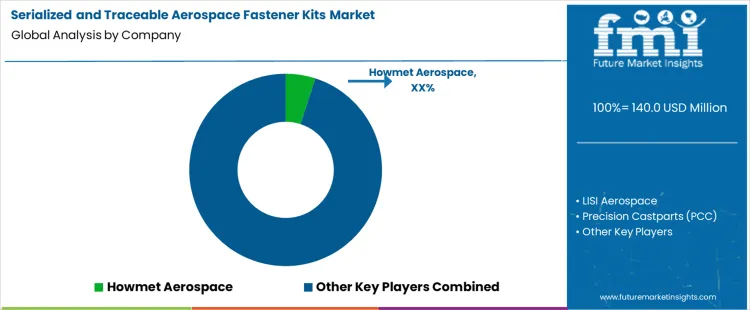
Demand for serialized and traceable aerospace fastener kits is driven by stringent regulations around component tracking, safety, and compliance within the aerospace industry. Buyers evaluate the traceability of fasteners, certification accuracy, and the ability to track each component throughout its lifecycle for maintenance, repair, and regulatory audits. Procurement behavior prioritizes manufacturers offering fastener kits that meet exacting industry standards, ensuring complete serialization, proper documentation, and reliable traceability for both new builds and MRO (maintenance, repair, and overhaul) activities. Purchasing decisions emphasize suppliers with a robust supply chain, quality control procedures, and the ability to provide quick access to product history and certifications. Trend in the market reflects increased regulatory scrutiny and the growing importance of supply chain transparency, particularly in safety-critical aerospace applications.
Howmet Aerospace leads competitive positioning through its advanced serialized fastener kits, offering full traceability, compliance with aerospace standards, and robust quality assurance across all product offerings. LISI Aerospace competes by providing highly reliable, traceable fastener kits designed to meet both civil and military aerospace requirements, ensuring complete certification and compliance. Precision Castparts (PCC) participates by offering serialized fasteners with rigorous quality controls, catering to a variety of aerospace and defense applications. Stanley Engineered Fastening delivers reliable, high-performance serialized fastener kits with robust tracking systems, ensuring complete lifecycle management for aerospace components. Böllhoff Group supports demand with traceable fastener solutions, focusing on product certification and efficient supply chain management for aerospace applications.
Key Players in the Serialized and Traceable Aerospace Fastener Kits Market
- Howmet Aerospace
- LISI Aerospace
- Precision Castparts (PCC)
- Stanley Engineered Fastening
- Böllhoff Group
- Würth Aerospace
- Bossard Group
- Bufab
- National Aerospace Fasteners
- Fastenal
Scope of the Report
| Items | Values |
|---|---|
| Quantitative Units | USD million |
| Kit Type | Line-Fit Assembly Kits; MRO Replacement Kits; Certification or QA Kits; Other |
| End User | OEMs; Tier 1 Assemblers; MRO Providers; Other |
| Traceability Level | Lot Traceable; Serialized Item-Level; Digital Certificate Attached; Other |
| Sales Channel | Direct Contract Supply; Authorized Distributors; E-Procurement; Other |
| Regions Covered | Asia Pacific, Europe, North America, Latin America, Middle East & Africa |
| Countries Covered | India, China, Poland, USA, France, and 40+ countries |
| Key Companies Profiled | Howmet Aerospace; LISI Aerospace; Precision Castparts (PCC); Stanley Engineered Fastening; Böllhoff Group; Würth Aerospace; Bossard Group; Bufab; National Aerospace Fasteners; Fastenal |
| Additional Attributes | Dollar sales by kit type, end user, traceability level, and sales channel; performance of traceability features including lot traceability, serialized item-level tracking, and digital certificates in aerospace fastener kits; application trends in OEM line-fit, MRO replacement, and certification kits; procurement dynamics influenced by direct contract supply, authorized distributors, and e-procurement. |
Serialized and Traceable Aerospace Fastener Kits Market by Segment
Kit Type:
- Line-Fit Assembly Kits
- MRO Replacement Kits
- Certification or QA Kits
- Other
End User:
- OEMs
- Tier 1 Assemblers
- MRO Providers
- Other
Traceability Level:
- Lot Traceable
- Serialized Item-Level
- Digital Certificate Attached
- Other
Sales Channel:
- Direct Contract Supply
- Authorized Distributors
- E-Procurement
- Other
Region:
- Asia Pacific
- China
- Japan
- South Korea
- India
- Australia & New Zealand
- ASEAN
- Rest of Asia Pacific
- Europe
- Germany
- United Kingdom
- France
- Italy
- Spain
- Nordic
- BENELUX
- Rest of Europe
- North America
- United States
- Canada
- Mexico
- Latin America
- Brazil
- Chile
- Rest of Latin America
- Middle East & Africa
- Kingdom of Saudi Arabia
- Other GCC Countries
- Turkey
- South Africa
- Other African Union
- Rest of Middle East & Africa
Bibliography
- International Organization for Standardization. (2023). Quality management systems-Requirements for aviation, space, and defence organizations (ISO 9100:2023, aligned revision). ISO.
- SAE International. (2023). Traceability, serialization, and configuration control of aerospace fasteners and safety-critical hardware (SAE Aerospace Information Report). SAE International.
- Federal Aviation Administration. (2023). Advisory Circular AC 21-43: Manufacturing, traceability, and identification of aeronautical products (Updated guidance on serialized hardware and documentation). USA Department of Transportation.
- European Union Aviation Safety Agency. (2024). Part-21 and Part-145 guidance on component traceability, release documentation, and configuration control (AMC/GM amendments). EASA.
- National Aeronautics and Space Administration. (2023). Fastener identification, serialization durability, and lifecycle traceability in aerospace systems (NASA Technical Memorandum). NASA.
Frequently Asked Questions
How big is the serialized and traceable aerospace fastener kits market in 2026?
The global serialized and traceable aerospace fastener kits market is estimated to be valued at USD 140.0 million in 2026.
What will be the size of serialized and traceable aerospace fastener kits market in 2036?
The market size for the serialized and traceable aerospace fastener kits market is projected to reach USD 205.3 million by 2036.
How much will be the serialized and traceable aerospace fastener kits market growth between 2026 and 2036?
The serialized and traceable aerospace fastener kits market is expected to grow at a 3.9% CAGR between 2026 and 2036.
What are the key product types in the serialized and traceable aerospace fastener kits market?
The key product types in serialized and traceable aerospace fastener kits market are line-fit assembly kits, mro replacement kits, certification or qa kits and other.
Which end user segment to contribute significant share in the serialized and traceable aerospace fastener kits market in 2026?
In terms of end user, oems segment to command 42.0% share in the serialized and traceable aerospace fastener kits market in 2026.
Preview the report firsthand - request a free sample
Get SampleGet the brochure for pricing and purchase details.
Get PDFTable of Content
- Executive Summary
- Global Market Outlook
- Demand-side Trends
- Supply-side Trends
- Technology Roadmap Analysis
- Analysis and Recommendations
- Market Overview
- Market Coverage / Taxonomy
- Market Definition / Scope / Limitations
- Market Background
- Market Dynamics
- Drivers
- Restraints
- Opportunity
- Trends
- Scenario Forecast
- Demand in Optimistic Scenario
- Demand in Likely Scenario
- Demand in Conservative Scenario
- Opportunity Map Analysis
- Product Life Cycle Analysis
- Supply Chain Analysis
- Investment Feasibility Matrix
- Value Chain Analysis
- PESTLE and Porter’s Analysis
- Regulatory Landscape
- Regional Parent Market Outlook
- Production and Consumption Statistics
- Import and Export Statistics
- Market Dynamics
- Global Market Analysis 2021 to 2025 and Forecast, 2026 to 2036
- Historical Market Size Value (USD Million) Analysis, 2021 to 2025
- Current and Future Market Size Value (USD Million) Projections, 2026 to 2036
- Y-o-Y Growth Trend Analysis
- Absolute $ Opportunity Analysis
- Global Market Pricing Analysis 2021 to 2025 and Forecast 2026 to 2036
- Global Market Analysis 2021 to 2025 and Forecast 2026 to 2036, By Kit Type
- Introduction / Key Findings
- Historical Market Size Value (USD Million) Analysis By Kit Type , 2021 to 2025
- Current and Future Market Size Value (USD Million) Analysis and Forecast By Kit Type , 2026 to 2036
- Line-Fit Assembly Kits
- MRO Replacement Kits
- Certification or QA Kits
- Other
- Line-Fit Assembly Kits
- Y-o-Y Growth Trend Analysis By Kit Type , 2021 to 2025
- Absolute $ Opportunity Analysis By Kit Type , 2026 to 2036
- Global Market Analysis 2021 to 2025 and Forecast 2026 to 2036, By End User
- Introduction / Key Findings
- Historical Market Size Value (USD Million) Analysis By End User, 2021 to 2025
- Current and Future Market Size Value (USD Million) Analysis and Forecast By End User, 2026 to 2036
- OEMs
- Tier 1 Assemblers
- MRO Providers
- Other
- OEMs
- Y-o-Y Growth Trend Analysis By End User, 2021 to 2025
- Absolute $ Opportunity Analysis By End User, 2026 to 2036
- Global Market Analysis 2021 to 2025 and Forecast 2026 to 2036, By Traceability Level
- Introduction / Key Findings
- Historical Market Size Value (USD Million) Analysis By Traceability Level, 2021 to 2025
- Current and Future Market Size Value (USD Million) Analysis and Forecast By Traceability Level, 2026 to 2036
- Lot Traceable
- Serialized Item-Level
- Digital Certificate Attached
- Other
- Lot Traceable
- Y-o-Y Growth Trend Analysis By Traceability Level, 2021 to 2025
- Absolute $ Opportunity Analysis By Traceability Level, 2026 to 2036
- Global Market Analysis 2021 to 2025 and Forecast 2026 to 2036, By Sales Channel
- Introduction / Key Findings
- Historical Market Size Value (USD Million) Analysis By Sales Channel, 2021 to 2025
- Current and Future Market Size Value (USD Million) Analysis and Forecast By Sales Channel, 2026 to 2036
- Direct Contract Supply
- Authorized Distributors
- E-Procurement
- Other
- Direct Contract Supply
- Y-o-Y Growth Trend Analysis By Sales Channel, 2021 to 2025
- Absolute $ Opportunity Analysis By Sales Channel, 2026 to 2036
- Global Market Analysis 2021 to 2025 and Forecast 2026 to 2036, By Region
- Introduction
- Historical Market Size Value (USD Million) Analysis By Region, 2021 to 2025
- Current Market Size Value (USD Million) Analysis and Forecast By Region, 2026 to 2036
- North America
- Latin America
- Western Europe
- Eastern Europe
- East Asia
- South Asia and Pacific
- Middle East & Africa
- Market Attractiveness Analysis By Region
- North America Market Analysis 2021 to 2025 and Forecast 2026 to 2036, By Country
- Historical Market Size Value (USD Million) Trend Analysis By Market Taxonomy, 2021 to 2025
- Market Size Value (USD Million) Forecast By Market Taxonomy, 2026 to 2036
- By Country
- USA
- Canada
- Mexico
- By Kit Type
- By End User
- By Traceability Level
- By Sales Channel
- By Country
- Market Attractiveness Analysis
- By Country
- By Kit Type
- By End User
- By Traceability Level
- By Sales Channel
- Key Takeaways
- Latin America Market Analysis 2021 to 2025 and Forecast 2026 to 2036, By Country
- Historical Market Size Value (USD Million) Trend Analysis By Market Taxonomy, 2021 to 2025
- Market Size Value (USD Million) Forecast By Market Taxonomy, 2026 to 2036
- By Country
- Brazil
- Chile
- Rest of Latin America
- By Kit Type
- By End User
- By Traceability Level
- By Sales Channel
- By Country
- Market Attractiveness Analysis
- By Country
- By Kit Type
- By End User
- By Traceability Level
- By Sales Channel
- Key Takeaways
- Western Europe Market Analysis 2021 to 2025 and Forecast 2026 to 2036, By Country
- Historical Market Size Value (USD Million) Trend Analysis By Market Taxonomy, 2021 to 2025
- Market Size Value (USD Million) Forecast By Market Taxonomy, 2026 to 2036
- By Country
- Germany
- UK
- Italy
- Spain
- France
- Nordic
- BENELUX
- Rest of Western Europe
- By Kit Type
- By End User
- By Traceability Level
- By Sales Channel
- By Country
- Market Attractiveness Analysis
- By Country
- By Kit Type
- By End User
- By Traceability Level
- By Sales Channel
- Key Takeaways
- Eastern Europe Market Analysis 2021 to 2025 and Forecast 2026 to 2036, By Country
- Historical Market Size Value (USD Million) Trend Analysis By Market Taxonomy, 2021 to 2025
- Market Size Value (USD Million) Forecast By Market Taxonomy, 2026 to 2036
- By Country
- Russia
- Poland
- Hungary
- Balkan & Baltic
- Rest of Eastern Europe
- By Kit Type
- By End User
- By Traceability Level
- By Sales Channel
- By Country
- Market Attractiveness Analysis
- By Country
- By Kit Type
- By End User
- By Traceability Level
- By Sales Channel
- Key Takeaways
- East Asia Market Analysis 2021 to 2025 and Forecast 2026 to 2036, By Country
- Historical Market Size Value (USD Million) Trend Analysis By Market Taxonomy, 2021 to 2025
- Market Size Value (USD Million) Forecast By Market Taxonomy, 2026 to 2036
- By Country
- China
- Japan
- South Korea
- By Kit Type
- By End User
- By Traceability Level
- By Sales Channel
- By Country
- Market Attractiveness Analysis
- By Country
- By Kit Type
- By End User
- By Traceability Level
- By Sales Channel
- Key Takeaways
- South Asia and Pacific Market Analysis 2021 to 2025 and Forecast 2026 to 2036, By Country
- Historical Market Size Value (USD Million) Trend Analysis By Market Taxonomy, 2021 to 2025
- Market Size Value (USD Million) Forecast By Market Taxonomy, 2026 to 2036
- By Country
- India
- ASEAN
- Australia & New Zealand
- Rest of South Asia and Pacific
- By Kit Type
- By End User
- By Traceability Level
- By Sales Channel
- By Country
- Market Attractiveness Analysis
- By Country
- By Kit Type
- By End User
- By Traceability Level
- By Sales Channel
- Key Takeaways
- Middle East & Africa Market Analysis 2021 to 2025 and Forecast 2026 to 2036, By Country
- Historical Market Size Value (USD Million) Trend Analysis By Market Taxonomy, 2021 to 2025
- Market Size Value (USD Million) Forecast By Market Taxonomy, 2026 to 2036
- By Country
- Kingdom of Saudi Arabia
- Other GCC Countries
- Turkiye
- South Africa
- Other African Union
- Rest of Middle East & Africa
- By Kit Type
- By End User
- By Traceability Level
- By Sales Channel
- By Country
- Market Attractiveness Analysis
- By Country
- By Kit Type
- By End User
- By Traceability Level
- By Sales Channel
- Key Takeaways
- Key Countries Market Analysis
- USA
- Pricing Analysis
- Market Share Analysis, 2025
- By Kit Type
- By End User
- By Traceability Level
- By Sales Channel
- Canada
- Pricing Analysis
- Market Share Analysis, 2025
- By Kit Type
- By End User
- By Traceability Level
- By Sales Channel
- Mexico
- Pricing Analysis
- Market Share Analysis, 2025
- By Kit Type
- By End User
- By Traceability Level
- By Sales Channel
- Brazil
- Pricing Analysis
- Market Share Analysis, 2025
- By Kit Type
- By End User
- By Traceability Level
- By Sales Channel
- Chile
- Pricing Analysis
- Market Share Analysis, 2025
- By Kit Type
- By End User
- By Traceability Level
- By Sales Channel
- Germany
- Pricing Analysis
- Market Share Analysis, 2025
- By Kit Type
- By End User
- By Traceability Level
- By Sales Channel
- UK
- Pricing Analysis
- Market Share Analysis, 2025
- By Kit Type
- By End User
- By Traceability Level
- By Sales Channel
- Italy
- Pricing Analysis
- Market Share Analysis, 2025
- By Kit Type
- By End User
- By Traceability Level
- By Sales Channel
- Spain
- Pricing Analysis
- Market Share Analysis, 2025
- By Kit Type
- By End User
- By Traceability Level
- By Sales Channel
- France
- Pricing Analysis
- Market Share Analysis, 2025
- By Kit Type
- By End User
- By Traceability Level
- By Sales Channel
- India
- Pricing Analysis
- Market Share Analysis, 2025
- By Kit Type
- By End User
- By Traceability Level
- By Sales Channel
- ASEAN
- Pricing Analysis
- Market Share Analysis, 2025
- By Kit Type
- By End User
- By Traceability Level
- By Sales Channel
- Australia & New Zealand
- Pricing Analysis
- Market Share Analysis, 2025
- By Kit Type
- By End User
- By Traceability Level
- By Sales Channel
- China
- Pricing Analysis
- Market Share Analysis, 2025
- By Kit Type
- By End User
- By Traceability Level
- By Sales Channel
- Japan
- Pricing Analysis
- Market Share Analysis, 2025
- By Kit Type
- By End User
- By Traceability Level
- By Sales Channel
- South Korea
- Pricing Analysis
- Market Share Analysis, 2025
- By Kit Type
- By End User
- By Traceability Level
- By Sales Channel
- Russia
- Pricing Analysis
- Market Share Analysis, 2025
- By Kit Type
- By End User
- By Traceability Level
- By Sales Channel
- Poland
- Pricing Analysis
- Market Share Analysis, 2025
- By Kit Type
- By End User
- By Traceability Level
- By Sales Channel
- Hungary
- Pricing Analysis
- Market Share Analysis, 2025
- By Kit Type
- By End User
- By Traceability Level
- By Sales Channel
- Kingdom of Saudi Arabia
- Pricing Analysis
- Market Share Analysis, 2025
- By Kit Type
- By End User
- By Traceability Level
- By Sales Channel
- Turkiye
- Pricing Analysis
- Market Share Analysis, 2025
- By Kit Type
- By End User
- By Traceability Level
- By Sales Channel
- South Africa
- Pricing Analysis
- Market Share Analysis, 2025
- By Kit Type
- By End User
- By Traceability Level
- By Sales Channel
- USA
- Market Structure Analysis
- Competition Dashboard
- Competition Benchmarking
- Market Share Analysis of Top Players
- By Regional
- By Kit Type
- By End User
- By Traceability Level
- By Sales Channel
- Competition Analysis
- Competition Deep Dive
- Howmet Aerospace
- Overview
- Product Portfolio
- Profitability by Market Segments (Product/Age /Sales Channel/Region)
- Sales Footprint
- Strategy Overview
- Marketing Strategy
- Product Strategy
- Channel Strategy
- LISI Aerospace
- Precision Castparts (PCC)
- Stanley Engineered Fastening
- Böllhoff Group
- Würth Aerospace
- Bossard Group
- Bufab
- National Aerospace Fasteners
- Fastenal
- Howmet Aerospace
- Competition Deep Dive
- Assumptions & Acronyms Used
- Research Methodology


