

- Industry Size (2026)
- USD 70.4 Mn
- Forecast (2036)
- USD 114.9 Mn
- CAGR (2026 to 2036)
- 5.00%
Aerospace Robotic Scotchblue Painting Tapes Market Forecast and Outlook 2026 to 2036
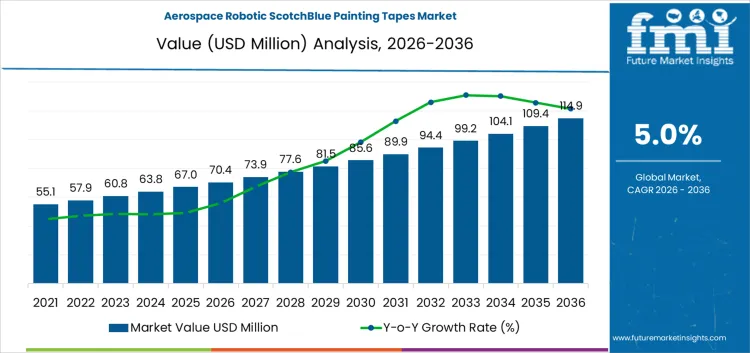
The aerospace robotic Scotchblue painting tapes market is likely to be valued at USD 70.4 million in 2026 and is projected to reach USD 114.9 million by 2036, reflecting a CAGR of 5.0%. Market expansion is influenced by capital intensity associated with precision tape manufacturing, robotic application systems, and aerospace-grade material compliance. Return timelines are extended due to rigorous testing, certification requirements, and alignment with aircraft production cycles. Investment selectivity is critical, with preference given to suppliers demonstrating high adhesion consistency, compatibility with automated painting equipment, and multi-aircraft platform applicability.
Financial performance is concentrated among companies that integrate tape production, robotic application solutions, and certification support. Adoption varies according to regional aircraft assembly volumes, aerospace OEM program schedules, and regulatory compliance. Margins favor operators providing validated, multi-platform tapes with technical guidance and integration support. Smaller suppliers face constraints in scaling production, meeting aerospace standards, and accessing high-volume OEM contracts. Concentrated value accrues to firms controlling production, certification, and robotic system compatibility rather than output quantity alone.
Quick Stats of the Aerospace Robotic Scotchblue Painting Tapes Market
- Aerospace Robotic Scotchblue Painting Tapes Market Value (2026): USD 70.4 million
- Aerospace Robotic Scotchblue Painting Tapes Forecast Value (2036): USD 114.9 million
- Aerospace Robotic Scotchblue Painting Tapes Forecast CAGR 2026 to 2036: 5.0%
- Leading Application in Aerospace Robotic Scotchblue Painting Tapes Market: Fuselage masking (41% share)
- Leading Aircraft Type in Aerospace Robotic Scotchblue Painting Tapes Market: Commercial aircraft (52% share)
- Key Growth Regions in Aerospace Robotic Scotchblue Painting Tapes Market: USA, France, Germany, Japan
- Top Players in Aerospace Robotic Scotchblue Painting Tapes Market: 3M, Tesa SE, Nitto Denko, Saint-Gobain, Shurtape, Intertape Polymer
What is the Growth Forecast for Aerospace Robotic Scotchblue Painting Tapes Market through 2036?
Between 2026 and 2031, the aerospace robotic Scotchblue painting tapes market is projected to grow from USD 70.4 million to USD 85.6 million, generating an absolute increase of USD 15.2 million and reflecting a CAGR of 5.0%. Growth is driven by adoption in fuselage masking, wing and composite applications, and MRO repainting across commercial, military, and business jets. Robotic automation and manual processes are key enablers. Expansion is supported by increasing aircraft production, rising MRO activities, and demand for precise, repeatable masking solutions. Suppliers focus on tape adhesion, residue-free performance, and compatibility with aerospace paints.
From 2031 to 2036, the market is expected to expand from USD 85.6 million to USD 114.9 million, adding USD 28.9 million. Growth is supported by wider adoption of robotic masking, enhanced tape technologies, and increasing aircraft fleet maintenance. Market drivers include operational efficiency, reduced labor costs, and improved coating quality. Competitive advantage favors suppliers providing high-performance, aerospace-certified tapes and technical support for robotic and manual applications. Leading companies include 3M, Tesa SE, Nitto Denko, Saint-Gobain, Shurtape, and Intertape Polymer.
Aerospace Robotic Scotchblue Painting Tapes Market Key Takeaways
| Metric | Value |
|---|---|
| Market Value (2026) | USD 70.4 million |
| Forecast Value (2036) | USD 114.9 million |
| Forecast CAGR 2026 to 2036 | 5.00% |
What Is Driving Demand for Aerospace Robotic Scotchblue Painting Tapes?
Aerospace robotic ScotchBlue painting tapes are increasingly adopted to support precision masking during automated painting and coating processes in aircraft manufacturing and maintenance. Historically, masking relied on manual tape application, which limited accuracy, increased labor costs, and extended production cycles. Modern robotic-compatible tapes provide consistent adhesion, clean edges, and resistance to solvents and high temperatures, enabling seamless integration with automated painting systems. Aerospace OEMs, maintenance providers, and coating suppliers prioritize tape durability, compatibility with robotic applicators, and residue-free removal. Early adoption focused on high-value military and commercial aircraft, while current demand extends to wide-body and regional fleets driven by production efficiency, surface finish quality, and regulatory coating standards. Tape adhesion, flexibility, and removal performance influence selection and deployment.
Rising production automation, quality control standards, and efficiency requirements are shaping market growth. Compared with conventional masking methods, robotic ScotchBlue tapes emphasize uniform application, chemical resistance, and compatibility with high-speed robotic arms. Cost structures depend on adhesive formulation, backing material, and production precision, concentrating margins among suppliers capable of delivering consistent, high-performance tapes. Aerospace manufacturers adopt these tapes to reduce labor, improve surface finish, and integrate seamlessly with automated coating lines. By 2036, robotic ScotchBlue painting tapes are expected to become standard in aircraft painting operations, supporting efficiency, precision, and regulatory compliance across commercial and military aerospace production.
What Factors Are Shaping the Demand for Aerospace Robotic Scotchblue Painting Tapes in Terms of Application and Aircraft Type?
The demand for aerospace robotic Scotchblue painting tapes is segmented by application and aircraft type. Applications include fuselage masking, wing and composite surface protection, and MRO repainting. Aircraft types include commercial aircraft, military aircraft, and business jets. Adoption is influenced by surface protection requirements, coating precision, and operational efficiency. Uptake is driven by automation trends, labor cost reduction, and paint quality consistency. Application and aircraft type selection depend on surface complexity, paint process requirements, and maintenance schedules, ensuring reliable, accurate, and scalable masking solutions across commercial, defense, and business aviation sectors.
Why Is Fuselage Masking Leading the Application Segment in Aerospace Robotic Scotchblue Painting Tapes?
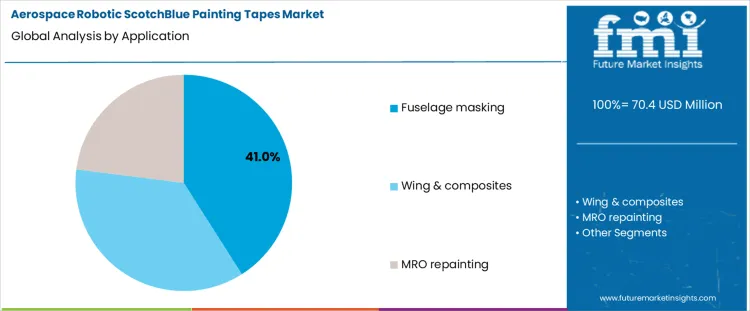
Fuselage masking accounts for approximately 41% of total application demand, making it the leading category. Robotic painting systems use Scotchblue tapes to precisely mask fuselage surfaces during coating operations. Adoption is driven by the need for consistent paint lines, minimal overspray, and high-quality finishes. These tapes integrate with robotic arms and automated applicators to ensure repeatable masking across large aircraft surfaces. Operational procedures include surface preparation, tape application, adhesion verification, and alignment with robotic programming. Fuselage masking leads because it provides reliable protection, reduces paint defects, and improves coating efficiency, particularly for high-volume commercial aircraft production and refurbishment.
Operational factors further support adoption. Tapes must withstand solvent exposure, maintain adhesion during curing, and allow clean removal without residue. Masking must accommodate curvature, panel seams, and access to inspection points. Fuselage masking leads because robotic application ensures precision, operational efficiency, and reproducible results, enhancing coating quality, reducing labor dependency, and enabling scalable automation in commercial, military, and MRO operations.
Why Are Commercial Aircraft Representing the Largest Aircraft Type Segment in Aerospace Robotic Scotchblue Painting Tapes?
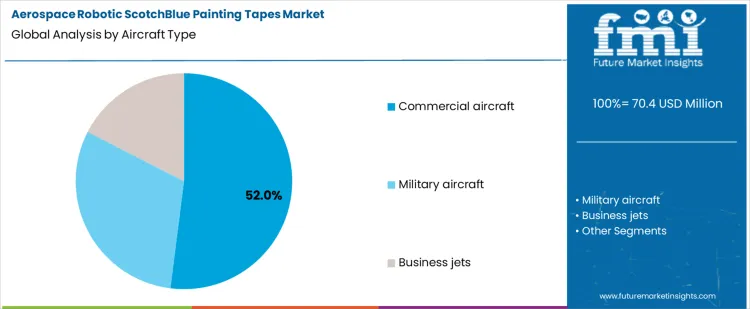
Commercial aircraft account for approximately 52% of total aircraft type demand, making them the largest category. Adoption is driven by high production volumes, complex fuselage geometry, and stringent paint quality standards. Robotic painting systems with Scotchblue tapes are employed to mask fuselage panels, control surface edges, and wing roots. Operational procedures include tape alignment, robotic calibration, surface inspection, and post-process removal. Automation ensures consistent paint coverage, minimal overspray, and reduced cycle time.
Functional and operational factors further reinforce adoption. Tapes must adhere reliably under variable temperature and humidity conditions, be compatible with primers and coatings, and facilitate repeatable robotic operation. Commercial aircraft lead because robotic masking delivers measurable efficiency, paint quality, and scalability, supporting both new production and MRO repainting operations while maintaining operational safety and regulatory compliance.
How Are Robotic Scotchblue Tapes Enhancing Aerospace Painting Precision?
Robotic Scotchblue painting tapes are increasingly adopted in aerospace manufacturing for automated masking during painting, coating, and surface finishing processes. Adoption is strongest in regions with high aircraft production, advanced automation, and stringent surface quality standards. Tapes are selected for adhesion reliability, clean removal, and resistance to paint bleed under robotic application. Growth is driven by the need for consistent finish quality, reduced labor dependency, and faster production cycles. Investment focuses on tape material innovation, robotic application compatibility, and process repeatability. Manufacturers prioritize tapes that maintain coating precision, withstand varied environmental conditions, and integrate with automated painting systems.
Why Are Regional Aerospace Production and Automation Initiatives Driving Adoption?
Demand is influenced by local aircraft manufacturing volumes, aerospace automation programs, and regulatory requirements for coating quality. Manufacturers adopt robotic tapes to minimize masking errors, enhance surface finish consistency, and reduce rework. Products offering high adhesion, residue-free removal, and adaptability to complex geometries gain preference. Adoption is concentrated in regions with high aircraft assembly activity and advanced automation infrastructure. Process efficiency, finish quality, and operational reliability drive procurement rather than cost. Suppliers delivering validated, robot-compatible tapes gain competitive advantage among aerospace OEMs and coating system integrators.
What Operational Constraints Limit Broader Deployment of Robotic Painting Tapes?
High tape material costs, compatibility requirements with robotic systems, and environmental sensitivity restrict adoption. Performance can degrade under temperature fluctuations, humidity, or extended application times. Integration with robotic arms and programming requires technical expertise. Smaller aerospace manufacturers or regions with limited automated painting infrastructure adopt tapes more slowly. These factors concentrate early deployment among large OEMs, tier-one suppliers, and facilities with advanced coating automation capabilities.
How Are Material Innovations and Collaborative Robotics Shaping Market Trends?
Recent developments include multi-layer tape constructions, enhanced adhesion polymers, and tapes optimized for robotic handling and complex surface geometries. Collaboration between tape manufacturers, robotic system integrators, and aerospace coating engineers ensures performance validation, automation compatibility, and regulatory compliance. Pilot programs evaluate masking accuracy, residue-free removal, and coating uniformity before full-scale deployment. Quality monitoring, process standardization, and material traceability maintain consistent performance. Focus is on coating precision, automation efficiency, and operational reliability rather than cost or volume. Collaborative initiatives enable broader adoption of robotic Scotchblue painting tapes in aerospace manufacturing and surface finishing operations.
What is the Demand for Aerospace Robotic Scotchblue Painting Tapes by Country?
| Country | CAGR (%) |
|---|---|
| USA | 5.0% |
| France | 4.8% |
| Germany | 4.6% |
| Japan | 4.5% |
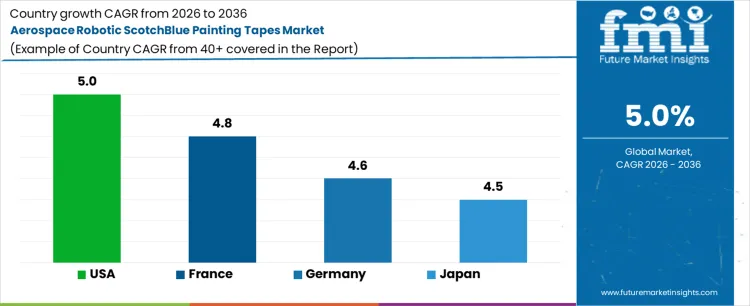
Demand for aerospace robotic Scotchblue painting tapes is rising as aircraft manufacturers and MRO providers adopt automated masking solutions to improve coating precision, reduce labor costs, and enhance production efficiency. The USA leads with a 5.0% CAGR, driven by high adoption of robotic painting systems, large-scale aircraft manufacturing, and maintenance operations. France follows at 4.8%, supported by aerospace production facilities and MRO services. Germany records 4.6% growth, shaped by integration of robotic masking in commercial and defense aviation programs. Japan shows 4.5% CAGR, reflecting steady adoption in aircraft coating operations and gradual implementation of automated painting technologies.
How Is the United States Experiencing Growth in the Aerospace Robotic Scotchblue Painting Tapes Market?
United States is experiencing growth at a CAGR of 5%, supported by adoption of Aerospace Robotic Scotchblue Painting Tapes Market solutions in aerospace manufacturing and maintenance for precise masking during automated painting operations. Manufacturers and suppliers are deploying tapes optimized for adhesion, temperature resistance, and compatibility with robotic painting systems. Demand is concentrated in aircraft assembly lines, maintenance facilities, and aerospace R&D centers. Investments focus on material performance, robotic integration, and compliance with aerospace coating standards rather than large-scale deployment. Growth reflects industrial adoption of automated painting processes, increasing aircraft production, and demand for precision finishing in aerospace applications.
- Automated aerospace painting drives adoption.
- Tapes optimize adhesion, temperature resistance, and precision.
- Aircraft assembly lines and R&D centers concentrate demand.
- Material performance and robotic integration guide investment.
How Is France Witnessing Growth in the Aerospace Robotic Scotchblue Painting Tapes Market?
France is witnessing growth at a CAGR of 4.8%, supported by adoption of Aerospace Robotic Scotchblue Painting Tapes Market solutions in aircraft manufacturing and maintenance to enable precise masking during automated painting. Manufacturers and suppliers are producing tapes optimized for adhesion, thermal resistance, and robotic system compatibility. Demand is concentrated in aerospace assembly lines, R&D centers, and maintenance hubs. Investments focus on material quality, integration with robotic painting systems, and compliance with coating standards rather than fleet-scale deployment. Growth reflects industrial adoption of automated painting, aircraft production expansion, and precision finishing requirements.
- Automated painting drives adoption.
- Tapes ensure adhesion, temperature resistance, and precision.
- Aerospace assembly lines and R&D centers concentrate demand.
- Material quality and system integration guide investment.
How Is Germany Experiencing Growth in the Aerospace Robotic Scotchblue Painting Tapes Market?
Germany is experiencing growth at a CAGR of 4.6%, fueled by adoption of Aerospace Robotic Scotchblue Painting Tapes Market solutions to improve masking accuracy during robotic painting operations in aircraft manufacturing and maintenance. Manufacturers and suppliers are deploying tapes optimized for adhesion, thermal resistance, and compatibility with automated systems. Demand is concentrated in aerospace production hubs, R&D facilities, and maintenance centers. Investments prioritize material performance, integration with robotic painting equipment, and adherence to aerospace coating standards rather than large-scale deployment. Growth reflects industrial adoption of automation, precise finishing requirements, and aerospace manufacturing efficiency initiatives.
- Robotic painting drives adoption.
- Tapes optimize adhesion, thermal resistance, and masking precision.
- Aerospace hubs and R&D centers concentrate demand.
- Material performance and robotic integration guide investment.
How Is Japan Witnessing Growth in the Aerospace Robotic Scotchblue Painting Tapes Market?
Japan is witnessing growth at a CAGR of 4.5%, supported by adoption of Aerospace Robotic Scotchblue Painting Tapes Market solutions in automated painting operations for aerospace manufacturing and maintenance. Manufacturers and suppliers are producing tapes optimized for adhesion, temperature tolerance, and robotic system compatibility. Demand is concentrated in aircraft assembly lines, R&D centers, and aerospace maintenance facilities. Investments focus on material performance, precision integration with robotic painting, and compliance with coating standards rather than large-scale fleet deployment. Growth reflects industrial adoption of automation, aircraft production, and demand for high-precision masking solutions in aerospace operations.
- Automated painting drives adoption.
- Tapes provide adhesion, thermal tolerance, and precision.
- Aircraft assembly lines and R&D centers concentrate demand.
- Material performance and system integration guide investment.
Who Competes in the Aerospace Robotic Scotchblue Painting Tapes Market and What Defines Their Capabilities?
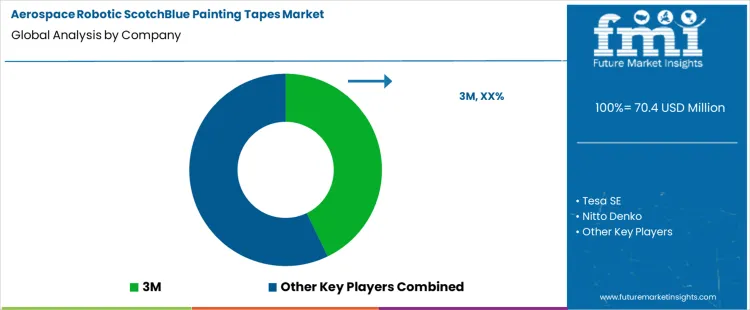
Competition in the aerospace robotic Scotchblue painting tapes market is defined by adhesion reliability, clean removal, and compatibility with robotic application systems. 3M supplies Scotchblue tapes engineered for high-performance masking in automated aerospace painting, providing consistent adhesion and residue-free removal. Tesa SE offers tapes optimized for robotic application with uniform release properties and thermal stability for aerospace coatings. Nitto Denko develops high-precision masking tapes designed for clean detachment and resistance to solvents and paint overspray. Saint-Gobain provides specialty tapes for robotic painting processes with controlled adhesion and dimensional stability. Shurtape delivers aerospace-grade tapes compatible with automated painting systems, emphasizing clean peel performance.
Intertape Polymer supplies tapes engineered for consistency in robotic coating lines, offering resistance to heat and solvents used in aerospace finishing. Other competitors include regional manufacturers and specialty adhesive suppliers producing masking tapes tailored for automated aerospace painting and coating processes. Differentiation arises from adhesive formulation, clean peel performance, dimensional stability, thermal tolerance, and compatibility with robotic dispensing equipment. Market relevance is shaped by tape reliability during high-speed automated operations, ease of removal without residue, and performance under repeated cycles of coating and curing. Companies offering validated, consistent tape performance with robotic integration maintain a competitive edge in aerospace finishing applications.
Key Players in the Aerospace Robotic Scotchblue Painting Tapes Market
- 3M
- Tesa SE
- Nitto Denko
- Saint-Gobain
- Shurtape
- Intertape Polymer
Scope of the Report
| Items | Values |
|---|---|
| Quantitative Units (2026) | USD million |
| Application | Fuselage masking, Wing & composites, MRO repainting |
| Aircraft Type | Commercial aircraft, Military aircraft, Business jets |
| Automation Level | Robotic, Manual |
| Region | Asia Pacific, Europe, North America, Latin America, Middle East & Africa |
| Key Countries Covered | USA, France, Germany, Japan |
| Key Companies Profiled | 3M, Tesa SE, Nitto Denko, Saint-Gobain, Shurtape, Intertape Polymer |
| Additional Attributes | Dollar sales by application, aircraft type, and automation level; regional CAGR, volume and value growth projections; adoption across commercial, military, and business aircraft; validated adhesion, residue-free removal, and thermal stability; compatibility with robotic and manual painting systems; integration with automated painting lines and coating workflows; support for fuselage, wing, composite, and MRO repainting operations; focus on operational efficiency, coating precision, and repeatable masking performance; concentration of margins among suppliers offering certified aerospace tapes with technical support. |
Aerospace Robotic Scotchblue Painting Tapes Market Segmentation
Application:
- Fuselage masking
- Wing & composites
- MRO repainting
Aircraft Type:
- Commercial aircraft
- Military aircraft
- Business jets
Automation Level:
- Robotic
- Manual
Region
- Asia Pacific
- China
- Japan
- South Korea
- India
- Australia & New Zealand
- ASEAN
- Rest of Asia Pacific
- Europe
- Germany
- United Kingdom
- France
- Italy
- Spain
- Nordic
- BENELUX
- Rest of Europe
- North America
- United States
- Canada
- Mexico
- Latin America
- Brazil
- Chile
- Rest of Latin America
- Middle East & Africa
- Kingdom of Saudi Arabia
- Other GCC Countries
- Turkey
- South Africa
- Other African Union
- Rest of Middle East & Africa
Bibliography
SAE International. (2023). AMS03_2: Cleaning and preparation of metal surfaces. SAE International. SAE International
Federal Aviation Administration. (2018). Advisory Circular 43-4B: Corrosion control for aircraft. U.S. Department of Transportation, Federal Aviation Administration.
ASTM International. (2023). ASTM D3359-23: Standard test methods for rating adhesion by tape test. ASTM International.
International Federation of Robotics. (2023). World Robotics 2023: Industrial Robots. IFR Publishing.
National Institute for Aviation Research. (n.d.). Automation Research Center (ARC) laboratory overview. Wichita State University, NIAR.
National Institute for Aviation Research. (n.d.). Advanced Coatings laboratory overview. Wichita State University, NIAR
Frequently Asked Questions
How big is the aerospace robotic scotchblue painting tapes market in 2026?
The global aerospace robotic scotchblue painting tapes market is estimated to be valued at USD 70.4 million in 2026.
What will be the size of aerospace robotic scotchblue painting tapes market in 2036?
The market size for the aerospace robotic scotchblue painting tapes market is projected to reach USD 114.9 million by 2036.
How much will be the aerospace robotic scotchblue painting tapes market growth between 2026 and 2036?
The aerospace robotic scotchblue painting tapes market is expected to grow at a 5.0% CAGR between 2026 and 2036.
What are the key product types in the aerospace robotic scotchblue painting tapes market?
The key product types in aerospace robotic scotchblue painting tapes market are fuselage masking, wing & composites and mro repainting.
Which aircraft type segment to contribute significant share in the aerospace robotic scotchblue painting tapes market in 2026?
In terms of aircraft type, commercial aircraft segment to command 52.0% share in the aerospace robotic scotchblue painting tapes market in 2026.
Preview the report firsthand - request a free sample
Get SampleGet the brochure for pricing and purchase details.
Get PDFTable of Content
- Executive Summary
- Global Market Outlook
- Demand-side Trends
- Supply-side Trends
- Technology Roadmap Analysis
- Analysis and Recommendations
- Market Overview
- Market Coverage / Taxonomy
- Market Definition / Scope / Limitations
- Market Background
- Market Dynamics
- Drivers
- Restraints
- Opportunity
- Trends
- Scenario Forecast
- Demand in Optimistic Scenario
- Demand in Likely Scenario
- Demand in Conservative Scenario
- Opportunity Map Analysis
- Product Life Cycle Analysis
- Supply Chain Analysis
- Investment Feasibility Matrix
- Value Chain Analysis
- PESTLE and Porter’s Analysis
- Regulatory Landscape
- Regional Parent Market Outlook
- Production and Consumption Statistics
- Import and Export Statistics
- Market Dynamics
- Global Market Analysis 2021 to 2025 and Forecast, 2026 to 2036
- Historical Market Size Value (USD Million) Analysis, 2021 to 2025
- Current and Future Market Size Value (USD Million) Projections, 2026 to 2036
- Y-o-Y Growth Trend Analysis
- Absolute $ Opportunity Analysis
- Global Market Pricing Analysis 2021 to 2025 and Forecast 2026 to 2036
- Global Market Analysis 2021 to 2025 and Forecast 2026 to 2036, By Application
- Introduction / Key Findings
- Historical Market Size Value (USD Million) Analysis By Application , 2021 to 2025
- Current and Future Market Size Value (USD Million) Analysis and Forecast By Application , 2026 to 2036
- Fuselage masking
- Wing & composites
- MRO repainting
- Fuselage masking
- Y-o-Y Growth Trend Analysis By Application , 2021 to 2025
- Absolute $ Opportunity Analysis By Application , 2026 to 2036
- Global Market Analysis 2021 to 2025 and Forecast 2026 to 2036, By Aircraft Type
- Introduction / Key Findings
- Historical Market Size Value (USD Million) Analysis By Aircraft Type, 2021 to 2025
- Current and Future Market Size Value (USD Million) Analysis and Forecast By Aircraft Type, 2026 to 2036
- Commercial aircraft
- Military aircraft
- Business jets
- Commercial aircraft
- Y-o-Y Growth Trend Analysis By Aircraft Type, 2021 to 2025
- Absolute $ Opportunity Analysis By Aircraft Type, 2026 to 2036
- Global Market Analysis 2021 to 2025 and Forecast 2026 to 2036, By Automation Level
- Introduction / Key Findings
- Historical Market Size Value (USD Million) Analysis By Automation Level, 2021 to 2025
- Current and Future Market Size Value (USD Million) Analysis and Forecast By Automation Level, 2026 to 2036
- Robotic
- Manual
- Robotic
- Y-o-Y Growth Trend Analysis By Automation Level, 2021 to 2025
- Absolute $ Opportunity Analysis By Automation Level, 2026 to 2036
- Global Market Analysis 2021 to 2025 and Forecast 2026 to 2036, By Region
- Introduction
- Historical Market Size Value (USD Million) Analysis By Region, 2021 to 2025
- Current Market Size Value (USD Million) Analysis and Forecast By Region, 2026 to 2036
- North America
- Latin America
- Western Europe
- Eastern Europe
- East Asia
- South Asia and Pacific
- Middle East & Africa
- Market Attractiveness Analysis By Region
- North America Market Analysis 2021 to 2025 and Forecast 2026 to 2036, By Country
- Historical Market Size Value (USD Million) Trend Analysis By Market Taxonomy, 2021 to 2025
- Market Size Value (USD Million) Forecast By Market Taxonomy, 2026 to 2036
- By Country
- USA
- Canada
- Mexico
- By Application
- By Aircraft Type
- By Automation Level
- By Country
- Market Attractiveness Analysis
- By Country
- By Application
- By Aircraft Type
- By Automation Level
- Key Takeaways
- Latin America Market Analysis 2021 to 2025 and Forecast 2026 to 2036, By Country
- Historical Market Size Value (USD Million) Trend Analysis By Market Taxonomy, 2021 to 2025
- Market Size Value (USD Million) Forecast By Market Taxonomy, 2026 to 2036
- By Country
- Brazil
- Chile
- Rest of Latin America
- By Application
- By Aircraft Type
- By Automation Level
- By Country
- Market Attractiveness Analysis
- By Country
- By Application
- By Aircraft Type
- By Automation Level
- Key Takeaways
- Western Europe Market Analysis 2021 to 2025 and Forecast 2026 to 2036, By Country
- Historical Market Size Value (USD Million) Trend Analysis By Market Taxonomy, 2021 to 2025
- Market Size Value (USD Million) Forecast By Market Taxonomy, 2026 to 2036
- By Country
- Germany
- UK
- Italy
- Spain
- France
- Nordic
- BENELUX
- Rest of Western Europe
- By Application
- By Aircraft Type
- By Automation Level
- By Country
- Market Attractiveness Analysis
- By Country
- By Application
- By Aircraft Type
- By Automation Level
- Key Takeaways
- Eastern Europe Market Analysis 2021 to 2025 and Forecast 2026 to 2036, By Country
- Historical Market Size Value (USD Million) Trend Analysis By Market Taxonomy, 2021 to 2025
- Market Size Value (USD Million) Forecast By Market Taxonomy, 2026 to 2036
- By Country
- Russia
- Poland
- Hungary
- Balkan & Baltic
- Rest of Eastern Europe
- By Application
- By Aircraft Type
- By Automation Level
- By Country
- Market Attractiveness Analysis
- By Country
- By Application
- By Aircraft Type
- By Automation Level
- Key Takeaways
- East Asia Market Analysis 2021 to 2025 and Forecast 2026 to 2036, By Country
- Historical Market Size Value (USD Million) Trend Analysis By Market Taxonomy, 2021 to 2025
- Market Size Value (USD Million) Forecast By Market Taxonomy, 2026 to 2036
- By Country
- China
- Japan
- South Korea
- By Application
- By Aircraft Type
- By Automation Level
- By Country
- Market Attractiveness Analysis
- By Country
- By Application
- By Aircraft Type
- By Automation Level
- Key Takeaways
- South Asia and Pacific Market Analysis 2021 to 2025 and Forecast 2026 to 2036, By Country
- Historical Market Size Value (USD Million) Trend Analysis By Market Taxonomy, 2021 to 2025
- Market Size Value (USD Million) Forecast By Market Taxonomy, 2026 to 2036
- By Country
- India
- ASEAN
- Australia & New Zealand
- Rest of South Asia and Pacific
- By Application
- By Aircraft Type
- By Automation Level
- By Country
- Market Attractiveness Analysis
- By Country
- By Application
- By Aircraft Type
- By Automation Level
- Key Takeaways
- Middle East & Africa Market Analysis 2021 to 2025 and Forecast 2026 to 2036, By Country
- Historical Market Size Value (USD Million) Trend Analysis By Market Taxonomy, 2021 to 2025
- Market Size Value (USD Million) Forecast By Market Taxonomy, 2026 to 2036
- By Country
- Kingdom of Saudi Arabia
- Other GCC Countries
- Turkiye
- South Africa
- Other African Union
- Rest of Middle East & Africa
- By Application
- By Aircraft Type
- By Automation Level
- By Country
- Market Attractiveness Analysis
- By Country
- By Application
- By Aircraft Type
- By Automation Level
- Key Takeaways
- Key Countries Market Analysis
- USA
- Pricing Analysis
- Market Share Analysis, 2025
- By Application
- By Aircraft Type
- By Automation Level
- Canada
- Pricing Analysis
- Market Share Analysis, 2025
- By Application
- By Aircraft Type
- By Automation Level
- Mexico
- Pricing Analysis
- Market Share Analysis, 2025
- By Application
- By Aircraft Type
- By Automation Level
- Brazil
- Pricing Analysis
- Market Share Analysis, 2025
- By Application
- By Aircraft Type
- By Automation Level
- Chile
- Pricing Analysis
- Market Share Analysis, 2025
- By Application
- By Aircraft Type
- By Automation Level
- Germany
- Pricing Analysis
- Market Share Analysis, 2025
- By Application
- By Aircraft Type
- By Automation Level
- UK
- Pricing Analysis
- Market Share Analysis, 2025
- By Application
- By Aircraft Type
- By Automation Level
- Italy
- Pricing Analysis
- Market Share Analysis, 2025
- By Application
- By Aircraft Type
- By Automation Level
- Spain
- Pricing Analysis
- Market Share Analysis, 2025
- By Application
- By Aircraft Type
- By Automation Level
- France
- Pricing Analysis
- Market Share Analysis, 2025
- By Application
- By Aircraft Type
- By Automation Level
- India
- Pricing Analysis
- Market Share Analysis, 2025
- By Application
- By Aircraft Type
- By Automation Level
- ASEAN
- Pricing Analysis
- Market Share Analysis, 2025
- By Application
- By Aircraft Type
- By Automation Level
- Australia & New Zealand
- Pricing Analysis
- Market Share Analysis, 2025
- By Application
- By Aircraft Type
- By Automation Level
- China
- Pricing Analysis
- Market Share Analysis, 2025
- By Application
- By Aircraft Type
- By Automation Level
- Japan
- Pricing Analysis
- Market Share Analysis, 2025
- By Application
- By Aircraft Type
- By Automation Level
- South Korea
- Pricing Analysis
- Market Share Analysis, 2025
- By Application
- By Aircraft Type
- By Automation Level
- Russia
- Pricing Analysis
- Market Share Analysis, 2025
- By Application
- By Aircraft Type
- By Automation Level
- Poland
- Pricing Analysis
- Market Share Analysis, 2025
- By Application
- By Aircraft Type
- By Automation Level
- Hungary
- Pricing Analysis
- Market Share Analysis, 2025
- By Application
- By Aircraft Type
- By Automation Level
- Kingdom of Saudi Arabia
- Pricing Analysis
- Market Share Analysis, 2025
- By Application
- By Aircraft Type
- By Automation Level
- Turkiye
- Pricing Analysis
- Market Share Analysis, 2025
- By Application
- By Aircraft Type
- By Automation Level
- South Africa
- Pricing Analysis
- Market Share Analysis, 2025
- By Application
- By Aircraft Type
- By Automation Level
- USA
- Market Structure Analysis
- Competition Dashboard
- Competition Benchmarking
- Market Share Analysis of Top Players
- By Regional
- By Application
- By Aircraft Type
- By Automation Level
- Competition Analysis
- Competition Deep Dive
- 3M
- Overview
- Product Portfolio
- Profitability by Market Segments (Product/Age /Sales Channel/Region)
- Sales Footprint
- Strategy Overview
- Marketing Strategy
- Product Strategy
- Channel Strategy
- Tesa SE
- Nitto Denko
- Saint-Gobain
- Shurtape
- Intertape Polymer
- 3M
- Competition Deep Dive
- Assumptions & Acronyms Used
- Research Methodology


