

- Market Size (2026)
- USD 1.4 Bn
- Forecast (2036)
- USD 2.6 Bn
- CAGR (2026 to 2036)
- 6.4%
Aerospace-Grade Conduit and Raceway Fitting Systems Market Size, Forecast, and Outlook By FMI
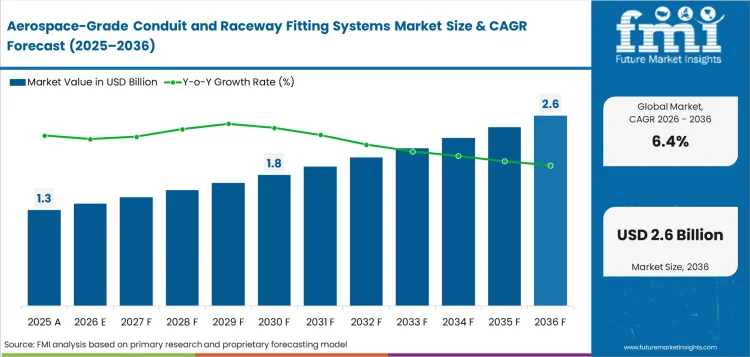
The aerospace-grade conduit and raceway fitting systems market was valued at USD 1.3 billion in 2025. Market value is expected to reach USD 1.4 billion in 2026 and reach USD 2.6 billion by 2036 at 6.4% CAGR.
Summary of the Aerospace-Grade Conduit and Raceway Fitting Systems Market
- Demand and Growth Drivers
- Higher aircraft electrical content is turning wire routing hardware into a certified platform decision.
- OEMs need repeatable conduit and raceway geometry as wiring bundles move through tight fuselage zones.
- MRO providers need traceable fittings as older aircraft receive avionics and cabin electrical upgrades.
- Product and Segment View
- OEM supply is expected to account for 61.4% share in 2026 since fittings are locked during aircraft design approval.
- Commercial aircraft is forecast to account for 57.8% share in 2026, reflecting single-aisle production using recurring wiring hardware.
- Aluminum alloy fittings are expected to hold 44.6% share in 2026 due to weight control and corrosion resistance needs.
- Geography and Competitive Outlook
- India is expected to grow at an 8.4% CAGR by 2036, reflected by expanding airline fleets and increasing local maintenance capacity.
- China is anticipated to expand at a 7.7% CAGR by 2036, driven by rising domestic aircraft production and greater demand for certified routing components.
- Amphenol and Eaton compete on qualified interconnect breadth. Glenair competes through conduit depth and assembly support.
- Analyst Opinion
- Nikhil Kaitwade, Principal Consultant at FMI, says, “As wiring density increases across modern aircraft platforms, aerospace conduit and raceway fittingsare shifting from simple routing parts to certified components that affect system reliability. Suppliers that show strict qualification control and repeatable fit across different aircraft zones gain preferred supplier status. OEMs value certified solutions paired with short lead times for engineering changes.”
- Aerospace-Grade Conduit and Raceway Fitting Systems Market Value Analysis
- Aerospace-grade conduit and raceway fitting value is shifting from basic cable support toward certified routing hardware with traceable material records.
- Operator spending is tied to wiring protection as MRO shops compare fit accuracy and documentation quality during avionics changes.
- Aircraft builders link fitting selection with weight control as conduit systems must protect harnesses without adding avoidable mass.
- Demand is supported by commercial airframes and defense platforms seeking repeatable wire protection across high-vibration areas.
Key Takeaways, Market Size, and Forecast
- The aerospace-grade conduit and raceway fitting systems market size stood at USD 1.3 billion in 2025.
- The aerospace-grade conduit and raceway fitting systems market value is expected to reach USD 2.6 billion by 2036.
- From 2026 to 2036, the sector is expected to expand at 6.4% CAGR.
- Market expansion is estimated to create an incremental opportunity of USD 1.2 billion from 2026 to 2036.
- OEM supply is projected to account for 61.4% share of sales channel in 2026.
- In 2026, commercial aircraft is forecast to account for 57.8% share of aircraft type.
- Country-level analysis projects India at 8.4% CAGR, followed by China at 7.7% CAGR by 2036.
Aircraft wiring pressure is rising as OEMs need protected routing hardware supporting production schedules and retrofit work. In January 2026, Airbus reported 793 commercial aircraft deliveries for 2025 and a backlog of 8,754 aircraft. This backlog gives approved conduit fitting and raceway suppliers a stronger route into repeat line-fit orders. In February 2025, EASA certified Safran’s ENGINeUS 100 electric engine under SC E-19 with a power range of 89 kW to 180 kW, making traceable routing hardware more important near power electronics and engine zones. Supplier competition is also shifting toward full interconnect packages. Amphenol’s May 2024 acquisition of CIT added a harsh-environment interconnect business with expected 2024 sales of about USD 900 million. Leading suppliers with connectors and cable management parts under one qualification path are well placed to gain OEM and MRO work.
Aerospace-Grade Conduit and Raceway Fitting Systems Market Definition
Aerospace-grade conduit and raceway fitting systems cover certified parts used to route and protect aircraft wiring. Scope includes conduit fittings and raceway fittings sold for aircraft electrical wiring interconnection systems. Backshells and cable clamps are included when sold for aircraft wire protection. Hardware used with aircraft wire bundles and harness runs is included. Products used only in ground buildings or airport electrical work fall outside core value.
Aerospace-Grade Conduit and Raceway Fitting Systems Market Inclusions
Scope includes aircraft-grade conduit connectors and backshell interfaces used in commercial aircraft. Raceway fittings used in military and business aircraft are included. Material coverage includes aluminum alloy and stainless steel. Composite and polymer products complete the material view. OEM line-fit and MRO replacement channels are included. Custom assemblies are counted if the fitting package is sold as part of aircraft wire protection work.
Aerospace-Grade Conduit and Raceway Fitting Systems Market Exclusions
Scope excludes building conduit, airport terminal raceways and general industrial cable trays. Standard electrical fittings used outside certified aircraft programs are excluded. Wire harness assembly value is excluded unless fittings are priced separately. Avionics boxes and connectors are excluded unless sold as a conduit or raceway interface package.
Aerospace-Grade Conduit and Raceway Fitting Systems Market Research Methodology
- Primary Research: Interviews by FMI analysts covered OEM wiring workflows, distributor stocking practice and MRO fitting replacement needs across major aerospace countries.
- Desk Research: Aviation fleet data, aerospace output figures and official company releases supported aircraft exposure and program timing checks.
- Market Sizing and Forecasting: Forecast values used aircraft build rates, wiring density assumptions and fitting content per aircraft platform.
- Data Validation: Checks compared 2026 value with 2036 value, segment shares and country growth patterns against aircraft production maturity.
Why is the Aerospace-Grade Conduit and Raceway Fitting Systems Market Growing?
- Aircraft electrical routing is becoming denser as power, sensor and data lines need protected paths through crowded airframes.
- Certification discipline is raising part value as suppliers must prove material traceability and drawing control.
- Fleet retrofit work is increasing fitting replacement as avionics and cabin systems add new wire routes.
Aircraft builders are treating wire protection as part of reliability planning rather than a late-stage installation choice. EASA reported over 7.7 million European flights in 2024 through 623 air operator certificate holders. Large active fleets create repeat demand for inspection access and replacement routing hardware. The connector supply chain reinforces the same need as backshells and conduit interfaces must align at termination points. Suppliers able to document finish quality and fit checks gain stronger access to OEM programs and MRO work packages.
Market Segmentation Analysis
- Conduit fittings are expected to account for 38.7% share in 2026 as flexible wire protection needs adapters and backshell interfaces.
- Aluminum alloy is projected to account for 44.6% share in 2026 since airframers balance strength and corrosion control.
- Airframe wiring is forecast to represent 41.2% share in 2026, led by fuselage and wing harness routes needing protective hardware.
- Commercial aircraft is expected to hold 57.8% share in 2026, driven by recurring single-aisle output and standardized harness routing zones.
- OEM supply is projected to capture 61.4% share in 2026 due to conduit and raceway fittings specified during platform wiring approval.
Market segmentation reflects how aircraft wiring parts are specified and bought. Product type separates conduit connectors from raceway hardware and backshell interfaces. Material type shows how weight and environmental exposure influence selection. Application area explains aircraft zones generating fitting demand. Aircraft type captures platform exposure across defense and business aircraft. Sales channel shows how line-fit approval differs from replacement buying.
Insights into Aerospace-Grade Conduit and Raceway Fitting Systems Market by Product Type
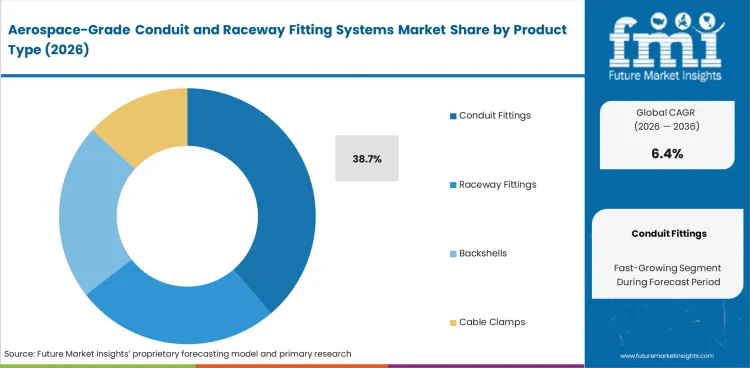
- Conduit fittings are expected to account for 38.7% share in 2026 since aircraft harness routes need sealed transitions and bend control in compact zones.
- Raceway fittings retain a defined role as floor and equipment bay wire runs need organized paths supporting inspection access.
Insights into Aerospace-Grade Conduit and Raceway Fitting Systems Market by Material Type
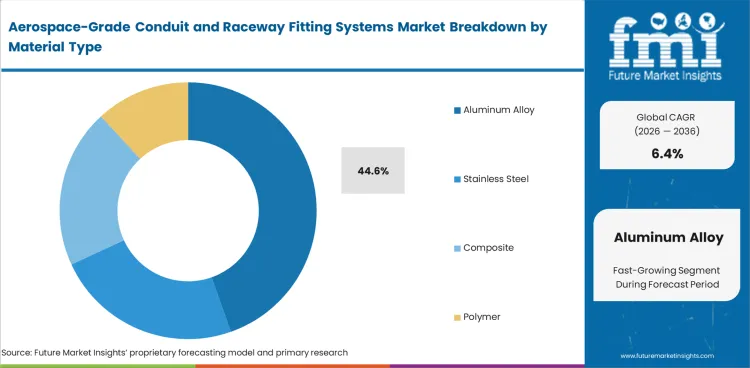
- Aluminum alloy is expected to represent 44.6% share in 2026 as the material gives aircraft builders a practical balance of low weight and machinable strength.
- Composite fittings gain attention in selected platforms as OEMs test lighter routes for non-hot zones and corrosion-sensitive areas.
Insights into Aerospace-Grade Conduit and Raceway Fitting Systems Market by Application Area
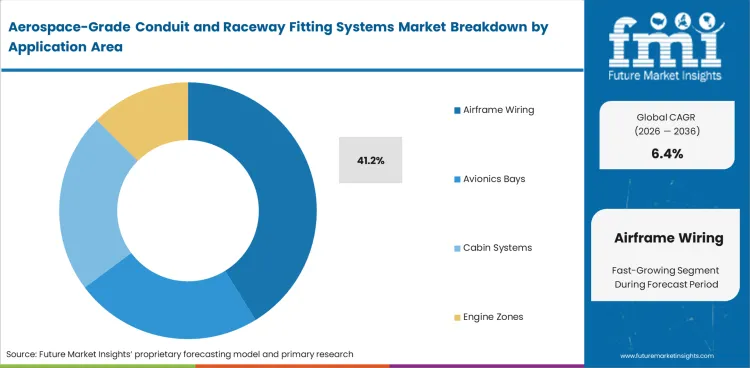
- Airframe wiring is projected to account for 41.2% share in 2026, led by fuselage and wing harness paths requiring protected routing across long aircraft zones.
- Avionics bays gain traction as signal integrity and connector access make neat wire routing more valuable during maintenance checks.
Insights into Aerospace-Grade Conduit and Raceway Fitting Systems Market by Aircraft Type
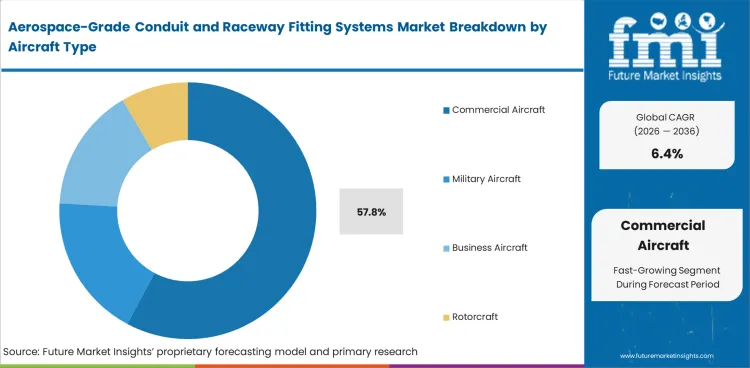
- Commercial aircraft is forecast to hold 57.8% share in 2026 since narrow-body and wide-body production repeats high-volume fitting packages across programs.
- Military aircraft holds a meaningful role as electromagnetic shielding and survivability needs raise fitting specification depth.
Insights into Aerospace-Grade Conduit and Raceway Fitting Systems Market by Sales Channel
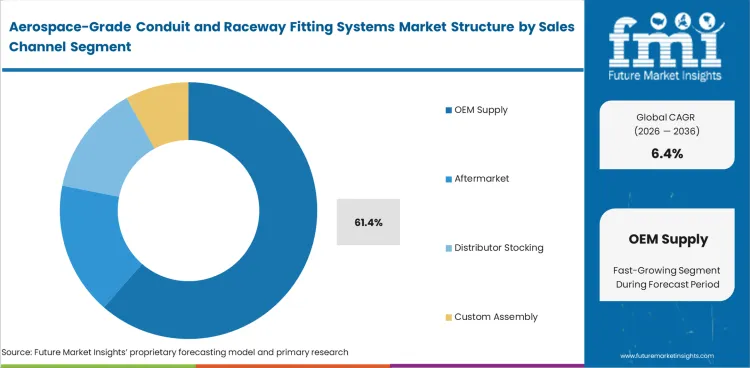
- OEM supply is expected to account for 61.4% share in 2026, as approved parts enter aircraft build plans before line installation begins.
- Aftermarket channels stay important as MRO teams replace damaged fittings and add new routing hardware during avionics upgrades.
Aerospace-Grade Conduit and Raceway Fitting Systems Market Drivers, Restraints and Opportunities
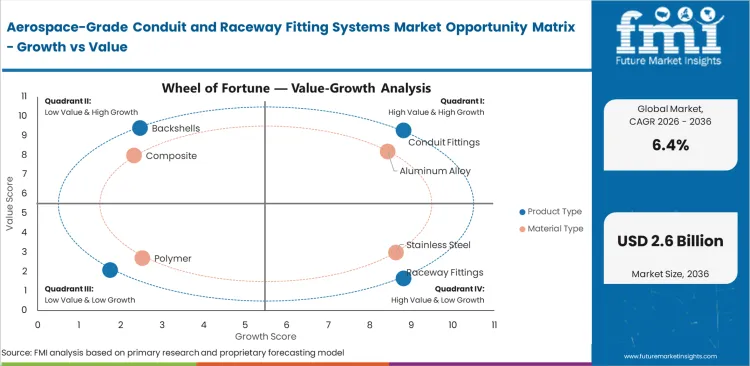
- Aircraft wiring density is raising demand for conduit fittings as power lines and data lines need safer routing through compact aircraft zones.
- Certification control can slow supplier approval since aerospace fittings need material traceability and drawing discipline before program use.
- Retrofit and electric aircraft work create opportunity as avionics upgrades and new propulsion layouts add protected wire routes.
Aerospace-grade conduit and raceway fitting system growth is expected to come from aircraft production, fleet wiring upgrades and certification-led part approval. Airbus reported 766 commercial aircraft deliveries in 2024 and a year-end backlog of 8,658 aircraft, supporting line-fit demand for approved wire protection hardware. EASA certified Safran’s ENGINeUS 100 electric engine in February 2025 under Special Condition SC E-19, reflecting how electrical architecture is moving further into aircraft certification. Amphenol completed the acquisition of Carlisle Interconnect Technologies in May 2024, strengthening harsh-environment interconnect coverage for commercial air and defense programs. Supplier opportunity is likely to strengthen in backshell interfaces and raceway hardware as OEMs and MRO providers compare part traceability and program approval records before awarding repeat contracts.
Regulatory Compliance and Operating Standards Analysis
Aerospace grade conduit and raceway fitting systems are expected to gain value as aircraft wiring moves into stricter safety and certification paths. EASA’s February 2025 certification of Safran’s ENGINeUS 100 electric engine under Special Condition SC E-19 shows how electrical architecture is becoming a controlled certification area. This shift supports demand for protected routing and approved installation records across airframe wiring and engine zones. Suppliers serving aircraft wire and cable programs will need stronger documentation as OEMs and MRO providers check material control before approving parts.
Competitive Benchmarking and Technology Positioning Analysis
Competitive benchmarking should focus on certified portfolio depth, cable routing fit, and ability to support OEM and aftermarket orders. TE Connectivity, Amphenol, Belden, Nexans, and Carlisle Interconnect are among key aircraft wire and cable suppliers, making interconnect breadth a useful comparison point for conduit and raceway fitting suppliers. Amphenol reports commercial aerospace exposure through interconnect systems and related aircraft applications in its 2025 Form 10-K. Over the forecast period, companies tied to aircraft cables and wiring assemblies can gain share by offering lighter fittings and documentation that supports faster approval.
Analysis of Aerospace-Grade Conduit and Raceway Fitting Systems Market by Key Countries
.webp "Top Country Growth Comparison Aerospace Grade Conduit And Raceway Fitting Systems Market Cagr (2026 2036)")
| Country | CAGR |
|---|---|
| India | 8.4% |
| China | 7.7% |
| United States | 6.2% |
| France | 6.1% |
| Germany | 5.8% |
| United Kingdom | 5.5% |
| Japan | 4.8% |
Source: Future Market Insights, 2026.
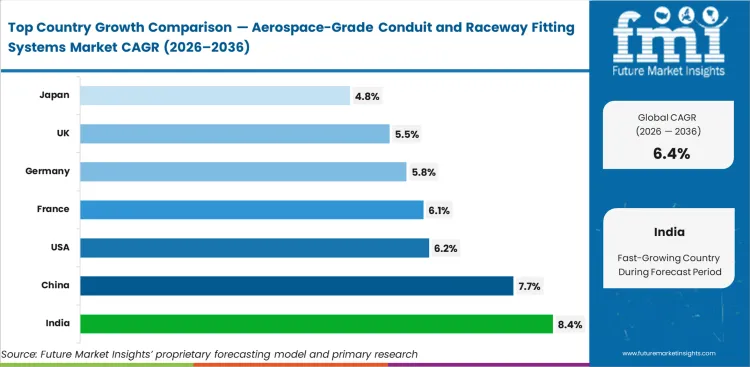
Aerospace-Grade Conduit and Raceway Fitting Systems Market CAGR Analysis by Country
- India is projected to record 8.4% CAGR by 2036 due to airline expansion and rising local aircraft maintenance capacity.
- China is expected to expand at 7.7% CAGR by 2036, reflected by domestic aircraft production and high commercial fleet scale.
- United States is forecast to grow at 6.2% CAGR by 2036, influenced by OEM concentration and mature aerospace distribution.
- France is expected to advance at 6.1% CAGR by 2036 since civil and defense aerospace output supports qualified fitting demand.
- Germany is projected to rise at 5.8% CAGR by 2036 as aerospace suppliers serve airframe, cabin and systems programs.
- United Kingdom is forecast at 5.5% CAGR by 2036 through aircraft backlog exposure and specialized aerospace manufacturing.
- Japan is expected to post 4.8% CAGR by 2036, driven by steady MRO work and electronics-rich aircraft programs.
Country performance varies by aircraft production, MRO depth and program access. India and China track above global expansion as fleet growth adds new wiring work from a smaller starting point. United States and France stay close to the global rate due to established aerospace supply chains. Japan records lower growth as fitting demand is stable but less tied to fast aircraft output expansion.
Demand Outlook for Aerospace-Grade Conduit and Raceway Fitting Systems in India
Demand in India is projected to record 8.4% CAGR by 2036, led by airline fleet growth and MRO localization. India’s civil aviation ministry reported that scheduled and commuter operators held 834 aircraft at the end of December 2024. Larger local fleets create more maintenance touchpoints for wire protection hardware. Suppliers need approved part availability and technical support to convert aircraft use into fitting orders.
- Growing MRO activity in India may boost replacement demand as operators bring maintenance work back from overseas.
- Airline fleet expansion should support repeat orders for cable clamps and conduit adapters during cabin changes.
- Approval discipline will decide supplier access as certified aircraft parts need traceable paperwork and stable stock.
Sales Analysis of Aerospace-Grade Conduit and Raceway Fitting Systems in China
Sector in China is expected to expand at 7.7% CAGR by 2036, driven by commercial fleet scale and domestic aircraft programs. China’s civil aviation regulator reported 65 commercial airlines and 4,574 commercial aircraft by the end of 2025. Large fleet size creates a broad pool for MRO fitting replacement. Local suppliers can gain share if qualification coverage matches aircraft program requirements.
- Domestic aircraft output raises line-fit need for repeatable conduit and raceway hardware.
- High airport throughput increases maintenance exposure for fittings used in cabin and avionics modifications.
- Price pressure may limit per-part value, so suppliers need efficient machining and broad distributor coverage.
Opportunity Analysis of Aerospace-Grade Conduit and Raceway Fitting Systems in the United States
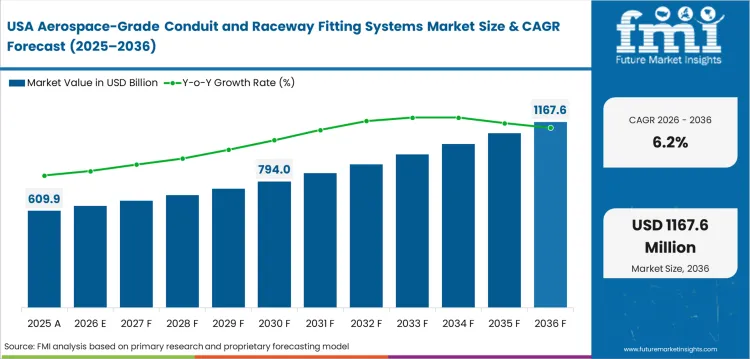
The market in United States is forecast to grow at 6.2% CAGR by 2036 with OEM scale and mature aftermarket channels. FAA forecast data expects the USA commercial aircraft fleet to rise to 10,607 aircraft by 2045. A larger fleet widens the pool for routing hardware during checks and modifications. Suppliers with quick spares access can defend positions across airline and defense service channels.
- OEM clusters create early access for suppliers with certified fitting families and engineering support.
- Defense aircraft programs support premium fittings with shielding and vibration performance requirements.
- Distributor depth affects replacement capture as grounded aircraft work needs fast part availability.
Demand Outlook for Aerospace-Grade Conduit and Raceway Fitting Systems in France
Sector in France is expected to advance at 6.1% CAGR by 2036, influenced by aircraft production and defense program activity. French aerospace industry revenue reached EUR 85.6 billion in 2025 according to GIFAS. Civil aeronautics accounted for EUR 63.3 billion of revenue. Qualified conduit and raceway hardware benefits from this industrial depth as aircraft electrical work passes through local suppliers.
- Airbus supply exposure gives French fitting suppliers a route into line-fit aircraft programs.
- Defense aircraft work supports specialty backshells and shielded conduit interfaces for demanding zones.
- Supplier qualification remains central as airframe programs require stable drawings and repeat test records.
Demand Analysis of Aerospace-Grade Conduit and Raceway Fitting Systems in Germany
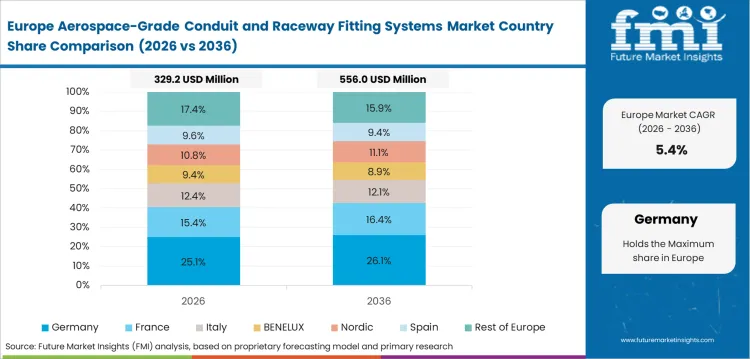
Demand in Germany is projected to rise at 5.8% CAGR by 2036 as aerospace suppliers support airframe and systems production. BDLI reported German aerospace turnover of EUR 52.0 billion in 2024. Civil aviation accounted for EUR 39.0 billion of total turnover. German suppliers should keep steady fitting demand as wiring protection remains tied to aircraft systems work.
- Systems suppliers can use local engineering depth to support conduit routing changes during program updates.
- Civil aircraft exposure gives distributors a stable route for approved clamps and raceway fittings.
- Cost pressure will favor suppliers able to combine precision machining with documented quality checks.
Opportunity Analysis of Aerospace-Grade Conduit and Raceway Fitting Systems in the United Kingdom
The United Kingdom is forecast at 5.5% CAGR by 2036 through aircraft backlog exposure and specialized aerospace production. UK Civil Aviation Authority data shows air transport movements reached 2.1 million in 2024. Active airport movements support long-term aircraft use and maintenance checks. Long work packages support suppliers serving wing systems and wiring protection hardware.
- Wing and systems clusters can sustain fitting demand even without full aircraft assembly.
- Aerospace distributors gain value by holding certified stock for short-notice MRO requirements.
- Smaller suppliers need clear documentation to win work tied to export-controlled aircraft programs.
Future Outlook for Aerospace-Grade Conduit and Raceway Fitting Systems in Japan
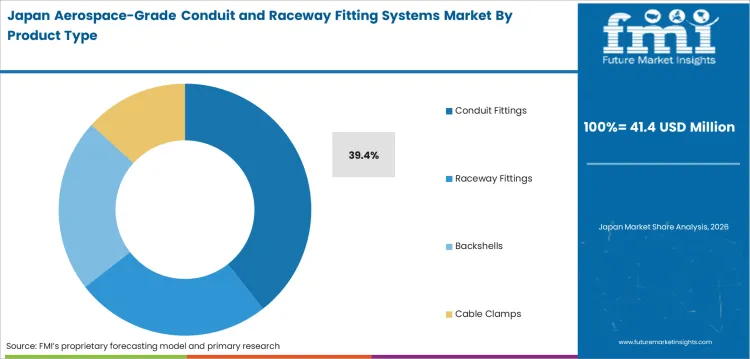
Demand in Japan is expected to post 4.8% CAGR by 2036 led by precision manufacturing and electronics-rich aircraft systems. Japan’s aerospace industry association lists about 130 companies across aircraft and related technologies. Established suppliers support MRO and systems work even as domestic aircraft assembly stays selective. Growth stays measured as demand is tied to quality depth more than rapid fleet expansion.
- Electronics and systems capability maintains careful fitting selection for avionics and data routes.
- MRO demand should favor suppliers with consistent quality and short delivery windows.
- Program access remains selective as local suppliers must align with global OEM qualification rules.
Competitive Landscape and Strategic Positioning
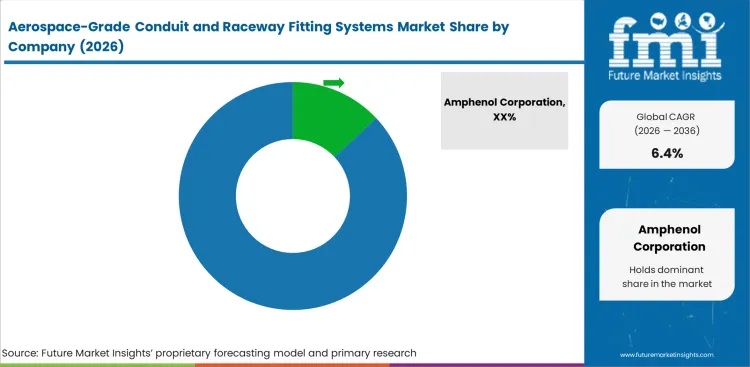
- Qualification coverage gives established suppliers a clear advantage as aircraft fittings need drawing control and material traceability.
- Portfolio depth separates conduit specialists from connector-only firms unable to support full wire routing packages.
- Distributor reach is becoming a commercial filter as MRO providers need approved fittings with shorter lead times.
Competition in aerospace-grade conduit and raceway fitting systems is shaped by certification access and product coverage. Interconnect specialists and conduit makers compete with distributors supporting OEM programs and MRO orders. Amphenol holds a strong position after adding CIT to its harsh-environment interconnect platform. Eaton has broader adoption across aerospace interconnects and wire protection products. Glenair stands out led by deep conduit system coverage and in-house fitting capability. TE Connectivity and Parker Hannifin defend their positions through connector accessory breadth and aerospace customer reach. Smaller firms can retain wide work by serving defense modifications and low-volume custom fittings.
Supplier strength now depends on fast response to aircraft wiring changes. Avionics upgrades and cabin changes often create new routing needs across existing platforms. Aircraft makers and MRO providers prefer suppliers providing finish options and mating interfaces with documented quality records. Broad distributors improve availability but cannot replace qualification depth. Suppliers with control across machining and plating have a stronger route to repeat OEM and MRO work. Companies combining approved product ranges with reliable delivery and clear documentation should hold an advantage.
Key Companies in the Aerospace-Grade Conduit and Raceway Fitting Systems Market
Competitive structure is easier to read when companies are grouped by service role. Interconnect groups control connector-to-conduit interfaces. Conduit specialists hold share with fitting depth and custom assembly support. Aerospace systems suppliers shape demand even though many fittings are bought through distributors.
- Global Interconnect Suppliers: Amphenol and TE Connectivity serve aircraft connector accessories, backshells and wire protection interfaces.
- Aerospace Systems Suppliers: Eaton and Parker Hannifin support aircraft electrical and mechanical routing needs through certified product families.
- Specialist Conduit and EWIS Providers: Glenair supports conduit assemblies. Safran Electrical & Power and Collins Aerospace support aircraft electrical systems.
Competitive Benchmarking: Aerospace-Grade Conduit and Raceway Fitting Systems Market
| Company | Conduit Portfolio Depth | Qualification Traceability | OEM Line-Fit Access | Geographic Footprint |
|---|---|---|---|---|
| Amphenol Corporation | High | Strong | Strong | Global |
| Eaton Corporation | High | Strong | Strong | Global |
| Glenair | High | Strong | Medium | North America and export markets |
| TE Connectivity | Medium | Strong | Strong | Global |
| Safran Electrical & Power | Medium | Strong | Strong | Global |
| Collins Aerospace | Medium | Strong | Strong | Global |
| Parker Hannifin | Medium | Strong | Medium | Global |
Source: Future Market Insights competitive analysis, 2026. Ratings reflect relative positioning based on conduit portfolio depth, qualification traceability and OEM line-fit access.
Key Developments in Aerospace-Grade Conduit and Raceway Fitting Systems Market
- In May 2024, Amphenol completed the acquisition of Carlisle Interconnect Technologies and expanded its harsh-environment interconnect offering for commercial air and defense programs.
- In January 2025, Airbus reported 766 commercial aircraft deliveries for 2024 and ended the year with 8,658 aircraft in backlog.
- at F4.1 standard under a 39-aircraft batch planned before the end of 2025.In December 2024, France’s defense acquisition agency received the 14th Rafale of 2024
Key Players in the Aerospace-Grade Conduit and Raceway Fitting Systems Market
Major Global Players:
- Amphenol Corporation
- Eaton Corporation
- Glenair
- TE Connectivity
- Parker Hannifin Corporation
- ITT Cannon
Specialist and Adjacent EWIS Providers:
- Safran Electrical & Power
- HellermannTyton
Report Scope and Coverage
| Parameter | Details |
|---|---|
| Quantitative Units | USD 1.4 billion to USD 2.6 billion at 6.4% CAGR |
| Market Definition | Aircraft-certified conduit and raceway fittings for wire protection and routing |
| Product Type | Conduit Fittings, Raceway Fittings, Backshells, Cable Clamps |
| Material Type | Aluminum Alloy, Stainless Steel, Composite, Polymer |
| Application Area | Airframe Wiring, Avionics Bays, Cabin Systems, Engine Zones |
| Aircraft Type | Commercial Aircraft, Military Aircraft, Business Aircraft, Rotorcraft |
| Sales Channel | OEM Supply, Aftermarket, Distributor Stocking, Custom Assembly |
| Regions Covered | North America, Latin America, Western Europe, Eastern Europe, East Asia, South Asia and Pacific, Middle East and Africa |
| Countries Covered | United States, China, India, France, Germany, United Kingdom, Japan |
| Key Companies Profiled | Amphenol, Eaton, Glenair, TE Connectivity, Safran Electrical & Power, Collins Aerospace, Parker Hannifin |
| Forecast Period | 2026 to 2036 |
| Approach | Bottom-up aircraft content model checked against fleet and aerospace output indicators |
Source: Future Market Insights, 2026.
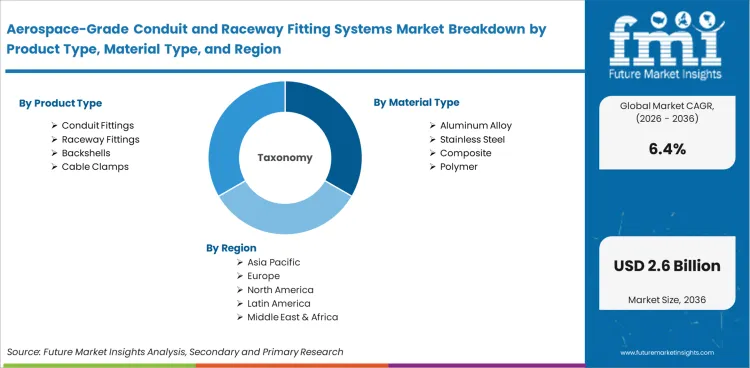
Aerospace-Grade Conduit and Raceway Fitting Systems Market Breakdown by Product Type, Material Type, Application Area, Aircraft Type, Sales Channel, and Region
By Product Type:
- Conduit Fittings
- Raceway Fittings
- Backshells
- Cable Clamps
By Material Type:
- Aluminum Alloy
- Stainless Steel
- Composite
- Polymer
By Application Area:
- Airframe Wiring
- Avionics Bays
- Cabin Systems
- Engine Zones
By Aircraft Type:
- Commercial Aircraft
- Military Aircraft
- Business Aircraft
- Rotorcraft
By Sales Channel:
- OEM Supply
- Aftermarket
- Distributor Stocking
- Custom Assembly
By Region:
- North America
- Latin America
- Western Europe
- Eastern Europe
- East Asia
- South Asia and Pacific
- Middle East and Africa
Research Sources and Bibliography
- Airbus. (2025, January 9). Airbus reports 766 commercial aircraft deliveries in 2024.
- Airbus. (2026, January 12). Airbus reports 793 commercial aircraft deliveries in 2025.
- Amphenol Corporation. (2024, May 21). Amphenol Corporation completes acquisition of CIT business from Carlisle.
- Amphenol Corporation. (2026, February 11). Form 10-K for the fiscal year ended December 31, 2025. USA Securities and Exchange Commission.
- BDLI. (2025, May 22). Industry data 2024: German aerospace industry on the rise.
- Civil Aviation Administration of China. (2026, April 22). CAAC releases statistical bulletin of civil aviation industry development in 2025.
- European Union Aviation Safety Agency. (2025, February 4). How EASA certified Safran’s ENGINeUS 100 electric engine.
- European Union Aviation Safety Agency. (2025, August 26). Annual Safety Review 2025.
- Federal Aviation Administration. (2025, October 1). FAA aerospace forecasts.
- GIFAS. (2026, May 11). 2025 results: The French aerospace industry remains strongly positioned for the future.
- Ministry of Civil Aviation. (2025, March 21). Annual report 2024-25.
- UK Civil Aviation Authority. (2026, March 24). Annual airport data 2025.
- Direction generale de l'armement. (2024, December 27). Livraison par la DGA du 14e et dernier Rafale de l'annee 2024 a l'armee de l'Air et de l'Espace.
Bibliography uses official regulatory evidence, trade association data and company-issued information relevant to aerospace-grade conduit and raceway fitting systems.
This Report Answers
- What is the current value of aerospace-grade conduit and raceway fitting systems?
- How fast will aerospace-grade conduit and raceway fitting systems expand by 2036?
- Which aircraft type accounts for a significant share of demand in 2026?
- Why does OEM supply hold a strong share of conduit and raceway fitting demand?
- Which countries show stronger readiness for aerospace-grade fitting systems?
- How do MRO channels influence replacement fitting demand and supplier selection?
- Which companies are active in aerospace-grade conduit and raceway fitting systems?
- How is the aerospace-grade conduit and raceway fitting systems scope defined?
Frequently Asked Questions
What is the global demand for aerospace-grade conduit and raceway fitting systems in 2026?
In 2026, aerospace-grade conduit and raceway fitting systems market value is projected to reach USD 1.4 billion across global aircraft channels.
How big will the aerospace-grade conduit and raceway fitting systems market be in 2036?
By 2036, aerospace-grade conduit and raceway fitting systems industry revenue is forecast to reach USD 2.6 billion as aircraft wiring density rises.
How much is aerospace-grade conduit and raceway fitting systems demand projected to expand?
The aerospace-grade conduit and raceway fitting systems sector is projected to expand at 6.4% CAGR from 2026 to 2036.
Which aircraft type is expected to lead aerospace-grade conduit and raceway fitting systems?
Commercial aircraft is expected to account for 57.8% share in 2026 due to repeated wire routing needs across new airframes.
Which sales channel holds a strong share in aerospace-grade conduit and raceway fitting systems?
OEM supply is forecast to account for 61.4% share in 2026 as fittings enter aircraft programs during design approval.
Which country records stronger pace in aerospace-grade conduit and raceway fitting systems?
India is projected to record 8.4% CAGR by 2036 as airline fleet growth and local MRO capacity expand.
What does aerospace-grade conduit and raceway fitting systems scope include?
Scope includes aircraft-certified conduit fittings and raceway fittings sold for certified wiring protection applications. Backshells and cable clamps are counted when sold for aerospace wiring protection.
How does FMI estimate aerospace-grade conduit and raceway fitting systems value?
FMI uses aircraft build rates, fitting content per platform and replacement demand assumptions to validate value and segment shares.
Preview the report firsthand - request a free sample
Get SampleGet the brochure for pricing and purchase details.
Get PDFTable of Content
- Executive Summary
- Global Market Outlook
- Demand-side Trends
- Supply-side Trends
- Technology Roadmap Analysis
- Analysis and Recommendations
- Market Overview
- Market Coverage / Taxonomy
- Market Definition / Scope / Limitations
- Research Methodology
- Chapter Orientation
- Analytical Lens and Working Hypotheses
- Market Structure, Signals, and Trend Drivers
- Benchmarking and Cross-market Comparability
- Market Sizing, Forecasting, and Opportunity Mapping
- Research Design and Evidence Framework
- Desk Research Programme (Secondary Evidence)
- Company Annual and Sustainability Reports
- Peer-reviewed Journals and Academic Literature
- Corporate Websites, Product Literature, and Technical Notes
- Earnings Decks and Investor Briefings
- Statutory Filings and Regulatory Disclosures
- Technical White Papers and Standards Notes
- Trade Journals, Industry Magazines, and Analyst Briefs
- Conference Proceedings, Webinars, and Seminar Materials
- Government Statistics Portals and Public Data Releases
- Press Releases and Reputable Media Coverage
- Specialist Newsletters and Curated Briefings
- Sector Databases and Reference Repositories
- FMI Internal Proprietary Databases and Historical Market Datasets
- Subscription Datasets and Paid Sources
- Social Channels, Communities, and Digital Listening Inputs
- Additional Desk Sources
- Expert Input and Fieldwork (Primary Evidence)
- Primary Modes
- Qualitative Interviews and Expert Elicitation
- Quantitative Surveys and Structured Data Capture
- Blended Approach
- Why Primary Evidence is Used
- Field Techniques
- Interviews
- Surveys
- Focus Groups
- Observational and In-context Research
- Social and Community Interactions
- Stakeholder Universe Engaged
- C-suite Leaders
- Board Members
- Presidents and Vice Presidents
- R&D and Innovation Heads
- Technical Specialists
- Domain Subject-matter Experts
- Scientists
- Physicians and Other Healthcare Professionals
- Governance, Ethics, and Data Stewardship
- Research Ethics
- Data Integrity and Handling
- Primary Modes
- Tooling, Models, and Reference Databases
- Desk Research Programme (Secondary Evidence)
- Data Engineering and Model Build
- Data Acquisition and Ingestion
- Cleaning, Normalisation, and Verification
- Synthesis, Triangulation, and Analysis
- Quality Assurance and Audit Trail
- Market Background
- Market Dynamics
- Drivers
- Restraints
- Opportunity
- Trends
- Scenario Forecast
- Demand in Optimistic Scenario
- Demand in Likely Scenario
- Demand in Conservative Scenario
- Opportunity Map Analysis
- Product Life Cycle Analysis
- Supply Chain Analysis
- Investment Feasibility Matrix
- Value Chain Analysis
- PESTLE and Porter’s Analysis
- Regulatory Landscape
- Regional Parent Market Outlook
- Production and Consumption Statistics
- Import and Export Statistics
- Market Dynamics
- Global Market Analysis 2021 to 2025 and Forecast, 2026 to 2036
- Historical Market Size Value (USD Million) Analysis, 2021 to 2025
- Current and Future Market Size Value (USD Million) Projections, 2026 to 2036
- Y-o-Y Growth Trend Analysis
- Absolute $ Opportunity Analysis
- Global Market Pricing Analysis 2021 to 2025 and Forecast 2026 to 2036
- Global Market Analysis 2021 to 2025 and Forecast 2026 to 2036, By Product Type
- Introduction / Key Findings
- Historical Market Size Value (USD Million) Analysis By Product Type , 2021 to 2025
- Current and Future Market Size Value (USD Million) Analysis and Forecast By Product Type , 2026 to 2036
- Conduit Fittings
- Raceway Fittings
- Backshells
- Cable Clamps
- Conduit Fittings
- Y-o-Y Growth Trend Analysis By Product Type , 2021 to 2025
- Absolute $ Opportunity Analysis By Product Type , 2026 to 2036
- Global Market Analysis 2021 to 2025 and Forecast 2026 to 2036, By Material Type
- Introduction / Key Findings
- Historical Market Size Value (USD Million) Analysis By Material Type, 2021 to 2025
- Current and Future Market Size Value (USD Million) Analysis and Forecast By Material Type, 2026 to 2036
- Aluminum Alloy
- Stainless Steel
- Composite
- Polymer
- Aluminum Alloy
- Y-o-Y Growth Trend Analysis By Material Type, 2021 to 2025
- Absolute $ Opportunity Analysis By Material Type, 2026 to 2036
- Global Market Analysis 2021 to 2025 and Forecast 2026 to 2036, By Application Area
- Introduction / Key Findings
- Historical Market Size Value (USD Million) Analysis By Application Area, 2021 to 2025
- Current and Future Market Size Value (USD Million) Analysis and Forecast By Application Area, 2026 to 2036
- Airframe Wiring
- Avionics Bays
- Cabin Systems
- Engine Zones
- Airframe Wiring
- Y-o-Y Growth Trend Analysis By Application Area, 2021 to 2025
- Absolute $ Opportunity Analysis By Application Area, 2026 to 2036
- Global Market Analysis 2021 to 2025 and Forecast 2026 to 2036, By Aircraft Type
- Introduction / Key Findings
- Historical Market Size Value (USD Million) Analysis By Aircraft Type, 2021 to 2025
- Current and Future Market Size Value (USD Million) Analysis and Forecast By Aircraft Type, 2026 to 2036
- Commercial Aircraft
- Military Aircraft
- Business Aircraft
- Rotorcraft
- Commercial Aircraft
- Y-o-Y Growth Trend Analysis By Aircraft Type, 2021 to 2025
- Absolute $ Opportunity Analysis By Aircraft Type, 2026 to 2036
- Global Market Analysis 2021 to 2025 and Forecast 2026 to 2036, By Sales Channel
- Introduction / Key Findings
- Historical Market Size Value (USD Million) Analysis By Sales Channel, 2021 to 2025
- Current and Future Market Size Value (USD Million) Analysis and Forecast By Sales Channel, 2026 to 2036
- OEM Supply
- Aftermarket
- Distributor Stocking
- Custom Assembly
- OEM Supply
- Y-o-Y Growth Trend Analysis By Sales Channel, 2021 to 2025
- Absolute $ Opportunity Analysis By Sales Channel, 2026 to 2036
- Global Market Analysis 2021 to 2025 and Forecast 2026 to 2036, By Region
- Introduction
- Historical Market Size Value (USD Million) Analysis By Region, 2021 to 2025
- Current Market Size Value (USD Million) Analysis and Forecast By Region, 2026 to 2036
- North America
- Latin America
- Western Europe
- Eastern Europe
- East Asia
- South Asia and Pacific
- Middle East & Africa
- Market Attractiveness Analysis By Region
- North America Market Analysis 2021 to 2025 and Forecast 2026 to 2036, By Country
- Historical Market Size Value (USD Million) Trend Analysis By Market Taxonomy, 2021 to 2025
- Market Size Value (USD Million) Forecast By Market Taxonomy, 2026 to 2036
- By Country
- USA
- Canada
- Mexico
- By Product Type
- By Material Type
- By Application Area
- By Aircraft Type
- By Sales Channel
- By Country
- Market Attractiveness Analysis
- By Country
- By Product Type
- By Material Type
- By Application Area
- By Aircraft Type
- By Sales Channel
- Key Takeaways
- Latin America Market Analysis 2021 to 2025 and Forecast 2026 to 2036, By Country
- Historical Market Size Value (USD Million) Trend Analysis By Market Taxonomy, 2021 to 2025
- Market Size Value (USD Million) Forecast By Market Taxonomy, 2026 to 2036
- By Country
- Brazil
- Chile
- Rest of Latin America
- By Product Type
- By Material Type
- By Application Area
- By Aircraft Type
- By Sales Channel
- By Country
- Market Attractiveness Analysis
- By Country
- By Product Type
- By Material Type
- By Application Area
- By Aircraft Type
- By Sales Channel
- Key Takeaways
- Western Europe Market Analysis 2021 to 2025 and Forecast 2026 to 2036, By Country
- Historical Market Size Value (USD Million) Trend Analysis By Market Taxonomy, 2021 to 2025
- Market Size Value (USD Million) Forecast By Market Taxonomy, 2026 to 2036
- By Country
- Germany
- UK
- Italy
- Spain
- France
- Nordic
- BENELUX
- Rest of Western Europe
- By Product Type
- By Material Type
- By Application Area
- By Aircraft Type
- By Sales Channel
- By Country
- Market Attractiveness Analysis
- By Country
- By Product Type
- By Material Type
- By Application Area
- By Aircraft Type
- By Sales Channel
- Key Takeaways
- Eastern Europe Market Analysis 2021 to 2025 and Forecast 2026 to 2036, By Country
- Historical Market Size Value (USD Million) Trend Analysis By Market Taxonomy, 2021 to 2025
- Market Size Value (USD Million) Forecast By Market Taxonomy, 2026 to 2036
- By Country
- Russia
- Poland
- Hungary
- Balkan & Baltic
- Rest of Eastern Europe
- By Product Type
- By Material Type
- By Application Area
- By Aircraft Type
- By Sales Channel
- By Country
- Market Attractiveness Analysis
- By Country
- By Product Type
- By Material Type
- By Application Area
- By Aircraft Type
- By Sales Channel
- Key Takeaways
- East Asia Market Analysis 2021 to 2025 and Forecast 2026 to 2036, By Country
- Historical Market Size Value (USD Million) Trend Analysis By Market Taxonomy, 2021 to 2025
- Market Size Value (USD Million) Forecast By Market Taxonomy, 2026 to 2036
- By Country
- China
- Japan
- South Korea
- By Product Type
- By Material Type
- By Application Area
- By Aircraft Type
- By Sales Channel
- By Country
- Market Attractiveness Analysis
- By Country
- By Product Type
- By Material Type
- By Application Area
- By Aircraft Type
- By Sales Channel
- Key Takeaways
- South Asia and Pacific Market Analysis 2021 to 2025 and Forecast 2026 to 2036, By Country
- Historical Market Size Value (USD Million) Trend Analysis By Market Taxonomy, 2021 to 2025
- Market Size Value (USD Million) Forecast By Market Taxonomy, 2026 to 2036
- By Country
- India
- ASEAN
- Australia & New Zealand
- Rest of South Asia and Pacific
- By Product Type
- By Material Type
- By Application Area
- By Aircraft Type
- By Sales Channel
- By Country
- Market Attractiveness Analysis
- By Country
- By Product Type
- By Material Type
- By Application Area
- By Aircraft Type
- By Sales Channel
- Key Takeaways
- Middle East & Africa Market Analysis 2021 to 2025 and Forecast 2026 to 2036, By Country
- Historical Market Size Value (USD Million) Trend Analysis By Market Taxonomy, 2021 to 2025
- Market Size Value (USD Million) Forecast By Market Taxonomy, 2026 to 2036
- By Country
- Kingdom of Saudi Arabia
- Other GCC Countries
- Turkiye
- South Africa
- Other African Union
- Rest of Middle East & Africa
- By Product Type
- By Material Type
- By Application Area
- By Aircraft Type
- By Sales Channel
- By Country
- Market Attractiveness Analysis
- By Country
- By Product Type
- By Material Type
- By Application Area
- By Aircraft Type
- By Sales Channel
- Key Takeaways
- Key Countries Market Analysis
- USA
- Pricing Analysis
- Market Share Analysis, 2025
- By Product Type
- By Material Type
- By Application Area
- By Aircraft Type
- By Sales Channel
- Canada
- Pricing Analysis
- Market Share Analysis, 2025
- By Product Type
- By Material Type
- By Application Area
- By Aircraft Type
- By Sales Channel
- Mexico
- Pricing Analysis
- Market Share Analysis, 2025
- By Product Type
- By Material Type
- By Application Area
- By Aircraft Type
- By Sales Channel
- Brazil
- Pricing Analysis
- Market Share Analysis, 2025
- By Product Type
- By Material Type
- By Application Area
- By Aircraft Type
- By Sales Channel
- Chile
- Pricing Analysis
- Market Share Analysis, 2025
- By Product Type
- By Material Type
- By Application Area
- By Aircraft Type
- By Sales Channel
- Germany
- Pricing Analysis
- Market Share Analysis, 2025
- By Product Type
- By Material Type
- By Application Area
- By Aircraft Type
- By Sales Channel
- UK
- Pricing Analysis
- Market Share Analysis, 2025
- By Product Type
- By Material Type
- By Application Area
- By Aircraft Type
- By Sales Channel
- Italy
- Pricing Analysis
- Market Share Analysis, 2025
- By Product Type
- By Material Type
- By Application Area
- By Aircraft Type
- By Sales Channel
- Spain
- Pricing Analysis
- Market Share Analysis, 2025
- By Product Type
- By Material Type
- By Application Area
- By Aircraft Type
- By Sales Channel
- France
- Pricing Analysis
- Market Share Analysis, 2025
- By Product Type
- By Material Type
- By Application Area
- By Aircraft Type
- By Sales Channel
- India
- Pricing Analysis
- Market Share Analysis, 2025
- By Product Type
- By Material Type
- By Application Area
- By Aircraft Type
- By Sales Channel
- ASEAN
- Pricing Analysis
- Market Share Analysis, 2025
- By Product Type
- By Material Type
- By Application Area
- By Aircraft Type
- By Sales Channel
- Australia & New Zealand
- Pricing Analysis
- Market Share Analysis, 2025
- By Product Type
- By Material Type
- By Application Area
- By Aircraft Type
- By Sales Channel
- China
- Pricing Analysis
- Market Share Analysis, 2025
- By Product Type
- By Material Type
- By Application Area
- By Aircraft Type
- By Sales Channel
- Japan
- Pricing Analysis
- Market Share Analysis, 2025
- By Product Type
- By Material Type
- By Application Area
- By Aircraft Type
- By Sales Channel
- South Korea
- Pricing Analysis
- Market Share Analysis, 2025
- By Product Type
- By Material Type
- By Application Area
- By Aircraft Type
- By Sales Channel
- Russia
- Pricing Analysis
- Market Share Analysis, 2025
- By Product Type
- By Material Type
- By Application Area
- By Aircraft Type
- By Sales Channel
- Poland
- Pricing Analysis
- Market Share Analysis, 2025
- By Product Type
- By Material Type
- By Application Area
- By Aircraft Type
- By Sales Channel
- Hungary
- Pricing Analysis
- Market Share Analysis, 2025
- By Product Type
- By Material Type
- By Application Area
- By Aircraft Type
- By Sales Channel
- Kingdom of Saudi Arabia
- Pricing Analysis
- Market Share Analysis, 2025
- By Product Type
- By Material Type
- By Application Area
- By Aircraft Type
- By Sales Channel
- Turkiye
- Pricing Analysis
- Market Share Analysis, 2025
- By Product Type
- By Material Type
- By Application Area
- By Aircraft Type
- By Sales Channel
- South Africa
- Pricing Analysis
- Market Share Analysis, 2025
- By Product Type
- By Material Type
- By Application Area
- By Aircraft Type
- By Sales Channel
- USA
- Market Structure Analysis
- Competition Dashboard
- Competition Benchmarking
- Market Share Analysis of Top Players
- By Regional
- By Product Type
- By Material Type
- By Application Area
- By Aircraft Type
- By Sales Channel
- Competition Analysis
- Competition Deep Dive
- Amphenol Corporation
- Overview
- Product Portfolio
- Profitability by Market Segments (Product/Age /Sales Channel/Region)
- Sales Footprint
- Strategy Overview
- Marketing Strategy
- Product Strategy
- Channel Strategy
- Eaton Corporation
- Glenair
- TE Connectivity
- Safran Electrical & Power
- Collins Aerospace
- Parker Hannifin
- Amphenol Corporation
- Competition Deep Dive
- Assumptions & Acronyms Used


