

- Industry Size (2026)
- USD 280.0 Mn
- Forecast (2036)
- USD 422.5 Mn
- CAGR (2026 to 2036)
- 4.2%
Aerospace Locknuts Market Forecast and Outlook 2026 to 2036
The aerospace locknuts market is likely to be valued at USD 280.0 million in 2026, and reach USD 422.5 million by 2036, at 4.2% CAGR. Value formation reflects fastening reliability requirements embedded within certified aircraft assemblies rather than discretionary hardware choice. Locknuts are specified to preserve preload under vibration, thermal cycling, and repeated fatigue loading across flight operations. Adoption is anchored to airworthiness standards, OEM design approvals, and validated torque retention performance. Procurement remains bound to traceability, batch testing, and approved supplier lists, limiting substitution flexibility. Demand density is highest in commercial airframes and engines where fastener count, inspection frequency, and utilization intensity converge.
Quick Stats for Aerospace Locknuts Market
- Aerospace Locknuts Market Value (2026): USD 280.0 million
- Aerospace Locknuts Market Forecast Value (2036): USD 422.5 million
- Aerospace Locknuts Market Forecast CAGR 2026 to 2036: 4.2%
- Leading Locking Mechanism by Demand Share: All-Metal Locknuts
- Fastest-Growing Countries: India, China, USA, Canada, France
- Top Players in Global Demand: Precision Castparts (PCC), Howmet Aerospace, LISI Aerospace, TriMas Aerospace, Böllhoff Group

Growth persistence is shaped by replacement cycles, reuse limits, and manufacturing precision constraints. Prevailing torque characteristics degrade after defined installation cycles, sustaining recurring replacement during scheduled inspections. Material selection, heat treatment control, and locking feature geometry raise production complexity and cost thresholds. Certification discipline extends qualification timelines and restricts rapid capacity expansion. Interchangeability remains limited due to platform-specific specifications and torque requirements. Aftermarket volumes track fleet utilization and maintenance intensity rather than production surges. Expansion therefore aligns with long-term aircraft service exposure, regulatory enforcement, and controlled manufacturing throughput instead of short-cycle delivery fluctuations or price-driven substitution.
Aerospace Locknuts Market Key Takeaways
| Metric | Value |
|---|---|
| Market Value (2026) | USD 280.0 million |
| Market Forecast Value (2036) | USD 422.5 million |
| Forecast CAGR (2026 to 2036) | 4.2% |
Why is the Demand for Aerospace Locknuts Growing?
Demand for aerospace locknuts is rising as aircraft manufacturers and maintenance organizations require secure fastening solutions that resist loosening under vibration, thermal cycling, and dynamic load conditions typical of aviation operations. Locknuts used in airframes, engine mounts, and flight control systems are specified with precise thread tolerances, controlled clamping force characteristics, and materials selected for both strength and environmental resilience. Engineers assess configuration options such as prevailing torque, castellated designs, and compound insert styles to ensure joints remain stable through takeoff, cruise, and landing cycles. Procurement teams evaluate supplier traceability, compliance with aerospace specifications such as AS9100, and documented batch testing to maintain alignment with strict quality management and airworthiness requirements.
Growth in commercial aircraft deliveries, business jet production, and defense platforms reinforces the need for reliable locknut solutions that contribute to structural integrity and flight safety. Replacement demand in maintenance, repair, and overhaul (MRO) programs also supports uptake because locknuts in high vibration zones are regularly inspected and replaced to sustain certification and operational readiness. MRO facilities require availability of locknuts that match original engineering specifications to minimize aircraft downtime during scheduled heavy checks and unscheduled service events. Advances in material science and locking mechanisms enhance resistance to fretting, temperature variation effects, and torque degradation, which extends service intervals and reduces maintenance overhead. Technical requirements for secure joints in critical systems and operational continuity are contributing to sustained demand growth in the aerospace locknuts market.
How Are the Segments Classified in the Aerospace Locknuts Market?
Demand for aerospace locknuts is shaped by vibration resistance requirements, joint reliability expectations, and airworthiness compliance obligations. Aircraft assemblies experience cyclic loads, temperature variation, and sustained vibration requiring secure threaded retention. Adoption aligns with fleet production, maintenance cycles, and upgrades across fixed-wing and rotary platforms. Product selection prioritizes locking effectiveness, material compatibility, and repeatable torque behavior. Segment classification reflects differentiation by locking mechanism design, material composition, and aircraft deployment context influencing qualification rigor, service life, and installation practices across aerospace assemblies.
Which Locking Mechanism Represents the Largest Share of Demand?

All-metal locknuts hold 46.0%, representing the largest share among locking mechanisms due to temperature and vibration tolerance. Metallic prevailing torque designs maintain locking performance without polymer degradation risks. Reusability supports maintenance operations requiring repeated installation cycles. Consistent locking force remains stable under thermal extremes and chemical exposure. Nylon insert locknuts provide cost efficiency with temperature limitations. Prevailing torque nuts offer controlled resistance with varied geometries. Locking mechanism segmentation reflects preference for robust designs meeting severe operating conditions and inspection standards across aerospace structures.
Key Points
- All-metal designs withstand vibration and temperature extremes.
- Reusability supports maintenance and inspection cycles.
- Other mechanisms trade temperature limits for cost efficiency.
Which Material Accounts for the Highest Share of Demand?
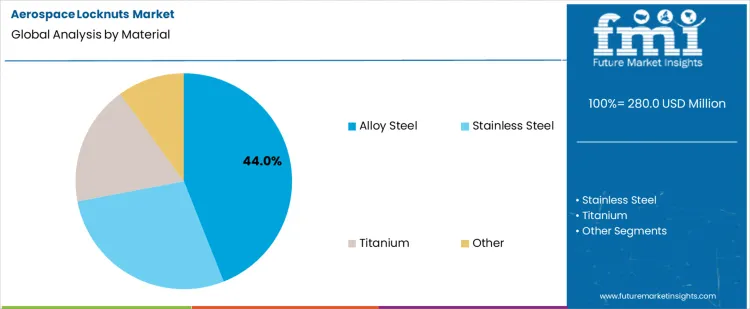
Alloy steel holds 44.0%, representing the largest share among materials due to strength and fatigue performance. Heat-treated alloy steels support high preload retention under cyclic loading. Surface treatments enhance corrosion resistance and galling control. Machinability enables precise thread tolerances required for aerospace fitment. Stainless steel offers corrosion resistance with lower strength. Titanium provides weight reduction with higher cost considerations. Material segmentation reflects preference for balanced strength, durability, and manufacturability across high-load aerospace joints.
Key Points
- Alloy steel delivers high strength and fatigue resistance.
- Surface treatments improve corrosion and wear behavior.
- Other materials prioritize corrosion resistance or weight reduction.
Which Aircraft Type Drives the Largest Share of Demand?

Commercial aircraft hold 54.0%, representing the largest share among aircraft types due to production scale. Narrowbody and widebody programs require large quantities of standardized locking hardware. High utilization rates emphasize reliability and predictable torque retention. Fleet commonality supports specification consistency across platforms. Defense aircraft apply specialized locknuts with lower unit volumes. Business jets adopt premium materials selectively. Rotary wing platforms require vibration-resistant designs with limited scale. Aircraft type segmentation reflects concentration where production volume and standardized certification drive sustained locknut demand.
Key Points
- Commercial programs require high volumes of certified locknuts.
- Utilization intensity emphasizes reliability and torque retention.
- Other aircraft types apply locknuts based on mission profiles.
What are the Key Dynamics in the Aerospace Locknuts Market?
Demand for aerospace locknuts reflects safety-critical requirements to maintain joint preload under vibration, thermal cycling, and cyclic loading in aircraft assemblies. Adoption concentrates in commercial aviation, military aircraft, rotorcraft, and space systems. Global scope aligns with stringent airworthiness standards and long service life targets. Usage centers on self-locking nuts using prevailing torque, deformed threads, or insert-based mechanisms qualified for primary and secondary structures.
How do vibration resistance and preload retention requirements shape adoption?
Aircraft structures experience continuous vibration from engines, airflow, and control surface actuation. Demand increases as loss of clamp load directly affects fatigue life and joint integrity. Aerospace locknuts provide resistance to loosening without reliance on secondary locking devices, reducing assembly complexity and inspection burden. High-temperature zones require all-metal locknuts that retain prevailing torque after repeated thermal cycles. Composite airframes drive selection of locknuts compatible with controlled torque and galvanic mitigation. Flight-critical joints prioritize predictable locking behavior across installation and removal cycles. Adoption reflects engineering necessity to preserve preload stability under dynamic operating conditions rather than assembly convenience.
How do material selection, reuse limits, and certification burden influence market scalability?
Locknut performance depends on alloy choice, heat treatment, and locking feature geometry, increasing manufacturing precision requirements. Demand sensitivity rises where premium alloys and coatings elevate unit cost. Prevailing torque characteristics degrade with reuse, limiting allowable installation cycles and increasing replacement volume. Certification standards mandate lot traceability, torque testing, and environmental validation, extending qualification timelines. Program-specific specifications reduce cross-platform interchangeability. Installation torque control affects locking performance, increasing assembly discipline requirements. Limited supplier capacity for aerospace-qualified locknuts constrains volume flexibility across overlapping aircraft programs.
How Is Demand for Aerospace Locknuts Evolving Globally?
Demand for aerospace locknuts is expanding globally due to vibration resistance requirements, airframe safety standards, and maintenance-driven replacement cycles. Aircraft structures and systems rely on locknuts to maintain joint integrity under dynamic loads and thermal variation. OEM qualification and certification processes govern material selection and geometry. MRO activity sustains recurring consumption aligned with inspection schedules. Growth rates in India at 6.1%, China at 5.8%, USA at 3.8%, Canada at 3.6%, and France at 3.5% indicate measured expansion driven by fleet utilization, manufacturing localization, and lifecycle servicing intensity rather than rapid aircraft delivery growth.
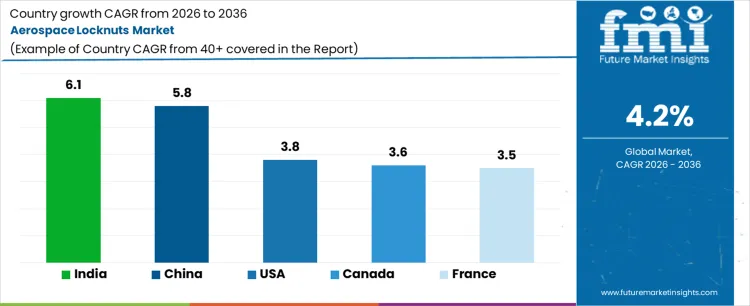
| Country | CAGR (%) |
|---|---|
| India | 6.1% |
| China | 5.8% |
| Canada | 3.6% |
| USA | 3.8% |
| France | 3.5% |
What Is Driving Expansion of Aerospace Locknut Demand in India?
Demand for aerospace locknuts in India is growing at a CAGR of 6.1%, supported by expanding aircraft maintenance capacity and defense aviation programs. Vibratory loads across airframes increase reliance on self-locking fastening solutions. Localization initiatives encourage domestic production of certified locknuts. Rising utilization of commercial fleets elevates replacement during scheduled inspections. Defense platforms operating under varied climates emphasize joint reliability. Growth reflects manufacturing capability development and maintenance-driven consumption rather than acceleration of complete aircraft assembly output.
- Expansion of domestic MRO infrastructure
- Defense aviation vibration resistance requirements
- Localization of certified fastener manufacturing
- Higher fleet utilization increasing replacement cycles
Why Is China Sustaining Growth in Aerospace Locknut Adoption?
Aerospace locknut demand in China is expanding at a CAGR of 5.8%, driven by indigenous aircraft programs and structural standardization. Airframe assemblies specify locknuts to ensure joint security under fatigue loading. State-backed manufacturing supports scale production of qualified components. Fleet growth increases routine maintenance consumption. Program-level standardization reinforces approved fastener usage. Growth reflects program-driven manufacturing scale and lifecycle servicing needs rather than reliance on imported fastening systems.
- Indigenous commercial and military aircraft programs
- Structural fatigue management requirements
- State-supported certified fastener production
- Rising fleet maintenance activity
How Are Aerospace Locknut Sales Developing in United States?
Sales of aerospace locknuts in the United States are growing at a CAGR of 3.8%, supported by a large installed aircraft base and stringent safety standards. Extensive MRO networks replace locknuts during inspections and component overhauls. OEM production maintains steady specification volumes. Military platforms emphasize vibration-resistant joint security. Mature qualification frameworks moderate growth pace. Expansion reflects maintenance-led demand and program continuity rather than rapid increases in aircraft manufacturing output.
- Large installed commercial and military fleet
- Extensive scheduled inspection and overhaul activity
- OEM specification continuity for locknuts
- Stringent safety and qualification standards
What Factors Are Sustaining Aerospace Locknut Demand in Canada?
Aerospace locknut demand in Canada is expanding at a CAGR of 3.6%, shaped by MRO specialization and regional manufacturing support. Cold climate operations increase stress on mechanical joints, reinforcing locknut usage. Maintenance facilities replace fastening hardware during heavy checks. Aerospace suppliers support export-oriented programs. Fleet stability sustains predictable replacement cycles. Growth reflects maintenance intensity and environmental operating conditions rather than expansion of domestic aircraft assembly.
- Cold climate operational stress on joints
- MRO-focused replacement demand
- Support for export-oriented aerospace programs
- Stable fleet utilization patterns
Why Is France Experiencing Measured Growth in Aerospace Locknut Demand?
Demand for aerospace locknuts in France is growing at a CAGR of 3.5%, driven by established aircraft manufacturing and long-term maintenance activity. Structural assemblies require vibration-resistant fastening solutions. Civil and defense aviation programs sustain consistent specification volumes. Mature supplier networks limit rapid volume shifts. Aftermarket demand aligns with scheduled maintenance cycles. Growth remains measured, reflecting stable program output and lifecycle servicing rather than expansion of new aircraft platforms.
- Established commercial aircraft manufacturing base
- Vibration resistance needs in structural assemblies
- Civil and defense program continuity
- Maintenance cycle-driven aftermarket demand
What is the competitive landscape of demand for the aerospace locknuts market globally?
Demand for aerospace locknuts is driven by the need for secure, vibration-resistant, and reliable fastening solutions in critical aerospace applications, including both commercial aviation and military sectors. Buyers evaluate locknut performance in high-stress environments, material strength, resistance to loosening, and ease of installation and maintenance. Procurement behavior prioritizes suppliers offering locknuts that meet stringent aerospace standards, offer long-term durability, and ensure operational safety. Purchasing decisions emphasize the ability to meet high-volume production needs while maintaining strict quality control. Trend in the market reflects the ongoing demand for high-performance, lightweight materials and secure locking mechanisms that improve safety and reduce maintenance requirements for aerospace manufacturers.
Precision Castparts (PCC) leads competitive positioning with its advanced aerospace locknuts, offering high-performance materials and exceptional reliability for aerospace systems. Howmet Aerospace competes with its broad range of locknuts designed for demanding aerospace applications, focusing on strength, security, and long-lasting performance. LISI Aerospace participates by offering high-quality locknuts with robust designs that meet critical safety and performance standards in aerospace applications. TriMas Aerospace supports demand with innovative fastening solutions, providing locknuts tailored to aerospace requirements, especially for high-vibration environments. Böllhoff Group delivers precision-engineered locknuts designed for various aerospace systems, ensuring reliability and durability even in harsh conditions.
Key Players in the Aerospace Locknuts Market
- Precision Castparts (PCC)
- Howmet Aerospace
- LISI Aerospace
- TriMas Aerospace
- Böllhoff Group
- Bossard Group
- National Aerospace Fasteners
- Incora
- Bufab
Scope of the Report
| Items | Values |
|---|---|
| Quantitative Units | USD million |
| Locking Mechanism | All-Metal Locknuts; Nylon Insert Locknuts; Prevailing Torque Nuts; Other |
| Material | Alloy Steel; Stainless Steel; Titanium; Other |
| Aircraft Type | Commercial; Defense; Business Jets; Rotary Wing |
| Sales Channel | OEM or Tier Direct; Distributors; MRO; Other |
| Regions Covered | Asia Pacific, Europe, North America, Latin America, Middle East & Africa |
| Countries Covered | India, China, Canada, USA, France, and 40+ countries |
| Key Companies Profiled | Precision Castparts (PCC); Howmet Aerospace; LISI Aerospace; TriMas Aerospace; Böllhoff Group; Bossard Group; National Aerospace Fasteners; Incora; Bufab |
| Additional Attributes | Dollar sales by locking mechanism, material, aircraft type, and sales channel; locking performance, durability, and resistance to loosening across all-metal, nylon insert, and prevailing torque nuts; application in commercial, defense, business jets, and rotary wing aircraft; procurement patterns influenced by OEM direct supply, distributors, and MRO demand. |
Aerospace Locknuts Market by Segment
Locking Mechanism:
- All-Metal Locknuts
- Nylon Insert Locknuts
- Prevailing Torque Nuts
- Other
Material:
- Alloy Steel
- Stainless Steel
- Titanium
- Other
Aircraft Type:
- Commercial
- Defense
- Business Jets
- Rotary Wing
Sales Channel:
- OEM or Tier Direct
- Distributors
- MRO
- Other
Region:
- Asia Pacific
- China
- Japan
- South Korea
- India
- Australia & New Zealand
- ASEAN
- Rest of Asia Pacific
- Europe
- Germany
- United Kingdom
- France
- Italy
- Spain
- Nordic
- BENELUX
- Rest of Europe
- North America
- United States
- Canada
- Mexico
- Latin America
- Brazil
- Chile
- Rest of Latin America
- Middle East & Africa
- Kingdom of Saudi Arabia
- Other GCC Countries
- Turkey
- South Africa
- Other African Union
- Rest of Middle East & Africa
Bibliography
- International Organization for Standardization. (2023). Fasteners-Prevailing torque type steel nuts-Functional and mechanical requirements (ISO 2320:2023). ISO.
- SAE International. (2023). Self-locking nut performance under vibration and thermal cycling in aerospace structures (SAE Aerospace Materials Technical Report). SAE International.
- Federal Aviation Administration. (2023). Advisory circular AC 43-13-1B: Acceptable methods, techniques, and practices-Aircraft inspection and repair (Updated guidance on self-locking fasteners). USA Department of Transportation.
- European Union Aviation Safety Agency. (2024). Certification considerations for threaded fasteners and self-locking devices in aircraft structures (AMC/GM to CS-25 and CS-27). EASA.
- National Aeronautics and Space Administration. (2023). Evaluation of prevailing-torque locknuts subjected to vibration-induced preload loss (NASA Technical Memorandum). NASA.
Frequently Asked Questions
How big is the aerospace locknuts market in 2026?
The global aerospace locknuts market is estimated to be valued at USD 280.0 million in 2026.
What will be the size of aerospace locknuts market in 2036?
The market size for the aerospace locknuts market is projected to reach USD 422.5 million by 2036.
How much will be the aerospace locknuts market growth between 2026 and 2036?
The aerospace locknuts market is expected to grow at a 4.2% CAGR between 2026 and 2036.
What are the key product types in the aerospace locknuts market?
The key product types in aerospace locknuts market are all-metal locknuts, nylon insert locknuts, prevailing torque nuts and other.
Which material segment to contribute significant share in the aerospace locknuts market in 2026?
In terms of material, alloy steel segment to command 44.0% share in the aerospace locknuts market in 2026.
Preview the report firsthand - request a free sample
Get SampleGet the brochure for pricing and purchase details.
Get PDFTable of Content
- Executive Summary
- Global Market Outlook
- Demand-side Trends
- Supply-side Trends
- Technology Roadmap Analysis
- Analysis and Recommendations
- Market Overview
- Market Coverage / Taxonomy
- Market Definition / Scope / Limitations
- Market Background
- Market Dynamics
- Drivers
- Restraints
- Opportunity
- Trends
- Scenario Forecast
- Demand in Optimistic Scenario
- Demand in Likely Scenario
- Demand in Conservative Scenario
- Opportunity Map Analysis
- Product Life Cycle Analysis
- Supply Chain Analysis
- Investment Feasibility Matrix
- Value Chain Analysis
- PESTLE and Porter’s Analysis
- Regulatory Landscape
- Regional Parent Market Outlook
- Production and Consumption Statistics
- Import and Export Statistics
- Market Dynamics
- Global Market Analysis 2021 to 2025 and Forecast, 2026 to 2036
- Historical Market Size Value (USD Million) Analysis, 2021 to 2025
- Current and Future Market Size Value (USD Million) Projections, 2026 to 2036
- Y-o-Y Growth Trend Analysis
- Absolute $ Opportunity Analysis
- Global Market Pricing Analysis 2021 to 2025 and Forecast 2026 to 2036
- Global Market Analysis 2021 to 2025 and Forecast 2026 to 2036, By Locking Mechanism
- Introduction / Key Findings
- Historical Market Size Value (USD Million) Analysis By Locking Mechanism , 2021 to 2025
- Current and Future Market Size Value (USD Million) Analysis and Forecast By Locking Mechanism , 2026 to 2036
- All-Metal Locknuts
- Nylon Insert Locknuts
- Prevailing Torque Nuts
- Other
- All-Metal Locknuts
- Y-o-Y Growth Trend Analysis By Locking Mechanism , 2021 to 2025
- Absolute $ Opportunity Analysis By Locking Mechanism , 2026 to 2036
- Global Market Analysis 2021 to 2025 and Forecast 2026 to 2036, By Material
- Introduction / Key Findings
- Historical Market Size Value (USD Million) Analysis By Material, 2021 to 2025
- Current and Future Market Size Value (USD Million) Analysis and Forecast By Material, 2026 to 2036
- Alloy Steel
- Stainless Steel
- Titanium
- Other
- Alloy Steel
- Y-o-Y Growth Trend Analysis By Material, 2021 to 2025
- Absolute $ Opportunity Analysis By Material, 2026 to 2036
- Global Market Analysis 2021 to 2025 and Forecast 2026 to 2036, By Aircraft Type
- Introduction / Key Findings
- Historical Market Size Value (USD Million) Analysis By Aircraft Type, 2021 to 2025
- Current and Future Market Size Value (USD Million) Analysis and Forecast By Aircraft Type, 2026 to 2036
- Commercial
- Defense
- Business Jets
- Rotary Wing
- Commercial
- Y-o-Y Growth Trend Analysis By Aircraft Type, 2021 to 2025
- Absolute $ Opportunity Analysis By Aircraft Type, 2026 to 2036
- Global Market Analysis 2021 to 2025 and Forecast 2026 to 2036, By Sales Channel
- Introduction / Key Findings
- Historical Market Size Value (USD Million) Analysis By Sales Channel, 2021 to 2025
- Current and Future Market Size Value (USD Million) Analysis and Forecast By Sales Channel, 2026 to 2036
- OEM or Tier Direct
- Distributors
- MRO
- Other
- OEM or Tier Direct
- Y-o-Y Growth Trend Analysis By Sales Channel, 2021 to 2025
- Absolute $ Opportunity Analysis By Sales Channel, 2026 to 2036
- Global Market Analysis 2021 to 2025 and Forecast 2026 to 2036, By Region
- Introduction
- Historical Market Size Value (USD Million) Analysis By Region, 2021 to 2025
- Current Market Size Value (USD Million) Analysis and Forecast By Region, 2026 to 2036
- North America
- Latin America
- Western Europe
- Eastern Europe
- East Asia
- South Asia and Pacific
- Middle East & Africa
- Market Attractiveness Analysis By Region
- North America Market Analysis 2021 to 2025 and Forecast 2026 to 2036, By Country
- Historical Market Size Value (USD Million) Trend Analysis By Market Taxonomy, 2021 to 2025
- Market Size Value (USD Million) Forecast By Market Taxonomy, 2026 to 2036
- By Country
- USA
- Canada
- Mexico
- By Locking Mechanism
- By Material
- By Aircraft Type
- By Sales Channel
- By Country
- Market Attractiveness Analysis
- By Country
- By Locking Mechanism
- By Material
- By Aircraft Type
- By Sales Channel
- Key Takeaways
- Latin America Market Analysis 2021 to 2025 and Forecast 2026 to 2036, By Country
- Historical Market Size Value (USD Million) Trend Analysis By Market Taxonomy, 2021 to 2025
- Market Size Value (USD Million) Forecast By Market Taxonomy, 2026 to 2036
- By Country
- Brazil
- Chile
- Rest of Latin America
- By Locking Mechanism
- By Material
- By Aircraft Type
- By Sales Channel
- By Country
- Market Attractiveness Analysis
- By Country
- By Locking Mechanism
- By Material
- By Aircraft Type
- By Sales Channel
- Key Takeaways
- Western Europe Market Analysis 2021 to 2025 and Forecast 2026 to 2036, By Country
- Historical Market Size Value (USD Million) Trend Analysis By Market Taxonomy, 2021 to 2025
- Market Size Value (USD Million) Forecast By Market Taxonomy, 2026 to 2036
- By Country
- Germany
- UK
- Italy
- Spain
- France
- Nordic
- BENELUX
- Rest of Western Europe
- By Locking Mechanism
- By Material
- By Aircraft Type
- By Sales Channel
- By Country
- Market Attractiveness Analysis
- By Country
- By Locking Mechanism
- By Material
- By Aircraft Type
- By Sales Channel
- Key Takeaways
- Eastern Europe Market Analysis 2021 to 2025 and Forecast 2026 to 2036, By Country
- Historical Market Size Value (USD Million) Trend Analysis By Market Taxonomy, 2021 to 2025
- Market Size Value (USD Million) Forecast By Market Taxonomy, 2026 to 2036
- By Country
- Russia
- Poland
- Hungary
- Balkan & Baltic
- Rest of Eastern Europe
- By Locking Mechanism
- By Material
- By Aircraft Type
- By Sales Channel
- By Country
- Market Attractiveness Analysis
- By Country
- By Locking Mechanism
- By Material
- By Aircraft Type
- By Sales Channel
- Key Takeaways
- East Asia Market Analysis 2021 to 2025 and Forecast 2026 to 2036, By Country
- Historical Market Size Value (USD Million) Trend Analysis By Market Taxonomy, 2021 to 2025
- Market Size Value (USD Million) Forecast By Market Taxonomy, 2026 to 2036
- By Country
- China
- Japan
- South Korea
- By Locking Mechanism
- By Material
- By Aircraft Type
- By Sales Channel
- By Country
- Market Attractiveness Analysis
- By Country
- By Locking Mechanism
- By Material
- By Aircraft Type
- By Sales Channel
- Key Takeaways
- South Asia and Pacific Market Analysis 2021 to 2025 and Forecast 2026 to 2036, By Country
- Historical Market Size Value (USD Million) Trend Analysis By Market Taxonomy, 2021 to 2025
- Market Size Value (USD Million) Forecast By Market Taxonomy, 2026 to 2036
- By Country
- India
- ASEAN
- Australia & New Zealand
- Rest of South Asia and Pacific
- By Locking Mechanism
- By Material
- By Aircraft Type
- By Sales Channel
- By Country
- Market Attractiveness Analysis
- By Country
- By Locking Mechanism
- By Material
- By Aircraft Type
- By Sales Channel
- Key Takeaways
- Middle East & Africa Market Analysis 2021 to 2025 and Forecast 2026 to 2036, By Country
- Historical Market Size Value (USD Million) Trend Analysis By Market Taxonomy, 2021 to 2025
- Market Size Value (USD Million) Forecast By Market Taxonomy, 2026 to 2036
- By Country
- Kingdom of Saudi Arabia
- Other GCC Countries
- Turkiye
- South Africa
- Other African Union
- Rest of Middle East & Africa
- By Locking Mechanism
- By Material
- By Aircraft Type
- By Sales Channel
- By Country
- Market Attractiveness Analysis
- By Country
- By Locking Mechanism
- By Material
- By Aircraft Type
- By Sales Channel
- Key Takeaways
- Key Countries Market Analysis
- USA
- Pricing Analysis
- Market Share Analysis, 2025
- By Locking Mechanism
- By Material
- By Aircraft Type
- By Sales Channel
- Canada
- Pricing Analysis
- Market Share Analysis, 2025
- By Locking Mechanism
- By Material
- By Aircraft Type
- By Sales Channel
- Mexico
- Pricing Analysis
- Market Share Analysis, 2025
- By Locking Mechanism
- By Material
- By Aircraft Type
- By Sales Channel
- Brazil
- Pricing Analysis
- Market Share Analysis, 2025
- By Locking Mechanism
- By Material
- By Aircraft Type
- By Sales Channel
- Chile
- Pricing Analysis
- Market Share Analysis, 2025
- By Locking Mechanism
- By Material
- By Aircraft Type
- By Sales Channel
- Germany
- Pricing Analysis
- Market Share Analysis, 2025
- By Locking Mechanism
- By Material
- By Aircraft Type
- By Sales Channel
- UK
- Pricing Analysis
- Market Share Analysis, 2025
- By Locking Mechanism
- By Material
- By Aircraft Type
- By Sales Channel
- Italy
- Pricing Analysis
- Market Share Analysis, 2025
- By Locking Mechanism
- By Material
- By Aircraft Type
- By Sales Channel
- Spain
- Pricing Analysis
- Market Share Analysis, 2025
- By Locking Mechanism
- By Material
- By Aircraft Type
- By Sales Channel
- France
- Pricing Analysis
- Market Share Analysis, 2025
- By Locking Mechanism
- By Material
- By Aircraft Type
- By Sales Channel
- India
- Pricing Analysis
- Market Share Analysis, 2025
- By Locking Mechanism
- By Material
- By Aircraft Type
- By Sales Channel
- ASEAN
- Pricing Analysis
- Market Share Analysis, 2025
- By Locking Mechanism
- By Material
- By Aircraft Type
- By Sales Channel
- Australia & New Zealand
- Pricing Analysis
- Market Share Analysis, 2025
- By Locking Mechanism
- By Material
- By Aircraft Type
- By Sales Channel
- China
- Pricing Analysis
- Market Share Analysis, 2025
- By Locking Mechanism
- By Material
- By Aircraft Type
- By Sales Channel
- Japan
- Pricing Analysis
- Market Share Analysis, 2025
- By Locking Mechanism
- By Material
- By Aircraft Type
- By Sales Channel
- South Korea
- Pricing Analysis
- Market Share Analysis, 2025
- By Locking Mechanism
- By Material
- By Aircraft Type
- By Sales Channel
- Russia
- Pricing Analysis
- Market Share Analysis, 2025
- By Locking Mechanism
- By Material
- By Aircraft Type
- By Sales Channel
- Poland
- Pricing Analysis
- Market Share Analysis, 2025
- By Locking Mechanism
- By Material
- By Aircraft Type
- By Sales Channel
- Hungary
- Pricing Analysis
- Market Share Analysis, 2025
- By Locking Mechanism
- By Material
- By Aircraft Type
- By Sales Channel
- Kingdom of Saudi Arabia
- Pricing Analysis
- Market Share Analysis, 2025
- By Locking Mechanism
- By Material
- By Aircraft Type
- By Sales Channel
- Turkiye
- Pricing Analysis
- Market Share Analysis, 2025
- By Locking Mechanism
- By Material
- By Aircraft Type
- By Sales Channel
- South Africa
- Pricing Analysis
- Market Share Analysis, 2025
- By Locking Mechanism
- By Material
- By Aircraft Type
- By Sales Channel
- USA
- Market Structure Analysis
- Competition Dashboard
- Competition Benchmarking
- Market Share Analysis of Top Players
- By Regional
- By Locking Mechanism
- By Material
- By Aircraft Type
- By Sales Channel
- Competition Analysis
- Competition Deep Dive
- Precision Castparts (PCC)
- Overview
- Product Portfolio
- Profitability by Market Segments (Product/Age /Sales Channel/Region)
- Sales Footprint
- Strategy Overview
- Marketing Strategy
- Product Strategy
- Channel Strategy
- Howmet Aerospace
- LISI Aerospace
- TriMas Aerospace
- Böllhoff Group
- Bossard Group
- National Aerospace Fasteners
- Incora
- Bufab
- Precision Castparts (PCC)
- Competition Deep Dive
- Assumptions & Acronyms Used
- Research Methodology


