

- Industry Size (2026):
- USD 520.0 Mn
- Forecast (2036)
- USD 855.1 Mn
- CAGR (2026 to 2036)
- 5.1%
Titanium Aerospace Fasteners Market Forecast and Outlook 2026 to 2036
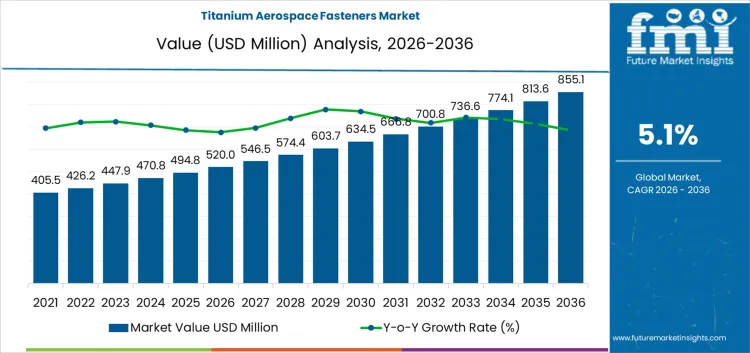
The titanium aerospace fasteners market is likely to be valued at USD 520.0 million in 2026, and reach USD 855.1 million by 2036, at 5.1% CAGR. Value expansion reflects structural and safety-critical requirements rather than discretionary material substitution. Demand concentrates in commercial aviation and defense platforms where weight reduction, fatigue resistance, and corrosion performance directly influence airframe reliability and operating efficiency. Titanium fasteners are specified in load-bearing and thermally stressed zones where aluminum and steel alternatives fail to meet lifecycle and certification thresholds. Procurement remains closely tied to OEM qualification cycles, traceability requirements, and long-term program contracts.
Growth remains governed by cost intensity, manufacturing complexity, and certification discipline. High raw material pricing, machining difficulty, and extended approval timelines constrain rapid supplier expansion. Interchangeability remains limited due to platform-specific designs and documentation requirements. Aftermarket demand provides stability through scheduled maintenance and replacement cycles rather than volume acceleration. Expansion therefore tracks aircraft utilization rates, MRO intensity, and localized aerospace manufacturing capability instead of short-term delivery fluctuations or pricing-driven substitution trends.
Quick Stats for Titanium Aerospace Fasteners Market
- Titanium Aerospace Fasteners Market Value (2026): USD 520.0 million
- Titanium Aerospace Fasteners Market Forecast Value (2036): USD 855.1 million
- Titanium Aerospace Fasteners Market Forecast CAGR 2026 to 2036: 5.1%
- Leading Fastener Type by Demand Share: Bolts & Screws
- Fastest-Growing Countries: India, China, UAE, USA, France
- Top Players in Global Demand: Howmet Aerospace, LISI Aerospace, Precision Castparts (PCC), Stanley Engineered Fastening, Böllhoff Group
Titanium Aerospace Fasteners Market Key Takeaways
| Metric | Value |
|---|---|
| Market Value (2026) | USD 520.0 million |
| Market Forecast Value (2036) | USD 855.1 million |
| Forecast CAGR (2026-2036) | 5.1% |
Why is the Demand for Titanium Aerospace Fasteners Growing?
Demand for titanium aerospace fasteners is increasing as aircraft manufacturers and maintenance organizations prioritize high-performance hardware that supports structural integrity and weight reduction in critical airframe and engine assemblies. Titanium’s high strength-to-weight ratio and corrosion resistance make it suitable for fuselage frames, wing structures, landing gear interfaces, and engine components where aluminum and steel fasteners cannot meet stringent performance criteria under cyclic loading and extreme temperature variation. Engineers specify fasteners with controlled alloy composition, precise thread geometry, and proven fatigue life because these attributes directly influence safety margins in fatigue-sensitive zones and contribute to extended airframe service intervals. Procurement teams assess certification records, traceability, and supplier quality management systems to ensure components align with aviation standards such as AS9100 and manufacturer design specifications. Growth in regional jet, business aircraft, and wide-body programs reinforces need for fasteners that maintain performance throughout lengthy flight cycles without degradation from moisture, salt, or vibration stress.
Replacement and aftermarket demand is also driving uptake as fleet operators conduct scheduled heavy maintenance checks that require replacement of hardware in high-stress locations to maintain airworthiness. Technical development in titanium forging, heat treatment, and coating processes enhances fastener durability and reduces susceptibility to galling and fretting in assemblies with mixed-metal interfaces. Maintenance, repair, and overhaul (MRO) facilities require ready availability of titanium fasteners that match exact engineering specifications to minimize aircraft downtime during intensive service windows. These performance-driven and safety-critical considerations are contributing to sustained demand growth in the titanium aerospace fasteners market.
How Are the Segments Classified in the Titanium Aerospace Fasteners Market?
Demand for titanium aerospace fasteners is shaped by weight reduction targets, structural integrity requirements, and corrosion resistance expectations in flight-critical assemblies. Aircraft programs prioritize materials delivering high strength-to-weight performance under cyclic loads and temperature variation. Adoption aligns with fleet modernization, efficiency standards, and extended service life objectives. Product selection emphasizes fatigue performance, dimensional precision, and certification compliance. Segment classification reflects differentiation by fastener configuration, aircraft deployment context, and manufacturing route, influencing qualification rigor, production scalability, and lifecycle reliability across aerospace platforms.
Which Fastener Type Represents the Largest Share of Demand?
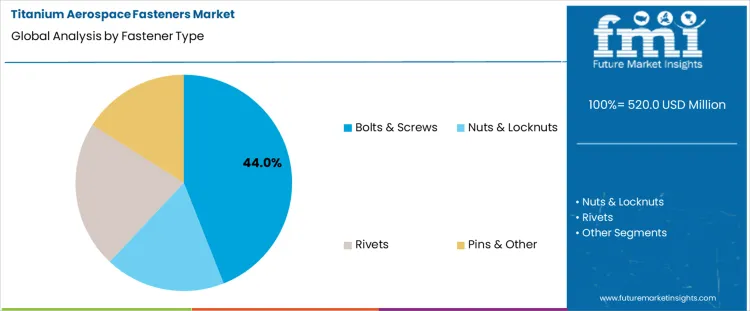
Bolts and screws hold 44.0%, representing the largest share among fastener types due to primary load-bearing roles. These components secure structural joints, engine mounts, and system interfaces requiring precise preload control. Threaded designs enable repeatable installation and maintenance during scheduled service intervals. Titanium properties support reduced mass without compromising tensile and shear performance. Rivets serve permanent joints with distributed load transfer across skins and frames. Nuts and locknuts support retention and vibration resistance in assemblies. Pins and other forms address alignment and hinging needs. Fastener type segmentation reflects dominance of threaded elements where serviceability and structural performance requirements converge.
Key Points
- Threaded fasteners support critical structural load paths.
- Repeatable installation aids maintenance and inspection cycles.
- Other fasteners address permanent joints or alignment functions.
Which Aircraft Type Accounts for the Highest Share of Demand?
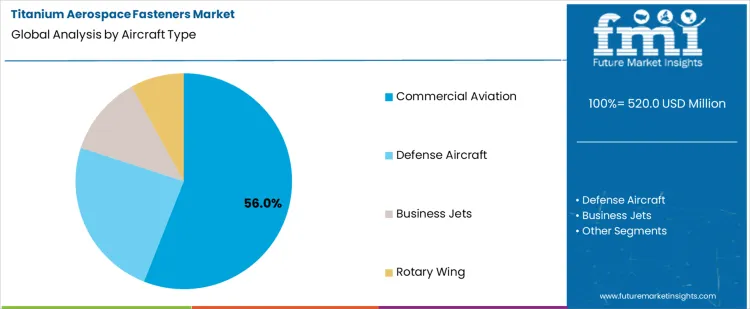
Commercial aviation holds 56.0%, representing the largest share among aircraft types due to fleet size. Narrowbody and widebody programs require large volumes of certified fasteners across airframes and systems. High utilization rates emphasize fatigue resistance and corrosion performance. Production scale supports standardized fastener specifications across platforms. Defense aircraft apply titanium for performance-critical zones with lower unit volumes. Business jets adopt lightweight materials for range and efficiency gains. Rotary wing aircraft require specialized fastening for dynamic load environments. Aircraft type segmentation reflects concentration where production scale and certification-driven consistency sustain the highest fastener demand.
Key Points
- Commercial fleets require high volumes of certified fasteners.
- Utilization intensity emphasizes fatigue and corrosion resistance.
- Other aircraft types apply titanium selectively by mission profile.
Which Manufacturing Route Drives the Largest Share of Demand?
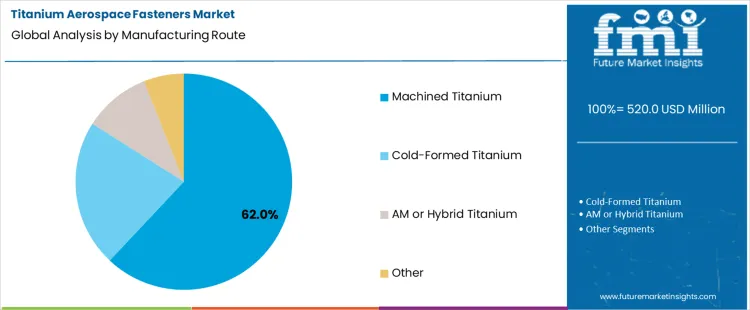
Machined titanium holds 62.0%, representing the largest share among manufacturing routes due to precision requirements. Machining enables tight tolerances and complex geometries demanded by aerospace standards. Material integrity and surface finish control support fatigue performance and inspection acceptance. Low defect risk aligns with certification expectations for flight-critical hardware. Cold-formed titanium offers material efficiency with geometry limitations. Additive or hybrid routes support design flexibility with limited qualification breadth. Manufacturing route segmentation reflects preference for proven processes delivering dimensional accuracy, material consistency, and regulatory acceptance across aerospace fastener programs.
Key Points
- Machining achieves tight tolerances and surface quality.
- Proven processes align with certification expectations.
- Other routes address efficiency or design flexibility needs.
What are the Key Dynamics in the Titanium Aerospace Fasteners Market?
Demand for titanium aerospace fasteners reflects structural, thermal, and weight-critical requirements in aircraft and spacecraft assembly. Adoption concentrates in commercial aviation, military aircraft, space launch systems, and advanced unmanned platforms. Global scope aligns with lightweighting priorities, corrosion resistance needs, and extreme operating environment exposure. Usage centers on bolts, screws, nuts, and studs manufactured from titanium alloys for primary and secondary structural joints.
How do aircraft weight reduction and operating environment requirements shape adoption?
Aircraft programs prioritize mass reduction to improve fuel efficiency, payload capacity, and range. Demand increases as titanium fasteners deliver high strength-to-weight ratios compared with steel alternatives. Corrosion resistance supports long-term durability in humid, saline, and temperature-variable flight conditions. High thermal stability enables use near engines, exhaust zones, and high-speed airframe sections. Composite airframe structures require fasteners compatible with galvanic corrosion control and differential thermal expansion. Fatigue resistance supports long service intervals under cyclic pressurization and vibration. Military and space applications rely on titanium for performance retention under extreme stress. Adoption reflects structural necessity tied directly to aircraft performance and lifecycle reliability.
How do material cost, manufacturing complexity, and certification burden influence market scalability?
Titanium alloy fasteners involve significantly higher raw material and processing cost than steel or aluminum options. Demand sensitivity rises where program budgets face cost containment pressure. Machining difficulty increases tool wear and production cycle time. Thread forming and surface treatment require tight process control to avoid galling and fatigue initiation. Aerospace certification standards mandate extensive traceability, testing, and documentation, extending lead times. Limited supplier capacity for aerospace-grade titanium constrains volume flexibility. Program-specific fastener designs reduce interchangeability. Long qualification cycles restrict rapid onboarding of new suppliers, limiting scalable expansion across concurrent aircraft platforms.
How Is Demand for Titanium Aerospace Fasteners Evolving Globally?
Demand for titanium aerospace fasteners is expanding globally due to aircraft production recovery, lightweighting requirements, and fatigue-resistant joining needs. Adoption aligns with commercial aircraft, military platforms, and maintenance programs prioritizing corrosion resistance and strength-to-weight optimization. OEM qualification cycles and long-term contracts shape procurement stability. Aftermarket demand follows fleet utilization and scheduled maintenance intervals. Growth rates in India at 7.2%, China at 6.8%, UAE at 5.0%, USA at 4.5%, and France at 4.1% indicate steady expansion driven by manufacturing localization, fleet modernization, and MRO intensity rather than rapid aircraft delivery acceleration.
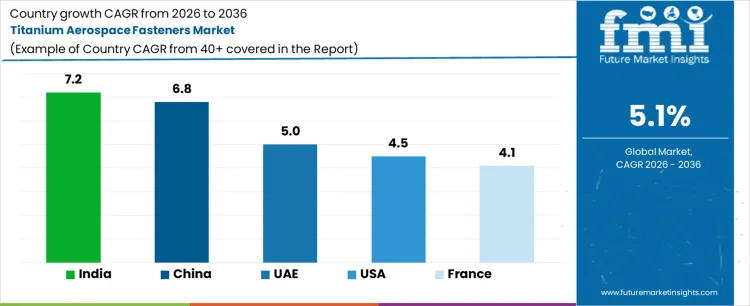
| Country | CAGR (%) |
|---|---|
| India | 7.2% |
| China | 6.8% |
| UAE | 5.0% |
| USA | 4.5% |
| France | 4.1% |
What Is Driving Expansion of Titanium Aerospace Fastener Demand in India?
Demand for titanium aerospace fasteners in India is growing at a CAGR of 7.2%, supported by increasing aircraft assembly, defense manufacturing, and MRO capacity. Localization initiatives encourage domestic sourcing of certified fasteners. Military aircraft programs prioritize corrosion resistance for varied climatic exposure. Commercial aviation growth sustains component replacement during heavy checks. Supplier qualification efforts expand approved vendor bases. Growth reflects manufacturing capability development and lifecycle maintenance demand rather than near-term surges in aircraft deliveries.
- Localization of aerospace component manufacturing
- Defense aircraft programs requiring corrosion resistance
- Expansion of domestic MRO facilities
- Vendor qualification and certification progress
Why Is China Sustaining Growth in Titanium Aerospace Fastener Adoption?
Titanium aerospace fastener demand in China is expanding at a CAGR of 6.8%, driven by indigenous aircraft programs and supply chain consolidation. Structural assemblies favor titanium for weight reduction and fatigue performance. State-backed manufacturing investment supports scale production of certified fasteners. Military aviation modernization increases specification volumes. Aftermarket demand grows with fleet utilization. Growth reflects program-driven manufacturing scale and controlled supply integration rather than reliance on imported fastener systems.
- Indigenous commercial and military aircraft programs
- Weight reduction focus in structural assemblies
- State-backed investment in certified manufacturing
- Rising fleet utilization supporting aftermarket demand
How Is the UAE Supporting Demand for Titanium Aerospace Fasteners?
Sales of titanium aerospace fasteners in the United Arab Emirates are growing at a CAGR of 5.0%, shaped by MRO specialization and defense aviation activity. Regional hubs perform heavy maintenance requiring certified fastener replacement. Harsh operating environments increase corrosion resistance requirements. Defense procurement sustains consistent demand for high-performance fasteners. Strategic partnerships support approved supply access. Growth reflects maintenance-driven consumption and defense usage rather than large-scale aircraft manufacturing.
- Regional heavy maintenance and overhaul activity
- Corrosion resistance needs under harsh climates
- Defense aviation procurement requirements
- Approved supplier partnerships for certified parts
What Factors Are Influencing Titanium Aerospace Fastener Demand in United States?
Titanium aerospace fastener demand in the United States is expanding at a CAGR of 4.5%, supported by a large installed aircraft base and ongoing modernization. OEM production maintains steady specification volumes. Military programs emphasize fatigue resistance and weight optimization. Extensive MRO networks drive consistent replacement demand. Supply chain qualification requirements moderate growth pace. Expansion reflects maturity of aerospace manufacturing and maintenance ecosystems rather than rapid increases in aircraft output.
- Large commercial and military aircraft installed base
- OEM specification continuity for titanium fasteners
- Extensive domestic MRO replacement demand
- Stringent qualification and certification processes
Why Is France Experiencing Measured Growth in Titanium Aerospace Fastener Demand?
Demand for titanium aerospace fasteners in France is growing at a CAGR of 4.1%, driven by established aircraft manufacturing and maintenance activity. Structural components favor titanium for durability and weight efficiency. Defense and civil aviation programs sustain long-term fastener usage. Mature supplier networks limit rapid volume shifts. Aftermarket demand aligns with fleet maintenance cycles. Growth remains measured, reflecting stable program output and lifecycle servicing rather than expansion of new aircraft lines.
- Established commercial aircraft manufacturing base
- Titanium use in structural and fatigue-critical areas
- Defense and civil aviation program continuity
- Maintenance cycle-driven aftermarket demand
What is the competitive landscape of demand for the titanium aerospace fasteners market globally?
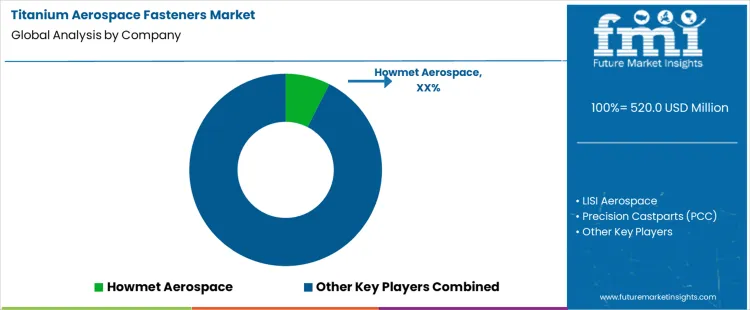
Demand for titanium aerospace fasteners is driven by the increasing need for lightweight, high-strength components in aircraft, space exploration, and defense applications. Buyers evaluate fastener strength, corrosion resistance, weight reduction capabilities, and compatibility with advanced aerospace materials. Procurement behavior emphasizes manufacturers offering titanium fasteners that meet stringent aerospace certifications, offer superior fatigue resistance, and perform under extreme conditions. Purchasing decisions prioritize companies with strong technical expertise, high-quality manufacturing processes, and the ability to meet complex project timelines. Trend in the market reflects the rising adoption of titanium in aerospace applications due to its high strength-to-weight ratio, leading to increased demand for reliable and durable fastening solutions.
Howmet Aerospace leads competitive positioning with a broad portfolio of titanium aerospace fasteners, known for their superior performance in critical aerospace applications. LISI Aerospace competes by offering high-precision titanium fasteners designed for aerospace, defense, and commercial applications, focusing on compliance with industry standards. Precision Castparts (PCC) participates with advanced fastener solutions, providing lightweight and high-strength titanium components tailored for both civil aviation and defense sectors. Stanley Engineered Fastening provides innovative fastening solutions for aircraft, emphasizing lightweight, high-strength materials and fastener reliability. Böllhoff Group supports demand with precision-engineered titanium fasteners, offering both standard and custom solutions for aerospace and military applications.
Key Players in the Titanium Aerospace Fasteners Market
- Howmet Aerospace
- LISI Aerospace
- Precision Castparts (PCC)
- Stanley Engineered Fastening
- Böllhoff Group
- TriMas Aerospace
- Monogram Aerospace Fasteners
- National Aerospace Fasteners
- MS Aerospace
Scope of the Report
| Items | Values |
|---|---|
| Quantitative Units | USD million |
| Fastener Type | Bolts & Screws; Nuts & Locknuts; Rivets; Pins & Other |
| Aircraft Type | Commercial Aviation; Defense Aircraft; Business Jets; Rotary Wing |
| Manufacturing Route | Machined Titanium; Cold-Formed Titanium; AM or Hybrid Titanium; Other |
| Sales Channel | Tier 1 or OEM Direct; Authorized Distributors; MRO Supply; Other |
| Regions Covered | Asia Pacific, Europe, North America, Latin America, Middle East & Africa |
| Countries Covered | India, China, UAE, USA, France, and 40+ countries |
| Key Companies Profiled | Howmet Aerospace; LISI Aerospace; Precision Castparts (PCC); Stanley Engineered Fastening; Böllhoff Group; TriMas Aerospace; Monogram Aerospace Fasteners; National Aerospace Fasteners; MS Aerospace |
| Additional Attributes | Dollar sales by fastener type, aircraft type, manufacturing route, and sales channel; material strength, fatigue resistance, and corrosion performance of machined, cold-formed, and AM hybrid titanium fasteners; application trends in commercial, defense, business aviation, and rotary wing aircraft; procurement patterns driven by OEM direct supply, authorized distribution, and MRO demand. |
Titanium Aerospace Fasteners Market by Segment
Fastener Type:
- Bolts & Screws
- Nuts & Locknuts
- Rivets
- Pins & Other
Aircraft Type:
- Commercial Aviation
- Defense Aircraft
- Business Jets
- Rotary Wing
Manufacturing Route:
- Machined Titanium
- Cold-Formed Titanium
- AM or Hybrid Titanium
- Other
Sales Channel:
- Tier 1 or OEM Direct
- Authorized Distributors
- MRO Supply
- Other
Region:
- Asia Pacific
- China
- Japan
- South Korea
- India
- Australia & New Zealand
- ASEAN
- Rest of Asia Pacific
- Europe
- Germany
- United Kingdom
- France
- Italy
- Spain
- Nordic
- BENELUX
- Rest of Europe
- North America
- United States
- Canada
- Mexico
- Latin America
- Brazil
- Chile
- Rest of Latin America
- Middle East & Africa
- Kingdom of Saudi Arabia
- Other GCC Countries
- Turkey
- South Africa
- Other African Union
- Rest of Middle East & Africa
Bibliography
- International Organization for Standardization. (2023). Titanium and titanium alloys—Chemical analysis—General principles (ISO 15528:2023). ISO.
- International Organization for Standardization. (2024). Fasteners—Mechanical properties of corrosion-resistant titanium alloy fasteners (ISO 3506-5:2024). ISO.
- SAE International. (2023). Aerospace material specification requirements for titanium alloy fasteners used in structural applications (SAE AMS technical report). SAE International.
Frequently Asked Questions
How big is the titanium aerospace fasteners market in 2026?
The global titanium aerospace fasteners market is estimated to be valued at USD 520.0 million in 2026.
What will be the size of titanium aerospace fasteners market in 2036?
The market size for the titanium aerospace fasteners market is projected to reach USD 855.1 million by 2036.
How much will be the titanium aerospace fasteners market growth between 2026 and 2036?
The titanium aerospace fasteners market is expected to grow at a 5.1% CAGR between 2026 and 2036.
What are the key product types in the titanium aerospace fasteners market?
The key product types in titanium aerospace fasteners market are bolts & screws, nuts & locknuts, rivets and pins & other.
Which aircraft type segment to contribute significant share in the titanium aerospace fasteners market in 2026?
In terms of aircraft type, commercial aviation segment to command 56.0% share in the titanium aerospace fasteners market in 2026.
Preview the report firsthand - request a free sample
Get SampleGet the brochure for pricing and purchase details.
Get PDFTable of Content
- Executive Summary
- Global Market Outlook
- Demand-side Trends
- Supply-side Trends
- Technology Roadmap Analysis
- Analysis and Recommendations
- Market Overview
- Market Coverage / Taxonomy
- Market Definition / Scope / Limitations
- Market Background
- Market Dynamics
- Drivers
- Restraints
- Opportunity
- Trends
- Scenario Forecast
- Demand in Optimistic Scenario
- Demand in Likely Scenario
- Demand in Conservative Scenario
- Opportunity Map Analysis
- Product Life Cycle Analysis
- Supply Chain Analysis
- Investment Feasibility Matrix
- Value Chain Analysis
- PESTLE and Porter’s Analysis
- Regulatory Landscape
- Regional Parent Market Outlook
- Production and Consumption Statistics
- Import and Export Statistics
- Market Dynamics
- Global Market Analysis 2021 to 2025 and Forecast, 2026 to 2036
- Historical Market Size Value (USD Million) Analysis, 2021 to 2025
- Current and Future Market Size Value (USD Million) Projections, 2026 to 2036
- Y-o-Y Growth Trend Analysis
- Absolute $ Opportunity Analysis
- Global Market Pricing Analysis 2021 to 2025 and Forecast 2026 to 2036
- Global Market Analysis 2021 to 2025 and Forecast 2026 to 2036, By Fastener Type
- Introduction / Key Findings
- Historical Market Size Value (USD Million) Analysis By Fastener Type , 2021 to 2025
- Current and Future Market Size Value (USD Million) Analysis and Forecast By Fastener Type , 2026 to 2036
- Bolts & Screws
- Nuts & Locknuts
- Rivets
- Pins & Other
- Bolts & Screws
- Y-o-Y Growth Trend Analysis By Fastener Type , 2021 to 2025
- Absolute $ Opportunity Analysis By Fastener Type , 2026 to 2036
- Global Market Analysis 2021 to 2025 and Forecast 2026 to 2036, By Aircraft Type
- Introduction / Key Findings
- Historical Market Size Value (USD Million) Analysis By Aircraft Type, 2021 to 2025
- Current and Future Market Size Value (USD Million) Analysis and Forecast By Aircraft Type, 2026 to 2036
- Commercial Aviation
- Defense Aircraft
- Business Jets
- Rotary Wing
- Commercial Aviation
- Y-o-Y Growth Trend Analysis By Aircraft Type, 2021 to 2025
- Absolute $ Opportunity Analysis By Aircraft Type, 2026 to 2036
- Global Market Analysis 2021 to 2025 and Forecast 2026 to 2036, By Manufacturing Route
- Introduction / Key Findings
- Historical Market Size Value (USD Million) Analysis By Manufacturing Route, 2021 to 2025
- Current and Future Market Size Value (USD Million) Analysis and Forecast By Manufacturing Route, 2026 to 2036
- Machined Titanium
- Cold-Formed Titanium
- AM or Hybrid Titanium
- Other
- Machined Titanium
- Y-o-Y Growth Trend Analysis By Manufacturing Route, 2021 to 2025
- Absolute $ Opportunity Analysis By Manufacturing Route, 2026 to 2036
- Global Market Analysis 2021 to 2025 and Forecast 2026 to 2036, By Sales Channel
- Introduction / Key Findings
- Historical Market Size Value (USD Million) Analysis By Sales Channel, 2021 to 2025
- Current and Future Market Size Value (USD Million) Analysis and Forecast By Sales Channel, 2026 to 2036
- Tier 1 or OEM Direct
- Authorized Distributors
- MRO Supply
- Other
- Tier 1 or OEM Direct
- Y-o-Y Growth Trend Analysis By Sales Channel, 2021 to 2025
- Absolute $ Opportunity Analysis By Sales Channel, 2026 to 2036
- Global Market Analysis 2021 to 2025 and Forecast 2026 to 2036, By Region
- Introduction
- Historical Market Size Value (USD Million) Analysis By Region, 2021 to 2025
- Current Market Size Value (USD Million) Analysis and Forecast By Region, 2026 to 2036
- North America
- Latin America
- Western Europe
- Eastern Europe
- East Asia
- South Asia and Pacific
- Middle East & Africa
- Market Attractiveness Analysis By Region
- North America Market Analysis 2021 to 2025 and Forecast 2026 to 2036, By Country
- Historical Market Size Value (USD Million) Trend Analysis By Market Taxonomy, 2021 to 2025
- Market Size Value (USD Million) Forecast By Market Taxonomy, 2026 to 2036
- By Country
- USA
- Canada
- Mexico
- By Fastener Type
- By Aircraft Type
- By Manufacturing Route
- By Sales Channel
- By Country
- Market Attractiveness Analysis
- By Country
- By Fastener Type
- By Aircraft Type
- By Manufacturing Route
- By Sales Channel
- Key Takeaways
- Latin America Market Analysis 2021 to 2025 and Forecast 2026 to 2036, By Country
- Historical Market Size Value (USD Million) Trend Analysis By Market Taxonomy, 2021 to 2025
- Market Size Value (USD Million) Forecast By Market Taxonomy, 2026 to 2036
- By Country
- Brazil
- Chile
- Rest of Latin America
- By Fastener Type
- By Aircraft Type
- By Manufacturing Route
- By Sales Channel
- By Country
- Market Attractiveness Analysis
- By Country
- By Fastener Type
- By Aircraft Type
- By Manufacturing Route
- By Sales Channel
- Key Takeaways
- Western Europe Market Analysis 2021 to 2025 and Forecast 2026 to 2036, By Country
- Historical Market Size Value (USD Million) Trend Analysis By Market Taxonomy, 2021 to 2025
- Market Size Value (USD Million) Forecast By Market Taxonomy, 2026 to 2036
- By Country
- Germany
- UK
- Italy
- Spain
- France
- Nordic
- BENELUX
- Rest of Western Europe
- By Fastener Type
- By Aircraft Type
- By Manufacturing Route
- By Sales Channel
- By Country
- Market Attractiveness Analysis
- By Country
- By Fastener Type
- By Aircraft Type
- By Manufacturing Route
- By Sales Channel
- Key Takeaways
- Eastern Europe Market Analysis 2021 to 2025 and Forecast 2026 to 2036, By Country
- Historical Market Size Value (USD Million) Trend Analysis By Market Taxonomy, 2021 to 2025
- Market Size Value (USD Million) Forecast By Market Taxonomy, 2026 to 2036
- By Country
- Russia
- Poland
- Hungary
- Balkan & Baltic
- Rest of Eastern Europe
- By Fastener Type
- By Aircraft Type
- By Manufacturing Route
- By Sales Channel
- By Country
- Market Attractiveness Analysis
- By Country
- By Fastener Type
- By Aircraft Type
- By Manufacturing Route
- By Sales Channel
- Key Takeaways
- East Asia Market Analysis 2021 to 2025 and Forecast 2026 to 2036, By Country
- Historical Market Size Value (USD Million) Trend Analysis By Market Taxonomy, 2021 to 2025
- Market Size Value (USD Million) Forecast By Market Taxonomy, 2026 to 2036
- By Country
- China
- Japan
- South Korea
- By Fastener Type
- By Aircraft Type
- By Manufacturing Route
- By Sales Channel
- By Country
- Market Attractiveness Analysis
- By Country
- By Fastener Type
- By Aircraft Type
- By Manufacturing Route
- By Sales Channel
- Key Takeaways
- South Asia and Pacific Market Analysis 2021 to 2025 and Forecast 2026 to 2036, By Country
- Historical Market Size Value (USD Million) Trend Analysis By Market Taxonomy, 2021 to 2025
- Market Size Value (USD Million) Forecast By Market Taxonomy, 2026 to 2036
- By Country
- India
- ASEAN
- Australia & New Zealand
- Rest of South Asia and Pacific
- By Fastener Type
- By Aircraft Type
- By Manufacturing Route
- By Sales Channel
- By Country
- Market Attractiveness Analysis
- By Country
- By Fastener Type
- By Aircraft Type
- By Manufacturing Route
- By Sales Channel
- Key Takeaways
- Middle East & Africa Market Analysis 2021 to 2025 and Forecast 2026 to 2036, By Country
- Historical Market Size Value (USD Million) Trend Analysis By Market Taxonomy, 2021 to 2025
- Market Size Value (USD Million) Forecast By Market Taxonomy, 2026 to 2036
- By Country
- Kingdom of Saudi Arabia
- Other GCC Countries
- Turkiye
- South Africa
- Other African Union
- Rest of Middle East & Africa
- By Fastener Type
- By Aircraft Type
- By Manufacturing Route
- By Sales Channel
- By Country
- Market Attractiveness Analysis
- By Country
- By Fastener Type
- By Aircraft Type
- By Manufacturing Route
- By Sales Channel
- Key Takeaways
- Key Countries Market Analysis
- USA
- Pricing Analysis
- Market Share Analysis, 2025
- By Fastener Type
- By Aircraft Type
- By Manufacturing Route
- By Sales Channel
- Canada
- Pricing Analysis
- Market Share Analysis, 2025
- By Fastener Type
- By Aircraft Type
- By Manufacturing Route
- By Sales Channel
- Mexico
- Pricing Analysis
- Market Share Analysis, 2025
- By Fastener Type
- By Aircraft Type
- By Manufacturing Route
- By Sales Channel
- Brazil
- Pricing Analysis
- Market Share Analysis, 2025
- By Fastener Type
- By Aircraft Type
- By Manufacturing Route
- By Sales Channel
- Chile
- Pricing Analysis
- Market Share Analysis, 2025
- By Fastener Type
- By Aircraft Type
- By Manufacturing Route
- By Sales Channel
- Germany
- Pricing Analysis
- Market Share Analysis, 2025
- By Fastener Type
- By Aircraft Type
- By Manufacturing Route
- By Sales Channel
- UK
- Pricing Analysis
- Market Share Analysis, 2025
- By Fastener Type
- By Aircraft Type
- By Manufacturing Route
- By Sales Channel
- Italy
- Pricing Analysis
- Market Share Analysis, 2025
- By Fastener Type
- By Aircraft Type
- By Manufacturing Route
- By Sales Channel
- Spain
- Pricing Analysis
- Market Share Analysis, 2025
- By Fastener Type
- By Aircraft Type
- By Manufacturing Route
- By Sales Channel
- France
- Pricing Analysis
- Market Share Analysis, 2025
- By Fastener Type
- By Aircraft Type
- By Manufacturing Route
- By Sales Channel
- India
- Pricing Analysis
- Market Share Analysis, 2025
- By Fastener Type
- By Aircraft Type
- By Manufacturing Route
- By Sales Channel
- ASEAN
- Pricing Analysis
- Market Share Analysis, 2025
- By Fastener Type
- By Aircraft Type
- By Manufacturing Route
- By Sales Channel
- Australia & New Zealand
- Pricing Analysis
- Market Share Analysis, 2025
- By Fastener Type
- By Aircraft Type
- By Manufacturing Route
- By Sales Channel
- China
- Pricing Analysis
- Market Share Analysis, 2025
- By Fastener Type
- By Aircraft Type
- By Manufacturing Route
- By Sales Channel
- Japan
- Pricing Analysis
- Market Share Analysis, 2025
- By Fastener Type
- By Aircraft Type
- By Manufacturing Route
- By Sales Channel
- South Korea
- Pricing Analysis
- Market Share Analysis, 2025
- By Fastener Type
- By Aircraft Type
- By Manufacturing Route
- By Sales Channel
- Russia
- Pricing Analysis
- Market Share Analysis, 2025
- By Fastener Type
- By Aircraft Type
- By Manufacturing Route
- By Sales Channel
- Poland
- Pricing Analysis
- Market Share Analysis, 2025
- By Fastener Type
- By Aircraft Type
- By Manufacturing Route
- By Sales Channel
- Hungary
- Pricing Analysis
- Market Share Analysis, 2025
- By Fastener Type
- By Aircraft Type
- By Manufacturing Route
- By Sales Channel
- Kingdom of Saudi Arabia
- Pricing Analysis
- Market Share Analysis, 2025
- By Fastener Type
- By Aircraft Type
- By Manufacturing Route
- By Sales Channel
- Turkiye
- Pricing Analysis
- Market Share Analysis, 2025
- By Fastener Type
- By Aircraft Type
- By Manufacturing Route
- By Sales Channel
- South Africa
- Pricing Analysis
- Market Share Analysis, 2025
- By Fastener Type
- By Aircraft Type
- By Manufacturing Route
- By Sales Channel
- USA
- Market Structure Analysis
- Competition Dashboard
- Competition Benchmarking
- Market Share Analysis of Top Players
- By Regional
- By Fastener Type
- By Aircraft Type
- By Manufacturing Route
- By Sales Channel
- Competition Analysis
- Competition Deep Dive
- Howmet Aerospace
- Overview
- Product Portfolio
- Profitability by Market Segments (Product/Age /Sales Channel/Region)
- Sales Footprint
- Strategy Overview
- Marketing Strategy
- Product Strategy
- Channel Strategy
- LISI Aerospace
- Precision Castparts (PCC)
- Stanley Engineered Fastening
- Böllhoff Group
- TriMas Aerospace
- Monogram Aerospace Fasteners
- National Aerospace Fasteners
- MS Aerospace
- Howmet Aerospace
- Competition Deep Dive
- Assumptions & Acronyms Used
- Research Methodology


