

- Industry Size (2026)
- USD 220.0 Mn
- Forecast (2036)
- USD 405.3 Mn
- CAGR (2026 to 2036)
- 6.3%
3D Printed Aerospace Fasteners Market Forecast and Outlook 2026 to 2036
The 3D printed aerospace fasteners market is likely to be valued at USD 220.0 million in 2026, and reach USD 405.3 million by 2036, at 6.3% CAGR. Value generation is linked to adoption of additive manufacturing for low-volume, high-complexity fastening requirements rather than displacement of conventional forged hardware. Demand concentrates on fasteners requiring geometry optimization, rapid iteration, or on-demand availability where traditional machining lead times and tooling constraints limit responsiveness.
Growth is governed by qualification-driven deployment across prototyping, defense modernization, and maintenance-led replacement programs. Additive fasteners are specified where design flexibility, digital inventory models, and material efficiency offset higher unit costs and post-processing requirements. Adoption remains selective due to certification burden, material consistency control, and inspection complexity, which restrict scalability to defined applications. Expansion aligns with lifecycle servicing needs, supply chain resilience objectives, and localized additive capability development rather than broad-based substitution across high-volume aerospace fastening categories.
Quick Stats for 3D Printed Aerospace Fasteners Market
- 3D Printed Aerospace Fasteners Market Value (2026): USD 220.0 million
- 3D Printed Aerospace Fasteners Market Forecast Value (2036): USD 405.3 million
- 3D Printed Aerospace Fasteners Market Forecast CAGR 2026 to 2036: 6.3%
- Leading Printing Technology by Demand Share: LPBF Metal Printing
- Fastest-Growing Countries: India, China, South Korea, USA, Germany
- Top Players in Global Demand: EOS, GE Additive, Nikon SLM Solutions, 3D Systems, Stratasys
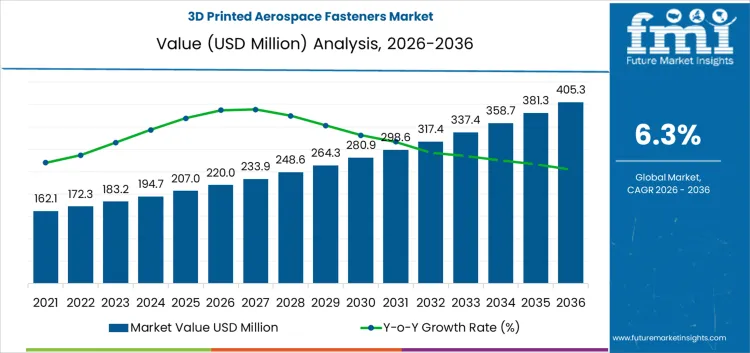
3D Printed Aerospace Fasteners Market Key Takeaways
| Metric | Value |
|---|---|
| Market Value (2026) | USD 220.0 million |
| Market Forecast Value (2036) | USD 405.3 million |
| Forecast CAGR 2026 to 2036 | 6.3% |
Why is the Demand for 3D Printed Aerospace Fasteners Growing?
Demand for 3D printed aerospace fasteners is rising as aircraft manufacturers and maintenance organizations adopt additive manufacturing to produce hardware that meets stringent performance and certification requirements while reducing lead times. Traditional machining of aerospace fasteners involves long production cycles and inventory carrying costs, especially for low-volume, specialty parts used in aging platforms or bespoke designs. Additive manufacturing enables on-demand production of titanium, aluminum, and high-performance polymer fasteners with complex geometries that reduce weight without compromising strength or fatigue resistance.
Engineers specify 3D printed fasteners that conform to design tolerance expectations, controlled microstructure properties, and documented quality control protocols because consistent mechanical performance is essential in structural joints, engine components, and systems subjected to thermal cycling and vibration stress. Procurement teams evaluate supplier additive capability, certification traceability, and inspection records to ensure compliance with aerospace quality standards and minimize risk during part qualification.
Growth in aircraft modernization, defense platform upgrades, and MRO programs reinforces uptake of 3D printed fasteners that align with strategic initiatives to improve supply chain resiliency and reduce time to service. Additive manufacturing supports digital inventory models where virtual stock replaces physical warehousing, enabling rapid fulfillment of specific part numbers that may no longer be in mass production. Certification pathways for additive hardware, including process validation and nondestructive evaluation, strengthen confidence among design engineers and quality auditors. These application-specific production and logistical benefits are contributing to sustained demand growth in the 3D printed aerospace fasteners market.
How Are the Segments Classified in the 3D Printed Aerospace Fasteners Market?
Demand for 3D printed aerospace fasteners is shaped by design flexibility needs, rapid iteration requirements, and material efficiency objectives. Aerospace programs adopt additive manufacturing to reduce lead times and enable complex geometries not feasible through conventional processes. Adoption aligns with qualification-driven development cycles, low-volume production strategies, and digital manufacturing integration. Fastener selection prioritizes mechanical performance, dimensional accuracy, and certification compatibility. Segment classification reflects differentiation by additive printing technology, material system selection, and operational end use influencing qualification rigor, production scalability, and lifecycle support.
Which Printing Technology Represents the Largest Share of Demand?
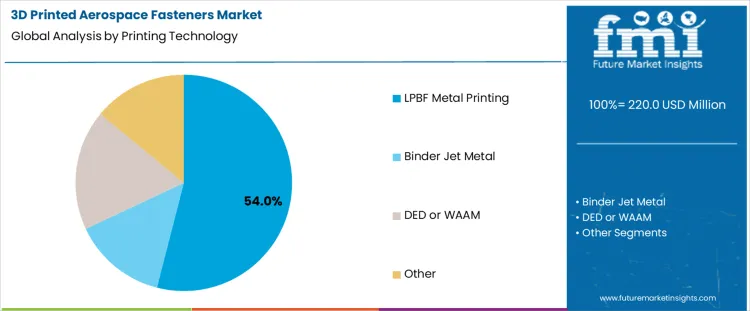
LPBF metal printing holds 54.0%, representing the largest share among printing technologies due to precision and material density control. Layer-wise fusion enables tight tolerances required for aerospace fastener threads and bearing surfaces. High-resolution capability supports complex internal features and weight-optimized designs. Material properties approach wrought performance after post-processing. Directed energy deposition or WAAM supports larger geometries with lower resolution. Binder jet metal printing enables batch production with sintering requirements. Printing technology segmentation reflects preference for processes delivering accuracy, repeatability, and qualification readiness for flight-related fastener applications.
Key Points
- LPBF delivers high precision and dense material structure.
- Resolution supports threaded and load-critical fastener features.
- Other technologies address scale or batch efficiency needs.
Which Material Accounts for the Highest Share of Demand?
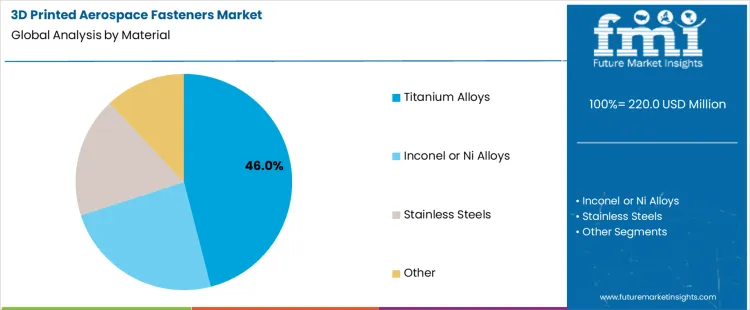
Titanium alloys hold 46.0%, representing the largest share among materials due to strength-to-weight advantages. Titanium supports aerospace weight reduction objectives while maintaining fatigue and corrosion performance. Additive processing enables material-efficient designs reducing waste. Compatibility with LPBF processes supports consistent microstructure control. Inconel and nickel alloys address high-temperature applications with lower volume. Stainless steels serve non-critical or interior uses with cost considerations. Material segmentation reflects dominance of lightweight alloys where performance efficiency and additive manufacturability align with aerospace fastener requirements.
Key Points
-
Titanium offers high strength with reduced mass.
- Additive processing supports efficient material usage.
- Other alloys serve thermal or cost-driven applications.
Which End Use Drives the Largest Share of Demand?
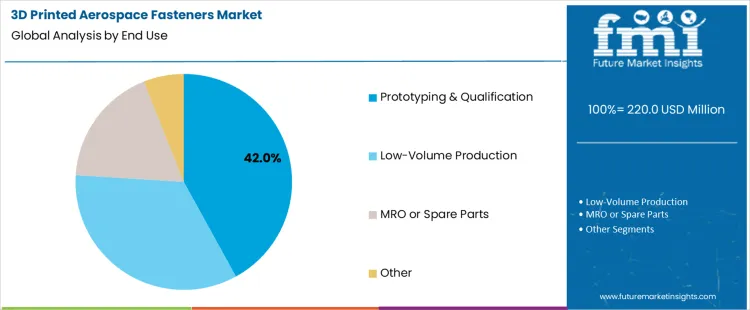
Prototyping and qualification hold 42.0%, representing the largest share among end uses due to iterative development needs. Additive fasteners support rapid design validation and testing cycles. Engineering teams evaluate fit, load behavior, and installation performance before production release. Reduced tooling dependency accelerates program timelines. Low-volume production follows for specialized components. MRO and spare parts applications address lead-time reduction for legacy platforms. End-use segmentation reflects concentration where flexibility, speed, and design iteration remain primary drivers for additive fastener adoption.
Key Points
- Prototyping accelerates design validation and testing.
- Tooling-free production shortens development timelines.
- Other uses address low-volume output or spares availability.
What are the Key Dynamics in the 3D Printed Aerospace Fasteners Market?
Demand for 3D printed aerospace fasteners reflects need for highly customized, lightweight fastening solutions in low-volume, high-complexity aircraft programs. Adoption concentrates in space systems, military aircraft, prototyping lines, and advanced development platforms. Global scope aligns with additive manufacturing qualification in aerospace supply chains. Usage centers on metal fasteners produced through powder bed fusion and directed energy deposition using titanium and nickel alloys.
How do design flexibility and low-volume production requirements shape adoption?
Aerospace programs increasingly require fasteners tailored to localized load paths, constrained geometries, and integrated features. Demand increases where conventional machining cannot economically support complex geometries or rapid design iteration. Additive manufacturing enables internal lattice structures, optimized head shapes, and integrated washers that reduce part count and mass. Space and defense programs adopt printed fasteners to shorten lead times during development and sustainment. Tool-less production supports rapid configuration changes without new dies or tooling. Weight reduction supports performance targets in mass-sensitive platforms. Adoption reflects engineering-driven need for geometry optimization and supply chain agility rather than replacement of high-volume standard fasteners.
How do qualification barriers, material consistency, and cost structure influence market scalability?
3D printed fasteners face extensive qualification requirements for strength, fatigue, and repeatability. Demand sensitivity rises where batch-to-batch variability in powder quality affects mechanical consistency. Post-processing steps including heat treatment and surface finishing add cost and cycle time. Inspection complexity increases due to internal features and anisotropic properties. Unit cost remains higher than forged fasteners in volume applications. Certification frameworks for additively manufactured hardware remain program-specific. Limited approved suppliers constrain sourcing flexibility. Scalability remains restricted to niche aerospace applications where customization value offsets cost and qualification burden.
How Is Demand for 3D Printed Aerospace Fasteners Evolving Globally?
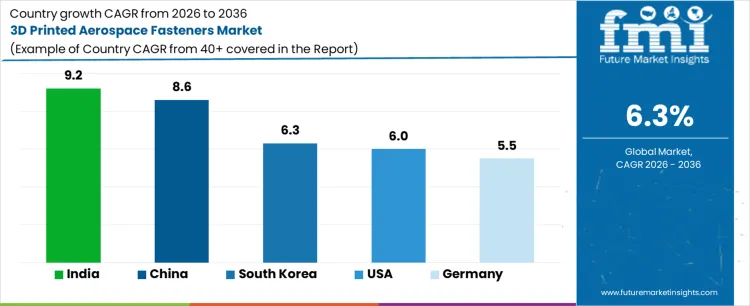
Demand for 3D printed aerospace fasteners is expanding globally due to lightweighting goals, part consolidation, and accelerated qualification cycles. Additive manufacturing enables complex geometries, rapid prototyping, and reduced lead times for low-volume certified hardware. Adoption aligns with defense programs, MRO customization, and digital inventory strategies. Material control, repeatability, and certification frameworks shape deployment pace. Growth rates in India at 9.2%, China at 8.6%, South Korea at 6.3%, USA at 6.0%, and Germany at 5.5% indicate strong expansion driven by localization initiatives, lifecycle maintenance needs, and manufacturing agility rather than broad replacement of conventional fasteners.
| Country | CAGR (%) |
|---|---|
| India | 9.2% |
| China | 8.6% |
| South Korea | 6.3% |
| USA | 6.0% |
| Germany | 5.5% |
What Is Driving Expansion of 3D Printed Aerospace Fastener Demand in India?
Demand for 3D printed aerospace fasteners in India is growing at a CAGR of 9.2%, supported by localization mandates and defense-led prototyping programs. Additive manufacturing shortens development cycles for certified hardware used in limited production runs. MRO operations value rapid fabrication for non-standard replacements during heavy checks. Material efficiency and topology optimization improve strength-to-weight outcomes for specific applications. Qualification pathways mature through public research and private partnerships. Growth reflects capability building and maintenance responsiveness rather than immediate substitution of mass-produced fasteners.
- Localization-driven additive manufacturing adoption
- Rapid prototyping for defense and limited runs
- MRO demand for non-standard replacements
- Public-private qualification and testing programs
Why Is China Sustaining Growth in 3D Printed Aerospace Fastener Adoption?
3D printed aerospace fastener demand in China is expanding at a CAGR of 8.6%, driven by indigenous aircraft programs and digital manufacturing integration. Additive processes support fast iteration of complex fastening designs aligned with composite structures. State-backed investment accelerates material development and process control. Production flexibility reduces tooling dependency for specialized parts. Fleet growth increases tailored maintenance needs addressed through on-demand printing. Growth reflects program-led manufacturing agility and supply chain control rather than wholesale replacement of conventional machining.
- Indigenous aircraft program requirements
- Integration with composite structure designs
- State-supported additive manufacturing investment
- On-demand production for tailored maintenance
How Is South Korea Advancing Demand for 3D Printed Aerospace Fasteners?
Sales of 3D printed aerospace fasteners in South Korea are growing at a CAGR of 6.3%, shaped by participation in global aerospace supply chains. Tier suppliers use additive manufacturing for low-volume, high-complexity fasteners. Emphasis on precision and repeatability supports qualification progress. Defense R&D programs test additive solutions for weight and performance gains. MRO collaboration encourages limited series production. Growth reflects supplier integration and targeted application development rather than expansion of domestic airframe assembly.
- Tier supplier participation in global programs
- Low-volume, high-complexity fastener needs
- Precision and repeatability qualification focus
- Defense R&D validation programs
What Factors Are Influencing 3D Printed Aerospace Fastener Demand in United States?
3D printed aerospace fastener demand in the United States is expanding at a CAGR of 6.0%, supported by advanced materials research and certified additive ecosystems. OEMs and MROs deploy printing for rapid spares and design optimization. Digital inventory strategies reduce downtime for legacy platforms. Robust standards development guides process validation. Adoption remains selective for critical applications. Expansion reflects innovation-led deployment and maintenance flexibility rather than displacement of established high-volume fastener production.
- Advanced materials and additive research base
- Digital inventory for rapid spare production
- Standards-led process validation frameworks
- Selective deployment for critical applications
Why Is Germany Experiencing Measured Growth in 3D Printed Aerospace Fasteners?
Demand for 3D printed aerospace fasteners in Germany is growing at a CAGR of 5.5%, driven by engineering rigor and certification discipline. Manufacturers apply additive methods to specialized fasteners requiring complex geometry. Focus on process stability and traceability moderates adoption speed. Collaboration between OEMs and research institutes supports qualification. MRO usage concentrates on low-volume replacements. Growth remains measured, reflecting standards compliance and engineering validation rather than rapid scaling of additive output.
- Engineering-driven application of additive methods
- Emphasis on traceability and process stability
- OEM-research institute qualification collaboration
- Low-volume MRO replacement focus
What is the competitive landscape of demand for the 3D printed aerospace fasteners market globally?
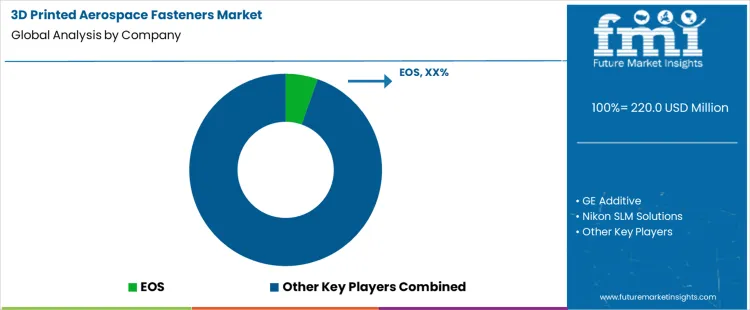
Demand for 3D printed aerospace fasteners is driven by the growing adoption of additive manufacturing in the aerospace industry, which enables the production of lightweight, custom, and complex fastener designs with reduced lead times and material waste. Buyers evaluate the precision, material strength, and ability to integrate fasteners into lightweight aerospace components. Procurement behavior emphasizes manufacturers offering high-quality, certified 3D printing solutions that meet stringent aerospace regulations, as well as those that can deliver cost-effective production for small to medium batch runs. Purchasing decisions prioritize suppliers that provide tailored solutions, innovation in material properties, and flexibility in design. Trend in the market reflects the increasing interest in additive manufacturing technologies, including metal 3D printing, for producing durable, high-performance aerospace fasteners that offer enhanced design freedom.
EOS leads competitive positioning with its advanced metal 3D printing technology, offering precise and high-strength aerospace fasteners tailored for the aerospace industry. GE Additive competes by providing comprehensive additive manufacturing solutions, including 3D printed fasteners that meet rigorous aerospace standards for performance and safety. Nikon SLM Solutions supports demand with its high-precision selective laser melting (SLM) 3D printing technologies, which enable the production of complex and durable aerospace fasteners. 3D Systems participates with a broad portfolio of 3D printing solutions, offering flexibility in material selection and fastener design for aerospace applications. Stratasys provides additive manufacturing systems that allow for quick prototyping and production of lightweight, functional aerospace fasteners with excellent mechanical properties.
Key Players in the 3D Printed Aerospace Fasteners Market
- EOS
- GE Additive
- Nikon SLM Solutions
- 3D Systems
- Stratasys
- Materialise
- Renishaw
- Velo3D
- Carpenter Additive
- GKN Additive
Scope of the Report
| Items | Values |
|---|---|
| Quantitative Units | USD million |
| Printing Technology | LPBF Metal Printing; Binder Jet Metal; DED or WAAM; Other |
| Material | Titanium Alloys; Inconel or Ni Alloys; Stainless Steels; Other |
| End Use | Prototyping & Qualification; Low-Volume Production; MRO or Spare Parts; Other |
| Sales Channel | Service Bureaus; OEM Captive Printing; Printer OEM Ecosystem; Other |
| Regions Covered | Asia Pacific, Europe, North America, Latin America, Middle East & Africa |
| Countries Covered | India, China, South Korea, USA, Germany, and 40+ countries |
| Key Companies Profiled | EOS; GE Additive; Nikon SLM Solutions; 3D Systems; Stratasys; Materialise; Renishaw; Velo3D; Carpenter Additive; GKN Additive |
| Additional Attributes | Dollar sales by printing technology, material, end use, and sales channel; material performance, mechanical properties, and quality control in titanium, Inconel, and stainless steel alloys for 3D printed aerospace fasteners; application trends in prototyping, low-volume production, and MRO spare parts; procurement dynamics driven by service bureaus, OEM captive printing, and printer OEM ecosystems. |
3D Printed Aerospace Fasteners Market by Segment
Printing Technology:
- LPBF Metal Printing
- Binder Jet Metal
- DED or WAAM
- Other
Material:
- Titanium Alloys
- Inconel or Ni Alloys
- Stainless Steels
- Other
End Use:
- Prototyping & Qualification
- Low-Volume Production
- MRO or Spare Parts
- Other
Sales Channel:
- Service Bureaus
- OEM Captive Printing
- Printer OEM Ecosystem
- Other
Region:
- Asia Pacific
- China
- Japan
- South Korea
- India
- Australia & New Zealand
- ASEAN
- Rest of Asia Pacific
- Europe
- Germany
- United Kingdom
- France
- Italy
- Spain
- Nordic
- BENELUX
- Rest of Europe
- North America
- United States
- Canada
- Mexico
- Latin America
- Brazil
- Chile
- Rest of Latin America
- Middle East & Africa
- Kingdom of Saudi Arabia
- Other GCC Countries
- Turkey
- South Africa
- Other African Union
- Rest of Middle East & Africa
Bibliography
- International Organization for Standardization. (2021). Additive manufacturing—General principles—Fundamentals and vocabulary (ISO/ASTM 52900:2021). ISO.
- ASTM International. (2018). Standard specification for additive manufacturing—Finished part properties—Titanium alloys via powder bed fusion (ASTM F3302-18). ASTM International.
- Federal Aviation Administration. (2023). Powder bed fusion additive manufacturing process for aircraft engine parts (Advisory Circular AC 33.15-3). U.S. Department of Transportation.
Frequently Asked Questions
How big is the 3d printed aerospace fasteners market in 2026?
The global 3d printed aerospace fasteners market is estimated to be valued at USD 220.0 million in 2026.
What will be the size of 3d printed aerospace fasteners market in 2036?
The market size for the 3d printed aerospace fasteners market is projected to reach USD 405.3 million by 2036.
How much will be the 3d printed aerospace fasteners market growth between 2026 and 2036?
The 3d printed aerospace fasteners market is expected to grow at a 6.3% CAGR between 2026 and 2036.
What are the key product types in the 3d printed aerospace fasteners market?
The key product types in 3d printed aerospace fasteners market are lpbf metal printing, binder jet metal, ded or waam and other.
Which material segment to contribute significant share in the 3d printed aerospace fasteners market in 2026?
In terms of material, titanium alloys segment to command 46.0% share in the 3d printed aerospace fasteners market in 2026.
Preview the report firsthand - request a free sample
Get SampleGet the brochure for pricing and purchase details.
Get PDFTable of Content
- Executive Summary
- Global Market Outlook
- Demand-side Trends
- Supply-side Trends
- Technology Roadmap Analysis
- Analysis and Recommendations
- Market Overview
- Market Coverage / Taxonomy
- Market Definition / Scope / Limitations
- Market Background
- Market Dynamics
- Drivers
- Restraints
- Opportunity
- Trends
- Scenario Forecast
- Demand in Optimistic Scenario
- Demand in Likely Scenario
- Demand in Conservative Scenario
- Opportunity Map Analysis
- Product Life Cycle Analysis
- Supply Chain Analysis
- Investment Feasibility Matrix
- Value Chain Analysis
- PESTLE and Porter’s Analysis
- Regulatory Landscape
- Regional Parent Market Outlook
- Production and Consumption Statistics
- Import and Export Statistics
- Market Dynamics
- Global Market Analysis 2021 to 2025 and Forecast, 2026 to 2036
- Historical Market Size Value (USD Million) Analysis, 2021 to 2025
- Current and Future Market Size Value (USD Million) Projections, 2026 to 2036
- Y-o-Y Growth Trend Analysis
- Absolute $ Opportunity Analysis
- Global Market Pricing Analysis 2021 to 2025 and Forecast 2026 to 2036
- Global Market Analysis 2021 to 2025 and Forecast 2026 to 2036, By Printing Technology
- Introduction / Key Findings
- Historical Market Size Value (USD Million) Analysis By Printing Technology , 2021 to 2025
- Current and Future Market Size Value (USD Million) Analysis and Forecast By Printing Technology , 2026 to 2036
- LPBF Metal Printing
- Binder Jet Metal
- DED or WAAM
- Other
- LPBF Metal Printing
- Y-o-Y Growth Trend Analysis By Printing Technology , 2021 to 2025
- Absolute $ Opportunity Analysis By Printing Technology , 2026 to 2036
- Global Market Analysis 2021 to 2025 and Forecast 2026 to 2036, By Material
- Introduction / Key Findings
- Historical Market Size Value (USD Million) Analysis By Material, 2021 to 2025
- Current and Future Market Size Value (USD Million) Analysis and Forecast By Material, 2026 to 2036
- Titanium Alloys
- Inconel or Ni Alloys
- Stainless Steels
- Other
- Titanium Alloys
- Y-o-Y Growth Trend Analysis By Material, 2021 to 2025
- Absolute $ Opportunity Analysis By Material, 2026 to 2036
- Global Market Analysis 2021 to 2025 and Forecast 2026 to 2036, By End Use
- Introduction / Key Findings
- Historical Market Size Value (USD Million) Analysis By End Use, 2021 to 2025
- Current and Future Market Size Value (USD Million) Analysis and Forecast By End Use, 2026 to 2036
- Prototyping & Qualification
- Low-Volume Production
- MRO or Spare Parts
- Other
- Prototyping & Qualification
- Y-o-Y Growth Trend Analysis By End Use, 2021 to 2025
- Absolute $ Opportunity Analysis By End Use, 2026 to 2036
- Global Market Analysis 2021 to 2025 and Forecast 2026 to 2036, By Sales Channel
- Introduction / Key Findings
- Historical Market Size Value (USD Million) Analysis By Sales Channel, 2021 to 2025
- Current and Future Market Size Value (USD Million) Analysis and Forecast By Sales Channel, 2026 to 2036
- Service Bureaus
- OEM Captive Printing
- Printer OEM Ecosystem
- Other
- Service Bureaus
- Y-o-Y Growth Trend Analysis By Sales Channel, 2021 to 2025
- Absolute $ Opportunity Analysis By Sales Channel, 2026 to 2036
- Global Market Analysis 2021 to 2025 and Forecast 2026 to 2036, By Region
- Introduction
- Historical Market Size Value (USD Million) Analysis By Region, 2021 to 2025
- Current Market Size Value (USD Million) Analysis and Forecast By Region, 2026 to 2036
- North America
- Latin America
- Western Europe
- Eastern Europe
- East Asia
- South Asia and Pacific
- Middle East & Africa
- Market Attractiveness Analysis By Region
- North America Market Analysis 2021 to 2025 and Forecast 2026 to 2036, By Country
- Historical Market Size Value (USD Million) Trend Analysis By Market Taxonomy, 2021 to 2025
- Market Size Value (USD Million) Forecast By Market Taxonomy, 2026 to 2036
- By Country
- USA
- Canada
- Mexico
- By Printing Technology
- By Material
- By End Use
- By Sales Channel
- By Country
- Market Attractiveness Analysis
- By Country
- By Printing Technology
- By Material
- By End Use
- By Sales Channel
- Key Takeaways
- Latin America Market Analysis 2021 to 2025 and Forecast 2026 to 2036, By Country
- Historical Market Size Value (USD Million) Trend Analysis By Market Taxonomy, 2021 to 2025
- Market Size Value (USD Million) Forecast By Market Taxonomy, 2026 to 2036
- By Country
- Brazil
- Chile
- Rest of Latin America
- By Printing Technology
- By Material
- By End Use
- By Sales Channel
- By Country
- Market Attractiveness Analysis
- By Country
- By Printing Technology
- By Material
- By End Use
- By Sales Channel
- Key Takeaways
- Western Europe Market Analysis 2021 to 2025 and Forecast 2026 to 2036, By Country
- Historical Market Size Value (USD Million) Trend Analysis By Market Taxonomy, 2021 to 2025
- Market Size Value (USD Million) Forecast By Market Taxonomy, 2026 to 2036
- By Country
- Germany
- UK
- Italy
- Spain
- France
- Nordic
- BENELUX
- Rest of Western Europe
- By Printing Technology
- By Material
- By End Use
- By Sales Channel
- By Country
- Market Attractiveness Analysis
- By Country
- By Printing Technology
- By Material
- By End Use
- By Sales Channel
- Key Takeaways
- Eastern Europe Market Analysis 2021 to 2025 and Forecast 2026 to 2036, By Country
- Historical Market Size Value (USD Million) Trend Analysis By Market Taxonomy, 2021 to 2025
- Market Size Value (USD Million) Forecast By Market Taxonomy, 2026 to 2036
- By Country
- Russia
- Poland
- Hungary
- Balkan & Baltic
- Rest of Eastern Europe
- By Printing Technology
- By Material
- By End Use
- By Sales Channel
- By Country
- Market Attractiveness Analysis
- By Country
- By Printing Technology
- By Material
- By End Use
- By Sales Channel
- Key Takeaways
- East Asia Market Analysis 2021 to 2025 and Forecast 2026 to 2036, By Country
- Historical Market Size Value (USD Million) Trend Analysis By Market Taxonomy, 2021 to 2025
- Market Size Value (USD Million) Forecast By Market Taxonomy, 2026 to 2036
- By Country
- China
- Japan
- South Korea
- By Printing Technology
- By Material
- By End Use
- By Sales Channel
- By Country
- Market Attractiveness Analysis
- By Country
- By Printing Technology
- By Material
- By End Use
- By Sales Channel
- Key Takeaways
- South Asia and Pacific Market Analysis 2021 to 2025 and Forecast 2026 to 2036, By Country
- Historical Market Size Value (USD Million) Trend Analysis By Market Taxonomy, 2021 to 2025
- Market Size Value (USD Million) Forecast By Market Taxonomy, 2026 to 2036
- By Country
- India
- ASEAN
- Australia & New Zealand
- Rest of South Asia and Pacific
- By Printing Technology
- By Material
- By End Use
- By Sales Channel
- By Country
- Market Attractiveness Analysis
- By Country
- By Printing Technology
- By Material
- By End Use
- By Sales Channel
- Key Takeaways
- Middle East & Africa Market Analysis 2021 to 2025 and Forecast 2026 to 2036, By Country
- Historical Market Size Value (USD Million) Trend Analysis By Market Taxonomy, 2021 to 2025
- Market Size Value (USD Million) Forecast By Market Taxonomy, 2026 to 2036
- By Country
- Kingdom of Saudi Arabia
- Other GCC Countries
- Turkiye
- South Africa
- Other African Union
- Rest of Middle East & Africa
- By Printing Technology
- By Material
- By End Use
- By Sales Channel
- By Country
- Market Attractiveness Analysis
- By Country
- By Printing Technology
- By Material
- By End Use
- By Sales Channel
- Key Takeaways
- Key Countries Market Analysis
- USA
- Pricing Analysis
- Market Share Analysis, 2025
- By Printing Technology
- By Material
- By End Use
- By Sales Channel
- Canada
- Pricing Analysis
- Market Share Analysis, 2025
- By Printing Technology
- By Material
- By End Use
- By Sales Channel
- Mexico
- Pricing Analysis
- Market Share Analysis, 2025
- By Printing Technology
- By Material
- By End Use
- By Sales Channel
- Brazil
- Pricing Analysis
- Market Share Analysis, 2025
- By Printing Technology
- By Material
- By End Use
- By Sales Channel
- Chile
- Pricing Analysis
- Market Share Analysis, 2025
- By Printing Technology
- By Material
- By End Use
- By Sales Channel
- Germany
- Pricing Analysis
- Market Share Analysis, 2025
- By Printing Technology
- By Material
- By End Use
- By Sales Channel
- UK
- Pricing Analysis
- Market Share Analysis, 2025
- By Printing Technology
- By Material
- By End Use
- By Sales Channel
- Italy
- Pricing Analysis
- Market Share Analysis, 2025
- By Printing Technology
- By Material
- By End Use
- By Sales Channel
- Spain
- Pricing Analysis
- Market Share Analysis, 2025
- By Printing Technology
- By Material
- By End Use
- By Sales Channel
- France
- Pricing Analysis
- Market Share Analysis, 2025
- By Printing Technology
- By Material
- By End Use
- By Sales Channel
- India
- Pricing Analysis
- Market Share Analysis, 2025
- By Printing Technology
- By Material
- By End Use
- By Sales Channel
- ASEAN
- Pricing Analysis
- Market Share Analysis, 2025
- By Printing Technology
- By Material
- By End Use
- By Sales Channel
- Australia & New Zealand
- Pricing Analysis
- Market Share Analysis, 2025
- By Printing Technology
- By Material
- By End Use
- By Sales Channel
- China
- Pricing Analysis
- Market Share Analysis, 2025
- By Printing Technology
- By Material
- By End Use
- By Sales Channel
- Japan
- Pricing Analysis
- Market Share Analysis, 2025
- By Printing Technology
- By Material
- By End Use
- By Sales Channel
- South Korea
- Pricing Analysis
- Market Share Analysis, 2025
- By Printing Technology
- By Material
- By End Use
- By Sales Channel
- Russia
- Pricing Analysis
- Market Share Analysis, 2025
- By Printing Technology
- By Material
- By End Use
- By Sales Channel
- Poland
- Pricing Analysis
- Market Share Analysis, 2025
- By Printing Technology
- By Material
- By End Use
- By Sales Channel
- Hungary
- Pricing Analysis
- Market Share Analysis, 2025
- By Printing Technology
- By Material
- By End Use
- By Sales Channel
- Kingdom of Saudi Arabia
- Pricing Analysis
- Market Share Analysis, 2025
- By Printing Technology
- By Material
- By End Use
- By Sales Channel
- Turkiye
- Pricing Analysis
- Market Share Analysis, 2025
- By Printing Technology
- By Material
- By End Use
- By Sales Channel
- South Africa
- Pricing Analysis
- Market Share Analysis, 2025
- By Printing Technology
- By Material
- By End Use
- By Sales Channel
- USA
- Market Structure Analysis
- Competition Dashboard
- Competition Benchmarking
- Market Share Analysis of Top Players
- By Regional
- By Printing Technology
- By Material
- By End Use
- By Sales Channel
- Competition Analysis
- Competition Deep Dive
- EOS
- Overview
- Product Portfolio
- Profitability by Market Segments (Product/Age /Sales Channel/Region)
- Sales Footprint
- Strategy Overview
- Marketing Strategy
- Product Strategy
- Channel Strategy
- GE Additive
- Nikon SLM Solutions
- 3D Systems
- Stratasys
- Materialise
- Renishaw
- Velo3D
- Carpenter Additive
- GKN Additive
- EOS
- Competition Deep Dive
- Assumptions & Acronyms Used
- Research Methodology


