

- Industry Size (2026)
- USD 63.87 Bn
- Forecast (2036)
- USD 348.73 Bn
- CAGR (2026 to 2036)
- 18.50%
3D Printed Brain Model Market Size, Market Forecast and Outlook By FMI
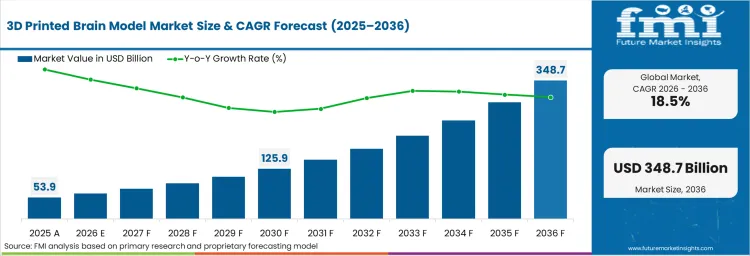
In 2025, the 3d printed brain model market was valued at USD 53.90 billion. Based on Future Market Insights' analysis, demand is estimated to grow to USD 63.87 billion in 2026 and USD 348.73 billion by 2036. FMI projects a CAGR of 18.50% during the forecast period.
The market is set to add approximately USD 284.86 billion in absolute terms between 2026 and 2036. Neurosurgical preoperative planning adoption and medical education program expansion are driving demand for patient-specific 3D printed brain models. Multi-material polyjet printing enables anatomically accurate replicas with differentiated tissue properties (tumor vs. healthy tissue, vascular vs. parenchymal), providing surgeons with tactile rehearsal capability that 2D imaging and virtual 3D displays cannot match. India and China lead growth due to neurosurgery training program expansion and medical 3D printing laboratory establishment at academic medical centers.
Summary of 3D Printed Brain Model Market
- 3D Printed Brain Model Market Definition
- 3D printed brain models are patient-specific and anatomically standardized three-dimensional replicas of cerebral structures fabricated using multijet, stereolithography, FDM, and colorjet printing technologies from polymer and plastic materials for neurosurgical planning, medical education, device testing, and patient communication applications.
- Demand Drivers in the Market
- Neurosurgical preoperative planning for tumor resection, aneurysm clipping, and deep brain stimulation electrode placement benefits from patient-specific 3D brain models that enable surgical approach rehearsal, reducing intraoperative decision-making uncertainty in complex cranial procedures.
- Medical school anatomy education programs are integrating 3D printed brain models as supplements to cadaveric dissection, with multi-color polyjet models enabling visualization of white matter tracts, cortical regions, and vascular territories at costs below cadaveric specimen procurement.
- Medical device companies use 3D printed brain phantoms for testing catheter navigation, electrode placement accuracy, and implant fit verification during product development, reducing the need for animal testing and accelerating regulatory submission timelines.
- Key Segments Analyzed in the FMI Report
- Multijet/Polyjet Printing technology: 34.0% share in 2026, reflecting its structural position as the primary category across established procurement channels.
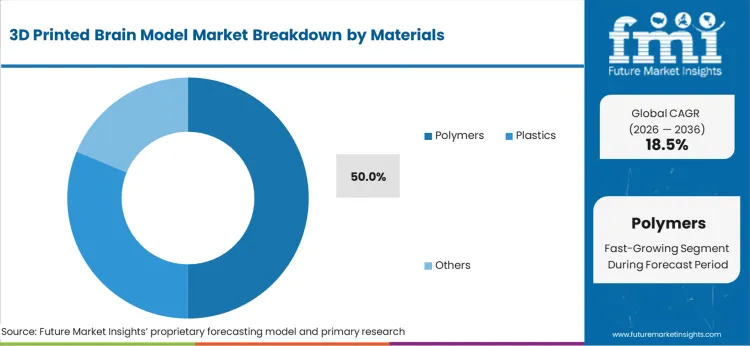
- Polymers materials: 50.0% share in 2026, reflecting its structural position as the primary category across established procurement channels.
- India: 28.40% compound growth through 2036, indicating concentrated demand acceleration.
- Analyst Opinion at FMI
- Sabyasachi Ghosh, Principal Consultant for Healthcare analysts observe that The 3D printed brain model market is a medical additive manufacturing niche where clinical utility in neurosurgical planning and education drives adoption. FMI analysts observe that multijet/polyjet printing commands 34.0% technology share because multi-material capability enables simultaneous printing of translucent, flexible, and rigid regions within a single brain model, replicating the tactile differences between tumor tissue, blood vessels, and cortical structures. Polymers at 50.0% material share dominate because photopolymer resins used in polyjet and SLA printers deliver the surface resolution and material property variation required for anatomically faithful brain replicas. India leads at 28.4% CAGR because the convergence of neurosurgery training program expansion, medical 3D printing laboratory establishment, and lower per-model production costs creates the fastest adoption trajectory globally.
- Strategic Implications / Executive Takeaways
- Medical 3D printing service providers must establish ISO 13485-certified production workflows to qualify for hospital procurement programs requiring medical device quality management system documentation for patient-specific anatomical models.
- Neurosurgery departments should evaluate multi-material polyjet brain model programs for complex tumor and vascular cases where preoperative rehearsal demonstrably reduces operative time and improves resection margin accuracy.
- Medical education institutions in India and China should invest in in-house 3D printing laboratories to produce brain anatomy models at per-unit costs below imported commercial anatomical teaching models.
3D Printed Brain Model Market Key Takeaways
| Metric | Details |
|---|---|
| Industry Size (2026) | USD 63.87 Billion |
| Industry Value (2036) | USD 348.73 Billion |
| CAGR (2026 to 2036) | 18.50% |
Source: Future Market Insights, 2026
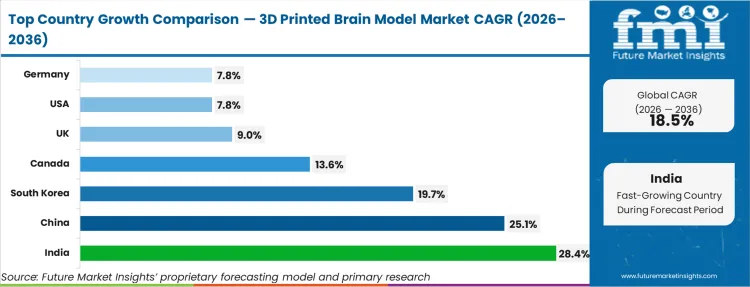
As per FMI, country-level growth rates through 2036 are projected as follows: India at 28.40%, China at 25.10%, South Korea at 19.70%, Canada at 13.60%, UK at 9.00%, Germany at 7.80%, USA at 7.80%. India records the fastest expansion driven by concentrated institutional investment and infrastructure development.
3D Printed Brain Model Market Definition
The 3D printed brain model market represents patient-specific and standardized anatomical replica production using additive manufacturing technologies for neurosurgical, educational, and medical device development applications. Multi-material printing platforms produce brain models with differentiated tissue properties, enabling surgeons to physically rehearse complex procedures on tactile replicas that replicate the spatial relationships between tumors, blood vessels, and functional cortical regions. As per FMI, the market is in a clinical adoption acceleration phase where neurosurgical planning utility is the primary revenue driver, with medical education and device testing providing supplementary growth channels concentrated in academic medical centers and medical device R&D laboratories.
3D Printed Brain Model Market Inclusions
Market scope covers 3D printed brain models produced via multijet/polyjet, stereolithography, fused deposition modeling, and colorjet printing technologies using polymer and plastic materials for neurosurgical planning, anatomical education, medical device validation, and clinical communication applications.
3D Printed Brain Model Market Exclusions
3D bioprinted functional brain tissue constructs with living cells, standard anatomical teaching models produced by injection molding, and virtual 3D brain visualization software without physical model output are excluded.
3D Printed Brain Model Market Research Methodology
- Primary Research: Analysts conducted structured interviews with procurement managers, product engineers, and distribution channel operators to map purchase decision triggers and specification requirements across key verticals.
- Desk Research: Data collection aggregated regulatory filings, industry standards documentation, patent registries, trade body publications, and company annual reports across all target geographies.
- Market-Sizing and Forecasting: Baseline values derive from a bottom-up aggregation of product shipment volumes and average selling prices, validated against publicly disclosed revenue figures from leading suppliers.
- Data Validation and Update Cycle: Projections are cross-referenced against quarterly earnings data, import-export trade statistics, and industry association production reports to maintain forecast integrity.
Key Industry Highlights
Growth Factors Influencing the 3D Printed Brain Models Market
An accurate and detailed representation of the intricate architecture of the brain can be provided by 3D printed brain models, which make it possible to gain a deeper understanding of its structure and function.
Besides being useful teaching tools, these models are also useful for educators and students, whether they need to learn anatomy, ophthalmology, or neurological conditions. In addition to providing a hands-on learning environment, they encourage a deeper understanding of brain architecture and disease.
The use of 3D printed brain models by surgeons can assist them in planning complex surgical procedures, such as brain surgery. The accuracy of a patient's brain model can help surgeons anticipate potential difficulties and better understand the specific anatomy of the patient, which will improve the patient's surgical outcome. The use of 3D brain models for simulation training can improve surgical skills and improve surgical techniques among healthcare professionals. In a risk-free environment, surgeons can practice and develop their surgical skills by simulating surgical scenarios on these models.
Market trends in 3D Printed Brain Models
With the advancements in printing materials, biocompatible and flexible polymers can now be used to print brain models that function correctly and are much more realistic. By using this approach, it is possible to mimic both the texture and density of the brain tissues, which is of particular significance for the model's use in different applications.
Using a multi-material 3D printer, this model can be customized with different colors and textures to distinguish between different brain regions and pathologies, making it great for education and clinical use.
A significant decrease in the cost of 3D printers and advanced 3D printing technology has made it possible to manufacture high-quality brain models at a lower cost. Thus, researchers and medical institutions have easier access to the technology.
Incorporating 3D Printed Brain Models into Online Learning Environments will be Beneficial
Globally, 3D printed brain models have the potential to become more widely used in the field of medical education, particularly in areas with limited access to conventional medical care.
The potential impact of this initiative is to raise the standard of medical education and training throughout the world. Using 3D-printed brain models in an online learning environment can provide students with opportunities to engage in virtual dissections and interactive learning experiences.
3D brain exhibits can be used to demonstrate and educate the public on the significance of brain health, neurological diseases, and neuroscience research in museums, research facilities, and educational facilities. Increasing community awareness and preventive measures about neurological health through community health programs may provide opportunities over the years.
For Alzheimer's, Parkinson's, and brain tumors, scientists might be able to use this technique to construct disease-specific brain models to gain a better understanding and treatment of the diseases. New strategies for healing brain injuries and disorders can be uncovered by studying the potential of 3D-printed brain models for regenerative medicine, such as neural tissue engineering scaffolds.
Cost and Time Efficiency May Limit the Growth for 3D Printed Brain Models
Printing microstructures with two-photon polymerization is a good method for high-resolution microstructures, but printing larger items is time-consuming. The brain phantoms thus generated have a limited size.
The softness and deformability of the human brain cannot be replicated by current 3D printing technology. As a result, it is challenging to build realistic models of the brain that are capable of reproducing its tactile characteristics. In addition to being costly and time-consuming, the process of creating customized brain models can be complex.
Models made using 3D printing may not adequately represent the complex structure and physiology of the brain. Depending on this, they may be less beneficial during surgical training or for preoperative planning. Materials used in 3D printing can greatly influence the functionality and realism of brain models. Real brain tissue may be more malleable and soft than models made of ABS (acrylonitrile butadiene styrene) thermoplastic.
2021 to 2025 3D Printed Brain Model Market Outlook Compared to Demand Forecast from 2026 to 2036
A CAGR of 17.2% was recorded between 2021 and 2025 for the 3D printed brain model industry. A 3D printed brain model industry worth USD 37.5 billion was recorded in 2025, up from USD 14.6 billion in 2021.
Using bioprinting techniques to create functional brain tissue could be one of the most promising applications of 3D printed brain models in the future. Personalized therapies and regenerative medicine may benefit from this development.
Researchers and medical experts can better understand neurological illnesses through 3D printed brain models, which provide a concrete depiction of the brain's anatomy and physiology. A 3D printed brain model enables physicians to examine and identify specific brain abnormalities or lesions, which will assist them in diagnosing diseases of the nervous system.
Neurosurgeons can plan intricate neurosurgical procedures, like deep brain stimulation and tumor excision, using 3D printed brain models to improve surgical precision and outcomes. Models of the human brain that are made using 3D printing can be used to develop new treatment modalities for neurological disorders. To examine the effects of medications and treatments on specific brain areas or neural networks, researchers can use these models.
A 3D-printed model of the brain is an invaluable educational tool for students and medical professionals alike who wish to better understand and research the complexities of neurological diseases through experiential learning in a hands-on environment.
By using 3D printing, custom medicines can be developed to deliver medication to patients with neurological illnesses. Through the modification of the printed devices' structures and forms, researchers can optimize drug delivery to specific brain regions.
3D printing techniques such as bioprinting can be used to create nerve conduits that facilitate peripheral nerve regeneration. As a result of the printing of these nerve conduits, neurological disorders brought on by damaged peripheral nerves may be treated. There is also the potential to repair damaged nerves with the use of these conduits.
Market Concentration
A sizeable 43.7% of the global market is captured by Tier 1 companies. Players are focused on developing advanced materials and establishing strong brand recognition to achieve success.
A continuous investment in research and development will ensure that new 3D printing materials and technologies are developed. Supporting the adoption of 3D printing in the healthcare sector through training programs and resources. Prominent firms within Tier 1 include 3D Systems and Stratasys.
In Tier 2, mid-size players hold a 29.7% market share. They are highly positioned in specific geographical areas and are steadily growing, but can't compete with Tier 1 players for global reach or product diversity. A majority of Tier 2 companies are focused on offering affordable technologies with user-friendly interfaces, such as bioprinting, which are enabling them to grow steadily.
To meet the needs of small medical practices and research laboratories, companies are focused on offering reliable, and cost-effective 3D printing solutions. Companies include Formlabs and CELLINK.
Tier 3 firms specialize in bioprinting technologies and custom implant manufacturing. To establish a presence in the market, players are focused on niche markets, breakthrough technologies, and regional strengths. Players include Rokit Healthcare Inc., MedPrim, Voxeljet, and Cyfuse Biomedical.
Country-wise Insights
Different country-specific industry analyses are provided for 3D printed brain models. A study of industry demand is conducted for various regions worldwide, including North America, Europe, Asia Pacific, etc.
With a CAGR of 13.6% through 2034, Canada is expected to top the charts in North America. By 2034, India is predicted to experience a CAGR of 28.4% in Asia Pacific.
.webp "Top Country Growth Comparison 3d Printed Brain Model Market Cagr (2026 2036)")
| Countries | Value CAGR |
|---|---|
| United States | 7.8% |
| Canada | 13.6% |
| United Kingdom | 9% |
| Germany | 7.8% |
| India | 28.4% |
| China | 25.1% |
| South Korea | 19.7% |
Source: FMI analysis based on primary research and proprietary forecasting model
3D Printed Brain Models in Canada to be boosted by Medical Research
A growing demand for 3D printed brain models has made Canada a leader in this rapidly evolving field of healthcare technology. The Canadian healthcare system is known for its comprehensiveness and commitment to innovative medical research. Medical education, prognosis, and patient communication are all impacted by the use of these models.
An academic research team at the University of Toronto is using 3D printers to construct brain models to examine Alzheimer's disease-related changes in brain function and structure. Researchers are working to develop treatment options that are more effective for this illness.
In the medically advanced nation, with a growing network of research institutes and medical facilities, 3D printing technology may have the potential to improve patient care and transform neurosurgery.
Canadian hospitals and universities have taken a major step toward a patient-centric and efficient healthcare ecosystem by increasingly relying on these complex models to train medical professionals and improve outcomes.
Healthcare Quality and Safety in Germany to Fuel Demand
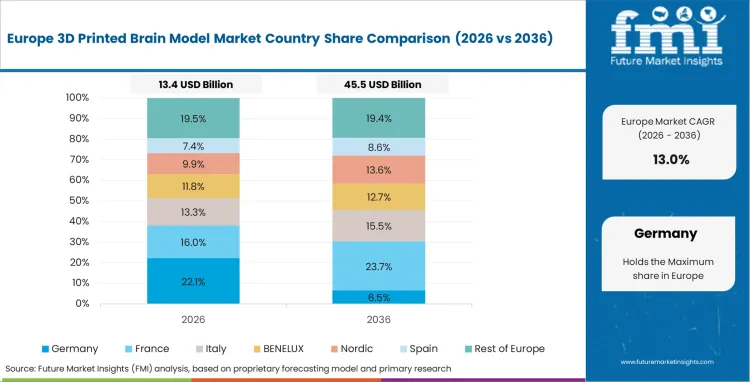
Over the next few years, Germany's market is expected to grow significantly. The industry is projected to expand at a CAGR of 7.8% during the forecast period. University of Wisconsin scientists created brain tissue that develops and performs normally. In addition to providing a model for studying diseased and healthy brains, this discovery may also provide a basis for drug development.
With major industrial companies embracing 3D printing technology, Germany has a well-established 3D printing industry. A survey performed in 2021 revealed that 44% of German industrial enterprises employing more than 100 persons have already implemented 3D printing technologies. In the next two years, another 20% of respondents are planning to do the same.
With the fine resolution and accuracy of 3D printed brain models, surgeons can plan treatments and simulate interventions with greater precision, which ultimately results in better surgical results.
In a nation that emphasizes patient safety and informed consent, this model facilitates patient communication and helps people make informed healthcare choices. With the development of 3D printed brain models, Germany continues to demonstrate its commitment to providing high-quality healthcare.
Innovation in Healthcare Sectors in India Fuels the Demand
In India, 3D printed brain models are showing positive growth trends. Between 2024 and 2034, India's market is expected to expand at a CAGR of 28.4%. An increase in the demand for 3D printed brain models can be attributed to the government's commitment to innovation and accessibility in healthcare. With its burgeoning population and diverse medical needs, India is exploiting advanced technologies such as 3D printing to solve complex medical problems.
Intensely crafted models provide unparalleled clarity in neuroanatomy teaching and learning for students and medical educators. Patients can also consult with a 3D printed brain model during surgery and plan out their treatment in a country with affordable healthcare solutions.
Due to a booming network of medical institutes and startups in India, the process of integrating 3D printing into healthcare has become an emblem of the country's transition to a more efficient and inclusive healthcare system.
Category-wise Insights
The information in this section will provide a brief overview of the industry's most prominent segments. A value share of 28.7% was accounted for by fused deposition modeling in 2023. Based on material type, plastics held a market share of 43.7% in 2023.
Tailor-made 3D Brain Models Based on Fused Deposition Modelling will Drive Demand
| Type | Fused Deposition Modelling |
|---|---|
| Value Share (2023) | 28.7% |
The fused deposition modeling segment accounted for approximately 28.7% of revenue in 2023. A major improvement in material capabilities can be expected with FDM technology.
Due to the development of new materials and tailor-made for FDM printing, printed items will perform better and have a wider range of applications. Resolution and precision are expected to improve with FDM technology. A continuation of research and development will enable FDM-printed products to achieve higher dimensional accuracy and surface polish.
The declining cost of FDM printers and supplies has made them more affordable to a greater number of customers. In the coming years, ongoing efforts will reduce expenses and increase affordability for individuals, small businesses, and educational institutions to access FDM technology.
Scholars are constantly refining FDM settings so they can get better print quality, dimensional accuracy, and surface polish. Taguchi and ANOVA are two methods for optimizing process parameters and improving printing quality.
Plastics Materials Are Likely to Expand Demand for 3D Printed Brain Model
| Material | Plastics |
|---|---|
| Value Share (2023) | 43.7% |
Plastic filaments are relatively inexpensive in contrast to other materials like metals or ceramics. 3D printing is now available to a wide range of users, including medical facilities, universities, and research laboratories. The flexibility of plastic materials makes them ideal for customization.
3D printers can mimic specific brain tissues or structures using plastic filaments that researchers can customize. These customized models closely resemble real brain anatomy in order to assist in various research studies and surgery planning.
3D printing using plastic materials allows the creation of complex and realistic brain models since plastic materials are flexible and long-lasting. The models can be examined and modified without damaging them for medical education, research experiments, or demonstrations.
Competitive Landscape of the 3D Printed Brain Models industry
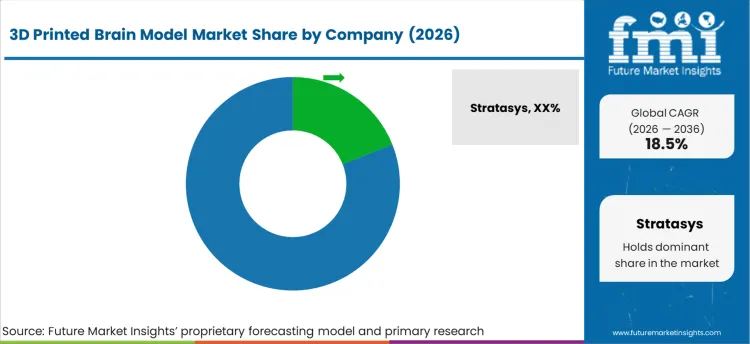
The market is competitive since there are both local and foreign businesses that operate in it. A market participant's existing products are constantly developed and expanded to remain competitive. To increase market share, businesses utilize a variety of methods, including mergers, acquisitions, alliances, and joint ventures.
Scope of the Report
| Metric | Value |
|---|---|
| Quantitative Units | USD 63.87 Bn to USD 348.73 Bn, at a CAGR of 18.50% |
| Market Definition | 3D printed brain models are patient-specific and anatomically standardized three-dimensional replicas of cerebral structures fabricated using multijet, stereolithography, FDM, and colorjet printing technologies from polymer and plastic materials for neurosurgical planning, medical education, device testing, and patient communication applications. |
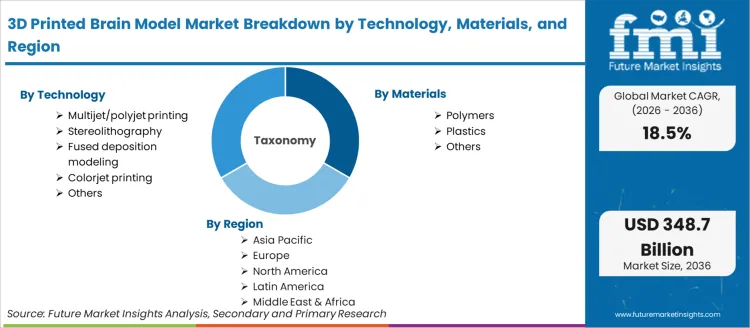
| Technology Segmentation | Multijet/Polyjet Printing, Stereolithography, Fused Deposition Modeling, Colorjet Printing, Others |
| Materials Segmentation | Polymers, Plastics, Others |
| Regions Covered | North America, Latin America, Europe, East Asia, South Asia, Oceania, Middle East & Africa |
| Countries Covered | India, China, South Korea, UK, Germany, USA, Canada, and 40 plus countries |
| Key Companies Profiled | Stratasys, 3D Systems, Formlabs, CELLINK, Rokit Healthcare Inc., Voxeljet, Cyfuse Biomedical, MedPrim |
| Forecast Period | 2026 to 2036 |
| Approach | Hybrid bottom-up and top-down modeling validated against primary research inputs and publicly available industry data. |
Key Segments of the 3D Printed Brain Model Industry
By Technology:
In terms of technology, the industry is segmented into stereolithography (SLA), colorjet printing, multijet/polyjet printing, fused deposition modeling (FDM), and others.
By Materials:
In terms of material, the industry is segregated into polymers, plastics, and others.
By Region:
Key countries of North America, Latin America, Western Europe, Eastern Europe, South Asia, East Asia, Middle East, and Africa have been covered in the report.
Bibliography
- [1] US Food and Drug Administration. (2024). Technical Considerations for Additive Manufactured Medical Devices: Guidance for Industry. FDA.
- [2] Stratasys Ltd. (2024). Annual Report 2024: Healthcare Division, Anatomical Modeling. Stratasys.
- [3] National Institutes of Health. (2024). 3D Print Exchange: Medical Model Repository. NIH.
- [4] International Organization for Standardization. (2024). ISO 13485: Medical Devices, Quality Management Systems. ISO.
- [5] World Federation of Neurosurgical Societies. (2024). Global Neurosurgery Training Programme Report. WFNS.
This bibliography is provided for reader reference. The full FMI report contains the complete reference list with primary research documentation.
Frequently Asked Questions
How large is the demand for 3D Printed Brain Model in the global market in 2026?
Demand for 3D Printed Brain Model in the global market is estimated to be valued at USD 63.87 billion in 2026.
What will be the market size of 3D Printed Brain Model by 2036?
Market size for 3D Printed Brain Model is projected to reach USD 348.73 billion by 2036.
What is the expected demand growth between 2026 and 2036?
Demand is expected to grow at a CAGR of 18.50% between 2026 and 2036.
Which Technology is poised to lead by 2026?
Multijet/Polyjet Printing accounts for 34.0% in 2026, reflecting its established position across primary channels.
How significant is Polymers in driving adoption?
Polymers represents 50.0% of segment share in 2026.
What country records the fastest growth?
India is projected to grow at a CAGR of 28.40% during 2026 to 2036.
What is the projected growth for China?
China is projected to expand at a CAGR of 25.10% during 2026 to 2036.
What is included in the scope of this report?
Market scope covers 3D printed brain models produced via multijet/polyjet, stereolithography, fused deposition modeling, and colorjet printing technologies using polymer and plastic materials for neurosurgical planning, anatomical education, medical device validation, and clinical communication applications.
Preview the report firsthand - request a free sample
Get SampleGet the brochure for pricing and purchase details.
Get PDFTable of Content
- Executive Summary
- Global Market Outlook
- Demand-side Trends
- Supply-side Trends
- Technology Roadmap Analysis
- Analysis and Recommendations
- Market Overview
- Market Coverage / Taxonomy
- Market Definition / Scope / Limitations
- Research Methodology
- Chapter Orientation
- Analytical Lens and Working Hypotheses
- Market Structure, Signals, and Trend Drivers
- Benchmarking and Cross-market Comparability
- Market Sizing, Forecasting, and Opportunity Mapping
- Research Design and Evidence Framework
- Desk Research Programme (Secondary Evidence)
- Company Annual and Sustainability Reports
- Peer-reviewed Journals and Academic Literature
- Corporate Websites, Product Literature, and Technical Notes
- Earnings Decks and Investor Briefings
- Statutory Filings and Regulatory Disclosures
- Technical White Papers and Standards Notes
- Additional Desk Sources
- Expert Input and Fieldwork (Primary Evidence)
- Primary Modes
- Qualitative Interviews and Expert Elicitation
- Quantitative Surveys and Structured Data Capture
- Blended Approach
- Why Primary Evidence is Used
- Field Techniques
- Interviews
- Surveys
- Focus Groups
- Observational and In-context Research
- Social and Community Interactions
- Stakeholder Universe Engaged
- C-suite Leaders
- Board Members
- Presidents and Vice Presidents
- R&D and Innovation Heads
- Technical Specialists
- Domain Subject-matter Experts
- Scientists
- Physicians and Other Healthcare Professionals
- Governance, Ethics, and Data Stewardship
- Research Ethics
- Data Integrity and Handling
- Primary Modes
- Tooling, Models, and Reference Databases
- Desk Research Programme (Secondary Evidence)
- Data Engineering and Model Build
- Data Acquisition and Ingestion
- Cleaning, Normalisation, and Verification
- Synthesis, Triangulation, and Analysis
- Quality Assurance and Audit Trail
- Market Background
- Market Dynamics
- Drivers
- Restraints
- Opportunity
- Trends
- Scenario Forecast
- Demand in Optimistic Scenario
- Demand in Likely Scenario
- Demand in Conservative Scenario
- Opportunity Map Analysis
- Product Life Cycle Analysis
- Supply Chain Analysis
- Investment Feasibility Matrix
- Value Chain Analysis
- PESTLE and Porter’s Analysis
- Regulatory Landscape
- Regional Parent Market Outlook
- Production and Consumption Statistics
- Import and Export Statistics
- Market Dynamics
- Global Market Analysis 2021 to 2025 and Forecast, 2026 to 2036
- Historical Market Size Value (USD Million) Analysis, 2021 to 2025
- Current and Future Market Size Value (USD Million) Projections, 2026 to 2036
- Y-o-Y Growth Trend Analysis
- Absolute $ Opportunity Analysis
- Global Market Pricing Analysis 2021 to 2025 and Forecast 2026 to 2036
- Global Market Analysis 2021 to 2025 and Forecast 2026 to 2036, By Technology
- Introduction / Key Findings
- Historical Market Size Value (USD Million) Analysis By Technology , 2021 to 2025
- Current and Future Market Size Value (USD Million) Analysis and Forecast By Technology , 2026 to 2036
- Multijet/polyjet printing
- Stereolithography
- Fused deposition modeling
- Colorjet printing
- Others
- Multijet/polyjet printing
- Y-o-Y Growth Trend Analysis By Technology , 2021 to 2025
- Absolute $ Opportunity Analysis By Technology , 2026 to 2036
- Global Market Analysis 2021 to 2025 and Forecast 2026 to 2036, By Materials
- Introduction / Key Findings
- Historical Market Size Value (USD Million) Analysis By Materials, 2021 to 2025
- Current and Future Market Size Value (USD Million) Analysis and Forecast By Materials, 2026 to 2036
- Polymers
- Plastics
- Others
- Polymers
- Y-o-Y Growth Trend Analysis By Materials, 2021 to 2025
- Absolute $ Opportunity Analysis By Materials, 2026 to 2036
- Global Market Analysis 2021 to 2025 and Forecast 2026 to 2036, By Region
- Introduction
- Historical Market Size Value (USD Million) Analysis By Region, 2021 to 2025
- Current Market Size Value (USD Million) Analysis and Forecast By Region, 2026 to 2036
- North America
- Latin America
- Western Europe
- Eastern Europe
- East Asia
- South Asia and Pacific
- Middle East & Africa
- Market Attractiveness Analysis By Region
- North America Market Analysis 2021 to 2025 and Forecast 2026 to 2036, By Country
- Historical Market Size Value (USD Million) Trend Analysis By Market Taxonomy, 2021 to 2025
- Market Size Value (USD Million) Forecast By Market Taxonomy, 2026 to 2036
- By Country
- USA
- Canada
- Mexico
- By Technology
- By Materials
- By Country
- Market Attractiveness Analysis
- By Country
- By Technology
- By Materials
- Key Takeaways
- Latin America Market Analysis 2021 to 2025 and Forecast 2026 to 2036, By Country
- Historical Market Size Value (USD Million) Trend Analysis By Market Taxonomy, 2021 to 2025
- Market Size Value (USD Million) Forecast By Market Taxonomy, 2026 to 2036
- By Country
- Brazil
- Chile
- Rest of Latin America
- By Technology
- By Materials
- By Country
- Market Attractiveness Analysis
- By Country
- By Technology
- By Materials
- Key Takeaways
- Western Europe Market Analysis 2021 to 2025 and Forecast 2026 to 2036, By Country
- Historical Market Size Value (USD Million) Trend Analysis By Market Taxonomy, 2021 to 2025
- Market Size Value (USD Million) Forecast By Market Taxonomy, 2026 to 2036
- By Country
- Germany
- UK
- Italy
- Spain
- France
- Nordic
- BENELUX
- Rest of Western Europe
- By Technology
- By Materials
- By Country
- Market Attractiveness Analysis
- By Country
- By Technology
- By Materials
- Key Takeaways
- Eastern Europe Market Analysis 2021 to 2025 and Forecast 2026 to 2036, By Country
- Historical Market Size Value (USD Million) Trend Analysis By Market Taxonomy, 2021 to 2025
- Market Size Value (USD Million) Forecast By Market Taxonomy, 2026 to 2036
- By Country
- Russia
- Poland
- Hungary
- Balkan & Baltic
- Rest of Eastern Europe
- By Technology
- By Materials
- By Country
- Market Attractiveness Analysis
- By Country
- By Technology
- By Materials
- Key Takeaways
- East Asia Market Analysis 2021 to 2025 and Forecast 2026 to 2036, By Country
- Historical Market Size Value (USD Million) Trend Analysis By Market Taxonomy, 2021 to 2025
- Market Size Value (USD Million) Forecast By Market Taxonomy, 2026 to 2036
- By Country
- China
- Japan
- South Korea
- By Technology
- By Materials
- By Country
- Market Attractiveness Analysis
- By Country
- By Technology
- By Materials
- Key Takeaways
- South Asia and Pacific Market Analysis 2021 to 2025 and Forecast 2026 to 2036, By Country
- Historical Market Size Value (USD Million) Trend Analysis By Market Taxonomy, 2021 to 2025
- Market Size Value (USD Million) Forecast By Market Taxonomy, 2026 to 2036
- By Country
- India
- ASEAN
- Australia & New Zealand
- Rest of South Asia and Pacific
- By Technology
- By Materials
- By Country
- Market Attractiveness Analysis
- By Country
- By Technology
- By Materials
- Key Takeaways
- Middle East & Africa Market Analysis 2021 to 2025 and Forecast 2026 to 2036, By Country
- Historical Market Size Value (USD Million) Trend Analysis By Market Taxonomy, 2021 to 2025
- Market Size Value (USD Million) Forecast By Market Taxonomy, 2026 to 2036
- By Country
- Kingdom of Saudi Arabia
- Other GCC Countries
- Turkiye
- South Africa
- Other African Union
- Rest of Middle East & Africa
- By Technology
- By Materials
- By Country
- Market Attractiveness Analysis
- By Country
- By Technology
- By Materials
- Key Takeaways
- Key Countries Market Analysis
- USA
- Pricing Analysis
- Market Share Analysis, 2025
- By Technology
- By Materials
- Canada
- Pricing Analysis
- Market Share Analysis, 2025
- By Technology
- By Materials
- Mexico
- Pricing Analysis
- Market Share Analysis, 2025
- By Technology
- By Materials
- Brazil
- Pricing Analysis
- Market Share Analysis, 2025
- By Technology
- By Materials
- Chile
- Pricing Analysis
- Market Share Analysis, 2025
- By Technology
- By Materials
- Germany
- Pricing Analysis
- Market Share Analysis, 2025
- By Technology
- By Materials
- UK
- Pricing Analysis
- Market Share Analysis, 2025
- By Technology
- By Materials
- Italy
- Pricing Analysis
- Market Share Analysis, 2025
- By Technology
- By Materials
- Spain
- Pricing Analysis
- Market Share Analysis, 2025
- By Technology
- By Materials
- France
- Pricing Analysis
- Market Share Analysis, 2025
- By Technology
- By Materials
- India
- Pricing Analysis
- Market Share Analysis, 2025
- By Technology
- By Materials
- ASEAN
- Pricing Analysis
- Market Share Analysis, 2025
- By Technology
- By Materials
- Australia & New Zealand
- Pricing Analysis
- Market Share Analysis, 2025
- By Technology
- By Materials
- China
- Pricing Analysis
- Market Share Analysis, 2025
- By Technology
- By Materials
- Japan
- Pricing Analysis
- Market Share Analysis, 2025
- By Technology
- By Materials
- South Korea
- Pricing Analysis
- Market Share Analysis, 2025
- By Technology
- By Materials
- Russia
- Pricing Analysis
- Market Share Analysis, 2025
- By Technology
- By Materials
- Poland
- Pricing Analysis
- Market Share Analysis, 2025
- By Technology
- By Materials
- Hungary
- Pricing Analysis
- Market Share Analysis, 2025
- By Technology
- By Materials
- Kingdom of Saudi Arabia
- Pricing Analysis
- Market Share Analysis, 2025
- By Technology
- By Materials
- Turkiye
- Pricing Analysis
- Market Share Analysis, 2025
- By Technology
- By Materials
- South Africa
- Pricing Analysis
- Market Share Analysis, 2025
- By Technology
- By Materials
- USA
- Market Structure Analysis
- Competition Dashboard
- Competition Benchmarking
- Market Share Analysis of Top Players
- By Regional
- By Technology
- By Materials
- Competition Analysis
- Competition Deep Dive
- Stratasys
- Overview
- Product Portfolio
- Profitability by Market Segments (Product/Age /Sales Channel/Region)
- Sales Footprint
- Strategy Overview
- Marketing Strategy
- Product Strategy
- Channel Strategy
- 3D Systems
- Formlabs
- CELLINK
- Rokit Healthcare Inc.
- Voxeljet
- Cyfuse Biomedical
- MedPrim
- Stratasys
- Competition Deep Dive
- Assumptions & Acronyms Used


