

- Industry Size (2026)
- USD 890 Mn
- Forecast (2036)
- USD 6395.3 Mn
- CAGR (2026 to 2036)
- 21.8%
3D Printed Drones Market Forecast and Outlook 2026 to 2036
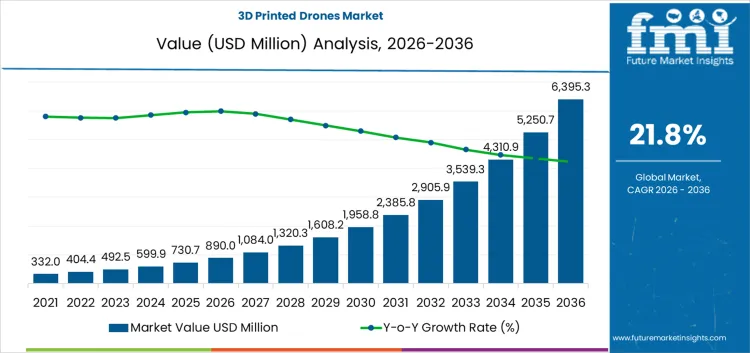
The 3D printed drones market is projected to grow from USD 890 million in 2026 to USD 6,395.3 million by 2036, reflecting a compound annual growth rate (CAGR) of 21.8%. The market is being driven by advancements in 3D printing technologies, which enable the production of lightweight, customizable, and cost-effective drones. As industries such as agriculture, logistics, surveillance, and military applications increasingly adopt drone technology, the demand for 3D printed drones is expected to rise. The ability to rapidly prototype and manufacture complex drone components using 3D printing will further accelerate market growth, along with the growing need for drones that offer enhanced performance, durability, and design flexibility.
The market is projected to experience rapid growth, with values rising from USD 890 million in 2026 to USD 1,070 million in 2027, followed by USD 1,290 million in 2028. In 2029, the market will reach USD 1,550 million, continuing to rise to USD 1,850 million in 2030. By 2036, the market is expected to reach USD 6,395.3 million, driven by ongoing technological advancements, increasing adoption of drones across various industries, and the growing need for efficient and customized solutions.
Quick Stats for the 3D Printed Drones Market
- 3D Printed Drones Market Value (2026): USD 890 million
- 3D Printed Drones Market Forecast Value (2036): USD 6,395.3 million
- 3D Printed Drones Market Global Forecast CAGR (2026-2036): 21.8%
- 3D Printed Drones Market Leading Segment: Rotary Wing Drones (48%)
- Key Growth Regions in 3D Printed Drones Market: USA
- Top Players in 3D Printed Drones Market: Boeing, AeroVironment, Inc., Parrot SA, Skydio, Inc., DJI Innovations, General Atomics Aeronautical Systems, 3D Robotics, Stratasys Ltd., Velo3D, Lockheed Martin Corporation
What is the Market Share Erosion or Gain Analysis for the 3D Printed Drones Market through 2036?
The market share gain in the 3D printed drones market will be significant over the next decade, driven by the widespread adoption of 3D printing technologies in drone manufacturing. Starting from USD 890 million in 2026, the market will see consistent growth, reaching USD 1,290 million by 2028. This early phase of growth will reflect a strong gain in market share, particularly driven by increased demand for cost-effective, customizable drones in sectors like logistics, agriculture, and surveillance.
From 2028 to 2032, the market will experience continued gains in market share, with the value rising from USD 1,550 million in 2029 to USD 2,210 million by 2032. The rise in market share during this period will be fueled by technological innovations in drone design, including lightweight and durable 3D printed components that improve drone performance.
By 2036, the market will reach USD 6,395.3 million, with further market share gains. As 3D printing continues to mature, more industries will adopt drones for various applications, leading to increased competition and further market penetration. This market share gain will reflect both the adoption of drones across new sectors and the improved efficiency and affordability enabled by 3D printing technologies. The growth in market share will be particularly pronounced as drone capabilities continue to evolve, offering more advanced features at lower costs, making them increasingly attractive to industries globally.
3D Printed Drones Market Key Takeaways
| Metric | Value |
|---|---|
| Industry Sales Value (2026) | USD 890 million |
| Industry Forecast Value (2036) | USD 6,395.3 million |
| Industry Forecast CAGR 2026 to 2036 | 21.8% |
What Is Driving the 3D Printed Drones Market?
Historically, the 3D printed drones market emerged from the convergence of additive manufacturing and unmanned aerial system development as manufacturers sought rapid prototyping and customization benefits that traditional fabrication could not deliver. Early drone designs were constrained by sheet metal, CNC machined parts, and composite layups that required long lead times and high tooling costs, limiting innovation cycles and small batch production. When 3D printing entered aerospace and hobbyist drone segments, designers began exploiting lightweight lattice structures, complex internal geometries, and integrated components that reduced part count and improved payload to weight ratios.
Initial adoption occurred in research labs, prototyping workshops, and enthusiast communities where the ability to iterate designs quickly and economically was paramount. These early applications demonstrated how additive manufacturing could shorten development cycles, enable bespoke form factors, and lower entry barriers for new entrants. Awareness of material choices, printing parameters, and post processing informed performance expectations and highlighted limitations in durability and surface finish that guided subsequent improvements in materials and technology.
Future demand for 3D printed drones is expected to be shaped by rising commercial, defense, and industrial use cases that value design flexibility, on demand manufacture, and lightweight performance. Growth factors include increased adoption in sectors such as logistics, inspection, agriculture, and emergency response where mission specific drone configurations can be produced without extensive tooling investments. Advances in high strength polymers, carbon fiber reinforced composites, and metal additive manufacturing will enable printed structures with improved mechanical properties suitable for heavier payloads and more rigorous operational environments.
Integration of sensors, modular payload bays, and conformal aerodynamics directly into printed airframes will further drive interest. Broader acceptance of 3D printing in certified production, coupled with localized manufacturing strategies that reduce supply chain lead times, will enhance commercial viability. Barriers include certification challenges in regulated airspace, material cost relative to traditional methods, and scale limitations for large frame sizes. Long term expansion will depend on demonstrated reliability, regulatory pathways for printed components, and how effectively the technology supports rapid customization and sustainability in drone production.
What are the Key Segments in the 3D Printed Drones Market?
The 3D Printed Drones market is segmented by drone type and component or manufacturing focus. Drone types include rotary-wing drones, fixed-wing drones, and hybrid VTOL (Vertical Take-Off and Landing) drones, with rotary-wing drones holding the largest market share at 48%. Component or manufacturing focus includes airframes & frames, propulsion components, payload mounts & sensors, electronics enclosures, and other 3D-printed parts, with airframes & frames leading the market at 42%. The market is driven by the increasing use of 3D printing technology to reduce manufacturing time and cost, as well as to enable the production of lightweight, customized, and high-performance drone components. The growing demand for drones in sectors like agriculture, logistics, surveillance, and defense is fueling the growth of the 3D printed drones market.
What is Driving Growth in the Rotary-Wing Drones Segment?
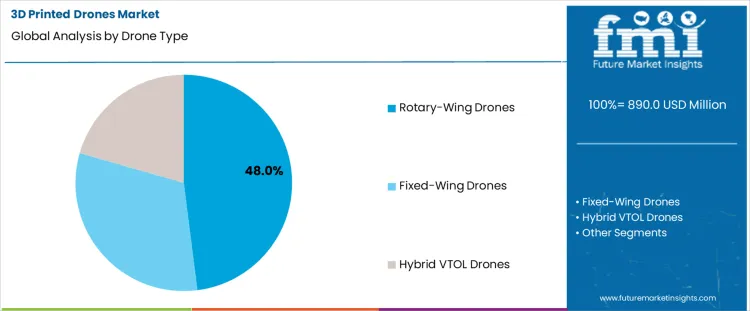
Rotary-wing drones are the leading drone type in the 3D Printed Drones market, accounting for 48% of the market share. This growth is primarily driven by the versatility and maneuverability of rotary-wing drones, which can take off and land vertically, making them ideal for a wide range of applications. These drones are commonly used in surveillance, mapping, agriculture, and delivery services, where precise control over flight patterns and the ability to operate in confined spaces are crucial.
The growing adoption of rotary-wing drones for commercial and industrial applications, including inspection and monitoring tasks, is further driving the demand for 3D-printed components, such as airframes and propulsion systems, that are lightweight yet durable. The customization capabilities offered by 3D printing also allow for the design of specialized parts for rotary-wing drones, improving their performance and operational efficiency. As industries continue to recognize the advantages of rotary-wing drones, particularly in urban areas where vertical takeoff and landing are required, the demand for 3D printed rotary-wing drones is expected to grow.
What is Driving the Demand for Airframes & Frames in the Component Focus Segment?
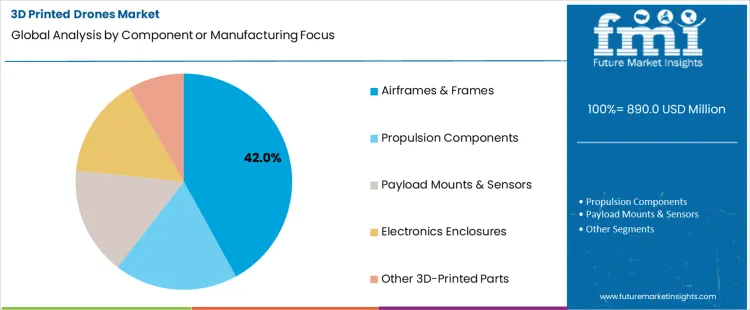
Airframes & frames are the largest component or manufacturing focus segment in the 3D Printed Drones market, holding 42% of the market share. This growth is driven by the critical role that airframes play in determining the strength, durability, and aerodynamics of a drone. 3D printing allows manufacturers to produce lightweight yet strong airframes with complex geometries that would be difficult or cost-prohibitive to create using traditional manufacturing methods. The ability to rapidly prototype and produce customized airframes for different drone types, especially rotary-wing and fixed-wing drones, enhances their performance and reduces production costs.
The demand for high-performance drones in sectors like agriculture, defense, logistics, and environmental monitoring is driving the need for advanced, customized airframes. As drones become more integrated into commercial and industrial operations, particularly in logistics and surveillance, the market for 3D-printed airframes and frames is expected to continue expanding. Additionally, the increasing focus on reducing drone weight to improve flight time and payload capacity is further fueling the demand for 3D-printed airframes, making this segment a key driver of market growth.
What are the Key Dynamics in the 3D Printed Drones Market?
The 3D printed drones market is expanding rapidly due to advancements in drone technology and the growing demand for customizable, cost-effective, and lightweight drone solutions across various industries, including agriculture, logistics, construction, and surveillance. 3D printing allows for the rapid prototyping and production of drone components, enabling the creation of customized drones tailored to specific applications. This technology helps reduce manufacturing costs, lead times, and material waste, making drones more affordable and accessible. The market is driven by the increasing adoption of drones for industrial applications, such as precision agriculture, inspection, and delivery services, where lightweight and customizable drone designs are essential for efficiency and performance.
What are the Key Drivers of Growth in the 3D Printed Drones Market?
The primary drivers of growth in the 3D printed drones market include the increasing demand for drones in commercial and industrial applications. Drones are increasingly being used for aerial surveys, inspections, mapping, and deliveries, which require specific designs and customizations to meet unique operational needs. 3D printing technology enables the production of lightweight, durable, and complex drone components, which enhances the performance and reduces the costs of manufacturing.
The ability to print drones on-demand reduces lead times and provides manufacturers with greater flexibility in design. Furthermore, the rapid development of 3D printing materials, such as carbon fiber composites and lightweight plastics, has improved the overall performance and durability of 3D printed drones. The growing focus on automation, precision, and cost efficiency in industries such as agriculture, logistics, and security is also contributing to the demand for 3D printed drones. Additionally, government regulations that support drone usage for various commercial applications, as well as increasing investment in drone technology, are fueling the market’s growth.
What are the Key Restraints in the 3D Printed Drones Market?
Despite its growth potential, the 3D printed drones market faces several challenges. One key restraint is the limited availability of high-performance 3D printing materials that can meet the stringent requirements for durability, payload capacity, and weather resistance in some applications. While advancements are being made, there is still a gap in material performance when compared to traditionally manufactured drone components.
Another challenge is the regulatory landscape surrounding drones, which is still evolving. As drone use continues to increase, regulatory challenges related to airspace management, safety, and privacy concerns may slow down market adoption. Additionally, the initial cost of 3D printing equipment and the specialized skills required for designing and printing drones may deter some small manufacturers or users from adopting this technology. Finally, while 3D printing offers customization and flexibility, it may not be suitable for mass production of drones at competitive prices, which could limit its scalability in certain segments of the market.
What are the Key Trends in the 3D Printed Drones Market?
Several trends are shaping the 3D printed drones market. One major trend is the increasing use of additive manufacturing for creating customized drones designed for specific tasks. These drones can be tailored for particular industries, such as agriculture, construction, or emergency services, where specialized features like sensors, cameras, and payload capacity are required. Another trend is the integration of advanced 3D printing materials, such as lightweight carbon fiber, titanium alloys, and flexible polymers, which enhance the strength, durability, and performance of drones.
The rise of autonomous drones that can be customized for specific use cases, along with advances in AI and machine learning for enhanced drone navigation and operations, is further pushing the demand for 3D printed drones. Additionally, the trend towards decentralized manufacturing and on-demand production is gaining traction, as 3D printing enables businesses to produce drones locally, reducing shipping costs and production time. This trend is particularly valuable for industries like logistics, where rapid delivery of drones is essential. Finally, as industries increasingly recognize the potential of drones for tasks such as monitoring, surveying, and delivery, the demand for drones with bespoke designs and optimized performance is expected to grow, further driving innovation and expansion in the 3D printed drones market.
What is the Country-Wise Analysis of the 3D Printed Drones Market?
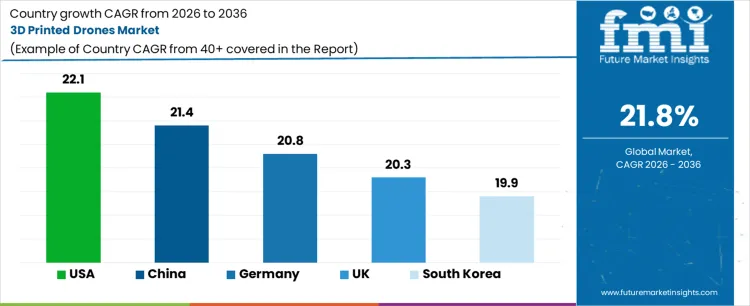
The 3D printed drones market is experiencing strong growth as technological advancements in 3D printing and drone capabilities converge to offer more cost-effective, customizable, and efficient solutions across various industries. 3D printing enables manufacturers to produce lightweight, high-performance drones with complex designs, offering advantages in speed, cost, and flexibility. The market is driven by the increasing demand for drones in sectors such as logistics, agriculture, surveillance, and defense. Countries like the USA, China, Germany, the UK, and South Korea are leading the way in adopting and developing 3D printed drones, with a strong focus on innovation, manufacturing capabilities, and expanding applications for drone technologies.
| Country | CAGR (%) |
|---|---|
| USA | 22.1 |
| China | 21.4 |
| Germany | 20.8 |
| UK | 20.3 |
| South Korea | 19.9 |
What is Driving the Growth of the 3D Printed Drones Market in the USA?
The USA’s 3D printed drones market is growing at a CAGR of 22.1%, the highest among the countries analyzed. The market growth is primarily driven by the USA’s leadership in technological innovation and manufacturing capabilities, particularly in the aerospace and defense sectors. The growing demand for drones in industries such as logistics, surveillance, agriculture, and defense is further supporting the market’s expansion. The USA is also a leader in 3D printing technologies, which are enabling more efficient and customizable drone production. The ongoing advancements in drone technologies and government support for research and development are expected to continue fueling growth in the 3D printed drones market in the USA.
How is the 3D Printed Drones Market Performing in China?
China’s 3D printed drones market is growing at a CAGR of 21.4%. As the largest manufacturer of drones globally, China is playing a crucial role in driving the growth of the 3D printed drones market. The country’s focus on technological innovation, combined with its large-scale manufacturing capabilities, is contributing to the increasing adoption of 3D printed drones. China’s growing interest in drone applications across various industries, including logistics, agriculture, and surveillance, is boosting the demand for lightweight, cost-effective drones. Government support for advanced manufacturing and drone technologies is expected to continue driving the growth of the 3D printed drones market in China, making it a key player in this sector.
What Factors are Shaping the 3D Printed Drones Market in Germany?
Germany’s 3D printed drones market is growing at a CAGR of 20.8%. Germany’s strong manufacturing and engineering capabilities, combined with its focus on innovation in drone technologies, are driving the adoption of 3D printed drones. The growing demand for drones in industries such as logistics, agriculture, and industrial inspections is supporting the market’s expansion. Additionally, Germany’s leadership in aerospace and automotive sectors, where drones are being increasingly integrated for various applications, is contributing to the growth of the 3D printed drones market. As Germany continues to invest in research and development for advanced drone technologies, the market for 3D printed drones is expected to grow steadily.
How is the 3D Printed Drones Market Evolving in the UK?
The UK’s 3D printed drones market is growing at a CAGR of 20.3%. The market is primarily driven by the UK’s growing drone industry, where 3D printing is being leveraged to produce lightweight and efficient drones for a variety of applications. The UK government’s focus on supporting drone technology and its integration into various sectors, including agriculture, surveillance, and logistics, is fueling the demand for 3D printed drones. The increasing adoption of drones for both commercial and defense applications, combined with advancements in 3D printing technology, is expected to continue driving market growth in the UK. As the UK strengthens its position in the global drone market, the demand for 3D printed drones is likely to increase.
What is Contributing to the Growth of the 3D Printed Drones Market in South Korea?
South Korea’s 3D printed drones market is growing at a CAGR of 19.9%. South Korea is increasingly adopting drones in industries such as logistics, surveillance, and agriculture, where the demand for advanced drone technologies is rising. The country’s focus on innovation, combined with its strong manufacturing capabilities, is driving the growth of the 3D printed drones market. South Korea’s government is investing in drone technology and its integration into various sectors, which is fueling the demand for lightweight, customizable drones. As the adoption of drones in commercial and industrial applications continues to grow, South Korea’s market for 3D printed drones is expected to continue expanding, supported by technological advancements in both drone and 3D printing technologies.
What is the Competitive Landscape for the 3D Printed Drones Market?
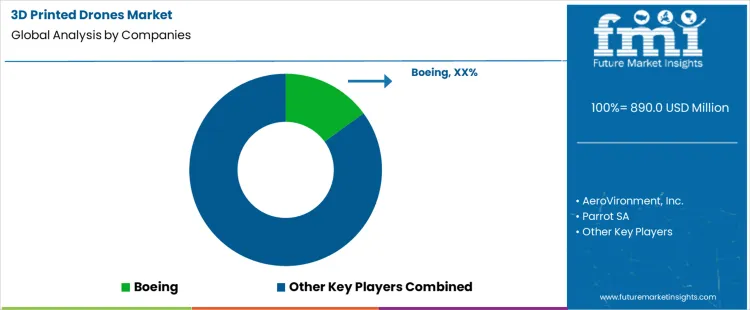
The 3D printed drones market is expanding rapidly as demand grows for lightweight, customizable, and cost-efficient unmanned aerial platforms across defense, agriculture, logistics, and industrial applications. Boeing leads the competitive landscape by leveraging advanced additive manufacturing to develop high-performance drones with enhanced durability, precision, and rapid production capability. Its aerospace expertise enables efficient integration of 3D printed components for both prototyping and end-use platforms.
AeroVironment, Inc. remains a key competitor, using 3D printing to manufacture lightweight, high-strength drone components that support rapid deployment for military and commercial missions. DJI Innovations applies 3D printed elements to improve structural efficiency, flight performance, and manufacturing flexibility across its professional and consumer drone portfolios. Skydio, Inc. focuses on autonomous drone platforms, utilizing 3D printing to enable customization, reduce weight, and enhance system integration.
Parrot SA competes through flexible and cost-effective drones incorporating 3D printed parts for commercial and recreational users. General Atomics Aeronautical Systems and Lockheed Martin Corporation apply additive manufacturing to military-grade drones, improving part functionality, production efficiency, and time-to-market. 3D Robotics targets industry-specific customization for agriculture and construction applications.
Supporting this ecosystem, Stratasys Ltd. and Velo3D provide advanced 3D printing technologies that enable high-precision drone component production. Overall, competition is driven by innovation, customization capability, and advanced manufacturing integration.
Key Players of the 3D Printed Drones Market
- Boeing
- AeroVironment, Inc.
- Parrot SA
- Skydio, Inc.
- DJI Innovations
- General Atomics Aeronautical Systems
- 3D Robotics
- Stratasys Ltd.
- Velo3D
- Lockheed Martin Corporation
Scope of the Report
| Items | Values |
|---|---|
| Quantitative Units (2026) | USD Million |
| Drone Type | Rotary-Wing Drones, Fixed-Wing Drones, Hybrid VTOL Drones, Other |
| Application | Defense & Government, Commercial, Civil & Consumer, Research & Academic, Other |
| Component or Manufacturing Focus | Airframes & Frames, Propulsion Components, Payload Mounts & Sensors, Electronics Enclosures, Other 3D-Printed Parts |
| Companies | Boeing, AeroVironment, Inc., Parrot SA, Skydio, Inc., DJI Innovations, General Atomics Aeronautical Systems, 3D Robotics, Stratasys Ltd., Velo3D, Lockheed Martin Corporation |
| Regions Covered | North America, Latin America, Western Europe, Eastern Europe, South Asia and Pacific, East Asia, Middle East & Africa |
| Countries Covered | United States, Canada, Mexico, Brazil, Argentina, Germany, France, United Kingdom, Italy, Spain, Netherlands, China, India, Japan, South Korea, ANZ, GCC Countries, South Africa |
| Additional Attributes | Dollar sales by drone type, application, component or manufacturing focus, and region. Includes market trends towards efficiency, cost-effectiveness, and the role of 3D printing in enhancing drone design and manufacturing capabilities. |
3D Printed Drones Market Segmentation
Drone Type
- Rotary-Wing Drones
- Fixed-Wing Drones
- Hybrid VTOL Drones
- Other
Application
- Defense & Government
- Commercial
- Civil & Consumer
- Research & Academic
- Other
Component or Manufacturing Focus
- Airframes & Frames
- Propulsion Components
- Payload Mounts & Sensors
- Electronics Enclosures
- Other 3D-Printed Parts
Region
- Asia Pacific
- China
- Japan
- India
- Australia & New Zealand
- ASEAN
- Rest of Asia Pacific
- Europe
- Germany
- United Kingdom
- France
- Italy
- Spain
- Nordic
- BENELUX
- Rest of Europe
- North America
- United States
- Canada
- Mexico
- Latin America
- Brazil
- Argentina
- Rest of Latin America
- Middle East & Africa
- Kingdom of Saudi Arabia
- Other GCC Countries
- South Africa
- Rest of Middle East & Africa
Bibliography
- Federal Aviation Administration. (2025). 14 CFR Part 107: Small unmanned aircraft systems. Electronic Code of Federal Regulations.
- European Union Aviation Safety Agency. (2024). Easy access rules for unmanned aircraft systems: Regulation (EU) 2019/947 and Regulation (EU) 2019/945 (July 2024 ed.). EASA.
- International Organization for Standardization. (2024). ISO/ASTM 52927:2024: Additive manufacturing-Principal requirements applied to the testing of parts produced by additive manufacturing processes. ISO.
Frequently Asked Questions
How big is the 3d printed drones market in 2026?
The global 3d printed drones market is estimated to be valued at USD 890.0 million in 2026.
What will be the size of 3d printed drones market in 2036?
The market size for the 3d printed drones market is projected to reach USD 6,395.3 million by 2036.
How much will be the 3d printed drones market growth between 2026 and 2036?
The 3d printed drones market is expected to grow at a 21.8% CAGR between 2026 and 2036.
What are the key product types in the 3d printed drones market?
The key product types in 3d printed drones market are rotary‑wing drones, fixed‑wing drones and hybrid vtol drones.
Which application segment to contribute significant share in the 3d printed drones market in 2026?
In terms of application, defense & government segment to command 39.0% share in the 3d printed drones market in 2026.
Preview the report firsthand - request a free sample
Get SampleGet the brochure for pricing and purchase details.
Get PDFTable of Content
- Executive Summary
- Global Market Outlook
- Demand-side Trends
- Supply-side Trends
- Technology Roadmap Analysis
- Analysis and Recommendations
- Market Overview
- Market Coverage / Taxonomy
- Market Definition / Scope / Limitations
- Market Background
- Market Dynamics
- Drivers
- Restraints
- Opportunity
- Trends
- Scenario Forecast
- Demand in Optimistic Scenario
- Demand in Likely Scenario
- Demand in Conservative Scenario
- Opportunity Map Analysis
- Product Life Cycle Analysis
- Supply Chain Analysis
- Investment Feasibility Matrix
- Value Chain Analysis
- PESTLE and Porter’s Analysis
- Regulatory Landscape
- Regional Parent Market Outlook
- Production and Consumption Statistics
- Import and Export Statistics
- Market Dynamics
- Global Market Analysis 2021 to 2025 and Forecast, 2026 to 2036
- Historical Market Size Value (USD Million) Analysis, 2021 to 2025
- Current and Future Market Size Value (USD Million) Projections, 2026 to 2036
- Y-o-Y Growth Trend Analysis
- Absolute $ Opportunity Analysis
- Global Market Pricing Analysis 2021 to 2025 and Forecast 2026 to 2036
- Global Market Analysis 2021 to 2025 and Forecast 2026 to 2036, By Drone Type
- Introduction / Key Findings
- Historical Market Size Value (USD Million) Analysis By Drone Type, 2021 to 2025
- Current and Future Market Size Value (USD Million) Analysis and Forecast By Drone Type, 2026 to 2036
- Rotary‑Wing Drones
- Fixed‑Wing Drones
- Hybrid VTOL Drones
- Rotary‑Wing Drones
- Y-o-Y Growth Trend Analysis By Drone Type, 2021 to 2025
- Absolute $ Opportunity Analysis By Drone Type, 2026 to 2036
- Global Market Analysis 2021 to 2025 and Forecast 2026 to 2036, By Application
- Introduction / Key Findings
- Historical Market Size Value (USD Million) Analysis By Application, 2021 to 2025
- Current and Future Market Size Value (USD Million) Analysis and Forecast By Application, 2026 to 2036
- Defense & Government
- Commercial
- Civil & Consumer
- Research & Academic
- Defense & Government
- Y-o-Y Growth Trend Analysis By Application, 2021 to 2025
- Absolute $ Opportunity Analysis By Application, 2026 to 2036
- Global Market Analysis 2021 to 2025 and Forecast 2026 to 2036, By Component or Manufacturing Focus
- Introduction / Key Findings
- Historical Market Size Value (USD Million) Analysis By Component or Manufacturing Focus, 2021 to 2025
- Current and Future Market Size Value (USD Million) Analysis and Forecast By Component or Manufacturing Focus, 2026 to 2036
- Airframes & Frames
- Propulsion Components
- Payload Mounts & Sensors
- Electronics Enclosures
- Other 3D‑Printed Parts
- Airframes & Frames
- Y-o-Y Growth Trend Analysis By Component or Manufacturing Focus, 2021 to 2025
- Absolute $ Opportunity Analysis By Component or Manufacturing Focus, 2026 to 2036
- Global Market Analysis 2021 to 2025 and Forecast 2026 to 2036, By Region
- Introduction
- Historical Market Size Value (USD Million) Analysis By Region, 2021 to 2025
- Current Market Size Value (USD Million) Analysis and Forecast By Region, 2026 to 2036
- North America
- Latin America
- Western Europe
- Eastern Europe
- East Asia
- South Asia and Pacific
- Middle East & Africa
- Market Attractiveness Analysis By Region
- North America Market Analysis 2021 to 2025 and Forecast 2026 to 2036, By Country
- Historical Market Size Value (USD Million) Trend Analysis By Market Taxonomy, 2021 to 2025
- Market Size Value (USD Million) Forecast By Market Taxonomy, 2026 to 2036
- By Country
- USA
- Canada
- Mexico
- By Drone Type
- By Application
- By Component or Manufacturing Focus
- By Country
- Market Attractiveness Analysis
- By Country
- By Drone Type
- By Application
- By Component or Manufacturing Focus
- Key Takeaways
- Latin America Market Analysis 2021 to 2025 and Forecast 2026 to 2036, By Country
- Historical Market Size Value (USD Million) Trend Analysis By Market Taxonomy, 2021 to 2025
- Market Size Value (USD Million) Forecast By Market Taxonomy, 2026 to 2036
- By Country
- Brazil
- Chile
- Rest of Latin America
- By Drone Type
- By Application
- By Component or Manufacturing Focus
- By Country
- Market Attractiveness Analysis
- By Country
- By Drone Type
- By Application
- By Component or Manufacturing Focus
- Key Takeaways
- Western Europe Market Analysis 2021 to 2025 and Forecast 2026 to 2036, By Country
- Historical Market Size Value (USD Million) Trend Analysis By Market Taxonomy, 2021 to 2025
- Market Size Value (USD Million) Forecast By Market Taxonomy, 2026 to 2036
- By Country
- Germany
- UK
- Italy
- Spain
- France
- Nordic
- BENELUX
- Rest of Western Europe
- By Drone Type
- By Application
- By Component or Manufacturing Focus
- By Country
- Market Attractiveness Analysis
- By Country
- By Drone Type
- By Application
- By Component or Manufacturing Focus
- Key Takeaways
- Eastern Europe Market Analysis 2021 to 2025 and Forecast 2026 to 2036, By Country
- Historical Market Size Value (USD Million) Trend Analysis By Market Taxonomy, 2021 to 2025
- Market Size Value (USD Million) Forecast By Market Taxonomy, 2026 to 2036
- By Country
- Russia
- Poland
- Hungary
- Balkan & Baltic
- Rest of Eastern Europe
- By Drone Type
- By Application
- By Component or Manufacturing Focus
- By Country
- Market Attractiveness Analysis
- By Country
- By Drone Type
- By Application
- By Component or Manufacturing Focus
- Key Takeaways
- East Asia Market Analysis 2021 to 2025 and Forecast 2026 to 2036, By Country
- Historical Market Size Value (USD Million) Trend Analysis By Market Taxonomy, 2021 to 2025
- Market Size Value (USD Million) Forecast By Market Taxonomy, 2026 to 2036
- By Country
- China
- Japan
- South Korea
- By Drone Type
- By Application
- By Component or Manufacturing Focus
- By Country
- Market Attractiveness Analysis
- By Country
- By Drone Type
- By Application
- By Component or Manufacturing Focus
- Key Takeaways
- South Asia and Pacific Market Analysis 2021 to 2025 and Forecast 2026 to 2036, By Country
- Historical Market Size Value (USD Million) Trend Analysis By Market Taxonomy, 2021 to 2025
- Market Size Value (USD Million) Forecast By Market Taxonomy, 2026 to 2036
- By Country
- India
- ASEAN
- Australia & New Zealand
- Rest of South Asia and Pacific
- By Drone Type
- By Application
- By Component or Manufacturing Focus
- By Country
- Market Attractiveness Analysis
- By Country
- By Drone Type
- By Application
- By Component or Manufacturing Focus
- Key Takeaways
- Middle East & Africa Market Analysis 2021 to 2025 and Forecast 2026 to 2036, By Country
- Historical Market Size Value (USD Million) Trend Analysis By Market Taxonomy, 2021 to 2025
- Market Size Value (USD Million) Forecast By Market Taxonomy, 2026 to 2036
- By Country
- Kingdom of Saudi Arabia
- Other GCC Countries
- Turkiye
- South Africa
- Other African Union
- Rest of Middle East & Africa
- By Drone Type
- By Application
- By Component or Manufacturing Focus
- By Country
- Market Attractiveness Analysis
- By Country
- By Drone Type
- By Application
- By Component or Manufacturing Focus
- Key Takeaways
- Key Countries Market Analysis
- USA
- Pricing Analysis
- Market Share Analysis, 2025
- By Drone Type
- By Application
- By Component or Manufacturing Focus
- Canada
- Pricing Analysis
- Market Share Analysis, 2025
- By Drone Type
- By Application
- By Component or Manufacturing Focus
- Mexico
- Pricing Analysis
- Market Share Analysis, 2025
- By Drone Type
- By Application
- By Component or Manufacturing Focus
- Brazil
- Pricing Analysis
- Market Share Analysis, 2025
- By Drone Type
- By Application
- By Component or Manufacturing Focus
- Chile
- Pricing Analysis
- Market Share Analysis, 2025
- By Drone Type
- By Application
- By Component or Manufacturing Focus
- Germany
- Pricing Analysis
- Market Share Analysis, 2025
- By Drone Type
- By Application
- By Component or Manufacturing Focus
- UK
- Pricing Analysis
- Market Share Analysis, 2025
- By Drone Type
- By Application
- By Component or Manufacturing Focus
- Italy
- Pricing Analysis
- Market Share Analysis, 2025
- By Drone Type
- By Application
- By Component or Manufacturing Focus
- Spain
- Pricing Analysis
- Market Share Analysis, 2025
- By Drone Type
- By Application
- By Component or Manufacturing Focus
- France
- Pricing Analysis
- Market Share Analysis, 2025
- By Drone Type
- By Application
- By Component or Manufacturing Focus
- India
- Pricing Analysis
- Market Share Analysis, 2025
- By Drone Type
- By Application
- By Component or Manufacturing Focus
- ASEAN
- Pricing Analysis
- Market Share Analysis, 2025
- By Drone Type
- By Application
- By Component or Manufacturing Focus
- Australia & New Zealand
- Pricing Analysis
- Market Share Analysis, 2025
- By Drone Type
- By Application
- By Component or Manufacturing Focus
- China
- Pricing Analysis
- Market Share Analysis, 2025
- By Drone Type
- By Application
- By Component or Manufacturing Focus
- Japan
- Pricing Analysis
- Market Share Analysis, 2025
- By Drone Type
- By Application
- By Component or Manufacturing Focus
- South Korea
- Pricing Analysis
- Market Share Analysis, 2025
- By Drone Type
- By Application
- By Component or Manufacturing Focus
- Russia
- Pricing Analysis
- Market Share Analysis, 2025
- By Drone Type
- By Application
- By Component or Manufacturing Focus
- Poland
- Pricing Analysis
- Market Share Analysis, 2025
- By Drone Type
- By Application
- By Component or Manufacturing Focus
- Hungary
- Pricing Analysis
- Market Share Analysis, 2025
- By Drone Type
- By Application
- By Component or Manufacturing Focus
- Kingdom of Saudi Arabia
- Pricing Analysis
- Market Share Analysis, 2025
- By Drone Type
- By Application
- By Component or Manufacturing Focus
- Turkiye
- Pricing Analysis
- Market Share Analysis, 2025
- By Drone Type
- By Application
- By Component or Manufacturing Focus
- South Africa
- Pricing Analysis
- Market Share Analysis, 2025
- By Drone Type
- By Application
- By Component or Manufacturing Focus
- USA
- Market Structure Analysis
- Competition Dashboard
- Competition Benchmarking
- Market Share Analysis of Top Players
- By Regional
- By Drone Type
- By Application
- By Component or Manufacturing Focus
- Competition Analysis
- Competition Deep Dive
- Boeing
- Overview
- Product Portfolio
- Profitability by Market Segments (Product/Age /Sales Channel/Region)
- Sales Footprint
- Strategy Overview
- Marketing Strategy
- Product Strategy
- Channel Strategy
- AeroVironment, Inc.
- Parrot SA
- Skydio, Inc.
- DJI Innovations
- General Atomics Aeronautical Systems
- 3D Robotics
- Stratasys Ltd.
- Velo3D
- Lockheed Martin Corporation
- Boeing
- Competition Deep Dive
- Assumptions & Acronyms Used
- Research Methodology


