

- Industry Size (2026)
- USD 1.4 Bn
- Forecast (2036)
- USD 3.4 Bn
- CAGR (2026 to 2036)
- 9.4%
3D-Printed Implant Polypropylenes Market Forecast and Outlook 2026 to 2036
The global 3d-printed implant polypropylenes market is valued at USD 1.4 billion in 2026 and is projected to reach USD 3.4 billion by 2036, growing at a CAGR of 9.4%. The market’s growth quality is heavily influenced by application concentration, with orthopedic and dental implants leading the demand. The increasing shift towards patient-specific solutions in these applications enhances volume stability, which in turn ensures consistent market expansion.
As the healthcare sector increasingly adopts 3D printing, the end-use dependency on personalized implants drives both production scale and technological advancements. The ability to produce high-precision, customized implants using polypropylene ensures improved patient outcomes, reducing the risk of implant failure. Companies focusing on these high-demand applications, particularly with advanced polymer formulations for improved biocompatibility and mechanical properties, are likely to see sustained growth. The market's progression will also be influenced by the integration of new 3D printing technologies that improve cost-effectiveness and production time.
Quick Stats for 3D-Printed Implant Polypropylenes Market
- 3D-Printed Implant Polypropylenes Market Value (2026): USD 1.4 Billion
- 3D-Printed Implant Polypropylenes Market Forecast Value (2036): USD 3.4 Billion
- 3D-Printed Implant Polypropylenes Market Forecast CAGR 2026 to 2036: 9.4%
- Leading Polymer Type in 3D-Printed Implant Polypropylenes Market: Medical-Grade Polypropylene
- Key Growth Regions in 3D-Printed Implant Polypropylenes Market: Asia Pacific, North America, Europe
- Top Key Players in 3D-Printed Implant Polypropylenes Market: 3D Systems, Inc., Stratasys Ltd., Evonik Industries, BASF Forward AM, Arkema
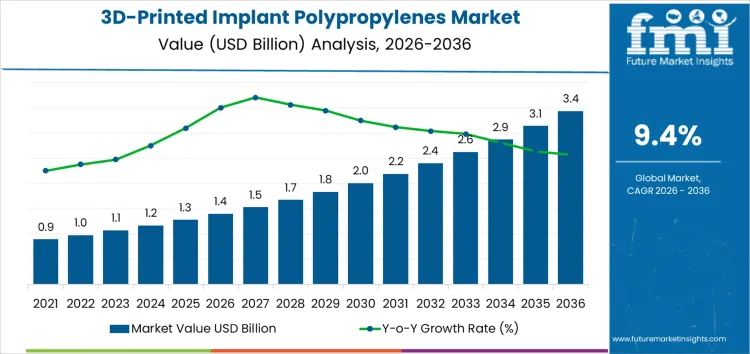
3D-Printed Implant Polypropylenes Market Key Takeaways
| Metric | Value |
|---|---|
| Industry Value (2026) | USD 1.4 Billion |
| Forecast Value (2036) | USD 3.4 Billion |
| Forecast CAGR 2026 to 2036 | 9.4% |
How Is the Global 3D-Printed Implant Polypropylenes Market Advancing?
The global 3D-printed implant polypropylenes market is witnessing rapid growth, driven by advancements in additive manufacturing (3D printing) technology and the increasing demand for customized medical implants. Polypropylene, a versatile and durable polymer, is gaining traction in 3D printing for medical implants due to its excellent mechanical properties, biocompatibility, and resistance to wear and tear. The use of polypropylene in 3D printing enables the creation of complex, personalized implant designs that improve patient outcomes and reduce the risk of implant failure.
A major driver of the market is the growing demand for patient-specific implants in orthopedic and dental applications. Traditional implant manufacturing methods often struggle to meet the complex, individualized needs of patients, particularly in cases requiring custom solutions. 3D printing, using polypropylene, offers the ability to produce implants that are tailored to the unique anatomy of the patient, resulting in better fit, functionality, and recovery outcomes. The shift towards minimally invasive surgeries and the increasing preference for personalized healthcare solutions are further boosting the demand for 3D-printed implants.
Technological advancements in 3D printing and material science are also contributing to the growth of the market. Researchers and manufacturers are continuously improving the printing processes and developing advanced polypropylene formulations that enhance the mechanical and biological performance of implants. As the healthcare industry continues to embrace the benefits of 3D printing for custom medical devices, the 3D-printed implant polypropylenes market is expected to see significant expansion, with growing applications in a wide range of medical fields, including orthopedics, dental implants, and even soft tissue repair.
What Is the Segment-Wise Analysis for the 3D-Printed Implant Polypropylenes Market?
The 3D-printed implant polypropylenes market is segmented by polypropylene type and technology type. Medical-grade polypropylene leads the polypropylene type segment with a 44% share, followed by reinforced polypropylene composites, bio-compatible PP blends, functionalized PP (surface-modified), and other types. Medical-grade polypropylene is favored for its biocompatibility and ability to meet stringent medical standards. In terms of technology type, fused deposition modeling (FDM) leads with a 38% share, followed by selective laser sintering (SLS), multi-jet fusion (MJF), stereolithography (SLA), and other technologies
Why Does Medical-Grade Polypropylene Lead the 3D-Printed Implant Polypropylenes Market?

Medical-grade polypropylene leads the 3D-printed implant polypropylenes market with a 44% share due to its essential properties for medical applications, including biocompatibility, durability, and sterilization compatibility. This type of polypropylene is specifically designed to meet rigorous safety and performance standards required for medical implants. It is widely used in the manufacturing of implantable medical devices, such as prosthetics and surgical tools, as it is non-toxic and resistant to chemical degradation. As the demand for personalized, precise medical implants grows, medical-grade polypropylene remains the preferred choice in the 3D printing of implants due to its proven safety and performance in the healthcare sector.
How Does Fused Deposition Modeling (FDM) Contribute to the 3D-Printed Implant Polypropylenes Market?
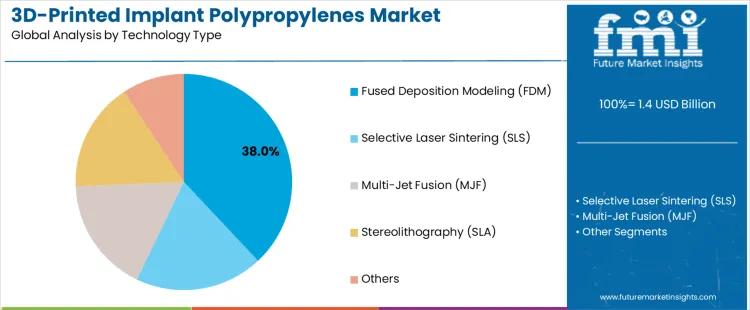
Fused deposition modeling (FDM) holds a 38% share in the technology type segment of the 3D-printed implant polypropylenes market. FDM is widely used in 3D printing for medical implants due to its ability to precisely layer materials and create complex geometries required in implant designs. This technology is ideal for producing customized implants, which are crucial for personalized healthcare solutions. FDM offers cost-effective, scalable, and accurate production, making it a preferred choice for the medical device industry. As the demand for tailored implants increases, FDM continues to play a significant role in the production of 3D-printed implants using polypropylene-based materials, driving its market share.
What Are the Key Dynamics for the 3D-Printed Implant Polypropylenes Market?
The 3D-printed implant polypropylenes market is driven by the growing demand for customized, patient-specific implants in the healthcare and medical device industries. Polypropylene, a versatile thermoplastic, is increasingly used in 3D printing for implants due to its durability, biocompatibility, and flexibility. The ability to produce implants that fit the exact specifications of individual patients is significantly improving the success rates of surgeries and reducing recovery times. The growing trend towards personalized medicine and the continuous advancements in 3D printing technology are fueling the growth of this market, particularly in orthopedic and dental applications.
Why is the 3D-Printed Implant Polypropylenes Market Growing?
The market for 3D-printed implant polypropylenes is growing due to several factors. First, the increasing demand for customized medical implants, especially in orthopedic, dental, and reconstructive surgeries, is pushing the adoption of 3D printing technologies. These implants offer higher precision, better fit, and improved patient outcomes. 3D printing reduces manufacturing time and costs, allowing for faster production of implants. The flexibility of polypropylene in 3D printing and its proven biocompatibility further drive its use in implant manufacturing. The trend towards minimally invasive surgeries also supports the need for customized and accurately printed implants.
How Are the Key Drivers Shaping the 3D-Printed Implant Polypropylenes Market?
Key drivers shaping the 3D-printed implant polypropylenes market include the continuous advancements in 3D printing technologies and the increasing demand for personalized medical solutions. 3D printing allows manufacturers to produce implants with complex geometries tailored to individual patient needs, improving surgical outcomes and reducing risks of complications. The growing focus on reducing surgical recovery times and improving implant integration with natural tissue further promotes the use of polypropylene in 3D printing. The rise in the number of patients requiring joint replacements and dental implants is contributing to the demand for 3D-printed polypropylene implants.
What is the Growth Outlook for the 3D-Printed Implant Polypropylenes Market by Country?
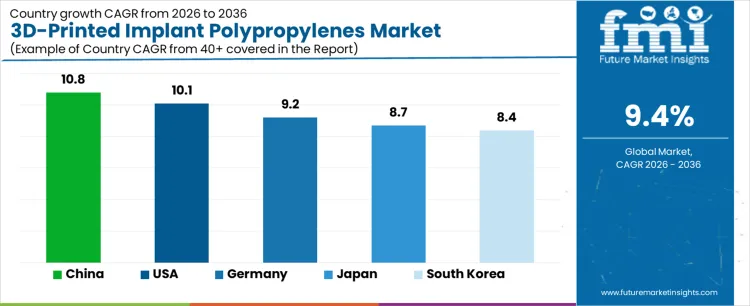
| Country | CAGR (%) |
|---|---|
| China | 10.8% |
| USA | 10.1% |
| Germany | 9.2% |
| South Korea | 8.4% |
| Japan | 8.7% |
The 3D-printed implant polypropylenes market is growing rapidly across key regions, with China leading at 10.8%, driven by advancements in healthcare. The USA grows at 10.1%, supported by a strong healthcare infrastructure and the demand for personalized medical devices. Germany’s market expands at 9.2%, driven by its medical device manufacturing expertise and focus on healthcare innovation. South Korea’s market grows at 8.4%, supported by advancements in 3D printing technologies and the increasing demand for customized healthcare solutions. Japan grows at 8.7%, driven by an aging population and a focus on personalized medicine and prosthetics.
What is Driving the Growth of the 3D-Printed Implant Polypropylenes Market in China?
China’s 3D-printed implant polypropylenes market is growing at 10.8%, driven by rapid advancements in the healthcare and manufacturing sectors. The increasing adoption of 3D printing technologies in the medical field, particularly in the production of customized implants and prosthetics, is fueling the demand for 3D-printed polypropylene materials. China’s expanding healthcare infrastructure, coupled with government initiatives to support medical innovation, is accelerating the use of advanced materials in medical device manufacturing. The demand for personalized healthcare solutions and the rise of the aging population, which requires implants and prosthetics, are contributing to the market’s growth. As the country continues to develop its capabilities in 3D printing, particularly in the medical sector, the demand for high-quality, cost-effective polypropylene implants is expected to rise.
How is the 3D-Printed Implant Polypropylenes Market Expanding in the USA?
The 3D-printed implant polypropylenes market in the USA is growing at 10.1%, driven by the increasing demand for customized implants and prosthetics. The USA’s advanced healthcare sector, which is at the forefront of medical technology innovation, is rapidly adopting 3D printing to produce tailored, high-performance implants using polypropylene materials. The rising popularity of personalized medicine and the ability to create patient-specific implants for various medical conditions, such as bone fractures and joint replacements, is fueling market growth. The USA’s strong emphasis on healthcare innovation, regulatory frameworks ensuring safety, and the rising demand for cost-effective and efficient medical devices are driving the adoption of 3D-printed polypropylenes. As 3D printing technologies continue to advance and gain acceptance in the medical field, the market for 3D-printed implant polypropylenes will continue to expand in the USA.
How is the 3D-Printed Implant Polypropylenes Market Expanding in Germany?
Germany’s 3D-printed implant polypropylenes market is growing at 9.2%, driven by the country’s strong medical device manufacturing sector and its commitment to healthcare innovation. Germany is a leader in adopting 3D printing technologies, particularly for personalized medicine and custom medical implants. The growing demand for customized implants in orthopedics, dentistry, and other fields is pushing the market for 3D-printed polypropylenes. Germany’s robust healthcare system, regulatory standards for medical devices, and focus on sustainability and cost-efficiency are key factors driving the market. The country’s expertise in precision engineering and material science, coupled with the increasing use of polypropylene in 3D-printed implants, ensures continued growth in this sector. As Germany continues to innovate in healthcare and medical technology, the adoption of 3D-printed implants using polypropylene will expand steadily.
What is Driving the Growth of the 3D-Printed Implant Polypropylenes Market in South Korea?
South Korea’s 3D-printed implant polypropylenes market is growing at 8.4%, supported by advancements in 3D printing technologies and the country’s rapidly growing healthcare sector. South Korea is known for its innovation in medical technologies, and the adoption of 3D printing for creating customized implants is gaining momentum. The demand for personalized healthcare solutions, especially in the field of orthopedics and prosthetics, is driving the need for 3D-printed implants made from polypropylene. South Korea’s strong emphasis on research and development in material science, combined with the rise of an aging population and the demand for more efficient and accessible healthcare, is fueling the market. As 3D printing technologies continue to evolve, South Korea is expected to play a significant role in the growth of the 3D-printed implant polypropylenes market.
How is the 3D-Printed Implant Polypropylenes Market Expanding in Japan?
Japan’s 3D-printed implant polypropylenes market is growing at 8.7%, driven by the country’s leadership in healthcare innovation and the increasing demand for personalized medical solutions. The aging population in Japan is a significant factor, as there is a growing need for customized implants and prosthetics to address various age-related health conditions. The Japanese medical device industry is adopting 3D printing to create tailored, cost-effective, and high-performance implants using polypropylene. Japan’s focus on cutting-edge technologies, research in biomaterials, and a strong regulatory environment for medical devices are supporting the adoption of 3D-printed polypropylenes. With continued technological advancements and a strong healthcare infrastructure, Japan’s market for 3D-printed implant polypropylenes is expected to continue expanding.
How Are Companies Competing in the 3D‑Printed Implant Polypropylenes Market?
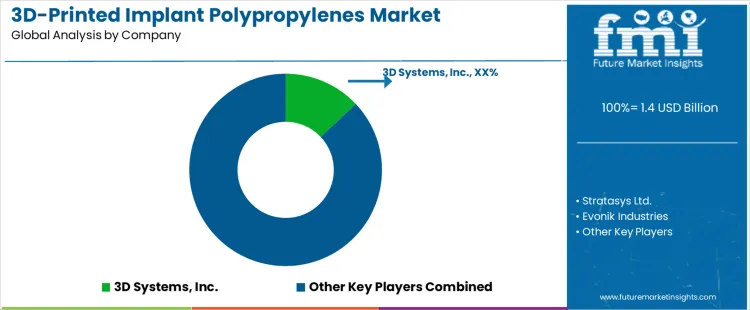
Competition in the 3D‑printed implant polypropylenes market is driven by material performance (biocompatibility, strength, durability), printability, regulatory support, and integration with medical design workflows. 3D Systems, Inc. positions itself with advanced additive manufacturing platforms that support medical‑grade polypropylene materials, and its product literature emphasizes precision, repeatability, and compatibility with complex implant geometries that help designers meet clinical demands. Stratasys Ltd. competes with robust 3D printing systems and certified materials portfolios that deliver consistent mechanical performance and surface quality, with brochures highlighting ease of integration into medical device development and rapid prototyping.
Material innovators such as Evonik Industries and BASF Forward AM differentiate through specialized polymer formulations tailored for additive processes that deliver enhanced thermal stability and biocompatibility. Their documentation focuses on optimized feedstock chemistry, controlled flow properties in extrusion, and strong mechanical integrity that align with implant performance requirements. Arkema brings high‑performance polypropylene derivatives and additives designed to improve impact resistance and durability in printed implants, with collateral stressing consistent filament or powder quality and support for regulated environments.
Others in the market contribute with emerging materials and niche formulations aimed at specific implant applications or regulatory pathways, and their product materials underscore printability, tailored property profiles, and targeted support for additive workflows. Across all vendors, documentation highlights biocompatibility, mechanical performance, processing reliability, and regulatory readiness as key differentiators that help med‑tech designers and manufacturers bring 3D‑printed polypropylene implants to market with confidence.
Key Players in 3D-Printed Implant Polypropylenes Market
- 3D Systems, Inc.
- Stratasys Ltd.
- Evonik Industries
- BASF Forward AM
- Arkema
- Others
Scope of Report
| Attributes | Description |
|---|---|
| Quantitative Unit (2026) | USD Billion |
| Polypropylene Type | Medical-Grade Polypropylene, Reinforced Polypropylene Composites, Bio-Compatible PP Blends, Functionalized PP (Surface-Modified), Others |
| Technology Type | Fused Deposition Modeling (FDM), Selective Laser Sintering (SLS), Multi Jet Fusion (MJF), Stereolithography (SLA), Others |
| Regions Covered | Asia Pacific, Europe, North America, Latin America, Middle East & Africa |
| Countries Covered | China, Japan, South Korea, India, Australia & New Zealand, ASEAN, Germany, United Kingdom, France, Italy, Spain, Nordic, BENELUX, United States, Canada, Mexico, Brazil, Chile, Turkey, South Africa, Other GCC Countries |
| Key Companies Profiled | 3D Systems, Inc., Stratasys Ltd., Evonik Industries, BASF Forward AM, Arkema, Others |
| Additional Attributes | Dollar sales by polypropylene type, technology type, and region; regional CAGR and growth outlook for the 3D-Printed Implant Polypropylenes market. |
3D-Printed Implant Polypropylenes Market by Key Segments
Polypropylene Type
- Medical‑Grade Polypropylene
- Reinforced Polypropylene Composites
- Bio‑Compatible PP Blends
- Functionalized PP (Surface‑Modified)
- Others
Technology Type
- Fused Deposition Modeling (FDM)
- Selective Laser Sintering (SLS)
- Multi‑Jet Fusion (MJF)
- Stereolithography (SLA)
- Others
Region:
- Asia Pacific
- China
- Japan
- South Korea
- India
- Australia & New Zealand
- ASEAN
- Rest of Asia Pacific
- Europe
- Germany
- United Kingdom
- France
- Italy
- Spain
- Nordic
- BENELUX
- Rest of Europe
- North America
- United States
- Canada
- Mexico
- Latin America
- Brazil
- Chile
- Rest of Latin America
- Middle East & Africa
- Kingdom of Saudi Arabia
- Other GCC Countries
- Turkey
- South Africa
- Other African Union
- Rest of Middle East & Africa
Bibliography
- U.S. Food and Drug Administration. (2023). 3D Printing of Medical Devices. U.S. Food and Drug Administration.
- Federal Register. (2024). Medical Devices; Quality System Regulation Amendments. Federal Register.
- ISO/ASTM. (2023). ISO/ASTM 52920: Additive manufacturing — Qualification principles — Installation, operational and performance qualification (IQ/OQ/PQ). International Organization for Standardization.
- ISO/ASTM. (2023). ISO/ASTM 52924: Additive manufacturing — Qualification principles — Classification of part properties for additive manufacturing. International Organization for Standardization.
- ISO/ASTM. (2023). ISO/ASTM TR 52905: Additive manufacturing — Material extrusion of plastics — Process characteristics and performance: Benchmarking of machines, materials, and processes. International Organization for Standardization.
Frequently Asked Questions
How big is the 3d-printed implant polypropylenes market in 2026?
The global 3d-printed implant polypropylenes market is estimated to be valued at USD 1.4 billion in 2026.
What will be the size of 3d-printed implant polypropylenes market in 2036?
The market size for the 3d-printed implant polypropylenes market is projected to reach USD 3.4 billion by 2036.
How much will be the 3d-printed implant polypropylenes market growth between 2026 and 2036?
The 3d-printed implant polypropylenes market is expected to grow at a 9.4% CAGR between 2026 and 2036.
What are the key product types in the 3d-printed implant polypropylenes market?
The key product types in 3d-printed implant polypropylenes market are medical‑grade polypropylene, reinforced polypropylene composites, bio‑compatible pp blends, functionalized pp (surface‑modified) and others.
Which technology type segment to contribute significant share in the 3d-printed implant polypropylenes market in 2026?
In terms of technology type, fused deposition modeling (fdm) segment to command 38.0% share in the 3d-printed implant polypropylenes market in 2026.
Preview the report firsthand - request a free sample
Get SampleGet the brochure for pricing and purchase details.
Get PDFTable of Content
- Executive Summary
- Global Market Outlook
- Demand-side Trends
- Supply-side Trends
- Technology Roadmap Analysis
- Analysis and Recommendations
- Market Overview
- Market Coverage / Taxonomy
- Market Definition / Scope / Limitations
- Market Background
- Market Dynamics
- Drivers
- Restraints
- Opportunity
- Trends
- Scenario Forecast
- Demand in Optimistic Scenario
- Demand in Likely Scenario
- Demand in Conservative Scenario
- Opportunity Map Analysis
- Product Life Cycle Analysis
- Supply Chain Analysis
- Investment Feasibility Matrix
- Value Chain Analysis
- PESTLE and Porter’s Analysis
- Regulatory Landscape
- Regional Parent Market Outlook
- Production and Consumption Statistics
- Import and Export Statistics
- Market Dynamics
- Global Market Analysis 2021 to 2025 and Forecast, 2026 to 2036
- Historical Market Size Value (USD Million) Analysis, 2021 to 2025
- Current and Future Market Size Value (USD Million) Projections, 2026 to 2036
- Y-o-Y Growth Trend Analysis
- Absolute $ Opportunity Analysis
- Global Market Pricing Analysis 2021 to 2025 and Forecast 2026 to 2036
- Global Market Analysis 2021 to 2025 and Forecast 2026 to 2036, By Polypropylene Type
- Introduction / Key Findings
- Historical Market Size Value (USD Million) Analysis By Polypropylene Type , 2021 to 2025
- Current and Future Market Size Value (USD Million) Analysis and Forecast By Polypropylene Type , 2026 to 2036
- Medical‑Grade Polypropylene
- Reinforced Polypropylene Composites
- Bio‑Compatible PP Blends
- Functionalized PP (Surface‑Modified)
- Others
- Medical‑Grade Polypropylene
- Y-o-Y Growth Trend Analysis By Polypropylene Type , 2021 to 2025
- Absolute $ Opportunity Analysis By Polypropylene Type , 2026 to 2036
- Global Market Analysis 2021 to 2025 and Forecast 2026 to 2036, By Technology Type
- Introduction / Key Findings
- Historical Market Size Value (USD Million) Analysis By Technology Type, 2021 to 2025
- Current and Future Market Size Value (USD Million) Analysis and Forecast By Technology Type, 2026 to 2036
- Fused Deposition Modeling (FDM)
- Selective Laser Sintering (SLS)
- Multi‑Jet Fusion (MJF)
- Stereolithography (SLA)
- Others
- Fused Deposition Modeling (FDM)
- Y-o-Y Growth Trend Analysis By Technology Type, 2021 to 2025
- Absolute $ Opportunity Analysis By Technology Type, 2026 to 2036
- Global Market Analysis 2021 to 2025 and Forecast 2026 to 2036, By Region
- Introduction
- Historical Market Size Value (USD Million) Analysis By Region, 2021 to 2025
- Current Market Size Value (USD Million) Analysis and Forecast By Region, 2026 to 2036
- North America
- Latin America
- Western Europe
- Eastern Europe
- East Asia
- South Asia and Pacific
- Middle East & Africa
- Market Attractiveness Analysis By Region
- North America Market Analysis 2021 to 2025 and Forecast 2026 to 2036, By Country
- Historical Market Size Value (USD Million) Trend Analysis By Market Taxonomy, 2021 to 2025
- Market Size Value (USD Million) Forecast By Market Taxonomy, 2026 to 2036
- By Country
- USA
- Canada
- Mexico
- By Polypropylene Type
- By Technology Type
- By Country
- Market Attractiveness Analysis
- By Country
- By Polypropylene Type
- By Technology Type
- Key Takeaways
- Latin America Market Analysis 2021 to 2025 and Forecast 2026 to 2036, By Country
- Historical Market Size Value (USD Million) Trend Analysis By Market Taxonomy, 2021 to 2025
- Market Size Value (USD Million) Forecast By Market Taxonomy, 2026 to 2036
- By Country
- Brazil
- Chile
- Rest of Latin America
- By Polypropylene Type
- By Technology Type
- By Country
- Market Attractiveness Analysis
- By Country
- By Polypropylene Type
- By Technology Type
- Key Takeaways
- Western Europe Market Analysis 2021 to 2025 and Forecast 2026 to 2036, By Country
- Historical Market Size Value (USD Million) Trend Analysis By Market Taxonomy, 2021 to 2025
- Market Size Value (USD Million) Forecast By Market Taxonomy, 2026 to 2036
- By Country
- Germany
- UK
- Italy
- Spain
- France
- Nordic
- BENELUX
- Rest of Western Europe
- By Polypropylene Type
- By Technology Type
- By Country
- Market Attractiveness Analysis
- By Country
- By Polypropylene Type
- By Technology Type
- Key Takeaways
- Eastern Europe Market Analysis 2021 to 2025 and Forecast 2026 to 2036, By Country
- Historical Market Size Value (USD Million) Trend Analysis By Market Taxonomy, 2021 to 2025
- Market Size Value (USD Million) Forecast By Market Taxonomy, 2026 to 2036
- By Country
- Russia
- Poland
- Hungary
- Balkan & Baltic
- Rest of Eastern Europe
- By Polypropylene Type
- By Technology Type
- By Country
- Market Attractiveness Analysis
- By Country
- By Polypropylene Type
- By Technology Type
- Key Takeaways
- East Asia Market Analysis 2021 to 2025 and Forecast 2026 to 2036, By Country
- Historical Market Size Value (USD Million) Trend Analysis By Market Taxonomy, 2021 to 2025
- Market Size Value (USD Million) Forecast By Market Taxonomy, 2026 to 2036
- By Country
- China
- Japan
- South Korea
- By Polypropylene Type
- By Technology Type
- By Country
- Market Attractiveness Analysis
- By Country
- By Polypropylene Type
- By Technology Type
- Key Takeaways
- South Asia and Pacific Market Analysis 2021 to 2025 and Forecast 2026 to 2036, By Country
- Historical Market Size Value (USD Million) Trend Analysis By Market Taxonomy, 2021 to 2025
- Market Size Value (USD Million) Forecast By Market Taxonomy, 2026 to 2036
- By Country
- India
- ASEAN
- Australia & New Zealand
- Rest of South Asia and Pacific
- By Polypropylene Type
- By Technology Type
- By Country
- Market Attractiveness Analysis
- By Country
- By Polypropylene Type
- By Technology Type
- Key Takeaways
- Middle East & Africa Market Analysis 2021 to 2025 and Forecast 2026 to 2036, By Country
- Historical Market Size Value (USD Million) Trend Analysis By Market Taxonomy, 2021 to 2025
- Market Size Value (USD Million) Forecast By Market Taxonomy, 2026 to 2036
- By Country
- Kingdom of Saudi Arabia
- Other GCC Countries
- Turkiye
- South Africa
- Other African Union
- Rest of Middle East & Africa
- By Polypropylene Type
- By Technology Type
- By Country
- Market Attractiveness Analysis
- By Country
- By Polypropylene Type
- By Technology Type
- Key Takeaways
- Key Countries Market Analysis
- USA
- Pricing Analysis
- Market Share Analysis, 2025
- By Polypropylene Type
- By Technology Type
- Canada
- Pricing Analysis
- Market Share Analysis, 2025
- By Polypropylene Type
- By Technology Type
- Mexico
- Pricing Analysis
- Market Share Analysis, 2025
- By Polypropylene Type
- By Technology Type
- Brazil
- Pricing Analysis
- Market Share Analysis, 2025
- By Polypropylene Type
- By Technology Type
- Chile
- Pricing Analysis
- Market Share Analysis, 2025
- By Polypropylene Type
- By Technology Type
- Germany
- Pricing Analysis
- Market Share Analysis, 2025
- By Polypropylene Type
- By Technology Type
- UK
- Pricing Analysis
- Market Share Analysis, 2025
- By Polypropylene Type
- By Technology Type
- Italy
- Pricing Analysis
- Market Share Analysis, 2025
- By Polypropylene Type
- By Technology Type
- Spain
- Pricing Analysis
- Market Share Analysis, 2025
- By Polypropylene Type
- By Technology Type
- France
- Pricing Analysis
- Market Share Analysis, 2025
- By Polypropylene Type
- By Technology Type
- India
- Pricing Analysis
- Market Share Analysis, 2025
- By Polypropylene Type
- By Technology Type
- ASEAN
- Pricing Analysis
- Market Share Analysis, 2025
- By Polypropylene Type
- By Technology Type
- Australia & New Zealand
- Pricing Analysis
- Market Share Analysis, 2025
- By Polypropylene Type
- By Technology Type
- China
- Pricing Analysis
- Market Share Analysis, 2025
- By Polypropylene Type
- By Technology Type
- Japan
- Pricing Analysis
- Market Share Analysis, 2025
- By Polypropylene Type
- By Technology Type
- South Korea
- Pricing Analysis
- Market Share Analysis, 2025
- By Polypropylene Type
- By Technology Type
- Russia
- Pricing Analysis
- Market Share Analysis, 2025
- By Polypropylene Type
- By Technology Type
- Poland
- Pricing Analysis
- Market Share Analysis, 2025
- By Polypropylene Type
- By Technology Type
- Hungary
- Pricing Analysis
- Market Share Analysis, 2025
- By Polypropylene Type
- By Technology Type
- Kingdom of Saudi Arabia
- Pricing Analysis
- Market Share Analysis, 2025
- By Polypropylene Type
- By Technology Type
- Turkiye
- Pricing Analysis
- Market Share Analysis, 2025
- By Polypropylene Type
- By Technology Type
- South Africa
- Pricing Analysis
- Market Share Analysis, 2025
- By Polypropylene Type
- By Technology Type
- USA
- Market Structure Analysis
- Competition Dashboard
- Competition Benchmarking
- Market Share Analysis of Top Players
- By Regional
- By Polypropylene Type
- By Technology Type
- Competition Analysis
- Competition Deep Dive
- 3D Systems, Inc.
- Overview
- Product Portfolio
- Profitability by Market Segments (Product/Age /Sales Channel/Region)
- Sales Footprint
- Strategy Overview
- Marketing Strategy
- Product Strategy
- Channel Strategy
- Stratasys Ltd.
- Evonik Industries
- BASF Forward AM
- Arkema
- Others
- 3D Systems, Inc.
- Competition Deep Dive
- Assumptions & Acronyms Used
- Research Methodology


