

- Industry Size (2025)
- USD 342.1 Mn
- Forecast (2035)
- USD 1098.4 Mn
- CAGR (2025 to 2035)
- 12.3%
3D Printed Sleep Apnea Devices Market Forecast and Outlook 2025 to 2035
3D printed sleep apnea devices market is projected to reach USD 1,098.4 million by 2035, reflecting an absolute increase of USD 756.3 million from its USD 342.1 million valuation in 2025. Growth at 12.3% CAGR will expand overall revenue by nearly 3.1x times during the forecast period 2025-2035.
Demand is driven by rising diagnosis rates for obstructive sleep apnea, increasing adoption of personalized mandibular advancement devices, and broader acceptance of digital dentistry and additive manufacturing workflows across clinical settings. Reimbursement constraints and inconsistent regulatory pathways for custom-fabricated oral appliances may influence adoption rates.
Quick Stats for 3D Printed Sleep Apnea Devices Market
- 3D Printed Sleep Apnea Devices Market Value (2025): USD 342.1 million
- 3D Printed Sleep Apnea Devices Market Forecast Value (2035): USD 1,098.4 million
- 3D Printed Sleep Apnea Devices Market Forecast CAGR (2025 to 2035): 12.3%
- Largest Application in 3D Printed SleepApnea Devices Market: Mild-moderate OSA (63.4%)
- Key Growth Regions in 3D Printed Sleep Apnea Devices Market: North America, Asia Pacific, and Europe
- Top Players in 3D Printed Sleep Apnea Devices Market: ProSomnus, SomnoMed, Panthera Dental; DynaFlex, Great Lakes Dental Technologies, Glidewell
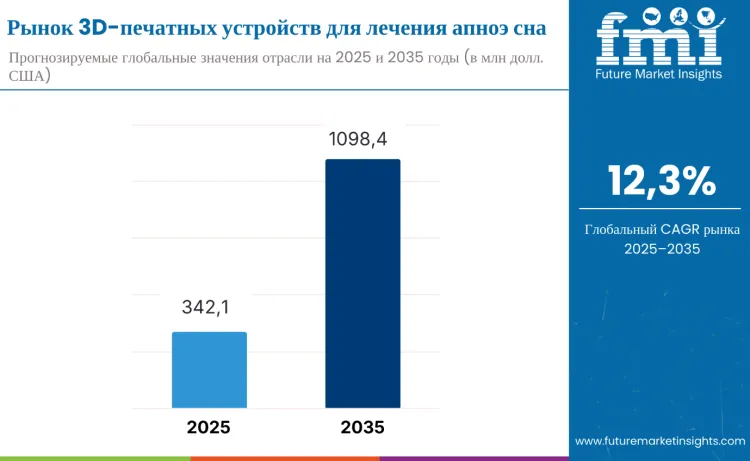
3D Printed Sleep Apnea Devices Market Key Takeaways
| Metric | Value |
|---|---|
| Market Value (2025) | USD 342.1 million |
| Market Forecast Value (2035) | USD 1,098.4 million |
| Forecast CAGR (2025 to 2035) | 12.3% |
3D Printed Sleep Apnea Devices Market Year-over-Year Forecast (2025-2035)
Rapid advancements in intraoral scanning, biocompatible materials, and automated design engines continue reshaping competitive dynamics. High-resolution printers deliver accurate dental geometries with reduced manual finishing, while integration with digital treatment planning and sleep monitoring platforms enables optimized airway management. Improvements in material durability and flexibility support long-term intraoral stability.
Government initiatives promoting sleep disorder diagnosis and adoption of digital healthcare add strong momentum. Dental networks, sleep centers, and training institutions are investing in digital fabrication, remote scanning workflows, and tele-dentistry follow-ups, aligned with growing patient preference for high-comfort, non-invasive alternatives to CPAP therapy.
Between 2025 and 2030, 3D printed sleep apnea devices market is projected to expand from USD 342.1 million to USD 613.0 million, creating a value gain of USD 270.9 million, equal to 35.8% of total forecast growth for the decade. This progression will be driven by rising adoption of personalized oral appliance therapy, broader use of intraoral digital scanning, and growing patient preference for non-invasive comfort-focused solutions.
From 2030 to 2035, value is expected to rise from USD 613.0 million to USD 1,098.4 million, adding USD 485.4 million and representing 64.2% of total ten-year expansion. This phase will be defined by next-generation customized appliance systems featuring digital titration functions, automated airway design tools, and materials engineered for long-term intraoral durability.
Why Is the 3D Printed Sleep Apnea Devices Market Growing Worldwide?
Growth in 3D printed sleep apnea devices is driven by ability to deliver highly personalized oral appliance therapy that enhances airway patency, comfort, and long-term adherence in obstructive sleep apnea management. Patients and clinicians increasingly seek non-invasive, patient-centric alternatives to CPAP systems, which face non-compliance rates above 30% due to discomfort, noise, and limited portability. Customized 3D printed mandibular advancement devices provide superior anatomical fit, improved comfort, and more consistent nightly usage than traditional prefabricated appliances, strengthening clinical importance of digitally fabricated solutions for mild to moderate obstructive sleep apnea.
Rising global awareness of sleep-disordered breathing, broader screening programs, and deeper collaboration between dental and sleep-medicine professionals are accelerating adoption of custom oral appliances. Expansion of digital dentistry infrastructure supports growth, as intraoral scanning, CAD-CAM workflows, and medical-grade polymer printing systems enable predictable fabrication, shorter turnaround times, and repeatable design quality. Advances in biocompatible materials, cloud-based design tools, and precision adjustment technologies help clinicians achieve reliable mandibular repositioning and higher patient satisfaction.
How Are the 3D Printed Sleep Apnea Devices Market Segmented by Product Type, Material/Technology, Application, End User and Region?
3D printed sleep apnea devices market is segmented by product type, material or technology, application, end user, and region. By product type, it is divided into 3D-printed mandibular advancement devices, custom 3D-printed CPAP mask interfaces, 3D-printed nasal or oral splints and positioners. Based on material or technology, it is categorized into biocompatible dental resins, nylon (PA12) and PEEK polymers, hybrid multi-material coatings and layered structures, and titanium and other metal frameworks.
By application, it is segmented into mild to moderate obstructive sleep apnea, severe OSA in CPAP-intolerant or adjunct therapy cases, and primary snoring and upper airway resistance syndrome. End users include sleep dentists and orofacial pain clinics, dental labs and DSOs, hospitals and sleep centers, and D2C or tele-dentistry providers. Regionally, it is divided into Asia Pacific, Europe, North America, Latin America, and Middle East & Africa.
By Product Type, 3D-Printed Mandibular Advancement Devices Account for 58.7% Share
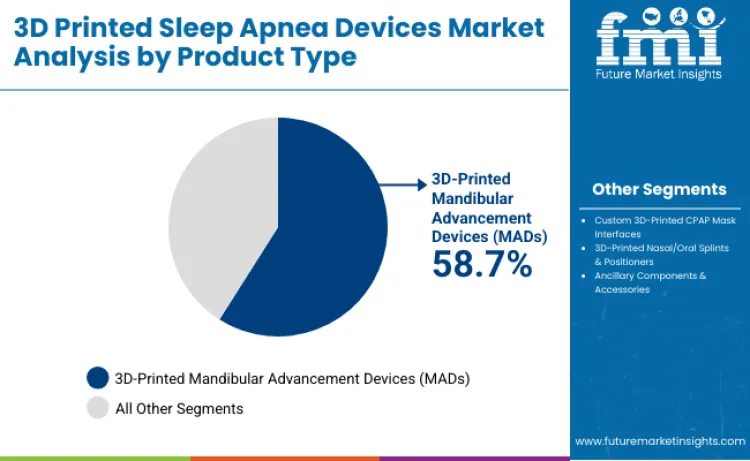
3D-printed mandibular advancement devices hold a leading position in 2025 with an estimated 58.7% share due to their strong suitability for individualized mandibular repositioning therapy. Clinicians favor these devices because they deliver accurate jaw guidance, improved airway support, and higher long-term comfort than traditional prefabricated appliances. Digital intraoral scanning and CAD-based modeling enable precise control of advancement levels, enhance occlusal accuracy, and ensure consistency across diverse anatomical profiles.
Their prominence is reinforced by widespread adoption of digital workflows, real-time titration design tools, and strengthened collaboration between dental sleep specialists and sleep physicians. Additive manufacturing technologies improve outcomes through lightweight structures, precise hinge geometry, and streamlined fabrication cycles, enabling reliable performance for patients seeking alternatives to CPAP therapy.
Key advantages driving the 3D-Printed MAD segment include:
- Anatomical precision ensuring secure jaw positioning and optimized airflow improvement
- Digitally planned titration protocols supporting clinician-controlled adjustments and repeat fabrication integrity
- Biocompatible polymer systems offering comfort, structural reliability, and long-term intraoral stability
By Material/Technology, Biocompatible Dental Resins Account for 41.2% Share
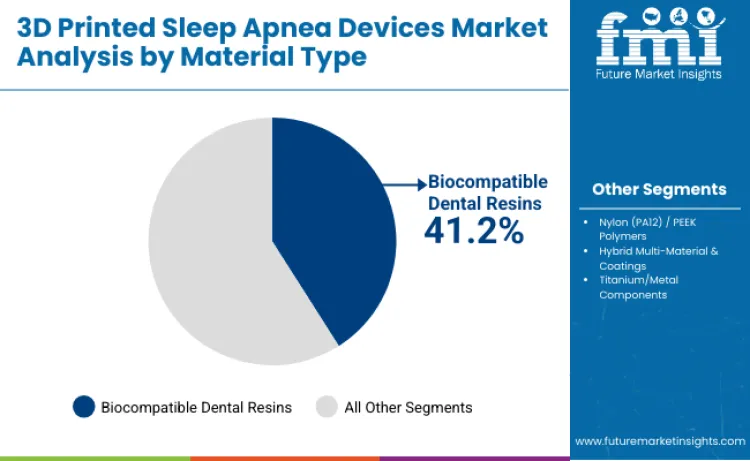
Biocompatible dental resins account for about 41.2% share in 2025, supported by their ability to deliver durable and comfortable appliances tailored to individual craniofacial structures. These materials provide smooth finishing, balanced elasticity, and optimized thickness, enabling reliable retention and long-term tolerance. Photopolymer resin systems used with additive manufacturing ensure controlled curing behavior and predictable geometric accuracy, giving clinicians confidence in device fit and function.
Continued refinement in medical-grade resin formulations, enhanced compatibility with digital dentistry systems, and regulatory acceptance for oral appliance therapy reinforce clinical preference. Lightweight design capabilities, dependable mechanical strength, and stable performance across repeated fabrication cycles make these resins widely used in dental sleep practices and digital labs.
Key advantages driving the resin segment include:
- High dimensional accuracy enabling precise intraoral fit and stable mandibular positioning
- Proven biocompatibility minimizing irritation risk and supporting prolonged appliance wear
- Efficient production workflows reducing fabrication time and enabling scalable lab output
By Application, Mild-to-Moderate OSA Represents 63.4% Share
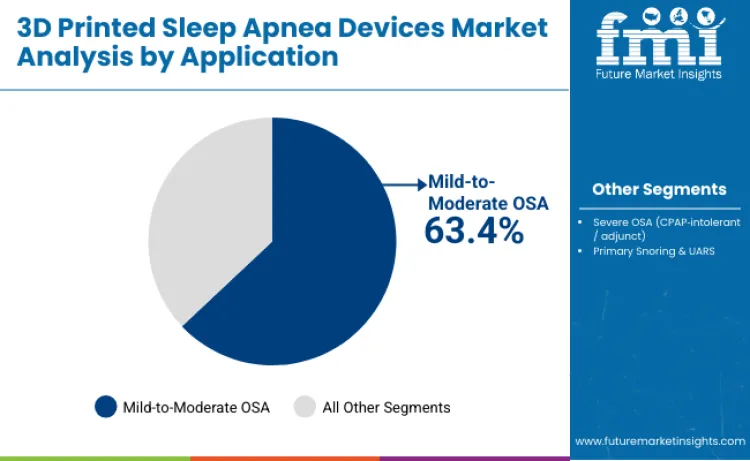
Mild-to-moderate obstructive sleep apnea represents the largest application category in 2025 with 63.4% share, supported by strong suitability for custom mandibular advancement therapy. Patients in this group increasingly prefer non-invasive treatment pathways that allow greater comfort and portability than CPAP systems. Digital workflows enable precise mandibular calibration, accurate anatomical modeling, and reproducible fabrication, contributing to better adherence and improved patient-reported comfort.
Growing diagnostic initiatives and close coordination between sleep physicians and dental sleep specialists enhance early identification and structured treatment planning. Remote titration options, tele-consult channels, and systematic follow-ups ensure consistent engagement and optimized long-term outcomes. These factors collectively reinforce position of custom oral appliances as a primary option for mild-to-moderate OSA.
Key advantages driving the mild-to-moderate OSA segment include:
- High suitability for oral appliance therapy supported by strong adherence and comfort profiles
- Standardized referral pathways between sleep physicians and dental sleep practices
- Ability to deliver effective treatment without invasive procedures or machine-based airflow systems
By End User, Sleep Dentists and Orofacial Pain Clinics Hold 46.3% Share
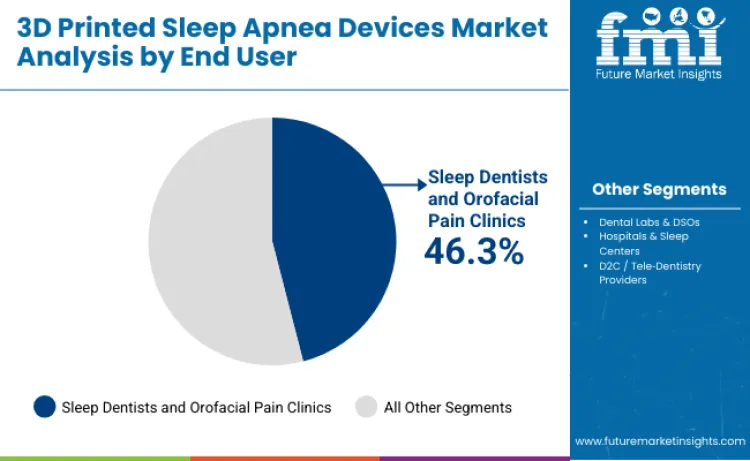
Sleep dentists and orofacial pain clinics hold a leading position in 2025 with 46.3% share due to extensive adoption of digital dentistry workflows and specialized training in mandibular repositioning therapy. These environments integrate intraoral scanners, CAD-CAM planning tools, and in-clinic titration protocols that support precise adjustment and predictable treatment outcomes. Collaborative partnerships with diagnostic centers and participation in dental-sleep medicine certification programs strengthen referral pathways and expand clinical capability.
Digital lab networks and scalable production platforms streamline fabrication, refit cycles, and quality consistency across multiple practice locations. Multi-site dental service organizations increasingly standardize sleep workflows, improving operational capacity, communication continuity, and access to customized appliance therapy.
Key advantages driving adoption within this end-user segment include:
- Advanced digital dentistry infrastructure supporting precision appliance fabrication and titration
- Professional specialization pathways strengthening clinical capability and referral confidence
- Integrated collaboration with sleep physicians improving diagnostic throughput and treatment alignment
What Are the Major Drivers, Restraints, and Emerging Trends Influencing the 3D Printed Sleep Apnea Devices Market?
The 3D-printed sleep apnea devices segment is propelled by rising global sleep apnea prevalence, now exceeding one billion individuals, which increases demand for customized mandibular advancement devices produced through additive manufacturing. Growing CPAP intolerance is shifting patients toward digitally fabricated oral appliances offering superior comfort and adherence. Simultaneously, rapid digital dentistry expansion, including intraoral scanning, CAD-based airway modeling, and resin-based printing, drives broader adoption as clinics invest in integrated digital production workflows.
What Are the Major Restraints Limiting Adoption of 3D Printed Sleep Apnea Devices?
Restraints include material and equipment cost considerations that create adoption barriers, as medical-grade 3D printers and specialized biocompatible resins require significant capital expenditure and workflow re-training for dental teams. Regulatory variation across regions and payer-coverage limitations also influence adoption pace, especially in geographies where reimbursement for oral appliance therapy remains limited.
What Emerging Trends Are Shaping the Future of the 3D Printed Sleep Apnea Devices Market?
Key trends indicate accelerated adoption across digitally enabled dental and sleep medicine ecosystems, particularly in North America and select European markets where structured sleep-dentistry training pathways and remote scanning workflows enhance care access. Growing investment in digital labs, seamless CAD/CAM integration, and advanced 3D printing materials is strengthening the shift toward patient-specific, precision-fit sleep apnea therapies.
How Are Leading Countries Driving Growth in the 3D Printed Sleep Apnea Devices Market?
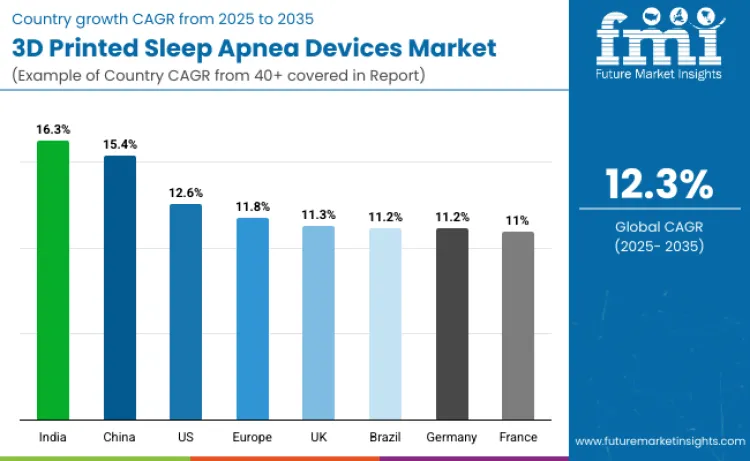
| Country/Region | CAGR (2025 to 2035) |
|---|---|
| India | 16.3% |
| China | 15.4% |
| USA | 12.6% |
| Europe | 11.8% |
| UK | 11.3% |
| Brazil | 11.2% |
| Germany | 11.2% |
| France | 11.0% |
3D-printed sleep apnea devices are gaining traction globally, led by India (16.3%), where rapid digital dentistry growth, rising sleep-disorder awareness, and widespread adoption of intraoral scanning and CAD-CAM workflows drive strong uptake. China (15.4%) follows with expanding dental infrastructure, growing middle-class access to sleep services, and increasing investment in medical 3D printing and polymer innovation. The USA (12.6%) shows robust progress supported by mature sleep networks and rising CPAP-intolerant patient demand. Europe (11.8%), including Germany (11.2%), the UK (11.3%), and France (11.0%), continues to advance through strong screening initiatives and high digitalization levels, while Brazil (11.2%) progresses with growing diagnosis rates and broader adoption of customized oral appliances.
The report covers an in-depth analysis of 40+ countries top-performing countries are highlighted below.
How Is Digital Healthcare and Dental Infrastructure Accelerating Growth in China?
China shows one of the fastest growth trajectories with a CAGR of 15.4% through 2035, driven by rapid expansion of digital dentistry, rising awareness of sleep disorders, and strong government focus on healthcare modernization and MedTech innovation. Widespread adoption of intraoral scanners, growth in private dental chains, and integration of 3D printing into clinical workflows are accelerating use of custom mandibular advancement devices across major urban centers. Digital dental labs in Shanghai, Beijing, Guangzhou, and Shenzhen streamline appliance production and improve quality consistency. Policy initiatives supporting dental digitalization and local manufacturing of polymers and medical printers enhance affordability, supply resilience, and access to precision sleep appliance therapy.
Why Are Sleep Medicine Capacity-Building Programs Enhancing Adoption in India?
India's 3D printed sleep apnea devices market demonstrates strongest growth momentum with a CAGR of 16.3% through 2035, driven by growing recognition of obstructive sleep apnea, rising awareness of CPAP intolerance, and expanding use of intraoral scanning and CAD-CAM workflows across dental clinics. Digital dentistry hubs, metropolitan healthcare networks, and training institutions increasingly integrate 3D-printed sleep appliance workflows into sleep dentistry, ENT, and orthodontic practices.
National Digital Health initiatives and medical technology development programs are strengthening adoption. Wider use of remote titration tools and teleconsultation is improving therapy reach across Tier-2 and Tier-3 cities. Major clusters such as Bengaluru, Mumbai, Delhi-NCR, Hyderabad, and Chennai are accelerating deployment of dental labs and 3D printing systems for precision mandibular advancement devices.
How Does Medical Manufacturing Excellence Sustain Leadership in Germany?
Germany’s advanced medical manufacturing ecosystem supports strong adoption of 3D-printed sleep apnea appliances, reinforced by digital workflows across sleep dentistry clinics, orthodontic practices, and university-affiliated oral medicine centers. Innovation hubs such as Berlin, Munich, Hamburg, and Frankfurt demonstrate deep integration of intraoral scanning, CAD-guided mandibular positioning, and polymer-based additive manufacturing aligned with Germany’s strict quality and safety standards.
Clinicians prioritize reliability, biocompatibility, durability, and evidence-based treatment outcomes, driving preference for premium-grade appliances. A CAGR of 11.2% is sustained by structured digital workflow deployment, academic partnerships enabling research and training, and collaboration between device manufacturers, dental distributors, and polymer suppliers supporting nationwide clinical and technical implementation.
Why Is Growing Sleep Disorder Awareness Fueling Demand in Brazil?
Brazilian 3D printed sleep apnea devices market leads Latin American adoption driven by rising sleep apnea diagnosis rates, broader digital dentistry penetration, and expanding private dental care networks. Major metropolitan centers including São Paulo, Rio de Janeiro, Brasília, and Porto Alegre are adopting 3D-printed mandibular advancement devices as awareness of CPAP intolerance increases. Dental sleep practitioners, implant-focused clinics, and digital labs are integrating intraoral scanning and custom appliance workflows, improving access to personalized therapy. Partnerships with international device and material suppliers support training, financing, and localized distribution. National efforts to expand sleep disorder screening and digital clinic infrastructure continue to advance adoption of precision sleep appliances.
How Do Established Sleep Medicine Networks Strengthen Performance in United States?
United States 3D printed sleep apnea devices market demonstrates mature adoption supported by established sleep medicine centers, integrated dental-sleep practices, and ENT networks across major medical hubs including California, Texas, New York, Florida, and Illinois. With a CAGR of 12.6%, growth is reinforced by advanced OSA screening protocols, selective reimbursement coverage, and rising CPAP intolerance driving demand for precision-fit oral appliance therapy.
The country hosts leading dental CAD, intraoral scanning, and airway-assessment software innovators, ensuring strong interoperability across digital workflows. Dental labs, DSOs, and medical device distributors provide nationwide fabrication and clinical support. Academic partnerships and professional societies promote research, training, and next-generation appliance development, strengthening long-term adoption.
How Is Clinical Collaboration Expansion Supporting Growth in United Kingdom?
United Kingdom's 3D printed sleep apnea devices market shows solid growth potential with a CAGR of 11.3% through 2035, supported by NHS-backed sleep disorder awareness programs and increasing integration of digital dentistry within private dental groups and specialist practices. Clinics across London, Manchester, Birmingham, and Edinburgh are adopting 3D-printed oral appliance workflows to address rising demand for non-CPAP treatment options, achieving improved adherence and comfort outcomes.
British dental sleep practitioners increasingly use intraoral scanners and CAD-driven design tools to enhance diagnostic precision and streamline titration. Collaboration among dental universities, technology providers, and sleep-medicine organizations expands training and guideline adoption, reinforcing preference for biocompatible, durable, precision-printed mandibular advancement devices.
How Are Digital Health Investments Advancing Market Expansion Across Europe?
The 3D-printed sleep apnea devices market in Europe is projected to grow from USD 89.6 million in 2025 to USD 270.2 million by 2035, driven by expanding digital health investment and strong clinical adoption. Germany leads with 27.4% share in 2025, edging to 27.9% by 2035 due to its advanced dental and sleep-medicine ecosystem. France grows from 21.6% to 21.9% supported by integrated orthodontic and sleep-care networks, while the UK increases from 19.3% to 19.7% through digital dentistry expansion. Italy (12.8%), Spain (9.2% to 9.4%), the Netherlands (6.7%), and Rest of Europe (3.0% to 3.2%) maintain steady progress.
Precision-Fit Oral Appliance Quality Dominates Requirements in Japan
Japan’s 3D-printed sleep apnea device landscape reflects a mature, precision-driven clinical environment supported by high-accuracy intraoral scanning, advanced CAD simulation, and biocompatible polymer printing integrated across university hospitals and specialist dental centers. Strong focus on treatment precision, comfort, and long-term device stability drives demand for premium, research-validated oral appliances designed to meet stringent performance expectations.
Collaboration between domestic digital dentistry providers and academic institutions strengthens workflow standardization, ensuring predictable airway improvement and reliable mandibular advancement. Clinics in Tokyo, Osaka, and Kyoto demonstrate advanced digital titration and fabrication protocols that deliver anatomically exact, durable, and adherence-focused appliance solutions.
International Providers Lead Clinical Integration and Digital Dentistry Enablement in South Korea
South Korea’s 3D-printed sleep apnea device landscape is strengthened by growing involvement from international dental technology developers providing advanced onboarding, appliance design support, and digital workflow training. Demand for precision oral appliance therapy is rising as dental sleep clinics, ENT practices, and orthodontic centers adopt 3D-printed mandibular advancement devices integrated with domestic medical software and nationwide sleep-diagnostic ecosystems.
Regional distributors and digital dentistry providers expand adoption through partnerships with global appliance manufacturers, offering localized training and regulatory-aligned support. Collaboration between multinational firms and Korean dental associations enables hybrid implementation models combining global appliance technology with localized treatment standards and clinician education frameworks.
How Competitive Is the Global 3D Printed Sleep Apnea Devices Market and What Defines Its Structure?
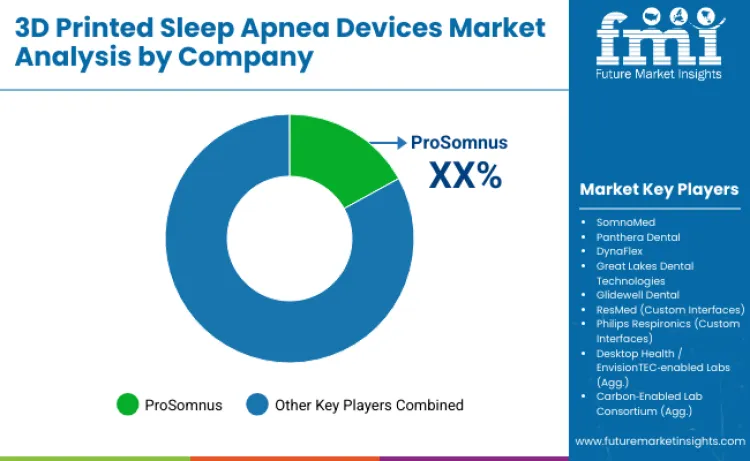
The 3D-printed sleep apnea devices landscape includes a focused group of key participants operating within a moderately concentrated environment, where the leading companies dominate through strong clinical partnerships, proprietary digital-printing workflows, and differentiated mandibular advancement device platforms. ProSomnus holds a leading position supported by precision additive manufacturing, durable advancement mechanics, and a clinically validated oral-appliance portfolio. SomnoMed and Panthera Dental maintain comparable competitive strength through advanced polymer engineering, seamless digital-scanning integration, and well-established dentist-physician referral ecosystems across major global regions.
These leaders continue to invest in material innovation, remote titration technologies, and structure clinician-training programs to expand professional adoption. Challenger companies such as DynaFlex and Great Lakes Dental Technologies capitalize on orthodontic manufacturing expertise and hybrid digital-manual production models, while emerging entrants increase competitive pressure through distributed printing strategies and smart-polymer development tailored to cost-sensitive dental sleep practices.
Key Players in the 3D-Printed Sleep Apnea Devices Market
- ProSomnus
- SomnoMed
- Panthera Dental
- DynaFlex
- Great Lakes Dental Technologies
- Glidewell Dental
- ResMed (Custom Interfaces)
- Philips Respironics (Custom Interfaces)
- Desktop Health/EnvisionTEC‑enabled Labs (Agg.)
- Carbon‑Enabled Lab Consortium (Agg.)
- Others
Scope of the Report
| Items | Values |
|---|---|
| Quantitative Units | USD 342.1 million |
| Product Type | 3D-Printed Mandibular Advancement Devices (MADs), Custom 3D-Printed CPAP Mask Interfaces, 3D-Printed Nasal/Oral Splints & Positioners, Ancillary Components & Accessories |
| Material/Technology | Biocompatible Dental Resins (Photopolymer), Nylon (PA12)/PEEK Polymers, Hybrid Multi-Material & Coatings, Titanium/Metal Components |
| Application | Mild-Moderate OSA, Severe OSA (CPAP-intolerant/adjunct), Primary Snoring & UARS |
| End User | Sleep Dentists & Orofacial Pain Clinics, Dental Labs & DSOs, Hospitals & Sleep Centers, D2C/Tele-Dentistry Providers |
| Regions Covered | Asia Pacific, Europe, North America, Latin America, Middle East & Africa |
| Country Covered | China, India, Germany, Brazil, USA, UK, Japan, and 40+ countries |
| Key Companies Profiled | ProSomnus, SomnoMed, Panthera Dental, DynaFlex, Great Lakes Dental Technologies, Glidewell Dental, ResMed (Custom Interfaces), Philips Respironics (Custom Interfaces), Desktop Health / EnvisionTEC -enabled Labs ( Agg.), Carbon-Enabled Lab Consortium (Agg.), Others. |
| Additional Attributes | Dollar sales by appliance type and end-use, with adoption trends across major regions, highlight competition among dental device makers and digital labs. Advances in biocompatible resins, hinge mechanics, intraoral scanner integration, CAD-CAM planning, and tele-monitored, digitally titratable systems are driving precision mandibular advancement and long-term therapy adherence. |
3D-Printed Sleep Apnea Devices Market by Segments
By Product Type:
- 3D-Printed Mandibular Advancement Devices (MADs)
- Custom 3D-Printed CPAP Mask Interfaces
- 3D-Printed Nasal/Oral Splints & Positioners
- Ancillary Components & Accessories
By Material/Technology:
- Biocompatible Dental Resins (Photopolymer)
- Nylon (PA12) / PEEK Polymers
- Hybrid Multi-Material & Coatings
- Titanium/Metal Components
By Application:
- Mild-Moderate OSA
- Severe OSA (CPAP‑intolerant / adjunct)
- Primary Snoring & UARS
By End User:
- Sleep Dentists & Orofacial Pain Clinics
- Dental Labs & DSOs
- Hospitals & Sleep Centers
- D2C / Tele‑Dentistry Providers
By Region:
- Asia Pacific
- China
- India
- Japan
- South Korea
- Vietnam
- Australia & New Zealand
- ASEAN
- Rest of Asia Pacific
- Europe
- Germany
- United Kingdom
- France
- Italy
- Spain
- Netherlands
- Nordic
- BENELUX
- Rest of Europe
- North America
- United States
- Canada
- Mexico
- Latin America
- Brazil
- Argentina
- Rest of Latin America
- Middle East & Africa
- Kingdom of Saudi Arabia
- Other GCC Countries
- Turkey
- South Africa
- Other African Union
- Rest of Middle East & Africa
Frequently Asked Questions
How big is the 3D printed sleep apnea devices market in 2025?
The global 3D printed sleep apnea devices market is valued at USD 342.1 million in 2025.
What will be the size of the 3D printed sleep apnea devices market in 2035?
The market is projected to reach USD 1,098.4 million by 2035.
How fast will the 3D printed sleep apnea devices market grow between 2025 and 2035?
The market will grow at a CAGR of 12.3% from 2025 to 2035.
Which product type leads the 3D printed sleep apnea devices market in 2025?
3D-printed mandibular advancement devices lead the market with a 58.7% share in 2025.
Who are the major players in the 3D printed sleep apnea devices market?
Key players include ProSomnus, SomnoMed, Panthera Dental, DynaFlex, Great Lakes Dental Technologies, and Glidewell.
Preview the report firsthand - request a free sample
Get SampleGet the brochure for pricing and purchase details.
Get PDFTable of Content
- Executive Summary
- Regional Level Market Outlook
- Demand-side Trends
- Supply-side Trends
- Technology Roadmap Analysis
- Analysis and Recommendations
- Market Overview
- Market Coverage / Taxonomy
- Market Definition / Scope / Limitations
- Market Background
- Market Dynamics
- Drivers
- Restraints
- Opportunity
- Trends
- Scenario Forecast
- Demand in Optimistic Scenario
- Demand in Likely Scenario
- Demand in Conservative Scenario
- Opportunity Assessment
- Market Trade Assessment
- Products Market Assessment
- Investment Feasibility Matrix
- Value Chain Analysis
- Participants and their Roles
- Profit Margin Analysis
- Operating Margins By Region
- PESTLE and Porter’s Analysis
- Regulatory Landscape
- By Key Regions
- By Key Countries
- Regional Parent Market Outlook
- Product Launches & Development
- Technological Innovation
- Market Dynamics
- Regional Level Market Analysis 2020 to 2024 and Forecast, 2025 to 2035
- Historical Market Size USD Million Analysis, 2020 to 2024
- Current and Future Market Size USD Million Projections, 2025 to 2035
- Y-o-Y Growth Trend Analysis
- Absolute $ Opportunity Analysis
- Regional Level Market Analysis 2020 to 2024 and Forecast 2025 to 2035, By Product Type
- Introduction / Key Findings
- Historical Market Size USD Million Analysis By Product Type, 2020 to 2024
- Current and Future Market Size USD Million Analysis and Forecast By Product Type, 2025 to 2035
- 3D-Printed Mandibular Advancement Devices (MADs)
- Custom 3D-Printed CPAP Mask Interfaces
- 3D-Printed Nasal/Oral Splints & Positioners
- Ancillary Components & Accessories
- Y-o-Y Growth Trend Analysis By Product Type, 2020 to 2024
- Absolute $ Opportunity Analysis By Product Type, 2025 to 2035
- Regional Level Market Analysis 2020 to 2024 and Forecast 2025 to 2035, By Material/Technology
- Introduction / Key Findings
- Historical Market Size USD Million Analysis By Material/Technology, 2020 to 2024
- Current and Future Market Size USD Million Analysis and Forecast By Material/Technology, 2025 to 2035
- Biocompatible Dental Resins (Photopolymer)
- Nylon (PA12) / PEEK Polymers
- Hybrid Multi-Material & Coatings
- Titanium/Metal Components
- Y-o-Y Growth Trend Analysis By Material/Technology, 2020 to 2024
- Absolute $ Opportunity Analysis By Material/Technology, 2025 to 2035
- Regional Level Market Analysis 2020 to 2024 and Forecast 2025 to 2035, By Application
- Introduction / Key Findings
- Historical Market Size USD Million Analysis By Application, 2020 to 2024
- Current and Future Market Size USD Million Analysis and Forecast By Application, 2025 to 2035
- Mild-Moderate OSA
- Severe OSA (CPAP intolerant / adjunct)
- Primary Snoring & UARS
- Y-o-Y Growth Trend Analysis By Application, 2020 to 2024
- Absolute $ Opportunity Analysis By Application, 2025 to 2035
- Regional Level Market Analysis 2020 to 2024 and Forecast 2025 to 2035, By End User
- Introduction / Key Findings
- Historical Market Size USD Million Analysis By End User, 2020 to 2024
- Current and Future Market Size USD Million Analysis and Forecast By End User, 2025 to 2035
- Sleep Dentists & Orofacial Pain Clinics
- Dental Labs & DSOs
- Hospitals & Sleep Centers
- D2C / Tele Dentistry Providers
- Y-o-Y Growth Trend Analysis By End User, 2020 to 2024
- Absolute $ Opportunity Analysis By End User, 2025 to 2035
- Regional Level Market Analysis 2020 to 2024 and Forecast 2025 to 2035, By Region
- Introduction
- Historical Market Size USD Million Analysis By Region, 2020 to 2024
- Current Market Size USD Million Analysis and Forecast By Region, 2025 to 2035
- North America
- Latin America
- East Asia
- South Asia
- Western Europe
- Eastern Europe
- Middle East & Africa
- Market Attractiveness Analysis By Region
- North America Market Analysis 2020 to 2024 and Forecast 2025 to 2035, By Country
- Historical Market Size USD Million Trend Analysis By Market Taxonomy, 2020 to 2024
- Market Size USD Million Forecast By Market Taxonomy, 2025 to 2035
- By Country
- USA
- Canada
- Mexico
- By Product Type
- By Material/Technology
- By Application
- By End User
- By Country
- Market Attractiveness Analysis
- By Country
- By Product Type
- By Material/Technology
- By Application
- By End User
- Key Takeaways
- Latin America Market Analysis 2020 to 2024 and Forecast 2025 to 2035, By Country
- Historical Market Size USD Million Trend Analysis By Market Taxonomy, 2020 to 2024
- Market Size USD Million Forecast By Market Taxonomy, 2025 to 2035
- By Country
- Brazil
- Argentina
- Rest of Latin America
- By Product Type
- By Material/Technology
- By Application
- By End User
- By Country
- Market Attractiveness Analysis
- By Country
- By Product Type
- By Material/Technology
- By Application
- By End User
- Key Takeaways
- East Asia Market Analysis 2020 to 2024 and Forecast 2025 to 2035, By Country
- Historical Market Size USD Million Trend Analysis By Market Taxonomy, 2020 to 2024
- Market Size USD Million Forecast By Market Taxonomy, 2025 to 2035
- By Country
- China
- Japan
- South Korea
- By Product Type
- By Material/Technology
- By Application
- By End User
- By Country
- Market Attractiveness Analysis
- By Country
- By Product Type
- By Material/Technology
- By Application
- By End User
- Key Takeaways
- South Asia Market Analysis 2020 to 2024 and Forecast 2025 to 2035, By Country
- Historical Market Size USD Million Trend Analysis By Market Taxonomy, 2020 to 2024
- Market Size USD Million Forecast By Market Taxonomy, 2025 to 2035
- By Country
- India
- ASEAN Countries
- Australia & New Zealand
- Rest of South Asia
- By Product Type
- By Material/Technology
- By Application
- By End User
- By Country
- Market Attractiveness Analysis
- By Country
- By Product Type
- By Material/Technology
- By Application
- By End User
- Key Takeaways
- Western Europe Market Analysis 2020 to 2024 and Forecast 2025 to 2035, By Country
- Historical Market Size USD Million Trend Analysis By Market Taxonomy, 2020 to 2024
- Market Size USD Million Forecast By Market Taxonomy, 2025 to 2035
- By Country
- Germany
- UK
- France
- Italy
- Spain
- BENELUX
- Nordic Countries
- Rest of Western Europe
- By Product Type
- By Material/Technology
- By Application
- By End User
- By Country
- Market Attractiveness Analysis
- By Country
- By Product Type
- By Material/Technology
- By Application
- By End User
- Key Takeaways
- Eastern Europe Market Analysis 2020 to 2024 and Forecast 2025 to 2035, By Country
- Historical Market Size USD Million Trend Analysis By Market Taxonomy, 2020 to 2024
- Market Size USD Million Forecast By Market Taxonomy, 2025 to 2035
- By Country
- Russia
- Hungary
- Poland
- Rest of Eastern Europe
- By Product Type
- By Material/Technology
- By Application
- By End User
- By Country
- Market Attractiveness Analysis
- By Country
- By Product Type
- By Material/Technology
- By Application
- By End User
- Key Takeaways
- Middle East & Africa Market Analysis 2020 to 2024 and Forecast 2025 to 2035, By Country
- Historical Market Size USD Million Trend Analysis By Market Taxonomy, 2020 to 2024
- Market Size USD Million Forecast By Market Taxonomy, 2025 to 2035
- By Country
- Saudi Arabia
- Other GCC Countries
- Türkiye
- South Africa
- Rest of MEA
- By Product Type
- By Material/Technology
- By Application
- By End User
- By Country
- Market Attractiveness Analysis
- By Country
- By Product Type
- By Material/Technology
- By Application
- By End User
- Key Takeaways
- Market Structure Analysis
- Competition Dashboard
- Competition Benchmarking
- Market Share Analysis of Top Players
- By Regional
- By Product Type
- By Material/Technology
- By Application
- By End User
- Competition Analysis
- Competition Deep Dive
- ProSomnus
- Overview
- Product Portfolio
- Key Financials
- Key Developments
- Global/Regional Footprint
- Strategy Overview
- Marketing Strategy
- SWOT
- Analyst Comment
- SomnoMed
- Overview
- Product Portfolio
- Key Financials
- Key Developments
- Global/Regional Footprint
- Strategy Overview
- Marketing Strategy
- SWOT
- Analyst Comment
- Panthera Dental
- Overview
- Product Portfolio
- Key Financials
- Key Developments
- Global/Regional Footprint
- Strategy Overview
- Marketing Strategy
- SWOT
- Analyst Comment
- DynaFlex
- Overview
- Product Portfolio
- Key Financials
- Key Developments
- Global/Regional Footprint
- Strategy Overview
- Marketing Strategy
- SWOT
- Analyst Comment
- Great Lakes Dental Technologies
- Overview
- Product Portfolio
- Key Financials
- Key Developments
- Global/Regional Footprint
- Strategy Overview
- Marketing Strategy
- SWOT
- Analyst Comment
- Glidewell Dental
- Overview
- Product Portfolio
- Key Financials
- Key Developments
- Global/Regional Footprint
- Strategy Overview
- Marketing Strategy
- SWOT
- Analyst Comment
- ResMed (Custom Interfaces)
- Overview
- Product Portfolio
- Key Financials
- Key Developments
- Global/Regional Footprint
- Strategy Overview
- Marketing Strategy
- SWOT
- Analyst Comment
- Philips Respironics (Custom Interfaces)
- Overview
- Product Portfolio
- Key Financials
- Key Developments
- Global/Regional Footprint
- Strategy Overview
- Marketing Strategy
- SWOT
- Analyst Comment
- Desktop Health/EnvisionTEC enabled Labs (Agg.)
- Overview
- Product Portfolio
- Key Financials
- Key Developments
- Global/Regional Footprint
- Strategy Overview
- Marketing Strategy
- SWOT
- Analyst Comment
- Carbon Enabled Lab Consortium (Agg.)
- Overview
- Product Portfolio
- Key Financials
- Key Developments
- Global/Regional Footprint
- Strategy Overview
- Marketing Strategy
- SWOT
- Analyst Comment
- ProSomnus
- Competition Deep Dive
- Assumptions & Acronyms Used
- Research Methodology


