

- Market Size (2026)
- USD 484.5 Mn
- Forecast (2036)
- USD 1363.4 Mn
- CAGR (2026 to 2036)
- 10.9%
Titanium Aluminide Market Size, Market Forecast and Outlook By FMI
The titanium aluminide market was valued at USD 436.9 million in 2025. The market is set to reach USD 484.5 million by 2026-end and grow at a CAGR of 10.9% between 2026-2036 to reach USD 1,363.4 million by 2036. Gamma Tial will dominate with a 39.8% share, while Defense will lead with a 32.5%% share.
Summary of the Titanium Aluminide Market
- Demand and Growth Drivers
- Aerospace engine programs requiring lightweight high temperature materials are driving adoption of titanium aluminide alloys for turbine blades and structural components that reduce engine weight and improve fuel efficiency.
- Defense applications in missile components, armor systems, and military engine programs create high value demand for titanium aluminide with stringent performance and certification requirements.
- Automotive turbocharger manufacturers are adopting titanium aluminide wheels to reduce turbo lag and improve engine response through lower rotational inertia compared to nickel based alloy components.
- Product and Segment View
- Gamma TiAl is expected to account for 39.8% of the product type segment in 2026, reflecting its established position as the preferred titanium aluminide variant for aerospace turbine blades and high temperature structural applications.
- Defense is expected to represent 32.5% of the end use segment in 2026, driven by military engine programs, missile component requirements, and armor system development.
- Automotive applications represent the fastest growing end use as turbocharger manufacturers adopt titanium aluminide for weight reduction and performance improvement.
- Geography and Competitive Outlook
- China is expected to lead growth at 14.7%, reflecting its aerospace and defense industry expansion, growing titanium processing capability, and increasing domestic production of advanced alloy materials.
- India at 13.6% reflects defense modernization programs, growing aerospace manufacturing capability, and industrial investment in advanced materials.
- Companies combining alloy development capability, aerospace certification, and production scale are positioned to capture procurement during the forecast period.
- Analyst Opinion
- The titanium aluminide market is transitioning from a specialty research material to a commercially scaling structural alloy, with aerospace engine programs providing the primary demand catalyst.
- Adoption reflects the material's unique combination of low density, high temperature strength, and oxidation resistance that fills a performance gap between conventional titanium alloys and nickel superalloys.
- Growth at 10.9% CAGR reflects the expanding pipeline of aerospace engine programs specifying titanium aluminide components combined with emerging automotive and power generation applications.
- Companies investing in production scale, alloy optimization, and near net shape manufacturing processes are positioned to capture growing demand from aerospace and automotive OEMs.
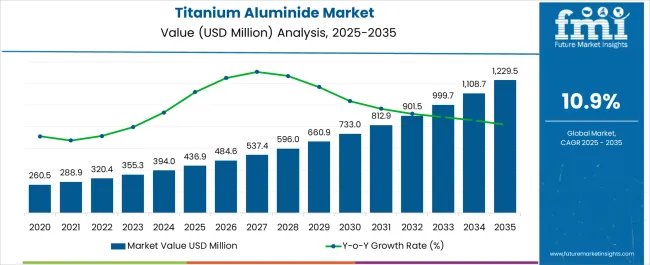
Key Takeaways, Market Size, and Forecast
- The titanium aluminide market was valued at USD Million 437 million in 2025.
- By 2036, the Titanium Aluminide Market is expected to be worth USD Million 1363.42 million.
- From 2026 to 2036, the market is projected to expand at a CAGR of 10.9%.
- The market is projected to create an incremental opportunity of USD Million 878.90 million between 2026 and 2036.
- In 2026, gamma tial is expected to account for 39.8% of the product type segment, driven by gamma titanium aluminide's superior high temperature strength to weight ratio that makes it the preferred material for aerospace turbine blades and automotive turbocharger wheels.
- China (14.7%) and India (13.6%) are two of the fastest growing markets in the world.
Titanium Aluminide Market Definition
The titanium aluminide market covers intermetallic alloy materials based on titanium and aluminum compounds used in high temperature structural applications across defense, aerospace, automotive, power and energy, and infrastructure sectors. Product types include gamma TiAl, alpha 2-Ti3Al, and TiAl3 alloys that provide high strength to weight ratios at elevated temperatures.
Titanium Aluminide Market Inclusions
Market scope includes all commercially traded titanium aluminide products categorized by product type (gamma TiAl, alpha 2-Ti3Al, TiAl3) and end use industry (defense, aerospace, automotive, power and energy, infrastructure). Revenue coverage spans 2026 to 2036.
Titanium Aluminide Market Exclusions
The scope does not include conventional titanium alloys without aluminide intermetallic structure, aluminum alloys, or nickel based superalloys.
Titanium Aluminide Market Research Methodology
- Primary Research: FMI analysts conducted interviews with manufacturers, technology specialists, and procurement professionals across key markets.
- Desk Research: Combined data from industry associations, regulatory bodies, and manufacturer disclosures.
- Market Sizing and Forecasting: Bottom up methodology aggregating segment and regional data with adoption velocity projections.
- Data Validation: Cross checked quarterly against production data, trade statistics, and manufacturer reporting.
Why is the Titanium Aluminide Market Growing?
- Next generation aircraft engine programs including the LEAP, PW1000G, and military engine platforms are specifying titanium aluminide turbine blades that reduce engine weight by up to 50% compared to nickel superalloy equivalents.
- Defense modernization programs in China, India, and the USA are creating demand for titanium aluminide components in missile systems, military engines, and advanced armor applications.
- Automotive turbocharger manufacturers are qualifying titanium aluminide turbine wheels that reduce rotational inertia by 50%, improving engine response and reducing turbo lag.
Demand for titanium aluminide is driven by the aerospace industry's pursuit of lighter engine components that improve fuel efficiency. Titanium aluminide alloys offer approximately half the density of nickel superalloys while maintaining adequate strength at temperatures up to 750 degrees Celsius. This weight reduction translates directly into fuel savings across the aircraft's operational life, making titanium aluminide turbine blades a cost effective investment despite higher material and manufacturing costs.
The defense sector provides the second largest demand source, with applications spanning military jet engines, missile components, and protective armor systems. Military programs prioritize performance over cost, creating high value procurement for certified titanium aluminide materials. Defense applications also benefit from the material's resistance to oxidation and creep at elevated temperatures.
Manufacturing technology advancement is critical to market growth. Titanium aluminide's inherent brittleness at room temperature creates machining and forming challenges that historically limited commercial adoption. Investment casting, additive manufacturing, and near net shape processing technologies are progressively overcoming these manufacturing barriers, enabling cost effective production of complex titanium aluminide components at commercial volumes.
Market Segmentation Analysis
- Gamma TiAl represents 39.8% of the product type segment, reflecting its established position for aerospace turbine blades and high temperature structural components.
- Defense accounts for 32.5% of the end use segment, driven by military engine programs, missile components, and armor development.
- Aerospace represents the highest growth potential as next generation engine programs expand titanium aluminide component specifications.
The titanium aluminide market segments by product type and end use industry. By product type, the market covers gamma TiAl, alpha 2-Ti3Al, and TiAl3. By end use, the market addresses defense, aerospace, automotive, power and energy, and infrastructure.
Insights into the Gamma TiAl Product Type Segment
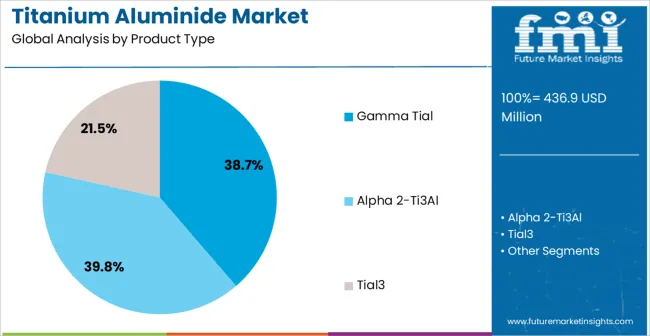
In 2026, gamma TiAl is expected to account for 39.8% of the segment. Gamma titanium aluminide provides the optimal balance of density, high temperature strength, and oxidation resistance for turbine blade applications. Its qualification in commercial engine programs has established production supply chains and manufacturing processes that support commercial volume production.
Insights into the Defense End Use Segment
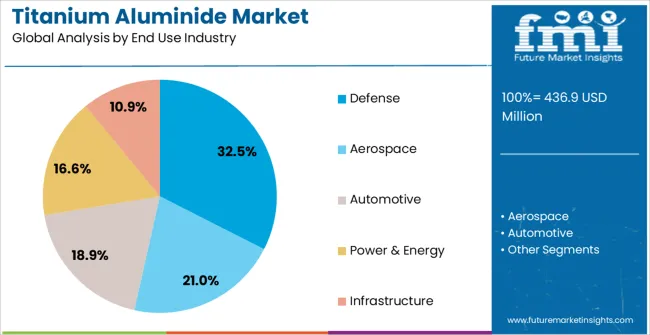
Defense is expected to represent 32.5% of the end use segment in 2026. Military applications value titanium aluminide's weight reduction and high temperature performance for engine components, missile structures, and protective systems. Defense procurement supports premium pricing and long term supply contracts that provide revenue stability for qualified manufacturers.
Titanium Aluminide Market Drivers, Restraints, and Opportunities
- Aerospace engine weight reduction requirements create structural demand for titanium aluminide components that offer density advantages over nickel superalloys.
- Manufacturing complexity, brittleness, and high processing costs constrain adoption to applications where weight savings justify material and fabrication premiums.
- Automotive turbocharger and power generation turbine applications create volume growth opportunities beyond traditional aerospace and defense markets.
The titanium aluminide market is expanding at 10.9% CAGR driven by aerospace engine programs, defense procurement, and emerging automotive applications. Manufacturing challenges constrain broader adoption, while technology advancement expands commercial viability.
Aerospace Engine Weight Reduction
Next generation engine programs specify titanium aluminide for turbine blades and structural components that deliver weight savings of up to 50% compared to nickel superalloys, directly improving aircraft fuel efficiency.
Manufacturing Complexity Barriers
Titanium aluminide's room temperature brittleness requires specialized manufacturing including investment casting and additive manufacturing. These processes add cost and limit production to manufacturers with specific technical capability.
Automotive Turbocharger Adoption
Titanium aluminide turbocharger wheels reduce rotational inertia, improving engine response and reducing emissions. Automotive volume production creates manufacturing scale that supports cost reduction.
Additive Manufacturing Advancement
Metal additive manufacturing enables near net shape production of complex titanium aluminide components, reducing material waste and machining requirements that constrain conventional manufacturing.
Analysis of Titanium Aluminide Market By Key Countries
.webp "Top Country Growth Comparison Titanium Aluminide Market Cagr (2026 2036)")
| Country | CAGR |
|---|---|
| China | 14.7% |
| India | 13.6% |
| Germany | 12.5% |
| Brazil | 11.4% |
| USA | 10.4% |
| UK | 9.3% |
| Japan | 8.2% |

- China leads at 14.7% CAGR through 2036.
- India leads at 13.6% CAGR through 2036.
- Germany leads at 12.5% CAGR through 2036.
- Brazil leads at 11.4% CAGR through 2036.
The global titanium aluminide market is projected to grow at a CAGR of 10.9% from 2026 to 2036. The analysis covers more than 30 countries, with the leading markets detailed below.
Demand Outlook for Titanium Aluminide Market in China
China is expected to lead growth at 14.7% through 2036, reflecting aerospace and defense industry expansion and growing domestic titanium aluminide production capability.
- Aerospace industry expansion drives turbine component demand.
- Defense programs create high value material procurement.
- Domestic production capability reduces import dependence.
Future Outlook for Titanium Aluminide Market in India
India is expected to grow at 13.6% through 2036, supported by defense modernization, growing aerospace manufacturing, and advanced material development investment.
- Defense modernization drives titanium aluminide procurement.
- Aerospace manufacturing growth creates engine component demand.
- Advanced material R&D supports domestic alloy development.
Opportunity Analysis of Titanium Aluminide Market in Germany
Germany is expected to grow at 12.5% through 2036, driven by its aerospace engine manufacturing, automotive turbocharger industry, and advanced metallurgy expertise.
- Aerospace engine manufacturing drives turbine blade demand.
- Automotive turbocharger industry creates volume application.
- Advanced metallurgy expertise supports alloy development.
In-depth Analysis of Titanium Aluminide Market in the United States
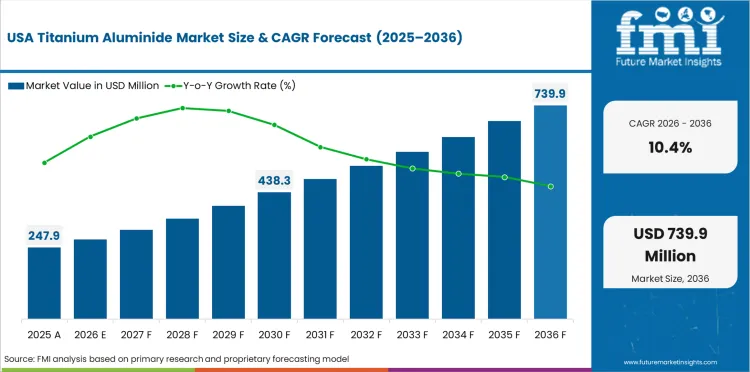
The USA is expected to grow at 10.4% through 2036, reflecting its aerospace and defense leadership, engine program procurement, and additive manufacturing adoption.
- Aerospace and defense leadership drives high value procurement.
- Engine program specifications create qualified material demand.
- Additive manufacturing advances improve production economics.
Sales Analysis of Titanium Aluminide Market in Japan
Japan is expected to grow at 8.2% through 2036, reflecting its titanium processing expertise, aerospace component manufacturing, and automotive technology development.
- Titanium processing expertise supports alloy production capability.
- Aerospace component manufacturing drives qualified material demand.
- Automotive technology creates turbocharger application development.
Demand Outlook for Titanium Aluminide Market in the United Kingdom
The UK is expected to grow at 9.3% through 2036, supported by its aerospace engine industry, defense programs, and advanced materials research.
- Aerospace engine industry drives titanium aluminide component demand.
- Defense programs create material procurement for military applications.
- Advanced materials research supports alloy and process development.
Competitive Landscape and Strategic Positioning
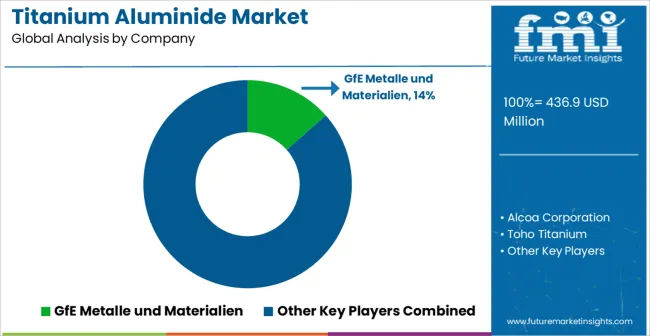
- GfE Metalle und Materialien leads the market with comprehensive product and service capabilities and established customer relationships.
- Multiple global and regional players compete on technology capability, certification credentials, and geographic reach.
- Emerging players are targeting specialized applications and next generation technology development.
GfE Metalle und Materialien leads in titanium aluminide powder and ingot production for aerospace applications. Alcoa Corporation and Carpenter Technology provide aerospace certified titanium aluminide materials and components for engine manufacturers.
Toho Titanium and Daido Steel serve Asian aerospace and industrial markets. Stanford Advanced Materials provides specialty alloy products globally. VSMPO-AVISMA supplies titanium based materials to aerospace customers.
Western Superconducting Technologies represents growing Chinese production capability. AMG Advanced Metallurgical Group and KBM Affilips provide European specialty alloy solutions.
Key Companies in the Titanium Aluminide Market
Key global companies leading the titanium aluminide market include:
- GfE Metalle und Materialien (Germany), Alcoa Corporation (USA), Toho Titanium (Japan), Stanford Advanced Materials (USA), Carpenter Technology Corporation (USA) hold strong positions through manufacturing scale, certification credentials, and established customer relationships.
- Daido Steel (Japan), Western Superconducting Technologies (China), Aerospace Alloys (USA), VSMPO-AVISMA Corporation (Russia) are expanding presence through regional focus and specialized product development.
- KBM Affilips (Netherlands), Titanium Metals Corporation (USA), AMG Advanced Metallurgical Group (Netherlands) represent emerging participants targeting niche applications.
Competitive Benchmarking: Titanium Aluminide Market
| Company | Alloy Technology | Production Scale | Aerospace Certification | Geographic Reach |
|---|---|---|---|---|
| GfE Metalle und Materialien | High | High | Strong | Europe, Global |
| Alcoa Corporation | High | High | Strong | Global |
| Toho Titanium | High | High | Strong | Asia, Global |
| Carpenter Technology | High | High | Strong | North America, Global |
| Stanford Advanced Materials | High | Medium | Moderate | Global |
| Daido Steel | High | High | Strong | Asia |
| VSMPO-AVISMA | High | High | Strong | Europe, Asia |
| Western Superconducting | High | High | Moderate | China |
| AMG Advanced Metallurgical | High | Medium | Moderate | Europe, Global |
| Titanium Metals Corp. | High | High | Strong | North America |
Source: Future Market Insights competitive analysis, 2026.
Key Players in the Titanium Aluminide Market
Major Global Players
- GfE Metalle und Materialien (Germany)
- Alcoa Corporation (USA)
- Toho Titanium (Japan)
- Stanford Advanced Materials (USA)
- Carpenter Technology Corporation (USA)
Emerging Players/Startups
- Daido Steel (Japan)
- Western Superconducting Technologies (China)
- Aerospace Alloys (USA)
- VSMPO-AVISMA Corporation (Russia)
- KBM Affilips (Netherlands)
- Titanium Metals Corporation (USA)
- AMG Advanced Metallurgical Group (Netherlands)
Report Scope and Coverage
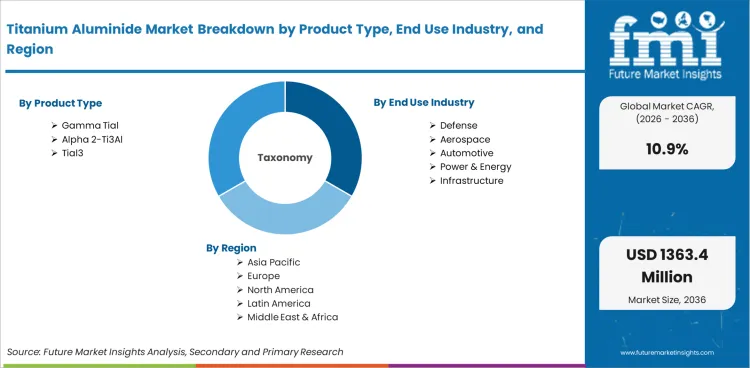
| Parameter | Details |
|---|---|
| Quantitative Units | USD Million 484.52 to USD Million 1363.42, at a CAGR of 10.9% |
| Market Definition | The titanium aluminide market covers intermetallic alloy materials based on titanium and aluminum compounds used in high temperature structural applications across defense, aerospace, automotive, power and energy, and infrastructure sectors. Product types include gamma TiAl, alpha 2-Ti3Al, and TiAl3 alloys that provide high strength to weight ratios at elevated temperatures. |
| Regions Covered | North America, Latin America, Europe, East Asia, South Asia and Pacific, Middle East and Africa |
| Countries Covered | China, India, Germany, Brazil, USA, UK, Japan, and 30 plus countries |
| Key Companies Profiled | GfE Metalle und Materialien, Alcoa Corporation, Toho Titanium, Stanford Advanced Materials, Carpenter Technology Corporation, Daido Steel, Western Superconducting Technologies, Aerospace Alloys |
| Forecast Period | 2026 to 2036 |
| Approach | Hybrid bottom up and top down methodology starting with verified transaction data, projecting adoption velocity across segments and regions. |
Segmentation
Titanium Aluminide Market Segmented by Product Type:
- Gamma Tial
- Alpha 2-Ti3Al
- Tial3
Titanium Aluminide Market Segmented by End Use Industry:
- Defense
- Aerospace
- Automotive
- Power & Energy
- Infrastructure
Titanium Aluminide Market by Region:
- North America
- USA
- Canada
- Mexico
- Latin America
- Brazil
- Chile
- Rest of Latin America
- Western Europe
- Germany
- UK
- Italy
- Spain
- France
- Nordic
- BENELUX
- Rest of Western Europe
- Eastern Europe
- Russia
- Poland
- Hungary
- Balkan & Baltic
- Rest of Eastern Europe
- East Asia
- China
- Japan
- South Korea
- South Asia and Pacific
- India
- ASEAN
- Australia & New Zealand
- Rest of South Asia and Pacific
- Middle East & Africa
- Kingdom of Saudi Arabia
- Other GCC Countries
- Turkiye
- South Africa
- Other African Union
- Rest of Middle East & Africa
Research Sources and Bibliography
- 1. National Aeronautics and Space Administration. (2025). NASA Technical Reports: Titanium Aluminide Alloy Development for Aerospace Applications. NASA.
- 2. European Aviation Safety Agency. (2024). EASA Material Certification Standards for Aircraft Engine Components. EASA.
- 3. International Titanium Association. (2025). ITA Annual Review: Titanium and Titanium Aluminide Market Report. ITA.
- 4. Society of Automotive Engineers. (2024). SAE International: Advanced Materials for Turbocharger Applications. SAE.
- 5. USA Department of Defense. (2025). DoD Strategic Materials Assessment: Titanium Aluminide Supply Chain Analysis. DoD.
This bibliography is provided for reader reference. The full Future Market Insights report contains the complete reference list.
This Report Answers
- Estimating the size of the market and projected revenue from 2026 to 2036.
- Segmentation by product type, end use industry, and region.
- Insights across more than 30 country markets.
- Analysis of alloy technology and manufacturing process trends.
- Assessment of the competitive landscape and manufacturer positioning.
- Identification of investment opportunities in aerospace, defense, and automotive applications.
- Tracking aerospace engine program developments and material specifications.
- Delivery of data in PDF and Excel formats.
Frequently Asked Questions
What is the global market demand for Titanium Aluminide in 2026?
In 2026, the global titanium aluminide market is expected to be worth USD Million 484.52 million.
How big will the Titanium Aluminide Market be in 2036?
By 2036, the titanium aluminide market is expected to be worth USD Million 1363.42 million.
How much is demand for Titanium Aluminide expected to grow between 2026 and 2036?
Between 2026 and 2036, demand is expected to grow at a CAGR of 10.9%.
Which product type segment is expected to lead in 2026?
Gamma TiAl is expected to account for 39.8% of the product type segment in 2026, driven by gamma titanium aluminide's superior high temperature strength to weight ratio that makes it the preferred material for aerospace turbine blades and automotive turbocharger wheels.
What is causing demand to rise in China?
China is expected to grow at 14.7% CAGR through 2036. Aerospace industry expansion drives turbine component demand.
What is causing demand to rise in India?
India is expected to grow at 13.6% CAGR through 2036. Defense modernization drives titanium aluminide procurement.
What does this report mean by 'Titanium Aluminide Market definition'?
The titanium aluminide market covers intermetallic alloy materials based on titanium and aluminum compounds used in high temperature structural applications across defense, aerospace, automotive, power and energy, and infrastructure sectors. Product types include gamma TiAl, alpha 2-Ti3Al, and TiAl3 alloys that provide high strength to weight ratios at elevated temperatures.
How does FMI make the Titanium Aluminide forecast and validate it?
Forecasting models use a hybrid bottom up and top down approach, starting with verified transaction data and validating against industry production statistics and manufacturer disclosures.
Preview the report firsthand - request a free sample
Get SampleGet the brochure for pricing and purchase details.
Get PDFTable of Content
- Executive Summary
- Global Market Outlook
- Demand-side Trends
- Supply-side Trends
- Technology Roadmap Analysis
- Analysis and Recommendations
- Market Overview
- Market Coverage / Taxonomy
- Market Definition / Scope / Limitations
- Research Methodology
- Chapter Orientation
- Analytical Lens and Working Hypotheses
- Market Structure, Signals, and Trend Drivers
- Desk Research Programme (Secondary Evidence)
- Company Annual and Sustainability Reports
- Peer-reviewed Journals and Academic Literature
- Corporate Websites, Product Literature, and Technical Notes
- Earnings Decks and Investor Briefings
- Statutory Filings and Regulatory Disclosures
- Technical White Papers and Standards Notes
- Trade Journals, Industry Magazines, and Analyst Briefs
- Conference Proceedings, Webinars, and Seminar Materials
- Government Statistics Portals and Public Data Releases
- Press Releases and Reputable Media Coverage
- Specialist Newsletters and Curated Briefings
- Sector Databases and Reference Repositories
- FMI Internal Proprietary Databases and Historical Market Datasets
- Subscription Datasets and Paid Sources
- Social Channels, Communities, and Digital Listening Inputs
- Additional Desk Sources
- Expert Input and Fieldwork (Primary Evidence)
- Primary Modes
- Qualitative Interviews and Expert Elicitation
- Quantitative Surveys and Structured Data Capture
- Blended Approach
- Why Primary Evidence is Used
- Field Techniques
- Interviews
- Surveys
- Focus Groups
- Observational and In-context Research
- Social and Community Interactions
- Stakeholder Universe Engaged
- C-suite Leaders
- Board Members
- Presidents and Vice Presidents
- R&D and Innovation Heads
- Technical Specialists
- Domain Subject-matter Experts
- Scientists
- Physicians and Other Healthcare Professionals
- Governance, Ethics, and Data Stewardship
- Research Ethics
- Data Integrity and Handling
- Primary Modes
- Tooling, Models, and Reference Databases
- Data Engineering and Model Build
- Data Acquisition and Ingestion
- Cleaning, Normalisation, and Verification
- Synthesis, Triangulation, and Analysis
- Quality Assurance and Audit Trail
- Market Background
- Market Dynamics
- Drivers
- Restraints
- Opportunity
- Trends
- Scenario Forecast
- Demand in Optimistic Scenario
- Demand in Likely Scenario
- Demand in Conservative Scenario
- Opportunity Map Analysis
- Product Life Cycle Analysis
- Supply Chain Analysis
- Investment Feasibility Matrix
- Value Chain Analysis
- PESTLE and Porter’s Analysis
- Regulatory Landscape
- Regional Parent Market Outlook
- Production and Consumption Statistics
- Import and Export Statistics
- Market Dynamics
- Global Market Analysis 2021 to 2025 and Forecast, 2026 to 2036
- Historical Market Size Value (USD Million) Analysis, 2021 to 2025
- Current and Future Market Size Value (USD Million) Projections, 2026 to 2036
- Y-o-Y Growth Trend Analysis
- Absolute $ Opportunity Analysis
- Global Market Pricing Analysis 2021 to 2025 and Forecast 2026 to 2036
- Global Market Analysis 2021 to 2025 and Forecast 2026 to 2036, By Product Type
- Introduction / Key Findings
- Historical Market Size Value (USD Million) Analysis By Product Type , 2021 to 2025
- Current and Future Market Size Value (USD Million) Analysis and Forecast By Product Type , 2026 to 2036
- Gamma Tial
- Alpha 2-Ti3Al
- Tial3
- Gamma Tial
- Y-o-Y Growth Trend Analysis By Product Type , 2021 to 2025
- Absolute $ Opportunity Analysis By Product Type , 2026 to 2036
- Global Market Analysis 2021 to 2025 and Forecast 2026 to 2036, By End Use Industry
- Introduction / Key Findings
- Historical Market Size Value (USD Million) Analysis By End Use Industry, 2021 to 2025
- Current and Future Market Size Value (USD Million) Analysis and Forecast By End Use Industry, 2026 to 2036
- Defense
- Aerospace
- Automotive
- Power & Energy
- Infrastructure
- Defense
- Y-o-Y Growth Trend Analysis By End Use Industry, 2021 to 2025
- Absolute $ Opportunity Analysis By End Use Industry, 2026 to 2036
- Global Market Analysis 2021 to 2025 and Forecast 2026 to 2036, By Region
- Introduction
- Historical Market Size Value (USD Million) Analysis By Region, 2021 to 2025
- Current Market Size Value (USD Million) Analysis and Forecast By Region, 2026 to 2036
- North America
- Latin America
- Western Europe
- Eastern Europe
- East Asia
- South Asia and Pacific
- Middle East & Africa
- Market Attractiveness Analysis By Region
- North America Market Analysis 2021 to 2025 and Forecast 2026 to 2036, By Country
- Historical Market Size Value (USD Million) Trend Analysis By Market Taxonomy, 2021 to 2025
- Market Size Value (USD Million) Forecast By Market Taxonomy, 2026 to 2036
- By Country
- USA
- Canada
- Mexico
- By Product Type
- By End Use Industry
- By Country
- Market Attractiveness Analysis
- By Country
- By Product Type
- By End Use Industry
- Key Takeaways
- Latin America Market Analysis 2021 to 2025 and Forecast 2026 to 2036, By Country
- Historical Market Size Value (USD Million) Trend Analysis By Market Taxonomy, 2021 to 2025
- Market Size Value (USD Million) Forecast By Market Taxonomy, 2026 to 2036
- By Country
- Brazil
- Chile
- Rest of Latin America
- By Product Type
- By End Use Industry
- By Country
- Market Attractiveness Analysis
- By Country
- By Product Type
- By End Use Industry
- Key Takeaways
- Western Europe Market Analysis 2021 to 2025 and Forecast 2026 to 2036, By Country
- Historical Market Size Value (USD Million) Trend Analysis By Market Taxonomy, 2021 to 2025
- Market Size Value (USD Million) Forecast By Market Taxonomy, 2026 to 2036
- By Country
- Germany
- UK
- Italy
- Spain
- France
- Nordic
- BENELUX
- Rest of Western Europe
- By Product Type
- By End Use Industry
- By Country
- Market Attractiveness Analysis
- By Country
- By Product Type
- By End Use Industry
- Key Takeaways
- Eastern Europe Market Analysis 2021 to 2025 and Forecast 2026 to 2036, By Country
- Historical Market Size Value (USD Million) Trend Analysis By Market Taxonomy, 2021 to 2025
- Market Size Value (USD Million) Forecast By Market Taxonomy, 2026 to 2036
- By Country
- Russia
- Poland
- Hungary
- Balkan & Baltic
- Rest of Eastern Europe
- By Product Type
- By End Use Industry
- By Country
- Market Attractiveness Analysis
- By Country
- By Product Type
- By End Use Industry
- Key Takeaways
- East Asia Market Analysis 2021 to 2025 and Forecast 2026 to 2036, By Country
- Historical Market Size Value (USD Million) Trend Analysis By Market Taxonomy, 2021 to 2025
- Market Size Value (USD Million) Forecast By Market Taxonomy, 2026 to 2036
- By Country
- China
- Japan
- South Korea
- By Product Type
- By End Use Industry
- By Country
- Market Attractiveness Analysis
- By Country
- By Product Type
- By End Use Industry
- Key Takeaways
- South Asia and Pacific Market Analysis 2021 to 2025 and Forecast 2026 to 2036, By Country
- Historical Market Size Value (USD Million) Trend Analysis By Market Taxonomy, 2021 to 2025
- Market Size Value (USD Million) Forecast By Market Taxonomy, 2026 to 2036
- By Country
- India
- ASEAN
- Australia & New Zealand
- Rest of South Asia and Pacific
- By Product Type
- By End Use Industry
- By Country
- Market Attractiveness Analysis
- By Country
- By Product Type
- By End Use Industry
- Key Takeaways
- Middle East & Africa Market Analysis 2021 to 2025 and Forecast 2026 to 2036, By Country
- Historical Market Size Value (USD Million) Trend Analysis By Market Taxonomy, 2021 to 2025
- Market Size Value (USD Million) Forecast By Market Taxonomy, 2026 to 2036
- By Country
- Kingdom of Saudi Arabia
- Other GCC Countries
- Turkiye
- South Africa
- Other African Union
- Rest of Middle East & Africa
- By Product Type
- By End Use Industry
- By Country
- Market Attractiveness Analysis
- By Country
- By Product Type
- By End Use Industry
- Key Takeaways
- Key Countries Market Analysis
- USA
- Pricing Analysis
- Market Share Analysis, 2025
- By Product Type
- By End Use Industry
- Canada
- Pricing Analysis
- Market Share Analysis, 2025
- By Product Type
- By End Use Industry
- Mexico
- Pricing Analysis
- Market Share Analysis, 2025
- By Product Type
- By End Use Industry
- Brazil
- Pricing Analysis
- Market Share Analysis, 2025
- By Product Type
- By End Use Industry
- Chile
- Pricing Analysis
- Market Share Analysis, 2025
- By Product Type
- By End Use Industry
- Germany
- Pricing Analysis
- Market Share Analysis, 2025
- By Product Type
- By End Use Industry
- UK
- Pricing Analysis
- Market Share Analysis, 2025
- By Product Type
- By End Use Industry
- Italy
- Pricing Analysis
- Market Share Analysis, 2025
- By Product Type
- By End Use Industry
- Spain
- Pricing Analysis
- Market Share Analysis, 2025
- By Product Type
- By End Use Industry
- France
- Pricing Analysis
- Market Share Analysis, 2025
- By Product Type
- By End Use Industry
- India
- Pricing Analysis
- Market Share Analysis, 2025
- By Product Type
- By End Use Industry
- ASEAN
- Pricing Analysis
- Market Share Analysis, 2025
- By Product Type
- By End Use Industry
- Australia & New Zealand
- Pricing Analysis
- Market Share Analysis, 2025
- By Product Type
- By End Use Industry
- China
- Pricing Analysis
- Market Share Analysis, 2025
- By Product Type
- By End Use Industry
- Japan
- Pricing Analysis
- Market Share Analysis, 2025
- By Product Type
- By End Use Industry
- South Korea
- Pricing Analysis
- Market Share Analysis, 2025
- By Product Type
- By End Use Industry
- Russia
- Pricing Analysis
- Market Share Analysis, 2025
- By Product Type
- By End Use Industry
- Poland
- Pricing Analysis
- Market Share Analysis, 2025
- By Product Type
- By End Use Industry
- Hungary
- Pricing Analysis
- Market Share Analysis, 2025
- By Product Type
- By End Use Industry
- Kingdom of Saudi Arabia
- Pricing Analysis
- Market Share Analysis, 2025
- By Product Type
- By End Use Industry
- Turkiye
- Pricing Analysis
- Market Share Analysis, 2025
- By Product Type
- By End Use Industry
- South Africa
- Pricing Analysis
- Market Share Analysis, 2025
- By Product Type
- By End Use Industry
- USA
- Market Structure Analysis
- Competition Dashboard
- Competition Benchmarking
- Market Share Analysis of Top Players
- By Regional
- By Product Type
- By End Use Industry
- Competition Analysis
- Competition Deep Dive
- GfE Metalle und Materialien
- Overview
- Product Portfolio
- Profitability by Market Segments (Product/Age /Sales Channel/Region)
- Sales Footprint
- Strategy Overview
- Marketing Strategy
- Product Strategy
- Channel Strategy
- Alcoa Corporation
- Toho Titanium
- Stanford Advanced Materials
- Carpenter Technology Corporation
- Daido Steel
- Western Superconducting Technologies
- Aerospace Alloys
- VSMPO-AVISMA Corporation
- KBM Affilips
- Titanium Metals Corporation
- AMG Advanced Metallurgical Group
- GfE Metalle und Materialien
- Competition Deep Dive
- Assumptions & Acronyms Used


