

- Industry Size (2026)
- USD 338.0 Mn
- Forecast (2036)
- USD 671.1 Mn
- CAGR (2026 to 2036)
- 7.1%
Multi-Band SATCOM and 6G-Ready Aircraft Radome Systems Market Size, Market Forecast and Outlook By FMI
The multi-band SATCOM and 6G-ready aircraft radome systems market was valued at USD 315.6 million in 2025. Demand is poised to cross USD 338.0 million in 2026, and reach USD 671.1 million by 2036, at a 7.1% CAGR over the forecast period. This is driven by airlines replacing opaque legacy fairings with low-loss composites to sustain hardware volume.
Summary of Multi-Band SATCOM and 6G-Ready Aircraft Radome Systems Market
- The market is estimated at USD 338.0 million in 2026.
- The market is projected to reach USD 671.1 million by 2036.
- The market is expected to grow at a CAGR of 7.1% from 2026 to 2036.
- The forecast period represents an incremental opportunity of USD 333.1 million.
- Ku/Ka hybrid leads the band architecture segment with a 42.0% share.
- Tail-mounted leads the installation zone segment with a 39.0% share.
- Commercial transport leads the aircraft type segment with a 46.0% share.
- Retrofit leads the end use segment with a 57.0% share.
- Quartz composites lead the material segment with a 36.0% share.
- The United States (7.3%), China (7.1%), and UAE (7.0%) are among the fastest-growing markets.
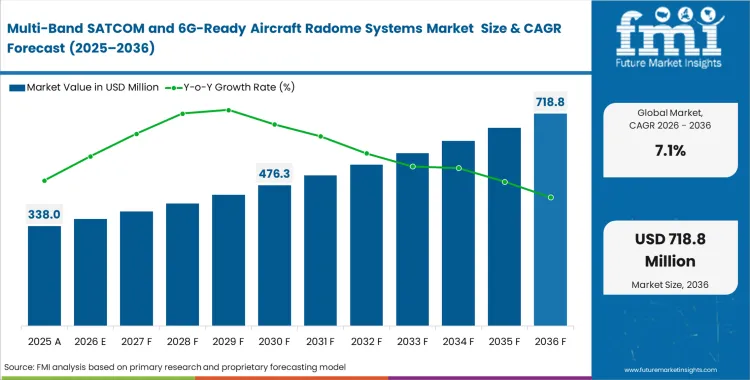
Key Takeaways, Market Size, and Forecast
- The Multi‑Band SATCOM and 6G‑Ready Aircraft Radome Systems Market is projected to grow from USD 338.0 million in 2026 to USD 671.1 million by 2036, expanding at a CAGR of 7.1%
- The market was valued at USD 315.6 million in 2025, reflecting early momentum from airline connectivity upgrades and defense fleet modernization
- By 2036, the market is expected to reach USD 671.1 million, supported by rising adoption of multi‑orbit and future 6G‑ready SATCOM architectures
- From 2026 to 2036, demand is forecast to expand at a 7.1% CAGR, driven by retrofit programs and standardized certification pathways across aircraft types
- The market is projected to generate an incremental opportunity of USD 333.1 million between 2026 and 2036 as operators replace legacy single‑band radome structures
- In 2026, the Ku/Ka hybrid band architecture segment is expected to account for 42.0% of total revenue, reflecting demand for seamless orbital roaming and long‑haul coverage resilience
- The United States (7.3% CAGR) and China (7.1% CAGR) are among the fastest‑growing national markets, driven by business jet retrofits, widebody fleet expansion, and high‑capacity connectivity priorities
Key Takeaways
| Metric | Details |
|---|---|
| Industry Size (2026) | USD 338.0 million |
| Industry Value (2036) | USD 671.1 million |
| CAGR (2026 to 2036) | 7.1% |
Source: Future Market Insights (FMI) analysis, based on proprietary forecasting model and primary research
Airlines upgrading aircraft connectivity are reaching a difficult investment point. Supporting multi-orbit communication across commercial fleets is not limited to changing internal terminal electronics. It usually requires full replacement of the outer radome structure as well. Holding back on that upgrade constrains bandwidth availability, weakens service quality for passengers, and leaves aircraft dependent on older, congested network architecture. Procurement teams also face a less visible challenge during these upgrade programs.
Installation momentum could strengthen once certification pathways become more standardized across airframe categories. Much of that shift depends on maintenance organizations and engineering partners building safety evidence that supports multiple aircraft platforms in one approval route. Wider STC coverage reduces repeat validation work, shortens aircraft grounding windows, and improves retrofit economics for operators managing dense flight schedules. What begins as a specialized engineering program can then move closer to a repeatable maintenance event, allowing carriers to deploy 6G-ready radome systems faster across both narrow-body and wide-body fleets.
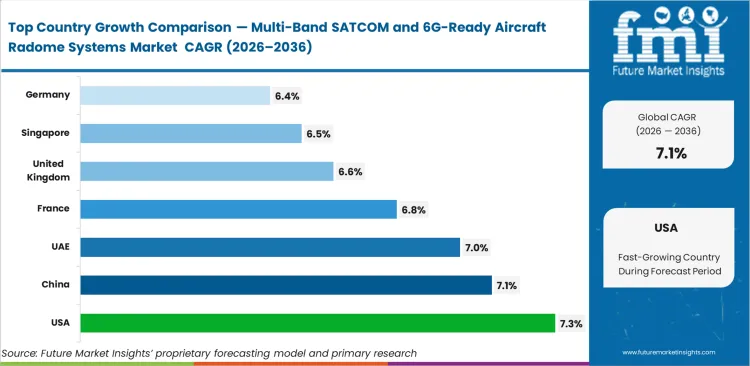
The USA multi‑band SATCOM and 6G‑ready aircraft radome systems market is projected to grow at a 7.3% CAGR through 2036, driven by extensive business‑jet retrofit activity. China is forecast to expand at 7.1% as widebody transit‑hub operations prioritize high‑capacity connectivity, while the UAE follows at 7.0% amid long‑haul fleet standardization. France is expected to record 6.8% growth, supported by strong aerospace manufacturing. The UK and Singapore are set to post 6.6% and 6.5% CAGRs respectively, with Germany advancing at 6.4%, reflecting compliance‑led adoption patterns.
Segmental Analysis
Multi-Band SATCOM and 6G-Ready Aircraft Radome Systems Market Analysis by Band Architecture
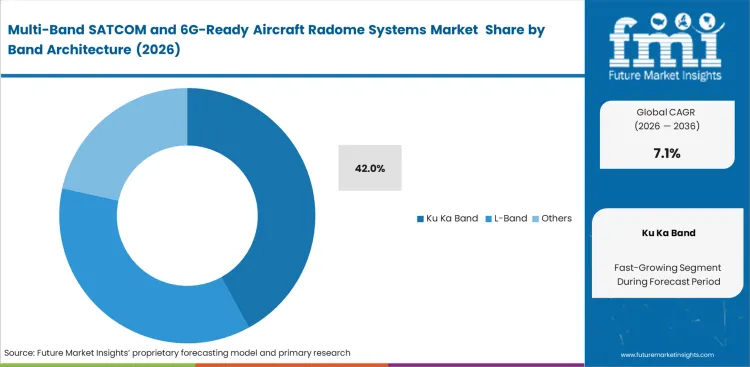
Seamless network roaming requires aircraft to switch between different orbital constellations dynamically. Fleet modernization directors prioritize hybrid systems to guarantee continuity. Analyzing hybrid ku ka vs single-band satcom radome economics shows airlines choosing single-band aircraft antenna fairing systems face expensive future overhauls when roaming agreements change. The ku ka band aircraft radome segment is expected to hold 42.0% revenue share in 2026. This sustained market position is supported by operational necessity to prevent coverage dropouts during long-haul transoceanic flights, and ability to eliminate duplicate aerodynamic drag penalties by integrating two frequencies into one enclosure.
- Cost-benefit realization: Integrating two frequencies into one enclosure eliminates duplicate aerodynamic drag penalties over the lifetime of the airframe. Fleet procurement heads avoid buying secondary hardware systems, significantly lowering the total cost of ownership while maximizing operational redundancy.
- Thermal degradation risk: Dual-band transceivers trapped under unventilated covers overheat rapidly under direct high-altitude solar radiation. Maintenance directors face sudden equipment shutdowns mid-flight unless cooling pathways function flawlessly and dissipate active heat loads consistently.
- Lifecycle efficiency: Roaming flexibility keeps hybrid systems viable for decades without requiring mid-life upgrades. Airline finance officers avoid early depreciation write-offs associated with obsolete single-band technology, ensuring the initial capital expenditure delivers maximum long-term value.
Multi-Band SATCOM and 6G-Ready Aircraft Radome Systems Market Analysis by Installation Zone
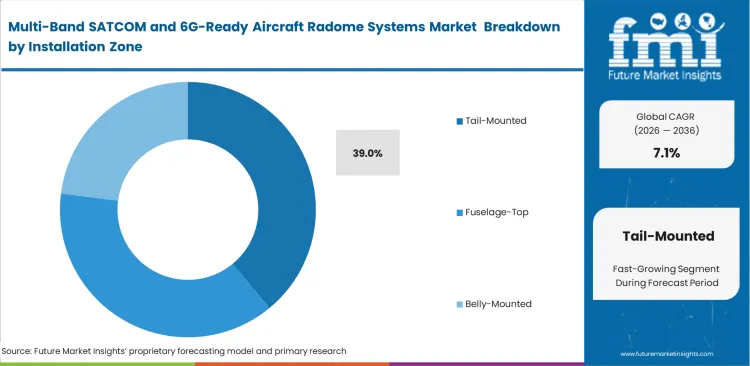
Mounting external hardware directly onto business jet vertical stabilizers minimizes airflow disruption over the main lifting body. The tail-mounted satcom radome segment is likely to secure 39.0% revenue share in 2026. This dominant allocation is driven by fuel-saving mandate to keep the primary fuselage completely clear of parasitic aerodynamic drag, and critical need to protect delicate aircraft nose and belly fairing systems from runway debris strikes. Adding weight to vertical stabilizers alters aircraft center-of-gravity calculations drastically. According to FMI's estimates, achieving perfect aerodynamic balance requires offsetting radome mass with heavy counterweights in forward fuselage zones. Airlines delaying tail-mount analyses face cascading recertification delays.
- Initial placement logic: Elevating hardware above fuselage curvature prevents signal blockage from wings during complex flight operations. Chief pilots maintain continuous line-of-sight connectivity during steep banking maneuvers, ensuring corporate executives never lose video conference links mid-flight.
- Vibration fatigue: Vertical stabilizers experience intense harmonic vibrations during severe weather turbulence and high-speed cruise phases. Structural engineering leads must specify heavily reinforced composite bases to prevent dangerous micro-fractures from propagating through the tail assembly.
- Routine serviceability: Accessing tail peaks requires specialized maintenance scaffolding and certified ramp personnel. Ramp operations managers face prolonged turnaround times if internal components require frequent physical inspection, making equipment reliability the paramount selection criterion.
Multi-Band SATCOM and 6G-Ready Aircraft Radome Systems Market Analysis by Aircraft Type
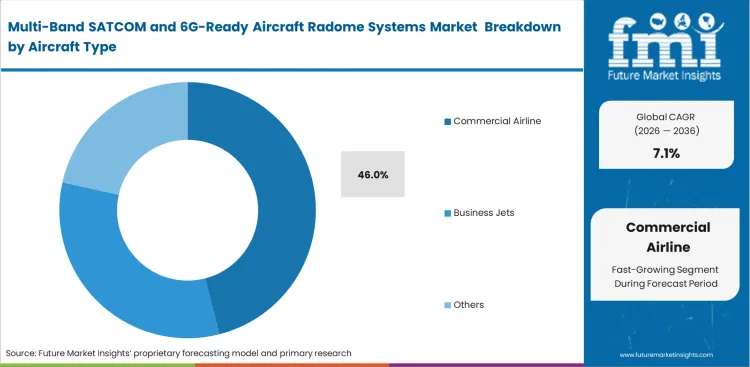
Providing broadband access to hundreds of passengers simultaneously demands massive data throughput capabilities across the fleet. In-flight entertainment directors push for reliable antenna transducer and radome installations to support dense streaming environments. Carriers offering subpar Wi-Fi lose lucrative business travelers to better-connected rivals. The commercial airline satcom radome systems segment is predicted to account for 46.0% share in 2026, fueled by the large scale of the active global commercial passenger fleet requiring immediate connectivity retrofits, and intense competitive pressure among legacy carriers to match low-cost carrier inflight entertainment offerings.
- Passenger density logic: High passenger counts justify expensive hardware investments quickly by distributing the capital cost across thousands of ticketed seats. Revenue strategy officers recoup installation costs rapidly through tiered internet subscription models and targeted inflight advertising portals.
- Certification complexity: Commercial airliners operate under extremely strict safety margins dictated by international regulatory bodies. Compliance officers struggle to push novel composite shapes through rigorous FAA approval cycles, forcing reliance on pre-certified blueprints to avoid grounding fleets.
- Fleet standardization: Standardizing connectivity hardware across diverse aircraft models lowers training costs for maintenance crews. Airline maintenance directors streamline inventory by utilizing universal mounting templates, ensuring spare parts remain interchangeable between different widebody and narrowbody airframes.
Multi-Band SATCOM and 6G-Ready Aircraft Radome Systems Market Analysis by End Use
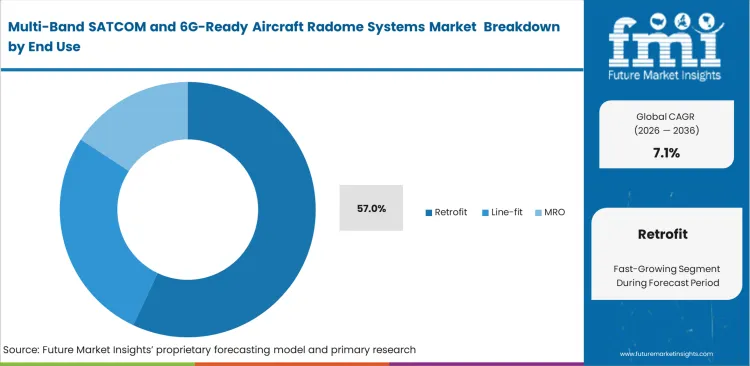
Upgrading active aircraft fleets dominates current spending patterns across the aerospace sector. Airline operations vice presidents utilize heavy maintenance checks to install modern aircraft radome impact detection systems alongside new broadband antennas. Delaying these scheduled upgrades forces aircraft back into hangars for costly dedicated installation windows later. The retrofit aircraft satcom radome segment is likely to account for 57.0% share in 2026, propelled by thousands of outdated airframes currently flying with obsolete narrowband communications hardware, and reluctance of airlines to retire structurally sound aircraft simply for connectivity upgrades. FMI's analysis indicates leasing companies forbid permanent modifications without complex engineering approvals. Carriers operating leased fleets face intense bureaucratic friction before cutting a single hole in their aluminum skin.
- Downtime synchronization: Performing upgrades during mandated heavy maintenance saves money by overlapping required labor hours. Hangar facility managers aggressively avoid pulling aircraft out of active revenue service purely for connectivity work, preferring to execute modifications when the cabin interior is already removed.
- Leaseholder resistance: Aircraft owners demand meticulous stress analyses before authorizing any hull penetrations. Airline legal teams spend months negotiating modification rights, ensuring the residual value of the leased asset is not compromised by third-party radome installations.
- Long-term transition: As modern aircraft leave factories with built-in broadband, retrofit dominance could slowly fade over the next two decades. Capital planning directors must shift budgets toward software upgrades rather than physical hardware as line-fit installations eventually saturate the global fleet.
Multi-Band SATCOM and 6G-Ready Aircraft Radome Systems Market Analysis by Material
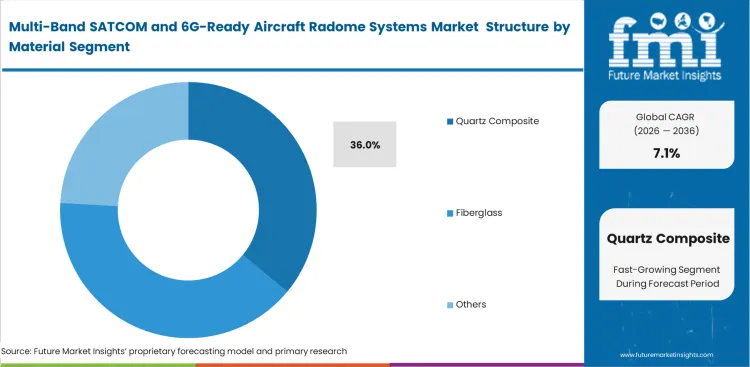
High-frequency Ku and Ka signals degrade rapidly when passing through dense barriers, demanding specialized composite engineering. The quartz composite radome aircraft segment is estimated to account for 36.0% share in 2026. This material leadership is driven by the near-perfect radio transparency quartz provides for multi-orbit signals, and extreme rigidity required to survive high-altitude bird strikes. Manufacturers choosing cheaper fiberglass alternatives discover their satcom on the move terminals cannot maintain lock on distant satellites. Weaving quartz fibers requires specialized tooling that wears out rapidly compared to standard carbon-fiber looms.
- Signal preservation: Quartz substrates minimize electromagnetic interference perfectly, ensuring maximum signal-to-noise ratios. Connectivity architects guarantee maximum bandwidth delivery to internal cabin routers, avoiding the expensive hardware re-tuning required when inferior composite matrices block critical uplink frequencies.
- Tooling degradation: Abrasive quartz fibers destroy cutting tools quickly, severely bottlenecking factory output speeds. Manufacturing plant managers must replace expensive precision drill bits after producing only a few units, keeping the final component cost structurally high despite rising production volumes.
- Standardization ceiling: High raw material costs prevent quartz from monopolizing every single aviation segment. Procurement officers relegate expensive quartz strictly to high-value broadband applications, opting for cheaper fiberglass blends on localized telemetry antennas where minor signal loss remains operationally acceptable.
Multi-Band SATCOM and 6G-Ready Aircraft Radome Systems Market Drivers, Restraints, and Opportunities
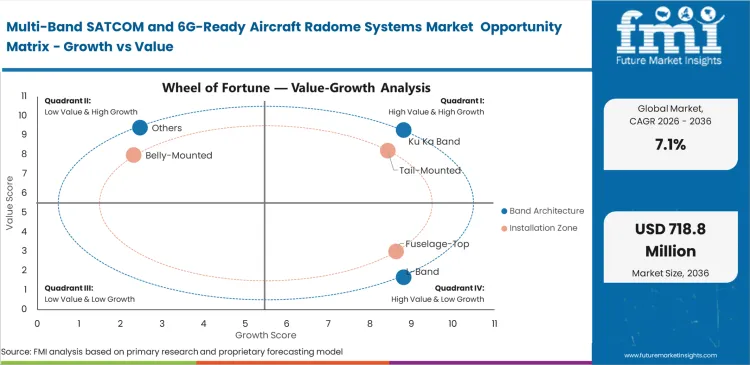
Airlines face growing pressure to upgrade onboard connectivity as passenger expectations move closer to ground-like broadband performance. FMI’s view is that carriers risk losing premium and corporate travelers when inflight systems cannot support stable video, cloud access, and high-capacity collaboration tools. That pressure is pushing fleet planners toward multi-orbit architectures that can shift traffic across GEO, MEO, and LEO capacity rather than relying on a single satellite layer. Airbus has already positioned multi-orbit connectivity as a practical path for airline flexibility, while broader aviation and telecom policy work is also moving toward tighter integration between terrestrial and non-terrestrial networks, including future 6G environments. Demand for hybrid Ku/Ka radome platforms is rising because operators want wider coverage, lower latency, stronger route resilience, and better service continuity on dense global corridors.
Certification remains the main restraint on deployment speed. Novel radome geometries still require extensive proof of aerodynamic performance, structural integrity, and resistance to bird-strike events before regulators allow broad installation. FAA flight-test guidance and EASA bird-strike compliance material both make clear that physical validation across structures, systems, and flight performance remains central to approval, which limits the speed at which new radome-airframe combinations can move into service. Standardized modeling tools and broader supplemental type certificate strategies create a real opportunity here, because multi-airframe validation can reduce repeated engineering work, shorten grounding periods, and make 6G-ready radome retrofits more practical across large fleets.
Opportunities in the Market
- Ultra-low-profile integration: Developing flush-mounted composite windows allows stealthy satellite communications and direct to device rf test platforms connectivity. Military procurement officers gain secure broadband without sacrificing aerodynamic radar cross-sections.
- Active thermal materials: Embedding heat-dissipating nanomaterials into quartz shells solves dual-band overheating problems. Airline maintenance directors reduce component failure rates significantly.
- Universal adapter plates: Creating modular mounting skirts simplifies installation across diverse fuselages. MRO facility managers cut aircraft grounding times by standardizing their physical attachment procedures.
Regional Analysis
Based on regional analysis, the multi-band SATCOM and 6G-ready aircraft radome systems market is segmented into North America, Europe, Asia Pacific, Latin America, and Middle East & Africa, across 40 plus countries.
.webp "Top Country Growth Comparison Multi Band Satcom And 6g Ready Aircraft Radome Systems Market Cagr (2026 2036)")
| Country | CAGR (2026 to 2036) |
|---|---|
| United States | 7.3% |
| China | 7.1% |
| UAE | 7.0% |
| France | 6.8% |
| United Kingdom | 6.6% |
| Singapore | 6.5% |
| Germany | 6.4% |
Source: Future Market Insights (FMI) analysis, based on proprietary forecasting model and primary research
North America Multi-Band SATCOM and 6G-Ready Aircraft Radome Systems Market Analysis
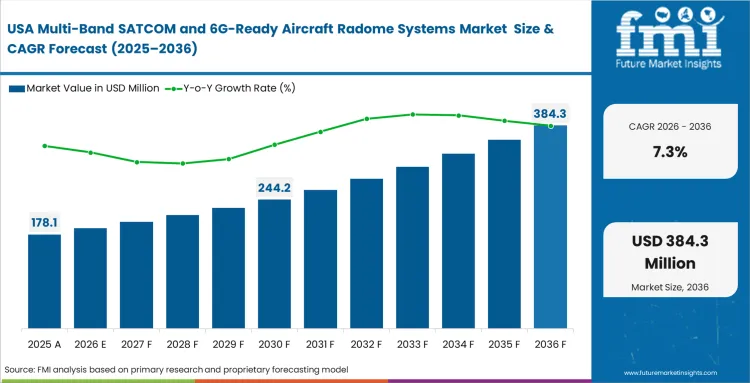
Extensive corporate modernization programs define current adoption patterns across North American airspace. Corporate aviation directors face intense pressure to accelerate business jet satcom radome upgrades to match commercial airline connectivity speeds on smaller airframes. This reality forces rapid procurement of customized tail-mounted enclosures designed explicitly for compact jets. Dense regional satellite coverage allows aggressive experimentation with low-profile phased array antennas, pushing composite engineers to refine multi-band transparency across shallower radome profiles.
- United States: The United States multi-band SATCOM and 6G-ready aircraft radome systems industry is projected to rise at a 7.3% CAGR during the forecast period. Expansion is driven by massive defense aviation budgets demanding stealthy broadband connectivity and rapid transition of major domestic passenger airlines from Ku to Ka band networks. Another factor is high concentration of specialized MRO facilities capable of executing complex composite retrofits efficiently. Deep defense aviation budgets and massive corporate jet fleets guarantee sustained retrofit volume. MRO facility managers process continuous streams of broadband upgrades. Securing these massive airline contracts dictates which composite manufacturers survive next decade's consolidation phase.
FMI's report includes Canada. Cross-border roaming agreements push regional carriers to match United States hardware standards.
Asia Pacific Multi-Band SATCOM and 6G-Ready Aircraft Radome Systems Market Analysis
Explosive widebody fleet expansion fundamentally shapes Asia Pacific aerospace hardware procurement. Airline executives focus heavily on optimizing twin-aisle aircraft for lucrative long-haul international routes bridging Asia and Western markets. Thick adapter plates dominate regional orders to accommodate massive electronically steered arrays capable of processing dense passenger data loads. These bulky installations highlight a regional preference for maximum bandwidth capability over pure aerodynamic efficiency, prioritizing inflight service revenue above minor fuel savings.
- China: High state-backed fleet expansions focus primarily on high-capacity long-haul aircraft requiring robust connectivity. Airline procurement heads prioritize multi-orbit readiness to bypass congested regional communication networks effectively. Integrating these large systems successfully forces domestic maintenance crews to rapidly upgrade their composite handling skills. China is projected to incline at a 7.1% CAGR during the forecast period. This growth is driven by high state-backed investments in widebody commercial aircraft modernization, and sheer scale of the domestic passenger market demanding uninterrupted connectivity over vast geographies. Strategic push by regional airlines to bypass congested terrestrial communication networks, and rapid upskilling of domestic maintenance crews to handle advanced composite installations are also driving market revenue growth.
- Singapore: Dense long-haul transit operations require seamless internet connectivity over vast oceanic distances. Airline strategy officers invest heavily in dual-band hardware to prevent coverage dropouts during transpacific crossings. Perfecting these tropical-weather-resistant installations positions local MRO hubs as leaders in maritime-environment aircraft modifications. Sales in Singapore is projected to expand at a 6.5% CAGR during the forecast period, propelled by absolute necessity of seamless Internet connectivity during long-haul transpacific crossings. Also, the heavy capital investments by airline strategy officers in dual-band hardware to eliminate coverage dropouts over vast oceanic distances further propel the sector growth.
FMI's report includes Australia, India, Japan and South Korea. Dense island-hopping routes require systems capable of managing constant handoffs between different satellite spot beams.
Middle East and Africa Multi-Band SATCOM and 6G-Ready Aircraft Radome Systems Market Analysis
Global transit hubs dictate hardware requirements across Middle Eastern fleets. Premium carrier operations vice presidents demand absolute connectivity perfection to satisfy ultra-high-net-worth passengers on 16-hour transcontinental flights. Extreme temperature fluctuations between desert tarmacs and cruising altitudes mandate highly specialized thermal radome engineering. Enclosures failing to dissipate ground heat properly melt internal antenna components before takeoff, forcing regional operators to demand uncompromising material specifications.
- UAE: Premium global carriers standardize ultra-high-speed internet across vast international fleets. UAE industry is estimated to incline at a 7.0% CAGR during the forecast period. This growth is sustained by fierce competition among premium global carriers to offer the fastest inflight internet on intercontinental routes, and implementation of standardization of hybrid Ku/Ka hardware across vast widebody fleets. Requirements for radomes capable of surviving intense desert tarmac heat loads without degradation, and strategic positioning of local MRO hubs securing exclusive STC approvals for these custom thermal enclosures are also driving market growth.
FMI's report includes Saudi Arabia and South Africa. Emerging long-haul carriers copy UAE procurement strategies to remain competitive on premium passenger metrics.
Western Europe Multi-Band SATCOM and 6G-Ready Aircraft Radome Systems Market Analysis
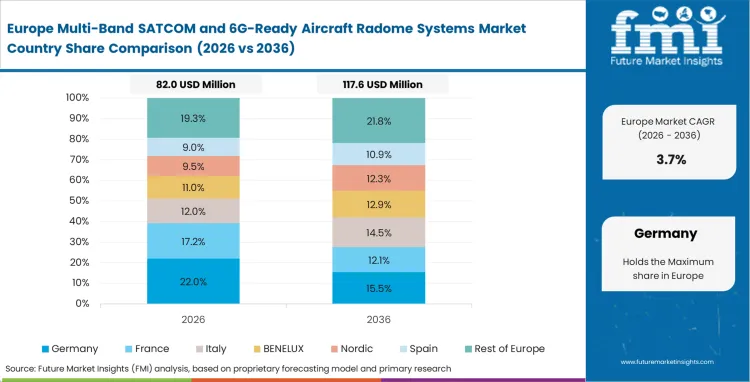
Stringent environmental regulations compel European aerospace manufacturers to prioritize absolute aerodynamic efficiency across the continent. Engineering chiefs scrutinize every parasitic drag coefficient before authorizing exterior modifications to ensure compliance with aggressive fuel-burn reduction targets. Regional airlines sacrifice peak bandwidth capacity to install smaller, more streamlined enclosures. This relentless focus on fuel economy dictates slower, highly precise STC certification cycles overseen by demanding regional aviation authorities.
- France: France market revenue is estimated to incline at a 6.8% CAGR during the forecast period. This growth is driven by heavy concentration of tier-one aerospace manufacturing facilities anchoring localized radome innovation, and pioneering work of local composite engineers developing ultra-lightweight cyanate ester blends. High volume of line-fit installations occurring directly on OEM factory floors, and successful export of these highly optimized composite structures to global airlines are also driving market growth. Rigorous domestic aerospace manufacturing output anchors local radome innovation. Lead composite engineers pioneer novel cyanate ester blends to achieve maximum strength with minimal weight. Perfecting these lightweight structures allows local suppliers to export their composite technology globally.
- United Kingdom: Extensive satellite communications expertise drives continuous hardware refinement. Navigating complex post-Brexit aviation certifications slows initial deployment but ensures bulletproof safety data. The United Kingdom revenue is projected to expand at a 6.6% CAGR during the forecast period. This growth is due to the country's extensive legacy expertise in advanced satellite communications engineering, and mandatory requirement for new fleet additions to support multi-network aircraft interface device compatibility. The meticulous execution of post-Brexit aviation certifications ensuring bulletproof safety data, and the continuous refinement of low-drag hardware by local design bureaus are also driving revenue growth.
- Germany: Deep materials science capabilities push local manufacturers toward advanced quartz applications. Precision manufacturing managers optimize complex tooling pathways for high-volume radome production. Achieving flawless factory yield rates on quartz composites determines long-term profitability. Germany is projected to register a 6.4% CAGR during the forecast period. Expansion is fueled by deep national capabilities in advanced materials science, and optimization of complex tooling pathways for high-volume radome production. The strict adherence to compliance-driven airline upgrade cycles, and relentless focus by precision manufacturing managers on achieving flawless factory yield rates for expensive quartz composites are other key driving factors.
FMI's report includes Italy and Spain. Regional operators balance tight capital constraints against escalating passenger demands for basic in-flight messaging.
Competitive Aligners for Market Players
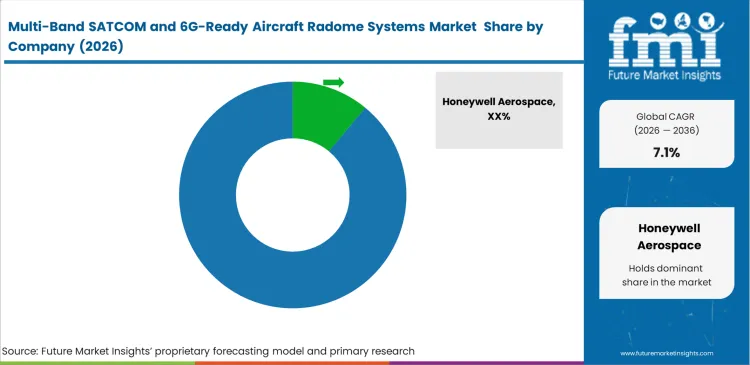
Executing successful aircraft satcom radome procurement relies heavily on certification barriers rather than pure manufacturing capacity. Producing a flawless composite shell matters little if aviation authorities refuse to issue an STC for its installation. Companies controlling vast libraries of pre-approved flight test data dominate procurement discussions because they guarantee airlines rapid deployment. Honeywell Aerospace commands 18.0% share because its JetWave X ecosystem combines multi-network connectivity with deep regulatory clearance history across multiple airframes. Astronics Corporation and ThinKom Solutions leverage their established aircraft sensor pod mounting structures expertise to streamline complicated integration pathways.
Established aircraft satcom radome manufacturers possess deep relationships with airframe builders, securing lucrative line-fit catalog placements. Getting a radome listed as standard factory equipment requires years of joint engineering studies. Viasat and Safran Passenger Innovations embed their engineers directly into aircraft design teams early, ensuring future fuselages accommodate their specific hardware dimensions. Challengers must build identical engineering credibility from scratch, a process taking decades. Supplying replacement enclosures for legacy fleets offers new aircraft satcom radome suppliers a foothold, but breaking into original equipment catalogs remains intensely difficult.
Major commercial airlines resist vendor lock-in by demanding modularity from their supply chain. When buyers request quote aircraft satcom radome pricing, they force manufacturers to design universal adapter plates capable of holding equipment from competing satellite networks. If Gilat Satellite Networks or Collins Aerospace attempt to force proprietary mounting hardware, carriers simply disqualify them from bidding. Maintaining open-architecture physical interfaces dictates which aircraft satcom radome companies survive brutal airline contract negotiations.
Key Players in Multi-Band SATCOM and 6G-Ready Aircraft Radome Systems Market
- Honeywell Aerospace
- Astronics Corporation
- ThinKom Solutions
- Viasat, Inc.
- Gilat Satellite Networks
- Safran Passenger Innovations
- Collins Aerospace
Scope of the Report
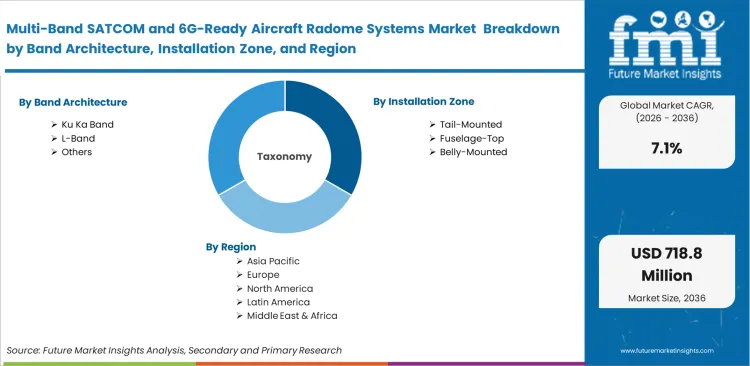
| Metric | Value |
|---|---|
| Quantitative Units | USD 338.0 million to USD 671.1 million, at a CAGR of 7.1% |
| Market Definition | External aerodynamic composite enclosures protecting aviation broadband transceivers while ensuring multi-orbit radio-frequency transparency. |
| Segmentation | Band Architecture, Installation Zone, Aircraft Type, End Use, Material, Region |
| Regions Covered | North America, Latin America, Western Europe, Eastern Europe, South Asia and Pacific, East Asia, Middle East and Africa |
| Countries Covered | United States, Canada, Brazil, Mexico, Germany, United Kingdom, France, Italy, Spain, Russia, Poland, China, Japan, South Korea, India, Thailand, Indonesia, Malaysia, Singapore, Australia, New Zealand, Turkiye, South Africa, GCC Countries |
| Key Companies Profiled | Honeywell Aerospace, Astronics Corporation, ThinKom Solutions, Viasat, Inc., Gilat Satellite Networks, Safran Passenger Innovations, Collins Aerospace |
| Forecast Period | 2026 to 2036 |
| Approach | Certified STC installation counts anchored baseline volumetric models. |
Source: Future Market Insights (FMI) analysis, based on proprietary forecasting model and primary research
Multi-Band SATCOM and 6G-Ready Aircraft Radome Systems Market Analysis by Segments
By Band Architecture
- Ku/Ka Hybrid
- Ka-band
- Ku-band
- L-band
By Installation Zone
- Tail-mounted
- Fuselage-top
- Belly-mounted
- Fin-mounted
By Aircraft Type
- Commercial Transport
- Business Jets
- Defense Aircraft
- Special Mission
By End Use
- Retrofit
- Line-fit
- MRO
- Upgrade Kits
By Material
- Quartz Composites
- Fiberglass
- Kevlar Composites
- Cyanate Ester
Region
- North America
- United States
- Canada
- Europe
- Germany
- United Kingdom
- France
- Italy
- Spain
- Asia Pacific
- China
- Japan
- South Korea
- Taiwan
- Singapore
- Latin America
- Brazil
- Mexico
- Argentina
- Middle East & Africa
- GCC Countries
- South Africa
- Israel
- Rest of Middle East & Africa
Bibliography
- USA Government Publishing Office. (2024, October). 47 CFR Part 25-Satellite communications.
- Wang, F., Zhang, S., Yang, H., & Quek, T. Q. S. (2025, November). Non-terrestrial networking for 6G: Evolution, opportunities, and future directions. Engineering, 54(11), 56-68. DOI: 10.1016/j.eng.2025.05.013.
- Yang, J., Pang, Y., Cai, G., Wang, J., Li, Y., Zheng, H., & Xu, Z. (2025, July). Integrated design, modeling, and manufacturing of rasorber radome composites with electrically tunable transmission and wideband absorption properties. Composites Part B: Engineering, 300, 112467. DOI: 10.1016/j.compositesb.2025.112467.
- Khichi, S. A., Bhutto, A. W., Maitlo, I., & Chandio, A. D. (2025, August). Processing and characterization of aerospace composites for advanced radome applications. ACS Omega, 10(32). DOI: 10.1021/acsomega.5c04792.
- Yang, J., Pang, Y., Wang, J., Li, Y., & Xu, Z. (2025, October). Absorption-transmission-integrated radome composites: Design, modeling, and fabrication. Composites Science and Technology, 271, 111332. DOI: 10.1016/j.compscitech.2025.111332.
This bibliography is provided for reader reference and is not exhaustive. The full report contains the complete reference list and detailed citations.
This Report Addresses
- Thermal management engineering required for dual-band Ku/Ka hybrid transceivers.
- Specific certification bottlenecks affecting tail-mounted business jet installations.
- Commercial airliner adapter plate aerodynamics and parasitic drag consequences.
- Leaseholder legal constraints blocking rapid retrofit connectivity upgrades.
- Specialized tooling degradation rates during quartz composite manufacturing.
- Widebody twin-aisle transit hub procurement dynamics in East Asia.
- Open-architecture mounting demands from major airline purchasing directors.
- Regulatory flight-test data requirements for novel aircraft shapes.
Frequently Asked Questions
What is an aircraft SATCOM radome system?
External aerodynamic composite enclosures protecting aviation broadband transceivers fall under this definition. They ensure physical environmental survivability while maintaining radio-frequency transparency for critical multi-orbit connectivity across commercial and defense fleets within the multi-band SATCOM and 6G-ready aircraft radome systems market.
How big is the aircraft SATCOM radome market in 2026?
Revenue sits at USD 338.0 million for 2026. This quantitative anchor reflects accelerating STC approvals for multi-orbit broadband hardware across active global passenger fleets.
Why are airlines upgrading to multi-band radome systems?
Evaluating hybrid ku ka vs single-band satcom radome hardware reveals dual-frequency flexibility prevents coverage dropouts during transoceanic flights. Airlines satisfy passenger demands for uninterrupted streaming across fragmented regional satellite networks.
What makes an aircraft radome 6G-ready?
Readiness means enclosures possess adequate bandwidth transparency for future non-terrestrial spectrums. Replacing hardware purely for software protocol updates destroys airline capital efficiency, making forward compatibility essential.
Which companies supply aircraft SATCOM radomes today?
Honeywell Aerospace, Astronics Corporation, ThinKom Solutions, Viasat, and Collins Aerospace dominate procurement. Ascertaining who are the top suppliers in aircraft satcom radome systems depends heavily on pre-approved STC libraries and existing line-fit catalog placements.
Why do tail-mounted radomes matter in business aviation?
Mounting hardware on vertical stabilizers keeps sensitive equipment clear of runway debris while minimizing fuel-burning aerodynamic disruption. This configuration remains vital for corporate jets demanding airline-grade internet connectivity.
How do Ku/Ka hybrid radomes compare with single-band systems?
Hybrid systems capture 42.0% share by enabling seamless orbital roaming. Dual-band flexibility prevents costly future hardware overhauls when regional roaming agreements shift between different communication network providers.
Is retrofit demand larger than linefit demand in this market?
Authorizing retrofit installations secures 57.0% share because thousands of flying jets carry obsolete narrowband communications hardware. Major airlines synchronize these upgrades alongside scheduled heavy maintenance checks to minimize hangar downtime.
Which countries are growing fastest in aircraft SATCOM radomes?
United States leads at 7.3% CAGR, followed closely by China at 7.1% and UAE at 7.0%. These regions prioritize corporate jet retrofits, widebody twin-aisle fleet expansions, and ultra-high-speed internet on global transit routes.
What materials are used in advanced SATCOM radomes?
Manufacturers weave quartz composites, fiberglass, Kevlar composites, and cyanate ester blends. Quartz controls premium installations due to its near-perfect radio transparency, preventing signal attenuation during critical non-terrestrial network uplinks.
How is 6G NTN affecting aircraft radome demand?
Transitioning toward non-terrestrial 5G networks pushes fleet modernization directors to install hardware capable of handling future spectrum allocations immediately. Delaying this transition cedes premium ticket sales to competitors offering flawless streaming capabilities.
How does evaluating mechanically steered vs electronically steered aircraft satcom impact radome design?
Smaller electronic units require highly specific composite tuning to prevent signal degradation at shallow orbital scan angles. Material science complexity drives unit costs higher even as physical transceiver footprints shrink.
What are the primary aircraft radome certification requirements?
Aviation authorities demand unique flight-test data for every specific radome-and-airframe combination. Aerospace certification engineers struggle to prove new radome geometries meet stringent bird-strike survivability metrics before securing STC clearance.
How does a buyer request quote aircraft satcom radome pricing effectively?
Airline procurement heads force manufacturers to design universal adapter plates capable of holding equipment from competing satellite networks. Maintaining open-architecture physical interfaces dictates which suppliers survive brutal airline contract negotiations.
What drives business jet satcom radome upgrades?
Corporate aviation directors face intense pressure to match commercial airline connectivity speeds on smaller airframes. This reality forces rapid procurement of customized tail-mounted enclosures designed explicitly for compact jet aerodynamics.
How do commercial airline satcom radome systems differ from defense variants?
Commercial carriers optimize for massive passenger data throughput via bulky adapter plates. Military procurement officers demand ultra-low-profile flush-mounted composite windows to gain secure broadband without sacrificing aerodynamic radar cross-sections.
What dictates the United States aircraft satcom radome market trajectory?
Deep defense aviation budgets and massive corporate jet fleets guarantee sustained retrofit volume. MRO facility managers process continuous streams of broadband upgrades as major domestic airlines complete fleet-wide Ku-to-Ka band transitions.
Why is the China aircraft satcom radome market expanding rapidly?
Massive state-backed fleet expansions focus primarily on high-capacity long-haul aircraft requiring robust connectivity. Airline procurement heads prioritize multi-orbit readiness to bypass congested regional communication networks effectively.
What defines successful aircraft satcom radome procurement?
Executing successful hardware procurement relies heavily on certification barriers rather than pure manufacturing capacity. Companies controlling vast libraries of pre-approved flight test data dominate discussions because they guarantee airlines rapid deployment.
Which metrics determine aircraft satcom radome market share?
Incumbents maintain control by leveraging established relationships with airframe builders, securing lucrative line-fit catalog placements. Getting a radome listed as standard factory equipment requires decades of joint engineering studies.
Preview the report firsthand - request a free sample
Get SampleGet the brochure for pricing and purchase details.
Get PDFTable of Content
- Executive Summary
- Global Market Outlook
- Demand-side Trends
- Supply-side Trends
- Technology Roadmap Analysis
- Analysis and Recommendations
- Market Overview
- Market Coverage / Taxonomy
- Market Definition / Scope / Limitations
- Research Methodology
- Chapter Orientation
- Analytical Lens and Working Hypotheses
- Market Structure, Signals, and Trend Drivers
- Benchmarking and Cross-market Comparability
- Market Sizing, Forecasting, and Opportunity Mapping
- Research Design and Evidence Framework
- Desk Research Programme (Secondary Evidence)
- Company Annual and Sustainability Reports
- Peer-reviewed Journals and Academic Literature
- Corporate Websites, Product Literature, and Technical Notes
- Earnings Decks and Investor Briefings
- Statutory Filings and Regulatory Disclosures
- Technical White Papers and Standards Notes
- Trade Journals, Industry Magazines, and Analyst Briefs
- Conference Proceedings, Webinars, and Seminar Materials
- Government Statistics Portals and Public Data Releases
- Press Releases and Reputable Media Coverage
- Specialist Newsletters and Curated Briefings
- Sector Databases and Reference Repositories
- FMI Internal Proprietary Databases and Historical Market Datasets
- Subscription Datasets and Paid Sources
- Social Channels, Communities, and Digital Listening Inputs
- Additional Desk Sources
- Expert Input and Fieldwork (Primary Evidence)
- Primary Modes
- Qualitative Interviews and Expert Elicitation
- Quantitative Surveys and Structured Data Capture
- Blended Approach
- Why Primary Evidence is Used
- Field Techniques
- Interviews
- Surveys
- Focus Groups
- Observational and In-context Research
- Social and Community Interactions
- Stakeholder Universe Engaged
- C-suite Leaders
- Board Members
- Presidents and Vice Presidents
- R&D and Innovation Heads
- Technical Specialists
- Domain Subject-matter Experts
- Scientists
- Physicians and Other Healthcare Professionals
- Governance, Ethics, and Data Stewardship
- Research Ethics
- Data Integrity and Handling
- Primary Modes
- Tooling, Models, and Reference Databases
- Desk Research Programme (Secondary Evidence)
- Data Engineering and Model Build
- Data Acquisition and Ingestion
- Cleaning, Normalisation, and Verification
- Synthesis, Triangulation, and Analysis
- Quality Assurance and Audit Trail
- Market Background
- Market Dynamics
- Drivers
- Restraints
- Opportunity
- Trends
- Scenario Forecast
- Demand in Optimistic Scenario
- Demand in Likely Scenario
- Demand in Conservative Scenario
- Opportunity Map Analysis
- Product Life Cycle Analysis
- Supply Chain Analysis
- Investment Feasibility Matrix
- Value Chain Analysis
- PESTLE and Porter’s Analysis
- Regulatory Landscape
- Regional Parent Market Outlook
- Production and Consumption Statistics
- Import and Export Statistics
- Market Dynamics
- Global Market Analysis 2021 to 2025 and Forecast, 2026 to 2036
- Historical Market Size Value (USD Million) Analysis, 2021 to 2025
- Current and Future Market Size Value (USD Million) Projections, 2026 to 2036
- Y-o-Y Growth Trend Analysis
- Absolute $ Opportunity Analysis
- Global Market Pricing Analysis 2021 to 2025 and Forecast 2026 to 2036
- Global Market Analysis 2021 to 2025 and Forecast 2026 to 2036, By Band Architecture
- Introduction / Key Findings
- Historical Market Size Value (USD Million) Analysis By Band Architecture , 2021 to 2025
- Current and Future Market Size Value (USD Million) Analysis and Forecast By Band Architecture , 2026 to 2036
- Ku Ka Band
- L-Band
- Others
- Ku Ka Band
- Y-o-Y Growth Trend Analysis By Band Architecture , 2021 to 2025
- Absolute $ Opportunity Analysis By Band Architecture , 2026 to 2036
- Global Market Analysis 2021 to 2025 and Forecast 2026 to 2036, By Installation Zone
- Introduction / Key Findings
- Historical Market Size Value (USD Million) Analysis By Installation Zone, 2021 to 2025
- Current and Future Market Size Value (USD Million) Analysis and Forecast By Installation Zone, 2026 to 2036
- Tail-Mounted
- Fuselage-Top
- Belly-Mounted
- Tail-Mounted
- Y-o-Y Growth Trend Analysis By Installation Zone, 2021 to 2025
- Absolute $ Opportunity Analysis By Installation Zone, 2026 to 2036
- Global Market Analysis 2021 to 2025 and Forecast 2026 to 2036, By Aircraft Type
- Introduction / Key Findings
- Historical Market Size Value (USD Million) Analysis By Aircraft Type, 2021 to 2025
- Current and Future Market Size Value (USD Million) Analysis and Forecast By Aircraft Type, 2026 to 2036
- Commercial Airline
- Business Jets
- Others
- Commercial Airline
- Y-o-Y Growth Trend Analysis By Aircraft Type, 2021 to 2025
- Absolute $ Opportunity Analysis By Aircraft Type, 2026 to 2036
- Global Market Analysis 2021 to 2025 and Forecast 2026 to 2036, By End Use
- Introduction / Key Findings
- Historical Market Size Value (USD Million) Analysis By End Use, 2021 to 2025
- Current and Future Market Size Value (USD Million) Analysis and Forecast By End Use, 2026 to 2036
- Retrofit
- Line-fit
- MRO
- Retrofit
- Y-o-Y Growth Trend Analysis By End Use, 2021 to 2025
- Absolute $ Opportunity Analysis By End Use, 2026 to 2036
- Global Market Analysis 2021 to 2025 and Forecast 2026 to 2036, By Material
- Introduction / Key Findings
- Historical Market Size Value (USD Million) Analysis By Material, 2021 to 2025
- Current and Future Market Size Value (USD Million) Analysis and Forecast By Material, 2026 to 2036
- Quartz Composite
- Fiberglass
- Others
- Quartz Composite
- Y-o-Y Growth Trend Analysis By Material, 2021 to 2025
- Absolute $ Opportunity Analysis By Material, 2026 to 2036
- Global Market Analysis 2021 to 2025 and Forecast 2026 to 2036, By Region
- Introduction
- Historical Market Size Value (USD Million) Analysis By Region, 2021 to 2025
- Current Market Size Value (USD Million) Analysis and Forecast By Region, 2026 to 2036
- North America
- Latin America
- Western Europe
- Eastern Europe
- East Asia
- South Asia and Pacific
- Middle East & Africa
- Market Attractiveness Analysis By Region
- North America Market Analysis 2021 to 2025 and Forecast 2026 to 2036, By Country
- Historical Market Size Value (USD Million) Trend Analysis By Market Taxonomy, 2021 to 2025
- Market Size Value (USD Million) Forecast By Market Taxonomy, 2026 to 2036
- By Country
- USA
- Canada
- Mexico
- By Band Architecture
- By Installation Zone
- By Aircraft Type
- By End Use
- By Material
- By Country
- Market Attractiveness Analysis
- By Country
- By Band Architecture
- By Installation Zone
- By Aircraft Type
- By End Use
- By Material
- Key Takeaways
- Latin America Market Analysis 2021 to 2025 and Forecast 2026 to 2036, By Country
- Historical Market Size Value (USD Million) Trend Analysis By Market Taxonomy, 2021 to 2025
- Market Size Value (USD Million) Forecast By Market Taxonomy, 2026 to 2036
- By Country
- Brazil
- Chile
- Rest of Latin America
- By Band Architecture
- By Installation Zone
- By Aircraft Type
- By End Use
- By Material
- By Country
- Market Attractiveness Analysis
- By Country
- By Band Architecture
- By Installation Zone
- By Aircraft Type
- By End Use
- By Material
- Key Takeaways
- Western Europe Market Analysis 2021 to 2025 and Forecast 2026 to 2036, By Country
- Historical Market Size Value (USD Million) Trend Analysis By Market Taxonomy, 2021 to 2025
- Market Size Value (USD Million) Forecast By Market Taxonomy, 2026 to 2036
- By Country
- Germany
- UK
- Italy
- Spain
- France
- Nordic
- BENELUX
- Rest of Western Europe
- By Band Architecture
- By Installation Zone
- By Aircraft Type
- By End Use
- By Material
- By Country
- Market Attractiveness Analysis
- By Country
- By Band Architecture
- By Installation Zone
- By Aircraft Type
- By End Use
- By Material
- Key Takeaways
- Eastern Europe Market Analysis 2021 to 2025 and Forecast 2026 to 2036, By Country
- Historical Market Size Value (USD Million) Trend Analysis By Market Taxonomy, 2021 to 2025
- Market Size Value (USD Million) Forecast By Market Taxonomy, 2026 to 2036
- By Country
- Russia
- Poland
- Hungary
- Balkan & Baltic
- Rest of Eastern Europe
- By Band Architecture
- By Installation Zone
- By Aircraft Type
- By End Use
- By Material
- By Country
- Market Attractiveness Analysis
- By Country
- By Band Architecture
- By Installation Zone
- By Aircraft Type
- By End Use
- By Material
- Key Takeaways
- East Asia Market Analysis 2021 to 2025 and Forecast 2026 to 2036, By Country
- Historical Market Size Value (USD Million) Trend Analysis By Market Taxonomy, 2021 to 2025
- Market Size Value (USD Million) Forecast By Market Taxonomy, 2026 to 2036
- By Country
- China
- Japan
- South Korea
- By Band Architecture
- By Installation Zone
- By Aircraft Type
- By End Use
- By Material
- By Country
- Market Attractiveness Analysis
- By Country
- By Band Architecture
- By Installation Zone
- By Aircraft Type
- By End Use
- By Material
- Key Takeaways
- South Asia and Pacific Market Analysis 2021 to 2025 and Forecast 2026 to 2036, By Country
- Historical Market Size Value (USD Million) Trend Analysis By Market Taxonomy, 2021 to 2025
- Market Size Value (USD Million) Forecast By Market Taxonomy, 2026 to 2036
- By Country
- India
- ASEAN
- Australia & New Zealand
- Rest of South Asia and Pacific
- By Band Architecture
- By Installation Zone
- By Aircraft Type
- By End Use
- By Material
- By Country
- Market Attractiveness Analysis
- By Country
- By Band Architecture
- By Installation Zone
- By Aircraft Type
- By End Use
- By Material
- Key Takeaways
- Middle East & Africa Market Analysis 2021 to 2025 and Forecast 2026 to 2036, By Country
- Historical Market Size Value (USD Million) Trend Analysis By Market Taxonomy, 2021 to 2025
- Market Size Value (USD Million) Forecast By Market Taxonomy, 2026 to 2036
- By Country
- Kingdom of Saudi Arabia
- Other GCC Countries
- Turkiye
- South Africa
- Other African Union
- Rest of Middle East & Africa
- By Band Architecture
- By Installation Zone
- By Aircraft Type
- By End Use
- By Material
- By Country
- Market Attractiveness Analysis
- By Country
- By Band Architecture
- By Installation Zone
- By Aircraft Type
- By End Use
- By Material
- Key Takeaways
- Key Countries Market Analysis
- USA
- Pricing Analysis
- Market Share Analysis, 2025
- By Band Architecture
- By Installation Zone
- By Aircraft Type
- By End Use
- By Material
- Canada
- Pricing Analysis
- Market Share Analysis, 2025
- By Band Architecture
- By Installation Zone
- By Aircraft Type
- By End Use
- By Material
- Mexico
- Pricing Analysis
- Market Share Analysis, 2025
- By Band Architecture
- By Installation Zone
- By Aircraft Type
- By End Use
- By Material
- Brazil
- Pricing Analysis
- Market Share Analysis, 2025
- By Band Architecture
- By Installation Zone
- By Aircraft Type
- By End Use
- By Material
- Chile
- Pricing Analysis
- Market Share Analysis, 2025
- By Band Architecture
- By Installation Zone
- By Aircraft Type
- By End Use
- By Material
- Germany
- Pricing Analysis
- Market Share Analysis, 2025
- By Band Architecture
- By Installation Zone
- By Aircraft Type
- By End Use
- By Material
- UK
- Pricing Analysis
- Market Share Analysis, 2025
- By Band Architecture
- By Installation Zone
- By Aircraft Type
- By End Use
- By Material
- Italy
- Pricing Analysis
- Market Share Analysis, 2025
- By Band Architecture
- By Installation Zone
- By Aircraft Type
- By End Use
- By Material
- Spain
- Pricing Analysis
- Market Share Analysis, 2025
- By Band Architecture
- By Installation Zone
- By Aircraft Type
- By End Use
- By Material
- France
- Pricing Analysis
- Market Share Analysis, 2025
- By Band Architecture
- By Installation Zone
- By Aircraft Type
- By End Use
- By Material
- India
- Pricing Analysis
- Market Share Analysis, 2025
- By Band Architecture
- By Installation Zone
- By Aircraft Type
- By End Use
- By Material
- ASEAN
- Pricing Analysis
- Market Share Analysis, 2025
- By Band Architecture
- By Installation Zone
- By Aircraft Type
- By End Use
- By Material
- Australia & New Zealand
- Pricing Analysis
- Market Share Analysis, 2025
- By Band Architecture
- By Installation Zone
- By Aircraft Type
- By End Use
- By Material
- China
- Pricing Analysis
- Market Share Analysis, 2025
- By Band Architecture
- By Installation Zone
- By Aircraft Type
- By End Use
- By Material
- Japan
- Pricing Analysis
- Market Share Analysis, 2025
- By Band Architecture
- By Installation Zone
- By Aircraft Type
- By End Use
- By Material
- South Korea
- Pricing Analysis
- Market Share Analysis, 2025
- By Band Architecture
- By Installation Zone
- By Aircraft Type
- By End Use
- By Material
- Russia
- Pricing Analysis
- Market Share Analysis, 2025
- By Band Architecture
- By Installation Zone
- By Aircraft Type
- By End Use
- By Material
- Poland
- Pricing Analysis
- Market Share Analysis, 2025
- By Band Architecture
- By Installation Zone
- By Aircraft Type
- By End Use
- By Material
- Hungary
- Pricing Analysis
- Market Share Analysis, 2025
- By Band Architecture
- By Installation Zone
- By Aircraft Type
- By End Use
- By Material
- Kingdom of Saudi Arabia
- Pricing Analysis
- Market Share Analysis, 2025
- By Band Architecture
- By Installation Zone
- By Aircraft Type
- By End Use
- By Material
- Turkiye
- Pricing Analysis
- Market Share Analysis, 2025
- By Band Architecture
- By Installation Zone
- By Aircraft Type
- By End Use
- By Material
- South Africa
- Pricing Analysis
- Market Share Analysis, 2025
- By Band Architecture
- By Installation Zone
- By Aircraft Type
- By End Use
- By Material
- USA
- Market Structure Analysis
- Competition Dashboard
- Competition Benchmarking
- Market Share Analysis of Top Players
- By Regional
- By Band Architecture
- By Installation Zone
- By Aircraft Type
- By End Use
- By Material
- Competition Analysis
- Competition Deep Dive
- Honeywell Aerospace
- Overview
- Product Portfolio
- Profitability by Market Segments (Product/Age /Sales Channel/Region)
- Sales Footprint
- Strategy Overview
- Marketing Strategy
- Product Strategy
- Channel Strategy
- Astronics Corporation
- ThinKom Solutions
- Viasat, Inc.
- Gilat Satellite Networks
- Safran Passenger Innovations
- Collins Aerospace
- Honeywell Aerospace
- Competition Deep Dive
- Assumptions & Acronyms Used


