

- Industry Size (2026)
- USD 525.0 Mn
- Forecast (2036)
- USD 855.2 Mn
- CAGR (2026 to 2036)
- 5.0%
Barium Chloride Market Size, Market Forecast and Outlook By FMI
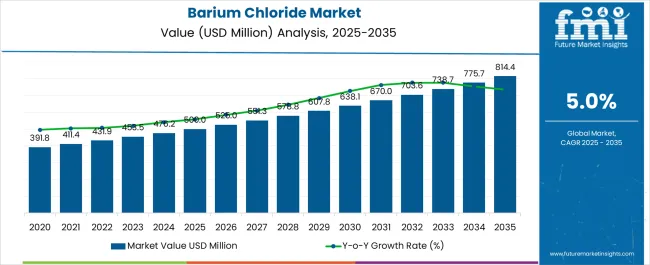
The barium chloride market was valued at USD 500.0 million in 2025, projected to reach USD 525.0 million in 2026, and is forecast to expand to USD 855.2 million by 2036 at a 5.0% CAGR. Water treatment infrastructure expansion in developing economies and steady demand from the chlor-alkali production chain sustain baseline consumption of barium chloride. Tightening wastewater discharge limits in industrial zones across Asia and Europe require higher-purity reagents, which shifts procurement toward anhydrous-grade suppliers. Chemical intermediate applications in barium salt derivatives and polymer stabilization maintain secondary demand channels that moderate cyclicality.
Summary of Barium Chloride Market
- Market Snapshot
- The barium chloride market is valued at USD 500.0 million in 2025 and is projected to reach USD 855.2 million by 2036.
- The industry is expected to grow at a 5.0% CAGR from 2026 to 2036, creating an incremental opportunity of USD 330.2 million.
- The market functions as a feedstock-driven inorganic chemicals category where production economics, purity grade control, and proximity to barium ore reserves determine supplier competitiveness.
- Demand and Growth Drivers
- Demand is sustained by water treatment infrastructure expansion in developing economies, where municipal and industrial wastewater facilities require barium-based reagents for sulfate removal.
- Chlor-alkali production chain demand for high-purity barium chloride reagents maintains a steady secondary consumption channel tied to caustic soda and chlorine output cycles.
- Barium salt derivative production for pigments, stabilizers, and specialty ceramics maintains a diversified demand base that moderates the cyclicality of primary water treatment consumption.
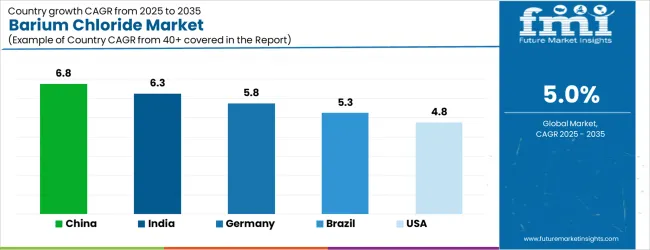
- As per FMI, among countries tracked, China leads at 6.8% CAGR, followed by India at 6.3%, Germany at 5.8%, Brazil at 5.3%, and USA at 4.8%.
- Product and Segment View
- The market covers barium chloride in anhydrous and dihydrate crystalline forms, produced from barium carbonate or sulfide precursors and graded by purity specifications.
- Applications span water treatment, chemical intermediates, caustic chlorine production, barium salt manufacturing, polymer stabilization, paints and coatings, and pyrotechnics.
- Based on FMI's barium chloride market report, Barium Chloride Anhydrous leads by Product Type with 60.0% share in 2026.
- Water Treatment leads by Application with 25.0% share in 2026.
- The scope includes market scope includes barium chloride in anhydrous and dihydrate forms across all industrial applications. coverage spans global and regional market s. Excluded are the scope excludes other barium compounds such as barium sulfate, barium carbonate, and barium hydroxide unless used as direct feedstock in barium chloride production.
- Geography and Competitive Outlook
- China and India are the fastest-growing markets, while Japan and UK remain mature demand bases with replacement-cycle purchasing patterns.
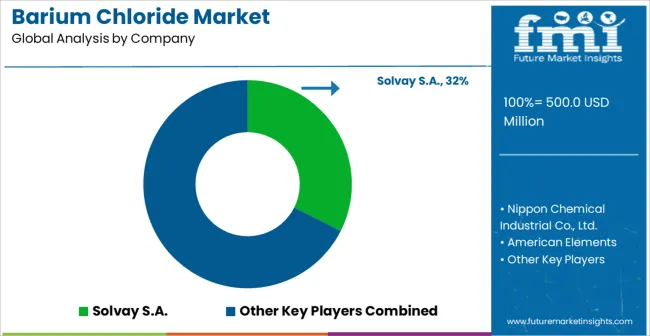
- Competition is shaped by manufacturing scale, distribution networks, and compliance capabilities, with key players including Solvay S.A., Nippon Chemical Industrial Co., Ltd., American Elements, Chemical Products Corporation, Chaitanya Chemicals.
- Analyst Opinion at FMI
- Nikhil Kaitwade, Principal Consultant for Chemicals at FMI, opines: 'In my analysis, I have observed that the barium chloride supply chain is structurally concentrated in China, and downstream consumers who fail to establish diversified procurement channels face inventory and pricing exposure. Water treatment plants operating under tightened sulfate discharge limits cannot substitute barium chloride in their precipitation processes, which locks in a non-discretionary demand floor. Procurement managers who secure multi-year supply contracts with purity-grade guarantees will protect margin stability against spot-market volatility.'
- Strategic Implications / Executive Takeaways
- Water treatment plant operators must establish multi-year supply contracts with purity-grade guarantees to protect against spot-market price volatility driven by Chinese production consolidation.
- Chemical intermediate manufacturers should evaluate vertical integration into barium chloride production where captive barite or hydrochloric acid feedstock access provides cost advantages.
- Procurement teams in the chlor-alkali production chain must map barium chloride supplier concentration risk and develop secondary sourcing channels outside dominant production regions.
Barium Chloride Market Key Takeaways
| Metric | Details |
|---|---|
| Industry Size (2026) | USD 525.0 million |
| Industry Value (2036) | USD 855.2 million |
| CAGR (2026-2036) | 5.0% |
Source: Future Market Insights, 2026
FMI is of the opinion that barium chloride procurement patterns reflect a supply chain where Chinese producers control the majority of global output, creating a price-setting dynamic that downstream consumers in Europe and North America must navigate through inventory hedging and long-term contracts. The anhydrous grade commands a price premium tied to purity specifications required by water treatment plants operating under tightened effluent discharge standards. Dihydrate-grade consumption remains volume-driven but faces margin pressure from substitute reagents in lower-criticality applications.
Country-level growth trajectories vary based on local regulatory frameworks and industrial maturity. China leads the expansion at 6.8% CAGR, followed by India at 6.3%, Germany at 5.8%, Brazil at 5.3%, USA at 4.8%, UK at 4.3%, Japan at 3.8%. Mature markets such as Japan and UK continue to generate steady replacement demand while China and India benefit from expanding capacity and industrial investment.
Barium Chloride Market Key Takeaways
Power in the barium chloride value chain is concentrated at the production level, where Chinese manufacturers control the majority of global output through integrated access to barite ore deposits and hydrochloric acid feedstock. Downstream consumers in water treatment and chemical synthesis have limited supplier alternatives, particularly for anhydrous-grade material meeting stringent purity specifications.
Pricing asymmetry reflects the gap between Chinese production costs, which benefit from ore proximity and scale, and delivered costs in import-dependent markets. European and North American buyers face a landed cost structure that includes logistics, trade duties, and currency exposure, which compresses their margins relative to regionally sourced alternatives that do not yet exist at competitive scale.
Sourcing fragility exists in the dependence on Chinese barite mining output and hydrochloric acid availability. Environmental enforcement campaigns in Chinese mining regions have periodically constrained barite supply, which cascades into barium chloride production shortfalls and spot price spikes for downstream consumers globally.
Brand and compliance risks in this market relate to hazardous materials handling requirements. Barium chloride is classified as toxic, and regulatory tightening of occupational exposure limits and environmental discharge standards adds compliance costs that smaller producers struggle to absorb, which consolidates market share among larger, better-capitalized manufacturers.
Geographic leverage splits between producing and consuming regions. China holds production cost leverage. India and Brazil are developing domestic capacity to reduce import dependency. Germany and the United States represent mature consumption bases with established water treatment infrastructure that generates replacement demand. Japan sustains steady consumption through chlor-alkali and specialty chemical production.
For C-suite executives, barium chloride is a commodity chemical with structural demand tied to non-discretionary water treatment and industrial chemistry applications. The strategic risk is supply concentration in China, which makes procurement diversification and inventory management the primary levers for protecting margin stability.
Barium Chloride Market Definition
Barium chloride is an inorganic compound available in anhydrous and dihydrate forms, used as a chemical reagent and intermediate in water treatment, chlor-alkali production, barium salt manufacturing, polymer stabilization, and coatings formulation. The compound is produced through the reaction of barium carbonate or barium sulfide with hydrochloric acid. Industrial procurement patterns are segmented by purity grade and crystalline form.
Barium Chloride Market Inclusions
Market scope includes barium chloride in anhydrous and dihydrate forms across all industrial applications. Coverage spans global and regional market sizes, forecast period 2026 to 2036, segmentation by product type, application, and geography. Trade flow analysis and pricing dynamics are incorporated.
Barium Chloride Market Exclusions
The scope excludes other barium compounds such as barium sulfate, barium carbonate, and barium hydroxide unless used as direct feedstock in barium chloride production. Downstream finished products and end-consumer applications are omitted from the valuation.
Barium Chloride Market Research Methodology
- Primary Research: Analysts engaged with procurement managers, manufacturing engineers, and supply chain directors to map the decision triggers driving product upgrades and supplier qualification cycles in the barium chloride space.
- Desk Research: Data collection aggregated regulatory filings, trade statistics, industry standards ratification schedules, and publicly available financial disclosures from leading participants.
- Market-Sizing and Forecasting: Baseline values derive from a bottom-up aggregation of production volumes and trade flows, applying region-specific adoption curves to project future demand velocity.
- Data Validation and Update Cycle: Projections are tested against publicly reported capital expenditure guidance and production capacity announcements from leading industry participants.
Why is the Barium Chloride Market Growing?
The Barium Chloride market is experiencing consistent growth driven by its essential role in industrial processes and water treatment applications. The future outlook for this market is influenced by rising investments in water purification infrastructure and increasing industrial demand for chemical intermediates. Growing awareness regarding water quality and stricter environmental regulations have accelerated the adoption of Barium Chloride in municipal and industrial water treatment facilities.
The versatility of Barium Chloride in diverse chemical processes, including the production of pigments, ceramics, and other industrial chemicals, further supports its market expansion. Additionally, ongoing innovations in chemical processing and the rising demand for high-purity compounds are expected to drive market growth.
As industries prioritize operational efficiency and compliance with environmental standards, the demand for Barium Chloride is anticipated to remain strong, with opportunities for expansion in both developed and emerging regions The market benefits from the combination of regulatory support, technological advancements, and the critical need for water purification and chemical applications.
Barium Chloride Market Drivers, Restraints, Opportunities
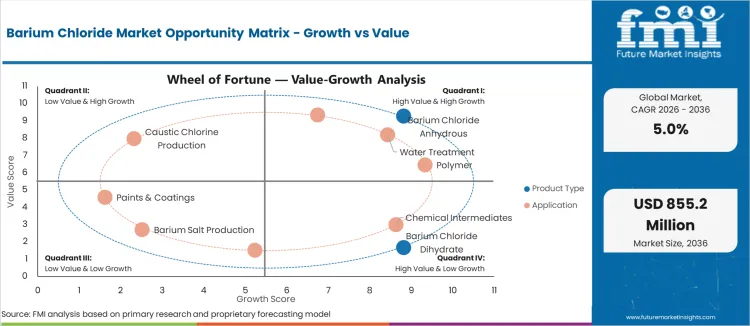
Future Market Insights analysis positions the barium chloride market as a mid-volume inorganic chemicals category with consumption anchored to municipal water treatment infrastructure and industrial chemical production chains. The market exists at its current valuation because sulfate removal in wastewater and brine purification in chlor-alkali electrolysis require barium-based precipitation chemistry for which commercially viable substitutes remain limited at scale.
The market faces a structural tension between concentrated Chinese production capacity and geographically dispersed downstream consumption. Buyers in Europe and North America depend on imported barium chloride for water treatment and chemical synthesis applications, which exposes them to trade policy, logistics, and currency risks. This import dependency creates periodic price volatility that incentivizes local capacity development in India and Brazil, though feedstock access to barium ore remains a limiting factor for new entrants.
- Water treatment regulatory tightening: Municipal wastewater discharge standards in China, India, and European Union member states have lowered permissible sulfate concentrations, which directly increases demand for barium chloride precipitation reagents at water treatment facilities undergoing compliance upgrades.
- Chlor-alkali production linkage: Barium chloride consumption in chlor-alkali electrolysis brine purification provides a demand channel tied to caustic soda and chlorine production volumes. As per FMI, global chlor-alkali capacity additions in Asia maintain a stable baseline for industrial-grade barium chloride procurement.
- Downstream barium salt diversification: Barium salt derivative production for barium sulfate pigments, barium carbonate in ceramics, and specialty chemical applications creates a diversified consumption base. Regional capacity in India and Brazil is expanding to serve domestic paints, coatings, and glass manufacturing sectors.
Segmental Analysis
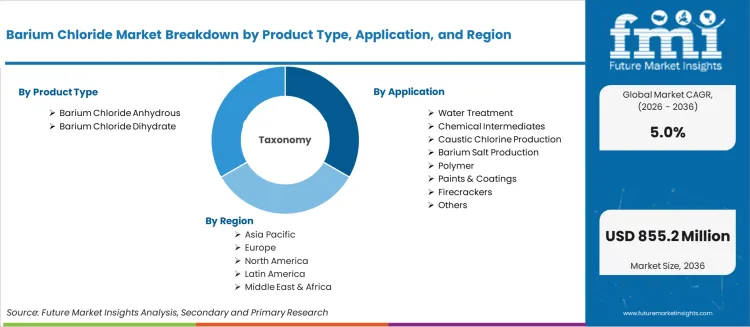
The barium chloride market is segmented by product type, application, and geographic regions. By product type, barium chloride market is divided into Barium Chloride Anhydrous and Barium Chloride Dihydrate. In terms of application, barium chloride market is classified into Water Treatment, Chemical Intermediates, Caustic Chlorine Production, Barium Salt Production, Polymer, Paints & Coatings, Firecrackers, and Others. Regionally, the barium chloride industry is classified into North America, Latin America, Western Europe, Eastern Europe, Balkan & Baltic Countries, Russia & Belarus, Central Asia, East Asia, South Asia & Pacific, and the Middle East & Africa.
Insights into the Barium Chloride Anhydrous Product Type Segment
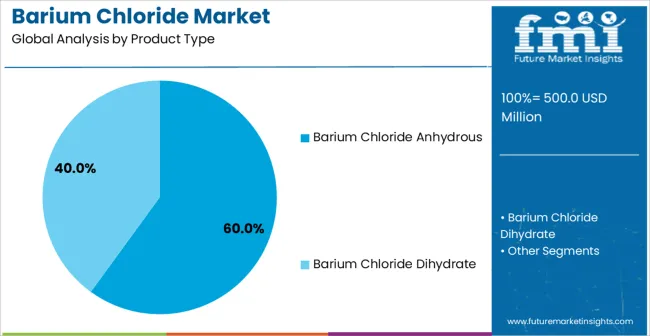
The Barium Chloride Anhydrous product type segment is projected to hold 60.0% of the market revenue share in 2026, making it the leading product type. This dominance is primarily driven by the high solubility and purity of anhydrous Barium Chloride, which ensures optimal performance in industrial and chemical applications.
The segment has benefited from increased demand in processes requiring precise chemical reactions and stable compound handling. Its wide applicability in pigment manufacturing, chemical intermediates, and laboratory use has reinforced its market position.
Additionally, the adaptability of anhydrous Barium Chloride for integration into large-scale water treatment and industrial systems has further propelled its adoption Growing awareness of process efficiency and the need for consistent high-quality chemicals continues to support the prominence of this segment in the overall market.
Insights into the Water Treatment Application Segment
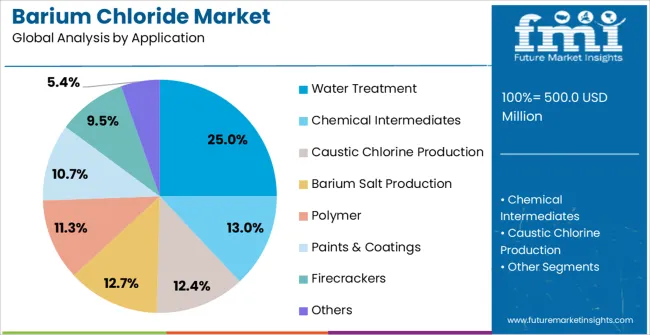
The water treatment application segment is expected to capture 25.0% of the market revenue share in 2026, positioning it as a leading application. The growth of this segment is driven by the increasing focus on ensuring safe and clean water in municipal and industrial facilities. Barium Chloride is extensively used as a flocculant to remove impurities and heavy metals, enhancing water quality and safety.
Rising environmental regulations and public health standards have accelerated its adoption in water treatment plants. Additionally, the ability of Barium Chloride to efficiently precipitate sulfates and other contaminants has made it a reliable solution for large-scale water purification systems.
Increasing investments in water infrastructure and sustainable treatment practices further reinforce the growth of this segment As the demand for clean and safe water continues to rise globally, the water treatment application segment is expected to maintain a leading position in the Barium Chloride market.
Market Overview
Barium Chloride Market Overview 2026 - 2036
Barium chloride is an inorganic compound usually produced by reaction between barites (barium sulfate) and hydrochloric acid. It has become one of the most commonly used water-soluble salts of barium.
Since ancient times, barium chloride has been used by humans for various applications including water treatment process, barium salt production, and chemical intermediates. However, due to its high toxicity levels, the use of this chemical has been limited to laboratory and industrial applications.
Presently, barium chloride is used in the production of chemical intermediates, barium salts, organic pigments etc. It also finds application in water treatments processes, aluminum refining, and brine purification.
Rising adoption of barium chloride for the purification of brine solution across caustic chlorine plants is one of the major factors triggering the sale of barium chloride and the trend is likely to continue in the future.
As the water shortage concerns continue to escalate worldwide, demand for barium chloride is anticipated to witness substantial increase during the forecast period. It is being increasingly used in water treatments processes for removing the impurities.
Subsequently, growing usage of barium chloride in the firecracker industry will further unlock growth opportunities for the key market players in the future. Owing to its ability to form a green flame while burning, barium chloride finds its application in firecrackers.
Analysis of Barium Chloride Market By Key Countries
.webp "Top Country Growth Comparison Barium Chloride Market Cagr (2026 2036)")
| Country | CAGR |
|---|---|
| China | 6.8% |
| India | 6.3% |
| Germany | 5.8% |
| Brazil | 5.3% |
| USA | 4.8% |
| UK | 4.3% |
| Japan | 3.8% |
Source: FMI analysis based on primary research and proprietary forecasting model
Country-wise Analysis
The Barium Chloride Market is expected to register a CAGR of 5.0% during the forecast period, exhibiting varied country level momentum. China leads with the highest CAGR of 6.8%, followed by India at 6.3%. Developed markets such as Germany, France, and the UK continue to expand steadily, while the USA is likely to grow at consistent rates. Japan posts the lowest CAGR at 3.8%, yet still underscores a broadly positive trajectory for the global Barium Chloride Market. In 2024, Germany held a dominant revenue in the Western Europe market and is expected to grow with a CAGR of 5.8%. The USA Barium Chloride Market is estimated to be valued at USD 184.8 million in 2026 and is anticipated to reach a valuation of USD 184.8 million by 2036. Sales are projected to rise at a CAGR of 0.0% over the forecast period between 2026 and 2036. While Japan and South Korea markets are estimated to be valued at USD 24.9 million and USD 13.7 million respectively in 2026.
Key Players in the Barium Chloride Market
- Solvay S.A.
- Nippon Chemical Industrial Co., Ltd.
- American Elements
- Chemical Products Corporation
- Chaitanya Chemicals
- Finoric LLC
- Jiaocheng Sanxi Chemical Co., Ltd.
- Shandong Xinke Environmental Chemistry Co., Ltd.
Scope of the Report
| Metric | Value |
|---|---|
| Quantitative Units | USD 525.0 million to USD 855.2 million, at a CAGR of 5.0% |
| Market Definition | Barium chloride is an inorganic compound available in anhydrous and dihydrate forms, used as a chemical reagent and intermediate in water treatment, chlor-alkali production, barium salt manufacturing, polymer stabilization, and coatings formulation. The compound is produced through the reaction of barium carbonate or barium sulfide with hydrochloric acid. Industrial procurement patterns are segmented by purity grade and crystalline form. |
| Segmentation | Product Type: Barium Chloride Anhydrous, Barium Chloride Dihydrate; Application: Water Treatment, Chemical Intermediates, Caustic Chlorine Production, Barium Salt Production, Polymer, Paints & Coatings, Firecrackers, Others |
| Regions Covered | North America, Latin America, Europe, East Asia, South Asia, Oceania, Middle East & Africa |
| Countries Covered | China, India, Germany, Brazil, USA, UK, Japan, and 40 plus countries |
| Key Companies Profiled | Solvay S.A., Nippon Chemical Industrial Co., Ltd., American Elements, Chemical Products Corporation, Chaitanya Chemicals, Finoric LLC, Jiaocheng Sanxi Chemical Co., Ltd., Shandong Xinke Environmental Chemistry Co., Ltd. |
| Forecast Period | 2026 to 2036 |
| Approach | Forecasting models apply a bottom-up methodology starting with global installed base metrics and projecting conversion rates to specialized applications. Cross-validation uses publicly reported expenditure guidance from leading industry participants. |
Barium Chloride Market by Segments
Product Type:
- Barium Chloride Anhydrous
- Barium Chloride Dihydrate
Application:
- Water Treatment
- Chemical Intermediates
- Caustic Chlorine Production
- Barium Salt Production
- Polymer
- Paints & Coatings
- Firecrackers
- Others
Region:
- North America
- USA
- Canada
- Mexico
- Latin America
- Brazil
- Chile
- Rest of Latin America
- Western Europe
- Germany
- UK
- Italy
- Spain
- France
- Nordic
- BENELUX
- Rest of Western Europe
- Eastern Europe
- Russia
- Poland
- Hungary
- Balkan & Baltic
- Rest of Eastern Europe
- East Asia
- China
- Japan
- South Korea
- South Asia and Pacific
- India
- ASEAN
- Australia & New Zealand
- Rest of South Asia and Pacific
- Middle East & Africa
- Kingdom of Saudi Arabia
- Other GCC Countries
- Turkiye
- South Africa
- Other African Union
- Rest of Middle East & Africa
Bibliography
- 1. United States Environmental Protection Agency. (2024). National primary drinking water regulations: Barium. USA EPA.
- 2. European Chemicals Agency. (2024). Barium chloride REACH registration dossier update. ECHA.
- 3. World Health Organization. (2024). Guidelines for drinking-water quality (4th ed., 2nd addendum). WHO.
- 4. International Organization for Standardization. (2023). ISO 6353-2:2023 Reagents for chemical analysis. ISO.
- 5. United States Geological Survey. (2024). Mineral commodity summaries: Barite. USGS.
- 6. Ministry of Ecology and Environment of the People's Republic of China. (2024). Discharge standard of pollutants for municipal wastewater treatment plant (GB 18918-2024). MEE.
This bibliography is provided for reader reference. The full Future Market Insights report contains the complete reference list with primary research documentation.
Frequently Asked Questions
How large is the demand for Barium Chloride in the global market in 2026?
Demand for barium chloride in the global market is estimated to be valued at USD 525.0 million in 2026.
What will be the market size of Barium Chloride in the global market by 2036?
Market size for barium chloride is projected to reach USD 855.2 million by 2036.
What is the expected demand growth for Barium Chloride in the global market between 2026 and 2036?
Demand for barium chloride is expected to grow at a CAGR of 5.0% between 2026 and 2036.
Which Product Type is poised to lead global sales by 2026?
Barium Chloride Anhydrous accounts for 60.0% in 2026 based on higher purity specifications required by water treatment and chemical synthesis applications where moisture content directly affects reagent performance.
How is the role of Water Treatment in driving Barium Chloride adoption in 2026?
Water Treatment holds 25.0% of Application share in 2026, driven by municipal and industrial wastewater sulfate precipitation processes that require barium-based reagents with no viable substitutes at scale.
What is driving demand in China?
China leads growth at 6.8% CAGR, supported by domestic production dominance and expanding water treatment infrastructure creating both supply-side scale and demand-side consumption growth.
What is India's growth outlook in this report?
India is projected to grow at a CAGR of 6.3% during 2026 to 2036.
What is Barium Chloride Market and what is it mainly used for?
Barium chloride is an inorganic compound available in anhydrous and dihydrate forms, used as a chemical reagent and intermediate in water treatment, chlor-alkali production, barium salt manufacturing, polymer stabilization, and coatings formulation. The compound is produced through the reaction of barium carbonate or barium sulfide with hydrochloric acid.
Preview the report firsthand - request a free sample
Get SampleGet the brochure for pricing and purchase details.
Get PDFTable of Content
- Demand-side Trends
- Supply-side Trends
- Technology Roadmap Analysis
- Analysis and Recommendations
- Market Overview
- Market Coverage / Taxonomy
- Market Definition / Scope / Limitations
- Research Methodology
- Chapter Orientation
- Analytical Lens and Working Hypotheses
- Market Structure, Signals, and Trend Drivers
- Company Annual and Sustainability Reports
- Peer-reviewed Journals and Academic Literature
- Corporate Websites, Product Literature, and Technical Notes
- Earnings Decks and Investor Briefings
- Statutory Filings and Regulatory Disclosures
- Technical White Papers and Standards Notes
- Trade Journals, Industry Magazines, and Analyst Briefs
- Conference Proceedings, Webinars, and Seminar Materials
- Government Statistics Portals and Public Data Releases
- Press Releases and Reputable Media Coverage
- Specialist Newsletters and Curated Briefings
- Sector Databases and Reference Repositories
- FMI Internal Proprietary Databases and Historical Market Datasets
- Subscription Datasets and Paid Sources
- Social Channels, Communities, and Digital Listening Inputs
- Additional Desk Sources
- Expert Input and Fieldwork (Primary Evidence)
- Primary Modes
- Qualitative Interviews and Expert Elicitation
- Quantitative Surveys and Structured Data Capture
- Blended Approach
- Why Primary Evidence is Used
- Field Techniques
- Interviews
- Surveys
- Focus Groups
- Observational and In-context Research
- Social and Community Interactions
- Stakeholder Universe Engaged
- C-suite Leaders
- Board Members
- Presidents and Vice Presidents
- R&D and Innovation Heads
- Technical Specialists
- Domain Subject-matter Experts
- Scientists
- Physicians and Other Healthcare Professionals
- Governance, Ethics, and Data Stewardship
- Research Ethics
- Data Integrity and Handling
- Primary Modes
- Tooling, Models, and Reference Databases
- Data Engineering and Model Build
- Data Acquisition and Ingestion
- Cleaning, Normalisation, and Verification
- Synthesis, Triangulation, and Analysis
- Quality Assurance and Audit Trail
- Market Background
- Market Dynamics
- Drivers
- Restraints
- Opportunity
- Trends
- Scenario Forecast
- Demand in Optimistic Scenario
- Demand in Likely Scenario
- Demand in Conservative Scenario
- Opportunity Map Analysis
- Product Life Cycle Analysis
- Supply Chain Analysis
- Investment Feasibility Matrix
- Value Chain Analysis
- PESTLE and Porter’s Analysis
- Regulatory Landscape
- Regional Parent Market Outlook
- Production and Consumption Statistics
- Import and Export Statistics
- Market Dynamics
- Global Market Analysis 2021 to 2025 and Forecast, 2026 to 2036
- Historical Market Size Value (USD Million) Analysis, 2021 to 2025
- Current and Future Market Size Value (USD Million) Projections, 2026 to 2036
- Y-o-Y Growth Trend Analysis
- Absolute $ Opportunity Analysis
- Global Market Pricing Analysis 2021 to 2025 and Forecast 2026 to 2036
- Global Market Analysis 2021 to 2025 and Forecast 2026 to 2036, By Product Type
- Introduction / Key Findings
- Historical Market Size Value (USD Million) Analysis By Product Type , 2021 to 2025
- Current and Future Market Size Value (USD Million) Analysis and Forecast By Product Type , 2026 to 2036
- Barium Chloride Anhydrous
- Barium Chloride Dihydrate
- Barium Chloride Anhydrous
- Y-o-Y Growth Trend Analysis By Product Type , 2021 to 2025
- Absolute $ Opportunity Analysis By Product Type , 2026 to 2036
- Global Market Analysis 2021 to 2025 and Forecast 2026 to 2036, By Application
- Introduction / Key Findings
- Historical Market Size Value (USD Million) Analysis By Application, 2021 to 2025
- Current and Future Market Size Value (USD Million) Analysis and Forecast By Application, 2026 to 2036
- Water Treatment
- Chemical Intermediates
- Caustic Chlorine Production
- Barium Salt Production
- Polymer
- Paints & Coatings
- Firecrackers
- Others
- Water Treatment
- Y-o-Y Growth Trend Analysis By Application, 2021 to 2025
- Absolute $ Opportunity Analysis By Application, 2026 to 2036
- Global Market Analysis 2021 to 2025 and Forecast 2026 to 2036, By Region
- Introduction
- Historical Market Size Value (USD Million) Analysis By Region, 2021 to 2025
- Current Market Size Value (USD Million) Analysis and Forecast By Region, 2026 to 2036
- North America
- Latin America
- Western Europe
- Eastern Europe
- East Asia
- South Asia and Pacific
- Middle East & Africa
- Market Attractiveness Analysis By Region
- North America Market Analysis 2021 to 2025 and Forecast 2026 to 2036, By Country
- Historical Market Size Value (USD Million) Trend Analysis By Market Taxonomy, 2021 to 2025
- Market Size Value (USD Million) Forecast By Market Taxonomy, 2026 to 2036
- By Country
- USA
- Canada
- Mexico
- By Product Type
- By Application
- By Country
- Market Attractiveness Analysis
- By Country
- By Product Type
- By Application
- Key Takeaways
- Latin America Market Analysis 2021 to 2025 and Forecast 2026 to 2036, By Country
- Historical Market Size Value (USD Million) Trend Analysis By Market Taxonomy, 2021 to 2025
- Market Size Value (USD Million) Forecast By Market Taxonomy, 2026 to 2036
- By Country
- Brazil
- Chile
- Rest of Latin America
- By Product Type
- By Application
- By Country
- Market Attractiveness Analysis
- By Country
- By Product Type
- By Application
- Key Takeaways
- Western Europe Market Analysis 2021 to 2025 and Forecast 2026 to 2036, By Country
- Historical Market Size Value (USD Million) Trend Analysis By Market Taxonomy, 2021 to 2025
- Market Size Value (USD Million) Forecast By Market Taxonomy, 2026 to 2036
- By Country
- Germany
- UK
- Italy
- Spain
- France
- Nordic
- BENELUX
- Rest of Western Europe
- By Product Type
- By Application
- By Country
- Market Attractiveness Analysis
- By Country
- By Product Type
- By Application
- Key Takeaways
- Eastern Europe Market Analysis 2021 to 2025 and Forecast 2026 to 2036, By Country
- Historical Market Size Value (USD Million) Trend Analysis By Market Taxonomy, 2021 to 2025
- Market Size Value (USD Million) Forecast By Market Taxonomy, 2026 to 2036
- By Country
- Russia
- Poland
- Hungary
- Balkan & Baltic
- Rest of Eastern Europe
- By Product Type
- By Application
- By Country
- Market Attractiveness Analysis
- By Country
- By Product Type
- By Application
- Key Takeaways
- East Asia Market Analysis 2021 to 2025 and Forecast 2026 to 2036, By Country
- Historical Market Size Value (USD Million) Trend Analysis By Market Taxonomy, 2021 to 2025
- Market Size Value (USD Million) Forecast By Market Taxonomy, 2026 to 2036
- By Country
- China
- Japan
- South Korea
- By Product Type
- By Application
- By Country
- Market Attractiveness Analysis
- By Country
- By Product Type
- By Application
- Key Takeaways
- South Asia and Pacific Market Analysis 2021 to 2025 and Forecast 2026 to 2036, By Country
- Historical Market Size Value (USD Million) Trend Analysis By Market Taxonomy, 2021 to 2025
- Market Size Value (USD Million) Forecast By Market Taxonomy, 2026 to 2036
- By Country
- India
- ASEAN
- Australia & New Zealand
- Rest of South Asia and Pacific
- By Product Type
- By Application
- By Country
- Market Attractiveness Analysis
- By Country
- By Product Type
- By Application
- Key Takeaways
- Middle East & Africa Market Analysis 2021 to 2025 and Forecast 2026 to 2036, By Country
- Historical Market Size Value (USD Million) Trend Analysis By Market Taxonomy, 2021 to 2025
- Market Size Value (USD Million) Forecast By Market Taxonomy, 2026 to 2036
- By Country
- Kingdom of Saudi Arabia
- Other GCC Countries
- Turkiye
- South Africa
- Other African Union
- Rest of Middle East & Africa
- By Product Type
- By Application
- By Country
- Market Attractiveness Analysis
- By Country
- By Product Type
- By Application
- Key Takeaways
- Key Countries Market Analysis
- USA
- Pricing Analysis
- Market Share Analysis, 2025
- By Product Type
- By Application
- Canada
- Pricing Analysis
- Market Share Analysis, 2025
- By Product Type
- By Application
- Mexico
- Pricing Analysis
- Market Share Analysis, 2025
- By Product Type
- By Application
- Brazil
- Pricing Analysis
- Market Share Analysis, 2025
- By Product Type
- By Application
- Chile
- Pricing Analysis
- Market Share Analysis, 2025
- By Product Type
- By Application
- Germany
- Pricing Analysis
- Market Share Analysis, 2025
- By Product Type
- By Application
- UK
- Pricing Analysis
- Market Share Analysis, 2025
- By Product Type
- By Application
- Italy
- Pricing Analysis
- Market Share Analysis, 2025
- By Product Type
- By Application
- Spain
- Pricing Analysis
- Market Share Analysis, 2025
- By Product Type
- By Application
- France
- Pricing Analysis
- Market Share Analysis, 2025
- By Product Type
- By Application
- India
- Pricing Analysis
- Market Share Analysis, 2025
- By Product Type
- By Application
- ASEAN
- Pricing Analysis
- Market Share Analysis, 2025
- By Product Type
- By Application
- Australia & New Zealand
- Pricing Analysis
- Market Share Analysis, 2025
- By Product Type
- By Application
- China
- Pricing Analysis
- Market Share Analysis, 2025
- By Product Type
- By Application
- Japan
- Pricing Analysis
- Market Share Analysis, 2025
- By Product Type
- By Application
- South Korea
- Pricing Analysis
- Market Share Analysis, 2025
- By Product Type
- By Application
- Russia
- Pricing Analysis
- Market Share Analysis, 2025
- By Product Type
- By Application
- Poland
- Pricing Analysis
- Market Share Analysis, 2025
- By Product Type
- By Application
- Hungary
- Pricing Analysis
- Market Share Analysis, 2025
- By Product Type
- By Application
- Kingdom of Saudi Arabia
- Pricing Analysis
- Market Share Analysis, 2025
- By Product Type
- By Application
- Turkiye
- Pricing Analysis
- Market Share Analysis, 2025
- By Product Type
- By Application
- South Africa
- Pricing Analysis
- Market Share Analysis, 2025
- By Product Type
- By Application
- USA
- Market Structure Analysis
- Competition Dashboard
- Competition Benchmarking
- Market Share Analysis of Top Players
- By Regional
- By Product Type
- By Application
- Competition Analysis
- Competition Deep Dive
- Solvay S.A.
- Overview
- Product Portfolio
- Profitability by Market Segments (Product/Age /Sales Channel/Region)
- Sales Footprint
- Strategy Overview
- Marketing Strategy
- Product Strategy
- Channel Strategy
- Nippon Chemical Industrial Co., Ltd.
- American Elements
- Chemical Products Corporation
- Chaitanya Chemicals
- Finoric LLC
- Jiaocheng Sanxi Chemical Co., Ltd.
- Shandong Xinke Environmental Chemistry Co., Ltd.
- Solvay S.A.
- Competition Deep Dive
- Assumptions & Acronyms Used


