

- Industry Size (2026)
- USD 12.85 Bn
- Forecast (2036)
- USD 16.94 Bn
- CAGR (2026 to 2036)
- 2.8%
Barium Fluoride Market Size, Market Forecast and Outlook By FMI
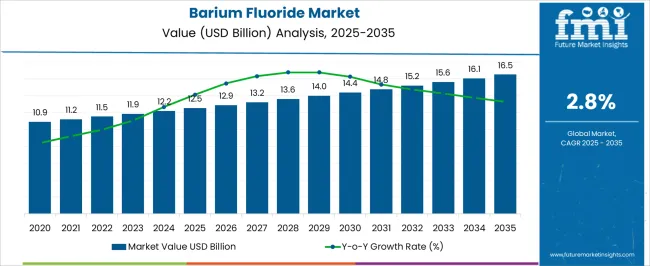
The barium fluoride market was valued at USD 12.50 billion in 2025, projected to reach USD 12.85 billion in 2026, and is forecast to expand to USD 16.94 billion by 2036 at a 2.8% CAGR. Aluminum smelting capacity additions across the Middle East, India, and Southeast Asia underpin the primary demand channel for barium fluoride through flux and electrolyte applications. Optical material fabrication for infrared spectroscopy and laser systems provides a secondary growth vector tied to defense and telecommunications capital spending cycles. Hydrogen fluoride synthesis consumes the largest single share of barium fluoride output, linking demand directly to fluorochemical supply chain expansions.
Summary of Barium Fluoride Market
- Market Snapshot
- The barium fluoride market is valued at USD 12.50 billion in 2025 and is projected to reach USD 16.94 billion by 2036.
- The industry is expected to grow at a 2.8% CAGR from 2026 to 2036, creating an incremental opportunity of USD 4.09 billion.
- The market operates as a resource-constrained inorganic chemicals category where fluorspar and baryte concentrate access, processing purity control, and end-use application certification determine competitive positioning.
- Demand and Growth Drivers
- Demand is anchored to aluminum smelting capacity additions across the Middle East and Asia, where barium fluoride serves as a flux and electrolyte additive in reduction cells.
- Optical-grade barium fluoride crystal fabrication for infrared spectroscopy and laser systems provides a technology-driven growth vector tied to defense and telecommunications procurement.
- Hydrogen fluoride synthesis capacity expansions for fluoropolymer and refrigerant production chains directly increase upstream barium fluoride consumption volumes.
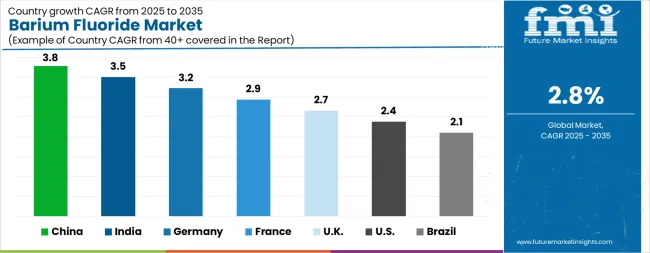
- As per FMI, among countries tracked, China leads at 3.8% CAGR, followed by India at 3.5%, Germany at 3.2%, France at 2.9%, and UK at 2.7%.
- Product and Segment View
- The market covers barium fluoride produced from baryte-fluorspar mineral processing, available in technical, reagent, and optical grades for industrial and specialty applications.
- Applications span hydrogen fluoride production, ammonium fluoride synthesis, calcium fluoride processing, sodium fluoride manufacturing, and sulphur hexafluoride production.
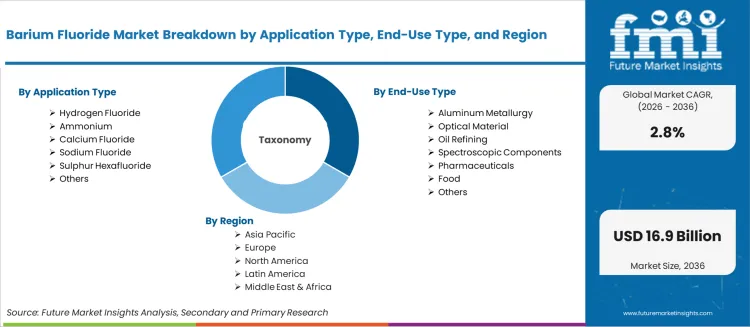
- Based on FMI's barium fluoride market report, Hydrogen Fluoride leads by Application Type with 35.6% share in 2026.
- Aluminum Metallurgy leads by End-Use Type with 34.7% share in 2026.
- The scope includes market scope includes barium fluoride across all application types and end-use industries. the analysis covers global and regional market sizes, forec. Excluded are the scope excludes other fluoride compounds such as calcium fluoride, sodium fluoride, and aluminum fluoride unless consumed as co-products in barium fluoride synthesis.
- Geography and Competitive Outlook
- China and India are the fastest-growing markets, while Brazil and USA remain mature demand bases with replacement-cycle purchasing patterns.
- Competition is shaped by manufacturing scale, distribution networks, and compliance capabilities, with key players including Solvay, GFS Chemicals, Inc., International Crystal Laboratories, All-Chemie, Ltd., Barium & Chemicals, Inc..
- Analyst Opinion at FMI
- Nikhil Kaitwade, Principal Consultant for Chemicals at FMI, opines: 'In my analysis, I have observed that barium fluoride demand is structurally coupled to two capital-intensive supply chains: aluminum smelting and hydrogen fluoride synthesis. Both chains are undergoing capacity expansion in regions with low-cost energy and mineral access, which concentrates future demand growth in a small number of geographies. Buyers who do not establish direct supply relationships with integrated baryte-fluorspar processors will face allocation constraints as smelter commissioning schedules tighten upstream demand.'
- Strategic Implications / Executive Takeaways
- Aluminum smelter operators expanding reduction cell capacity must lock in barium fluoride supply contracts before commissioning schedules tighten upstream allocation.
- Optical component manufacturers should qualify secondary barium fluoride crystal growers to reduce single-source dependency for defense and spectroscopy applications.
- Chemical procurement teams must assess fluorspar and baryte concentrate supply risk in their barium fluoride sourcing strategies as mineral export restrictions tighten in key producing countries.
Barium Fluoride Market Key Takeaways
| Metric | Details |
|---|---|
| Industry Size (2026) | USD 12.85 billion |
| Industry Value (2036) | USD 16.94 billion |
| CAGR (2026-2036) | 2.8% |
Source: Future Market Insights, 2026
FMI analysts note the barium fluoride market operates within a tightly controlled supply chain where raw material access to baryte and fluorspar concentrates determines production economics. Hydrogen fluoride manufacturing consumes the largest portion of barium fluoride output, and capacity additions in fluoropolymer and refrigerant production chains directly influence upstream demand. Optical-grade barium fluoride crystals carry a premium well above industrial grades, but this segment is volume-limited and driven by defense and scientific instrumentation procurement cycles.
Country-level growth trajectories vary based on local regulatory frameworks and industrial maturity. China leads the expansion at 3.8% CAGR, followed by India at 3.5%, Germany at 3.2%, France at 2.9%, UK at 2.7%, USA at 2.4%, Brazil at 2.1%. Mature markets such as Brazil and USA continue to generate steady replacement demand while China and India benefit from expanding capacity and industrial investment.
Barium Fluoride Market Key Takeaways
Power in the barium fluoride value chain concentrates at the mineral extraction and processing stage, where access to fluorspar and baryte reserves determines production viability. Chinese processors hold dominant market position through integrated mining and chemical processing operations that deliver cost advantages unmatched by import-dependent competitors.
Pricing asymmetry separates industrial-grade barium fluoride, priced on commodity mineral economics, from optical-grade crystals, which command premiums tied to crystal growth technology, defect control, and transmission window certification. Producers that serve both grades operate across fundamentally different margin structures.
Sourcing fragility in this market reflects mineral concentration risk. Fluorspar supply is subject to Chinese export controls and environmental mining enforcement campaigns that create periodic supply disruptions. Secondary producers in Mexico and South Africa face higher extraction costs and lower reserve quality, which limits their ability to absorb displaced demand during Chinese supply contractions.
Brand and compliance risks center on product certification for specific end-use applications. Optical-grade barium fluoride requires crystal quality certification for defense and scientific instrument applications, and loss of certification eliminates access to the highest-margin market segment. Industrial-grade producers face REACH and hazardous materials compliance costs that compress margins.
Geographic leverage is concentrated in China for production and dispersed across the Middle East, India, and Southeast Asia for consumption growth. European and North American consumption is stable but mature, driven by replacement demand in existing fluorochemical and metallurgical installations. Brazil holds emerging potential through nascent aluminum smelting capacity development.
For C-suite executives, barium fluoride is a mineral-constrained specialty chemical where supply security is the primary strategic variable. The market is not large enough to attract new entrants at scale, which means existing producers with integrated mineral access hold durable competitive positions. The strategic question is whether to secure long-term mineral supply contracts or invest in process technology that reduces barium fluoride consumption per unit of downstream output.
Barium Fluoride Market Definition
Barium fluoride is an inorganic salt used primarily in hydrogen fluoride production, aluminum smelting flux, optical component fabrication, and specialty chemical synthesis. The compound is derived from the reaction of barium carbonate with hydrofluoric acid or through direct processing of fluorite-baryte mineral blends. End-use applications span aluminum metallurgy, optical materials, oil refining catalysts, spectroscopic components, pharmaceuticals, and food-grade additives.
Barium Fluoride Market Inclusions
Market scope includes barium fluoride across all application types and end-use industries. The analysis covers global and regional market sizes, forecast period 2026 to 2036, segmentation by application type, end-use type, and geography. Supply chain mapping and raw material dependency analysis are incorporated.
Barium Fluoride Market Exclusions
The scope excludes other fluoride compounds such as calcium fluoride, sodium fluoride, and aluminum fluoride unless consumed as co-products in barium fluoride synthesis. Finished optical lenses, completed pharmaceutical formulations, and downstream aluminum products are omitted.
Barium Fluoride Market Research Methodology
- Primary Research: Analysts engaged with procurement managers, manufacturing engineers, and supply chain directors to map the decision triggers driving product upgrades and supplier qualification cycles in the barium fluoride space.
- Desk Research: Data collection aggregated regulatory filings, trade statistics, industry standards ratification schedules, and publicly available financial disclosures from leading participants.
- Market-Sizing and Forecasting: Baseline values derive from a bottom-up aggregation of production volumes and trade flows, applying region-specific adoption curves to project future demand velocity.
- Data Validation and Update Cycle: Projections are tested against publicly reported capital expenditure guidance and production capacity announcements from leading industry participants.
Why is the Barium Fluoride Market Growing?
The Barium Fluoride market is experiencing steady growth, driven by its increasing use in industrial and metallurgical applications. Demand is primarily supported by its chemical stability, high thermal resistance, and optical transparency, which make it essential for applications in chemical processing, laser technologies, and aluminum production. Rising production of aluminum and growth in related industries, particularly in emerging economies, are contributing to market expansion.
The market is further fueled by the adoption of hydrogen fluoride in various chemical reactions, where Barium Fluoride serves as a critical intermediate. Technological advancements in fluorine chemistry and process optimization are improving yield, quality, and efficiency, strengthening its commercial viability. Regulatory emphasis on environmentally safe handling and sustainable production practices is influencing manufacturing processes and supply chains.
As industries prioritize high-performance materials and cost-efficient production, the demand for Barium Fluoride is expected to remain strong Continuous research and innovation in chemical applications and metallurgical processes are anticipated to drive sustained growth over the coming years.
Barium Fluoride Market Drivers, Restraints, Opportunities
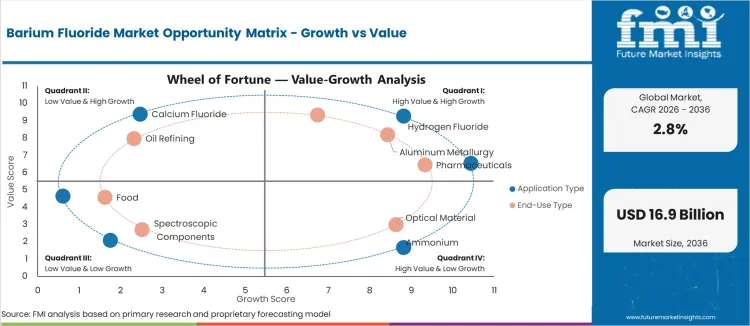
Future Market Insights analysis identifies the barium fluoride market as structurally coupled to two capital-intensive industrial chains: aluminum smelting and hydrogen fluoride production. The market exists at its current valuation because both chains require barium fluoride inputs that cannot be substituted without altering core process chemistry. This non-discretionary demand characteristic creates a stable consumption floor that is insensitive to short-term pricing fluctuations.
The tension in this market lies between resource-constrained supply and geographically expanding demand. Fluorspar and baryte, the primary mineral feedstocks for barium fluoride production, are concentrated in China, Mexico, and South Africa. Mineral export restrictions and environmental mining enforcement in these regions periodically tighten upstream supply, while downstream demand from aluminum smelters and fluorochemical plants in the Middle East, India, and Southeast Asia continues to expand with new facility commissioning schedules.
- Aluminum smelting capacity expansion: Primary aluminum production capacity is expanding across the Middle East, India, and Southeast Asia, where low-cost energy access drives new smelter construction. Each new reduction cell installation requires barium fluoride as a flux modifier in the electrolyte bath, creating a commissioning-linked demand pulse that is independent of downstream aluminum price cycles.
- Fluorochemical supply chain growth: Global hydrogen fluoride production is expanding to serve fluoropolymer, fluorocarbon refrigerant, and semiconductor etching chemical demand. As per FMI, barium fluoride consumption for HF synthesis is projected to grow in proportion to downstream fluorochemical capacity additions concentrated in China and India.
- Optical and defense applications: Barium fluoride crystals with controlled transmission windows in the infrared spectrum serve defense optics, spectroscopic analytical instruments, and emerging laser communication systems. This application segment commands price premiums of five to ten times above industrial-grade material, but volumes are constrained by defense procurement budgets and scientific instrument replacement cycles.
Segmental Analysis
The barium fluoride market is segmented by application type, end-use type, and geographic regions. By application type, barium fluoride market is divided into Hydrogen Fluoride, Ammonium, Calcium Fluoride, Sodium Fluoride, Sulphur Hexafluoride, and Others. In terms of end-use type, barium fluoride market is classified into Aluminum Metallurgy, Optical Material, Oil Refining, Spectroscopic Components, Pharmaceuticals, Food, and Others. Regionally, the barium fluoride industry is classified into North America, Latin America, Western Europe, Eastern Europe, Balkan & Baltic Countries, Russia & Belarus, Central Asia, East Asia, South Asia & Pacific, and the Middle East & Africa.
Insights into the Hydrogen Fluoride Application Type Segment
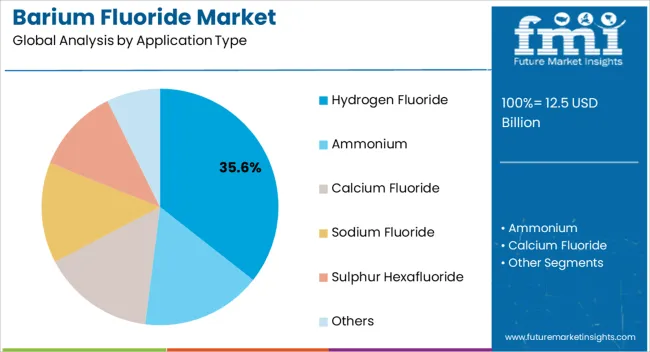
The hydrogen fluoride application type segment is projected to hold 35.6% of the market revenue in 2026, positioning it as the leading application category. Growth is being driven by the critical role of hydrogen fluoride in chemical synthesis, where Barium Fluoride is widely used as an intermediate. The ability of Barium Fluoride to withstand high temperatures and resist chemical degradation ensures reliability and consistency in industrial processes.
Its integration into hydrogen fluoride-based reactions enables high-quality product output while maintaining operational efficiency. Technological advancements and process optimizations have further enhanced the performance of Barium Fluoride in chemical applications.
The segment benefits from increasing demand in fluorochemical production, pharmaceutical intermediates, and other industrial processes requiring precise and stable fluoride compounds As chemical industries continue to expand and adopt more efficient, high-performance intermediates, the hydrogen fluoride application segment is expected to maintain its leadership, supported by sustained industrial demand and process innovations.
Insights into the Aluminum Metallurgy End-Use Type Segment
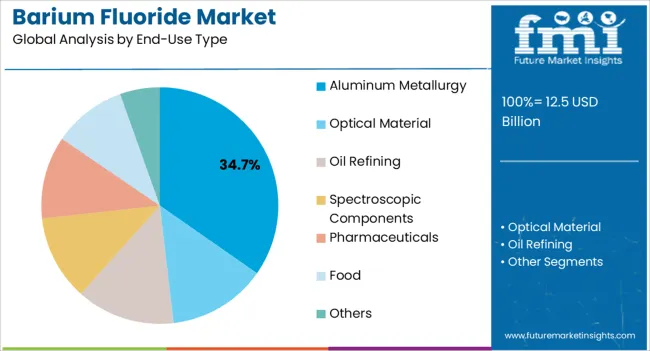
The aluminum metallurgy end-use segment is expected to account for 34.7% of the Barium Fluoride market revenue in 2026, making it the leading end-use sector. Its growth is being driven by the increasing production and processing of aluminum, where Barium Fluoride is utilized to improve fluxing efficiency and reduce impurities in molten metal. The material’s high thermal stability and chemical inertness enhance operational efficiency and reduce process-related losses.
Adoption is further supported by the expansion of aluminum manufacturing in automotive, construction, and aerospace industries, where high-quality metal output is essential. Barium Fluoride also enables energy-efficient operations and consistent metallurgical performance, which are critical for large-scale production facilities.
As the global aluminum industry continues to grow, demand for high-purity Barium Fluoride is expected to rise, reinforcing the segment’s market leadership Continuous innovation in metallurgical processing and integration with advanced flux technologies is likely to further support adoption in the aluminum sector.
Market Overview
Barium Fluoride Market Overview
Barium Fluoride is chemically termed as BaF2 with chemical composition of barium and fluoride. Barium fluoride is a salt and water insoluble barium source that is used in oxygen-sensitive applications includes metal production. Barium Fluoride have varied range of applications in modern technologies and science, ranging from etching and oil refining to the manufacture of pharmaceuticals synthetic and organic chemistry.
Barium Fluoride is also used in spectroscopic components and is commonly suitable for the passive IR band (8 to 14µm), as well as view-port window for thermography. Barium fluoride distinct crystals are cross-luminescent scintillators with short emission times, heavy, and high primary photon intensities.
In addition to scintillation properties, barium fluoride is also applicable in the fabrication of optical windows transmitting radiation in the spectrum from IR to UV. Moreover, barium fluoride is required to produce BaY2F8 crystals for UV-lasers and is also appropriate for a number of instrumental environments due to its resistance to water damage.
Analysis of Barium Fluoride Market By Key Countries
.webp "Top Country Growth Comparison Barium Fluoride Market Cagr (2026 2036)")
| Country | CAGR |
|---|---|
| China | 3.8% |
| India | 3.5% |
| Germany | 3.2% |
| France | 2.9% |
| UK | 2.7% |
| USA | 2.4% |
| Brazil | 2.1% |
Source: FMI analysis based on primary research and proprietary forecasting model
Country-wise Analysis
The Barium Fluoride Market is expected to register a CAGR of 2.8% during the forecast period, exhibiting varied country level momentum. China leads with the highest CAGR of 3.8%, followed by India at 3.5%. Developed markets such as Germany, France, and the UK continue to expand steadily, while the USA is likely to grow at consistent rates. Brazil posts the lowest CAGR at 2.1%, yet still underscores a broadly positive trajectory for the global Barium Fluoride Market. In 2024, Germany held a dominant revenue in the Western Europe market and is expected to grow with a CAGR of 3.2%. The USA Barium Fluoride Market is estimated to be valued at USD 4.4 billion in 2026 and is anticipated to reach a valuation of USD 5.5 billion by 2036. Sales are projected to rise at a CAGR of 2.4% over the forecast period between 2026 and 2036. While Japan and South Korea markets are estimated to be valued at USD 653.7 million and USD 432.5 million respectively in 2026.
Key Players in the Barium Fluoride Market
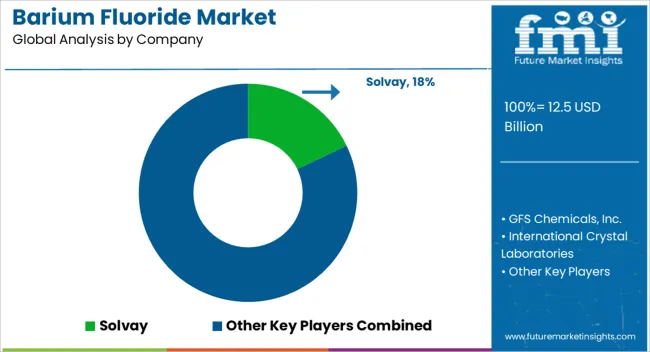
- Solvay
- GFS Chemicals, Inc.
- International Crystal Laboratories
- All-Chemie, Ltd.
- Barium & Chemicals, Inc.
- Wego Chemical & Mineral Corp
- Alfa Chemical Corp
- Super Conductor Materials
- Jay Intermediates
Scope of the Report
| Metric | Value |
|---|---|
| Quantitative Units | USD 12.85 billion to USD 16.94 billion, at a CAGR of 2.8% |
| Market Definition | Barium fluoride is an inorganic salt used primarily in hydrogen fluoride production, aluminum smelting flux, optical component fabrication, and specialty chemical synthesis. The compound is derived from the reaction of barium carbonate with hydrofluoric acid or through direct processing of fluorite-baryte mineral blends. End-use applications span aluminum metallurgy, optical materials, oil refining catalysts, spectroscopic components, pharmaceuticals, and food-grade additives. |
| Segmentation | Application Type: Hydrogen Fluoride, Ammonium, Calcium Fluoride, Sodium Fluoride, Sulphur Hexafluoride, Others; End-Use Type: Aluminum Metallurgy, Optical Material, Oil Refining, Spectroscopic Components, Pharmaceuticals, Food, Others |
| Regions Covered | North America, Latin America, Europe, East Asia, South Asia, Oceania, Middle East & Africa |
| Countries Covered | China, India, Germany, France, UK, USA, Brazil, and 40 plus countries |
| Key Companies Profiled | Solvay, GFS Chemicals, Inc., International Crystal Laboratories, All-Chemie, Ltd., Barium & Chemicals, Inc., Wego Chemical & Mineral Corp, Alfa Chemical Corp, Super Conductor Materials, Jay Intermediates |
| Forecast Period | 2026 to 2036 |
| Approach | Forecasting models apply a bottom-up methodology starting with global installed base metrics and projecting conversion rates to specialized applications. Cross-validation uses publicly reported expenditure guidance from leading industry participants. |
Barium Fluoride Market by Segments
Application Type:
- Hydrogen Fluoride
- Ammonium
- Calcium Fluoride
- Sodium Fluoride
- Sulphur Hexafluoride
- Others
End-Use Type:
- Aluminum Metallurgy
- Optical Material
- Oil Refining
- Spectroscopic Components
- Pharmaceuticals
- Food
- Others
Region:
- North America
- USA
- Canada
- Mexico
- Latin America
- Brazil
- Chile
- Rest of Latin America
- Western Europe
- Germany
- UK
- Italy
- Spain
- France
- Nordic
- BENELUX
- Rest of Western Europe
- Eastern Europe
- Russia
- Poland
- Hungary
- Balkan & Baltic
- Rest of Eastern Europe
- East Asia
- China
- Japan
- South Korea
- South Asia and Pacific
- India
- ASEAN
- Australia & New Zealand
- Rest of South Asia and Pacific
- Middle East & Africa
- Kingdom of Saudi Arabia
- Other GCC Countries
- Turkiye
- South Africa
- Other African Union
- Rest of Middle East & Africa
Bibliography
- 1. United States Geological Survey. (2024). Mineral commodity summaries: Fluorspar. USGS.
- 2. International Aluminium Institute. (2024). Global aluminium smelting capacity and production data. IAI.
- 3. European Chemicals Agency. (2024). Barium fluoride REACH substance evaluation update. ECHA.
- 4. International Organization for Standardization. (2022). ISO 9286:2022 Aluminium fluoride: Specification. ISO.
- 5. Organisation for Economic Co-operation and Development. (2024). Critical minerals strategy and supply chain mapping. OECD.
- 6. Ministry of Natural Resources of the People's Republic of China. (2024). Mineral resources extraction and export policy update. MNR.
This bibliography is provided for reader reference. The full Future Market Insights report contains the complete reference list with primary research documentation.
Frequently Asked Questions
How large is the demand for Barium Fluoride in the global market in 2026?
Demand for barium fluoride in the global market is estimated to be valued at USD 12.85 billion in 2026.
What will be the market size of Barium Fluoride in the global market by 2036?
Market size for barium fluoride is projected to reach USD 16.94 billion by 2036.
What is the expected demand growth for Barium Fluoride in the global market between 2026 and 2036?
Demand for barium fluoride is expected to grow at a CAGR of 2.8% between 2026 and 2036.
Which Application Type is poised to lead global sales by 2026?
Hydrogen Fluoride accounts for 35.6% in 2026 based on captive consumption in hydrofluoric acid production chains serving fluoropolymer, refrigerant, and semiconductor etching supply lines.
How is the role of Aluminum Metallurgy in driving Barium Fluoride adoption in 2026?
Aluminum Metallurgy holds 34.7% of End-Use Type share in 2026, driven by primary aluminum smelting capacity that consumes barium fluoride as a flux and electrolyte modifier in Hall-Heroult reduction cells.
What is driving demand in China?
China leads growth at 3.8% CAGR, supported by integrated fluorspar-to-fluorochemical production chains and aluminum smelting capacity that anchor domestic barium fluoride consumption.
What is India's growth outlook in this report?
India is projected to grow at a CAGR of 3.5% during 2026 to 2036.
What is Barium Fluoride Market and what is it mainly used for?
Barium fluoride is an inorganic salt used primarily in hydrogen fluoride production, aluminum smelting flux, optical component fabrication, and specialty chemical synthesis. The compound is derived from the reaction of barium carbonate with hydrofluoric acid or through direct processing of fluorite-baryte mineral blends.
Preview the report firsthand - request a free sample
Get SampleGet the brochure for pricing and purchase details.
Get PDFTable of Content
- Executive Summary
- Global Market Outlook
- Demand-side Trends
- Supply-side Trends
- Technology Roadmap Analysis
- Analysis and Recommendations
- Market Overview
- Market Coverage / Taxonomy
- Market Definition / Scope / Limitations
- Research Methodology
- Chapter Orientation
- Analytical Lens and Working Hypotheses
- Market Structure, Signals, and Trend Drivers
- Benchmarking and Cross-market Comparability
- Market Sizing, Forecasting, and Opportunity Mapping
- Research Design and Evidence Framework
- Desk Research Programme (Secondary Evidence)
- Company Annual and Sustainability Reports
- Peer-reviewed Journals and Academic Literature
- Corporate Websites, Product Literature, and Technical Notes
- Earnings Decks and Investor Briefings
- Statutory Filings and Regulatory Disclosures
- Technical White Papers and Standards Notes
- Trade Journals, Industry Magazines, and Analyst Briefs
- Conference Proceedings, Webinars, and Seminar Materials
- Government Statistics Portals and Public Data Releases
- Press Releases and Reputable Media Coverage
- Specialist Newsletters and Curated Briefings
- Sector Databases and Reference Repositories
- FMI Internal Proprietary Databases and Historical Market Datasets
- Subscription Datasets and Paid Sources
- Social Channels, Communities, and Digital Listening Inputs
- Additional Desk Sources
- Expert Input and Fieldwork (Primary Evidence)
- Primary Modes
- Qualitative Interviews and Expert Elicitation
- Quantitative Surveys and Structured Data Capture
- Blended Approach
- Why Primary Evidence is Used
- Field Techniques
- Interviews
- Surveys
- Focus Groups
- Observational and In-context Research
- Social and Community Interactions
- Stakeholder Universe Engaged
- C-suite Leaders
- Board Members
- Presidents and Vice Presidents
- R&D and Innovation Heads
- Technical Specialists
- Domain Subject-matter Experts
- Scientists
- Physicians and Other Healthcare Professionals
- Governance, Ethics, and Data Stewardship
- Research Ethics
- Data Integrity and Handling
- Primary Modes
- Tooling, Models, and Reference Databases
- Desk Research Programme (Secondary Evidence)
- Data Engineering and Model Build
- Data Acquisition and Ingestion
- Cleaning, Normalisation, and Verification
- Synthesis, Triangulation, and Analysis
- Quality Assurance and Audit Trail
- Market Background
- Market Dynamics
- Drivers
- Restraints
- Opportunity
- Trends
- Scenario Forecast
- Demand in Optimistic Scenario
- Demand in Likely Scenario
- Demand in Conservative Scenario
- Opportunity Map Analysis
- Product Life Cycle Analysis
- Supply Chain Analysis
- Investment Feasibility Matrix
- Value Chain Analysis
- PESTLE and Porter’s Analysis
- Regulatory Landscape
- Regional Parent Market Outlook
- Production and Consumption Statistics
- Import and Export Statistics
- Market Dynamics
- Global Market Analysis 2021 to 2025 and Forecast, 2026 to 2036
- Historical Market Size Value (USD Million) Analysis, 2021 to 2025
- Current and Future Market Size Value (USD Million) Projections, 2026 to 2036
- Y-o-Y Growth Trend Analysis
- Absolute $ Opportunity Analysis
- Global Market Pricing Analysis 2021 to 2025 and Forecast 2026 to 2036
- Global Market Analysis 2021 to 2025 and Forecast 2026 to 2036, By Application Type
- Introduction / Key Findings
- Historical Market Size Value (USD Million) Analysis By Application Type , 2021 to 2025
- Current and Future Market Size Value (USD Million) Analysis and Forecast By Application Type , 2026 to 2036
- Hydrogen Fluoride
- Ammonium
- Calcium Fluoride
- Sodium Fluoride
- Sulphur Hexafluoride
- Others
- Hydrogen Fluoride
- Y-o-Y Growth Trend Analysis By Application Type , 2021 to 2025
- Absolute $ Opportunity Analysis By Application Type , 2026 to 2036
- Global Market Analysis 2021 to 2025 and Forecast 2026 to 2036, By End-Use Type
- Introduction / Key Findings
- Historical Market Size Value (USD Million) Analysis By End-Use Type, 2021 to 2025
- Current and Future Market Size Value (USD Million) Analysis and Forecast By End-Use Type, 2026 to 2036
- Aluminum Metallurgy
- Optical Material
- Oil Refining
- Spectroscopic Components
- Pharmaceuticals
- Food
- Others
- Aluminum Metallurgy
- Y-o-Y Growth Trend Analysis By End-Use Type, 2021 to 2025
- Absolute $ Opportunity Analysis By End-Use Type, 2026 to 2036
- Global Market Analysis 2021 to 2025 and Forecast 2026 to 2036, By Region
- Introduction
- Historical Market Size Value (USD Million) Analysis By Region, 2021 to 2025
- Current Market Size Value (USD Million) Analysis and Forecast By Region, 2026 to 2036
- North America
- Latin America
- Western Europe
- Eastern Europe
- East Asia
- South Asia and Pacific
- Middle East & Africa
- Market Attractiveness Analysis By Region
- North America Market Analysis 2021 to 2025 and Forecast 2026 to 2036, By Country
- Historical Market Size Value (USD Million) Trend Analysis By Market Taxonomy, 2021 to 2025
- Market Size Value (USD Million) Forecast By Market Taxonomy, 2026 to 2036
- By Country
- USA
- Canada
- Mexico
- By Application Type
- By End-Use Type
- By Country
- Market Attractiveness Analysis
- By Country
- By Application Type
- By End-Use Type
- Key Takeaways
- Latin America Market Analysis 2021 to 2025 and Forecast 2026 to 2036, By Country
- Historical Market Size Value (USD Million) Trend Analysis By Market Taxonomy, 2021 to 2025
- Market Size Value (USD Million) Forecast By Market Taxonomy, 2026 to 2036
- By Country
- Brazil
- Chile
- Rest of Latin America
- By Application Type
- By End-Use Type
- By Country
- Market Attractiveness Analysis
- By Country
- By Application Type
- By End-Use Type
- Key Takeaways
- Western Europe Market Analysis 2021 to 2025 and Forecast 2026 to 2036, By Country
- Historical Market Size Value (USD Million) Trend Analysis By Market Taxonomy, 2021 to 2025
- Market Size Value (USD Million) Forecast By Market Taxonomy, 2026 to 2036
- By Country
- Germany
- UK
- Italy
- Spain
- France
- Nordic
- BENELUX
- Rest of Western Europe
- By Application Type
- By End-Use Type
- By Country
- Market Attractiveness Analysis
- By Country
- By Application Type
- By End-Use Type
- Key Takeaways
- Eastern Europe Market Analysis 2021 to 2025 and Forecast 2026 to 2036, By Country
- Historical Market Size Value (USD Million) Trend Analysis By Market Taxonomy, 2021 to 2025
- Market Size Value (USD Million) Forecast By Market Taxonomy, 2026 to 2036
- By Country
- Russia
- Poland
- Hungary
- Balkan & Baltic
- Rest of Eastern Europe
- By Application Type
- By End-Use Type
- By Country
- Market Attractiveness Analysis
- By Country
- By Application Type
- By End-Use Type
- Key Takeaways
- East Asia Market Analysis 2021 to 2025 and Forecast 2026 to 2036, By Country
- Historical Market Size Value (USD Million) Trend Analysis By Market Taxonomy, 2021 to 2025
- Market Size Value (USD Million) Forecast By Market Taxonomy, 2026 to 2036
- By Country
- China
- Japan
- South Korea
- By Application Type
- By End-Use Type
- By Country
- Market Attractiveness Analysis
- By Country
- By Application Type
- By End-Use Type
- Key Takeaways
- South Asia and Pacific Market Analysis 2021 to 2025 and Forecast 2026 to 2036, By Country
- Historical Market Size Value (USD Million) Trend Analysis By Market Taxonomy, 2021 to 2025
- Market Size Value (USD Million) Forecast By Market Taxonomy, 2026 to 2036
- By Country
- India
- ASEAN
- Australia & New Zealand
- Rest of South Asia and Pacific
- By Application Type
- By End-Use Type
- By Country
- Market Attractiveness Analysis
- By Country
- By Application Type
- By End-Use Type
- Key Takeaways
- Middle East & Africa Market Analysis 2021 to 2025 and Forecast 2026 to 2036, By Country
- Historical Market Size Value (USD Million) Trend Analysis By Market Taxonomy, 2021 to 2025
- Market Size Value (USD Million) Forecast By Market Taxonomy, 2026 to 2036
- By Country
- Kingdom of Saudi Arabia
- Other GCC Countries
- Turkiye
- South Africa
- Other African Union
- Rest of Middle East & Africa
- By Application Type
- By End-Use Type
- By Country
- Market Attractiveness Analysis
- By Country
- By Application Type
- By End-Use Type
- Key Takeaways
- Key Countries Market Analysis
- USA
- Pricing Analysis
- Market Share Analysis, 2025
- By Application Type
- By End-Use Type
- Canada
- Pricing Analysis
- Market Share Analysis, 2025
- By Application Type
- By End-Use Type
- Mexico
- Pricing Analysis
- Market Share Analysis, 2025
- By Application Type
- By End-Use Type
- Brazil
- Pricing Analysis
- Market Share Analysis, 2025
- By Application Type
- By End-Use Type
- Chile
- Pricing Analysis
- Market Share Analysis, 2025
- By Application Type
- By End-Use Type
- Germany
- Pricing Analysis
- Market Share Analysis, 2025
- By Application Type
- By End-Use Type
- UK
- Pricing Analysis
- Market Share Analysis, 2025
- By Application Type
- By End-Use Type
- Italy
- Pricing Analysis
- Market Share Analysis, 2025
- By Application Type
- By End-Use Type
- Spain
- Pricing Analysis
- Market Share Analysis, 2025
- By Application Type
- By End-Use Type
- France
- Pricing Analysis
- Market Share Analysis, 2025
- By Application Type
- By End-Use Type
- India
- Pricing Analysis
- Market Share Analysis, 2025
- By Application Type
- By End-Use Type
- ASEAN
- Pricing Analysis
- Market Share Analysis, 2025
- By Application Type
- By End-Use Type
- Australia & New Zealand
- Pricing Analysis
- Market Share Analysis, 2025
- By Application Type
- By End-Use Type
- China
- Pricing Analysis
- Market Share Analysis, 2025
- By Application Type
- By End-Use Type
- Japan
- Pricing Analysis
- Market Share Analysis, 2025
- By Application Type
- By End-Use Type
- South Korea
- Pricing Analysis
- Market Share Analysis, 2025
- By Application Type
- By End-Use Type
- Russia
- Pricing Analysis
- Market Share Analysis, 2025
- By Application Type
- By End-Use Type
- Poland
- Pricing Analysis
- Market Share Analysis, 2025
- By Application Type
- By End-Use Type
- Hungary
- Pricing Analysis
- Market Share Analysis, 2025
- By Application Type
- By End-Use Type
- Kingdom of Saudi Arabia
- Pricing Analysis
- Market Share Analysis, 2025
- By Application Type
- By End-Use Type
- Turkiye
- Pricing Analysis
- Market Share Analysis, 2025
- By Application Type
- By End-Use Type
- South Africa
- Pricing Analysis
- Market Share Analysis, 2025
- By Application Type
- By End-Use Type
- USA
- Market Structure Analysis
- Competition Dashboard
- Competition Benchmarking
- Market Share Analysis of Top Players
- By Regional
- By Application Type
- By End-Use Type
- Competition Analysis
- Competition Deep Dive
- Solvay
- Overview
- Product Portfolio
- Profitability by Market Segments (Product/Age /Sales Channel/Region)
- Sales Footprint
- Strategy Overview
- Marketing Strategy
- Product Strategy
- Channel Strategy
- GFS Chemicals, Inc.
- International Crystal Laboratories
- All-Chemie, Ltd.
- Barium & Chemicals, Inc.
- Wego Chemical & Mineral Corp
- Alfa Chemical Corp
- Super Conductor Materials
- Jay Intermediates
- Solvay
- Competition Deep Dive
- Assumptions & Acronyms Used


