

- Industry Size (2026)
- USD 4.0 Bn
- Forecast (2036)
- USD 6.5 Bn
- CAGR (2026 to 2036)
- 5.0%
Fluorochemical Intermediates Market Forecast and Outlook 2026 to 2036
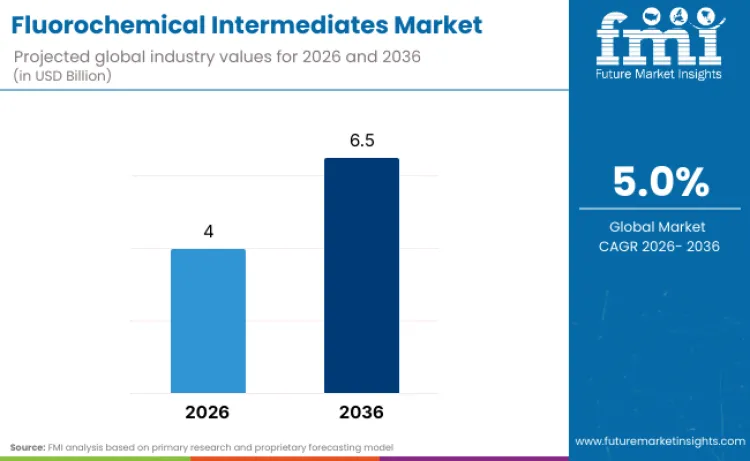
Future Market Insights expects the fluorochemical intermediates market to total USD 4.0 billion 2026, advancing to USD 6.5 billion by 2036, following a CAGR of 5.0%. Major fluorochemical producers are currently executing a pivot toward high-performance, low-GWP technologies while aggressively divesting or ceasing legacy forever chemical operations. Chemours has successfully operationalized a 40% capacity increase at its Corpus Christi facility to meet a surge in demand for Opteon™ refrigerant blends, driven by the USA AIM Act's strict transition timelines. This shift is mirrored by Honeywell's strategic separation of its Solstice Advanced Materials business in late 2025, creating a standalone entity focused on HFO technologies that reported billions in annual net sales prior to the spin-off.
Consolidation and portfolio high-grading characterize the current competitive landscape. Arkema reinforced its specialty position by finalizing the acquisition of Dow’s flexible packaging adhesives business and launching a new Rilsan® Clear transparent polyamide unit in Singapore. These moves focus on high-margin sectors like electrification and sports equipment. Solvay is actively contracting its legacy footprint, announcing the cessation of TFA and fluorinated derivative production at its Salindres and Bad Wimpfen sites by 2026 due to persistent unfavorable market conditions and increasing environmental scrutiny.
Operational strategies are influenced by rigorous regulatory compliance and sustainability benchmarks. Daikin has responded to these pressures by launching hydrocarbon-based, non-fluorinated processing aids and water repellents, moving away from traditional PFAS-containing formulations. Industry leaders are now committing to non-fluorosurfactant manufacturing processes for nearly their entire fluoropolymer portfolios by 2026. This reorganization of the supply chain reflects a broader transition where growth is concentrated in electronic-grade chemicals and thermal management solutions for data centers, while traditional intermediates volumes decline under tightening global refrigerant quotas.
The critical nature of this transition is underscored by the convergence of chemical manufacturing and the burgeoning artificial intelligence infrastructure sector, where specialized immersion cooling fluids are becoming essential for next-generation hardware. Denise Dignam, President and CEO of Chemours, emphasized this strategic alignment in an official 2025 disclosure:
"The fact is, next generation chips alone can't deliver the AI boom; the computing and resource demands created by this technology requires a new, integrated approach. Our deep expertise in cooling uniquely positions us to help bridge this gap. Innovative liquid cooling solutions, like Opteon™, can help significantly reduce data center total cost of ownership through decreased energy, water, space, maintenance and capex demands, all while enabling next generation chip capability. Partnering with Navin Fluorine enables us to meet this critical market need." - Denise Dignam, President and CEO, The Chemours Company (Source: Chemours News Release, 2025)
Summary of Fluorochemical Intermediates Market
What is Growth Outlook for Fluorochemical Intermediates Market as per Future Market Insights Projection?
Future Market Insights projects the fluorochemical intermediates market to expand at a CAGR of 5.0% from 2026 to 2036, increasing from USD 4.0 billion in 2026 to USD 6.5 billion by 2036.
FMI Research Approach: FMI proprietary forecasting model integrating semiconductor fabrication expansion, low-GWP refrigerant transition timelines, battery materials demand, and pharmaceutical fluorination intensity.
How do FMI Analysts Perceive Fluorochemical Intermediates Market to Evolve?
FMI analysts perceive the market evolving through a structural shift away from legacy PFAS-linked intermediates toward high-performance, compliance-aligned chemistries, where growth is increasingly concentrated in electronic-grade materials, low-GWP refrigerant intermediates, battery-grade fluorinated salts, and specialty pharmaceutical building blocks. Market value expansion is driven more by portfolio upgrading than by volume growth.
FMI Research Approach: Assessment of regulatory phase-out schedules, producer divestment strategies, and downstream qualification requirements across electronics, energy storage, and advanced cooling applications.
Which Country Holds Largest Share in Global Fluorochemical Intermediates Market?
China holds the largest share of the global fluorochemical intermediates market, supported by vertically integrated fluorochemical manufacturing, strong self-sufficiency mandates, and sustained investment in electronics, refrigerants, and battery material supply chains.
FMI Research Approach: Country-level modeling based on fluorochemical capacity, domestic substitution targets, and alignment with national industrial and technology self-reliance programs.
FMI Research Approach: Long-term revenue forecasting derived from semiconductor fab build-out schedules, low-GWP refrigerant conversion cycles, and battery and pharmaceutical materials demand.
What is the Definition of Fluorochemical Intermediates Market?
The fluorochemical intermediates market comprises fluorinated chemical building blocks used in the manufacture of high-performance materials, refrigerants, specialty polymers, battery components, and pharmaceutical compounds, delivering properties such as thermal stability, chemical resistance, dielectric performance, and enhanced bioavailability.
FMI Research Approach: FMI market taxonomy and inclusion-exclusion framework covering commercially scaled fluorinated intermediates across electronics, energy, healthcare, and industrial applications.
What are some Globally Unique Trends Shaping Fluorochemical Intermediates Market?
Globally unique trends include the exit of major producers from high-liability PFAS chemistries, accelerated adoption of low-GWP refrigerant intermediates, rising demand for ultra-high-purity electronic-grade fluorochemicals, and growing use of fluorinated salts and binders in next-generation lithium-ion batteries.
FMI Research Approach: Synthesis of regulatory developments, corporate restructuring activity, and technology adoption trends across major fluorochemical-producing regions.
Fluorochemical Intermediates Market Key Takeaways
| Metric | Value |
|---|---|
| Expected Value (2026E) | USD 4.0 billion |
| Projected Valued (2036F) | USD 6.5 billion |
| CAGR (2026-2036) | 5.0% |
Source: FMI analysis based on primary research and proprietary forecasting model
Why is the Fluorochemical Intermediates Market Growing?
Fluorochemical intermediates demand is set to expand through the 2026 fiscal year, enabled by the massive build-out of semiconductor fabrication facilities across the Asia-Pacific region and North America. Ultra-high purity etching gases such as nitrogen trifluoride and carbon tetrafluoride are seeing sustained demand as TSMC, Samsung, and Intel proceed with 90 new manufacturing projects. These facilities require materials that meet 99.999% purity standards to prevent organic extractables from compromising wafer lots, essentially turning specialized fluorochemical delivery systems into critical infrastructure for the global electronics supply chain.
Electrification and energy storage deployments provide a second significant growth pillar, particularly through the adoption of PVDF as a binder for lithium-ion battery cathodes. Kureha Corporation is currently executing a 70 billion yen capital investment at its Iwaki Factory to expand PVDF capacity, with commercial operations scheduled for 2026. This move aligns with growth trends for battery-grade adhesives as North American and European markets work to localize supply chains for electric vehicle gigafactories.
The pharmaceutical sector is also increasing its reliance on fluorinated intermediates to enhance drug efficacy and metabolic stability. Approximately 25% of newly approved small-molecule drugs now incorporate fluorine atoms to improve oral bioavailability and membrane permeability. This trend is expected to drive fluorinated drugs adoption, as manufacturers utilize late-stage fluorination techniques to develop targeted therapies for oncology and central nervous system disorders.
Segment Profile of Fluorochemical Intermediates Market
The following segmentation analysis delineates the primary categories and industrial applications currently influencing the global fluorochemical intermediates landscape. Each section highlights the specific market dynamics and technological shifts defining these individual sectors as they enter the 2026 fiscal year.
How is the Fluorinated Olefins and Monomers category evolving toward high-performance materials?
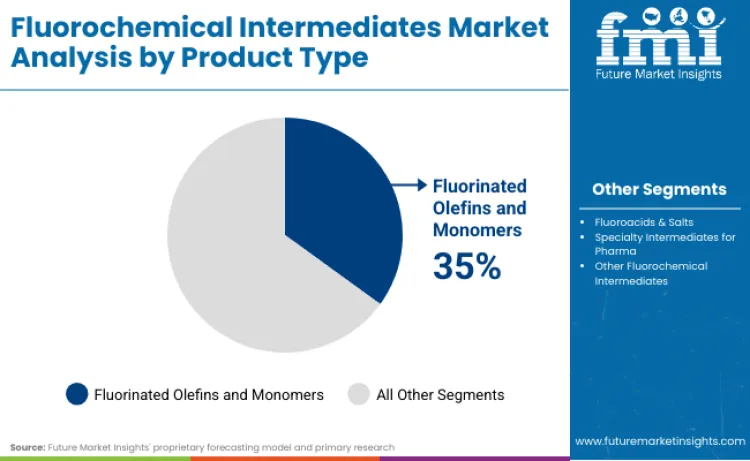
The dominance of fluorinated olefins and monomers, which currently accounts for a 35% market share, is supported by the rapid scale-up of next-generation polymer production for extreme-environment applications. These chemical building blocks serve as the foundation for high-margin products like FEP and ethylene ETFE, which are critical for wire and cable insulation in 5G infrastructure and aerospace systems. As global semiconductor manufacturing expands, the requirement for ultra-pure monomers that can withstand corrosive etching processes has prioritized the development of specialty monomer liquid crystals for advanced display panels and medical imaging sensors.
Growth within this segment is highlighted by the January 2026 commencement of operations at Arkema’s new Rilsan® Clear transparent polyamide unit in Singapore. This facility triples the group’s global production capacity for these specific high-performance polymers, targeting the rising need for sustainable, chemically resistant materials in the eyewear, AR/VR, and smart consumer electronics sectors. Additionally, the phase-out of legacy PFAS-based additives has led to a major industry shift toward novel monomer formulations that offer comparable thermal and chemical resistance while adhering to 2026 environmental compliance benchmarks.
Why is the Refrigerants and Blowing Agents segment transitioning to low-GWP alternatives?
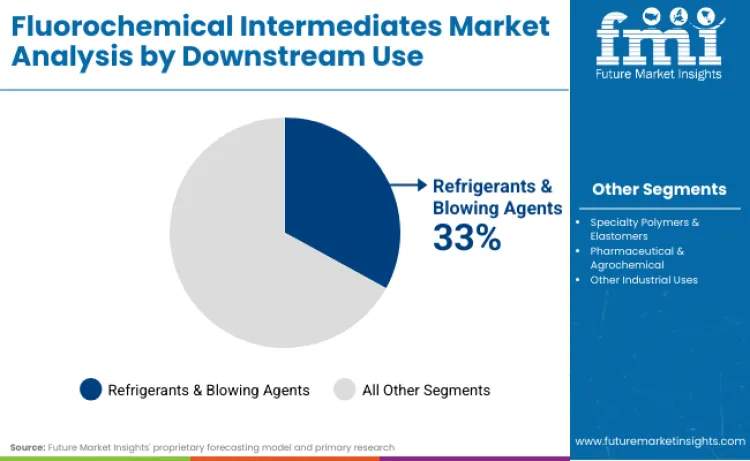
The refrigerants and blowing agents segment, representing a 33% market share, is undergoing a fundamental structural change as international mandates enforce the transition from high-GWP HFCs to HFOs. Under the American Innovation and Manufacturing (AIM) Act, the United States is implementing strict new limits starting January 1, 2026, requiring all new HVAC installations to comply with low-GWP standards. This regulatory hard-stop is accelerating the adoption of specialized intermediate blends that balance thermodynamic efficiency with significantly lower environmental impacts.
Major manufacturers have already standardized their product lines around R-32 and R-454B to comply with these looming 2026 deadlines, replacing legacy fluids like R-410A. The shift is further validated by the commercialization of Opteon™ two-phase immersion cooling technologies for data centers, which utilize low-GWP fluorinated fluids to manage the extreme heat generated by AI-optimized hardware. These developments ensure that while volume for traditional intermediates may contract, the value density of the segment increases through the adoption of more complex, patented chemical architectures designed for next-generation thermal management.
Can Electrochemical Fluorination maintain its lead through green chemistry?
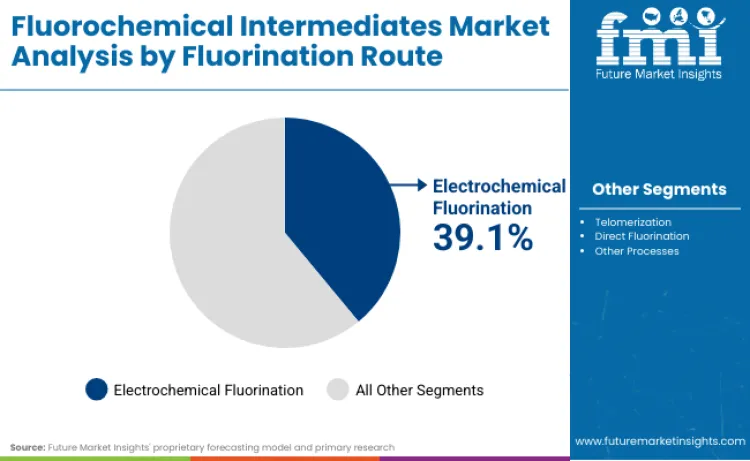
Electrochemical fluorination (ECF) remains the primary manufacturing route for a wide range of perfluorinated organic compounds, commanding a 39.1% share of the process market due to its ability to selectively replace hydrogen atoms with fluorine in complex molecules. This process is essential for the production of fluorinated solvents and electrolyte salts used in high-density lithium-based batteries and fuel cells. Despite its maturity, the technique is being refined to improve yields and reduce the formation of hazardous byproducts, as manufacturers face intensifying pressure to decarbonize their supply chains and improve process sustainability.
Recent milestones in green chemistry are redefining the operational footprint of this manufacturing route. Researchers at the Shibaura Institute of Technology in Japan developed a safer method for the synthesis of fluoride complexes for electrochemical fluorination in May 2025, utilizing common KF salt. This innovation overcomes previous solubility and moisture sensitivity barriers, allowing for the synthesis of pharmaceuticals and functional materials with a simplified, inexpensive ion-exchange reaction. This advancement positions the ECF route as a viable long-term solution for 2026 and beyond by eliminating the need for pressurized HF gas and corrosive liquid reagents.
What Drivers, Challenges, Opportunities and Trends exist in the Fluorochemical Intermediates Market?
Expansion is underpinned by the rapid localization of BESS supply chain and the integration of advanced chemical additives. In India, the 2026 Union Budget has introduced direct support for this sector by extending basic customs duty exemptions on capital goods used for manufacturing lithium-ion cells. This policy shift directly de-risks large-scale investments, such as Gujarat Fluorochemicals Limited's 6,000 crore rupee capital expenditure cycle focused on battery-grade PVDF and LiPF6. The resulting surge in domestic production capacity is timed to meet an expected tenfold increase in BESS capacity additions as projects transition from the tendering phase to active execution by early 2026.
Operational constraints are tightening as international regulatory bodies transition from substance-specific bans to broader chemical group restrictions. The ECHA proposal to restrict all per- and PFAS as a single class represents a fundamental challenge to legacy product lines, forcing a relocation of research priorities toward non-PFAS processing aids. Similarly, the Chinese Ministry of Ecology and Environment has established a 2026 deadline for the complete prohibition of HCFCs in industrial cleaning applications. These converging global mandates are compelling manufacturers to accelerate the decommissioning of older production assets and reallocate resources toward compliant alternatives.
The prevailing trend among market leaders is the strategic decoupling of advanced materials divisions to unlock higher valuation as pure-play entities. This was crystallized by Honeywell’s decision to spin off its Solstice Advanced Materials business in late 2025, allowing the new company to pursue focused innovation in HFO technology and high-purity electronic materials. Technical developments are concentrating on the performance limitations of electric vehicle batteries through the use of fluorinated lithium salts like LiFSI. These specialty intermediates are becoming essential for the next generation of 800-volt battery architectures, as they provide the interfacial stability required for fast-charging and high-voltage operations.
Fluorochemical Intermediates Profile in Key Countries
Fluorochemical intermediates landscape is characterized by a distinct divergence in regional strategies, where developed nations focus on high-value realignment and developing economies aggressively expand their industrial manufacturing bases. As the market enters the 2026 fiscal cycle, national growth rates are dictated by the interplay of domestic self-sufficiency targets, localized supply chain incentives, and large-scale infrastructure modernization.
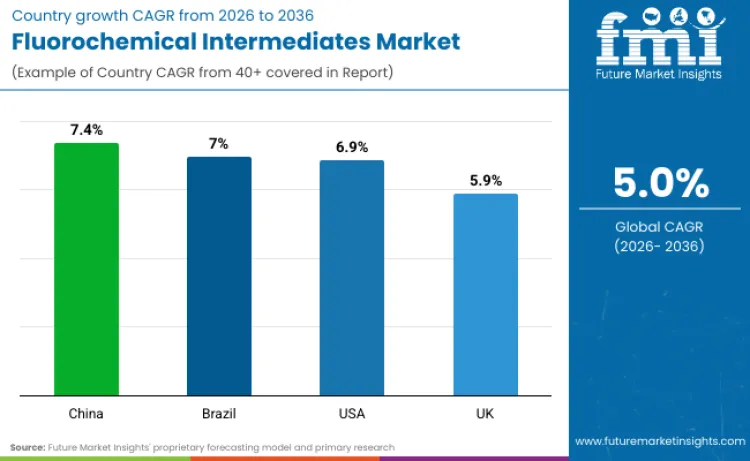
| Country | CAGR (2026-2036) |
|---|---|
| USA | 6.9% |
| UK | 5.9% |
| Brazil | 7.0% |
| China | 7.4% |
Source: Future Market Insights (FMI) analysis, based on proprietary forecasting model and primary research
How is USA’s Fluorochemical Intermediates Market securing Domestic Technology Resilience?
USA’s market is projected to grow at a CAGR of 6.9% through 2036, a trajectory underpinned by a decisive pivot toward reshoring critical manufacturing capabilities. Strategic industrial policies, reinforced by the acceleration of domestic semiconductor fabrication and automotive battery initiatives, have catalyzed a transformation in local asset utilization. In late 2024 and throughout 2025, the USA Environmental Protection Agency (EPA) facilitated this transition by expediting approvals for new chemical intermediates specifically designed to support the "closed-loop" manufacturing requirements of the domestic chip industry.
This growth is further characterized by a significant wave of corporate restructuring aimed at portfolio simplification. Major domestic entities are carving out non-core advanced materials divisions to create pure-play specialty chemical companies that are better equipped to navigate uneven industrial demand. By 2026, the market landscape is expected to favor these leaner, technology-focused organizations that can leverage USA feedstock cost advantages while meeting the stringent operational standards required for next-generation hardware and medical device components.
Why is UK’s Fluorochemical Intermediates Market recalibrating its Global Trade Architecture?
UK is expected to expand at a CAGR of 5.9% as manufacturers adapt to a more fragmented and complex international trading environment. With approximately 80% of local industrial firms reporting impacts from shifting tariffs and border rules, there is a clear strategic movement toward diversifying export destinations and strengthening trade relations with lower-risk geopolitical partners. This recalibration is designed to mitigate the friction of customs delays and inconsistent processes that have historically hindered high-volume chemical exports.
Despite these logistical headwinds, the UK sector remains focused on maintaining its competitive edge through specialization and outward-looking trade prospectives. By 2026, the industry is anticipated to prioritize seamless trading relationships and long-term partnerships that provide the certainty needed for sustained investment. This approach allows UK-based producers to remain essential contributors to the global supply chain, particularly in sectors that value regulatory stability and high-purity standards over sheer production volume.
Can Brazil leverage Fluorochemical Intermediaries Trends to Modernize its Industrial Chemistry Hubs?
Brazil, anticipated to grow at 7.0%, is currently defined by a massive 35.4 billion dollar infrastructure modernization strategy aimed at transforming its ports and airports into global trade hubs by 2026. This plan includes the auction of major logistics projects designed to boost trade routes and attract private capital into the country’s industrial heartlands. The integration of advanced manufacturing infrastructure is expected to enhance the country’s productivity and attractiveness to international investors who are looking for regionalized metal and chemical processing alternatives to traditional South Asian hubs.
However, the local industry faces a critical regulatory transition as it navigates the 2026 gap in the Special Chemical Industry Regime. The temporary removal of certain tax-relief provisions has prompted industry associations to advocate for urgent federal intervention to restore fiscal predictability. The resolution of this regulatory uncertainty is paramount for Brazil to maintain its competitive stance and avoid potential divestments, ensuring that its petrochemical and specialty chemical complexes can successfully transition to the more permanent sustainability programs scheduled for 2027.
Will China’s Self-sufficiency Mandates drive Expansion despite Global Overcapacity?
China maintains the highest growth projection at 7.4% as it formalizes its 15th Five-Year Plan from 2026-2030, which emphasizes indigenous innovation and technology self-sufficiency. The government’s Work Plan for Steady Growth in the Petrochemical and Chemical Industry mandates an average annual growth rate of over 5% in industry added value through 2026. This strategy is designed to elevate domestic self-sufficiency for critical intermediates from 85% to over 90%, effectively insulating the national economy from external supply chain disruptions and geopolitical shocks.
China is characterized by a focus on quality over quantity, where resources are being reallocated from traditional commodity sectors to high-value strategic materials. While the industry continues to add capacity in advanced manufacturing and green technologies, there is an intensifying effort to modernize traditional manufacturing through digitalization and structural upgrades. By the start of 2026, China’s role as a net exporter is expected to expand even further as it leverages its massive scale to compete aggressively in emerging markets across Southeast Asia and Latin America.
Competition in Fluorochemical Intermediates Market
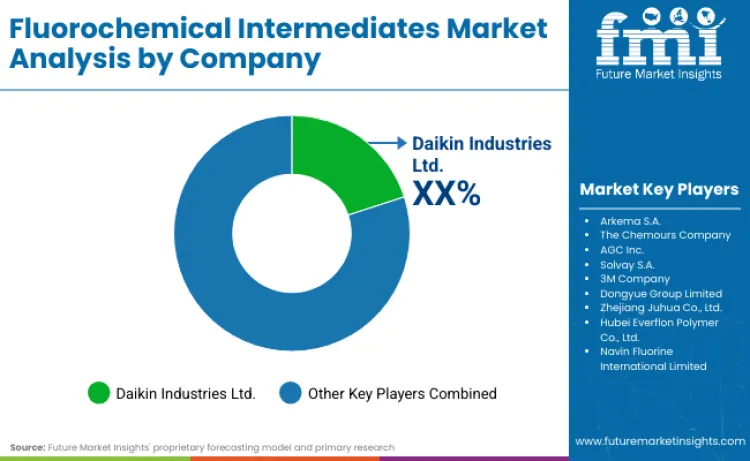
Competitive intensity in the fluorochemical intermediates market is characterized by a high-stakes transition from high-volume commodities to specialized, regulatory-compliant chemical architectures. In 2025, the landscape was defined by defensive maneuvers, as established leaders like 3M and Solvay initiated multi-billion dollar exits or asset impairments to distance themselves from legacy per- and PFAS liabilities.
This phase focused on portfolio stabilization and the realignment of manufacturing footprints toward regions with less immediate regulatory friction. In contrast, 2026 is emerging as an offensive cycle where competitive advantage is dictated by pure-play specialization and the ability to secure captive supply chains for emerging technology sectors like artificial intelligence and green hydrogen.
The distinction between 2025 and 2026 strategies reflects a shift from survival to strategic dominance. While 2025 was marked by a scramble to meet the initial 40% reduction in HFC quotas under the AIM Act, 2026 competition is centered on the rapid commercialization of HFO patents and high-purity etching gases for sub-5nm semiconductor fabrication.
Incumbents like Zhejiang Juhua and Dongyue Group have transitioned from being low-cost suppliers to technological frontrunners by aggressively verticalizing their operations, integrating fluorspar mining with advanced polymer refining. This vertical integration allows them to maintain price leadership even as Western competitors face rising capital expenditures for surfactant-free manufacturing conversions.
Key Developments
- 3M Company in January 2026 formally completed the total cessation of PFAS manufacturing across its global operations on schedule, affecting over 22,000 products and concluding a three-year exit strategy aimed at eliminating environmental liability from its core balance sheet.
- December 2025 saw AGC Inc. launched the AGC plus-2026 medium-term plan reallocating capital to mass produce EUV lithography photomask blanks and surfactant-free fluorinated resins for the semiconductor sector.
- In Decmeber 2025, Zhejiang Juhua Co., Ltd. secured an increased third-generation HFC production quota for 2026 as part of the Ministry of Ecology and Environment's 798,000-ton national limit, positioning the company to dominate the export market for compliant cooling fluids.
Key Players Profiled
- Daikin Industries Ltd.
- Arkema S.A.
- The Chemours Company
- AGC Inc.
- Solvay S.A.
- 3M Company
- Dongyue Group Limited
- Zhejiang Juhua Co., Ltd.
- Hubei Everflon Polymer Co., Ltd.
- Navin Fluorine International Limited
Market Definition
The fluorochemical intermediates market comprises fluorinated chemical building blocks used in the synthesis of high-performance materials, specialty chemicals, and advanced industrial products. These intermediates enable critical properties such as thermal stability, chemical resistance, low surface energy, and enhanced electrical or electrochemical performance. The market reflects a structural shift away from legacy PFAS-linked chemistries toward higher-value, specification-driven intermediates aligned with low-GWP refrigerants, advanced electronics, energy storage, and pharmaceutical innovation .
The report includes fluorinated olefins and monomers, fluoroacids and salts, battery-grade fluorinated lithium salts, electronic-grade etching and cleaning intermediates, and specialty fluorinated compounds used in refrigerants, blowing agents, polymers and elastomers, pharmaceuticals, agrochemicals, and other industrial applications. It covers production via electrochemical fluorination, telomerization, direct fluorination, and related industrial routes, focusing on commercially scaled, high-purity intermediates integrated into global manufacturing supply chains .
The scope excludes finished fluoropolymers, formulated end products, and downstream components, as well as legacy PFAS products undergoing regulatory phase-out without forward commercial relevance. It also excludes non-fluorinated chemical intermediates, pilot-scale or laboratory-only chemistries, mining of raw fluorspar, and recycling or destruction activities not directly linked to the manufacture of fluorochemical intermediates for industrial use.
Scope of Report
| Items | Values |
|---|---|
| Quantitative Units (2026) | USD 4.0 billion |
| Product Type | Fluorinated Olefins & Monomers, Fluoroacids & Salts, Specialty Intermediates for Pharma, Other Fluorochemical Intermediates |
| Downstream Use | Refrigerants & Blowing Agents, Specialty Polymers & Elastomers, Pharmaceutical & Agrochemical, Other Industrial Uses |
| Fluorination Route | Electrochemical Fluorination, Telomerization, Direct Fluorination, Other Processes |
| Regions Covered | North America, Western Europe, Eastern Europe, East Asia, South Asia & Pacific, Latin America, Middle East & Africa |
| Countries Covered | USA, UK, China, Brazil and 40+ Countries |
| Key Companies Profiled | Daikin Industries, Ltd., Arkema S.A., The Chemours Company, AGC Inc., Solvay S.A., 3M Company, Dongyue Group Limited, Zhejiang Juhua Co., Ltd., Hubei Everflon Polymer Co., Ltd., Navin Fluorine International Limited |
Source: FMI analysis based on primary research and proprietary forecasting model
Fluorochemical Intermediates Market by Key Segments
Product Type:
- Fluorinated Olefins & Monomers
- Fluoroacids & Salts
- Specialty Intermediates for Pharma
- Other Fluorochemical Intermediates
Downstream Use:
- Refrigerants & Blowing Agents
- Specialty Polymers & Elastomers
- Pharmaceutical & Agrochemical
- Other Industrial Uses
Fluorination Route:
- Electrochemical Fluorination
- Telomerization
- Direct Fluorination
- Other Processes
Region:
- North America
- Western Europe
- Eastern Europe
- East Asia
- South Asia & Pacific
- Latin America
- Middle East & Africa
Bibliography
- International Semiconductor Industry Association. (2025). Materials requirements and purity standards for advanced semiconductor manufacturing. Semiconductor Supply Chain Technical Report.
- Kureha Corporation. (2025). PVDF materials for lithium-ion batteries and advanced energy storage systems. Technical & Investor Disclosure.
- Ojima, I., Fluorine in medicinal chemistry: Recent advances. (2024). Journal of Fluorine Chemistry, 268, 110054.
- Shibata, K., Yamaguchi, S., & Watanabe, M. (2025). Safer electrochemical fluorination routes using inorganic fluoride salts. Green Chemistry, 27(6), 2891-2904.
- Zhang, H., Li, X., & Chen, Y. (2025). Fluorinated lithium salts and binders for high-voltage lithium-ion batteries. Progress in Energy and Combustion Science, 92, 101012.
Frequently Asked Questions
How large is the global fluorochemical intermediates market?
The fluorochemical intermediates market is valued at around USD 4.0 billion in 2026, supported by steady demand from electronics, refrigerants, batteries, and pharmaceutical manufacturing.
What end-use sectors are primarily driving demand for fluorochemical intermediates?
Refrigerants and blowing agents, specialty polymers and elastomers, battery materials, and pharmaceutical synthesis lead demand, where fluorination improves thermal stability, chemical resistance, or bioavailability.
Why is the market shifting away from legacy fluorochemical intermediates?
The market is moving away from legacy PFAS-linked intermediates due to tightening global regulations, rising compliance costs, and producer-led exits from high-liability product lines.
Which material types are gaining importance within fluorochemical intermediates?
Fluorinated olefins and monomers, low-GWP refrigerant intermediates, battery-grade fluorinated salts, and electronic-grade ultra-high-purity chemicals are gaining importance as higher-value, specification-driven materials.
What factors are constraining faster growth in this market?
Growth is constrained by regulatory uncertainty around fluorinated chemistries, high capital requirements for compliant production routes, and the ongoing need to redesign processes to meet evolving environmental and safety standards.
Preview the report firsthand - request a free sample
Get SampleGet the brochure for pricing and purchase details.
Get PDFTable of Content
- Executive Summary
- Fluorochemical Intermediates Market Forecast and Outlook (2026-2036)
- Why is the Fluorochemical Intermediates Market Growing?
- Semiconductor Fab Expansion and Ultra-high Purity Requirements
- Low-GWP Refrigerant Transition and Thermal Management Demand
- Battery Materials and Pharmaceutical Fluorination Intensity
- Segment Profile of Fluorochemical Intermediates Market
- By Product Type
- By Downstream Use
- By Fluorination Route
- What Drivers, Challenges, Opportunities and Trends exist in the Fluorochemical Intermediates Market?
- Regulatory Phase-outs and PFAS-linked Portfolio Exits
- Capacity Realignment toward High-value Intermediates
- Localization of Battery and Electronics Supply Chains
- Fluorochemical Intermediates Profile in Key Countries
- United States
- United Kingdom
- Brazil
- China
- Competition in Fluorochemical Intermediates Market
- Competitive Landscape
- Key Developments
- Key Players Profiled
- Daikin Industries Ltd.
- Arkema S.A.
- The Chemours Company
- AGC Inc.
- Solvay S.A.
- 3M Company
- Dongyue Group Limited
- Zhejiang Juhua Co., Ltd.
- Hubei Everflon Polymer Co., Ltd.
- Navin Fluorine International Limited
- Market Definition
- Scope of Report
- Fluorochemical Intermediates Market by Key Segments
- Bibliography
- Frequently Asked Questions (FAQs)


