

- Industry Size (2026)
- USD 11.9 Mn
- Forecast (2036)
- USD 93.0 Mn
- CAGR (2026 to 2036)
- 22.8%
Demand for Native Advertising in the UK 2026 to 2036
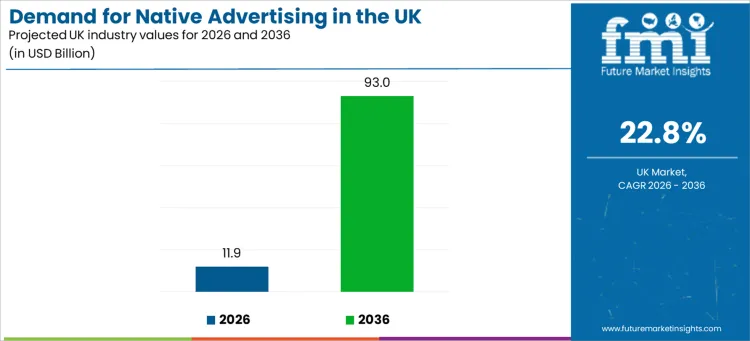
Demand for native advertising in the UK is expected to be valued at USD 11.9 million in 2026 and is forecasted to reach USD 93.0 million by 2036, at a CAGR of 22.8%. This demand is driven by the shift in how brands approach audience engagement across digital environments where attention is fragmented and tolerance for interruption is low. Native formats allow advertising to align with content presentation, reducing friction during consumption.
Adoption is shaped by changes in media consumption behavior. UK audiences spend extended time within social feeds, publisher platforms, and mobile content environments where standard display units deliver limited interaction. Native advertising supports contextual placement that mirrors editorial tone, layout, and pacing, enabling brand messages to sit naturally within user journeys. Advertisers prioritize formats that encourage reading, scrolling, and interaction without disrupting content flow.
Performance accountability reinforces uptake. Marketing teams rely on native formats that provide measurable engagement signals tied to dwell time, interaction depth, and downstream actions. Programmatic access to native inventory supports scale while preserving placement control and contextual relevance. Demand growth reflects how native advertising functions as a practical response to declining display effectiveness, balancing storytelling, audience alignment, and performance visibility within UK digital media strategies.
Quick Stats for Native Advertising Industry in the UK
- Native Advertising Industry Value (2026): USD 11.9 million
- Native Advertising Industry Forecast Value (2036): USD 93.0 million
- Native Advertising Industry Forecast CAGR 2026 to 2036: 22.8%
- Leading Ad Type by Demand Share: In-feed ad units
- Fastest-Growing Regions: England, Scotland, Wales, Northern Ireland
- Key Industry Participants: Taboola, Nativo, Sharethrough, AdPushup, Instinctive, IAB Playbook
Native Advertising Industry in the UK Key Takeaways
| Metric | Value |
|---|---|
| Industry Value (2026) | USD 11.9 million |
| Industry Forecast Value (2036) | USD 93.0 million |
| Forecast CAGR (2026 to 2036) | 22.8% |
Why is the UK Building Steady Demand for Native Advertising?
Brands and advertisers in the UK seek ways to connect with audiences without disrupting user experience, which makes native advertising attractive as it blends content with platform context. Publishers and platforms design native formats that reflect editorial tone or platform behaviour, helping advertisers present messages in ways audiences find less intrusive. This shift grows because attention has become a scarce commodity and native formats help secure engagement that feels natural rather than forced.
Digital consumption habits across the UK shape this demand. Audiences spend increasing time on social feeds, news sites and content platforms where traditional banner formats struggle to hold interest. Native advertising aligns with browsing behaviour by matching look and feel, encouraging deeper interaction. Marketers prioritize placements that integrate with user journeys, and native units enable storytelling that resonates with specific segments, from lifestyle communities to professional audiences.
Advertisers also focus on measurable outcomes tied to business objectives, pushing them toward formats that support performance tracking while preserving brand context. Native advertising enables click-through insights and engagement metrics embedded within content flows, giving teams clarity on what works and where to refine creative. Efficiencies in programmatic native supply help scale campaigns, strengthening uptake among UK advertisers who aim for relevance and measurable returns.
How is Native Advertising Demand Segmented by Type and Platform in the UK?
Demand for native advertising in the UK reflects how brands seek audience engagement that aligns with content consumption behaviour and platform governance. Segmentation patterns follow attention quality, integration depth, and control over placement environments rather than reach alone.
Why do in-feed ad units lead type-level adoption?
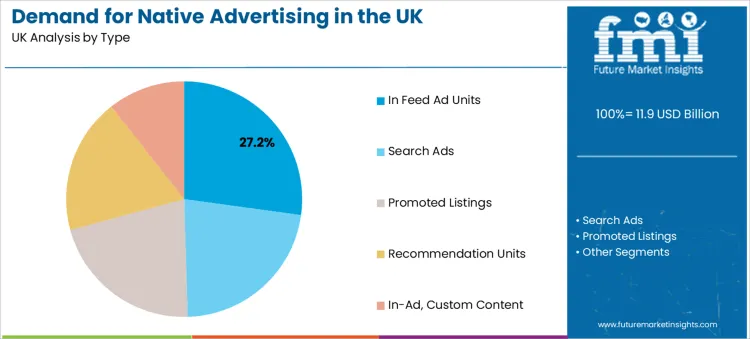
In-feed ad units hold a 27.2% share, placing them as the most selected native format. This preference reflects their ability to appear within editorial or social content streams without disrupting reading or scrolling behaviour. Advertisers value formats that match surrounding content structure, typography, and pacing, which supports higher dwell time and message absorption.
Creative teams also rely on in-feed units for flexibility in storytelling, allowing headline, visual, and call-to-action elements to be tuned to platform norms. Performance assessment benefits from clear engagement signals tied to scroll depth and interaction rather than click volume alone.
What positions closed platforms as the dominant delivery environment?
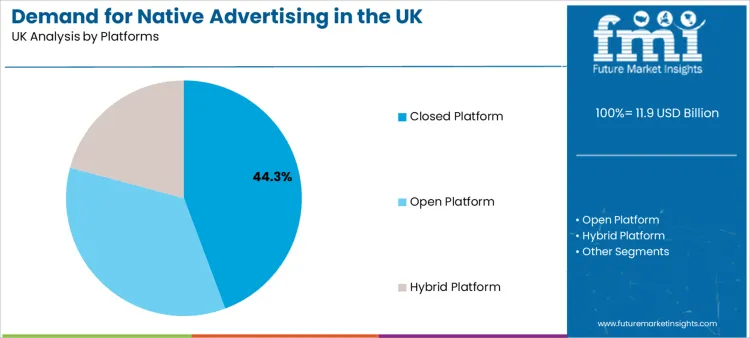
Closed platforms account for a 44.3% share, reflecting preference for controlled ecosystems with defined audience data and placement standards. These platforms offer integrated targeting, brand safety assurance, and measurement frameworks managed within a single environment. Advertisers gain confidence from predictable delivery conditions and reduced exposure to unsuitable content adjacency.
Operational simplicity also influences selection, since closed platforms centralise campaign setup, optimization, and reporting. This structure supports consistent execution across campaigns where message alignment and contextual relevance carry more weight than broad distribution.
What are the Key Dynamics in Demand for Native Advertising in the UK?
Demand for native advertising in the UK is driven by marketers’ need to engage audiences without interruptive messaging, particularly across digital content platforms, social media feeds, and publisher sites. Advertisers in retail, automotive, finance, and consumer goods sectors allocate spend to native formats that align with editorial tone and improve relevance to targeted audiences. Growth reflects shifts in consumer behavior toward mobile browsing and ad-supported content consumption, where traditional banner formats deliver lower engagement. UK brands emphasize measurable outcomes such as time-on-page, click-through rates and downstream conversion when evaluating native campaigns.
How do content consumption behaviors and platform ecosystems shape adoption?
UK audiences increasingly engage with content across social platforms, news aggregators, and search channels where in-feed native units blend with editorial experiences. Advertisers prioritize formats that deliver contextual relevance and non-disruptive integration, believing this enhances perception and reduces ad fatigue compared with conventional display. Retailers and FMCG (fast-moving consumer goods) brands integrate native content into lifestyle and review environments to support product discovery, especially where organic search behavior prevails. Media buyers value native placements that align with premium publisher environments, enabling sponsorship of long-form content and branded storytelling that resonates with target demographics without diminishing user experience. The rise of mobile and app usage in the UK increases exposure to native units that adapt to varied screen sizes and content flows, shaping campaign strategy around engagement and brand affinity.
How do measurement expectations and regulatory considerations influence demand?
Demand for native advertising in the UK is influenced by advertiser expectations for transparent performance measurement and compliance with advertising standards. Campaign planners focus on metrics that reflect meaningful interaction, such as dwell time and post-click engagement, to justify allocation of budgets away from traditional display or pre-roll video. Attribution models that link native placements with conversions and incremental revenue are prioritized in campaign reporting to demonstrate return on investment. Regulatory frameworks in the UK, including rules on ad disclosure, editorial separation, and clarity of paid content, shape how native ads are labeled and positioned to avoid misleading audiences. Advertiser and publisher adherence to self-regulatory codes affects creative execution and placement strategy, ensuring transparency while preserving content authenticity.
How is Native Advertising Demand Evolving across Key Regions in the UK?
Demand for native advertising across the UK accelerates as brands prioritize engagement quality, context relevance, and performance accountability. Regional variation reflects advertiser sophistication, publisher ecosystem depth, budget allocation models, and how teams integrate native formats into broader content, commerce, and attribution strategies.
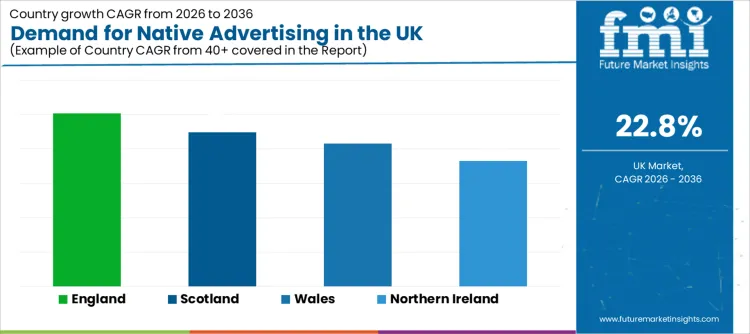
| Region | CAGR 2026 to 2036 |
|---|---|
| England | 25.1% |
| Scotland | 22.4% |
| Wales | 20.8% |
| Northern Ireland | 18.3% |
Why is England leading expansion through advertiser scale and publisher diversity?
England grows at 25.1%, supported by a dense concentration of national advertisers, media agencies, and premium publishers. Demand rises where brands deploy native formats to align storytelling with editorial environments and measurable outcomes. Buyers prioritize formats that scale across multiple publishers, support granular targeting, and integrate with analytics stacks that track engagement quality and downstream conversions.
How is Scotland progressing through focused adoption among regional brands and publishers?
Scotland expands at 22.4%, shaped by adoption among regional brands seeking stronger audience resonance. Demand builds where native placements complement trusted local media and deliver sustained attention. Advertisers value transparent labelling, consistent creative standards, and reporting that links content performance to brand lift and consideration within defined audience segments.
What is shaping Wales as advertisers emphasize efficiency and message fit?
Wales advances at 20.8%, driven by selective use among advertisers balancing reach with relevance. Demand strengthens when native executions align closely with publisher tone and audience interests. Decision-making centres on cost efficiency, creative adaptability, and clear performance signals that justify spend within tighter budget frameworks and shorter campaign cycles.
Why is Northern Ireland showing strong momentum tied to targeted campaigns?
Northern Ireland records 18.3% growth, reflecting targeted campaign strategies rather than broad-based buys. Adoption progresses where native advertising supports specific objectives such as awareness building or traffic generation. Demand improves when publishers offer dependable distribution, credible environments, and reporting that demonstrates audience engagement and message retention across focused placements.
What Defines the Competitive Landscape for Native Advertising in the UK?
Demand for native advertising in the UK is shaped by declining display performance, stricter privacy enforcement, and publisher monetization pressure. Advertisers evaluate native formats based on contextual relevance, brand safety controls, transparency in disclosure, and performance measurement beyond click-through rates. Buyer assessment includes integration with first-party data strategies, compatibility with consent frameworks, creative optimization support, and reach across premium UK publishers. Procurement behavior favors platforms offering measurable attention metrics, scalable inventory access, and compliance with UK advertising standards. Trend in the UK industry reflects migration toward content-led advertising aligned with editorial environments and reduced reliance on third-party cookies.
Taboola holds leading positioning in the UK through extensive publisher partnerships and large-scale native discovery distribution. Nativo competes by focusing on premium native placements integrated directly into publisher content management systems. Sharethrough maintains relevance via sustainability-focused ad formats and strong emphasis on attention-based measurement. AdPushup supports demand primarily through yield optimization and native monetization tools for publishers. Instinctive operates in niche, content-driven native executions, while IAB Playbook influences industry structure indirectly through standards and best-practice guidance rather than direct ad delivery. Competitive differentiation centers on publisher access quality, performance transparency, contextual targeting depth, and regulatory alignment.
Key Industry Participants
- Sharethrough, Inc.
- AdPushup Inc.
- Taboola, Inc.
- IAB Playbook
- Instinctive Inc.
- Nativo, Inc.
Scope of Report
| Items | Values |
|---|---|
| Quantitative Units | USD billion |
| Type | In Feed Ad Units; Search Ads; Promoted Listings; Recommendation Units; In-Ad, Custom Content |
| Platforms | Closed Platform; Open Platform; Hybrid Platform |
| Regions Covered | England; Scotland; Wales; Northern Ireland |
| Key Companies Profiled | Sharethrough, Inc.; AdPushup Inc.; Taboola, Inc.; IAB Playbook; Instinctive Inc.; Nativo, Inc. |
Native Advertising Demand in the UK by Segments
Type:
- In Feed Ad Units
- Search Ads
- Promoted Listings
- Recommendation Units
- In-Ad, Custom Content
Platforms:
- Closed Platform
- Open Platform
- Hybrid Platform
By Region:
- England
- Scotland
- Wales
- Northern Ireland
Bibliography
- Advertising Standards Authority. (2023). Native advertising: Guidance on disclosure and transparency. ASA.
- Competition and Markets Authority. (2023). Online choice architecture and consumer protection. UK Government.
- Information Commissioner’s Office. (2023). Guidance on the use of cookies and similar technologies. UK Government.
- OECD. (2023). Transparency and consumer trust in digital advertising ecosystems. OECD Publishing.
Frequently Asked Questions
How big is the demand for native advertising in the uk in 2026?
The demand for native advertising in the uk is estimated to be valued at USD 11.9 billion in 2026.
What will be the size of native advertising in the uk in 2036?
The market size for the native advertising in the uk is projected to reach USD 93.0 billion by 2036.
How much will be the demand for native advertising in the uk growth between 2026 and 2036?
The demand for native advertising in the uk is expected to grow at a 22.8% CAGR between 2026 and 2036.
What are the key product types in the native advertising in the uk?
The key product types in native advertising in the uk are in feed ad units, search ads, promoted listings, recommendation units and in-ad, custom content.
Which platforms segment is expected to contribute significant share in the native advertising in the uk in 2026?
In terms of platforms, closed platform segment is expected to command 44.3% share in the native advertising in the uk in 2026.
Preview the report firsthand - request a free sample
Get SampleGet the brochure for pricing and purchase details.
Get PDFTable of Content
- Executive Summary
- UK Market Outlook
- Demand-side Trends
- Supply-side Trends
- Technology Roadmap Analysis
- Analysis and Recommendations
- Market Overview
- Market Coverage / Taxonomy
- Market Definition / Scope / Limitations
- Market Background
- Market Dynamics
- Drivers
- Restraints
- Opportunity
- Trends
- Scenario Forecast
- Demand in Optimistic Scenario
- Demand in Likely Scenario
- Demand in Conservative Scenario
- Opportunity Map Analysis
- Product Life Cycle Analysis
- Supply Chain Analysis
- Investment Feasibility Matrix
- Value Chain Analysis
- PESTLE and Porter’s Analysis
- Regulatory Landscape
- Regional Parent Market Outlook
- Production and Consumption Statistics
- Import and Export Statistics
- Market Dynamics
- UK Market Analysis 2021 to 2025 and Forecast, 2026 to 2036
- Historical Market Size Value (USD Million) Analysis, 2021 to 2025
- Current and Future Market Size Value (USD Million) Projections, 2026 to 2036
- Y-o-Y Growth Trend Analysis
- Absolute $ Opportunity Analysis
- UK Market Pricing Analysis 2021 to 2025 and Forecast 2026 to 2036
- UK Market Analysis 2021 to 2025 and Forecast 2026 to 2036, By Type
- Introduction / Key Findings
- Historical Market Size Value (USD Million) Analysis By Type , 2021 to 2025
- Current and Future Market Size Value (USD Million) Analysis and Forecast By Type , 2026 to 2036
- In Feed Ad Value (USD Million)s
- Search Ads
- Promoted Listings
- Recommendation Value (USD Million)s
- In-Ad, Custom Content
- In Feed Ad Value (USD Million)s
- Y-o-Y Growth Trend Analysis By Type , 2021 to 2025
- Absolute $ Opportunity Analysis By Type , 2026 to 2036
- UK Market Analysis 2021 to 2025 and Forecast 2026 to 2036, By Platforms
- Introduction / Key Findings
- Historical Market Size Value (USD Million) Analysis By Platforms, 2021 to 2025
- Current and Future Market Size Value (USD Million) Analysis and Forecast By Platforms, 2026 to 2036
- Closed Platform
- Open Platform
- Hybrid Platform
- Closed Platform
- Y-o-Y Growth Trend Analysis By Platforms, 2021 to 2025
- Absolute $ Opportunity Analysis By Platforms, 2026 to 2036
- Market Structure Analysis
- Competition Dashboard
- Competition Benchmarking
- Market Share Analysis of Top Players
- By Regional
- By Type
- By Platforms
- Competition Analysis
- Competition Deep Dive
- Sharethrough, Inc.
- Overview
- Product Portfolio
- Profitability by Market Segments (Product/Age /Sales Channel/Region)
- Sales Footprint
- Strategy Overview
- Marketing Strategy
- Product Strategy
- Channel Strategy
- AdPushup Inc.
- Taboola, Inc.
- IAB Playbook
- Instinctive Inc.
- Nativo, Inc.
- Sharethrough, Inc.
- Competition Deep Dive
- Assumptions & Acronyms Used
- Research Methodology


