

- Industry Size (2026)
- USD 92.4 Mn
- Forecast (2036)
- USD 685.7 Mn
- CAGR (2026 to 2036)
- 22.1%
Lab-Grown Leather Alternative Apparel Market Size, Market Forecast and Outlook By FMI
The lab-grown leather alternative apparel market was valued at USD 78.5 million in 2025. The sector is poised to cross USD 92.4 million in 2026 at a CAGR of 22.1% during the forecast period. Rising investment propels the valuation to USD 685.7 million through 2036 as luxury fashion conglomerates seek drop-in replacements for exotic skins that meet tightening ESG shareholder mandates without sacrificing the biochemical aging properties of natural animal hide.
Evaluating the true lab-grown leather alternative apparel market size requires looking beyond seasonal marketing novelties. Material sourcing directors at tier-1 fashion houses are now treating the lab-grown leather alternative apparel as a primary supply chain risk-mitigation asset against future Scope 3 emissions taxes. If they delay this qualification, they risk relying on volatile traditional agricultural supply chains that face increasing land-use penalties. The real commercial value of these sustainable leather alternatives lies in the ability to engineer uniform thickness and eliminate natural scarring, drastically reducing cutting-room waste. The drive toward standardized leather goods is fundamentally reshaping early-stage garment prototyping.
Summary of Lab-Grown Leather Alternative Apparel Market
- Lab-Grown Leather Alternative Apparel Market Definition
- Functional apparel and accessories built from biofabricated cellular matrices, specifically engineered to replicate animal hide without agricultural inputs, bridging biotechnology and high-end fashion manufacturing.
- Demand Drivers in the Market
- Aggressive corporate ESG mandates compel luxury conglomerate sourcing directors to qualify biological alternatives to high-impact calfskin.
- Supply chain volatility pushes procurement teams to seek sustainable luxury fashion materials with predictable yields and zero natural scarring.
- Emerging extended producer responsibility frameworks require fashion designers to transition away from unrecyclable petrochemical-based synthetic alternatives.
- Key Segments Analyzed in the FMI Report
- Cultured Collagen Leather: Cultured Collagen Leather is poised to dominate with 41.6% share in 2026, as it can be tanned and finished using existing heritage tannery infrastructure without requiring fundamentally new machinery.
- Cell Culture Bioreactor Production: Cell Culture Bioreactor Production is expected to lead by 2026, driven by the absolute necessity to achieve continuous yield scaling beyond what static tray fermentation allows.
- Luxury Fashion Apparel: Luxury Fashion Apparel is likely to hold 44.8% share in 2026, because only luxury margins can currently absorb the premium per-meter cost of pilot-stage biofabricated materials.
- Designer Fashion Houses: Designer Fashion Houses are set to garner 37.9% share in 2026, utilizing exclusive supplier partnerships to lock in the limited early-stage bioreactor capacity.
- United States: 23.8% compound growth, propelled by the concentration of deep-tech venture capital funding specialized cellular agriculture infrastructure.
- Analyst Opinion at FMI
- Ronak Shah, Principal Analyst, Consumer Product, at FMI, states, "The generalist assumption focuses heavily on the consumer's desire for animal-free products. However, the actual inflection point for procurement directors is waste reduction. Natural hides yield about 60-70% usable material due to irregular shapes and scarring. Biofabricated leather offers perfect rectangular sheets of uniform thickness, functionally eliminating cutting room waste and completely shifting the margin calculus for luxury leather goods."
- Strategic Implications / Executive Takeaways
- Biotechnology founders must secure binding capacity-reservation agreements with tier-1 brands to unlock the capital required for commercial-scale facility construction.
- Heritage tannery operators should adapt their finishing chemistries to process lab-grown collagen matrices to avoid being bypassed by direct-to-brand biofabrication pipelines.
- Luxury brand material buyers face intense early-stage capacity constraints that require equity investments in startups to guarantee their future supply.
- Methodology
- Primary Research: Direct interviews with advanced material sourcing heads and bio-process engineers.
- Desk Research: Aggregation of patent landscapes, biotech scale-up blueprints, and brand sustainability reports to determine lab-grown leather alternative apparel market trends.
- Market-Sizing and Forecasting: Capacity-driven modeling based on announced bioreactor volume and premium material yield rates.
- Data Validation and Update Cycle: Continual tracking of series funding rounds and facility commissioning dates.
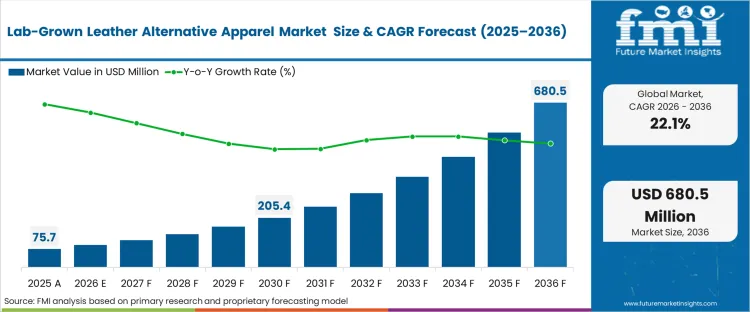
Lab-Grown Leather Alternative Apparel Market Key Takeaways
| Metric | Details |
|---|---|
| Industry Size (2026) | USD 92.4 million |
| Industry Value (2036) | USD 685.7 million |
| CAGR (2026-2036) | 22.1% |
Source: Future Market Insights (FMI) analysis, based on proprietary forecasting model and primary research
The future of cultured leather depends entirely on the industry's ability to transition from batch-level scaffold tissue engineering to continuous sheet biofabrication. Bioreactor operators trigger this inflection point once capital expenditure allows for facilities capable of producing thousands of square meters predictably. Once this capacity gate is crossed, heritage tanneries can integrate these biotechnology materials in fashion directly into their existing finishing infrastructure without expensive retooling.
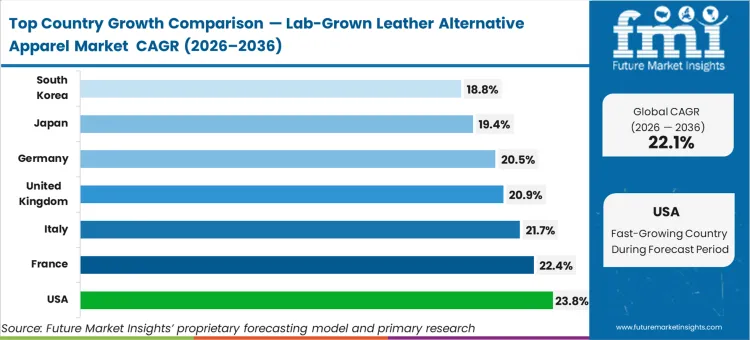
The lab-grown leather alternative apparel market CAGR forecast tracks the United States at 23.8%, followed by France at 22.4%, Italy at 21.7%, the United Kingdom at 20.9%, Germany at 20.5%, Japan at 19.4%, and South Korea at 18.8%. This geographic divergence reflects a split between the venture-backed biotechnology hubs developing the raw intellectual property and the European heritage design centers controlling the final commercial deployment.
Lab-Grown Leather Alternative Apparel Market Definition
To answer what is lab-grown leather, the market encompasses garments and accessories constructed from materials engineered in controlled laboratory environments to replicate the biochemical properties of animal hide. This explicitly differentiates the space from petroleum-based synthetic polyurethanes, focusing strictly on cellular agriculture, mycelium fermentation, and biofabricated collagen matrices that form genuine biotech leather materials.
Lab-Grown Leather Alternative Apparel Market Inclusions
Scope includes luxury fashion lines, outerwear, footwear, and accessories manufactured using cell-cultured collagen, scaffold-based tissue engineering, and biofabricated mycelium hybrids. It covers both limited-edition capsule collections and emerging core seasonal lines that integrate biofabricated leather clothing and vegan leather produced through direct biological synthesis rather than petrochemical extrusion.
Lab-Grown Leather Alternative Apparel Market Exclusions
The market explicitly excludes traditional animal-derived leather, polyurethane (PU) and polyvinyl chloride (PVC) synthetic leathers, and plant-based composites (such as apple or cactus leather) that rely on plastic binders for integrity. Clarifying the lab grown leather vs traditional leather boundary, these materials are excluded because they either depend on traditional agricultural supply chains or fail to solve the end-of-life microplastic pollution problem inherent to synthetics.
Lab-Grown Leather Alternative Apparel Market Research Methodology
- Primary Research: Chief Sustainability Officers and Material Innovation Directors at global luxury fashion conglomerates, alongside technical founders at biotechnology startups.
- Desk Research: Intellectual property filings, venture capital funding announcements, and pilot facility capacity disclosures mapping the biofabricated materials fashion market.
- Market-Sizing and Forecasting: Baseline sizing anchors to disclosed pilot production capacities, multiplied by the cultured leather price per square meter equivalents in the premium sector.
- Data Validation and Update Cycle: Forecasts are triangulated against the capital deployment schedules of major bio-fabrication facility construction projects.
Segmental Analysis
Lab-Grown Leather Alternative Apparel Market Analysis by Material Type
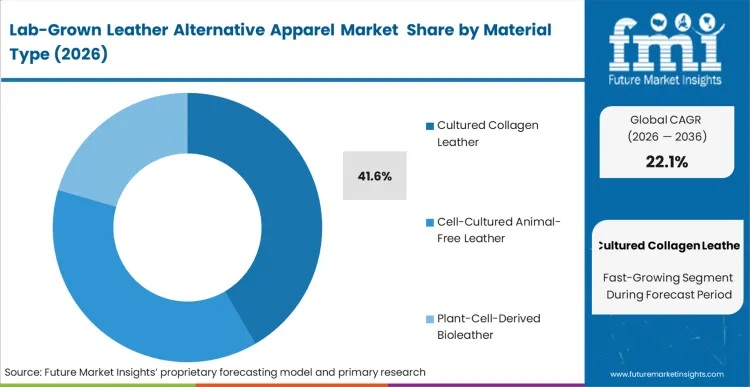
Cultured collagen leather segment is estimated to secure around 41.6% of the market in 2026, due to unique compatibility with legacy supply chains. Rather than forcing brands to invent entirely new fabrication techniques, cultured collagen leather technology provides the exact same biochemical triple-helix structure as calfskin. FMI projects that this drop-in capability allows the world’s oldest tanneries to apply their proprietary heritage finishes directly to a biofabricated collagen material. Material innovation directors rely on this continuity to maintain the specific hand-feel and aging characteristics that define their luxury margins. When companies explore mycelium leather, they often encounter differing tensile behaviors that require significant pattern re-engineering. Facilities that delay qualifying cultured collagen specifically face the operational burden of running parallel, incompatible manufacturing lines.
- Biochemical parity: Cultured collagen exactly mimics the protein structure of natural hide. This allows brands to maintain their exact quality standards without consumer pushback.
- Infrastructure compatibility: The material accepts traditional tanning and finishing chemistries. Supply chain directors avoid massive capital expenditures on new specialized finishing equipment.
- Yield predictability: Biofabricated sheets are grown to exact dimensional specifications. Procurement teams functionally eliminate the 30% scrap rate inherent in natural hide cutting.
Lab-Grown Leather Alternative Apparel Market Analysis by Production Technology
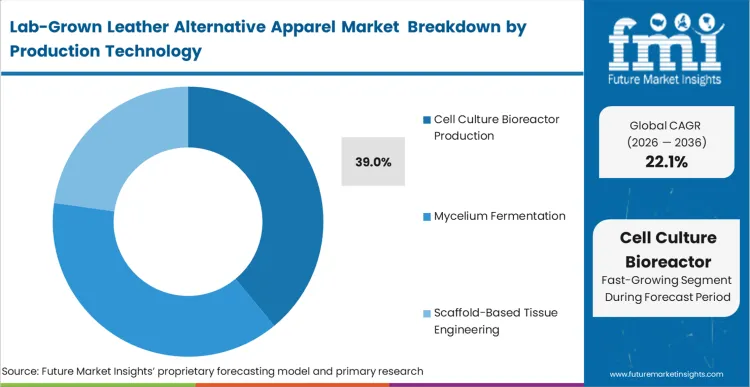
Early static-tray fermentation methods failed to deliver the throughput required for anything beyond limited capsule collections, forcing the shift toward cell cultured leather production. Capturing a dominant 46.3% share in 2026, the cell cultured leather production tech leads because continuous or high-density bioreactor systems are the only proven pathway to driving down the lab-grown leather cost per square meter at scale. According to FMI's estimates, biotechnology operators are aggressively transitioning from pilot-scale tissue engineering scaffolds to massive stirred-tank bioreactors to achieve true commercial viability and support this high volume. Engineering directors at these well-funded startups are optimizing the lab-grown leather production process to accelerate collagen network assembly without compromising the required tensile strength. If these operators fail to successfully commission large-scale bioreactors, they remain permanently stuck as niche R&D labs rather than viable tier-1 suppliers to the sustainable fashion industry.
- Capacity scaling: Bioreactors shift production from discrete batches to continuous yields. Operations managers can finally fulfill the volume requirements of core seasonal lines.
- Media optimization: Closed-loop systems allow precise control over the nutrient environments feeding the cells. Production engineers guarantee absolute consistency in material thickness and strength across every run.
- CapEx amortization: High-throughput systems distribute the initial facility cost over massively larger volumes. Financial directors can project a credible timeline to price parity with premium natural hides.
Lab-Grown Leather Alternative Apparel Market Analysis by Apparel Category
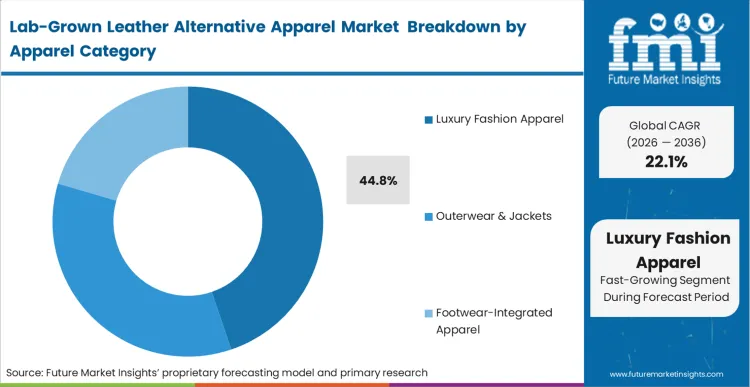
Apparel development teams are currently deciding whether to restrict biofabricated materials to accessories or integrate them into core Luxury Fashion Apparel, a segment holding 44.8% share. This segment leads simply because the current yield costs of cellular agriculture can only be absorbed by luxury fashion biomaterials commanding ultra-premium retail margins. As per FMI's projection, luxury houses are using these lab-grown leather applications as halo products to validate their ESG commitments to institutional shareholders. Sourcing directors must carefully allocate their limited supply of these bio-materials to high-visibility runway pieces rather than high-wear everyday garments. Those who attempt to deploy these expensive bio-based textiles into lower-margin categories too early face immediate margin collapse.
- Margin absorption: Luxury pricing models can hide the currently high cost of lab-grown materials. Financial planners deploy these textiles without triggering a retail price shock for the consumer.
- Brand positioning: First-mover integration establishes a brand as a technological pioneer. Marketing directors capture significant earned media while fulfilling strict corporate sustainability mandates.
- Performance validation: High-end garments see less abrasive wear than mass-market footwear. Product developers can safely validate the material's long-term durability in controlled use-cases.
Lab-Grown Leather Alternative Apparel Market Analysis by Distribution Channel
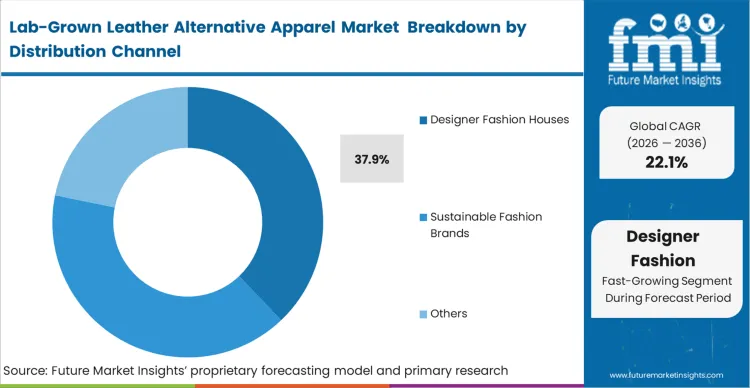
The distribution of these materials is moving away from experimental pop-up shops directly into the permanent supply networks of Designer Fashion Houses. The segment holds 37.9% share as these houses use their immense capital reserves to form exclusive, multi-year capacity agreements with specific biotech leather startups, functionally locking competitors out of the supply. Based on FMI's assessment, this monopolization of early yield means that independent plant-based leather innovators must align with massive conglomerates to survive the scale-up phase. Procurement heads dictate the R&D priorities of the biotech firms, focusing them strictly on luxury requirements. Independent brands that wait for open-market availability discover that all tier-1 biofabricated capacity is contractually restricted until the next decade.
- Capital deployment: Fashion houses provide the upfront funding required to build bioreactor facilities. Biotech founders secure their scale-up runway without relying entirely on volatile venture capital.
- Exclusive alignment: Conglomerates lock in multi-year purchase agreements for total facility output. Strategic sourcing directors gain a distinct competitive advantage in the premium sustainable materials space.
- Design integration: Direct collaboration allows materials to be engineered for specific aesthetic requirements. Creative directors dictate exact drape and grain specifications before the material is even grown.
Lab-Grown Leather Alternative Apparel Market Drivers, Restraints, and Opportunities
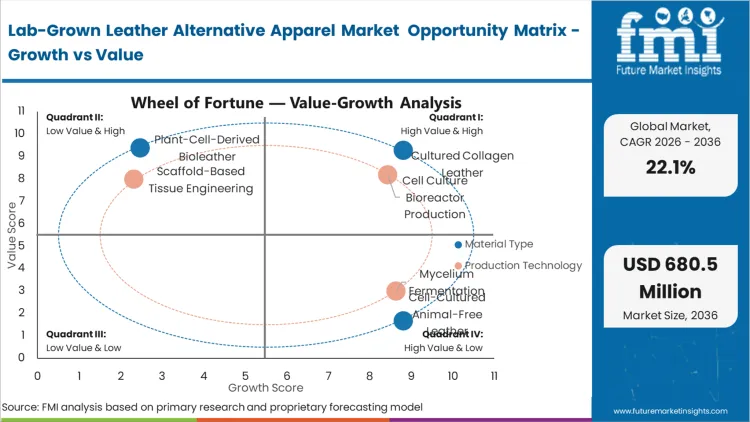
Aggressive corporate ESG mandates and looming extended producer responsibility frameworks compel sourcing directors to conduct rigorous cultured leather sustainability analysis. These executives face intense pressure from institutional investors to decarbonize Scope 3 emissions, generating massive lab grown leather environmental benefits. They cannot substitute premium leather with unrecyclable petrochemical synthetics without damaging brand equity, forcing procurement teams to actively fund cellular agriculture solutions that promise the performance of natural hide with a fraction of the lab grown leather environmental impact. Delaying this transition leaves brands exposed to tightening regulatory penalties regarding agricultural supply chains and deforestation links.
The single biggest friction in the lab grown leather supply chain is the massive capital expenditure and technical risk associated with scaling bioreactor throughput. While pilot facilities can produce flawless material for limited-edition capsule collections, translating cultured leather technology innovation to continuous commercial-scale yield remains an immense bio-processing challenge. Engineering directors struggle to maintain integrity and collagen cross-linking when moving from static trays to dynamic, high-volume environments. Although strategic partnerships with deep-pocketed fashion apparel groups provide some financial runway, the absolute scarcity of commercial-grade production capacity restricts broader market adoption.
Opportunities in the Lab-Grown Leather Alternative Apparel Market
- Bespoke engineering: Biofabricated fashion innovation allows control over density and flexibility at the cellular level. Footwear designers can request materials that are rigid at the heel but highly supple at the toe, all grown in a single continuous sheet.
- Zero-waste pattern integration: Growing materials to exact dimensional specifications eliminates cutting room scrap. Operations managers drastically reduce their raw material spend by purchasing only the exact square footage required for the final garment.
- Heritage finishing adaptation: Traditional tanneries hold centuries of expertise in finishing and texturing. Tannery operators who adapt their proprietary chemistries to process luxury apparel biomatrices capture a new, high-margin revenue stream.
Regional Analysis
.webp "Top Country Growth Comparison Lab Grown Leather Alternative Apparel Market Cagr (2026 2036)")
Based on the regional analysis, the lab-grown leather alternative apparel market is segmented into North America, Europe, Asia Pacific, and other regions across 40 plus countries.
| Country | CAGR (2026 to 2036) |
|---|---|
| United States | 23.8% |
| France | 22.4% |
| Italy | 21.7% |
| United Kingdom | 20.9% |
| Germany | 20.5% |
| Japan | 19.4% |
| South Korea | 18.8% |
Source: Future Market Insights (FMI) analysis, based on proprietary forecasting model and primary research
North America Lab-Grown Leather Alternative Apparel Market Analysis
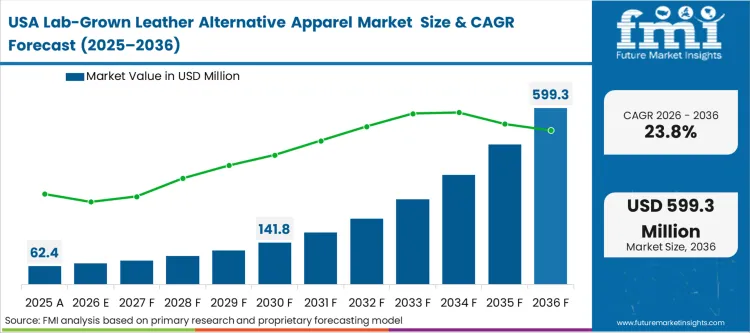
The trajectory in North America is defined by the heavy concentration of deep-tech venture capital required to fund high-CapEx cellular agriculture infrastructure. Unlike regions focused primarily on the aesthetic application of these materials, the cultured leather industry analysis in North America reveals an ecosystem operating at the foundational biotechnology level, driven by intense lab-grown leather alternative apparel market growth in bioreactor scaling and media formulation. FMI analysts opine that this capital density allows domestic startups to aggressively iterate their bio-processes without immediately requiring retail profitability. Sourcing directors within this environment prioritize securing intellectual property rights and scaling continuous manufacturing models. The focus remains heavily on pushing down the cost curve of eco-friendly textiles to prepare for global commercialization.
- United States: The concentration of specialized biotechnology investors in the United States enables startups to fund the critical transition from pilot scale to commercial bioreactors, creating a major lab-grown leather alternative apparel investment opportunity. Domestic bio-process engineers leverage existing talent pools from the pharmaceutical and alternative protein sectors to accelerate collagen network assembly. The demand for lab-grown leather alternative apparel in US is projected to witness growth at a CAGR of 23.8% through 2036. Companies that establish domestic manufacturing footprints lock in localized supply chains, insulating themselves from international shipping volatility and foreign regulatory shifts.
Europe Lab-Grown Leather Alternative Apparel Market Analysis
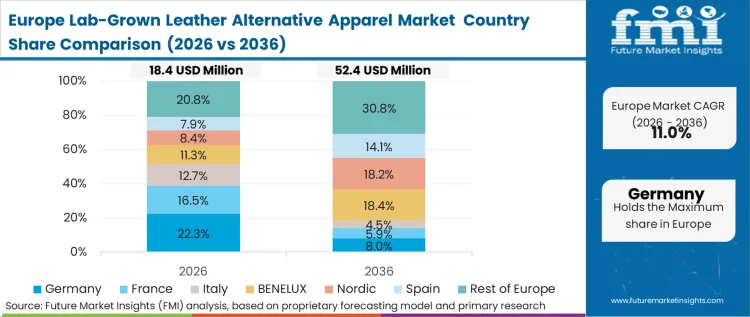
Europe adoption pattern is heavily shaped by the region's concentration of heritage luxury conglomerates reacting to tightening continental ESG directives. The regulatory environment fundamentally penalizes linear, high-impact agricultural supply chains, forcing material sourcing heads to aggressively secure sustainable alternatives. However, the region's primary leverage is not in biotechnology development, but in its unparalleled control over lab-grown leather alternative apparel adoption luxury brands. FMI's report indicates that European fashion houses dictate the exact tensile and grain requirements that global biotech startups must meet. The integration of biotechnology materials happens entirely on the terms set by centuries-old design institutions.
- France: Dominance of France market in the global luxury sector forces its major conglomerates to lead the integration of biofabricated materials to satisfy institutional shareholder ESG demands. Material innovation directors at tier-1 houses are moving beyond experimental drops, signing exclusive off-take agreements with biomaterial developers to secure future supply. France is expected to see its sector grow at a compound annual rate of 22.4%. This proactive capacity lock-up creates a significant competitive gap, leaving mid-tier brands without access to premium cellular leather until the next decade.
- Italy: The traditional tanning infrastructure in Italy presents a unique adaptation challenge, as heritage facilities must pivot to process lab-grown substrates. Tannery operators who successfully modify their finishing chemistries to accept cultured collagen secure highly lucrative contracts with major design houses. A CAGR of 21.7% is expected for Italy over the forecast period. This operational evolution transitions tanneries from relying on volatile agricultural inputs to operating as high-tech finishing hubs for engineered biological materials.
- United Kingdom: Procurement practices in the United Kingdom are increasingly influenced by stringent retail sustainability frameworks that penalize the use of unrecyclable plastics. British designers are leveraging biofabricated hybrids to replace synthetic leather in premium outerwear, addressing both animal welfare and microplastic concerns simultaneously. The UK landscape is set to achieve a CAGR of 20.9%. The swift adoption of these materials functionally simplifies brand compliance with emerging circular economy mandates.
- Germany: Germany's advanced industrial engineering sector focuses on the automation and scale-up mechanics of the bioreactor hardware itself. Operations managers apply automotive-level precision to fluid dynamics and tissue scaffolding, driving efficiencies in the physical production process. Demand for lab-grown alternatives in Germany is estimated to expand at a CAGR of 20.5%. By refining the manufacturing hardware, German engineering firms position themselves as the critical infrastructure providers for the global bio-textile industry's next growth phase.
Asia Pacific Lab-Grown Leather Alternative Apparel Market Analysis
The Asia Pacific dynamic is governed by the region's aggressive transition from traditional textile mass-manufacturing to advanced, high-performance materials engineering. As Western brands seek scaled production of bio-based goods, Asian infrastructure is pivoting to accommodate precision cellular agriculture alongside its existing synthetic capabilities. In FMI's view, the region utilizes its highly optimized supply chain logistics and massive industrial parks to transition bio-processes from lab-scale prototypes to massive continuous-yield facilities, boosting the lab-grown leather alternative apparel demand forecast. Sourcing heads in this region are rapidly qualifying new biopolymer supply routes to maintain their status as the primary execution hub for global fashion brands.
- Japan: Japan's deep expertise in precision fermentation and advanced material science allows its domestic innovators to engineer highly specialized mycelium and collagen hybrids. Technical directors leverage the country's legacy in biological engineering and chemical engineering to create substrates with hyper-specific stretch and durability profiles. The Japanese market for lab-grown apparel is likely to post a CAGR of 19.4%. This capability allows Japan to dominate the ultra-premium niche of bio-materials, capturing contracts that require exactingly precise tolerances.
- South Korea: South Korea's highly integrated tech-and-textile ecosystem enables rapid prototyping of biomaterials for fashion industry directly into consumer-ready streetwear and performance gear. Supply chain managers coordinate tight feedback loops between biotechnology labs and agile manufacturing facilities, vastly reducing the time from material harvest to final garment. Over the forecast period, South Korea is set for a CAGR of 18.8%. This operational speed allows Korean brands to commercialize and iterate sustainable textile applications significantly faster than their European counterparts.
FMI's report includes deep-dive analytics on additional countries across Scandinavia and Southeast Asia not detailed above. These emerging pockets demonstrate a unified shift where state-sponsored innovation grants actively de-risk the initial capital expenditures required to build pilot-scale biofabrication facilities.
Competitive Aligners for Market Players
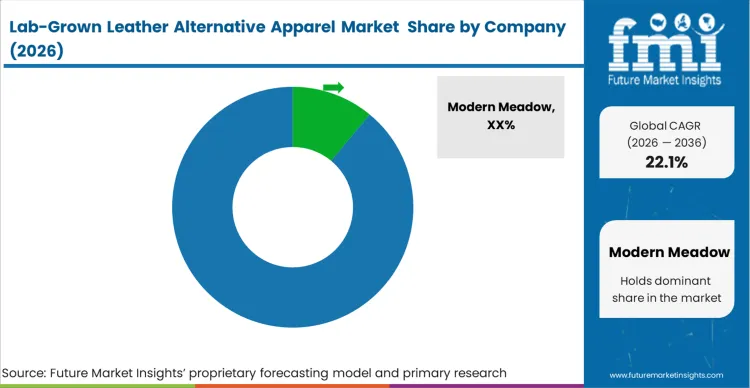
The competitive landscape in this sector is highly-concentrated, driven almost entirely by the massive intellectual property moats and high capital expenditures evaluated by lab-grown leather alternative apparel research companies. Leading companies producing lab grown leather like Modern Meadow, VitroLabs, and MycoWorks do not compete on standard textile metrics like color availability. Instead, procurement directors evaluate these lab-grown leather alternative apparel production companies strictly on their proven ability to scale bioreactor throughput while maintaining the integrity of the collagen network. Buyers distinguish qualified lab-grown leather alternative apparel suppliers from experimental labs based on the vendor's capacity to deliver continuous, predictable yields of mycelium materials, functionally ignoring startups that cannot guarantee volume for upcoming seasonal lines.
Incumbents who hold early leads possess a distinct advantage built on exclusive development partnerships tracked closely by lab grown leather investment trends. Biofabricated leather manufacturers like Polybion and Bolt Threads utilize these deep-pocketed alliances to amortize the staggering costs of their R&D and pilot facility construction, backed by robust cultured leather startups funding. A challenger entering this space cannot simply invent a better cell-culture medium; cultured leather apparel suppliers must build a comprehensive, end-to-end bio-processing architecture capable of seamless biofabricated materials integration. This requires demonstrating that their raw biological output can be immediately processed by heritage tanneries without demanding new, unproven finishing equipment.
Through 2036, the tension between luxury fashion houses desiring proprietary material exclusivity and lab-grown leather alternative apparel companies needing broad market volume to achieve profitability will dictate market consolidation. Large buyers actively resist being locked into a single proprietary bio-platform, preferring to fund multiple competing technologies to ensure supply chain resilience and price leverage. However, the sheer technical difficulty of lab-grown leather alternative apparel innovation ensures that only a handful of well-capitalized players will successfully bridge the gap to mass commercialization. As a result, the market will increasingly bifurcate into a few massive biomaterial suppliers operating as the exclusive biological foundries for the world's largest fashion groups.
Key Players in Lab-Grown Leather Alternative Apparel Market
- Modern Meadow
- VitroLabs
- Polybion
- MycoWorks
- Bolt Threads
- Natural Fiber Welding
- Geno
Scope of the Report
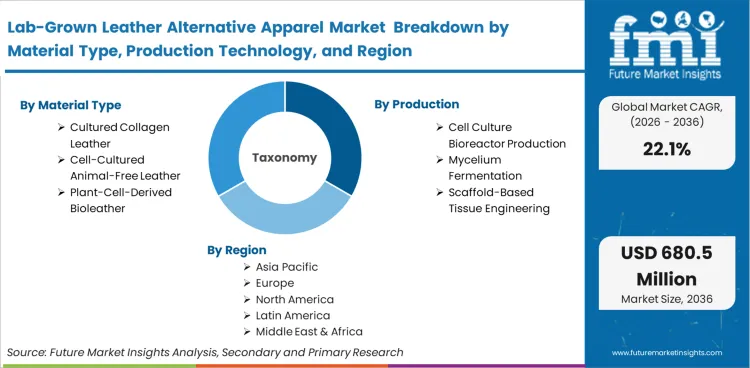
| Metric | Value |
|---|---|
| Quantitative Units | USD 92.4 million to USD 685.7 million, at a CAGR of 22.1% |
| Market Definition | The market encompasses apparel and accessories constructed from biofabricated cellular matrices, specifically engineered to replicate the biochemical and properties of animal hide without agricultural inputs. |
| Cultured Collagen Leather Segmentation | Biofabricated Mycelium-Leather Hybrids, Cell-Cultured Animal-Free Leather, Plant-Cell-Derived Bioleather |
| Cell Culture Bioreactor Production Segmentation | Mycelium Fermentation, Scaffold-Based Tissue Engineering, Bio-polymer Extrusion |
| Luxury Fashion Apparel Segmentation | Outerwear & Jackets, Footwear-Integrated Apparel, Fashion Accessories Apparel |
| Designer Fashion Houses Segmentation | Sustainable Fashion Brands, Direct-to-Consumer Online Brands, Collaborative Limited-Edition Drops |
| Regions Covered | North America, Europe, Asia Pacific, and others |
| Countries Covered | United States, France, Italy, United Kingdom, Germany, Japan, South Korea, and 40 plus countries |
| Key Companies Profiled | Modern Meadow, VitroLabs, Polybion, MycoWorks, Bolt Threads, Natural Fiber Welding, Geno |
| Forecast Period | 2026 to 2036 |
| Approach | Primary interviews were conducted with advanced material sourcing heads and bio-process engineers across the luxury supply chain. Baseline data is anchored to disclosed pilot production capacities and premium material yield rates. Forecasts are validated against the capital deployment schedules of major bio-fabrication facility construction projects. |
Source: Future Market Insights (FMI) analysis, based on proprietary forecasting model and primary research
Lab-Grown Leather Alternative Apparel Market Analysis by Segments
Material Type:
- Cultured Collagen Leather
- Biofabricated Mycelium-Leather Hybrids
- Cell-Cultured Animal-Free Leather
- Plant-Cell-Derived Bioleather
Production Technology:
- Cell Culture Bioreactor Production
- Mycelium Fermentation
- Scaffold-Based Tissue Engineering
- Bio-polymer Extrusion
Apparel Category:
- Luxury Fashion Apparel
- Outerwear & Jackets
- Footwear-Integrated Apparel
- Fashion Accessories Apparel
Distribution Channel:
- Designer Fashion Houses
- Sustainable Fashion Brands
- Direct-to-Consumer Online Brands
- Collaborative Limited-Edition Drops
Region:
- North America
- United States
- Canada
- Europe
- Germany
- United Kingdom
- France
- Italy
- Spain
- Asia Pacific
- China
- Japan
- South Korea
- Taiwan
- Singapore
- Latin America
- Brazil
- Mexico
- Argentina
- Middle East & Africa
- GCC Countries
- South Africa
- Israel
Bibliography
- Liu, X., Zhang, Y., & Chen, H. (2025, May). Engineered environmentally friendly leather-like bio-materials: Progress and challenges. Trends in Biotechnology.
- Wattanavichean, N., et al. (2025, April). Mycelium-based composites and their commercialization potential in sustainable materials. Discover Materials.
- Song, L., Li, Y., & Zhang, C. (2025, April). Preparation of mycelial leather using fermentation-based Ganoderma mycelium. Journal of Fungi.
- Aiduang, W., et al. (2025, November). Exploring mushroom mycelium as a sustainable leather substitute for fashion materials. Sustainability.
- Tewari, S., & Singh, P. (2026, February). Fabrication of cotton-mycelium biocomposite leather alternatives for sustainable products. Bioresource Technology.
- Chen, J. (2025, January). Leather-like mycelium materials: Future prospects for sustainable innovation in the fashion industry. Frontiers in Business Economics and Management.
- Zhang, Y., Li, H., & Zhao, J. (2025, September). Advances in sustainable bio-based leather alternatives for textile and fashion industries. Journal of Renewable Materials.
- Horvath, A.-S., Voinea, A.-E., & Arieşan, R. (2025, March). Bio-crafting architecture and material innovation with living mycelium. arXiv Preprint.
This bibliography is provided for reader reference. The full FMI report contains the complete reference list with primary source documentation.
This Report Addresses
- Market intelligence to support strategic decision making across Cultured Collagen Leather and biofabricated mycelium hybrids, informing the lab-grown leather alternative apparel market forecast 2036
- Market size estimation and 10-year revenue forecasts from 2026 to 2036, supported by capacity-driven modeling based on bioreactor volume inside the lab-grown leather alternative apparel market
- Growth opportunity mapping across production technology and distribution channel dimensions with emphasis on the transition from batch fermentation to continuous sheet biofabrication
- Segment and regional revenue forecasts covering luxury fashion apparel across extended producer responsibility frameworks in European markets
- Competition strategy assessment providing a comprehensive lab grown leather startups list, including bioreactor throughput scalability, heritage tannery integration, and exclusive off-take agreements
- Capability development tracking including continuous closed-loop media formulations, scaffold-based tissue engineering, and bio-process architecture
- Market access analysis covering institutional shareholder ESG mandates and zero-waste pattern integration pathways
- Market report delivery in PDF, Excel, PPT, and interactive dashboard formats for executive strategy, material innovation procurement, and operational benchmarking use
Frequently Asked Questions
What is lab grown leather and how is it produced?
To answer what is lab grown leather, it is an advanced textile engineered from cellular agriculture or mycelium networks that exactly mimics animal hide. How cultured leather is made involves cultivating these cells in massive bioreactors, feeding them optimized nutrients until they form a dense, harvestable matrix.
How sustainable is cultured leather compared to animal leather?
When evaluating is lab grown leather sustainable, metrics focus on the elimination of methane emissions, deforestation, and heavy-metal tanning effluent associated with livestock. The best sustainable leather alternatives drastically reduce water usage and land footprint, offering a superior ESG profile over traditional agricultural supply chains.
Which companies are developing lab-grown leather alternative apparel?
Key cultured leather fashion brands and bio-developers include Modern Meadow, VitroLabs, Polybion, and MycoWorks. These innovators represent the core lab grown leather supply chain, bridging the gap between deep-tech tissue engineering and commercial fashion distribution.
Is lab grown leather used in luxury fashion today?
Yes, fashion brands using lab grown leather primarily operate in the ultra-premium luxury tier. Material sourcing directors at elite European houses secure exclusive contracts with biotechnology startups to integrate these materials into high-visibility runway pieces and limited-edition capsule collections.
What technologies are used to produce cultured leather?
The dominant technology is cell culture bioreactor production, which transitions the industry from small static-tray R&D to continuous commercial yield. Secondary technologies include mycelium fermentation and scaffold-based tissue engineering, both critical to the evolving biofabricated apparel materials market.
What is the environmental impact of lab grown leather?
The lab grown leather environmental impact represents a paradigm shift in textile manufacturing, eliminating the Scope 3 emissions tied to cattle farming. By operating in closed-loop systems, these facilities also eliminate agricultural runoff, making them the benchmark for future sustainable fashion materials.
How large is the lab-grown leather alternative apparel market?
The market reaches USD 92.4 million in 2026 and expands aggressively to USD 685.7 million by 2036. This initial valuation reflects the highly constrained, premium nature of early pilot-stage bioreactor outputs exclusively absorbed by top-tier luxury fashion houses.
What industries will adopt cultured leather in the future?
While currently restricted to luxury fashion due to high per-meter costs, the future leather alternatives fashion landscape will expand into automotive interiors, premium furniture, and consumer electronics accessories once bioreactor capacities reach true commercial scale and drive down raw material pricing.
How does lab grown leather vs traditional leather affect cutting room waste?
Natural hides yield roughly 30% cutting room waste due to irregular shapes and scarring. Biofabrication produces perfect rectangular sheets of exact thickness, functionally eliminating scrap and completely changing the raw material margin calculus.
Why is mycelium leather vs lab grown leather an important distinction?
Mycelium offers rapid scaling but behaves differently under tension, requiring pattern adjustments. Conversely, cultured collagen precisely mimics calfskin but requires more complex bioreactor environments to cross-link properly, presenting distinct challenges for procurement directors.
How do exclusive off-take agreements shape competitive dynamics?
Large luxury conglomerates fund biotech startups in exchange for locking up their entire production capacity for years. This starves mid-tier brands of supply and forces challengers to align with massive institutional capital just to access premium raw materials.
Does cultured collagen leather technology require new tanning infrastructure?
No, it provides the exact biochemical triple-helix structure of natural calfskin. This allows heritage tanneries to process the material using their existing proprietary finishing chemistries without retooling their infrastructure.
How do European extended producer responsibility mandates affect adoption?
These mandates penalize the use of unrecyclable petrochemical synthetics like PU and PVC. This regulatory pressure forces procurement teams to bypass traditional textile innovation and move directly to biological, naturally degrading cellular materials.
What role does Japan play in the advanced biomaterial supply chain?
Japan leverages its deep expertise in precision biological computing and chemical engineering to create highly specialized substrates. Technical directors focus on developing biomaterials with exact stretch and durability tolerances required for ultra-premium performance wear.
Why are fashion accessories excluded from leading the segment share?
While accessories are a primary entry point, the true volume required to drive a 22.1% CAGR comes from large-surface-area garments like jackets and outerwear. Fashion accessories remain critical for prototyping but do not command the total square footage of full apparel lines.
What determines a startup's ability to secure series funding?
Investors look past basic material prototypes and evaluate the startup's pathway to continuous, high-density yield. Without a credible blueprint for scaling bioreactor capacity, eco-friendly apparel material innovators cannot secure the capital necessary to survive the pilot phase.
How does South Korea's supply chain speed influence its adoption rate?
South Korea's tight integration between biotech labs and agile manufacturing facilities vastly reduces the iteration cycle. This operational speed allows Korean brands to commercialize and test new bio-textiles much faster than traditional European fashion houses.
What exactly is excluded from this market's definition?
The market explicitly excludes traditional animal hides, petroleum-based synthetic leathers (PU/PVC), and plant-based composites that rely on plastic binders. The focus is strictly on materials grown through cellular agriculture or direct biological synthesis.
What happens to brands that delay qualifying biofabricated materials?
Brands that wait for open-market availability will find that all tier-1 bioreactor capacity has been locked up by major conglomerates. This delay functionally excludes them from offering true biological alternatives during the most critical window of ESG-driven market transition.
Preview the report firsthand - request a free sample
Get SampleGet the brochure for pricing and purchase details.
Get PDFTable of Content
- Executive Summary
- Global Market Outlook
- Demand-side Trends
- Supply-side Trends
- Technology Roadmap Analysis
- Analysis and Recommendations
- Market Overview
- Market Coverage / Taxonomy
- Market Definition / Scope / Limitations
- Research Methodology
- Chapter Orientation
- Analytical Lens and Working Hypotheses
- Market Structure, Signals, and Trend Drivers
- Benchmarking and Cross-market Comparability
- Market Sizing, Forecasting, and Opportunity Mapping
- Research Design and Evidence Framework
- Desk Research Programme (Secondary Evidence)
- Company Annual and Sustainability Reports
- Peer-reviewed Journals and Academic Literature
- Corporate Websites, Product Literature, and Technical Notes
- Earnings Decks and Investor Briefings
- Statutory Filings and Regulatory Disclosures
- Technical White Papers and Standards Notes
- Trade Journals, Industry Magazines, and Analyst Briefs
- Conference Proceedings, Webinars, and Seminar Materials
- Government Statistics Portals and Public Data Releases
- Press Releases and Reputable Media Coverage
- Specialist Newsletters and Curated Briefings
- Sector Databases and Reference Repositories
- FMI Internal Proprietary Databases and Historical Market Datasets
- Subscription Datasets and Paid Sources
- Social Channels, Communities, and Digital Listening Inputs
- Additional Desk Sources
- Expert Input and Fieldwork (Primary Evidence)
- Primary Modes
- Qualitative Interviews and Expert Elicitation
- Quantitative Surveys and Structured Data Capture
- Blended Approach
- Why Primary Evidence is Used
- Field Techniques
- Interviews
- Surveys
- Focus Groups
- Observational and In-context Research
- Social and Community Interactions
- Stakeholder Universe Engaged
- C-suite Leaders
- Board Members
- Presidents and Vice Presidents
- R&D and Innovation Heads
- Technical Specialists
- Domain Subject-matter Experts
- Scientists
- Physicians and Other Healthcare Professionals
- Governance, Ethics, and Data Stewardship
- Research Ethics
- Data Integrity and Handling
- Primary Modes
- Tooling, Models, and Reference Databases
- Desk Research Programme (Secondary Evidence)
- Data Engineering and Model Build
- Data Acquisition and Ingestion
- Cleaning, Normalisation, and Verification
- Synthesis, Triangulation, and Analysis
- Quality Assurance and Audit Trail
- Market Background
- Market Dynamics
- Drivers
- Restraints
- Opportunity
- Trends
- Scenario Forecast
- Demand in Optimistic Scenario
- Demand in Likely Scenario
- Demand in Conservative Scenario
- Opportunity Map Analysis
- Product Life Cycle Analysis
- Supply Chain Analysis
- Investment Feasibility Matrix
- Value Chain Analysis
- PESTLE and Porter’s Analysis
- Regulatory Landscape
- Regional Parent Market Outlook
- Production and Consumption Statistics
- Import and Export Statistics
- Market Dynamics
- Global Market Analysis 2021 to 2025 and Forecast, 2026 to 2036
- Historical Market Size Value (USD Million) Analysis, 2021 to 2025
- Current and Future Market Size Value (USD Million) Projections, 2026 to 2036
- Y-o-Y Growth Trend Analysis
- Absolute $ Opportunity Analysis
- Global Market Pricing Analysis 2021 to 2025 and Forecast 2026 to 2036
- Global Market Analysis 2021 to 2025 and Forecast 2026 to 2036, By Material Type
- Introduction / Key Findings
- Historical Market Size Value (USD Million) Analysis By Material Type , 2021 to 2025
- Current and Future Market Size Value (USD Million) Analysis and Forecast By Material Type , 2026 to 2036
- Cultured Collagen Leather
- Cell-Cultured Animal-Free Leather
- Plant-Cell-Derived Bioleather
- Cultured Collagen Leather
- Y-o-Y Growth Trend Analysis By Material Type , 2021 to 2025
- Absolute $ Opportunity Analysis By Material Type , 2026 to 2036
- Global Market Analysis 2021 to 2025 and Forecast 2026 to 2036, By Production Technology
- Introduction / Key Findings
- Historical Market Size Value (USD Million) Analysis By Production Technology, 2021 to 2025
- Current and Future Market Size Value (USD Million) Analysis and Forecast By Production Technology, 2026 to 2036
- Cell Culture Bioreactor Production
- Mycelium Fermentation
- Scaffold-Based Tissue Engineering
- Cell Culture Bioreactor Production
- Y-o-Y Growth Trend Analysis By Production Technology, 2021 to 2025
- Absolute $ Opportunity Analysis By Production Technology, 2026 to 2036
- Global Market Analysis 2021 to 2025 and Forecast 2026 to 2036, By Apparel Category
- Introduction / Key Findings
- Historical Market Size Value (USD Million) Analysis By Apparel Category, 2021 to 2025
- Current and Future Market Size Value (USD Million) Analysis and Forecast By Apparel Category, 2026 to 2036
- Luxury Fashion Apparel
- Outerwear & Jackets
- Footwear-Integrated Apparel
- Luxury Fashion Apparel
- Y-o-Y Growth Trend Analysis By Apparel Category, 2021 to 2025
- Absolute $ Opportunity Analysis By Apparel Category, 2026 to 2036
- Global Market Analysis 2021 to 2025 and Forecast 2026 to 2036, By Distribution Channel
- Introduction / Key Findings
- Historical Market Size Value (USD Million) Analysis By Distribution Channel, 2021 to 2025
- Current and Future Market Size Value (USD Million) Analysis and Forecast By Distribution Channel, 2026 to 2036
- Designer Fashion Houses
- Sustainable Fashion Brands
- Others
- Designer Fashion Houses
- Y-o-Y Growth Trend Analysis By Distribution Channel, 2021 to 2025
- Absolute $ Opportunity Analysis By Distribution Channel, 2026 to 2036
- Global Market Analysis 2021 to 2025 and Forecast 2026 to 2036, By Region
- Introduction
- Historical Market Size Value (USD Million) Analysis By Region, 2021 to 2025
- Current Market Size Value (USD Million) Analysis and Forecast By Region, 2026 to 2036
- North America
- Latin America
- Western Europe
- Eastern Europe
- East Asia
- South Asia and Pacific
- Middle East & Africa
- Market Attractiveness Analysis By Region
- North America Market Analysis 2021 to 2025 and Forecast 2026 to 2036, By Country
- Historical Market Size Value (USD Million) Trend Analysis By Market Taxonomy, 2021 to 2025
- Market Size Value (USD Million) Forecast By Market Taxonomy, 2026 to 2036
- By Country
- USA
- Canada
- Mexico
- By Material Type
- By Production Technology
- By Apparel Category
- By Distribution Channel
- By Country
- Market Attractiveness Analysis
- By Country
- By Material Type
- By Production Technology
- By Apparel Category
- By Distribution Channel
- Key Takeaways
- Latin America Market Analysis 2021 to 2025 and Forecast 2026 to 2036, By Country
- Historical Market Size Value (USD Million) Trend Analysis By Market Taxonomy, 2021 to 2025
- Market Size Value (USD Million) Forecast By Market Taxonomy, 2026 to 2036
- By Country
- Brazil
- Chile
- Rest of Latin America
- By Material Type
- By Production Technology
- By Apparel Category
- By Distribution Channel
- By Country
- Market Attractiveness Analysis
- By Country
- By Material Type
- By Production Technology
- By Apparel Category
- By Distribution Channel
- Key Takeaways
- Western Europe Market Analysis 2021 to 2025 and Forecast 2026 to 2036, By Country
- Historical Market Size Value (USD Million) Trend Analysis By Market Taxonomy, 2021 to 2025
- Market Size Value (USD Million) Forecast By Market Taxonomy, 2026 to 2036
- By Country
- Germany
- UK
- Italy
- Spain
- France
- Nordic
- BENELUX
- Rest of Western Europe
- By Material Type
- By Production Technology
- By Apparel Category
- By Distribution Channel
- By Country
- Market Attractiveness Analysis
- By Country
- By Material Type
- By Production Technology
- By Apparel Category
- By Distribution Channel
- Key Takeaways
- Eastern Europe Market Analysis 2021 to 2025 and Forecast 2026 to 2036, By Country
- Historical Market Size Value (USD Million) Trend Analysis By Market Taxonomy, 2021 to 2025
- Market Size Value (USD Million) Forecast By Market Taxonomy, 2026 to 2036
- By Country
- Russia
- Poland
- Hungary
- Balkan & Baltic
- Rest of Eastern Europe
- By Material Type
- By Production Technology
- By Apparel Category
- By Distribution Channel
- By Country
- Market Attractiveness Analysis
- By Country
- By Material Type
- By Production Technology
- By Apparel Category
- By Distribution Channel
- Key Takeaways
- East Asia Market Analysis 2021 to 2025 and Forecast 2026 to 2036, By Country
- Historical Market Size Value (USD Million) Trend Analysis By Market Taxonomy, 2021 to 2025
- Market Size Value (USD Million) Forecast By Market Taxonomy, 2026 to 2036
- By Country
- China
- Japan
- South Korea
- By Material Type
- By Production Technology
- By Apparel Category
- By Distribution Channel
- By Country
- Market Attractiveness Analysis
- By Country
- By Material Type
- By Production Technology
- By Apparel Category
- By Distribution Channel
- Key Takeaways
- South Asia and Pacific Market Analysis 2021 to 2025 and Forecast 2026 to 2036, By Country
- Historical Market Size Value (USD Million) Trend Analysis By Market Taxonomy, 2021 to 2025
- Market Size Value (USD Million) Forecast By Market Taxonomy, 2026 to 2036
- By Country
- India
- ASEAN
- Australia & New Zealand
- Rest of South Asia and Pacific
- By Material Type
- By Production Technology
- By Apparel Category
- By Distribution Channel
- By Country
- Market Attractiveness Analysis
- By Country
- By Material Type
- By Production Technology
- By Apparel Category
- By Distribution Channel
- Key Takeaways
- Middle East & Africa Market Analysis 2021 to 2025 and Forecast 2026 to 2036, By Country
- Historical Market Size Value (USD Million) Trend Analysis By Market Taxonomy, 2021 to 2025
- Market Size Value (USD Million) Forecast By Market Taxonomy, 2026 to 2036
- By Country
- Kingdom of Saudi Arabia
- Other GCC Countries
- Turkiye
- South Africa
- Other African Union
- Rest of Middle East & Africa
- By Material Type
- By Production Technology
- By Apparel Category
- By Distribution Channel
- By Country
- Market Attractiveness Analysis
- By Country
- By Material Type
- By Production Technology
- By Apparel Category
- By Distribution Channel
- Key Takeaways
- Key Countries Market Analysis
- USA
- Pricing Analysis
- Market Share Analysis, 2025
- By Material Type
- By Production Technology
- By Apparel Category
- By Distribution Channel
- Canada
- Pricing Analysis
- Market Share Analysis, 2025
- By Material Type
- By Production Technology
- By Apparel Category
- By Distribution Channel
- Mexico
- Pricing Analysis
- Market Share Analysis, 2025
- By Material Type
- By Production Technology
- By Apparel Category
- By Distribution Channel
- Brazil
- Pricing Analysis
- Market Share Analysis, 2025
- By Material Type
- By Production Technology
- By Apparel Category
- By Distribution Channel
- Chile
- Pricing Analysis
- Market Share Analysis, 2025
- By Material Type
- By Production Technology
- By Apparel Category
- By Distribution Channel
- Germany
- Pricing Analysis
- Market Share Analysis, 2025
- By Material Type
- By Production Technology
- By Apparel Category
- By Distribution Channel
- UK
- Pricing Analysis
- Market Share Analysis, 2025
- By Material Type
- By Production Technology
- By Apparel Category
- By Distribution Channel
- Italy
- Pricing Analysis
- Market Share Analysis, 2025
- By Material Type
- By Production Technology
- By Apparel Category
- By Distribution Channel
- Spain
- Pricing Analysis
- Market Share Analysis, 2025
- By Material Type
- By Production Technology
- By Apparel Category
- By Distribution Channel
- France
- Pricing Analysis
- Market Share Analysis, 2025
- By Material Type
- By Production Technology
- By Apparel Category
- By Distribution Channel
- India
- Pricing Analysis
- Market Share Analysis, 2025
- By Material Type
- By Production Technology
- By Apparel Category
- By Distribution Channel
- ASEAN
- Pricing Analysis
- Market Share Analysis, 2025
- By Material Type
- By Production Technology
- By Apparel Category
- By Distribution Channel
- Australia & New Zealand
- Pricing Analysis
- Market Share Analysis, 2025
- By Material Type
- By Production Technology
- By Apparel Category
- By Distribution Channel
- China
- Pricing Analysis
- Market Share Analysis, 2025
- By Material Type
- By Production Technology
- By Apparel Category
- By Distribution Channel
- Japan
- Pricing Analysis
- Market Share Analysis, 2025
- By Material Type
- By Production Technology
- By Apparel Category
- By Distribution Channel
- South Korea
- Pricing Analysis
- Market Share Analysis, 2025
- By Material Type
- By Production Technology
- By Apparel Category
- By Distribution Channel
- Russia
- Pricing Analysis
- Market Share Analysis, 2025
- By Material Type
- By Production Technology
- By Apparel Category
- By Distribution Channel
- Poland
- Pricing Analysis
- Market Share Analysis, 2025
- By Material Type
- By Production Technology
- By Apparel Category
- By Distribution Channel
- Hungary
- Pricing Analysis
- Market Share Analysis, 2025
- By Material Type
- By Production Technology
- By Apparel Category
- By Distribution Channel
- Kingdom of Saudi Arabia
- Pricing Analysis
- Market Share Analysis, 2025
- By Material Type
- By Production Technology
- By Apparel Category
- By Distribution Channel
- Turkiye
- Pricing Analysis
- Market Share Analysis, 2025
- By Material Type
- By Production Technology
- By Apparel Category
- By Distribution Channel
- South Africa
- Pricing Analysis
- Market Share Analysis, 2025
- By Material Type
- By Production Technology
- By Apparel Category
- By Distribution Channel
- USA
- Market Structure Analysis
- Competition Dashboard
- Competition Benchmarking
- Market Share Analysis of Top Players
- By Regional
- By Material Type
- By Production Technology
- By Apparel Category
- By Distribution Channel
- Competition Analysis
- Competition Deep Dive
- Modern Meadow
- Overview
- Product Portfolio
- Profitability by Market Segments (Product/Age /Sales Channel/Region)
- Sales Footprint
- Strategy Overview
- Marketing Strategy
- Product Strategy
- Channel Strategy
- VitroLabs
- Polybion
- MycoWorks
- Bolt Threads
- Natural Fiber Welding
- Geno
- Modern Meadow
- Competition Deep Dive
- Assumptions & Acronyms Used


