

- Industry Size (2026)
- USD 145.1 Mn
- Forecast (2036)
- USD 232.8 Mn
- CAGR (2026 to 2036)
- 4.8%
Demand for Savory Yogurt in the UK 2026 to 2036
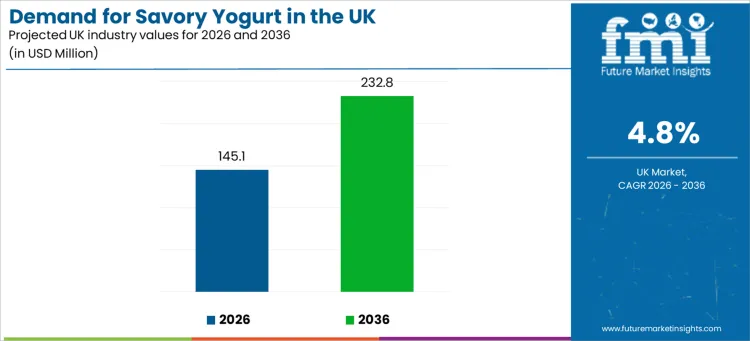
Demand for savory yogurt in the UK is likely to be valued at USD 145.1 million in 2026 and is projected to reach USD 232.8 million by 2036, reflecting a 4.8% CAGR. This demand emerges as yogurt consumption shifts beyond sweet breakfast occasions toward meal-linked and snack-oriented use. Savory yogurt fits changing eating routines where consumers seek protein-rich, dairy-based options that complement lunches, light dinners, and shared plates.
Adoption is shaped by how well savory yogurt integrates into everyday food preparation. UK buyers value formats that deliver creaminess, seasoning balance, and consistency suitable for dipping, spreading, or pairing with grains and vegetables. Texture stability, controlled acidity, and compatibility with herbs or spice blends influence repeat purchasing. Products that perform reliably across cooking and cold applications gain household acceptance more quickly than novelty-led variants.
Supply-side execution reinforces demand stability. Retailers support lines that maintain shelf life, temperature resilience, and predictable rotation within chilled dairy fixtures. Producers align savory yogurt output with existing fermentation and filling systems, limiting operational disruption while testing flavor extensions. Demand growth remains anchored in practical usage, culinary flexibility, and eating satisfaction rather than dessert replacement or short-term experimentation.
Quick Stats for Savory Yogurt Industry in the UK
- Savory Yogurt Industry Value (2026): USD 145.1 million
- Savory Yogurt Industry Forecast Value (2036): USD 232.8 million
- Savory Yogurt Industry Forecast CAGR 2026 to 2036: 4.8%
- Leading Product by Demand Share: Savory yogurt drinks
- Fastest-Growing Regions: England, Scotland, Wales, Northern Ireland
- Key Industry Participants: Fage International S.A., General Mills Inc., Chahani LLC, Blue Hill Inc., Noosa Yogurt
Savory Yogurt Industry in the UK Key Takeaways
| Metric | Value |
|---|---|
| Industry Value (2026) | USD 145.1 million |
| Industry Forecast Value (2036) | USD 232.8 million |
| Forecast CAGR (2026 to 2036) | 4.8% |
Source: FMI analysis based on primary research and proprietary forecasting model
Why is the UK Building Steady Demand for Savory Yogurt?
UK consumers are broadening how they think about yogurt beyond sweet breakfast bowls, embracing savory yogurt as a flexible ingredient in everyday meals and snacks. Interest grows as people experiment with tastes that balance creaminess and umami, fitting into brunch plates, lunch spreads, or light dinners. This shift reflects a desire to diversify eating patterns with options that feel both familiar and novel.
Chefs and food makers in the UK are elevating savory yogurt through product innovation and creative positioning. Flavours infused with herbs, spices, roasted vegetables, or tangy dressings appeal to home cooks and foodservice operators seeking cleaner ingredient lists. Retailers adjust shelf layouts to highlight these variants alongside dips and spreads, signalling acceptance of savory yogurt as a versatile culinary item rather than a peripheral niche.
Habitual consumption strengthens as shoppers discover practical uses for savory yogurt in daily cooking. UK households incorporate it into sauces, marinades, and sandwiches because it adds texture and flavour without heaviness. Word-of-mouth and social food content amplify this behaviour; more people share recipes and serve ideas that normalise savory yogurt in routine meal planning. This cumulative experience sustains growing demand rooted in practicality, variety, and taste exploration.
How is Savory Yogurt Demand Segmented by Product and Sales Channel in the UK?
Demand for savory yogurt in the UK reflects how consumers adapt yogurt consumption beyond sweet formats into meal-linked and snacking occasions. Segmentation patterns show emphasis on convenience, portion control, and availability within routine shopping environments.
Why do savory yogurt drinks lead product-level demand?
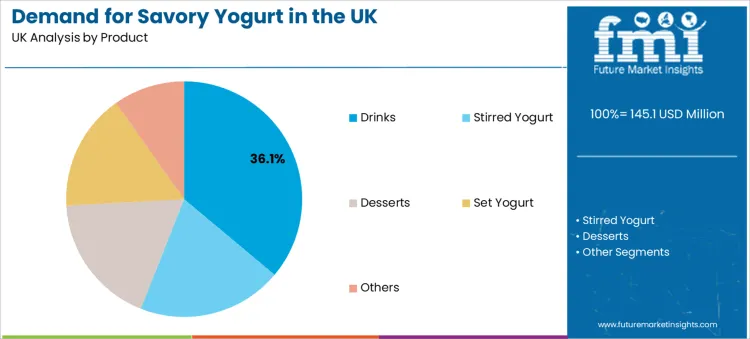
Savory yogurt drinks hold a 36.1% share, placing them as the most selected product format. These drinks fit usage moments tied to light meals, quick refreshment, and on-the-go consumption where spoons or extended preparation are impractical. The liquid format supports incorporation of herbs, spices, and vegetable notes that deliver savoury profiles without compromising texture uniformity.
Producers favour drinkable formats due to ease of flavour dispersion and stable viscosity control during processing. Packaging flexibility also supports single-serve positioning, which aligns with trial-driven adoption patterns for emerging savoury variants.
What sustains supermarket leadership as the primary sales channel?
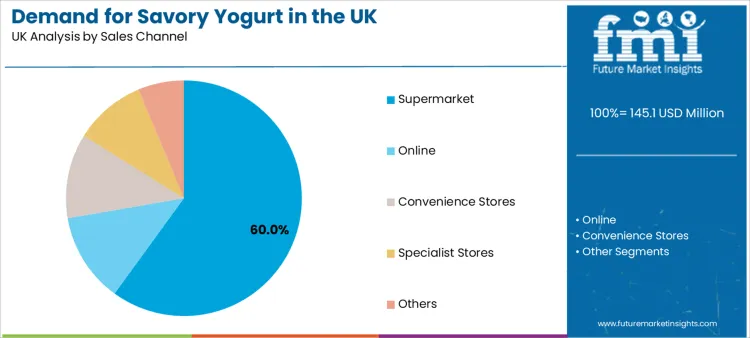
Supermarkets account for a 60.0% share, reflecting their role as the main discovery and replenishment point for savory yogurt. Consumers rely on supermarkets to explore new flavour concepts alongside familiar dairy products, which reduces purchase hesitation. Shelf adjacency to standard yogurt lines encourages trial without repositioning the product as niche.
From a supply perspective, supermarkets provide predictable volume flow, temperature-controlled distribution, and merchandising support that suits chilled dairy categories. This environment reinforces repeat purchase behaviour and supports broader acceptance of savoury yogurt within everyday diets.
What are the Key Dynamics in Demand for Savory Yogurt in the UK?
Demand for savory yogurt in the UK is influenced by evolving consumer taste preferences that extend beyond traditional sweet dairy options, with interest in culinary innovation and protein-rich snacks driving exploration of herb, spice and vegetable-infused formats. Retailers report trial in niche, premium chilled aisles and foodservice trial menus. Value aligns with perceived freshness, satiety and versatility as dip, spread or meal accompaniment rather than pure dessert positioning.
How do shifting flavour preferences and occasion use shape uptake?
UK consumers are experimenting with global and umami-forward profiles that challenge conventional sweet yogurt norms. Savory yogurt adoption rises where product developers blend fermented dairy with ingredients such as roasted vegetables, Mediterranean herbs, chili and fermented condiments to align with lunch and snack occasions. Growth in plant-centric and high-protein eating occasions supports interest in savory dairy as part of balanced nutrition, where texture complements grain bowls, salads or open-faced sandwiches. Foodservice operators in urban and convenience formats trial savory yogurt as a dip paired with crudités or flatbreads, providing exposure outside traditional breakfast segments. Sampling feedback often highlights mouthfeel and ingredient balance as key determinants of repeat consumption in this emerging niche.
How do sensory expectations and pricing sensitivity influence continued demand?
Savory yogurt demand in the UK is constrained by strong sensory expectations and relative price premiums. Consumers accustomed to smooth, mild sweet dairy may reject formulations perceived as overly tangy, bitter or inconsistent in seasoning, prompting developers to invest in iterative flavour balance work to achieve broad appeal. Pricing in mainstream chilled aisles remains sensitive, with many shoppers unwilling to pay a significant premium for experimental dairy formats unless taste and versatility justify repeat purchase. Limited production scale for savory variants can restrict distribution beyond premium and specialist retailers, slowing wider household penetration. Retail assortment decisions hinge on localized trial performance and inventory turnover, affecting where savory yogurts achieve sustained shelf space and consumer awareness.
How is Savory Yogurt Demand Evolving across Key Regions in the UK?
Demand for savory yogurt across the UK progresses as consumers seek meal-adjacent dairy formats with protein appeal and culinary versatility. Regional variation reflects chilled dairy innovation pace, foodservice experimentation, flavour localization, and how processors manage formulation stability, shelf life, and merchandising within established yogurt lines.
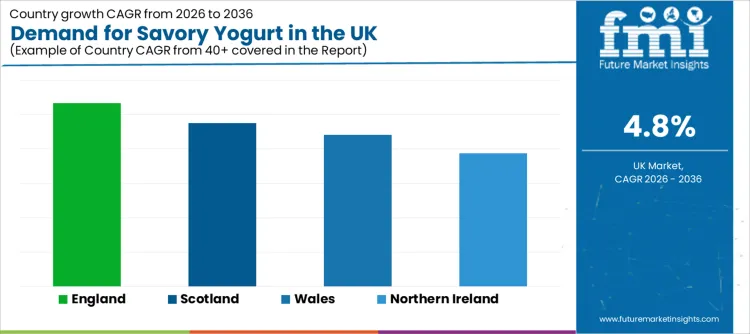
| Region | CAGR 2026 to 2036 |
|---|---|
| England | 5.3% |
| Scotland | 4.7% |
| Wales | 4.4% |
| Northern Ireland | 3.9% |
Source: FMI analysis based on primary research and proprietary forecasting model
Why is England leading expansion through product innovation and foodservice crossover?
England grows at 5.3%, supported by frequent product launches and stronger crossover between retail and foodservice concepts. Processors integrate savory yogurt into dips, meal sides, and snacking formats where texture consistency and flavour balance matter. Demand rises where manufacturers leverage existing yogurt infrastructure to trial savoury profiles without disrupting high-volume sweet ranges.
How is Scotland progressing through selective adoption in premium and regional lines?
Scotland expands at 4.7%, shaped by cautious adoption within premium chilled dairy and regionally inspired flavour sets. Producers emphasise clean savoury profiles that complement natural yogurt bases while maintaining fermentation stability. Demand builds where smaller batch production supports flavour experimentation and aligns with consumer interest in distinctive, meal-relevant dairy options.
What is shaping Wales as producers test versatility within limited portfolios?
Wales advances at 4.4%, driven by measured expansion among processors with narrower yogurt portfolios. Demand strengthens when savory variants deliver clear usage occasions such as cooking, dipping, or light meals. Manufacturers prioritise formulations that maintain viscosity, prevent separation, and fit existing filling and cold chain systems without extensive process modification.
Why is Northern Ireland showing measured growth tied to focused trial programmes?
Northern Ireland records 3.9% growth, reflecting focused trial programmes rather than broad category expansion. Processors evaluate savoury yogurt in specific flavour combinations and pack formats. Demand improves when repeat purchase signals emerge and when shelf life performance supports efficient distribution across shorter retail cycles.
What Defines the Competitive Landscape for Savory Yogurt in the UK?
Demand for savory yogurt in the UK is emerging from experimentation in high-protein diets, reduced sugar preferences, and crossover between dairy and meal occasions. Buyers evaluate texture thickness, salt balance, ingredient simplicity, and compatibility with herbs, spices, and vegetable inclusions. Assessment also includes protein content, live culture credibility, and positioning for snacking versus meal accompaniment. Retail procurement favors differentiated SKUs that can educate consumers while fitting chilled dairy planograms. Trend in the UK industry reflects cautious trial through limited launches, chef-led influence, and alignment with Mediterranean and Middle Eastern flavor profiles rather than mass-market sweet yogurt conventions.
Fage International S.A. holds strong relevance through strained yogurt formats that naturally support savory positioning and foodservice crossover. General Mills participates via brand-led innovation capabilities and retail leverage, enabling controlled category testing. Blue Hill Inc influences demand indirectly through premium, culinary-driven yogurt concepts that validate savory use cases. Noosa Yogurt remains adjacent through indulgent positioning, limiting direct savory penetration. Chahani LLC operates at a niche level, appealing to experimental consumers and specialty retailers. Competitive differentiation centers on culinary credibility, protein texture suitability, consumer education capability, and retailer willingness to allocate space to non-sweet yogurt formats.
Key Industry Participants
- Chahani LLC
- Noosa Yogurt
- Fage International S.A
- General Mills Inc.
- Blue Hill Inc
Scope of Report
| Items | Values |
|---|---|
| Quantitative Units | USD million |
| Product | Drinks; Stirred Yogurt; Desserts; Set Yogurt; Others |
| Sales Channel | Supermarket; Online; Convenience Stores; Specialist Stores; Others |
| Regions Covered | England; Scotland; Wales; Northern Ireland |
| Key Companies Profiled | Chahani LLC; Noosa Yogurt; Fage International S.A; General Mills Inc.; Blue Hill Inc |
Savory Yogurt Demand in the UK by Segments
Product:
- Drinks
- Stirred Yogurt
- Desserts
- Set Yogurt
- Others
Sales Channel:
- Supermarket
- Online
- Convenience Stores
- Specialist Stores
- Others
By Region
- England
- Scotland
- Wales
- Northern Ireland
Bibliography
- Department for Environment, Food & Rural Affairs. (2023). UK dairy statistics and production overview. UK Government.
- Department for Environment, Food & Rural Affairs. (2024). Food consumption trends and dietary shifts in the United Kingdom. UK Government.
- Food Standards Agency. (2023). Yogurt and fermented dairy products: Composition, labelling, and consumer information. FSA.
- British Retail Consortium. (2024). UK chilled food and dairy category trends. BRC.
- McMahon, D. J., Oberg, C. J., & Broadbent, J. R. (2023). Fermented dairy innovation and flavour development in modern yogurt products. Journal of Dairy Science, 106(9), 6121-6136.
Frequently Asked Questions
How big is the demand for savory yogurt in the uk in 2026?
The demand for savory yogurt in the uk is estimated to be valued at USD 145.1 million in 2026.
What will be the size of savory yogurt in the uk in 2036?
The market size for the savory yogurt in the uk is projected to reach USD 232.8 million by 2036.
How much will be the demand for savory yogurt in the uk growth between 2026 and 2036?
The demand for savory yogurt in the uk is expected to grow at a 4.8% CAGR between 2026 and 2036.
What are the key product types in the savory yogurt in the uk?
The key product types in savory yogurt in the uk are drinks, stirred yogurt, desserts, set yogurt and others.
Which sales channel segment is expected to contribute significant share in the savory yogurt in the uk in 2026?
In terms of sales channel, supermarket segment is expected to command 60.0% share in the savory yogurt in the uk in 2026.
Preview the report firsthand - request a free sample
Get SampleGet the brochure for pricing and purchase details.
Get PDFTable of Content
- Executive Summary
- UK Market Outlook
- Demand-side Trends
- Supply-side Trends
- Technology Roadmap Analysis
- Analysis and Recommendations
- Market Overview
- Market Coverage / Taxonomy
- Market Definition / Scope / Limitations
- Market Background
- Market Dynamics
- Drivers
- Restraints
- Opportunity
- Trends
- Scenario Forecast
- Demand in Optimistic Scenario
- Demand in Likely Scenario
- Demand in Conservative Scenario
- Opportunity Map Analysis
- Product Life Cycle Analysis
- Supply Chain Analysis
- Investment Feasibility Matrix
- Value Chain Analysis
- PESTLE and Porter’s Analysis
- Regulatory Landscape
- Regional Parent Market Outlook
- Production and Consumption Statistics
- Import and Export Statistics
- Market Dynamics
- UK Market Analysis 2021 to 2025 and Forecast, 2026 to 2036
- Historical Market Size Value (USD Million) Analysis, 2021 to 2025
- Current and Future Market Size Value (USD Million) Projections, 2026 to 2036
- Y-o-Y Growth Trend Analysis
- Absolute $ Opportunity Analysis
- UK Market Pricing Analysis 2021 to 2025 and Forecast 2026 to 2036
- UK Market Analysis 2021 to 2025 and Forecast 2026 to 2036, By Product
- Introduction / Key Findings
- Historical Market Size Value (USD Million) Analysis By Product , 2021 to 2025
- Current and Future Market Size Value (USD Million) Analysis and Forecast By Product , 2026 to 2036
- Drinks
- Stirred Yogurt
- Desserts
- Set Yogurt
- Others
- Drinks
- Y-o-Y Growth Trend Analysis By Product , 2021 to 2025
- Absolute $ Opportunity Analysis By Product , 2026 to 2036
- UK Market Analysis 2021 to 2025 and Forecast 2026 to 2036, By Sales Channel
- Introduction / Key Findings
- Historical Market Size Value (USD Million) Analysis By Sales Channel, 2021 to 2025
- Current and Future Market Size Value (USD Million) Analysis and Forecast By Sales Channel, 2026 to 2036
- Supermarket
- Online
- Convenience Stores
- Specialist Stores
- Others
- Supermarket
- Y-o-Y Growth Trend Analysis By Sales Channel, 2021 to 2025
- Absolute $ Opportunity Analysis By Sales Channel, 2026 to 2036
- Market Structure Analysis
- Competition Dashboard
- Competition Benchmarking
- Market Share Analysis of Top Players
- By Regional
- By Product
- By Sales Channel
- Competition Analysis
- Competition Deep Dive
- Chahani LLC
- Overview
- Product Portfolio
- Profitability by Market Segments (Product/Age /Sales Channel/Region)
- Sales Footprint
- Strategy Overview
- Marketing Strategy
- Product Strategy
- Channel Strategy
- Noosa Yogurt
- Fage International S.A
- General Mills Inc.
- Blue Hill Inc
- Chahani LLC
- Competition Deep Dive
- Assumptions & Acronyms Used
- Research Methodology


