

- Industry Size (2026)
- USD 1786.9 Mn
- Forecast (2036)
- USD 3463.5 Mn
- CAGR (2026 to 2036)
- 6.8%
Demand for Automotive Airbag in the UK 2026 to 2036
The automotive airbag industry in the UK is forecasted to reach USD 1,786.9 million in 2026 and grow to USD 3,463.5 million by 2036, at a CAGR of 6.8%. This demand surge is driven by increasingly stringent safety regulations, consumer safety awareness, and ongoing advancements in vehicle safety technologies. Airbags are critical components in meeting evolving occupant protection standards, and they remain essential to ensure compliance with crash safety tests and type approval requirements.
As vehicle safety features become a key consideration for buyers, especially in the UK, airbag systems are increasingly viewed as a core vehicle feature, rather than an optional extra. Manufacturers focus on developing airbags that integrate seamlessly with advanced driver assistance systems (ADAS) and electrified powertrains, meeting the rising demand for both passive and active safety solutions. The widespread adoption of electric and hybrid vehicles presents new opportunities for airbag innovation, requiring systems that integrate effectively with the vehicles' new electronic control units (ECUs) and sensor systems.
Quick Stats for Automotive Airbag Industry in the UK
- Automotive Airbag Industry Value (2026): USD 1,786.9 million
- Automotive Airbag Industry Forecast Value (2036): USD 3,463.5 million
- Automotive Airbag Industry Forecast CAGR 2026 to 2036: 6.8%
- Leading Product Type by Demand Share: Driver Airbag
- Fastest-Growing Regions: England, Scotland, Wales, Northern Ireland
- Key Industry Participants: Autoliv Inc, Joyson Safety System, Toyoda Gosei Co. Ltd, Robert Bosch GmbH, Hyundai Mobis Co. Ltd, Magna International
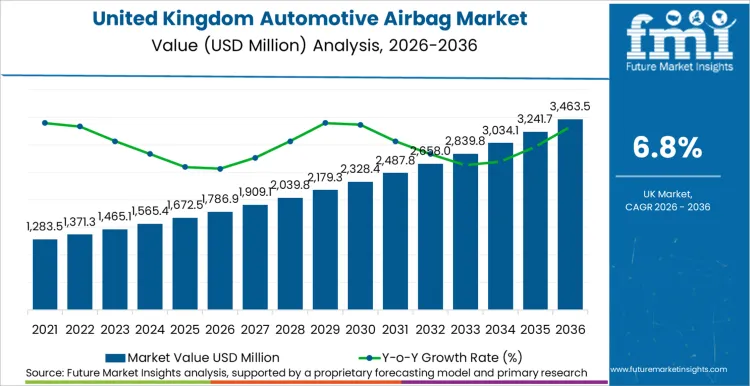
Automotive Airbag Industry in the UK Key Takeaways
| Metric | Value |
|---|---|
| Industry Value (2026) | USD 1786.9 million |
| Industry Forecast Value (2036) | USD 3463.5 million |
| Forecast CAGR (2026 to 2036) | 6.8% |
Source: FMI analysis based on primary research and proprietary forecasting model
Why is the UK Building Steady Demand for Automotive Airbags?
Safety standards and regulatory expectations in the UK keep advancing, which means manufacturers must ensure vehicles meet stringent occupant protection criteria. Airbags are critical components in compliance with crash safety tests and type approval requirements. This pushes vehicle assemblers and parts suppliers to maintain robust airbag systems across new models rather than treating them as optional extras.
Consumer awareness of vehicle safety also shapes purchasing behaviour. UK car buyers compare safety ratings and equipment lists when evaluating new and used vehicles. Well-engineered airbag systems influence perceived vehicle value and help brands differentiate in competitive segments. Dealers and OEMs prioritize airbag inclusion to match buyer expectations for protection and reliability.
Industry trends toward electrification and active safety technology reinforce this need. As advanced driver assistance systems become widespread, integration between sensor networks and passive protection like airbags must be seamless. UK manufacturers and Tier-1 suppliers source airbags that can communicate with control units to optimize deployment timing, supporting coherent safety system performance across vehicle models. This technical interoperability drives consistent demand for sophisticated airbag solutions.
How is Automotive Airbag Demand Segmented by Product Type, Vehicle Type, and Coating Type in the UK?
Demand for automotive airbags in the UK reflects how manufacturers prioritize safety features, regulatory compliance, and consumer protection in a highly competitive automotive industry. Segmentation follows vehicle type requirements, airbag functionality, and material properties designed to enhance both performance and reliability.
Why does the driver airbag lead product-level adoption?
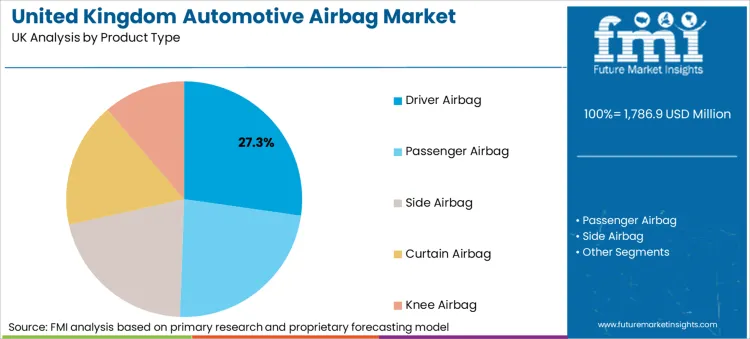
Driver airbags account for 27.3% of the demand, positioning them as the most critical safety feature in vehicles. This reflects their role in protecting the driver in frontal collisions, where the airbag inflates upon impact to cushion the driver’s head and chest. The high adoption of driver airbags aligns with global safety regulations and consumer expectations, making them a standard feature in most vehicles.
Automotive manufacturers prioritise driver airbag design to meet stringent safety ratings, improve crash-test performance, and ensure compliance with regulatory frameworks. This widespread adoption also supports the continued development of more advanced airbag technologies and integration into other vehicle safety systems.
What keeps passenger cars as the dominant vehicle type for airbag demand?
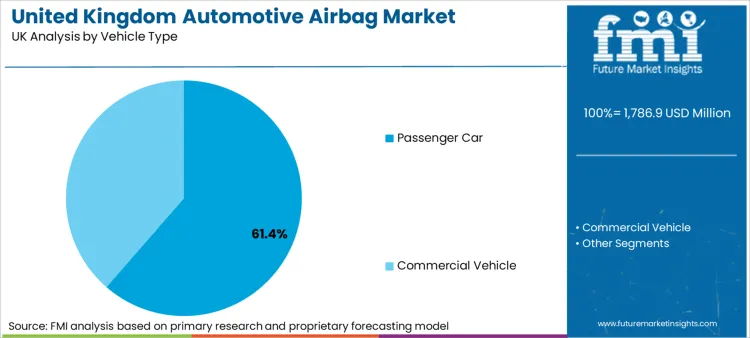
Passenger cars hold a 61.4% share, reflecting their extensive use in everyday commuting and family transportation, where occupant protection is paramount. The demand for airbags in passenger vehicles is driven by regulatory requirements for enhanced occupant safety in the event of collisions. Manufacturers prioritise airbags in this sector as part of comprehensive safety systems, which also include seat belts, stability control, and advanced driver-assistance systems (ADAS).
Consumer awareness and preference for higher safety standards in vehicles have led to increased demand for airbags, contributing to their standardisation in passenger vehicles.
Why does neoprene dominate as the preferred coating type?
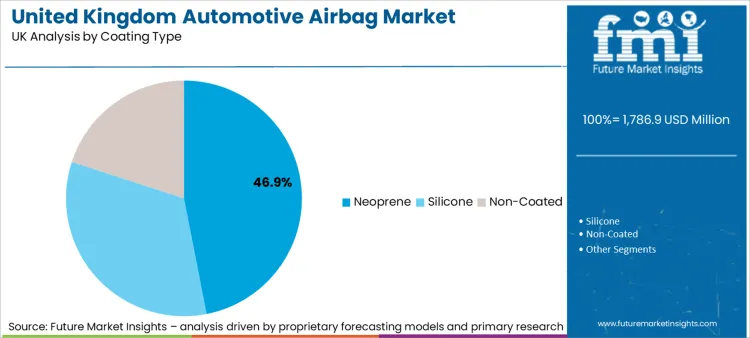
Neoprene accounts for 46.9% of the demand for airbag coatings, reflecting its durability, resistance to temperature fluctuations, and long-term performance under stress. Neoprene-coated airbags offer enhanced stability and reliability, especially in high-impact scenarios where airbag deployment needs to be rapid and effective. This material choice ensures that airbags can maintain their structural integrity over the lifetime of the vehicle, providing consistent performance during deployment.
Manufacturers favour neoprene due to its proven effectiveness in withstanding the extreme forces and environmental conditions associated with airbag operation. Neoprene also offers a balance between cost and performance, making it the preferred choice for many automotive airbag suppliers.
What are the Key Dynamics in Demand for Automotive Airbag in the UK?
Demand for automotive airbags in the UK is influenced by stringent vehicle safety regulations, rising consumer safety expectations and fleet renewal cycles. Manufacturers and importers prioritize advanced restraint systems to meet Euro NCAP safety ratings and mandatory UN R129 side-airbag requirements for many new vehicle categories. Passenger cars, light commercial vehicles and some electrified powertrain models increasingly incorporate multi-chamber and occupant detection airbags to reduce injury risk. OEM sourcing decisions hinge on compliance with UK and European homologation standards, fitment reliability across model variants, and integration with vehicle electronic control units to support robust deployment logic.
How do safety standards and vehicle design requirements shape demand?
Airbag demand in the UK reflects both regulatory mandates and consumer testing benchmarks that emphasise occupant protection. Frontal, side, curtain and knee airbag systems are specified as standard on higher trim levels and in safety-oriented segments to achieve high star ratings from independent assessment bodies. Vehicle designers collaborate with airbag suppliers to tailor cushion geometry and inflator performance to specific cabin layouts, balancing deployment force with occupant position data to mitigate risk across a range of crash scenarios. Growth in compact SUVs and crossover segments, which represent a large share of UK new registrations, leads to broader airbag inclusion across model portfolios. Demand for pedestrian protection systems that include external airbag solutions is emerging on select urban models, reflecting both regulatory outlooks and brand differentiation strategies focused on holistic safety.
How do electrification trends and aftermarket factors influence uptake?
Shifts in vehicle powertrain mix and fleet age distribution affect how airbag systems are specified and serviced in the UK industry. Electrified vehicles often incorporate additional sensor networks and higher-speed communication buses that support more sophisticated airbag control strategies, prompting OEMs to source modules compatible with enhanced crash detection algorithms. In the aftermarket and collision repair sector, replacement demand is driven by traffic volume, repairable crash incidence and certification requirements for airbag module reset or replacement. Airbag component traceability and remanufactured module quality influence acceptance among repairers, insurers and vehicle owners, particularly where cost pressures intersect with safety obligations. Service network capability to diagnose and recalibrate airbag systems after minor impacts shapes how quickly vehicles return to roadworthy status, affecting aftermarket demand patterns.
How is Automotive Airbag Demand Evolving across Key Regions in the UK?
Demand for automotive airbags across the UK progresses as vehicle safety standards evolve and consumer awareness of safety technology increases. Regional variation reflects production volume, vehicle manufacturing intensity, and how effectively manufacturers align with regulatory compliance, vehicle model developments, and long-term safety goals.
| Region | CAGR 2026 to 2036 |
|---|---|
| England | 7.5% |
| Scotland | 6.7% |
| Wales | 6.2% |
| Northern Ireland | 5.5% |
Source: FMI analysis based on primary research and proprietary forecasting model
Why is England leading expansion through higher production scale and vehicle safety focus?
England grows at 7.5%, supported by a larger automotive manufacturing base and higher integration of advanced safety systems in vehicles. Demand rises where manufacturers prioritise airbag systems that comply with stringent safety regulations and meet consumer demand for enhanced protection. Production lines focus on scalability and efficiency to meet evolving car model specifications while reducing costs.
How is Scotland progressing through steady adoption in mid-sized vehicle production?
Scotland expands at 6.7%, shaped by steady adoption within mid-sized vehicle production where safety features align with evolving consumer expectations. Manufacturers focus on integrating airbags seamlessly with other vehicle systems to enhance occupant protection. Demand builds when suppliers offer reliable, cost-effective solutions that ensure airbags perform optimally under diverse crash conditions.
What is shaping Wales as manufacturers balance cost control with safety feature adoption?
Wales advances at 6.2%, driven by manufacturers prioritising cost control while gradually adopting more advanced airbag systems. Demand strengthens when systems meet both regulatory standards and customer expectations for safety without increasing production complexity. Buyers focus on solutions that support efficiency across smaller production volumes while maintaining high-quality safety standards.
Why is Northern Ireland showing measured growth linked to selective vehicle model adoption?
Northern Ireland records 5.5% growth, reflecting measured adoption focused on select vehicle models and lower production volumes. Adoption progresses when airbag systems can be customised to fit specific model requirements while maintaining regulatory compliance. Demand improves when manufacturers optimize supply chains for just-in-time delivery and ensure long-term durability across targeted vehicle segments.
What Defines the Competitive Landscape for Automotive Airbag in the UK?
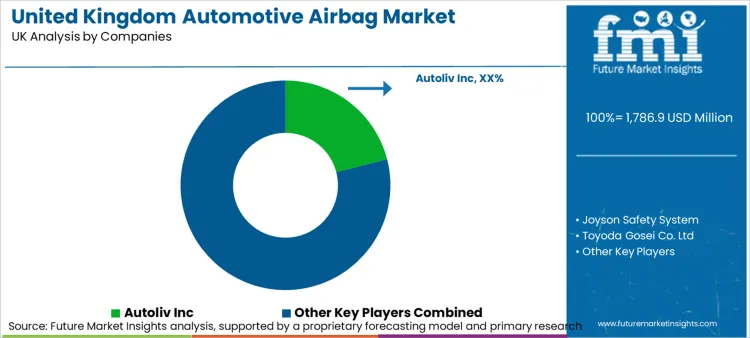
Demand for automotive airbags in the UK is driven by increasing vehicle safety regulations, consumer demand for enhanced protection, and the automotive industry's push for innovation in passive safety systems. OEMs and Tier 1 suppliers evaluate airbag performance based on deployment reliability, reaction time, integration with crash sensors, and compatibility with evolving vehicle designs. Buyers also assess cost efficiency, supplier experience, and the ability to meet international crash safety standards. Procurement behavior leans towards suppliers who offer modular airbag solutions, customized integration into vehicle platforms, and robust supply chain support for high-volume production. The trend in the UK industry reflects heightened focus on next-generation airbag systems, including side airbags, pedestrian protection, and integration with advanced driver-assistance systems (ADAS).
Autoliv Inc. holds leading positioning in the UK with a comprehensive portfolio of airbag systems and safety solutions tailored to both mainstream and luxury vehicles. Joyson Safety System competes through a wide range of passive safety components, including advanced airbag systems designed for high-performance vehicles. Toyoda Gosei Co. Ltd stands out with its expertise in inflator technology and its ability to provide cost-effective, reliable airbag solutions for mass-market vehicles. Robert Bosch GmbH participates with sensor technologies that integrate seamlessly with airbag systems, enabling precise deployment timing. Hyundai Mobis Co. Ltd and Magna International remain key players by offering airbag solutions as part of their larger automotive safety systems, particularly focusing on cost efficiency and integration with electric vehicle platforms. Competitive differentiation centers on system reliability, innovation in airbag technologies, integration capabilities, and the ability to meet evolving safety regulations.
Key Industry Participants
- Autoliv Inc
- Joyson Safety System
- Toyoda Gosei Co. Ltd
- Robert Bosch GmbH
- Hyundai Mobis Co. Ltd
- Magna International
Scope of Report
| Items | Values |
|---|---|
| Quantitative Units | USD million |
| Product Type | Driver Airbag; Passenger Airbag; Side Airbag; Curtain Airbag; Knee Airbag |
| Vehicle Type | Passenger Car; Commercial Vehicle |
| Coating Type | Neoprene; Silicone; Non-Coated |
| Yarn Type | Nylon; Polyester |
| Sales Channel | OEM; Aftermarket |
| Regions Covered | England; Scotland; Wales; Northern Ireland |
| Key Companies Profiled | Autoliv Inc; Joyson Safety System; Toyoda Gosei Co. Ltd; Robert Bosch GmbH; Hyundai Mobis Co. Ltd; Magna International |
Automotive Airbag Demand in the UK by Segments
Product Type:
- Driver Airbag
- Passenger Airbag
- Side Airbag
- Curtain Airbag
- Knee Airbag
Vehicle Type:
- Passenger Car
- Commercial Vehicle
Coating Type:
- Neoprene
- Silicone
- Non-Coated
Yarn Type:
- Nylon
- Polyester
Sales Channel:
- OEM
- Aftermarket
By Region
- England
- Scotland
- Wales
- Northern Ireland
Bibliography
- Department for Transport. (2024). Road vehicle safety standards and type approval requirements. UK Government.
- Euro NCAP. (2024). Assessment protocols for adult occupant protection and restraint systems. Euro NCAP.
- United Nations Economic Commission for Europe. (2023). UN Regulation No. 94, 95, and R129: Occupant protection in frontal and side impact. UNECE.
- Society of Motor Manufacturers and Traders. (2024). UK vehicle production, safety technology adoption, and powertrain trends. SMMT.
- European Commission. (2023). General Safety Regulation (EU) 2019/2144 and passive safety system requirements. European Union.
- International Organization for Standardization. (2023). ISO 12097 series: Road vehicles - Airbag components and deployment systems. ISO.
- Transport Research Laboratory. (2023). Vehicle restraint systems and real-world crash performance analysis. TRL.
Frequently Asked Questions
How big is the automotive airbag industry in the UK in 2026?
The automotive airbag industry in the UK is projected to be valued at USD 1,786.9 million in 2026.
What will be the size of the automotive airbag industry in the UK in 2036?
The industry size for automotive airbags in the UK is projected to reach USD 3,463.5 million by 2036.
How much will the demand for automotive airbags in the UK grow between 2026 and 2036?
Demand for automotive airbags in the UK is projected to grow at a 6.8% CAGR between 2026 and 2036.
Which product type holds a significant share in the automotive airbag industry in the UK in 2026?
In terms of product type, driver airbags are expected to account for a 27.3% share in 2026.
Which vehicle type contributes a major share in the automotive airbag industry in the UK in 2026?
Passenger cars are expected to account for a 61.4% share in the automotive airbag industry in the UK in 2026.
Preview the report firsthand - request a free sample
Get SampleGet the brochure for pricing and purchase details.
Get PDFTable of Content
- Executive Summary
- UK Market Outlook
- Demand-side Trends
- Supply-side Trends
- Technology Roadmap Analysis
- Analysis and Recommendations
- Market Overview
- Market Coverage / Taxonomy
- Market Definition / Scope / Limitations
- Market Background
- Market Dynamics
- Drivers
- Restraints
- Opportunity
- Trends
- Scenario Forecast
- Demand in Optimistic Scenario
- Demand in Likely Scenario
- Demand in Conservative Scenario
- Opportunity Map Analysis
- Product Life Cycle Analysis
- Supply Chain Analysis
- Investment Feasibility Matrix
- Value Chain Analysis
- PESTLE and Porter’s Analysis
- Regulatory Landscape
- Regional Parent Market Outlook
- Production and Consumption Statistics
- Import and Export Statistics
- Market Dynamics
- UK Market Analysis 2021 to 2025 and Forecast, 2026 to 2036
- Historical Market Size Value (USD Million) Analysis, 2021 to 2025
- Current and Future Market Size Value (USD Million) Projections, 2026 to 2036
- Y-o-Y Growth Trend Analysis
- Absolute $ Opportunity Analysis
- UK Market Pricing Analysis 2021 to 2025 and Forecast 2026 to 2036
- UK Market Analysis 2021 to 2025 and Forecast 2026 to 2036, By Product Type
- Introduction / Key Findings
- Historical Market Size Value (USD Million) Analysis By Product Type , 2021 to 2025
- Current and Future Market Size Value (USD Million) Analysis and Forecast By Product Type , 2026 to 2036
- Driver Airbag
- Passenger Airbag
- Side Airbag
- Curtain Airbag
- Knee Airbag
- Driver Airbag
- Y-o-Y Growth Trend Analysis By Product Type , 2021 to 2025
- Absolute $ Opportunity Analysis By Product Type , 2026 to 2036
- UK Market Analysis 2021 to 2025 and Forecast 2026 to 2036, By Vehicle Type
- Introduction / Key Findings
- Historical Market Size Value (USD Million) Analysis By Vehicle Type, 2021 to 2025
- Current and Future Market Size Value (USD Million) Analysis and Forecast By Vehicle Type, 2026 to 2036
- Passenger Car
- Commercial Vehicle
- Passenger Car
- Y-o-Y Growth Trend Analysis By Vehicle Type, 2021 to 2025
- Absolute $ Opportunity Analysis By Vehicle Type, 2026 to 2036
- UK Market Analysis 2021 to 2025 and Forecast 2026 to 2036, By Coating Type
- Introduction / Key Findings
- Historical Market Size Value (USD Million) Analysis By Coating Type, 2021 to 2025
- Current and Future Market Size Value (USD Million) Analysis and Forecast By Coating Type, 2026 to 2036
- Neoprene
- Silicone
- Non-Coated
- Neoprene
- Y-o-Y Growth Trend Analysis By Coating Type, 2021 to 2025
- Absolute $ Opportunity Analysis By Coating Type, 2026 to 2036
- UK Market Analysis 2021 to 2025 and Forecast 2026 to 2036, By Yarn Type
- Introduction / Key Findings
- Historical Market Size Value (USD Million) Analysis By Yarn Type, 2021 to 2025
- Current and Future Market Size Value (USD Million) Analysis and Forecast By Yarn Type, 2026 to 2036
- Nylon
- Polyester
- Nylon
- Y-o-Y Growth Trend Analysis By Yarn Type, 2021 to 2025
- Absolute $ Opportunity Analysis By Yarn Type, 2026 to 2036
- UK Market Analysis 2021 to 2025 and Forecast 2026 to 2036, By Sales Channel
- Introduction / Key Findings
- Historical Market Size Value (USD Million) Analysis By Sales Channel, 2021 to 2025
- Current and Future Market Size Value (USD Million) Analysis and Forecast By Sales Channel, 2026 to 2036
- OEM
- Aftermarket
- OEM
- Y-o-Y Growth Trend Analysis By Sales Channel, 2021 to 2025
- Absolute $ Opportunity Analysis By Sales Channel, 2026 to 2036
- Market Structure Analysis
- Competition Dashboard
- Competition Benchmarking
- Market Share Analysis of Top Players
- By Regional
- By Product Type
- By Vehicle Type
- By Coating Type
- By Yarn Type
- By Sales Channel
- Competition Analysis
- Competition Deep Dive
- Autoliv Inc
- Overview
- Product Portfolio
- Profitability by Market Segments (Product/Age /Sales Channel/Region)
- Sales Footprint
- Strategy Overview
- Marketing Strategy
- Product Strategy
- Channel Strategy
- Joyson Safety System
- Toyoda Gosei Co. Ltd
- Robert Bosch GmbH
- Hyundai Mobis Co. Ltd
- Magna International
- Autoliv Inc
- Competition Deep Dive
- Assumptions & Acronyms Used
- Research Methodology


