

- Industry Size (2026)
- USD 589.4 Mn
- Forecast (2036)
- USD 1045.2 Mn
- CAGR (2026 to 2036)
- 5.9%
Demand for Gluten Free Prepared Food in the UK 2026 to 2036
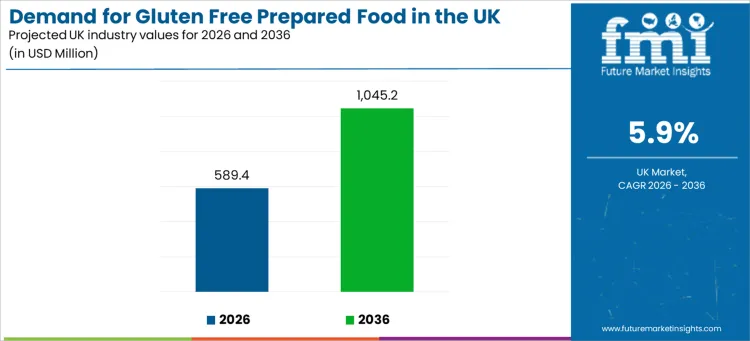
Demand for gluten free prepared food in the UK is likely to be valued at USD 589.4 million in 2026 and is projected to reach USD 1,045.2 million by 2036, at a CAGR of 5.9%. This demand reflects how gluten avoidance has shifted into a structured dietary requirement supported by routine purchasing rather than discretionary choice. Prepared formats meet the practical needs of consumers managing coeliac disease and clinically advised gluten sensitivity while balancing time constraints linked to work, commuting, and household routines.
Gluten free prepared food functions as a reliability-driven category where consistency outweighs experimentation. Buyers assess products based on formulation control, allergen assurance, shelf stability, and repeatable eating experience. Taste parity, texture integrity, and portion predictability influence whether products enter weekly shopping cycles. Purchasing decisions favor items that integrate seamlessly into existing meal patterns without requiring additional preparation effort or ingredient evaluation.
Quick Stats for Gluten Free Prepared Food Industry in the UK
- Gluten Free Prepared Food Industry Value (2026): USD 589.4 million
- Gluten Free Prepared Food Industry Forecast Value (2036): USD 1,045.2 million
- Gluten Free Prepared Food Industry Forecast CAGR 2026 to 2036: 5.9%
- Leading Product Type by Demand Share: Drinks
- Fastest-Growing Regions: England, Scotland, Wales, Northern Ireland
- Top Industry Participants: General Mills Inc., B&G Foods, Udi’s Healthy Foods, Enjoy Life Foods, Ener-G Foods
Retail and foodservice participation reinforces demand through normalization. Supermarkets position gluten free prepared foods within mainstream chilled, frozen, and ambient ranges, reducing friction during routine shopping trips. Foodservice operators adopt limited yet dependable offerings to meet dietary compliance expectations while simplifying menu execution. Manufacturers align production with audited gluten control processes, batch consistency, and distribution reliability, supporting confidence across households and institutional buyers. Demand strength is anchored in everyday usability, operational dependability, and trust in outcome consistency rather than novelty appeal.
Gluten Free Prepared Food Industry in the UK Key Takeaways
| Metric | Value |
|---|---|
| Industry Value (2026) | USD 589.4 million |
| Industry Forecast Value (2036) | USD 1,045.2 million |
| Forecast CAGR (2026 to 2036) | 5.9% |
Why is the UK Building Steady Demand for Gluten Free Prepared Food?
UK demand strengthens as gluten free diets move from preference-based choices to medically managed eating routines. A rising diagnosed population with coeliac disease and clinically advised gluten sensitivity requires dependable meal solutions that fit daily schedules. Prepared foods address this need by offering controlled formulations that reduce exposure risks while supporting consistent dietary adherence across home, work, and travel settings.
Retail and foodservice structures reinforce this demand pattern. Supermarkets treat gluten free prepared meals as core lines within chilled, frozen, and ambient ranges rather than specialist health products. Placement alongside standard ready meals signals normalized consumption, while private label expansion improves accessibility. Foodservice operators such as workplace caterers and transport hubs incorporate gluten free prepared options to meet duty-of-care expectations and simplify menu planning.
Product performance drives repeat purchasing behaviour. UK buyers expect gluten free prepared foods to deliver comparable taste, texture, and satiety to conventional equivalents. Manufacturers focus on recipe stability, shelf life reliability, and clear allergen control processes. Trust in consistent outcomes supports routine purchasing rather than occasional substitution, sustaining steady demand rooted in practicality rather than trend-driven interest.
How is Gluten Free Prepared Food Demand Segmented by Product Type and Sales Channel in the UK?
Demand for gluten free prepared food in the UK reflects how manufacturers and retailers respond to routine consumption needs, access convenience, and confidence in everyday dietary compliance. Product selection and channel presence are shaped by how easily consumers can integrate gluten free options into normal shopping patterns without altering meal planning habits or preparation routines.
Why do gluten free drinks lead product type demand in routine consumption?
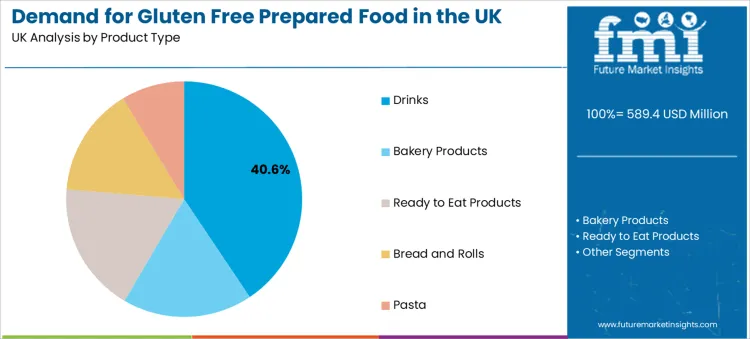
Drinks hold a 40.6% share, placing them as the most selected product type. This position reflects ease of substitution, low preparation effort, and broad usage across daily consumption occasions. Gluten free beverages allow consumers to maintain dietary adherence without recipe modification, ingredient scrutiny, or cooking adjustments. For producers, drinks support tighter formulation control, stable shelf life, and consistent texture outcomes, which reduces quality variation across batches.
Retailers also favor drinks due to predictable turnover and minimal in-store handling complexity. These products fit well within chilled, ambient, and on-the-go formats, reinforcing repeat purchasing behavior. Brand trust in this segment builds through sensory consistency rather than novelty, supporting steady volume movement.
What sustains supermarket dominance as the primary sales channel?
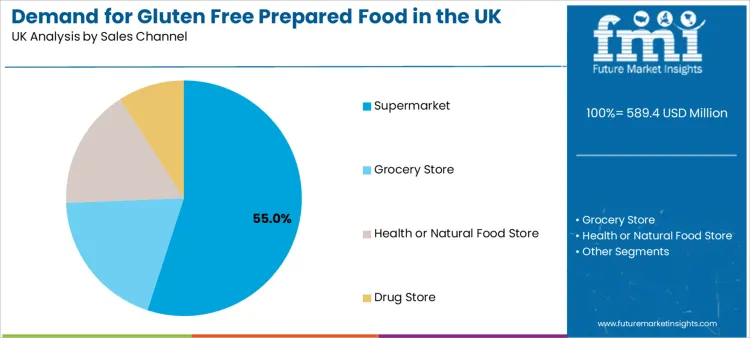
Supermarkets account for a 55.0% share, reflecting their role as the default access point for gluten free prepared food purchases. Consumers rely on supermarkets for range visibility, label clarity, and the ability to combine gluten free items with regular household shopping. Shelf placement within mainstream aisles reduces the perception of dietary separation and supports routine buying patterns.
From a supply perspective, supermarkets offer scale, predictable ordering cycles, and centralized distribution, which suits prepared food producers managing cost discipline and freshness control. Category management within these outlets prioritizes dependable sellers with consistent compliance records, reinforcing supermarket leadership in gluten free prepared food distribution.
What are the Key Dynamics in demand for Gluten Free Prepared Food in the UK?
Demand for gluten-free prepared food in the UK has expanded as consumer awareness of coeliac disease, non-coeliac gluten sensitivity, and lifestyle-driven choices rises. Retailers and foodservice operators report increased purchases of ready meals, bakery items, and snacks labelled gluten-free, reflecting both health-driven needs and convenience trends. Growth is influenced by demographic shifts with older adults prioritizing digestive wellbeing and younger consumers seeking specialty diets that align with personal health perceptions.
What roles do health perceptions and category penetration play in shaping demand?
Health perceptions are central to demand patterns because many UK consumers associate gluten avoidance with improved digestive comfort and overall wellbeing. Prepared foods such as gluten-free pizzas, lasagnes, and ambient snacks are chosen when branded with clear allergen information that inspires confidence. Increased penetration of gluten-free options in mainstream and premium grocery aisles reduces historical barriers to purchase, extending trial beyond small specialist niches. Retailer promotions and clear labelling standards adopted by UK chains enhance visibility and reduce purchase hesitation among shoppers managing diagnosed or self-reported sensitivities.
How do price sensitivity and product quality influence continued uptake?
Price sensitivity plays a significant role because gluten-free prepared foods in the UK typically carry a premium relative to conventional equivalents. Shoppers balance cost against perceived health benefits and sensory quality, with repeat buying driven by taste, texture, and convenience. Quality limitations in some gluten-free products, such as dry crumb structure in baked goods or dense textures in ready meals, can limit broader adoption if sensory expectations are not met. Brands that invest in formulation improvements and ingredient innovation tend to secure higher repeat purchase rates among consumers who seek both gluten-free compliance and eating enjoyment. Retailer range breadth and competitive pricing strategies further influence household penetration rates, especially among cost-conscious segments.
How is Gluten Free Prepared Food Demand Evolving across Key Regions in the UK?
Demand for gluten free prepared food across the UK advances as dietary management, allergen awareness, and structured retail distribution gain scale. Regional differences reflect production density, private label penetration, foodservice participation, and the speed at which manufacturers standardize gluten free lines within existing prepared food portfolios.
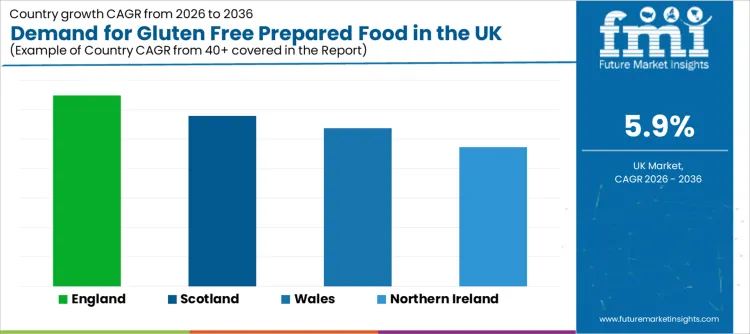
| Region | CAGR 2026 to 2036 |
|---|---|
| England | 6.5% |
| Scotland | 5.8% |
| Wales | 5.4% |
| Northern Ireland | 4.7% |
Why is England leading expansion through scale-driven production and retail penetration?
England expands at 6.5%, supported by dense prepared food manufacturing clusters and extensive supermarket private label programs. Large producers integrate gluten free variants into chilled and frozen ready meals to maximize line utilization. Demand strengthens where retailers prioritize nationwide SKU rollouts, centralized sourcing, and consistent allergen controls that reduce operational complexity.
How is Scotland progressing through steady uptake in branded and regional prepared foods?
Scotland grows at 5.8%, shaped by stable adoption within branded prepared meals and regionally distributed chilled food ranges. Manufacturers focus on controlled batch sizes and reliable texture outcomes to maintain consumer trust. Demand rises where producers balance gluten free compliance with taste retention and shelf life stability across smaller but loyal consumer bases.
What is shaping Wales as producers balance accessibility with production efficiency?
Wales advances at 5.4%, driven by selective expansion among ready meal producers serving value-focused retail channels. Purchasing decisions emphasise ingredients and formulations that integrate smoothly into existing processes. Demand builds when gluten free prepared foods deliver clear cost alignment, predictable yields, and minimal disruption to established production schedules.
Why is Northern Ireland showing measured growth tied to targeted product launches?
Northern Ireland records 4.7% growth, reflecting cautious rollout strategies and narrower prepared food portfolios. Producers prioritize high-rotation gluten free items rather than broad range expansion. Demand improves when manufacturers secure stable ingredient supply, confirm repeat purchase behaviour, and validate performance across limited yet strategically important prepared food categories.
What Defines the Competitive Landscape for Gluten Free Prepared Food in the UK?
Demand for gluten free prepared food in the UK is shaped by diagnosed coeliac prevalence, self-directed dietary avoidance, and retail availability expansion. Buyers evaluate ingredient transparency, allergen control credibility, taste parity with conventional foods, and nutritional balance. Assessment also includes price accessibility, shelf stability, and suitability for chilled and frozen distribution formats. Procurement behavior by retailers favors suppliers with audited gluten-free manufacturing, consistent SKU performance, and scalable UK supply chains. Trend in the UK industry reflects movement beyond niche health positioning toward everyday meal solutions integrated into mainstream ready-meal and bakery aisles.
General Mills holds leading positioning in the UK through established gluten free brands distributed via major grocery multiples. B&G Foods maintains relevance with shelf-stable and frozen gluten free prepared foods targeting convenience-led consumption. Udi’s Healthy Foods supports demand through bakery-style prepared offerings aligned with taste and texture expectations. Enjoy Life Foods participates by supplying allergen-free prepared snacks positioned for strict avoidance consumers. Ener-G Foods remains present through specialist gluten free prepared products serving long-standing coeliac consumer segments. Competitive differentiation centers on certified safety controls, taste consistency, retail penetration, and ability to balance affordability with clean-label expectations.
Key Industry Participants
- Ener-G Foods, Inc.
- General Mills Inc.
- Enjoy Life Foods
- Udi's Healthy Foods, LLC
- B&G Foods, Inc
Scope of Report
| Items | Values |
|---|---|
| Quantitative Units | USD million |
| Product Type | Drinks; Bakery Products; Ready to Eat Products; Bread and Rolls; Pasta |
| Sales Channel | Supermarket; Grocery Store; Health or Natural Food Store; Drug Store |
| Regions Covered | England; Scotland; Wales; Northern Ireland |
| Key Companies Profiled | Ener-G Foods, Inc.; General Mills Inc.; Enjoy Life Foods; Udi's Healthy Foods, LLC; B&G Foods, Inc. |
Gluten Free Prepared Food Demand in the UK by Segments
Product Type:
- Drinks
- Bakery Products
- Ready to Eat Products
- Bread and Rolls
- Pasta
Sales Channel:
- Supermarket
- Grocery Store
- Health or Natural Food Store
- Drug Store
By Region
- England
- Scotland
- Wales
- Northern Ireland
Bibliography
- Food Standards Agency. (2023). Food hypersensitivity and allergen labelling requirements in the United Kingdom. UK Government.
- Food Standards Agency. (2024). Guidance on gluten-free claims, ingredient control, and cross-contamination management. UK Government.
- National Health Service. (2023). Coeliac disease: Diagnosis, dietary management, and long-term adherence. NHS England.
- British Nutrition Foundation. (2024). Gluten-free diets in the UK: Population needs, food availability, and nutritional considerations. BNF.
- European Food Safety Authority. (2023). Scientific opinion on gluten thresholds and dietary exposure for individuals with coeliac disease. EFSA Journal.
- World Health Organization. (2023). Food safety, allergen management, and processed food consumption in high-income countries. WHO Press.
Frequently Asked Questions
How big is the demand for gluten free prepared food in the uk in 2026?
The demand for gluten free prepared food in the uk is estimated to be valued at USD 589.4 million in 2026.
What will be the size of gluten free prepared food in the uk in 2036?
The market size for the gluten free prepared food in the uk is projected to reach USD 1,045.2 million by 2036.
How much will be the demand for gluten free prepared food in the uk growth between 2026 and 2036?
The demand for gluten free prepared food in the uk is expected to grow at a 5.9% CAGR between 2026 and 2036.
What are the key product types in the gluten free prepared food in the uk?
The key product types in gluten free prepared food in the uk are drinks, bakery products, ready to eat products, bread and rolls and pasta.
Which sales channel segment is expected to contribute significant share in the gluten free prepared food in the uk in 2026?
In terms of sales channel, supermarket segment is expected to command 55.0% share in the gluten free prepared food in the uk in 2026.
Preview the report firsthand - request a free sample
Get SampleGet the brochure for pricing and purchase details.
Get PDFTable of Content
- Executive Summary
- UK Market Outlook
- Demand-side Trends
- Supply-side Trends
- Technology Roadmap Analysis
- Analysis and Recommendations
- Market Overview
- Market Coverage / Taxonomy
- Market Definition / Scope / Limitations
- Market Background
- Market Dynamics
- Drivers
- Restraints
- Opportunity
- Trends
- Scenario Forecast
- Demand in Optimistic Scenario
- Demand in Likely Scenario
- Demand in Conservative Scenario
- Opportunity Map Analysis
- Product Life Cycle Analysis
- Supply Chain Analysis
- Investment Feasibility Matrix
- Value Chain Analysis
- PESTLE and Porter’s Analysis
- Regulatory Landscape
- Regional Parent Market Outlook
- Production and Consumption Statistics
- Import and Export Statistics
- Market Dynamics
- UK Market Analysis 2021 to 2025 and Forecast, 2026 to 2036
- Historical Market Size Value (USD Million) Analysis, 2021 to 2025
- Current and Future Market Size Value (USD Million) Projections, 2026 to 2036
- Y-o-Y Growth Trend Analysis
- Absolute $ Opportunity Analysis
- UK Market Pricing Analysis 2021 to 2025 and Forecast 2026 to 2036
- UK Market Analysis 2021 to 2025 and Forecast 2026 to 2036, By Product Type
- Introduction / Key Findings
- Historical Market Size Value (USD Million) Analysis By Product Type , 2021 to 2025
- Current and Future Market Size Value (USD Million) Analysis and Forecast By Product Type , 2026 to 2036
- Drinks
- Bakery Products
- Ready to Eat Products
- Bread and Rolls
- Pasta
- Drinks
- Y-o-Y Growth Trend Analysis By Product Type , 2021 to 2025
- Absolute $ Opportunity Analysis By Product Type , 2026 to 2036
- UK Market Analysis 2021 to 2025 and Forecast 2026 to 2036, By Sales Channel
- Introduction / Key Findings
- Historical Market Size Value (USD Million) Analysis By Sales Channel, 2021 to 2025
- Current and Future Market Size Value (USD Million) Analysis and Forecast By Sales Channel, 2026 to 2036
- Supermarket
- Grocery Store
- Health or Natural Food Store
- Drug Store
- Supermarket
- Y-o-Y Growth Trend Analysis By Sales Channel, 2021 to 2025
- Absolute $ Opportunity Analysis By Sales Channel, 2026 to 2036
- Market Structure Analysis
- Competition Dashboard
- Competition Benchmarking
- Market Share Analysis of Top Players
- By Regional
- By Product Type
- By Sales Channel
- Competition Analysis
- Competition Deep Dive
- Ener-G Foods, Inc.
- Overview
- Product Portfolio
- Profitability by Market Segments (Product/Age /Sales Channel/Region)
- Sales Footprint
- Strategy Overview
- Marketing Strategy
- Product Strategy
- Channel Strategy
- General Mills Inc.
- Enjoy Life Foods
- Udi's Healthy Foods, LLC
- B&G Foods, Inc
- Ener-G Foods, Inc.
- Competition Deep Dive
- Assumptions & Acronyms Used
- Research Methodology


