

- Industry Size (2026)
- USD 403.6 Mn
- Forecast (2036)
- USD 1241.9 Mn
- CAGR (2026 to 2036)
- 11.9%
Demand for Interactive Projector in the UK 2026 to 2036
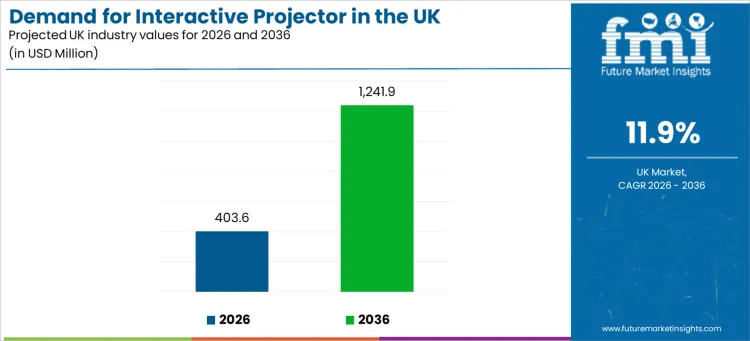
Demand for interactive projectors in the UK is likely to be valued at USD 403.6 million in 2026 and is projected to reach USD 1,241.9 million by 2036, reflecting an 11.9% CAGR. This demand is shaped by growing reliance on visual collaboration tools that support direct interaction, shared content creation, and participatory communication across education and professional environments.
Interactive projectors are adopted where engagement and flexibility matter more than static display performance. Schools, training centers, and meeting spaces rely on projection systems that allow users to annotate, manipulate content, and collaborate in real time. Touch responsiveness, image clarity under ambient light, and ease of calibration influence repeat usage. Buyers value solutions that integrate into existing rooms without structural modification while supporting frequent, hands-on interaction.
Procurement decisions emphasize practicality and longevity. Educational institutions favor systems that balance instructional impact with controlled budgets, while enterprises prioritize adaptability for hybrid collaboration. Ultra-short throw designs, dependable brightness, and compatibility with collaboration software strengthen adoption across varied settings. Demand growth reflects how interactive projectors function as everyday collaboration infrastructure, supporting learning and teamwork through consistent performance rather than occasional presentation use.
Quick Stats for Interactive Projector Industry in the UK
- Interactive Projector Industry Value (2026): USD 403.6 million
- Interactive Projector Industry Forecast Value (2036): USD 1,241.9 million
- Interactive Projector Industry Forecast CAGR 2026 to 2036: 11.9%
- Leading Technology by Demand Share: Liquid Crystal Display (LCD)
- Fastest-Growing Regions: England, Scotland, Wales, Northern Ireland
- Key Industry Participants: Seiko Epson Corporation, BenQ Corporation, Panasonic Corporation, NEC Display Solutions, Optoma Technology Inc., Dell Technologies Inc.
Interactive Projector Industry in the UK Key Takeaways
| Metric | Value |
|---|---|
| Industry Value (2026) | USD 403.6 million |
| Industry Forecast Value (2036) | USD 1,241.9 million |
| Forecast CAGR (2026 to 2036) | 11.9% |
Why is the UK Building Steady Demand for Interactive Projectors?
Demand for interactive projectors in the UK strengthens as organizations pursue more engaging ways to share information and collaborate. Schools, training centres and corporate teams place value on tools that enable dynamic presentations and real-time annotation. Interactive projection systems replace static displays, allowing participants to interact directly with content during lessons, workshops or brainstorming sessions.
Workplace practices in the UK increasingly favour hybrid and flexible meeting formats. Teams spread across locations require display solutions that support both in-room and remote engagement. Interactive projectors serve as hubs for visual communication, enabling touch or stylus interaction that improves clarity and participation. Buyers see these devices as practical enablers of teamwork rather than optional peripherals.
Education policy and procurement strategies also influence uptake. Schools and colleges look for solutions that fit budget constraints while delivering measurable classroom impact. Interactive projectors often offer cost-effective alternatives to large interactive flat panels, especially where space or infrastructure limits LCD or LED installations. Teachers appreciate the adaptability of projected content, and repeat use in daily lessons sustains demand across the UK education ecosystem.
How is Interactive Projector Demand Segmented by Technology, Resolution, and Projection Type in the UK?
Demand for interactive projectors in the UK reflects how users prioritise visual clarity, installation practicality, and interaction reliability across education, corporate, and training environments. Segmentation follows room constraints, content complexity, and expectations around long-term usability.
Why does LCD technology lead technology-level selection?
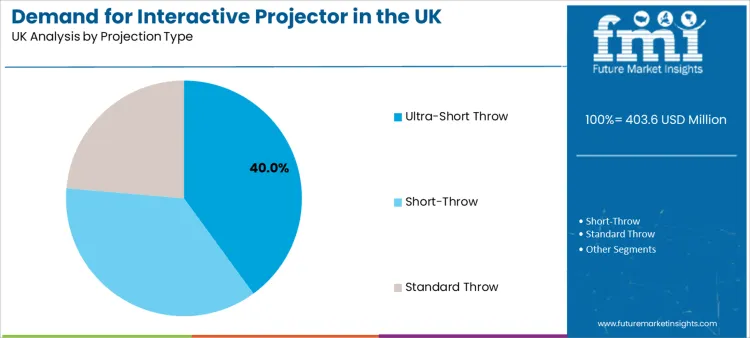
Liquid Crystal Display technology holds a 40.6% share, placing it as the most selected option. This preference reflects consistent colour accuracy, stable brightness output, and suitability for text-heavy and presentation-focused content. Users value LCD systems for maintaining legibility under ambient light conditions, which supports collaborative settings where lighting control remains limited.
Operational teams also favour LCD projectors due to predictable performance and familiarity with maintenance routines. These systems integrate smoothly into existing audiovisual setups, reducing adjustment time during upgrades or room standardization initiatives.
What sustains XGA as the most adopted resolution?
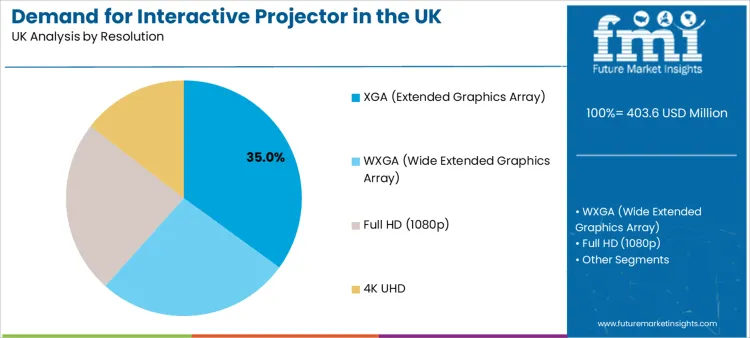
XGA resolution accounts for a 35.0% share, indicating continued relevance for structured presentation and instructional use. XGA delivers sufficient clarity for slides, diagrams, and annotations without driving hardware cost escalation. Many interactive applications rely on responsiveness and readability rather than ultra-high pixel density, which supports sustained adoption of this resolution tier.
Institutions also benefit from compatibility with legacy content formats and devices, easing transition across mixed equipment environments.
Why does ultra-short throw dominate projection type demand?
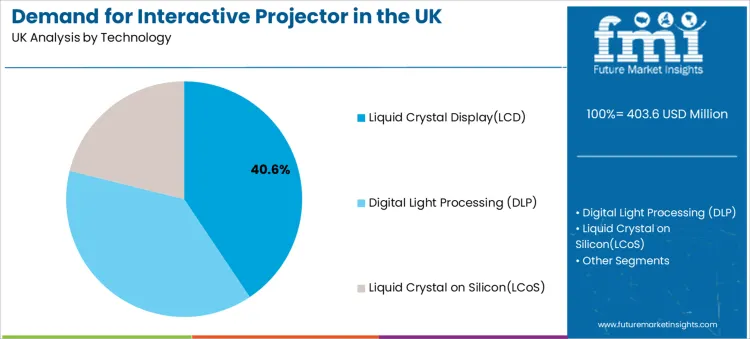
Ultra-short throw projectors represent a 40.0% share, reflecting strong preference for space-efficient installation. These systems minimise shadow interference and glare, improving interaction accuracy when users write or gesture near the display surface. Reduced throw distance supports safer classroom and meeting room layouts while simplifying mounting requirements.
What are the Key Dynamics in Demand for Interactive Projectors in the UK?
Demand for interactive projectors in the UK is influenced by adoption trends in education, corporate collaboration and hybrid work environments that require flexible visual communication tools. Schools and universities with technology-enhanced learning initiatives invest in interactive projection to support group work, digital annotations and immersive lesson delivery. In business settings, meeting rooms and agile workspaces use interactive projectors to facilitate brainstorming, remote collaboration and dynamic presentations without reliance on fixed display infrastructure. Selection is shaped by projection brightness, touch interactivity accuracy, connectivity with collaboration platforms, and ease of integration with existing AV systems.
How do specific use cases in education and business drive adoption?
In UK educational institutions, interactive projectors are used to replace or complement traditional whiteboards and static displays, enabling teachers to manipulate content directly on projected surfaces and engage students with digital resources. Procurement in this sector is tied to classroom size, ambient light conditions, and compatibility with school network and classroom management software. Training and support considerations influence long-term uptake where IT teams prioritise solutions that minimise downtime and simplify routine maintenance. In corporate environments, interactive projectors are chosen for spaces where flexibility is a priority; teams use projected whiteboarding and annotation tools during hybrid meetings to combine in-room interaction with remote participation.
How do technical performance and total cost considerations influence demand patterns?
Demand in the UK is shaped by performance criteria tied to image quality, responsiveness and operating costs. UK classrooms and offices with high ambient light levels prioritise projectors with higher lumen output to maintain clarity, while multi-touch capability and low latency contribute to seamless interaction. Solutions capable of wireless connectivity and integration with widely used collaboration platforms support interoperability across devices and user preferences. Pricing sensitivity affects uptake where education budgets are constrained or where businesses evaluate interactive projectors against large interactive flat panels with comparable capabilities. Operating costs such as lamp life, maintenance requirements and warranty support influence decisions, particularly in institutions with limited technical staffing.
How is Interactive Projector Demand Evolving across Key Regions in the UK?
Demand for interactive projectors across the UK accelerates as education, corporate training, and collaborative environments adopt touch-enabled visual systems. Regional variation reflects institutional spending capacity, digital classroom readiness, replacement cycles, and how users prioritize engagement, ease of integration, and long-term device reliability.
| CAGR 2026 to 2036 | |
|---|---|
| England | 13.1% |
| Scotland | 11.7% |
| Wales | 10.8% |
| Northern Ireland | 9.5% |
Why is England leading expansion through institutional scale and classroom modernization?
England grows at 13.1%, supported by extensive deployment across schools, universities, and enterprise collaboration spaces. Demand rises where institutions upgrade legacy display tools with interactive formats that support annotation, multi-user input, and hybrid instruction. Buyers prioritize brightness consistency, low maintenance operation, and compatibility with learning platforms to ensure dependable performance across high-usage environments.
How is Scotland progressing through structured adoption in education and training settings?
Scotland expands at 11.7%, shaped by steady investment in digital learning and professional training facilities. Adoption focuses on interactive projectors that enhance participation while fitting existing room layouts. Demand builds where institutions value simplified installation, durable touch accuracy, and software support that aligns with curriculum delivery and instructor-led collaboration workflows.
What is shaping Wales as adopters balance engagement benefits with budget discipline?
Wales advances at 10.8%, driven by selective purchasing among schools and public facilities seeking measurable engagement gains. Demand strengthens when interactive projectors deliver reliable touch response and clear visuals without increasing operating complexity. Decision-makers favour systems that integrate smoothly with current IT infrastructure and support flexible teaching methods within controlled budgets.
Why is Northern Ireland showing measured growth tied to targeted deployment programmes?
Northern Ireland records 9.5% growth, reflecting focused rollout programmes in education and training venues. Adoption progresses where interactive projection clearly improves lesson delivery and group interaction. Demand improves when devices demonstrate long service life, straightforward calibration, and dependable vendor support suited to smaller yet strategically planned installation footprints.
What Defines the Competitive Landscape for Interactive Projector in the UK?
Demand for interactive projectors in the UK is influenced by digital classroom investment, hybrid learning models, and collaborative workplace adoption. Buyers assess touch accuracy, latency, brightness under ambient light, software compatibility, and integration with existing learning platforms. Evaluation also includes installation flexibility, total cost of ownership, lamp or laser lifespan, and aftersales service coverage. Procurement behavior favors suppliers aligned with education frameworks, public sector procurement standards, and scalable deployment across multi-site estates. Trend in the UK industry reflects gradual migration from traditional whiteboards toward interactive projection systems supporting shared content creation and remote collaboration.
Seiko Epson Corporation holds strong positioning through laser-based interactive projectors widely adopted in UK schools and training centers. BenQ competes by offering education-focused interactive solutions emphasizing eye-care technology and classroom software integration. Panasonic Corporation maintains relevance in corporate and higher education environments requiring high brightness and system reliability. NEC Display Solutions supports demand with installation-grade projectors suited for larger collaborative spaces. Optoma Technology Inc. remains active in value-oriented segments serving schools and SMEs, while Dell Technologies participates indirectly through ecosystem integration supporting interactive learning environments. Competitive differentiation centers on user experience reliability, education software alignment, service support strength, and procurement compliance readiness.
Key Industry Participants
- Seiko Epson Corporation
- BenQ Corporation
- Panasonic Corporation
- Dell Technologies Inc.
- NEC Display Solutions Ltd.
- Optoma Technology Inc.
Scope of Report
| Items | Values |
|---|---|
| Quantitative Units | USD million |
| Technology | Liquid Crystal Display (LCD); Digital Light Processing (DLP); Liquid Crystal on Silicon (LCoS) |
| Resolution | XGA (Extended Graphics Array); WXGA (Wide Extended Graphics Array); Full HD (1080p); 4K UHD |
| Projection Type | Ultra-Short Throw; Short-Throw; Standard Throw |
| Regions Covered | England; Scotland; Wales; Northern Ireland |
| Key Companies Profiled | Seiko Epson Corporation; BenQ Corporation; Panasonic Corporation; Dell Technologies Inc.; NEC Display Solutions Ltd.; Optoma Technology Inc. |
Interactive Projector Demand in the UK by Segments
Technology:
- Liquid Crystal Display(LCD)
- Digital Light Processing (DLP)
- Liquid Crystal on Silicon(LCoS)
Resolution:
- XGA (Extended Graphics Array)
- WXGA (Wide Extended Graphics Array)
- Full HD (1080p)
- 4K UHD
Projection Type:
- Ultra-Short Throw
- Short-Throw
- Standard Throw
By Region:
- England
- Scotland
- Wales
- Northern Ireland
Bibliography
- Department for Education. (2023). Digital and technology standards in education: Guidance for schools and colleges. UK Government.
- Department for Education. (2024). EdTech strategy update: Technology-enabled teaching and learning in England. UK Government.
- Office for National Statistics. (2023). Digital adoption and ICT use in education and workplaces in the UK. UK Government.
- Organisation for Economic Co-operation and Development. (2023). Smart learning environments and digital classroom technologies. OECD Publishing.
Frequently Asked Questions
How big is the demand for interactive projector in the uk in 2026?
The demand for interactive projector in the uk is estimated to be valued at USD 403.6 million in 2026.
What will be the size of interactive projector in the uk in 2036?
The market size for the interactive projector in the uk is projected to reach USD 1,241.9 million by 2036.
How much will be the demand for interactive projector in the uk growth between 2026 and 2036?
The demand for interactive projector in the uk is expected to grow at a 11.9% CAGR between 2026 and 2036.
What are the key product types in the interactive projector in the uk?
The key product types in interactive projector in the uk are liquid crystal display(lcd), digital light processing (dlp) and liquid crystal on silicon(lcos).
Which resolution segment is expected to contribute significant share in the interactive projector in the uk in 2026?
In terms of resolution, xga (extended graphics array) segment is expected to command 35.0% share in the interactive projector in the uk in 2026.
Preview the report firsthand - request a free sample
Get SampleGet the brochure for pricing and purchase details.
Get PDFTable of Content
- Executive Summary
- UK Market Outlook
- Demand-side Trends
- Supply-side Trends
- Technology Roadmap Analysis
- Analysis and Recommendations
- Market Overview
- Market Coverage / Taxonomy
- Market Definition / Scope / Limitations
- Market Background
- Market Dynamics
- Drivers
- Restraints
- Opportunity
- Trends
- Scenario Forecast
- Demand in Optimistic Scenario
- Demand in Likely Scenario
- Demand in Conservative Scenario
- Opportunity Map Analysis
- Product Life Cycle Analysis
- Supply Chain Analysis
- Investment Feasibility Matrix
- Value Chain Analysis
- PESTLE and Porter’s Analysis
- Regulatory Landscape
- Regional Parent Market Outlook
- Production and Consumption Statistics
- Import and Export Statistics
- Market Dynamics
- UK Market Analysis 2021 to 2025 and Forecast, 2026 to 2036
- Historical Market Size Value (USD Million) Analysis, 2021 to 2025
- Current and Future Market Size Value (USD Million) Projections, 2026 to 2036
- Y-o-Y Growth Trend Analysis
- Absolute $ Opportunity Analysis
- UK Market Pricing Analysis 2021 to 2025 and Forecast 2026 to 2036
- UK Market Analysis 2021 to 2025 and Forecast 2026 to 2036, By Technology
- Introduction / Key Findings
- Historical Market Size Value (USD Million) Analysis By Technology , 2021 to 2025
- Current and Future Market Size Value (USD Million) Analysis and Forecast By Technology , 2026 to 2036
- Liquid Crystal Display(LCD)
- Digital Light Processing (DLP)
- Liquid Crystal on Silicon(LCoS)
- Liquid Crystal Display(LCD)
- Y-o-Y Growth Trend Analysis By Technology , 2021 to 2025
- Absolute $ Opportunity Analysis By Technology , 2026 to 2036
- UK Market Analysis 2021 to 2025 and Forecast 2026 to 2036, By Resolution
- Introduction / Key Findings
- Historical Market Size Value (USD Million) Analysis By Resolution, 2021 to 2025
- Current and Future Market Size Value (USD Million) Analysis and Forecast By Resolution, 2026 to 2036
- XGA (Extended Graphics Array)
- WXGA (Wide Extended Graphics Array)
- Full HD (1080p)
- 4K UHD
- XGA (Extended Graphics Array)
- Y-o-Y Growth Trend Analysis By Resolution, 2021 to 2025
- Absolute $ Opportunity Analysis By Resolution, 2026 to 2036
- UK Market Analysis 2021 to 2025 and Forecast 2026 to 2036, By Projection Type
- Introduction / Key Findings
- Historical Market Size Value (USD Million) Analysis By Projection Type, 2021 to 2025
- Current and Future Market Size Value (USD Million) Analysis and Forecast By Projection Type, 2026 to 2036
- Ultra-Short Throw
- Short-Throw
- Standard Throw
- Ultra-Short Throw
- Y-o-Y Growth Trend Analysis By Projection Type, 2021 to 2025
- Absolute $ Opportunity Analysis By Projection Type, 2026 to 2036
- Market Structure Analysis
- Competition Dashboard
- Competition Benchmarking
- Market Share Analysis of Top Players
- By Regional
- By Technology
- By Resolution
- By Projection Type
- Competition Analysis
- Competition Deep Dive
- Seiko Epson Corporation
- Overview
- Product Portfolio
- Profitability by Market Segments (Product/Age /Sales Channel/Region)
- Sales Footprint
- Strategy Overview
- Marketing Strategy
- Product Strategy
- Channel Strategy
- BenQ Corporation
- Panasonic Corporation
- Dell Technologies Inc.
- NEC Display Solutions Ltd.
- Optoma Technology Inc.
- Seiko Epson Corporation
- Competition Deep Dive
- Assumptions & Acronyms Used
- Research Methodology


