

The global automotive window regulator sector is on track to achieve a valuation of USD 27.1 billion by 2036, accelerating from USD 17.1 billion in 2026 at a CAGR of 4.7%. As per Future Market Insights, expansion is structurally underpinned by the global growth in vehicle production and the accelerating adoption of power window systems as standard equipment across all vehicle segments. The International Organization of Motor Vehicle Manufacturers (OICA) reported in 2024 that global vehicle production exceeded 92 million units, providing the volume baseline for component demand. This production trajectory compels Tier-1 suppliers to invest in automated assembly lines and localized manufacturing. Simultaneously, the industry is shifting from standalone mechanical regulators to electronically controlled systems integrated with vehicle body control modules, which forces a redesign of supplier engineering and validation processes.
Gerard Roose, President and CEO of Inteva Products, stated: 'This expansion aligns with the Make in India initiative and underscores our commitment to delivering localized, customer-centric solutions.' In April 2024, Brose debuted a new window regulator in China designed for global rollout, featuring electrification and intelligent functions such as personalized light dimming and privacy settings. The product is part of Brose's China Speed initiative, which shortens development lifecycles to adapt to rapid EV technological shifts. FMI opines that the integration of software-defined features into window regulators, where light control and privacy glass activation are managed through the vehicle operating system, will create a measurable ASP uplift for suppliers who can deliver this capability at scale.
The operational reality is defined by the need to balance global platform commonality with regional production mandates. In July 2024, Antolin inaugurated a 3,200-square-meter facility in India for advanced electronics and mechatronic components. In early 2025, Hi-Lex Controls commenced operations at a new plant in Coahuila, Mexico. Manolo Jimenez Salinas, Governor of Coahuila, stated: 'We are starting 2025 with a bang by inaugurating new investment projects.' As per FMI, the parallel expansion of window regulator production capacity in India and Mexico reflects the automotive industry's localization imperative, where proximity to vehicle assembly plants is a non-negotiable procurement criterion for Tier-1 component suppliers.
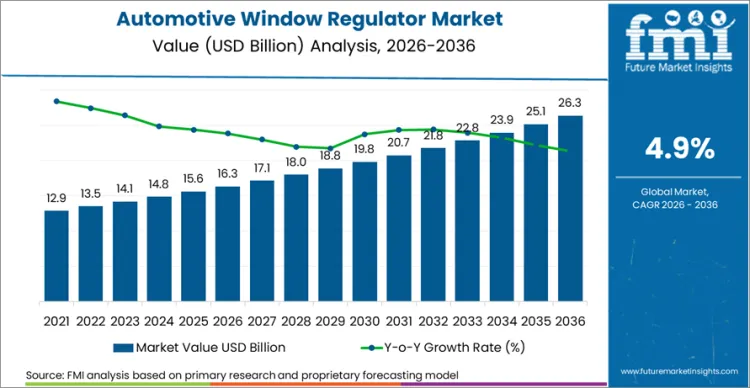
Future Market Insights projects the market to expand at a CAGR of 4.7% from 2026 to 2036, increasing from USD 17.1 Billion in 2026 to USD 27.1 Billion by 2036.
FMI Research Approach: FMI forecasting model based on OICA production volumes and power window standard equipment rates.
FMI analysts perceive the market evolving toward software-integrated closure systems where window regulators include privacy glass control and personalized comfort settings managed through vehicle body control modules.
FMI Research Approach: Brose intelligent window regulator launch (April 2024) and EV platform specification trends.
China holds a significant share, supported by the world's largest vehicle production base and the rapid electrification of its automotive fleet.
FMI Research Approach: FMI modeling by vehicle production volumes and power window penetration rates.
The global market is projected to reach USD 27.1 Billion by 2036.
FMI Research Approach: FMI forecast from OICA production projections and EV adoption curves.
The market includes revenue from manual and power window regulator assemblies, including motors, rails, and electronic controllers, for passenger cars, light trucks, and commercial vehicles.
FMI Research Approach: FMI taxonomy aligned with automotive component classification standards.
Globally unique trends include software-defined window functions for EVs, the China Speed development model for component localization, and parallel production capacity expansion in India and Mexico.
FMI Research Approach: Brose China Speed (April 2024) and Antolin India facility (July 2024).
| Metric | Details |
|---|---|
| Industry Size (2026) | USD 17.1 Billion |
| Industry Value (2036) | USD 27.1 Billion |
| CAGR (2026 to 2036) | 4.7% |
Source: Future Market Insights (FMI) analysis, based on proprietary forecasting model and primary research
The table below presents a comparative assessment of the variation in CAGR over six months for the base year (2025) and current year (2026) for the global automotive window regulator market. This analysis reveals crucial shifts in market performance and indicates revenue realization patterns, thus providing stakeholders with a better vision of the growth trajectory over the year.
The first half of the year, or H1, spans from January to June. The second half, H2, includes the months from July to December. In the first half (H1) of the semi-annual from 2025 to 2035, the business is predicted to surge at a CAGR of 3.9%, followed by a slightly higher growth rate of 5.3% in the second half (H2).
| Particular | Value CAGR |
|---|---|
| H1 2025 | 3.9% (2025 to 2035) |
| H2 2025 | 5.3% (2025 to 2035) |
| H1 2026 | 4.2% (2026 to 2036) |
| H2 2026 | 5.6% (2026 to 2036) |
Moving into the subsequent period, from H1 2026 to H2 2026, the CAGR is projected to increase slightly to 4.2% in the first half and remain relatively moderate at 5.6% in the second half. In the first half (H1) the market witnessed an increase of 30 BPS while in the second half (H2), the market witnessed an increase of 30 BPS.
The section contains information about the leading segments in the industry. By product type, automated segment is estimated to grow at a CAGR of 4.7% throughout 2035. Additionally, passenger vehicle is projected to expand at 4.7% by 2035.
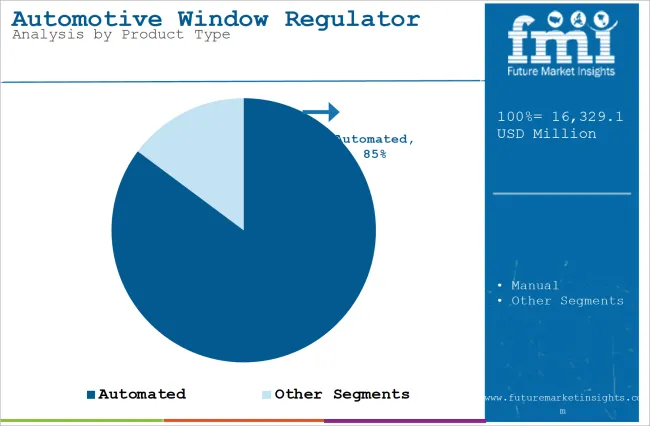
| Product Type | Value Share (2036) |
|---|---|
| Automated | 85.2% |
The demand for automated window regulators far exceeds manual variants. The advancement of consumer taste towards comfort, safety, and convenience leads to increased demand for the automated window regulators. Such features are increasingly becoming popular as they are often used as integral components of vehicle technologies such as anti-pinch mechanisms, child safety locks, and smart control. Most mid-range and premium vehicles are now equipped with such regulators, bringing them in line with increasing electrical and autonomous cars that lean towards a lightweight, efficient componentry.
Manufacturers are also investing in automation to meet regulatory safety standards and cater to the rising demand for enhanced user experiences. In contrast, manual systems are limited to entry-level and commercial vehicles, which represent a shrinking segment of the market. As urbanization and disposable incomes rise globally, consumers are prioritizing vehicles with advanced features, ensuring that automated window regulators remain the preferred choice across the automotive landscape.
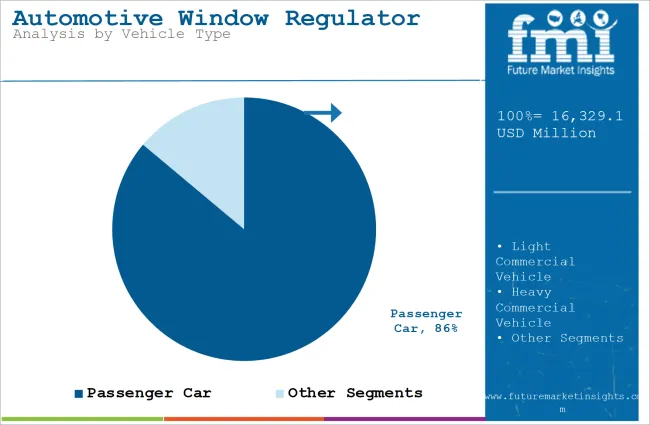
| Vehicle Type | Value Share (2036) |
|---|---|
| Passenger Car | 86.1% |
Passenger cars are produced far more than light commercial vehicles (LCVs) and heavy commercial vehicles (HCVs) worldwide, and this directly impacts the demand for automotive window regulators. The International Organization of Motor Vehicle Manufacturers reports that in 2023, about 61.6 million passenger cars were produced worldwide, while about 23.8 million commercial vehicles were produced, which include both LCVs and HCVs. This significant production gap is why the demand for window regulators is mainly dominated by the passenger car segment.
Consumer expectations further drive this demand. Passenger car buyers are concerned with comfort and convenience features, such as power windows, which are often standard or highly desired in this vehicle category. LCVs and HCVs, on the other hand, are designed for utilitarian purposes, where such amenities are less critical. Therefore, the higher volumes of commercial output for passenger cars in addition to the aspect of passenger experience improvement lead to a higher demand of window regulators by this segment than by commercial vehicles.
Growing Demand for Electric Vehicles in the Market
Governments around the world are gradually encouraging the use of electric vehicles due to increasing environmental issues and stricter emission standards. There is growing demand for EVs in countries such as the USA, Germany, and China as people become increasingly aware that EVs leave far fewer carbon emissions behind as compared to traditional fuel vehicles.
Electric vehicle sales around the world totalled around 14 million in 2023, making it a jump of 35% compared with 2022 sales. The same year saw that number swell up to 40 million. On average, nearly 18 percent of cars sold in 2023 were electric, from almost 14% in 2022 and nearly 2 percent in 2018.
A key driving factor for the automotive window regulator market is increasing demand for electric vehicles. Electric vehicles usually have a power window regulator with a design type that contains cables, hence compatible with lighter materials, one of the important trends in component innovation in automotive. This development is attributed to the rise in vehicle production and sales, plus growth in technologies engineered to improve vehicle windows' efficiency.
Increase in Demand for Passenger Cars and LCVs
Disposable incomes in North America, Europe, and Asia are key drivers of the automotive market. Automotive sales for these regions alone account for over 50% of the world's market; that's where it's primarily occurring. Shift in demographics, advancing technology, and manufacturing capacities add to this. Recovery is visible despite an overall 16% decline in global automotive production and a 14% decrease in sales for 2020. In the USA, automotive sales jumped 11% in 2023, whereas China's market recovered by 8%. The sales of light commercial vehicles, also known as mini trucks, showed a high percentage increase because e-commerce and logistics demand was in full swing. LCVs in North America alone rose 9% in a year's time. This increasing demand in mature markets like North America, Europe, and Asia is further speeding up the recovery of the global automotive industry.
Window regulators are at a risk of wearing down or breaking due to their frequent use in vehicles
Window regulators are the motor that allows vehicle windows to roll up and down. They are among the most commonly used parts in the vehicle’s interior, because of which they are always at a risk of wearing down and breaking. Failure in the functioning of window regulators can cause disfunctioning to the vehicle interior as well as the passengers. Power windows are used in many new vehicle models these days and a faulty window regulator could result in improper functioning of the same, resulting in discomfort and annoyance among the passengers.
Manufacturers use pulley cables to move the windows and these cables can get worn out or become detached from the window, leading to window regulator failure. The lifespan of a window regulator depends on how frequently the window is adjusted. A broken window regulator cable can cause the window to fall down inside the door, necessitating replacement from the user.
Increasing preference for electronic window regulators
Cable type window regulator design has become more popular among automobile manufacturers because of their compact size, which enables more room inside the door panel for safety beams and airbags. Their lighter weight also improves the fuel economy of the vehicle. Hence, the use of cable type design for window regulators has increased in the market.
Cable-driven regulators are typically available in single rail and double rail type designs. These cables allow easy movement of glass windows in the vehicle. Manufacturers use high-strength materials to ensure enhanced durability of the window regulators for single rail as well as double rail type designs, which is one of the factors driving the use of cable designs in window regulators.
The global automotive window regulator market recorded a CAGR of 2.5% during the historical period between 2021 and 2025. The growth of in-vehicle Ethernet system market was positive as it reached a value of USD 15,638.3 million in 2025 from USD 13,406.2 million in 2021.
The automotive window regulator market faced significant disruption in the period between 2021 and 2025, followed by a gradual recovery. The sharp decline in vehicle production and sales due to the COVID-19 pandemic directly impacted the demand for window regulators. As factories shut down and supply chains strained, both OEM and aftermarket segments suffered. However, market stabilization was seen by 2022, encouraged by a renewed surge in vehicle production, the shift toward electric vehicles, and increasing demand for higher technology, especially anti-pinch sensors as well as lightweight materials. By 2024, the industry reflected pre-pandemic levels, growth is still mainly from high and rapidly increasing EV sales, particularly in Asia-Pacific and Europe, and a rebound in consumer spending on vehicle maintenance and upgrades.
Looking ahead to 2025 and beyond, the market is poised for robust growth, supported by the rapid adoption of EVs, advancements in smart technologies, and increasing global automotive production. As EVs are projected to comprise over 20% of vehicle sales by 2025, demand for lightweight, energy-efficient window regulators will rise sharply. Additionally, regulatory mandates for safety features and growing consumer preferences for premium vehicles with advanced features are set to reshape market dynamics. Emerging economies in Asia-Pacific and Latin America will play a pivotal role in driving volume growth, while mature markets like North America and Europe will see demand for high-value, innovative solutions.
Tier 1 companies comprise market leaders with a market revenue of above USD 70 million capturing significant market share of 45% to 53% in global market. These market leaders are characterized by high production capacity and a wide product portfolio.
These market leaders are distinguished by their extensive expertise in manufacturing and reconditioning across multiple packaging formats and a broad geographical reach, underpinned by a robust consumer base. They provide a wide range of series including reconditioning, recycling, and manufacturing utilizing the latest technology and meeting the regulatory standards providing the highest quality.
Prominent companies within tier 1 include Continental AG, Grupo Antolin SA, Tokai Rika, Robert Bosch GmbH, Hi-Lex Corporation, Valeo SA, Magna International and Kongsberg Automotive.
Tier 2 companies include mid-size players with revenue of USD 30 to 70 million having presence in specific regions and highly influencing the local market. These are characterized by a strong presence overseas and strong market knowledge.
These market players have good technology and ensure regulatory compliance but may not have advanced technology and wide global reach. Prominent companies in tier 2 include Shiroki Corporation, Robert Bosch GmbH, Continental AG, Kongsberg Automotive, Inteva Products, Johnan Manufacturing, KÜSTER Holding GmbH, IFB Automotive Pvt. Ltd, Aditya Auto Products and Engineering Pvt. Ltd, Tokai Rika and a few others.
Tier 3 includes the majority of small-scale companies operating at the local presence and serving niche markets having revenue below USD 30 million. These companies are notably oriented towards fulfilling local market demands and are consequently classified within the tier 3 share segment.
They are small-scale players and have limited geographical reach. Tier 3, within this context, is recognized as an unorganized market, denoting a sector characterized by a lack of extensive structure and formalization when compared to organized competitors.
The section below covers the industry analysis of the automotive window regulator market for different countries. Market demand analysis on key countries in several regions of the globe, including North America, Asia Pacific, Western Europe, and others, is provided. The USA is anticipated to remain at the forefront in North America, with a value share of 68.2% of North America through 2036. In East Asia, China is projected to witness a CAGR of 4.6% by 2035.
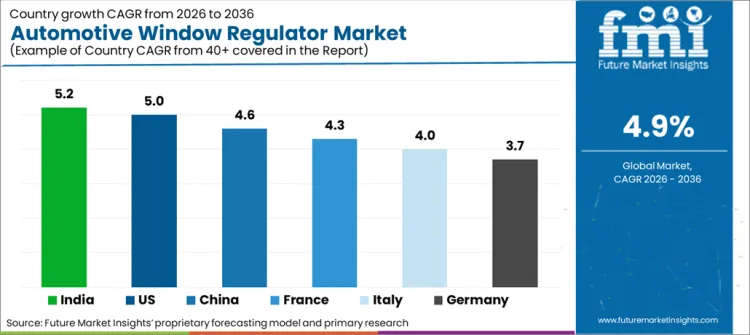
| Country | Value CAGR (2026 to 2036) |
|---|---|
| The USA | 5.0% |
| China | 4.6% |
| Germany | 3.7% |
| India | 5.2% |
| Italy | 4.0% |
| France | 4.3% |
Indian automotive window regulator market size will grow at a CAGR of 5.2% during the forecast period. It is forecast that it will reach around USD 975.4 million by 2036. It is growing on account of an increase in the production and sale of vehicles, increasing consumer demand for enhanced comfort and the rapidly increasing electric vehicle market. Push from the government towards the vehicle electrification process and the adaptation of modern automobile technologies support the upward growth trajectory.
Initiatives by the Government, through programs like FAME (Faster Adoption and Manufacturing of Hybrid and Electric Vehicles) to encourage acceptance of EVs and, thus indirectly, boosting the demand for components such as window regulators; The Automotive Mission Plan 2026 aims at getting the Indian automobile industry at 12 per cent plus contributions towards the Indian GDP and, besides, creation of an additional 65 million jobs which would depict the growth track for automotive component such as window regulators. These policy frameworks and market dynamics place India firmly at the center of the South Asia Pacific region's automotive sector.
The USA automotive window regulator market is expected to grow at a CAGR of 4.6% and reach USD 1,911.6 million by 2036. This growth is attributed to the increase in vehicle production and the surge in electric vehicle (EV) manufacturing. The growth of the EV segment has led to an increasing demand for lightweight and efficient components, such as power window regulators, which are in line with energy efficiency and advanced vehicle design trends.
The USA automotive industry is experiencing significant transformation with the initiation of several major manufacturing projects. Schaeffler has announced an investment of over USD 230 million to build a new manufacturing facility in Dover, Ohio, focusing on automotive electric mobility solutions, with construction beginning in mid-2024 and completion anticipated by the third quarter of 2025. These developments are set to drive demand for advanced automotive components, including window regulators, ensuring sustained market growth.
China's automotive window regulator market is projected to grow at a robust CAGR of 4.6%, reaching a market value of USD 5,778.9 million by 2036. As the world's largest automotive market, China produced over 27 million vehicles in 2022, maintaining its position as the global leader in automotive production. With such production volumes coupled with a nation's forceful push for electrification, there is ever-growing demand for light and efficient components such as power window regulators. The rise of electric vehicles has been fuelled by encouragement through subsidies, good policies from the government.
China’s automotive industry is undergoing a significant transformation, with several new manufacturing plants set to enhance production capabilities. BYD’s new EV factory in Xi’an, Shaanxi, began production in 2024, focusing on next-generation electric vehicles. Tesla’s Shanghai Gigafactory Phase 2 expansion, operational since 2023, significantly increased EV output. NIO's NeoPark, expected to produce over 1 million EVs a year by 2025, and Geely's Ningbo luxury EV plant, which will begin operations in 2025, indicate China's push for advancing the production of EVs. This also means constant demand for advanced window regulators and places China in the lead globally for automotive and EVs.
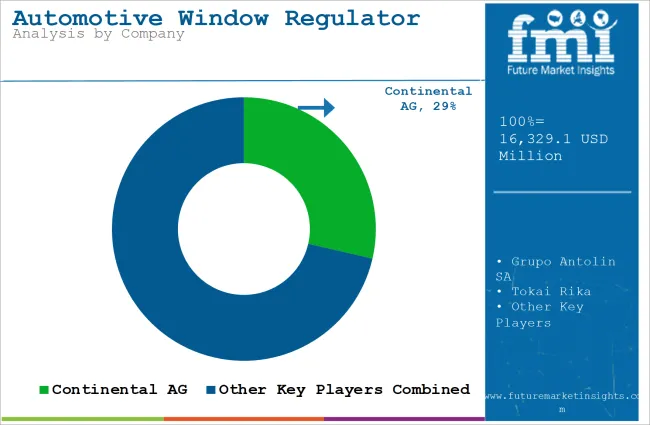
This section provides detailed evaluations and insights that focus on current opportunities and emerging trends within the Automotive Window Regulator market in both developed and developing regions. It examines technological advancements in manufacturing and identifies trends that are expected to open up new applications for market growth.
Key players in the automotive window regulator market are strengthening their market position and enhancing competitiveness through various strategies, such as adopting advanced technologies like power window motors, smart sensors, and innovations in material use to improve performance and durability.
Additionally, leading companies are introducing new product lines to meet the growing demand for innovative solutions in different automotive segments. Geographic expansion remains a key strategy for well-established firms. Start-ups are also expected to emerge in this space by 2035, adding further competition to the market.
Recent Developments
The automotive window regulator market represents revenue from manual and power window regulator assemblies used in passenger vehicles, light trucks, and commercial vehicles. The market measures the value of regulator mechanisms, motors, rails, and integrated electronic controllers sold to vehicle OEMs and aftermarket distributors.
Inclusions cover power window regulators (cable and scissor type), manual window regulators, integrated window regulator motors, and electronic pinch-protection controllers. Both OEM and aftermarket channels are included.
Exclusions include windshield wiper systems, sunroof mechanisms, and door lock actuators not part of the window regulator assembly. Standalone automotive glass and window tinting films are outside the scope.
In terms of product type, the industry is divided into Manual and Automated.
In terms of construction type, the industry is divided into cable type and arm type. Cable type is further segment into single rail and double rail. Similarly arm type is further segmented into single arm and X arm.
In terms of vehicle type, the industry is divided into passenger vehicle, light commercial vehicle and heavy commercial vehicle.
In terms of sales channel, the industry is divided into OEM and aftermarket.
Key regions of North America, Latin America, Western Europe, Eastern Europe, East Asia, South Asia & Pacific, and Middle East & Africa have been covered in the report.
What is the current global market size for Automotive Window Regulator?
The global market is valued at USD 17.1 Billion in 2026, driven by steady growth in global vehicle production and the standardization of power window systems across all vehicle segments including entry-level models.
What is the projected Compound Annual Growth Rate (CAGR) for the market over the next 10 years?
The market is projected to grow at a CAGR of 4.7% from 2026 to 2036.
Which regions are experiencing the fastest expansion?
Asia Pacific leads driven by China's position as the world's largest vehicle production base, followed by North America where Mexico is emerging as a key window regulator manufacturing hub for the region.
What are the primary market drivers?
The electrification of vehicles driving software-integrated window closure systems and the global growth in vehicle production volumes are the primary market drivers.
Who are the leading suppliers in the industry?
Brose, Inteva Products, Hi-Lex Controls, Antolin, and Magna International are key players, differentiating through intelligent closure systems and localized manufacturing in proximity to vehicle assembly plants.
Full Research Suite comprises of:

Market outlook & trends analysis
Interviews & case studies
Strategic recommendations
Vendor profiles & capabilities analysis
5-year forecasts
8 regions and 60+ country-level data splits
Market segment data splits
12 months of continuous data updates
DELIVERED AS:
PDF EXCEL ONLINE

Automotive Window Regulator Market

Thank you!
You will receive an email from our Business Development Manager. Please be sure to check your SPAM/JUNK folder too.

