

- Industry Size (2026)
- USD 2.82 Bn
- Forecast (2036)
- USD 4.29 Bn
- CAGR (2026 to 2036)
- 4.3%
Acetylcholine Market Size, Market Forecast and Outlook By FMI
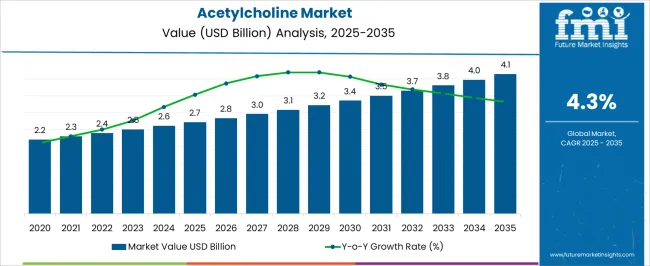
The Acetylcholine market was valued at USD 2.70 billion in 2025, projected to reach USD 2.82 billion in 2026, and is forecast to expand to USD 4.29 billion by 2036 at a 4.3% CAGR. Acetylcholine, the endogenous neurotransmitter governing cholinergic signalling across the peripheral and central nervous system, generates commercial market demand primarily through its pharmaceutical applications as acetylcholine chloride intraocular solution for miosis induction in ophthalmic surgery, its extensive role in neuropharmacological research as a reference standard and laboratory reagent, and the growing market for cholinergic modulator drug candidates targeting neurological and cognitive disorders including Alzheimer's disease, Parkinson's disease, and schizophrenia. As per FMI, the acetylcholine market is structurally supported by the ageing global population driving ophthalmic surgical procedure volumes, expanding neuroscience research investment in academic and pharmaceutical settings, and the clinical pipeline of muscarinic and nicotinic receptor modulator drug candidates that require acetylcholine reference material and cholinergic pathway characterisation studies.
Summary of Acetylcholine Market
- Market Snapshot
- The Acetylcholine market is valued at USD 2.7 billion in 2025 and is projected to reach USD 4.29 billion by 2036.
- The industry is expected to grow at a 4.3% CAGR from 2026 to 2036, creating an incremental opportunity of USD 1.474 billion.
- The market is a steady-growth, application-driven category where product form differentiation and end-use regulatory compliance requirements define competitive positioning.
- Demand and Growth Drivers
- Expanding end-use industry procurement driven by acetylcholine chloride applications and regulatory compliance specifications is sustaining acetylcholine demand growth across primary consuming markets.
- Product quality differentiation across liquid form and alternative product form categories is creating distinct pricing tiers and supply chain structures serving regulated and industrial end-use channels.
- Manufacturing capacity expansion in Asia Pacific and growing downstream industry output are generating incremental demand across all product grades and application segments.
- China leads at 5.8% CAGR, followed by India at 5.4%, Germany at 4.9%, France at 4.5%, and UK at 4.1%.
- Product and Segment View
- The market covers acetylcholine products across product form variants and application grades for industrial, research, pharmaceutical, and regulated end-use procurement channels.
- Liquid Form leads Product Form with 65.0% share in 2026, driven by established performance advantages and specification acceptance in primary application markets.
- Acetylcholine Chloride accounts for 40.0% by Product Type in 2026, reflecting its dominant procurement volume across primary institutional and industrial end users.
- Acetylcholine As A Neurotransmitter holds 45.0% by Applications in 2026, anchored by volume demand in the leading application segment.
- Scope includes certified acetylcholine products for defined end-use applications; excludes precursor chemicals, downstream derivative products, and non-certified materials.
- Geography and Competitive Outlook
- China and India are the fastest-growing markets driven by manufacturing and healthcare sector expansion, while Germany, France, and UK sustain demand through compliance upgrade and replacement cycles.
- Competition is served by global specialty chemical, pharmaceutical, and medical device manufacturers alongside regional producers, with key players including Sumitomo Dainippon Pharma, Tokyo Chemical Industry, Merck KGaA, NeuroHealing Pharmaceuticals, Karuna Pharmaceuticals, Sosei Heptares, AstraZeneca, Anavex Life Sciences.
The absolute dollar increment from 2026 to 2036 reaches USD 1.474 billion, reflecting growth anchored by neuroscience research programme expansion, increasing ophthalmic surgical volumes in ageing population markets, and pharmaceutical development pipeline investment in cholinergic nervous system modulator candidates. FMI analysts observe that liquid form acetylcholine chloride dominates commercial supply due to its direct applicability in ophthalmic surgical preparation, intravenous pharmacological testing, and laboratory cell and tissue-based neurotransmitter receptor assay systems. Research and development application demand is growing at an accelerating rate as academic neuroscience centres, pharmaceutical company discovery programmes, and contract research organisations expand cholinergic pathway investigation programmes linked to central nervous system drug candidate development.
China leads at a 5.8% CAGR through 2036, driven by pharmaceutical research investment expansion, growing ophthalmic surgical procedure volumes from ageing population and cataract surgery programme scaling, and domestic neuropharmacology research programme growth. India follows at 5.4% as pharmaceutical research and development investment and contract research organisation capacity expansion drive acetylcholine reagent and reference standard demand. Germany advances at 4.9% supported by neuroscience research investment and pharmaceutical development programmes. France progresses at 4.5% anchored by pharmaceutical research and ophthalmic applications. The United Kingdom tracks at 4.1% driven by neuroscience research and pharmaceutical development, the United States at 3.7% in a mature research market, and Brazil at 3.2% from pharmaceutical and research sector growth.
Acetylcholine Market Key Takeaways
| Metric | Details |
|---|---|
| Industry Size (2026) | USD 2.82 billion |
| Industry Value (2036) | USD 4.29 billion |
| CAGR (2026 to 2036) | 4.3% |
| Source | Future Market Insights, 2026 |
Acetylcholine Market Definition
The Acetylcholine market encompasses commercial preparations of acetylcholine and its salt forms, primarily acetylcholine chloride and acetylcholine bromide, supplied as pharmaceutical-grade ophthalmic surgical solutions, research-grade reagents and reference standards for neuropharmacology and cell biology applications, and active pharmaceutical ingredient material for cholinergic modulator drug development programmes. Products serve ophthalmic surgery, neuroscience research, pharmacological testing, and pharmaceutical development end users under applicable pharmaceutical regulatory standards and laboratory chemical quality specifications.
Acetylcholine Market Inclusions
Market scope includes pharmaceutical-grade acetylcholine chloride ophthalmic intraocular solutions for surgical miosis induction, research-grade acetylcholine chloride and bromide for laboratory receptor binding assays, electrophysiology studies, and cell biology applications, and reference standard material for pharmaceutical analytical testing. Acetylcholine precursor choline acetyl transferase enzyme system components for research applications and acetylcholine esterase inhibitor research reference compounds used in direct conjunction with acetylcholine testing are incorporated.
Acetylcholine Market Exclusions
Acetylcholinesterase inhibitor drugs including donepezil, rivastigmine, and galantamine as independent therapeutic categories are excluded from acetylcholine market valuation. Choline and acetyl coenzyme A as biosynthetic precursors, muscarinic and nicotinic receptor agonist drugs that are not acetylcholine itself, and acetylcholine receptor antibody diagnostic tests fall outside market scope.
Acetylcholine Market Research Methodology
- Primary Research: FMI analysts engaged with procurement managers, product development scientists, regulatory affairs specialists, and manufacturing executives across key end-use industries, alongside acetylcholine supplier product teams, to map adoption drivers, specification requirements, and regulatory compliance obligations governing market demand.
- Desk Research: Data aggregation incorporated end-use industry output statistics from national statistical agencies and international organisations, product regulatory standards and pharmacopoeia documentation, and primary disclosures from company annual reports, investor presentations, and official product announcements.
- Market-Sizing and Forecasting: Baseline values were derived from bottom-up aggregation of end-use industry activity levels, acetylcholine consumption intensity per unit of downstream output, and regional grade mix, with forward projections applying regulatory compliance adoption curves and end-use sector growth trajectories from government and multilateral sources.
- Data Validation and Update Cycle: Projections are cross-validated against publicly reported revenue data from leading manufacturers and calibrated against end-use industry production output statistics and regulatory programme enrolment data from national authorities.
Why is the Acetylcholine Market Growing?
The Acetylcholine market is being driven by increasing research and development in neurological health and pharmaceutical therapies. In the current scenario, the market is being influenced by rising investments in understanding neurotransmitter functions and addressing cognitive disorders. Growing awareness regarding neurological conditions, coupled with advancements in drug delivery systems, is supporting the expansion of the market.
The demand for neurotransmitter-based solutions is being strengthened by the need to manage conditions such as Alzheimer’s disease, Parkinson’s disease, and other neurodegenerative disorders. The availability of liquid formulations, which offer improved bioavailability and ease of administration, is further encouraging usage across research, clinical, and therapeutic applications.
Additionally, ongoing clinical trials and government support for neurological research are contributing to increased focus on neurotransmitter-based treatments Looking ahead, the market is expected to benefit from enhanced manufacturing capabilities, regulatory approvals for newer applications, and rising global demand for therapies that can support cognitive health and nervous system functions, thereby paving the way for sustainable growth.
Segmental Analysis
The acetylcholine market is segmented by product form, product type, applications, and geographic regions. By product form, acetylcholine market is divided into Liquid Form and Solid Form. In terms of product type, acetylcholine market is classified into Acetylcholine Chloride, Acetylcholine Bromide, Acetylcholine Fluoride, Acetylcholine Hydroxide, and Others. Based on applications, acetylcholine market is segmented into Acetylcholine As A Neurotransmitter, Acetylcholine As A Vasodilator Agent, Acetylcholine As A Cholinergic Agonists, and Acetylcholine For Other Applications. Regionally, the acetylcholine industry is classified into North America, Latin America, Western Europe, Eastern Europe, Balkan & Baltic Countries, Russia & Belarus, Central Asia, East Asia, South Asia & Pacific, and the Middle East & Africa.
Insights into the Liquid Form Segment
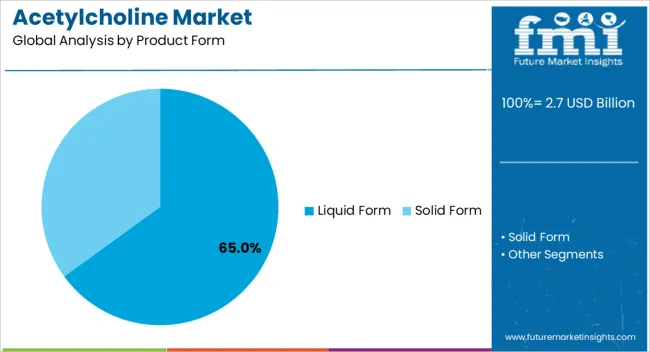
The liquid form is expected to hold 65.00% of the Acetylcholine market revenue share in 2026, making it the leading product form. This prominence is being attributed to its superior absorption and ease of administration, which are particularly important in research and therapeutic settings. The liquid formulation has been widely adopted in clinical trials and treatment protocols where precise dosing and rapid onset of action are required.
The flexibility to customize concentrations and deliver targeted therapeutic effects has made it preferable over other forms. In addition, the stability of liquid formulations under controlled storage conditions has further encouraged its adoption in hospitals, laboratories, and pharmaceutical manufacturing units.
As neurological disorders receive increasing attention, demand for liquid acetylcholine solutions is being supported by growing needs for tailored therapies and injectable solutions that ensure faster patient response The convenience offered by liquid formulations, along with their compatibility with various delivery mechanisms, is expected to sustain this segment’s leadership position.
Insights into the Acetylcholine Chloride Segment
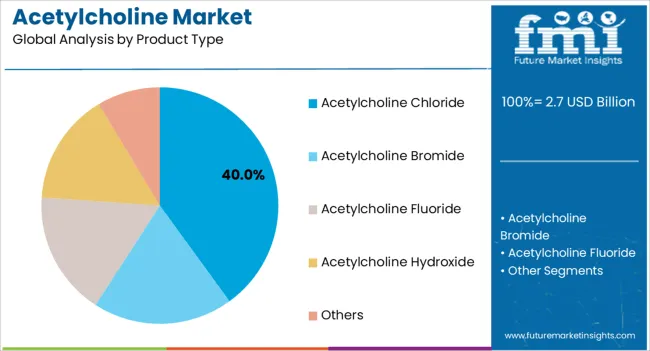
The acetylcholine chloride segment is anticipated to represent 40.00% of the overall Acetylcholine market revenue in 2026, establishing itself as a key product type. Its growth is being driven by its wide acceptance as a stable and effective compound in research and therapeutic applications. The chloride form allows for easier formulation into solutions, enabling researchers to work with consistent concentrations in laboratory settings.
Furthermore, it has been widely used in studies focusing on neurotransmission, cognitive enhancement, and nerve signal modulation, which has increased its demand in both pharmaceutical and clinical trial environments. The high solubility and purity associated with acetylcholine chloride have facilitated its role as a standard compound in neurological investigations.
Rising investments in neuroscience research and increasing interest in understanding cognitive and motor functions are strengthening the position of this segment As efforts to develop more effective treatments for neurodegenerative diseases and mood disorders continue, the acetylcholine chloride segment is expected to remain a cornerstone of pharmaceutical formulations and experimental studies.
Insights into the Acetylcholine as a Neurotransmitter Segment
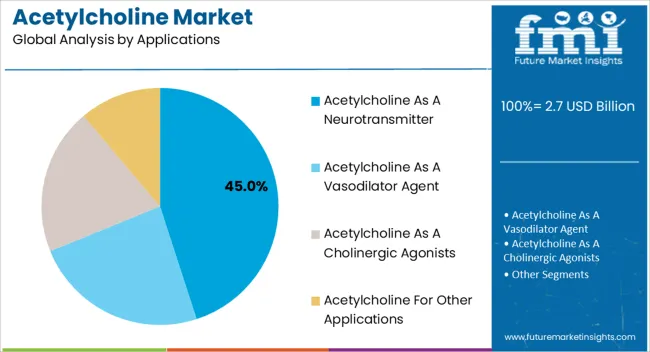
The acetylcholine as a neurotransmitter segment is projected to account for 45.00% of the market’s revenue share in 2026, highlighting its significance in both scientific research and therapeutic applications. The dominance of this segment is being supported by the central role acetylcholine plays in nerve signal transmission, memory formation, and muscle activation. With neurological disorders increasingly recognized as a major global health challenge, research focused on the neurotransmitter’s mechanisms has gained prominence.
The segment has benefited from growing demand in clinical research exploring treatments for Alzheimer’s disease, dementia, and cognitive impairments, where modulation of acetylcholine activity has been found to improve patient outcomes. Additionally, the pharmaceutical industry’s focus on developing drugs that enhance acetylcholine activity has further accelerated its adoption.
Educational and medical institutions have increasingly utilized acetylcholine-based studies to investigate neurological pathways and disease management, reinforcing its widespread application As personalized medicine gains traction, acetylcholine’s relevance in tailored neurotherapies is expected to drive continued growth in this segment.
Market Overview
Acetylcholine (Ach) is a chemical compound derived from choline and acetic acid. It is a prescription drug used in the preparation of a parasympathomimetic drug for intraocular usage. Acetylcholine plays a vital role in the central nervous system as a neurotransmitter. It is used by organisms in all domains of life. Acetylcholine has two key receptors- nicotinic receptors and muscarinic receptors.
Acetylcholine acts at various sites within the central nervous system where it plays an inhibitory role. Moreover, acetylcholine act as a key force in the functions of the brain, such as working memory, linguistic skills, and ability to reason and use logic, creativity. Also, acetylcholine is utilized to activate our muscle’s involuntary movement, mobility, and coordination, other applications.
Analysis of Acetylcholine Market By Key Countries
.webp "Top Country Growth Comparison Acetylcholine Market Cagr (2026 2036)")
| Country | CAGR |
|---|---|
| China | 5.8% |
| India | 5.4% |
| Germany | 4.9% |
| France | 4.5% |
| UK | 4.1% |
| USA | 3.7% |
| Brazil | 3.2% |
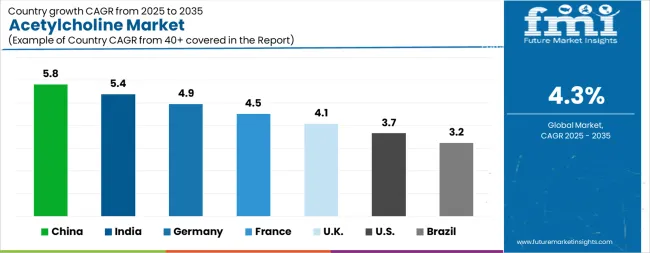
The Acetylcholine Market is expected to register a CAGR of 4.3% during the forecast period, exhibiting varied country level momentum. China leads with the highest CAGR of 5.8%, followed by India at 5.4%. Developed markets such as Germany, France, and the UK continue to expand steadily, while the USA is likely to grow at consistent rates. Brazil posts the lowest CAGR at 3.2%, yet still underscores a broadly positive trajectory for the global Acetylcholine Market. In 2026, Germany held a dominant revenue in the Western Europe market and is expected to grow with a CAGR of 4.9%. The USA Acetylcholine Market is estimated to be valued at USD 935.3 million in 2026 and is anticipated to reach a valuation of USD 1345.1 million by 2036. Sales are projected to rise at a CAGR of 3.7% over the forecast period between 2026 and 2036. While Japan and South Korea markets are estimated to be valued at USD 149.1 million and USD 72.9 million respectively in 2026.
Key Players in the Acetylcholine Market
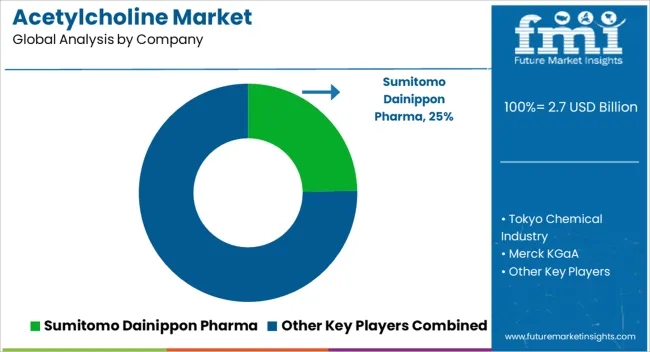
- Sumitomo Dainippon Pharma
- Tokyo Chemical Industry
- Merck KGaA
- NeuroHealing Pharmaceuticals
- Karuna Pharmaceuticals
- Sosei Heptares
- AstraZeneca
- Anavex Life Sciences
Scope of the Report
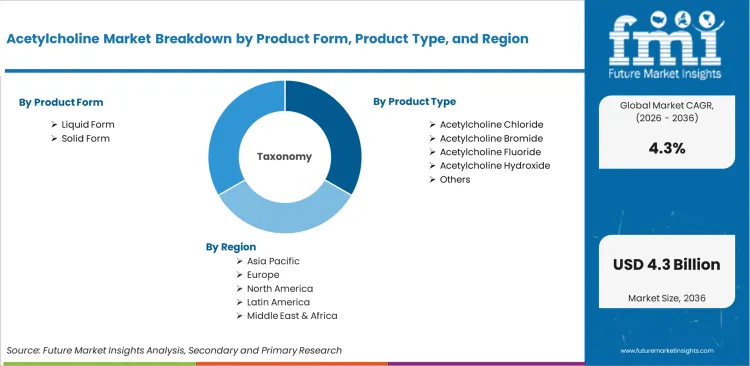
| Metric | Value |
|---|---|
| Quantitative Units | USD 2.82 billion to USD 4.29 billion, at a CAGR of 4.3% |
| Market Definition | The Acetylcholine market encompasses commercial preparations of acetylcholine and its salt forms, primarily acetylcholine chloride and acetylcholine bromide, supplied as pharmaceutical-grade ophthalmic surgical solutions, research-grade reagents and reference ... |
| Product Form Segmentation | Liquid Form, Powder Form) |
| Product Type Segmentation | Acetylcholine Chloride, Acetylcholine Bromide) |
| Regions Covered | North America, Latin America, Europe, East Asia, South Asia, Oceania, Middle East & Africa |
| Countries Covered | China, India, Germany, France, UK, USA, Brazil, and 40 plus countries |
| Key Companies Profiled | Sumitomo Dainippon Pharma, Tokyo Chemical Industry, Merck KGaA, NeuroHealing Pharmaceuticals, Karuna Pharmaceuticals, Sosei Heptares, AstraZeneca, Anavex Life Sciences |
| Forecast Period | 2026 to 2036 |
| Approach | Bottom-up aggregation from end-use industry activity volumes and acetylcholine consumption intensity parameters, with regulatory compliance adoption timeline scenario modelling applied to grade mix and application transitions. |
Acetylcholine Market by Segments
Product Form:
- Liquid Form
- Solid Form
Product Type:
- Acetylcholine Chloride
- Acetylcholine Bromide
- Acetylcholine Fluoride
- Acetylcholine Hydroxide
- Others
Applications:
- Acetylcholine As A Neurotransmitter
- Acetylcholine As A Vasodilator Agent
- Acetylcholine As A Cholinergic Agonists
- Acetylcholine For Other Applications
Region:
- North America
- USA
- Canada
- Mexico
- Latin America
- Brazil
- Chile
- Rest of Latin America
- Western Europe
- Germany
- UK
- Italy
- Spain
- France
- Nordic
- BENELUX
- Rest of Western Europe
- Eastern Europe
- Russia
- Poland
- Hungary
- Balkan & Baltic
- Rest of Eastern Europe
- East Asia
- China
- Japan
- South Korea
- South Asia and Pacific
- India
- ASEAN
- Australia & New Zealand
- Rest of South Asia and Pacific
- Middle East & Africa
- Kingdom of Saudi Arabia
- Other GCC Countries
- Turkiye
- South Africa
- Other African Union
- Rest of Middle East & Africa
Bibliography
- 1. United States Food and Drug Administration. (2025). Acetylcholine chloride ophthalmic: Drug label. FDA. https://www.fda.gov
- 2. European Medicines Agency. (2025). Assessment report: Cholinergic ophthalmic preparations. EMA. https://www.ema.europa.eu
- 3. National Institutes of Health. (2025). BRAIN initiative: Neurotransmitter research programme progress. NIH. https://www.nih.gov
- 4. World Health Organisation. (2025). Dementia: Global status report. WHO. https://www.who.int
- 5. European Federation of Pharmaceutical Industries and Associations. (2025). Pipeline tracker: CNS drug candidates. EFPIA. https://www.efpia.eu
- 6. International Council of Ophthalmology. (2023). Global cataract surgery rates and access report. ICO. https://www.icoph.org
This bibliography is provided for reader reference. The full Future Market Insights report contains the complete reference list with primary research documentation.
Frequently Asked Questions
How large is the Acetylcholine market in 2026?
The Acetylcholine market is estimated at USD 2.816 billion in 2026.
What will the Acetylcholine market reach by 2036?
The market is projected to reach USD 4.290 billion by 2036.
What is the CAGR for the Acetylcholine market from 2026 to 2036?
The market is expected to grow at a CAGR of 4.3% from 2026 to 2036.
Which Product Form leads the Acetylcholine market in 2026?
Liquid Form accounts for 65.0% share in 2026, driven by its direct applicability in ophthalmic surgical preparation as intraocular miosis induction solution and in laboratory pharmacological testing and receptor assay systems.
Which Product Type dominates in 2026?
Acetylcholine Chloride accounts for 40.0% share in 2026, reflecting its status as the primary commercially supplied salt form for ophthalmic pharmaceutical and research applications due to its stability, solubility, and established regulatory approval status.
Which Application accounts for the largest share in 2026?
Acetylcholine As A Neurotransmitter application accounts for 45.0% share in 2026, encompassing neuroscience research, pharmacological pathway characterisation, and drug discovery programme reference standard and assay reagent demand across academic and pharmaceutical settings.
Which country leads growth in the Acetylcholine market?
China leads with a 5.8% CAGR through 2036, driven by expanding pharmaceutical research investment, growing ophthalmic surgical cataract programme volumes, and domestic neuropharmacology research capacity expansion.
Preview the report firsthand - request a free sample
Get SampleGet the brochure for pricing and purchase details.
Get PDFTable of Content
- Executive Summary
- Global Market Outlook
- Demand-side Trends
- Supply-side Trends
- Technology Roadmap Analysis
- Analysis and Recommendations
- Market Overview
- Market Coverage / Taxonomy
- Market Definition / Scope / Limitations
- Research Methodology
- Chapter Orientation
- Analytical Lens and Working Hypotheses
- Market Structure, Signals, and Trend Drivers
- Benchmarking and Cross-market Comparability
- Market Sizing, Forecasting, and Opportunity Mapping
- Research Design and Evidence Framework
- Desk Research Programme (Secondary Evidence)
- Company Annual and Sustainability Reports
- Peer-reviewed Journals and Academic Literature
- Corporate Websites, Product Literature, and Technical Notes
- Earnings Decks and Investor Briefings
- Statutory Filings and Regulatory Disclosures
- Technical White Papers and Standards Notes
- Trade Journals, Industry Magazines, and Analyst Briefs
- Conference Proceedings, Webinars, and Seminar Materials
- Government Statistics Portals and Public Data Releases
- Press Releases and Reputable Media Coverage
- Specialist Newsletters and Curated Briefings
- Sector Databases and Reference Repositories
- FMI Internal Proprietary Databases and Historical Market Datasets
- Subscription Datasets and Paid Sources
- Social Channels, Communities, and Digital Listening Inputs
- Additional Desk Sources
- Expert Input and Fieldwork (Primary Evidence)
- Primary Modes
- Qualitative Interviews and Expert Elicitation
- Quantitative Surveys and Structured Data Capture
- Blended Approach
- Why Primary Evidence is Used
- Field Techniques
- Interviews
- Surveys
- Focus Groups
- Observational and In-context Research
- Social and Community Interactions
- Stakeholder Universe Engaged
- C-suite Leaders
- Board Members
- Presidents and Vice Presidents
- R&D and Innovation Heads
- Technical Specialists
- Domain Subject-matter Experts
- Scientists
- Physicians and Other Healthcare Professionals
- Governance, Ethics, and Data Stewardship
- Research Ethics
- Data Integrity and Handling
- Primary Modes
- Tooling, Models, and Reference Databases
- Desk Research Programme (Secondary Evidence)
- Data Engineering and Model Build
- Data Acquisition and Ingestion
- Cleaning, Normalisation, and Verification
- Synthesis, Triangulation, and Analysis
- Quality Assurance and Audit Trail
- Market Background
- Market Dynamics
- Drivers
- Restraints
- Opportunity
- Trends
- Scenario Forecast
- Demand in Optimistic Scenario
- Demand in Likely Scenario
- Demand in Conservative Scenario
- Opportunity Map Analysis
- Product Life Cycle Analysis
- Supply Chain Analysis
- Investment Feasibility Matrix
- Value Chain Analysis
- PESTLE and Porter’s Analysis
- Regulatory Landscape
- Regional Parent Market Outlook
- Production and Consumption Statistics
- Import and Export Statistics
- Market Dynamics
- Global Market Analysis 2021 to 2025 and Forecast, 2026 to 2036
- Historical Market Size Value (USD Million) Analysis, 2021 to 2025
- Current and Future Market Size Value (USD Million) Projections, 2026 to 2036
- Y-o-Y Growth Trend Analysis
- Absolute $ Opportunity Analysis
- Global Market Pricing Analysis 2021 to 2025 and Forecast 2026 to 2036
- Global Market Analysis 2021 to 2025 and Forecast 2026 to 2036, By Product Form
- Introduction / Key Findings
- Historical Market Size Value (USD Million) Analysis By Product Form , 2021 to 2025
- Current and Future Market Size Value (USD Million) Analysis and Forecast By Product Form , 2026 to 2036
- Liquid Form
- Solid Form
- Liquid Form
- Y-o-Y Growth Trend Analysis By Product Form , 2021 to 2025
- Absolute $ Opportunity Analysis By Product Form , 2026 to 2036
- Global Market Analysis 2021 to 2025 and Forecast 2026 to 2036, By Product Type
- Introduction / Key Findings
- Historical Market Size Value (USD Million) Analysis By Product Type, 2021 to 2025
- Current and Future Market Size Value (USD Million) Analysis and Forecast By Product Type, 2026 to 2036
- Acetylcholine Chloride
- Acetylcholine Bromide
- Acetylcholine Fluoride
- Acetylcholine Hydroxide
- Others
- Acetylcholine Chloride
- Y-o-Y Growth Trend Analysis By Product Type, 2021 to 2025
- Absolute $ Opportunity Analysis By Product Type, 2026 to 2036
- Global Market Analysis 2021 to 2025 and Forecast 2026 to 2036, By Applications
- Introduction / Key Findings
- Historical Market Size Value (USD Million) Analysis By Applications, 2021 to 2025
- Current and Future Market Size Value (USD Million) Analysis and Forecast By Applications, 2026 to 2036
- Acetylcholine As A Neurotransmitter
- Acetylcholine As A Vasodilator Agent
- Acetylcholine As A Cholinergic Agonists
- Acetylcholine For Other Applications
- Acetylcholine As A Neurotransmitter
- Y-o-Y Growth Trend Analysis By Applications, 2021 to 2025
- Absolute $ Opportunity Analysis By Applications, 2026 to 2036
- Global Market Analysis 2021 to 2025 and Forecast 2026 to 2036, By Region
- Introduction
- Historical Market Size Value (USD Million) Analysis By Region, 2021 to 2025
- Current Market Size Value (USD Million) Analysis and Forecast By Region, 2026 to 2036
- North America
- Latin America
- Western Europe
- Eastern Europe
- East Asia
- South Asia and Pacific
- Middle East & Africa
- Market Attractiveness Analysis By Region
- North America Market Analysis 2021 to 2025 and Forecast 2026 to 2036, By Country
- Historical Market Size Value (USD Million) Trend Analysis By Market Taxonomy, 2021 to 2025
- Market Size Value (USD Million) Forecast By Market Taxonomy, 2026 to 2036
- By Country
- USA
- Canada
- Mexico
- By Product Form
- By Product Type
- By Applications
- By Country
- Market Attractiveness Analysis
- By Country
- By Product Form
- By Product Type
- By Applications
- Key Takeaways
- Latin America Market Analysis 2021 to 2025 and Forecast 2026 to 2036, By Country
- Historical Market Size Value (USD Million) Trend Analysis By Market Taxonomy, 2021 to 2025
- Market Size Value (USD Million) Forecast By Market Taxonomy, 2026 to 2036
- By Country
- Brazil
- Chile
- Rest of Latin America
- By Product Form
- By Product Type
- By Applications
- By Country
- Market Attractiveness Analysis
- By Country
- By Product Form
- By Product Type
- By Applications
- Key Takeaways
- Western Europe Market Analysis 2021 to 2025 and Forecast 2026 to 2036, By Country
- Historical Market Size Value (USD Million) Trend Analysis By Market Taxonomy, 2021 to 2025
- Market Size Value (USD Million) Forecast By Market Taxonomy, 2026 to 2036
- By Country
- Germany
- UK
- Italy
- Spain
- France
- Nordic
- BENELUX
- Rest of Western Europe
- By Product Form
- By Product Type
- By Applications
- By Country
- Market Attractiveness Analysis
- By Country
- By Product Form
- By Product Type
- By Applications
- Key Takeaways
- Eastern Europe Market Analysis 2021 to 2025 and Forecast 2026 to 2036, By Country
- Historical Market Size Value (USD Million) Trend Analysis By Market Taxonomy, 2021 to 2025
- Market Size Value (USD Million) Forecast By Market Taxonomy, 2026 to 2036
- By Country
- Russia
- Poland
- Hungary
- Balkan & Baltic
- Rest of Eastern Europe
- By Product Form
- By Product Type
- By Applications
- By Country
- Market Attractiveness Analysis
- By Country
- By Product Form
- By Product Type
- By Applications
- Key Takeaways
- East Asia Market Analysis 2021 to 2025 and Forecast 2026 to 2036, By Country
- Historical Market Size Value (USD Million) Trend Analysis By Market Taxonomy, 2021 to 2025
- Market Size Value (USD Million) Forecast By Market Taxonomy, 2026 to 2036
- By Country
- China
- Japan
- South Korea
- By Product Form
- By Product Type
- By Applications
- By Country
- Market Attractiveness Analysis
- By Country
- By Product Form
- By Product Type
- By Applications
- Key Takeaways
- South Asia and Pacific Market Analysis 2021 to 2025 and Forecast 2026 to 2036, By Country
- Historical Market Size Value (USD Million) Trend Analysis By Market Taxonomy, 2021 to 2025
- Market Size Value (USD Million) Forecast By Market Taxonomy, 2026 to 2036
- By Country
- India
- ASEAN
- Australia & New Zealand
- Rest of South Asia and Pacific
- By Product Form
- By Product Type
- By Applications
- By Country
- Market Attractiveness Analysis
- By Country
- By Product Form
- By Product Type
- By Applications
- Key Takeaways
- Middle East & Africa Market Analysis 2021 to 2025 and Forecast 2026 to 2036, By Country
- Historical Market Size Value (USD Million) Trend Analysis By Market Taxonomy, 2021 to 2025
- Market Size Value (USD Million) Forecast By Market Taxonomy, 2026 to 2036
- By Country
- Kingdom of Saudi Arabia
- Other GCC Countries
- Turkiye
- South Africa
- Other African Union
- Rest of Middle East & Africa
- By Product Form
- By Product Type
- By Applications
- By Country
- Market Attractiveness Analysis
- By Country
- By Product Form
- By Product Type
- By Applications
- Key Takeaways
- Key Countries Market Analysis
- USA
- Pricing Analysis
- Market Share Analysis, 2025
- By Product Form
- By Product Type
- By Applications
- Canada
- Pricing Analysis
- Market Share Analysis, 2025
- By Product Form
- By Product Type
- By Applications
- Mexico
- Pricing Analysis
- Market Share Analysis, 2025
- By Product Form
- By Product Type
- By Applications
- Brazil
- Pricing Analysis
- Market Share Analysis, 2025
- By Product Form
- By Product Type
- By Applications
- Chile
- Pricing Analysis
- Market Share Analysis, 2025
- By Product Form
- By Product Type
- By Applications
- Germany
- Pricing Analysis
- Market Share Analysis, 2025
- By Product Form
- By Product Type
- By Applications
- UK
- Pricing Analysis
- Market Share Analysis, 2025
- By Product Form
- By Product Type
- By Applications
- Italy
- Pricing Analysis
- Market Share Analysis, 2025
- By Product Form
- By Product Type
- By Applications
- Spain
- Pricing Analysis
- Market Share Analysis, 2025
- By Product Form
- By Product Type
- By Applications
- France
- Pricing Analysis
- Market Share Analysis, 2025
- By Product Form
- By Product Type
- By Applications
- India
- Pricing Analysis
- Market Share Analysis, 2025
- By Product Form
- By Product Type
- By Applications
- ASEAN
- Pricing Analysis
- Market Share Analysis, 2025
- By Product Form
- By Product Type
- By Applications
- Australia & New Zealand
- Pricing Analysis
- Market Share Analysis, 2025
- By Product Form
- By Product Type
- By Applications
- China
- Pricing Analysis
- Market Share Analysis, 2025
- By Product Form
- By Product Type
- By Applications
- Japan
- Pricing Analysis
- Market Share Analysis, 2025
- By Product Form
- By Product Type
- By Applications
- South Korea
- Pricing Analysis
- Market Share Analysis, 2025
- By Product Form
- By Product Type
- By Applications
- Russia
- Pricing Analysis
- Market Share Analysis, 2025
- By Product Form
- By Product Type
- By Applications
- Poland
- Pricing Analysis
- Market Share Analysis, 2025
- By Product Form
- By Product Type
- By Applications
- Hungary
- Pricing Analysis
- Market Share Analysis, 2025
- By Product Form
- By Product Type
- By Applications
- Kingdom of Saudi Arabia
- Pricing Analysis
- Market Share Analysis, 2025
- By Product Form
- By Product Type
- By Applications
- Turkiye
- Pricing Analysis
- Market Share Analysis, 2025
- By Product Form
- By Product Type
- By Applications
- South Africa
- Pricing Analysis
- Market Share Analysis, 2025
- By Product Form
- By Product Type
- By Applications
- USA
- Market Structure Analysis
- Competition Dashboard
- Competition Benchmarking
- Market Share Analysis of Top Players
- By Region
- By Product Form
- By Product Type
- By Applications
- Competition Analysis
- Competition Deep Dive
- Sumitomo Dainippon Pharma
- Overview
- Product Portfolio
- Profitability by Market Segments (Product/Age /Sales Channel/Region)
- Sales Footprint
- Strategy Overview
- Marketing Strategy
- Product Strategy
- Channel Strategy
- Tokyo Chemical Industry
- Merck KGaA
- NeuroHealing Pharmaceuticals
- Karuna Pharmaceuticals
- Sosei Heptares
- AstraZeneca
- Anavex Life Sciences
- Sumitomo Dainippon Pharma
- Competition Deep Dive
- Assumptions & Acronyms Used


