

- Market Size (2026)
- USD 278.8 Bn
- Forecast (2036)
- USD 389.4 Bn
- CAGR (2026 to 2036)
- 3.4%
Canola Lecithin Market Size, Market Forecast and Outlook By FMI
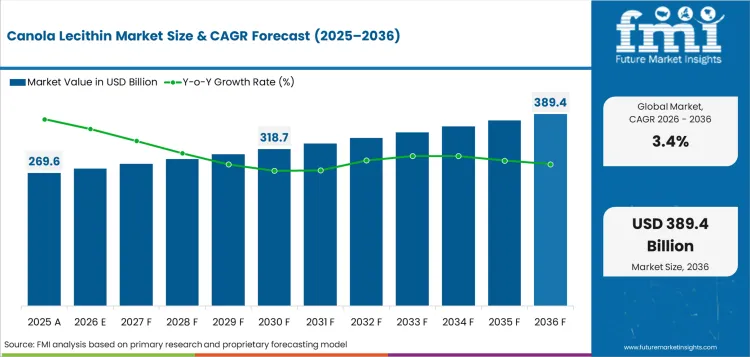
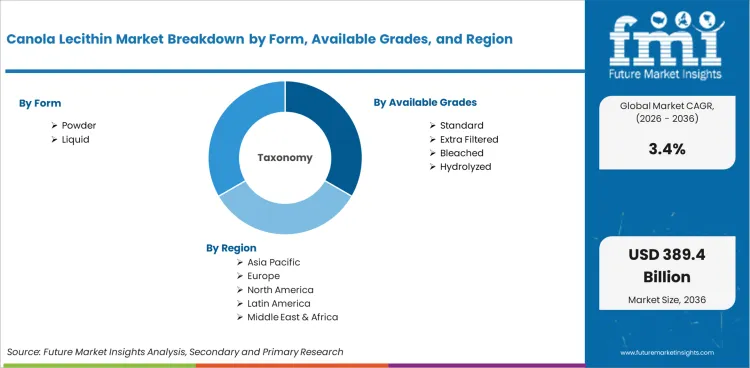
The canola lecithin market was valued at USD 269.6 billion in 2025. The market is set to reach USD 278.8 billion by 2026-end and grow at a CAGR of 3.4% between 2026-2036 to reach USD 389.4 billion by 2036. Powder will dominate with a 62.0% share, while Standard will lead with a 48.0% share.
Summary of the Canola Lecithin Market
- Demand and Growth Drivers
- Consumer dietary preferences shifting towards plant based and health conscious alternatives are anticipated to support demand across mainstream retail channels.
- Product accessibility is anticipated to enhance during the forecast period due to expansion in multi-channel distribution, including online grocery and convenience store formats.
- Premiumization trends and the positioning of functional ingredients are likely to contribute towards margin expansion and product diversification.
- Product and Segment View
- Powder is expected to make up 62% of the form in 2026, as consumer preferences shift and retail distribution expands.
- Standard is forecast to take 48% of the available grades segment, reflecting shifts in consumer preferences and expansion of retail distribution.
- Food & Beverages is estimated to hold 55% of the end use segment due to changing consumer preferences and growth of retail distribution.
- Geography and Competitive Outlook
- China is likely to remain a leading market with a projected CAGR of 4.4%, supported by established end use demand and favorable policy frameworks.
- India is expected to follow at 4%, reflecting growing adoption and expanding market infrastructure.
- Companies with integrated product portfolios and multi-regional distribution presence are likely to strengthen their competitive positions during the forecast period.
- Analyst Opinion
- Nandini Roy Choudhury, Principal Consultant at FMI says, 'Companies that balance cost competitiveness with credible product differentiation through functional ingredients and clean label positioning are likely to outperform during the forecast period.'
- The canola lecithin market is shifting from a niche category to mainstream retail positioning with changing consumer preferences and increased access to distribution.
- Accelerating adoption of growing health awareness, premiumization trends and growth of multi-channel retail in developed and emerging markets.
- Competitive advantage is increasingly a function of supply chain efficiency, brand credibility, and the capacity to adapt to rapid changes in consumer preference cycles.
- The demand is further strengthened by the growing interest in sustainable sourcing, clean label formulations and functional nutrition claims.
Key Takeaways, Market Size, and Forecast
- The canola lecithin market was valued at USD 269.60 billion in 2025.
- By 2036, the Canola Lecithin Market is expected to be worth USD 389.44 billion.
- From 2026 to 2036, the market is projected to expand at a CAGR of 3.4%.
- The market is projected to create an incremental opportunity of USD 110.67 billion between 2026 and 2036.
- In 2026, Powder is expected to account for 62% of the form, driven by shifting consumer preferences and retail distribution expansion.
- China (4.4%) and India (4%) are two of the fastest growing markets in the world.
Canola Lecithin Market Definition
The canola lecithin market encompasses commercially produced and distributed canola lecithin products across all major retail and foodservice channels. The market covers branded and private label products in various formats, packaging types, and formulations distributed through supermarkets, convenience stores, online channels, and other retail outlets across all major geographic regions.
Canola Lecithin Market Inclusions
Market scope encompasses all commercially traded canola lecithin products categorized by Form (Powder, Liquid); Available Grades (Standard, Extra Filtered, Bleached, Hydrolyzed); End Use (Food & Beverages, Bakery, Confectionery, Convenience Foods, Dairy, Meat & Fish, Cosmetic, Pharmaceutical, Animal Feed, Industrial); Functionality (Emulsification, Wetting, Softening, Stabilization). The revenue forecast spans 2026 to 2036.
Canola Lecithin Market Exclusions
The scope does not include unprocessed raw ingredients sold without branding, foodservice and institutional bulk supply not packaged for retail, or products marketed primarily as animal feed. Private label products are included where distributed through retail channels.
Canola Lecithin Market Research Methodology
- Primary Research: FMI analysts interviewed food manufacturers, retail buyers, distribution executives and consumer insights professionals across key markets.
- Desk Research: Data from retail audit data, trade association reports, consumer survey databases and manufacturer disclosures were merged.
- Market Size & Forecasting: Form, Available Grades, End Use, Functionality Segments with Regional Adoption Curves, Bottom Up Aggregation.
- Data Validation: Data is validated quarterly against retail sales tracking data, trade production statistics and manufacturer revenue disclosures.
Why is the Canola Lecithin Market Growing?
- The sustained demand for canola lecithin products is attributed to evolving consumer dietary preferences and growing health awareness, with adoption expanding beyond niche segments into mainstream retail.
- Increased product accessibility through multi-channel distribution expansion and online grocery penetration, with retailers allocating more shelf space to the category.
- The highest growth rate is 4.4 % in China, led by urbanization, increasing disposable income levels and rising consumer awareness of health trends.
Consumers’ sensitivity to price changes affects where and how you position products and get them to market. Mainstream consumers are becoming more value-conscious, forcing manufacturers to manage input costs while keeping product quality high. Large retailers expanding private label is squeezing branded product margins. Premium positioning needs clear functional differentiation, for instance organic certification, protein claims or allergen free formulations. Companies that control cost structure and brand perception keep more profitable margins.
The dynamics of distribution channels are changing as the penetration of online grocery grows and convenience store formats expand. While supermarkets and hypermarkets remain the main volume channel, direct to consumer and online platforms provide better margins and access to better consumer data. Retailers are asking for more category management support, promotional investment and faster product innovation cycles. Multi-channel distribution capabilities and good relationships with retailers may enable companies to capture broader market access.
Fluctuations in raw material sourcing affect production costs and margin stability. Agricultural input prices are sensitive to weather patterns, trade policies, and supply chain disruptions. Companies with long term supplier agreements, backward integration into ingredient sourcing or diversified supplier networks are better equipped to deal with cost volatility. Consistency of quality between batches is still a competitive differentiator, especially for products positioned in premium segments.
Market Segmentation Analysis
- Powder accounts for 62% of the form, in line with long standing demand patterns across the major markets.
- 48% of grades available segment is represented by standard accounts, supported by changing consumer tastes and increased retail distribution.
- Food & Beverages accounts for 55% of the end use segment, with adoption increasing due to changing consumer preferences and retail distribution expansion.
The canola lecithin market is segmented on the basis of form, available grades, end use, and functionality. Each segment has its own set of demand drivers, end use requirements and competitive dynamics that drive procurement patterns and growth paths.
Insights into the Powder Form Segment
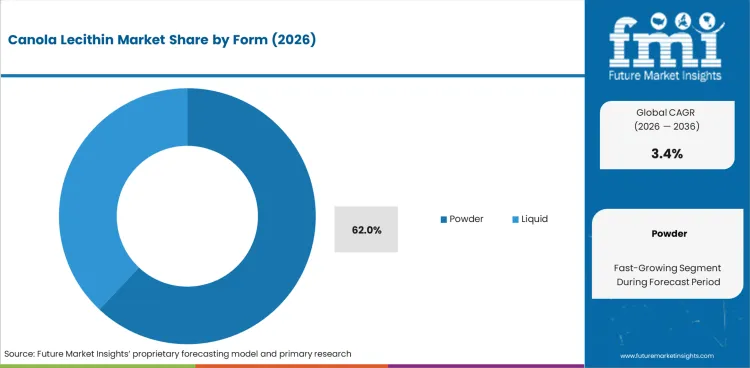
Powder is expected to hold the largest share of the form segment by 2026 at 62%. Demand is driven by changing consumer preferences and expanding retail distribution. Other Form Categories include Liquid , each for different application requirements.
Insights into the Standard Available Grades Segment
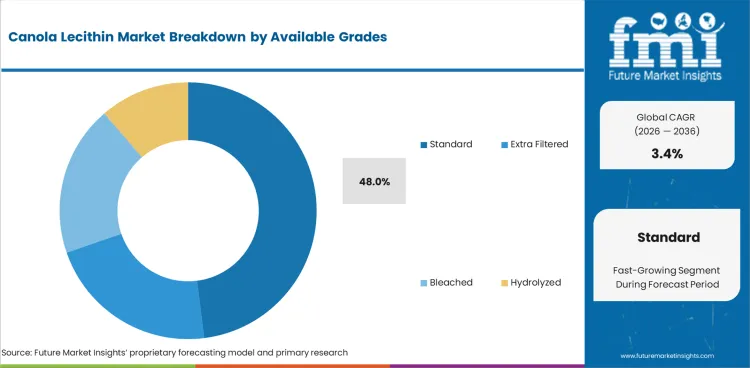
By 2026, Standard is expected to account for 48% of the available grades segment. Changing consumer tastes and the expansion of retail distribution drive demand. Other available grades categories are Extra Filtered, Bleached, Hydrolyzed, each for different application needs.
Canola Lecithin Market Drivers, Restraints, and Opportunities
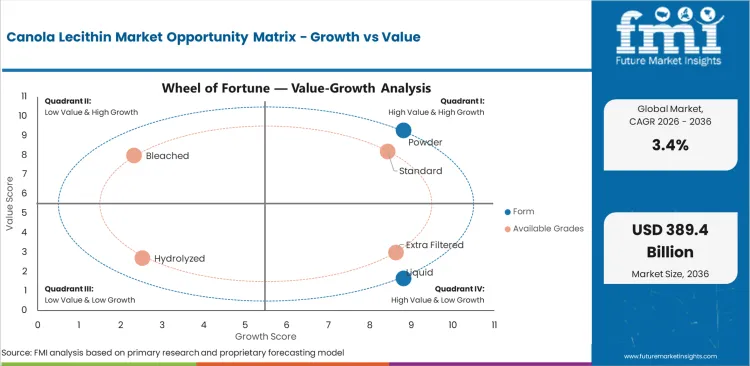
- Steady demand for canola lecithin products in developed markets is driven by Changing Consumer Dietary Preferences.
- Emerging markets growth is near-term constrained by cost volatility of raw materials, which limits adoption in price sensitive segments.
- Functional Positioning and premiumization is expected to generate incremental demand channels in the forecast period.
The growth path of the canola lecithin market demonstrates the dynamics of demand growth, cost challenges and market structural changes. Regulatory requirements, end use specifications and competitive dynamics within the value chain drive adoption.
Shifting Consumer Dietary Preferences
The demand is driven by the increasing adoption of plant based and health conscious diets across developed and urban emerging markets. Consumer trial willingness for alternative products supports growth of the category and diversification of products.
Retail Distribution and Channel Expansion
Growth is led by the expansion of retail shelf space, online grocery penetration and growth of the convenience store format. The ability to distribute through multiple channels is critical for selling volume across consumer segments.
Raw Material Cost Volatility
Input cost swings are driving margin pressure, particularly for manufacturers that depend on agricultural commodities that are subject to seasonal supply variability. Firms that diversify their sources and lock in suppliers through long-term contracts are better able to manage this risk.
Premiumization and Functional Positioning
Growth in premium product segments reflect consumers' desire to pay for functional ingredients, clean label formulations and sustainability certifications. This trend is supportive of margin expansion for manufacturers with differentiated product portfolios.
Analysis of Canola Lecithin Market By Key Countries
.webp "Top Country Growth Comparison Canola Lecithin Market Cagr (2026 2036)")
| Country | CAGR |
|---|---|
| China | 4.4% |
| India | 4% |
| Germany | 3.7% |
| Brazil | 3.4% |
Source: FMI analysis based on primary research and proprietary forecasting model
- China at 4.4% reflects large production base, urbanization, and growing quality standards.
- India at 4% reflects expanding adoption and growing market infrastructure.
- Germany at 3.7% reflects expanding adoption and growing market infrastructure.
- Brazil at 3.4% reflects expanding adoption and growing market infrastructure.
The global canola lecithin market is expected to grow at a rate of 3.4% per year from 2026 to 2036. The study covers more than 30 countries, and the main markets are listed below.
Demand Outlook for Canola Lecithin Market in China
China is projected to lead at 4.4% through 2036. Urbanization, rising disposable income, and growing awareness of plant based nutrition are accelerating market penetration.
- Urbanization and lifestyle changes are driving demand for convenient food formats.
- Rising disposable income is driving premiumization and product diversification.
- Growing health awareness changes consumer preferences towards plant based options.
Future Outlook for Canola Lecithin Market in India
India is projected to grow at 4% through 2036. Growth is shaped by expanding end use demand, infrastructure investment, and policy driven adoption.
- Continued demand growth is supported by expanding end use applications.
- Investment in infrastructure creates the capacity to grow markets.
- Policy frameworks support procurement-led adoption and compliance.
Opportunity Analysis of Canola Lecithin Market in Germany
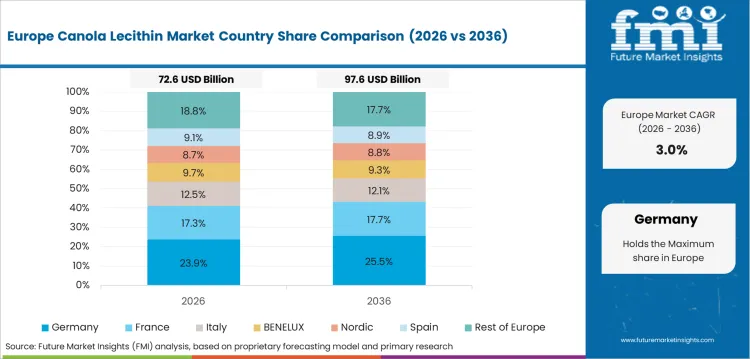
Germany is projected to grow at 3.7% through 2036. The country's established organic food culture, strong retail infrastructure, and consumer preference for sustainable products support demand.
- Organic food culture aligns with plant based product positioning.
- Strong discount and premium retail channels support distribution.
- Sustainability conscious consumers drive demand for plant based alternatives.
In-depth Analysis of Canola Lecithin Market in Brazil
Brazil is projected to grow at 3.4% through 2036. Growth is shaped by expanding end use demand, infrastructure investment, and policy driven adoption.
- Expanding end use applications support sustained demand growth.
- Infrastructure investment creates capacity for market expansion.
- Policy frameworks support adoption and compliance driven procurement.
Competitive Landscape and Strategic Positioning
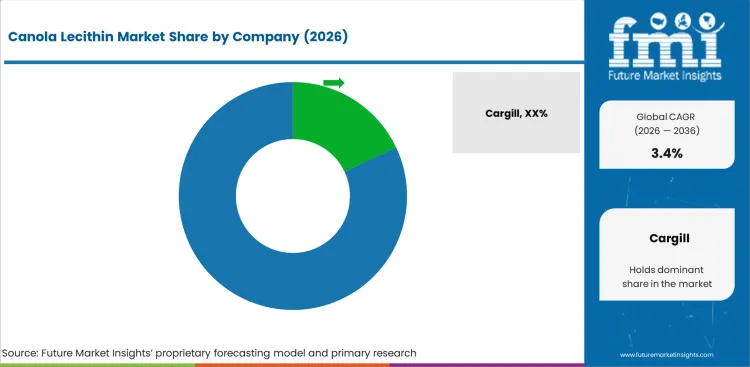
- Cargill’s integrated product capabilities and existing distribution relationships in key markets continue to keep it in the lead.
- Diversified product portfolios of established and emerging product categories are offered by Ciranda and Austrade Inc.
- Emerging players are looking at niche applications and unique product formulations in order to gain a foothold in the market.
Cargill’s integrated manufacturing abilities and established procurement relationships with major end users position it well. The company’s product portfolio is spread across different segments, which provides cross selling opportunities and benefits in terms of customer retention.
Ciranda’s products are diverse and its geographic reach is broad. Austrade Inc. is technology differentiation and specialized applications The two companies have built distribution networks and customer relationships in key markets.
Barriers to entry include regulatory approvals requirements, manufacturing scale, existing supply chain relationships and customer switching costs. The strategic priorities of the leading companies include cost optimization, geographic expansion, product portfolio diversification, and strategic partnerships.
Key Companies in the Canola Lecithin Market
Key global companies leading the canola lecithin market include:
- Cargill, Ciranda, Austrade Inc., Lecico maintain strong manufacturing infrastructure, established end user relationships, and broad product portfolios.
- American Chemie, European Ingredients Supply & Services B.V., Archer Daniels Midland have established positions through specialized product capabilities and regional distribution networks.
- Naturz Organics, Sternchemie GmbH & Co. KG, Lipoid, BungeMaxx are establishing market presence through differentiated product formulations and targeted application focus, demonstrating potential for future market leadership.
Competitive Benchmarking: Canola Lecithin Market
| Company | Product Range | Distribution Network | Brand Strength | Geographic Footprint |
|---|---|---|---|---|
| Cargill | High | High | Strong | Global |
| Ciranda | High | Medium | Strong | Global |
| Austrade Inc. | Medium | High | Moderate | Regional |
| Lecico | High | Medium | Strong | Global |
| American Chemie | Medium | High | Moderate | Regional |
| European Ingredients Supply & Services B.V. | High | Medium | Moderate | Regional |
| Archer Daniels Midland | Medium | High | Low | Regional |
| Naturz Organics | Low | High | Low | Regional |
| Sternchemie GmbH & Co. KG | Medium | Medium | Low | Regional |
| Lipoid | Low | Low | Low | Regional |
Source: Future Market Insights competitive analysis, 2026.
Key Developments in Canola Lecithin Market
- In 2025, Cargill continued expanding its specialty lecithin ingredient offerings, including non-soy emulsifier solutions for food and industrial applications.
- In 2025, Ciranda expanded its canola lecithin ingredient portfolio for bakery, confectionery, and processed food applications, targeting increasing demand for non-GMO emulsifier solutions in North America.
Key Players in the Canola Lecithin Market
Major Global Players
- Cargill
- Ciranda
- Austrade Inc.
- Lecico
- American Chemie
- European Ingredients Supply & Services B.V.
- Archer Daniels Midland
Emerging Players/Startups
- Naturz Organics
- Sternchemie GmbH & Co. KG
- Lipoid
- BungeMaxx
Report Scope and Coverage
| Parameter | Details |
|---|---|
| Quantitative Units | USD 278.77 billion to USD 389.44 billion, at a CAGR of 3.4% |
| Market Definition | The canola lecithin market encompasses commercially produced and distributed products for canola lecithin applications. |
| Regions Covered | North America, Latin America, Europe, East Asia, South Asia and Pacific, Middle East and Africa |
| Countries Covered | China, India, Germany, Brazil, 30 plus countries |
| Key Companies Profiled | Cargill, Ciranda, Austrade Inc., Lecico, American Chemie, European Ingredients Supply & Services B.V., Archer Daniels Midland, Naturz Organics, Sternchemie GmbH & Co. KG, Lipoid, BungeMaxx |
| Forecast Period | 2026 to 2036 |
| Approach | Hybrid bottom-up and top-down methodology starting with verified transaction data, projecting adoption velocity across segments and regions. |
Market Segmentation Analysis
Canola Lecithin Market Segmented by Form:
- Powder
- Liquid
Canola Lecithin Market Segmented by Available Grades:
- Standard
- Extra Filtered
- Bleached
- Hydrolyzed
Canola Lecithin Market Segmented by End Use:
- Food & Beverages
- Bakery
- Confectionery
- Convenience Foods
- Dairy
- Meat & Fish
- Cosmetic
- Pharmaceutical
- Animal Feed
- Industrial
Canola Lecithin Market Segmented by Functionality:
- Emulsification
- Wetting
- Softening
- Stabilization
Canola Lecithin Market by Region:
- North America
- USA
- Canada
- Mexico
- Latin America
- Brazil
- Chile
- Rest of Latin America
- Western Europe
- Germany
- UK
- Italy
- Spain
- France
- Nordic
- BENELUX
- Rest of Western Europe
- Eastern Europe
- Russia
- Poland
- Hungary
- Balkan & Baltic
- Rest of Eastern Europe
- East Asia
- China
- Japan
- South Korea
- South Asia and Pacific
- India
- ASEAN
- Australia & New Zealand
- Rest of South Asia and Pacific
- Middle East & Africa
- Kingdom of Saudi Arabia
- Other GCC Countries
- Turkiye
- South Africa
- Other African Union
- Rest of Middle East & Africa
Research Sources and Bibliography
- 1. Food and Agriculture Organization. (2025). FAO Global Food Market Report. FAO.
- 2. USA Department of Agriculture. (2025). USDA Food Production and Consumption Statistics. USDA.
- 3. European Commission. (2025). EU Food Safety and Labeling Regulation Updates. EC.
- 4. World Health Organization. (2025). WHO Nutrition and Food Safety Guidelines. WHO.
- 5. International Food Information Council. (2025). IFIC Consumer Food Insights Survey. IFIC.
This bibliography is provided for reader reference.
This Report Addresses
- Estimating the size of the market and revenue from 2026 to 2036.
- Segmentation by form, available grades, end use, functionality.
- Insights across more than 30 country markets.
- Analysis of competitive landscape and strategic positioning.
- Assessment of market drivers, restraints, and growth opportunities.
- Investment opportunity identification across segments and regions.
- Supply chain and procurement pattern analysis.
- Delivery of data in PDF and Excel formats.
Frequently Asked Questions
What is the global market demand for Canola Lecithin Market in 2026?
In 2026, the global canola lecithin market is expected to be worth USD 278.77 billion.
How big will the Canola Lecithin Market be in 2036?
By 2036, the canola lecithin market is expected to be worth USD 389.44 billion.
How much is demand for Canola Lecithin Market expected to grow between 2026 and 2036?
Between 2026 and 2036, the demand for canola lecithin market is expected to grow at a CAGR of 3.4%.
Which Form is likely to lead the Canola Lecithin Market globally by 2026?
Powder is expected to account for 62% of the form in 2026, reflecting shifting consumer preferences and retail distribution expansion.
What is causing demand to rise in China in the Canola Lecithin Market?
China is projected to grow at 4.4% per year through 2036, supported by large production base and growing quality standards.
What is causing demand to rise in India in the Canola Lecithin Market?
India is projected to grow at 4% per year through 2036, supported by growing market demand and infrastructure investment.
What does this report mean by 'Canola Lecithin Market definition'?
The canola lecithin market includes commercially produced and distributed products for canola lecithin applications across all major segments and regions.
How does FMI make the Canola Lecithin Market forecast and validate it?
Forecasting models use a hybrid bottom-up and top-down approach, starting with verified transaction data and checking it against retail sales data and production statistics.
Preview the report firsthand - request a free sample
Get SampleGet the brochure for pricing and purchase details.
Get PDFTable of Content
- Executive Summary
- Demand-side Trends
- Supply-side Trends
- Technology Roadmap Analysis
- Analysis and Recommendations
- Market Overview
- Market Coverage / Taxonomy
- Market Definition / Scope / Limitations
- Research Methodology
- Chapter Orientation
- Benchmarking and Cross-market Comparability
- Market Sizing, Forecasting, and Opportunity Mapping
- Research Design and Evidence Framework
- Desk Research Programme (Secondary Evidence)
- Company Annual and Sustainability Reports
- Peer-reviewed Journals and Academic Literature
- Corporate Websites, Product Literature, and Technical Notes
- Earnings Decks and Investor Briefings
- Statutory Filings and Regulatory Disclosures
- Technical White Papers and Standards Notes
- Trade Journals, Industry Magazines, and Analyst Briefs
- Conference Proceedings, Webinars, and Seminar Materials
- Government Statistics Portals and Public Data Releases
- Press Releases and Reputable Media Coverage
- Specialist Newsletters and Curated Briefings
- Qualitative Interviews and Expert Elicitation
- Quantitative Surveys and Structured Data Capture
- Blended Approach
- Why Primary Evidence is Used
- Field Techniques
- Interviews
- Surveys
- Focus Groups
- Observational and In-context Research
- Social and Community Interactions
- Stakeholder Universe Engaged
- C-suite Leaders
- Board Members
- Presidents and Vice Presidents
- R&D and Innovation Heads
- Technical Specialists
- Domain Subject-matter Experts
- Scientists
- Physicians and Other Healthcare Professionals
- Governance, Ethics, and Data Stewardship
- Research Ethics
- Data Integrity and Handling
- Desk Research Programme (Secondary Evidence)
- Tooling, Models, and Reference Databases
- Data Engineering and Model Build
- Data Acquisition and Ingestion
- Cleaning, Normalisation, and Verification
- Synthesis, Triangulation, and Analysis
- Import and Export Statistics
- Global Market Analysis 2021 to 2025 and Forecast, 2026 to 2036
- Historical Market Size Value (USD Million) Analysis, 2021 to 2025
- Current and Future Market Size Value (USD Million) Projections, 2026 to 2036
- Y-o-Y Growth Trend Analysis
- Absolute $ Opportunity Analysis
- Global Market Pricing Analysis 2021 to 2025 and Forecast 2026 to 2036
- Global Market Analysis 2021 to 2025 and Forecast 2026 to 2036, By Form
- Introduction / Key Findings
- Historical Market Size Value (USD Million) Analysis By Form , 2021 to 2025
- Current and Future Market Size Value (USD Million) Analysis and Forecast By Form , 2026 to 2036
- Powder
- Liquid
- Powder
- Y-o-Y Growth Trend Analysis By Form , 2021 to 2025
- Absolute $ Opportunity Analysis By Form , 2026 to 2036
- Global Market Analysis 2021 to 2025 and Forecast 2026 to 2036, By Available Grades
- Introduction / Key Findings
- Historical Market Size Value (USD Million) Analysis By Available Grades, 2021 to 2025
- Current and Future Market Size Value (USD Million) Analysis and Forecast By Available Grades, 2026 to 2036
- Standard
- Extra Filtered
- Bleached
- Hydrolyzed
- Standard
- Y-o-Y Growth Trend Analysis By Available Grades, 2021 to 2025
- Absolute $ Opportunity Analysis By Available Grades, 2026 to 2036
- Global Market Analysis 2021 to 2025 and Forecast 2026 to 2036, By End Use
- Introduction / Key Findings
- Historical Market Size Value (USD Million) Analysis By End Use, 2021 to 2025
- Current and Future Market Size Value (USD Million) Analysis and Forecast By End Use, 2026 to 2036
- Food & Beverages
- Bakery
- Confectionery
- Convenience Foods
- Dairy
- Meat & Fish
- Cosmetic
- Pharmaceutical
- Animal Feed
- Industrial
- Food & Beverages
- Y-o-Y Growth Trend Analysis By End Use, 2021 to 2025
- Absolute $ Opportunity Analysis By End Use, 2026 to 2036
- Global Market Analysis 2021 to 2025 and Forecast 2026 to 2036, By Functionality
- Introduction / Key Findings
- Historical Market Size Value (USD Million) Analysis By Functionality, 2021 to 2025
- Current and Future Market Size Value (USD Million) Analysis and Forecast By Functionality, 2026 to 2036
- Emulsification
- Wetting
- Softening
- Stabilization
- Emulsification
- Y-o-Y Growth Trend Analysis By Functionality, 2021 to 2025
- Absolute $ Opportunity Analysis By Functionality, 2026 to 2036
- Global Market Analysis 2021 to 2025 and Forecast 2026 to 2036, By Region
- Introduction
- Historical Market Size Value (USD Million) Analysis By Region, 2021 to 2025
- Current Market Size Value (USD Million) Analysis and Forecast By Region, 2026 to 2036
- North America
- Latin America
- Western Europe
- Eastern Europe
- East Asia
- South Asia and Pacific
- Middle East & Africa
- Market Attractiveness Analysis By Region
- North America Market Analysis 2021 to 2025 and Forecast 2026 to 2036, By Country
- Historical Market Size Value (USD Million) Trend Analysis By Market Taxonomy, 2021 to 2025
- Market Size Value (USD Million) Forecast By Market Taxonomy, 2026 to 2036
- By Country
- USA
- Canada
- Mexico
- By Form
- By Available Grades
- By End Use
- By Functionality
- By Country
- Market Attractiveness Analysis
- By Country
- By Form
- By Available Grades
- By End Use
- By Functionality
- Key Takeaways
- Latin America Market Analysis 2021 to 2025 and Forecast 2026 to 2036, By Country
- Historical Market Size Value (USD Million) Trend Analysis By Market Taxonomy, 2021 to 2025
- Market Size Value (USD Million) Forecast By Market Taxonomy, 2026 to 2036
- By Country
- Brazil
- Chile
- Rest of Latin America
- By Form
- By Available Grades
- By End Use
- By Functionality
- By Country
- Market Attractiveness Analysis
- By Country
- By Form
- By Available Grades
- By End Use
- By Functionality
- Key Takeaways
- Western Europe Market Analysis 2021 to 2025 and Forecast 2026 to 2036, By Country
- Historical Market Size Value (USD Million) Trend Analysis By Market Taxonomy, 2021 to 2025
- Market Size Value (USD Million) Forecast By Market Taxonomy, 2026 to 2036
- By Country
- Germany
- UK
- Italy
- Spain
- France
- Nordic
- BENELUX
- Rest of Western Europe
- By Form
- By Available Grades
- By End Use
- By Functionality
- By Country
- Market Attractiveness Analysis
- By Country
- By Form
- By Available Grades
- By End Use
- By Functionality
- Key Takeaways
- Eastern Europe Market Analysis 2021 to 2025 and Forecast 2026 to 2036, By Country
- Historical Market Size Value (USD Million) Trend Analysis By Market Taxonomy, 2021 to 2025
- Market Size Value (USD Million) Forecast By Market Taxonomy, 2026 to 2036
- By Country
- Russia
- Poland
- Hungary
- Balkan & Baltic
- Rest of Eastern Europe
- By Form
- By Available Grades
- By End Use
- By Functionality
- By Country
- Market Attractiveness Analysis
- By Country
- By Form
- By Available Grades
- By End Use
- By Functionality
- Key Takeaways
- East Asia Market Analysis 2021 to 2025 and Forecast 2026 to 2036, By Country
- Historical Market Size Value (USD Million) Trend Analysis By Market Taxonomy, 2021 to 2025
- Market Size Value (USD Million) Forecast By Market Taxonomy, 2026 to 2036
- By Country
- China
- Japan
- South Korea
- By Form
- By Available Grades
- By End Use
- By Functionality
- By Country
- Market Attractiveness Analysis
- By Country
- By Form
- By Available Grades
- By End Use
- By Functionality
- Key Takeaways
- South Asia and Pacific Market Analysis 2021 to 2025 and Forecast 2026 to 2036, By Country
- Historical Market Size Value (USD Million) Trend Analysis By Market Taxonomy, 2021 to 2025
- Market Size Value (USD Million) Forecast By Market Taxonomy, 2026 to 2036
- By Country
- India
- ASEAN
- Australia & New Zealand
- Rest of South Asia and Pacific
- By Form
- By Available Grades
- By End Use
- By Functionality
- By Country
- Market Attractiveness Analysis
- By Country
- By Form
- By Available Grades
- By End Use
- By Functionality
- Key Takeaways
- Middle East & Africa Market Analysis 2021 to 2025 and Forecast 2026 to 2036, By Country
- Historical Market Size Value (USD Million) Trend Analysis By Market Taxonomy, 2021 to 2025
- Market Size Value (USD Million) Forecast By Market Taxonomy, 2026 to 2036
- By Country
- Kingdom of Saudi Arabia
- Other GCC Countries
- Turkiye
- South Africa
- Other African Union
- Rest of Middle East & Africa
- By Form
- By Available Grades
- By End Use
- By Functionality
- By Country
- Market Attractiveness Analysis
- By Country
- By Form
- By Available Grades
- By End Use
- By Functionality
- Key Takeaways
- Key Countries Market Analysis
- USA
- Pricing Analysis
- Market Share Analysis, 2025
- By Form
- By Available Grades
- By End Use
- By Functionality
- Canada
- Pricing Analysis
- Market Share Analysis, 2025
- By Form
- By Available Grades
- By End Use
- By Functionality
- Mexico
- Pricing Analysis
- Market Share Analysis, 2025
- By Form
- By Available Grades
- By End Use
- By Functionality
- Brazil
- Pricing Analysis
- Market Share Analysis, 2025
- By Form
- By Available Grades
- By End Use
- By Functionality
- Chile
- Pricing Analysis
- Market Share Analysis, 2025
- By Form
- By Available Grades
- By End Use
- By Functionality
- Germany
- Pricing Analysis
- Market Share Analysis, 2025
- By Form
- By Available Grades
- By End Use
- By Functionality
- UK
- Pricing Analysis
- Market Share Analysis, 2025
- By Form
- By Available Grades
- By End Use
- By Functionality
- Italy
- Pricing Analysis
- Market Share Analysis, 2025
- By Form
- By Available Grades
- By End Use
- By Functionality
- Spain
- Pricing Analysis
- Market Share Analysis, 2025
- By Form
- By Available Grades
- By End Use
- By Functionality
- France
- Pricing Analysis
- Market Share Analysis, 2025
- By Form
- By Available Grades
- By End Use
- By Functionality
- India
- Pricing Analysis
- Market Share Analysis, 2025
- By Form
- By Available Grades
- By End Use
- By Functionality
- ASEAN
- Pricing Analysis
- Market Share Analysis, 2025
- By Form
- By Available Grades
- By End Use
- By Functionality
- Australia & New Zealand
- Pricing Analysis
- Market Share Analysis, 2025
- By Form
- By Available Grades
- By End Use
- By Functionality
- China
- Pricing Analysis
- Market Share Analysis, 2025
- By Form
- By Available Grades
- By End Use
- By Functionality
- Japan
- Pricing Analysis
- Market Share Analysis, 2025
- By Form
- By Available Grades
- By End Use
- By Functionality
- South Korea
- Pricing Analysis
- Market Share Analysis, 2025
- By Form
- By Available Grades
- By End Use
- By Functionality
- Russia
- Pricing Analysis
- Market Share Analysis, 2025
- By Form
- By Available Grades
- By End Use
- By Functionality
- Poland
- Pricing Analysis
- Market Share Analysis, 2025
- By Form
- By Available Grades
- By End Use
- By Functionality
- Hungary
- Pricing Analysis
- Market Share Analysis, 2025
- By Form
- By Available Grades
- By End Use
- By Functionality
- Kingdom of Saudi Arabia
- Pricing Analysis
- Market Share Analysis, 2025
- By Form
- By Available Grades
- By End Use
- By Functionality
- Turkiye
- Pricing Analysis
- Market Share Analysis, 2025
- By Form
- By Available Grades
- By End Use
- By Functionality
- South Africa
- Pricing Analysis
- Market Share Analysis, 2025
- By Form
- By Available Grades
- By End Use
- By Functionality
- USA
- Market Structure Analysis
- Competition Dashboard
- Competition Benchmarking
- Market Share Analysis of Top Players
- By Regional
- By Form
- By Available Grades
- By End Use
- By Functionality
- Competition Analysis
- Competition Deep Dive
- Cargill
- Overview
- Product Portfolio
- Profitability by Market Segments (Product/Age /Sales Channel/Region)
- Sales Footprint
- Strategy Overview
- Marketing Strategy
- Product Strategy
- Channel Strategy
- Ciranda
- Austrade Inc.
- Lecico
- American Chemie
- European Ingredients Supply & Services B.V.
- Archer Daniels Midland
- Naturz Organics
- Sternchemie GmbH & Co. KG
- Lipoid
- BungeMaxx
- Cargill
- Competition Deep Dive
- Assumptions & Acronyms Used


