

- Market Size (2026)
- USD 1.2 Bn
- Forecast (2036)
- USD 2.1 Bn
- CAGR (2026 to 2036)
- 5.4%
Chelated Selenium Market Size, Market Forecast and Outlook By FMI
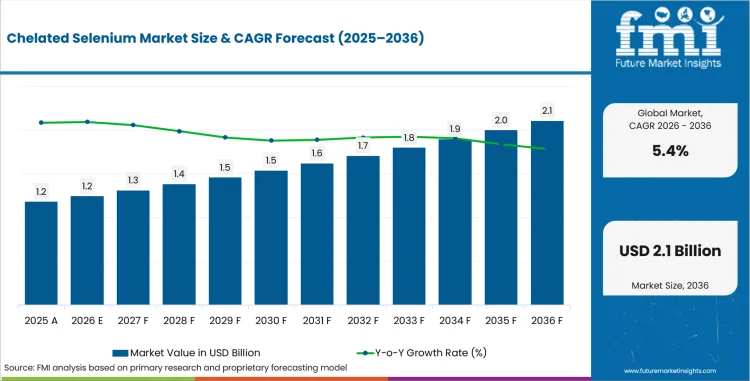
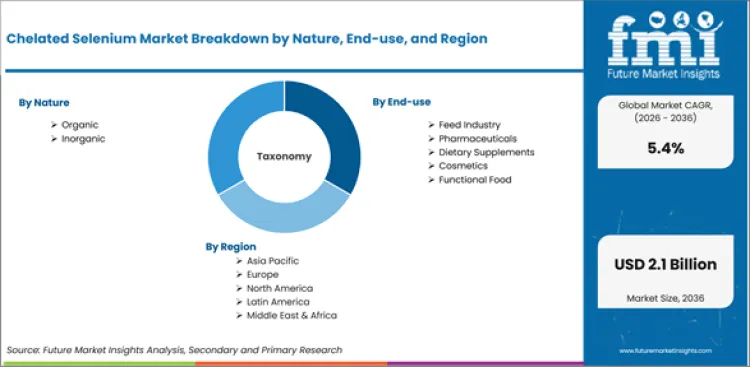
The chelated selenium market was valued at USD 1.2 billion in 2025. The market is set to reach USD 1.2 billion by 2026-end and grow at a CAGR of 5.4% between 2026-2036 to reach USD 2.1 billion by 2036. Organic will dominate with a 65.0% share, while Feed Industry will lead with a 50.0% share.
Key Takeaways, Market Size, and Forecast
- 2026 Market Size: USD 1.2 Billion
- 2036 Market Size: USD 2.1 Billion
- Compound Annual Growth Rate (CAGR): 5.4% from 2026 to 2036
- Absolute $ Opportunity: USD 0.9 Billion between 2026 and 2036
- Leading Nature Segment: Organic
- Organic Share in 2026: 65.0%
- Fastest-growing Country: China
- China CAGR: 7.3% through 2036
| Parameter | Details |
|---|---|
| Market Size in 2026 (Value) | USD 1.2 Billion |
| Market Forecast in 2036 (Value) | USD 2.1 Billion |
| CAGR (2026 to 2036) | 5.4% |
| Years Considered | 2021 to 2036 |
| Base Year | 2025 |
| Forecast Period | 2026 to 2036 |
| Units Considered | Value (USD Bn) |
| Leading Sub-Region | China |
Summary of the Chelated Selenium Market
- Demand and Growth Drivers
- Feed industry procurement of chelated selenium is expanding as animal nutrition programs shift from inorganic to organic selenium sources to improve bioavailability and livestock performance outcomes.
- Pharmaceutical and nutraceutical demand is supported by clinical evidence linking organic selenium supplementation to thyroid function, immune response, and antioxidant defense, creating structured procurement from supplement and drug manufacturers.
- Growth reflects the convergence of animal nutrition science and human health supplementation trends, with chelation technology enabling superior absorption compared to sodium selenite and selenate forms.
- Product and Segment View
- Organic accounts for 65.0% of the nature segment in 2026, reflecting the shift toward organic chelated forms that offer improved bioavailability over inorganic selenium compounds in feed and supplement applications.
- Feed Industry is likely to remain a leading end-use category, with feed industry procurement driving the largest share of chelated selenium demand across poultry, swine, and ruminant nutrition programs.
- Pharmacies is expected to account for 32.0% of the distribution channel segment, supported by pharmacy-channel distribution for human selenium supplementation and prescription nutritional products.
- Geography and Competitive Outlook
- China is expected to lead growth at 7.3% through 2036, supported by a large livestock production base, expanding feed additive adoption, and increasing pharmaceutical selenium supplementation demand.
- India at 6.8% reflects demand shaped by organized livestock operations, pharmaceutical manufacturing capacity, and regulatory standards for selenium content in feed and supplement products.
- Companies with chelation process technology, pharmaceutical-grade certification, and dual-channel capability in feed and human nutrition are positioned to capture share during the forecast period.
- Analyst Opinion
- Nandini Roy Choudhury, Principal Consultant at FMI says, 'Chelated selenium suppliers that can demonstrate bioavailability advantages through documented feed trials and clinical data while maintaining competitive pricing against inorganic alternatives are likely to accelerate conversion across both animal and human nutrition channels.'
- The chelated selenium market is transitioning from commodity inorganic selenium supply to specification-grade organic chelates as bioavailability data increasingly influences feed formulation and supplement specification decisions.
- Adoption is supported by regulatory tightening on maximum selenium inclusion levels in feed, which incentivizes organic forms that deliver equivalent biological activity at lower dosage rates.
- Dual-channel suppliers serving both feed-grade and pharmaceutical-grade markets benefit from manufacturing scale economies while accessing higher-margin human nutrition applications.
Chelated Selenium Market Definition
The chelated selenium market encompasses commercially traded products categorized by nature, end-use, distribution channel, application, technology. Core categories include organic, inorganic, feed industry, pharmaceuticals, dietary supplements, pharmacies, health beauty stores, hypermarket, and related formulations used across food processing, pharmaceutical, industrial, and consumer applications. The market covers revenue from 2026 to 2036 across all distribution and end-use channels.
Chelated Selenium Market Inclusions
Market scope encompasses all commercially traded chelated selenium products categorized by nature (organic, inorganic), end-use (feed industry, pharmaceuticals, dietary supplements, cosmetics, functional food), distribution channel (pharmacies, health beauty stores, hypermarket, direct selling, online), application (animal nutrition, human nutrition, agriculture), technology (chelation technology, encapsulation technology). Revenue coverage spans from 2026 to 2036 across all regions and distribution channels.
Chelated Selenium Market Exclusions
The scope does not include raw, unprocessed, or non-commercial-grade chelated selenium products sold outside organized trade channels. Products intended exclusively for non-commercial research or laboratory use are excluded. Synthetic substitutes not containing chelated selenium as a primary functional ingredient are also outside the scope.
Chelated Selenium Market Research Methodology
- Primary Research: FMI analysts conducted interviews with chelated selenium producers, food processors, ingredient distributors, and end-use application specialists in key markets.
- Desk Research: Combined data from industry trade associations, regulatory databases, certification bodies, and manufacturer disclosures.
- Market Sizing and Forecasting: Bottom-up aggregation across nature, end-use, distribution channel, application, technology segments, triangulated with trade and production data.
- Data Validation: Cross-checked quarterly against production data, trade statistics, and manufacturer-reported capacity utilization.
Why is the Chelated Selenium Market Growing?
- The shift from inorganic sodium selenite to organic chelated selenium in livestock feed programs is creating structured demand as feed formulators prioritize bioavailability and dosage efficiency in poultry, swine, and ruminant nutrition.
- Pharmaceutical and nutraceutical selenium supplementation is expanding on the basis of clinical evidence supporting thyroid, immune, and antioxidant health claims, with chelated forms preferred for superior absorption.
- China leads growth at 7.3%, supported by the scale of livestock production, increasing feed additive sophistication, and expanding domestic pharmaceutical manufacturing capacity.
The chelated selenium market is expanding as both animal nutrition and human health supplementation sectors shift toward organic selenium forms. Chelation technology binds selenium to amino acids or peptides, improving bioavailability compared to inorganic sodium selenite and selenate. In the feed industry, this translates to lower dosage requirements, improved livestock growth rates, and better reproductive performance. Poultry and swine operations represent the largest feed-grade demand, with organic selenium increasingly specified in broiler, layer, and breeding stock nutrition programs.
Growth in the human nutrition channel reflects increasing consumer awareness of selenium's role in thyroid metabolism, immune function, and antioxidant defense. Pharmacies lead distribution for human selenium supplementation, supported by healthcare professional recommendations and clinical dosing protocols. Regional demand variation reflects differences in soil selenium levels, livestock production intensity, and pharmaceutical supplement culture. China and India represent the strongest growth corridors, driven by the scale of livestock operations and expanding pharmaceutical manufacturing capacity.
Market Segmentation Analysis
- Organic accounts for 65.0% of the nature segment in 2026, reflecting established demand across primary commercial applications.
- Pharmacies leads the distribution channel segment at 32.0% share, supported by concentrated end-use demand.
- Animal Nutrition accounts for 60.0% of the application segment, reflecting institutional procurement and bulk sourcing.
The chelated selenium market is segmented by nature, end-use, distribution channel, application, technology. By nature, segments include Organic, Inorganic. By end-use, segments include Feed Industry, Pharmaceuticals, Dietary Supplements, Cosmetics, Functional Food. By distribution channel, segments include Pharmacies, Health Beauty stores, Hypermarket, Direct Selling, Online. By application, segments include Animal Nutrition, Human Nutrition, Agriculture. By technology, segments include Chelation Technology, Encapsulation Technology.
Insights into the Organic Nature Segment
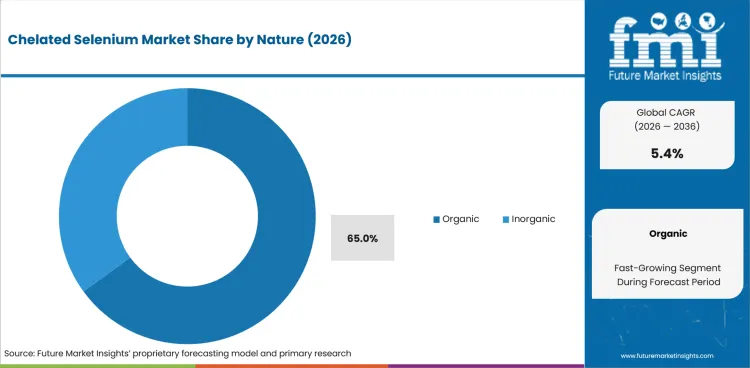
Organic is expected to account for 65.0% of the nature segment in 2026. Demand is concentrated in commercial manufacturing, institutional procurement, and specialty channels where product consistency and regulatory compliance are primary sourcing criteria.
Procurement patterns for organic products are shaped by downstream formulation requirements, performance targets, and compatibility with existing production systems. Suppliers that maintain certified quality management and offer consistent batch-to-batch performance are gaining preference among large-scale processors.
Insights into the Feed Industry End-use Segment
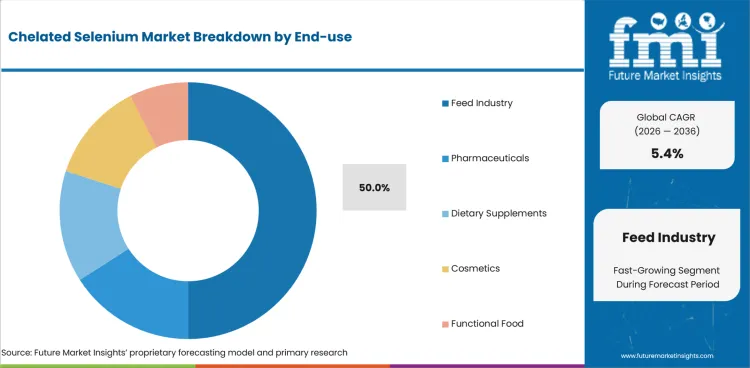
Feed Industry is expected to account for 50.0% of the end-use segment in 2026. Demand is concentrated in commercial manufacturing, institutional procurement, and specialty channels where product consistency and regulatory compliance are primary sourcing criteria.
Procurement patterns for feed industry products are shaped by downstream formulation requirements, performance targets, and compatibility with existing production systems. Suppliers that maintain certified quality management and offer consistent batch-to-batch performance are gaining preference among large-scale processors.
Chelated Selenium Market Drivers, Restraints, and Opportunities
- Bioavailability-Driven Feed Conversion requirements are creating structured demand for specification-grade chelated selenium products across primary commercial and institutional channels.
- regulatory limits on selenium inclusion constrains adoption in price-sensitive segments, concentrating procurement among established suppliers with scale advantages.
- Pharmaceutical and Nutraceutical Demand Growth is expanding higher-value application segments and supporting growth in premium and specialty product categories.
The chelated selenium market is expanding on the basis of bioavailability-driven feed conversion, pharmaceutical and nutraceutical demand growth, and chelation process technology barriers. Regulatory Limits on Selenium Inclusion remains a factor constraining margin growth in commodity segments.
Bioavailability-Driven Feed Conversion
Demand is shaped by the demonstrated superiority of chelated selenium over inorganic forms in livestock feed trials. Organic selenium chelates deliver equivalent biological activity at lower inclusion rates, reducing per-tonne supplementation cost while improving feed conversion ratios and animal health outcomes.
Regulatory Limits on Selenium Inclusion
Adoption is supported by maximum selenium inclusion regulations in major markets that incentivize organic chelated forms. EU, FDA, and FSSAI limits on total selenium in feed create a structural preference for high-bioavailability chelates that achieve target tissue levels within permitted inclusion rates.
Pharmaceutical and Nutraceutical Demand Growth
Growth reflects the expansion of selenium supplementation for thyroid, immune, and antioxidant health applications. Clinical evidence supporting organic selenium bioavailability advantages over inorganic forms is shifting pharmaceutical and supplement manufacturer specifications toward chelated products.
Chelation Process Technology Barriers
Procurement is constrained by the technical complexity of chelation manufacturing, which requires amino acid or peptide binding under controlled conditions to produce consistent, stable selenium chelates. This creates technology barriers that protect established manufacturers against commodity competition.
Analysis of Chelated Selenium Market By Key Countries
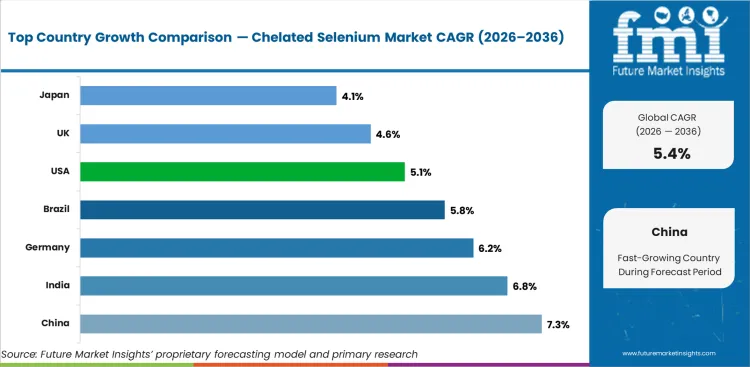
.webp "Top Country Growth Comparison Chelated Selenium Market Cagr (2026 2036)")
| Country | CAGR |
|---|---|
| China | 7.3% |
| India | 6.8% |
| Germany | 6.2% |
| Brazil | 5.8% |
| USA | 5.1% |
| UK | 4.6% |
| Japan | 4.0% |
- China leads with a CAGR of 7.3%, supported by government feed additive quality standards.
- pli schemes for pharmaceutical manufacturing are supporting domestic production ...
- Germany (6.2%) shows growth shaped by regulatory standards and institutional procurement expansion.
- Brazil (5.8%) shows growth shaped by regulatory standards and institutional procurement expansion.
The global chelated selenium market is projected to expand at a CAGR of 5.4% from 2026 to 2036. The analysis covers more than 30 countries, with key markets listed below.
In-depth Analysis of Chelated Selenium Market in China
The scale of China's livestock production sector is supporting growth at 7.3% through 2036. Domestic feed additive manufacturers are investing in chelation technology to serve poultry and swine nutrition programs, while industrial upgrading policies and e-commerce logistics are expanding distribution reach for pharmaceutical selenium supplements.
- Government feed additive quality standards are driving conversion from inorganic to organic selenium in large-scale poultry and swine operations.
- Domestic chelation technology investment is reducing import dependency for pharmaceutical-grade selenium chelates.
- E-commerce supplement distribution is broadening consumer access to chelated selenium products beyond pharmacy channels.
Sales Analysis of Chelated Selenium Market in India
Demand in India is expanding at 6.8% through 2036, shaped by organized poultry and livestock operations adopting sophisticated feed additive programs. Ayushman Bharat coverage and private healthcare investment are supporting pharmaceutical selenium supplementation demand, while tier-2 and tier-3 city pharmacy distribution is expanding consumer access.
- PLI schemes for pharmaceutical manufacturing are supporting domestic production capacity for chelated selenium products.
- Organized poultry farming growth is driving adoption of organic selenium in broiler and layer feed programs.
- Private healthcare expansion and urban tertiary care growth are supporting physician-recommended selenium supplementation.
Growth Analysis of Chelated Selenium Market in Germany
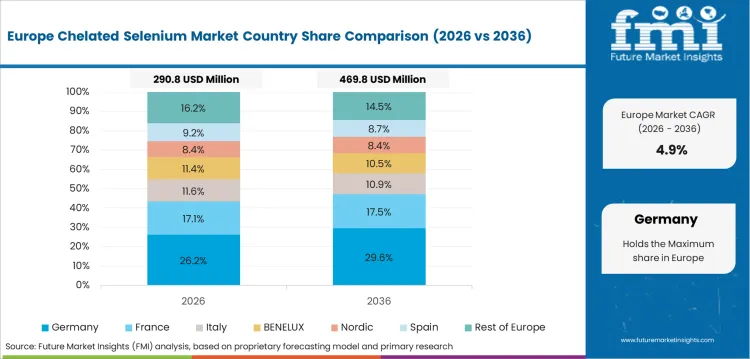
Regulatory standards shaped by EU feed additive regulations and pharmaceutical GMP requirements are influencing chelated selenium procurement in Germany, projected to grow at 6.2% through 2036. DIN and EU CE standards maintain strict quality thresholds for selenium chelate suppliers serving both feed and pharmaceutical channels.
- EU feed additive regulations and maximum selenium inclusion limits are driving organic chelate adoption across livestock operations.
- Pharmaceutical GMP compliance requirements shape qualification standards for selenium supplement ingredient suppliers.
- Industrie 4.0 integration in feed manufacturing enables precision selenium dosing in automated formulation systems.
Demand Outlook for Chelated Selenium Market in Brazil
Brazil is projected to grow at 5.8% through 2036. A large livestock production base and expanding organized poultry operations are creating volume demand for chelated selenium feed additives. SUS healthcare procurement and national pharmacy distribution infrastructure support pharmaceutical selenium supplement demand.
- The large-scale poultry and cattle production base generates volume demand for organic selenium feed additives.
- Modern retail expansion and pharmacy chain growth are broadening consumer access to chelated selenium supplements.
- National infrastructure programs for cold-chain and pharmaceutical distribution support reliable supplement supply.
Future Outlook for Chelated Selenium Market in USA
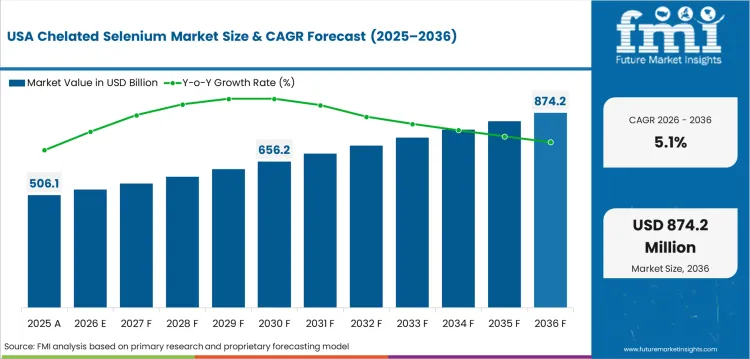
The USA is projected to register a CAGR of 5.1% through 2036. FDA regulatory frameworks for both feed additives and dietary supplements shape qualification requirements for chelated selenium suppliers. Reshoring investment and domestic pharmaceutical manufacturing expansion are supporting production capacity for organic selenium ingredients.
- FDA dietary supplement GMP requirements and feed additive regulations maintain high qualification standards for selenium chelate suppliers.
- Reshoring trends and domestic pharmaceutical manufacturing investment are expanding local chelated selenium production capacity.
- Clean-label supplement consumer preferences are driving brand-owner specification of organic chelated selenium over inorganic forms.
Opportunity Analysis of Chelated Selenium Market in UK
Post-Brexit regulatory realignment and NHS procurement pathways are shaping chelated selenium demand in the UK, projected to grow at 4.6% through 2036. Updated pharmaceutical ingredient regulations and feed additive standards are creating compliance requirements that favor organic selenium chelate suppliers with documented quality systems.
- NHS procurement pathways support institutional demand for pharmaceutical-grade chelated selenium supplement products.
- Post-Brexit regulatory updates are creating new compliance requirements for feed additive and supplement ingredient imports.
- Retailer sustainability targets influence consumer supplement product positioning and chelated selenium packaging decisions.
Competitive Landscape and Strategic Positioning
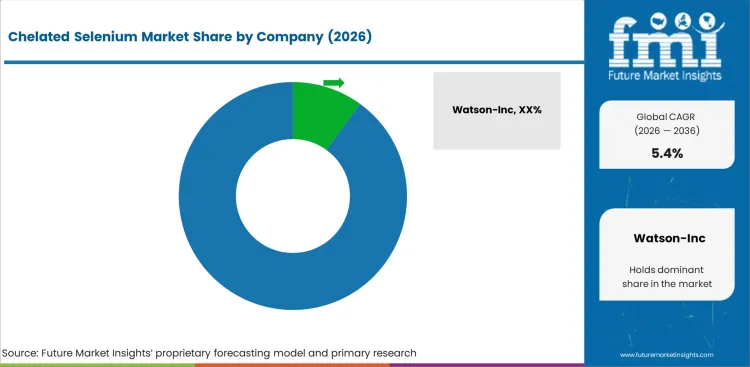
- Watson-Inc leads through integrated manufacturing, application expertise, and established procurement relationships across distribution channel channels.
- Spectrum Laboratory Products Inc. and Jost Chemical Co. compete on product specialization, regional coverage, and formulation support capability.
- Emerging players are targeting niche application segments, clean-label positioning, and regional specialty organic formulations.
Watson-Inc maintains a strong position through integrated supply chain capabilities and established relationships with large-scale end users. Spectrum Laboratory Products Inc. offers a diversified portfolio that includes organic products alongside complementary formulations.
Jost Chemical Co. competes on product quality, certification compliance, and regional distribution strength. Mid-tier players focus on niche segments or specific application expertise to differentiate from larger integrated competitors.
Barriers to entry include processing infrastructure capital cost, quality certification timelines, established supplier relationships, and multi-jurisdictional regulatory compliance. Strategic priorities include cost reduction through scale, expansion into high-growth regional markets, and specialty product development.
Key Companies in the Chelated Selenium Market
Key global companies leading the chelated selenium market include:
- Watson-Inc, Spectrum Laboratory Products Inc., Jost Chemical Co., Salvi Chemical Industries Ltd. maintain leading positions through manufacturing scale, regulatory compliance, and established procurement relationships.
- Vitex Nutrition Ltd, Sumitomo Metal Mining Co., Ltd., Mitsubishi Corporation have established regional leadership through focused distribution and application-specific formulation expertise.
- Shanghai Redbrillian Chemical Co., Ltd., Norilsk Nickel, Jinchuan Group Ltd.,, JX Nippon Mining Metals Corporation, Guangzhou Fineton Nonferrous, Nutri-West Inc., Others are emerging through specialty product development and targeted entry into high-growth application segments.
Competitive Benchmarking: Chelated Selenium Market
| Company | Chelation Technology | Feed-Grade Certification | Pharma-Grade Capability | Geographic Footprint |
|---|---|---|---|---|
| Watson-Inc | High | Medium | Strong | Global |
| Spectrum Laboratory Products Inc. | High | Medium | Strong | Global |
| Jost Chemical Co. | High | Medium | Strong | Global |
| Salvi Chemical Industries Ltd. | Medium | Medium | Moderate | Multi-regional |
| Vitex Nutrition Ltd | Medium | High | Moderate | Multi-regional |
| Sumitomo Metal Mining Co., Ltd. | Medium | High | Moderate | Multi-regional |
| Mitsubishi Corporation | Low | High | Low | Regional |
| Shanghai Redbrillian Chemical Co., Ltd. | Low | High | Low | Regional |
| Norilsk Nickel, Jinchuan Group Ltd., | Low | High | Low | Regional |
| JX Nippon Mining Metals Corporation | Low | High | Low | Regional |
Source: Future Market Insights competitive analysis, 2026.
Key Developments in Chelated Selenium Market
- In 2025, Watson-Inc expanded its organic product portfolio with new formulations targeting distribution channel applications.
- In 2025, Spectrum Laboratory Products Inc. invested in processing capacity expansion to support growing demand for certified organic ingredients across key regional markets.
Key Players in the Chelated Selenium Market
Major Global Players
- Watson-Inc
- Spectrum Laboratory Products Inc.
- Jost Chemical Co.
- Salvi Chemical Industries Ltd.
- Vitex Nutrition Ltd
- Sumitomo Metal Mining Co., Ltd.
- Mitsubishi Corporation
- Shanghai Redbrillian Chemical Co., Ltd.
Emerging Players/Startups
- Chemlife Innovations
- Prions Biotech
- Microbio
Report Scope and Coverage
| Parameter | Details |
|---|---|
| Market size by 2036 | USD 2.1 Billion |
| Growth rate | 5.4% CAGR (2026 to 2036) |
| Forecast period | 2026 to 2036 |
| Base year value (2025) | USD 1.2 Billion |
| Key Segment Covered | Nature, End-use, Distribution channel, Application, Technology |
| Regions covered | North America, Latin America, Western Europe, Eastern Europe, East Asia, South Asia and Pacific, Middle East and Africa |
| Countries covered | USA, China, India, Germany, Brazil, UK, Japan, 30 plus countries |
| Key companies profiled | Watson-Inc, Spectrum Laboratory Products Inc., Jost Chemical Co., Salvi Chemical Industries Ltd., Vitex Nutrition Ltd, Sumitomo Metal Mining Co., Ltd., Mitsubishi Corporation, Shanghai Redbrillian Chemical Co., Ltd., Norilsk Nickel, Jinchuan Group Ltd.,, JX Nippon Mining Metals Corporation |
| Approach | Hybrid bottom-up and top-down methodology starting with verified transaction data, projecting adoption velocity across segments and regions. |
Market Segmentation Analysis
Chelated Selenium Market Segmented by Nature:
- Organic
- Inorganic
Chelated Selenium Market Segmented by End-use:
- Feed Industry
- Pharmaceuticals
- Dietary Supplements
- Cosmetics
- Functional Food
Chelated Selenium Market Segmented by Distribution channel:
- Pharmacies
- Health Beauty stores
- Hypermarket
- Direct Selling
- Online
Chelated Selenium Market Segmented by Application:
- Animal Nutrition
- Poultry Feed
- Human Nutrition
- Dietary Supplements
- Agriculture
- Crop Nutrition
Chelated Selenium Market Segmented by Technology:
- Chelation Technology
- Chemical Chelation
- Amino Acid Binding
- Protein Binding
- Biological Chelation
- Yeast Fermentation
- Microbial Fermentation
- Chemical Chelation
- Encapsulation Technology
- Microencapsulation
- Spray Drying
- Coacervation
- Nanoencapsulation
- Lipid-Based
- Polymer-Based
- Microencapsulation
Chelated Selenium Market by Region:
- North America
- USA
- Canada
- Mexico
- Latin America
- Brazil
- Chile
- Rest of Latin America
- Western Europe
- Germany
- UK
- Italy
- Spain
- France
- Nordic
- BENELUX
- Rest of Western Europe
- Eastern Europe
- Russia
- Poland
- Hungary
- Balkan & Baltic
- Rest of Eastern Europe
- East Asia
- China
- Japan
- South Korea
- South Asia and Pacific
- India
- ASEAN
- Australia & New Zealand
- Rest of South Asia and Pacific
- Middle East & Africa
- Kingdom of Saudi Arabia
- Other GCC Countries
- Türkiye
- South Africa
- Other African Union
- Rest of Middle East & Africa
Research Sources and Bibliography
- 1. Food and Agriculture Organization. (2025). FAO Global Food and Agriculture Statistics. FAO.
- 2. World Health Organization. (2025). WHO Global Health Observatory Data Repository. WHO.
- 3. International Organization for Standardization. (2025). ISO Food Safety Management Standards. ISO.
- 4. USA Food and Drug Administration. (2025). FDA Food Safety Modernization Act Compliance Guide. FDA.
- 5. European Commission. (2025). EU Food Safety and Quality Standards Framework. EC.
This bibliography is provided for reader reference.
This Report Answers
- Estimating the size of the market and how much revenue it will generate from 2026 to 2036.
- Segmenting by nature, end-use, distribution channel, application, technology.
- Insights about more than 30 markets in the region.
- Analysis of demand drivers, restraints, and growth opportunities.
- Assessment of the competitive landscape.
- Finding investment opportunities across key application and end-use segments.
- Tracking supply chain and distribution channel developments.
- Delivery of data in PDF and Excel formats.
Frequently Asked Questions
How big is the chelated selenium market in 2026?
The global chelated selenium market is estimated to be valued at USD 1.2 billion in 2026.
What will be the size of the chelated selenium market in 2036?
The market size for the chelated selenium market is projected to reach USD 2.1 billion by 2036.
How much will the chelated selenium market growth be between 2026 and 2036?
The chelated selenium market is expected to grow at a 5.4% CAGR between 2026 and 2036.
What are the key natures in the chelated selenium market?
The key natures in the chelated selenium market are Organic and Inorganic.
Which end-use segment is expected to contribute a significant share in the chelated selenium market in 2026?
In terms of end-use, the feed industry segment is expected to command 50.0% share in the chelated selenium market in 2026.
Preview the report firsthand - request a free sample
Get SampleGet the brochure for pricing and purchase details.
Get PDFTable of Content
- Key Takeaways
- Market Size and CAGR
- Top Growth Driver
- Fastest Growing Segment
- Leading Region
- Key Companies
- Emerging Opportunities
- Executive Summary
- Global Market Outlook
- Demand-side Trends
- Supply-side Trends
- Technology Roadmap Analysis
- Analysis and Recommendations
- Analyst Perspective (What is happening? Why now? What should investors know?)
- Key Questions Answered
- How large is the market?
- What is the CAGR?
- What are key trends?
- Which region dominates?
- Who are the leaders?
- Market Overview
- Market Coverage / Taxonomy
- Market Definition / Scope / Limitations
- Research Methodology
- Chapter Orientation
- Analytical Lens and Working Hypotheses
- Market Structure, Signals, and Trend Drivers
- Benchmarking and Cross-market Comparability
- Market Sizing, Forecasting, and Opportunity Mapping
- Research Design and Evidence Framework
- Desk Research Programme (Secondary Evidence)
- Expert Input and Fieldwork (Primary Evidence)
- Tooling, Models, and Reference Databases
- Data Engineering and Model Build
- Quality Assurance and Audit Trail
- Market Background
- Market Dynamics (Drivers, Restraints, Opportunity, Trends)
- Scenario Forecast (Optimistic, Likely, Conservative)
- Impact Analysis
- AI Impact
- Sustainability Impact
- Regulatory Impact
- Technology Impact
- Consumer / Buyer Analysis
- Purchase Drivers
- Adoption Barriers
- Buyer Journey
- Opportunity Map Analysis
- Product Life Cycle Analysis
- Supply Chain Analysis
- Investment Feasibility Matrix
- Value Chain Analysis
- PESTLE and Porter's Analysis
- Regulatory Landscape
- Regional Parent Market Outlook
- Production and Consumption Statistics
- Import and Export Statistics
- Global Market Analysis and Forecast, 2021 to 2036
- Historical Market Size Value (USD Million) Analysis, 2021 to 2025
- Current and Future Market Size Value (USD Million) Projections, 2026 to 2036
- Y-o-Y Growth Trend Analysis
- Absolute $ Opportunity Analysis
- Global Market Pricing Analysis, 2021 to 2036
- Global Market Analysis and Forecast, By Nature, 2021 to 2036
- Introduction / Key Findings
- Historical Market Size Value (USD Million) Analysis By Nature, 2021 to 2025
- Current and Future Market Size Value (USD Million) Analysis and Forecast By Nature, 2026 to 2036
- Organic
- Inorganic
- Organic
- Y-o-Y Growth Trend Analysis By Nature, 2021 to 2025
- Absolute $ Opportunity Analysis By Nature, 2026 to 2036
- Global Market Analysis and Forecast, By End-use, 2021 to 2036
- Introduction / Key Findings
- Historical Market Size Value (USD Million) Analysis By End-use, 2021 to 2025
- Current and Future Market Size Value (USD Million) Analysis and Forecast By End-use, 2026 to 2036
- Feed Industry
- Pharmaceuticals
- Dietary Supplements
- Cosmetics
- Functional Food
- Feed Industry
- Y-o-Y Growth Trend Analysis By End-use, 2021 to 2025
- Absolute $ Opportunity Analysis By End-use, 2026 to 2036
- Global Market Analysis and Forecast, By Distribution channel, 2021 to 2036
- Introduction / Key Findings
- Historical Market Size Value (USD Million) Analysis By Distribution channel, 2021 to 2025
- Current and Future Market Size Value (USD Million) Analysis and Forecast By Distribution channel, 2026 to 2036
- Pharmacies
- Health Beauty stores
- Hypermarket
- Direct Selling
- Online
- Pharmacies
- Y-o-Y Growth Trend Analysis By Distribution channel, 2021 to 2025
- Absolute $ Opportunity Analysis By Distribution channel, 2026 to 2036
- Global Market Analysis and Forecast, By Application, 2021 to 2036
- Introduction / Key Findings
- Historical Market Size Value (USD Million) Analysis By Application, 2021 to 2025
- Current and Future Market Size Value (USD Million) Analysis and Forecast By Application, 2026 to 2036
- Animal Nutrition
- Poultry Feed
- Human Nutrition
- Dietary Supplements
- Agriculture
- Crop Nutrition
- Animal Nutrition
- Y-o-Y Growth Trend Analysis By Application, 2021 to 2025
- Absolute $ Opportunity Analysis By Application, 2026 to 2036
- Global Market Analysis and Forecast, By Technology, 2021 to 2036
- Introduction / Key Findings
- Historical Market Size Value (USD Million) Analysis By Technology, 2021 to 2025
- Current and Future Market Size Value (USD Million) Analysis and Forecast By Technology, 2026 to 2036
- Chelation Technology
- Chemical Chelation
- Biological Chelation
- Encapsulation Technology
- Microencapsulation
- Nanoencapsulation
- Chelation Technology
- Y-o-Y Growth Trend Analysis By Technology, 2021 to 2025
- Absolute $ Opportunity Analysis By Technology, 2026 to 2036
- Global Market Analysis and Forecast, By Region, 2021 to 2036
- Introduction
- Historical Market Size Value (USD Million) Analysis By Region, 2021 to 2025
- Current Market Size Value (USD Million) Analysis and Forecast By Region, 2026 to 2036
- North America
- Latin America
- Western Europe
- Eastern Europe
- East Asia
- South Asia and Pacific
- Middle East & Africa
- Market Attractiveness Analysis By Region
- North America Market Analysis and Forecast, By Country, 2021 to 2036
- Historical Market Size Value (USD Million) Trend Analysis By Market Taxonomy, 2021 to 2025
- Market Size Value (USD Million) Forecast By Market Taxonomy, 2026 to 2036
- By Country
- USA
- Canada
- Mexico
- By Nature
- By End-use
- By Distribution channel
- By Application
- By Technology
- By Country
- Market Attractiveness Analysis
- By Country
- By Nature
- By End-use
- By Distribution channel
- By Application
- By Technology
- Key Takeaways
- Latin America Market Analysis and Forecast, By Country
- Historical Market Size Value (USD Million) Trend Analysis By Market Taxonomy, 2021 to 2025
- Market Size Value (USD Million) Forecast By Market Taxonomy, 2026 to 2036
- By Country
- Brazil
- Chile
- Rest of Latin America
- By Nature
- By End-use
- By Distribution channel
- By Application
- By Technology
- By Country
- Market Attractiveness Analysis
- By Country
- By Nature
- By End-use
- By Distribution channel
- By Application
- By Technology
- Key Takeaways
- Western Europe Market Analysis and Forecast, By Country
- Historical Market Size Value (USD Million) Trend Analysis By Market Taxonomy, 2021 to 2025
- Market Size Value (USD Million) Forecast By Market Taxonomy, 2026 to 2036
- By Country
- Germany
- UK
- Italy
- Spain
- France
- Nordic
- BENELUX
- Rest of Western Europe
- By Nature
- By End-use
- By Distribution channel
- By Application
- By Technology
- By Country
- Market Attractiveness Analysis
- By Country
- By Nature
- By End-use
- By Distribution channel
- By Application
- By Technology
- Key Takeaways
- Eastern Europe Market Analysis and Forecast, By Country
- Historical Market Size Value (USD Million) Trend Analysis By Market Taxonomy, 2021 to 2025
- Market Size Value (USD Million) Forecast By Market Taxonomy, 2026 to 2036
- By Country
- Russia
- Poland
- Hungary
- Balkan & Baltic
- Rest of Eastern Europe
- By Nature
- By End-use
- By Distribution channel
- By Application
- By Technology
- By Country
- Market Attractiveness Analysis
- By Country
- By Nature
- By End-use
- By Distribution channel
- By Application
- By Technology
- Key Takeaways
- East Asia Market Analysis and Forecast, By Country
- Historical Market Size Value (USD Million) Trend Analysis By Market Taxonomy, 2021 to 2025
- Market Size Value (USD Million) Forecast By Market Taxonomy, 2026 to 2036
- By Country
- China
- Japan
- South Korea
- By Nature
- By End-use
- By Distribution channel
- By Application
- By Technology
- By Country
- Market Attractiveness Analysis
- By Country
- By Nature
- By End-use
- By Distribution channel
- By Application
- By Technology
- Key Takeaways
- South Asia and Pacific Market Analysis and Forecast, By Country
- Historical Market Size Value (USD Million) Trend Analysis By Market Taxonomy, 2021 to 2025
- Market Size Value (USD Million) Forecast By Market Taxonomy, 2026 to 2036
- By Country
- India
- ASEAN
- Australia & New Zealand
- Rest of South Asia and Pacific
- By Nature
- By End-use
- By Distribution channel
- By Application
- By Technology
- By Country
- Market Attractiveness Analysis
- By Country
- By Nature
- By End-use
- By Distribution channel
- By Application
- By Technology
- Key Takeaways
- Middle East & Africa Market Analysis and Forecast, By Country
- Historical Market Size Value (USD Million) Trend Analysis By Market Taxonomy, 2021 to 2025
- Market Size Value (USD Million) Forecast By Market Taxonomy, 2026 to 2036
- By Country
- Kingdom of Saudi Arabia
- Other GCC Countries
- Türkiye
- South Africa
- Other African Union
- Rest of Middle East & Africa
- By Nature
- By End-use
- By Distribution channel
- By Application
- By Technology
- By Country
- Market Attractiveness Analysis
- By Country
- By Nature
- By End-use
- By Distribution channel
- By Application
- By Technology
- Key Takeaways
- Key Countries Market Analysis
- USA
- Pricing Analysis
- Market Share Analysis, 2025
- By Nature
- By End-use
- By Distribution channel
- By Application
- By Technology
- Canada
- Pricing Analysis
- Market Share Analysis, 2025
- By Nature
- By End-use
- By Distribution channel
- By Application
- By Technology
- Mexico
- Pricing Analysis
- Market Share Analysis, 2025
- By Nature
- By End-use
- By Distribution channel
- By Application
- By Technology
- Brazil
- Pricing Analysis
- Market Share Analysis, 2025
- By Nature
- By End-use
- By Distribution channel
- By Application
- By Technology
- Chile
- Pricing Analysis
- Market Share Analysis, 2025
- By Nature
- By End-use
- By Distribution channel
- By Application
- By Technology
- Germany
- Pricing Analysis
- Market Share Analysis, 2025
- By Nature
- By End-use
- By Distribution channel
- By Application
- By Technology
- UK
- Pricing Analysis
- Market Share Analysis, 2025
- By Nature
- By End-use
- By Distribution channel
- By Application
- By Technology
- Italy
- Pricing Analysis
- Market Share Analysis, 2025
- By Nature
- By End-use
- By Distribution channel
- By Application
- By Technology
- Spain
- Pricing Analysis
- Market Share Analysis, 2025
- By Nature
- By End-use
- By Distribution channel
- By Application
- By Technology
- France
- Pricing Analysis
- Market Share Analysis, 2025
- By Nature
- By End-use
- By Distribution channel
- By Application
- By Technology
- India
- Pricing Analysis
- Market Share Analysis, 2025
- By Nature
- By End-use
- By Distribution channel
- By Application
- By Technology
- ASEAN
- Pricing Analysis
- Market Share Analysis, 2025
- By Nature
- By End-use
- By Distribution channel
- By Application
- By Technology
- Australia & New Zealand
- Pricing Analysis
- Market Share Analysis, 2025
- By Nature
- By End-use
- By Distribution channel
- By Application
- By Technology
- China
- Pricing Analysis
- Market Share Analysis, 2025
- By Nature
- By End-use
- By Distribution channel
- By Application
- By Technology
- Japan
- Pricing Analysis
- Market Share Analysis, 2025
- By Nature
- By End-use
- By Distribution channel
- By Application
- By Technology
- South Korea
- Pricing Analysis
- Market Share Analysis, 2025
- By Nature
- By End-use
- By Distribution channel
- By Application
- By Technology
- Russia
- Pricing Analysis
- Market Share Analysis, 2025
- By Nature
- By End-use
- By Distribution channel
- By Application
- By Technology
- Poland
- Pricing Analysis
- Market Share Analysis, 2025
- By Nature
- By End-use
- By Distribution channel
- By Application
- By Technology
- Hungary
- Pricing Analysis
- Market Share Analysis, 2025
- By Nature
- By End-use
- By Distribution channel
- By Application
- By Technology
- Kingdom of Saudi Arabia
- Pricing Analysis
- Market Share Analysis, 2025
- By Nature
- By End-use
- By Distribution channel
- By Application
- By Technology
- Türkiye
- Pricing Analysis
- Market Share Analysis, 2025
- By Nature
- By End-use
- By Distribution channel
- By Application
- By Technology
- South Africa
- Pricing Analysis
- Market Share Analysis, 2025
- By Nature
- By End-use
- By Distribution channel
- By Application
- By Technology
- USA
- Market Structure Analysis
- Competition Dashboard
- Competition Benchmarking
- Market Share Analysis of Top Players
- By Regional
- By Nature
- By End-use
- By Distribution channel
- By Application
- By Technology
- Emerging Startups
- Innovation Benchmarking
- Competition Analysis
- Competition Deep Dive
- Watson-Inc
- Overview
- Product Portfolio
- Profitability by Market Segments (Product/Region/Sales Channel)
- Sales Footprint
- Strategy Overview
- Marketing Strategy
- Product Strategy
- Channel Strategy
- Spectrum Laboratory Products Inc.
- Jost Chemical Co.
- Salvi Chemical Industries Ltd.
- Vitex Nutrition Ltd
- Sumitomo Metal Mining Co., Ltd.
- Mitsubishi Corporation
- Shanghai Redbrillian Chemical Co., Ltd.
- Norilsk Nickel, Jinchuan Group Ltd.,
- JX Nippon Mining Metals Corporation
- Guangzhou Fineton Nonferrous
- Nutri-West Inc.
- Others
- Watson-Inc
- Case Studies
- Success Stories
- Recent Developments
- Competition Deep Dive
- Assumptions & Acronyms Used


