

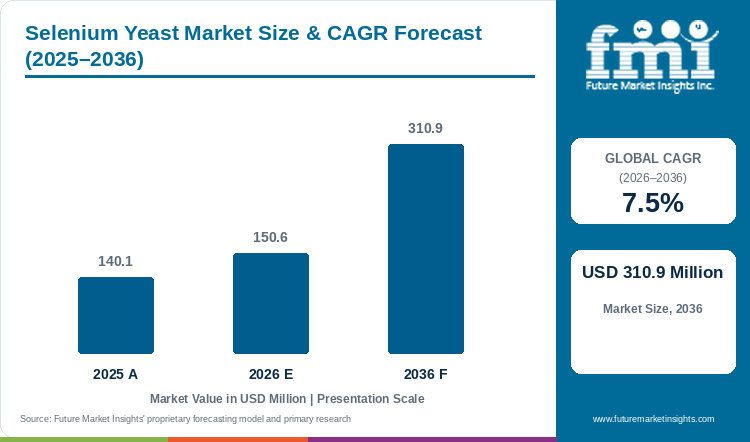
- Market Size (2026)
- USD 150.6 Mn
- Forecast (2036)
- USD 310.9 Mn
- CAGR (2026 to 2036)
- 7.5%
How big is Selenium Yeast Market in 2026?
Demand for selenium yeast is projected to expand at 7.5% CAGR between 2026 and 2036. Industry value grows from USD 140.1 million in 2025 to USD 150.6 million in 2026 and is projected to reach USD 310.9 million by 2036.
Selenium yeast has gained increasing application in poultry, dairy, swine and pet food products owing to its use as a trace mineral source. Selenium yeast is added in a small quantity through premix and compound feed; however, it is required in every production cycle, which keeps the demand recurring. According to USDA, the United States produced 9.40 billion broilers in 2025, increasing by 1% from 2024[1]. The large production of broilers is expected to increase the requirement for mineral premixes and support the sales of selenium yeast. FMI trend analysis has noted that feed manufacturers are shifting towards organic selenium grades due to their defined composition. Easy dispersion, storage stability and approval for the intended species are anticipated to remain key factors affecting the adoption of selenium yeast.
As per FMI’s proprietary survey, selenium yeast inclusion rates in commercial poultry diets vary significantly by market, with organic selenium forms commanding a notably higher share of premix formulations in Western Europe compared to Asia-Pacific, where inorganic selenium remains more prevalent in cost-sensitive feed programs. Regional uptake of selenium yeast varies considerably across key markets, shaped by poultry production scale, feed additive regulations and the availability of species-registered products. The UK market is projected to grow at 9.5% CAGR, whereas Japan is anticipated to expand at 8.6% CAGR through 2036. England has authorized CNCM I-3060 under defined product conditions, which supports the use of documented selenium yeast in animal feed. Japan has steady chicken consumption and depends on domestic production along with imported chicken supply. Availability of approved products, stable ingredient supply and compatibility with existing premix systems is expected to determine the growth trajectory of selenium yeast in these countries.
Key Takeaways
- Recurring trace-mineral supplementation supports demand because feed mills apply selenium through scheduled formulations.
- Based on product type, selenized yeast is projected to account for 53.6% in 2026, owing to documented organic-selenium composition.
- By specie type, broilers are estimated to hold 16.7% in 2026, supported by frequent feed cycles and standardized formulas.
- In 2026, dry powder is expected to lead form type with 53.7% share, driven by familiar premix handling.
- The UK is projected at 9.5% CAGR, whereas Japan is forecast at 8.6% because qualification conditions and production maturity differ.
- Notable companies include Alltech, Lesaffre, Lallemand, Novus International, ADM, Angel Yeast, Biorigin, Garuda International, Cypress Systems, and Pharma Nord.
Analyst Perspective
“Increasing use of organic selenium in poultry and livestock feed is expected to support the market growth. In my experience, selenium yeast products having consistent assay, easy mixing and approved feed use are likely to gain higher preference among feed manufacturers.”
- Nandini Roy Choudhury, Principal Consultant, Future Market Insights.
How is the selenium yeast market segmented?
Selenium yeast market is segmented by three primary commercial axes and region: product type, specie type, form type, and region. Selenized yeast is projected at 53.6%, broilers at 16.7%, and dry powder at 53.7% in 2026.
- By product type: selenized yeast (organic selenium yeast), high-selenium yeast, inorganic selenium-enriched yeast, and selenium-yeast blends.
- By specie type: broilers, dairy cattle, dogs, piglets, cats, layer hens, adult pigs, beef cattle, small ruminants, fish, equine, and shrimp.
- By form type: dry powder, liquid form, pelletized form, and coated forms.
- By region: North America, Latin America, Western Europe, Eastern Europe, East Asia, South Asia and Pacific, and Middle East and Africa.
What supports broilers as a preferred specie type?
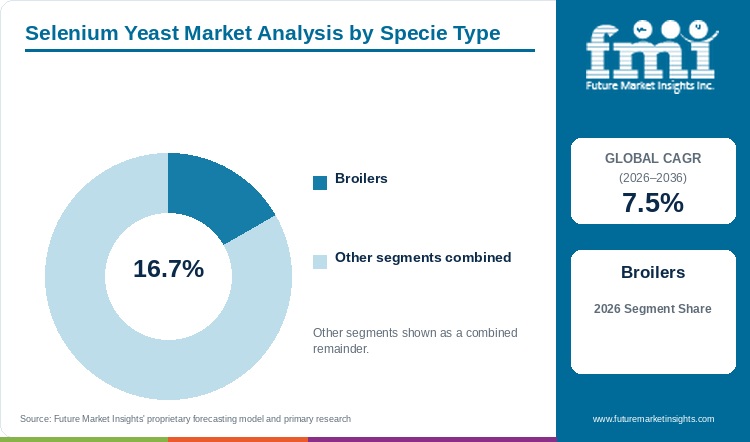
By specie type, broilers are estimated to hold 16.7% in 2026, supported by short cycles and repeat feed demand.
Broilers require complete feed at regular intervals throughout their short production cycle. Due to this, selenium yeast is repeatedly added through mineral premixes used in broiler feed. U.S. Department of Agriculture reported that total live weight broiler production reached 62.2 billion pounds in 2025, up 2% from the prior year[4]. Increasing broiler production along with frequent replacement of feed is expected to boost the demand for selenium yeast in this segment.
- Broilers are estimated at 16.7% in 2026 because standardized formulas repeat through short production cycles.
- Frequent feed replacement keeps trace-mineral purchasing active throughout the production calendar.
Why does selenized yeast hold notable product type demand?
Based on product type, selenized yeast is projected to account for 53.6% in 2026, owing to documented organic-selenium composition.
Selenized yeast is produced by growing yeast in the presence of selenium and is used as an organic selenium source in animal feed. It is increasingly applied in poultry, dairy and other livestock feed due to its defined selenium composition and easy inclusion in premixes. European Food Safety Authority confirmed the safety and nutritional efficacy of selenised yeast across all animal species under defined specification limits[3]. Availability of an authorized organic selenium source is expected to support the selenized yeast segment during the forecast period.
- Selenized yeast is projected at 53.6% in 2026 because buyers can qualify a stated organic-selenium source.
- The authorization keeps composition and labeling attached to the product throughout the feed route.
How does dry powder meet changing form type needs?
In 2026, dry powder is expected to lead form type with 53.7% share, driven by familiar premix handling.
Dry powder is highly used in feed premixes owing to its easy storage, metering and blending properties. It can be added through the existing dry dosing equipment, which helps feed manufacturers avoid investment in a separate liquid handling system. In 2026, Novus listed ZORIEN SeY 3000 as a prilled feed additive for complete feed[5]. Increasing availability of powder and prilled products with improved flow is expected to support the dry form segment.
- Dry powder is expected at 53.7% in 2026 because feed mills can use existing dry dosing equipment.
- Prilled options improve flow while avoiding a separate liquid-handling line.
What are the drivers, restraints, and opportunities in the selenium yeast market?
In the selenium yeast market, the key driver is repeat feed supplementation, the key restraint is qualification control, and the key opportunity is easier handling.
- Driver: Repeated use of selenium in poultry and livestock feed formulations is supporting regular market demand.
- Restraint: Strict dose, labeling and worker safety requirements increase the time required for approving a new supplier.
- Opportunity: Development of granular, prilled and coated forms can expand adoption by improving flow and uniform distribution in feed.
Repeat Feed Cycles Support Demand
Increasing poultry and livestock production is creating repeated demand for selenium yeast in animal feed. Trace minerals are required in every commercial feed cycle, which supports regular purchasing by feed mills. USDA valued U.S. poultry production and sales at USD 81.7 billion in 2025, out of which broilers accounted for USD 44.6 billion[6]. Expansion of commercial poultry production and the associated requirement for standardized mineral premixes is expected to drive the selenium yeast market during the forecast period.
Dose Controls Slow Supplier Changes
Selenium is added in a very small quantity and excess inclusion can make the complete feed unsuitable for use. The U.S. regulation provides defined selenium conditions for covered livestock species[7]. Feed manufacturers require assay records, correct labeling and uniform mixing before approving a new selenium yeast product. These requirements increase the product qualification time and can restrict the entry of suppliers having incomplete technical and regulatory records.
Handling Formats Open New Routes
Prilled, granular and coated selenium yeast products are being developed to improve flow and homogeneous distribution in feed. In August 2025, Lallemand included ALKOSEL in an antioxidant nutrition program for animal production[8]. This has expanded the use of selenium yeast from a stand-alone mineral ingredient towards a wider nutrition program. Development of easy handling forms is expected to create growth opportunities in pet food, dairy, poultry and aquaculture feed.
Which country CAGRs are profiled in the selenium yeast market?
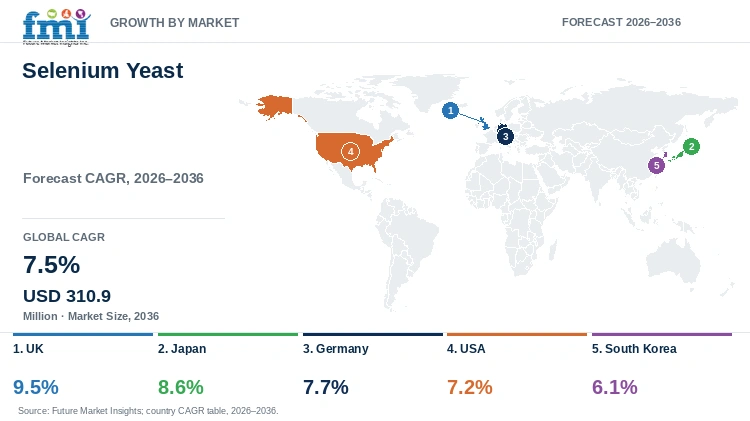
| Country | CAGR |
|---|---|
| UK | 9.5% |
| Japan | 8.6% |
| Germany | 7.7% |
| USA | 7.2% |
| South Korea | 6.1% |
How do country-level CAGRs compare in the selenium yeast market?
Selenium yeast demand across the countries is influenced by the size of poultry production, local feed regulations and availability of approved organic selenium products. Countries having large commercial feed production are expected to generate repeated demand, while registration requirements can slow the entry of new products.
Japan and South Korea also depend on imported chicken when domestic production is not sufficient to meet the consumption. Feed manufacturers in these countries require stable ingredient supply and selenium yeast forms that can be easily used through the existing premix system.
- UK demand benefits from a large poultry base and an active feed-additive authorization route.
- Japan combines stable production with firm consumption and continued reliance on imported chicken products.
- Germany connects high poultry throughput with established European feed-control procedures.
- USA pairs a large poultry economy with explicit federal selenium limits.
- South Korea expects measured production growth while consumption and imports continue to rise.
Full report country CAGRs cover: North America; Latin America; Western Europe; Eastern Europe; East Asia; South Asia and Pacific; Middle East and Africa.
Country-wise Analysis
- The UK selenium yeast market is projected to grow at 9.5% CAGR through 2036, supported by the large poultry population. DEFRA reported 183 million poultry in June 2025, including 121 million broilers, representing a 7.6% increase from the previous year[9]. Increasing broiler production is expected to raise the requirement for complete feed and mineral premixes. Apart from that, England maintains defined conditions for selenised yeast CNCM I-3060. Large poultry base along with availability of an authorized organic selenium product is anticipated to support the UK market.
- Japan selenium yeast market is expected to advance at 8.6% CAGR during the assessment period owing to steady chicken consumption. A September 2025 USDA assessment forecast the 2026 chicken production at around 1.84 million tonnes, while consumption was projected near 2.95 million tonnes[10]. Higher consumption compared to domestic production keeps imported chicken relevant in the country. Domestic poultry producers continue to use standardized feed formulations for maintaining output. Product registration, stable supply and premix compatibility are expected to influence selenium yeast adoption in Japan.
- Selenium yeast demand in Germany is forecast to increase at 7.7% CAGR over the forecast period, attributed to high poultry processing activity. Destatis reported slaughter of 697.3 million chickens, turkeys and ducks in 2025, with young broiler meat production increasing by 3.6% to reach 1.1 million tonnes[11]. Large poultry throughput requires regular commercial feed production and consistent mineral inclusion. Availability of standardized selenium yeast products along with established European feed rules is likely to support the Germany market.
- Adoption of selenium yeast in the USA is estimated to expand at 7.2% CAGR through 2036 owing to large poultry and livestock feed production. The Institute for Feed Education and Research reported that U.S. livestock, poultry and farmed aquaculture consumed approximately 283.6 million tons of feed in 2023, with beef cattle representing the largest share at 76.7 million tons, followed by broilers at 61.5 million tons and hogs at 60.9 million tons [12]. Federal regulations permit selenium yeast in complete feed for listed animal species under defined conditions. Feed manufacturers therefore require correct selenium assay, labeling and premix instructions before using the product. Increasing preference for controlled organic selenium sources is expected to support the U.S. selenium yeast market.
- The South Korea selenium yeast market is projected to record 6.1% CAGR during the assessment period, influenced by increasing chicken consumption. A September 2025 USDA assessment forecast 2026 chicken consumption to increase by 2% and reach 1.1 million tonnes, alongside a 9% rise in chicken imports after regionalized disease controls reopened supply[13]. Rising chicken consumption will upkeep the requirement for commercial poultry feed. Local registration and stable ingredient availability are expected to remain important for selenium yeast sales in South Korea.
Who are the notable companies in the selenium yeast market?
Notable companies include Alltech, Lesaffre, Lallemand, Novus International, ADM, Angel Yeast, Biorigin, Garuda International, Cypress Systems, and Pharma Nord.
The selenium yeast market includes feed additive manufacturers, fermentation companies and animal nutrition ingredient suppliers. Alltech, Lesaffre, Lallemand, Novus International and Angel Yeast offer selenium yeast products for animal nutrition. ADM participates through premix and wider animal nutrition offerings, whereas Garuda International supplies selenium yeast through an ingredient route. Market players are focusing on defined product composition, easy handling forms and technical support in order to increase their customer base.
- Direct feed products: Alltech, Lesaffre, Lallemand, Novus International, and Angel Yeast document selenium-yeast offers for animal nutrition.
- Integration platforms: ADM and Biorigin participate through premix, yeast-derivative or wider animal-nutrition capability.
- Adjacent channels: Garuda documents an animal-nutrition route, while Cypress Systems and Pharma Nord remain stronger in human nutrition.
Competitive Benchmarking: Selenium Yeast Market
| Company | Feed-grade offer | Species breadth | Feed integration | Reach |
|---|---|---|---|---|
| Alltech | High | High | High | High |
| Lesaffre | High | High | Medium | High |
| Lallemand | High | High | High | High |
| Novus International | High | Medium | High | High |
| ADM | Medium | Medium | High | High |
| Angel Yeast | High | Medium | Medium | Medium |
| Biorigin | Low | High | Medium | Medium |
| Garuda International | Medium | Low | Medium | Medium |
| Cypress Systems | Low | Low | Low | Medium |
| Pharma Nord | Low | Low | Low | High |
High indicates broad public evidence, Medium indicates narrower evidence and Low indicates limited evidence. These ratings represent documented capability and do not indicate product quality, revenue or market share.
Key Developments in the Selenium Yeast Market
- In October 2024, Lesaffre announced the acquisition of a 70% majority stake in Biorigin from Zilor, combining Biorigin’s yeast-derivative production in São Paulo with Lesaffre’s Biospringer unit to expand natural savory ingredient and animal nutrition solutions globally.[14].
- In August 2025, Lallemand positioned ALKOSEL within an antioxidant nutrition program for animal health and heat-stress management.
- In January 2025, Alltech documented Sel-Plex premix formulations for dogs and cats in its U.S. pet guide[16].
Key Players in the Selenium Yeast Market
Dedicated Selenium-Yeast Feed Suppliers
- Alltech
- Lesaffre
- Lallemand
- Novus International
- Angel Yeast
Animal Nutrition and Yeast Platforms
- ADM
- Biorigin
- Garuda International
Adjacent Selenium-Yeast Channels
- Cypress Systems
- Pharma Nord
Selenium Yeast Market - Report Scope
| Coverage field | Report scope |
|---|---|
| Market breakdown | Product type, specie type, form type, and region. |
| Quantitative units | USD million. |
| Market definition | Revenue from selenium yeast sold as a feed ingredient, premix component or selenium-yeast blend. Finished human supplements and complete downstream feeds are excluded. |
| Regions covered | North America; Latin America; Western Europe; Eastern Europe; East Asia; South Asia and Pacific; Middle East and Africa. |
| Countries covered | UK, Japan, Germany, USA, and South Korea. |
| Key companies profiled | Alltech, Lesaffre, Lallemand, Novus International, ADM, Angel Yeast, Biorigin, Garuda International, Cypress Systems, Pharma Nord. |
| Forecast period | 2026 to 2036. |
| Approach | The Future Market Insights report covers segment structure, country conditions and product-level competition. |
Selenium Yeast Market - Research Methodology
| Method | Approach |
|---|---|
| Primary Research | FMI analysts gathered input from manufacturers, service providers, technology developers, distributors, end users, procurement teams, and subject-matter experts. Interviews examined purchasing decisions, product evaluation, adoption barriers, approval requirements, pricing considerations, and expectations for technical support. |
| Desk Research | Desk research covered government statistics, regulatory publications, trade data, technical literature, standards, company filings, product information, and official corporate announcements. |
| Market Sizing and Forecasting | The market model combined the baseline value with historical performance, segment structure, pricing and volume indicators, adoption levels, company participation, and country demand conditions. |
| Data Validation | Estimates were checked against public data, company activity, trade patterns, industry developments, and findings from primary interviews. Adjacent categories and overlapping revenues were excluded. |
Segment shares and forecast values are proprietary analytical estimates and are not government statistics or direct measurements of worldwide market share.
Selenium Yeast Market by Segments
Selenium Yeast Market segmented by Product Type:
- Selenized yeast (organic selenium yeast)
- High-selenium yeast
- Inorganic selenium-enriched yeast
- Selenium-yeast blends
Selenium Yeast Market segmented by Specie Type:
- Broilers
- Dairy cattle
- Dogs
- Piglets
- Cats
- Layer hens
- Adult pigs
- Beef cattle
- Small ruminants
- Fish
- Equine
- Shrimp
Selenium Yeast Market segmented by Form Type:
- Dry powder
- Liquid form
- Pelletized form
- Coated forms
Selenium Yeast Market by Region
- North America
- United States
- Canada
- Latin America
- Brazil
- Mexico
- Argentina
- Chile
- Western Europe
- Germany
- France
- United Kingdom
- Italy
- Spain
- Benelux
- Nordics
- Eastern Europe
- Poland
- Czech Republic
- Romania
- Hungary
- East Asia
- China
- Japan
- South Korea
- South Asia and Pacific
- India
- ASEAN
- Australia and New Zealand
- Middle East and Africa
- GCC Countries
- South Africa
- Türkiye
- Israel
Research Sources and Bibliography
- [1] U.S. Department of Agriculture, National Agricultural Statistics Service. (2026, April 30). Poultry production and value 2025 summary.
- [2] Food Standards Agency. (2025, April 1). Selenised yeast Saccharomyces cerevisiae CNCM I-3060, inactivated.
- [3] European Food Safety Authority. (2024). Safety and efficacy of selenised yeast Saccharomyces cerevisiae for all animal species. EFSA Journal.
- [4] U.S. Department of Agriculture, National Agricultural Statistics Service. (2026, April 30). Broiler production and value, 2025.
- [5] Novus International. (2026). ZORIEN SeY 3000 prilled feed additive.
- [6] U.S. Department of Agriculture, Economic Research Service. (2026, September 4). Poultry and eggs: Sector at a glance.
- [7] Electronic Code of Federal Regulations. (2026, September 25). 21 CFR 573.920: Selenium.
- [8] Lallemand Animal Nutrition. (2025, August 20). Fighting oxidative stress in animals with antioxidants.
- [9] Department for Environment, Food & Rural Affairs. (2026, October 2). Livestock populations in the United Kingdom at 1 June 2025.
- [10] U.S. Department of Agriculture, Foreign Agricultural Service. (2025, September 30). Japan: Poultry and products annual.
- [11] Statistisches Bundesamt. (2026, February 13). Fleischproduktion im Jahr 2025 nahezu unverändert.
- [12] Institute for Feed Education and Research (IFEEDER). (2025, February 25). Animal feed consumption data: Livestock, poultry, and aquaculture feed trends. Conducted in collaboration with the American Feed Industry Association (AFIA) and Fats and Proteins Research Foundation (FPRF).
- [13]U.S. Department of Agriculture, Foreign Agricultural Service. (2025, September 22). Korea: Poultry and products annual. Report Number: KS2025-0036.
- [14] Lesaffre. (2024, October 7). Lesaffre acquires a majority stake in Biorigin.
- [15] Angel Yeast Co., Ltd. (2026, February 12). JiaoKang selenium-rich feed supports branded laying-hen egg programs.
- [16] Alltech. (2025, January). U.S. pet solutions 2025.
This bibliography is provided for reader reference. The full report contains the complete reference list and detailed citations.
This Report Answers
- How large is Selenium Yeast Market during 2026?
- What value is Selenium Yeast Market projected by 2036?
- Which product type holds notable Selenium Yeast Market share?
- Which specie type holds notable Selenium Yeast Market share?
- Which country has notable Selenium Yeast Market growth?
- Which companies are notable in Selenium Yeast Market today?
Frequently Asked Questions
How large is the Selenium Yeast Market expected to be in 2026?
Future Market Insights estimates that the selenium yeast market will reach USD 150.6 million in 2026. The market is projected to expand further and reach USD 310.9 million by 2036.
What CAGR is forecast for the Selenium Yeast Market through 2036?
As per FMI, the selenium yeast market is projected to grow at a 7.5% CAGR from 2026 to 2036. Growth is supported by repeat organic-selenium use in controlled feed formulas.
Which product type holds a notable selenium yeast demand share in 2026?
Future Market Insights projects selenized yeast to hold 53.6% of product type revenue in 2026. The segment benefits from documented organic-selenium composition and established feed use.
Which form segment holds a notable selenium yeast share in 2026?
FMI finds that dry powder will hold 53.7% of form type revenue in 2026. Demand is supported by familiar storage, metering and premix handling.
Which country has a notable selenium yeast expansion outlook during the forecast period?
Future Market Insights predicts the UK to expand at a 9.5% CAGR during the 2026 to 2036 assessment period. Growth is supported by its commercial poultry base and active feed-additive qualification.
Which companies are active in the Selenium Yeast Market during 2026?
As per FMI analysis, notable companies include Alltech, Lesaffre, Lallemand, Novus International, ADM, Angel Yeast, Biorigin, Garuda International, Cypress Systems, and Pharma Nord. These companies focus on product qualification, handling formats and regional technical support.
Preview the report firsthand - request a free sample
Get SampleGet the brochure for pricing and purchase details.
Get PDFTable of Content
- Key Takeaways
- Market Size and CAGR
- Top Growth Driver
- Fastest Growing Segment
- Leading Region
- Key Companies
- Emerging Opportunities
- Executive Summary
- Global Market Outlook
- Demand-side Trends
- Supply-side Trends
- Technology Roadmap Analysis
- Analysis and Recommendations
- Analyst Perspective (What is happening? Why now? What should investors know?)
- Key Questions Answered
- How large is the market?
- What is the CAGR?
- What are key trends?
- Which region dominates?
- Who are the leaders?
- Market Overview
- Market Coverage / Taxonomy
- Market Definition / Scope / Limitations
- Research Methodology
- Chapter Orientation
- Analytical Lens and Working Hypotheses
- Market Structure, Signals, and Trend Drivers
- Benchmarking and Cross-market Comparability
- Market Sizing, Forecasting, and Opportunity Mapping
- Research Design and Evidence Framework
- Desk Research Programme (Secondary Evidence)
- Expert Input and Fieldwork (Primary Evidence)
- Tooling, Models, and Reference Databases
- Data Engineering and Model Build
- Quality Assurance and Audit Trail
- Market Background
- Market Dynamics (Drivers, Restraints, Opportunity, Trends)
- Scenario Forecast (Optimistic, Likely, Conservative)
- Impact Analysis
- AI Impact
- Sustainability Impact
- Regulatory Impact
- Technology Impact
- Consumer / Buyer Analysis
- Purchase Drivers
- Adoption Barriers
- Buyer Journey
- Opportunity Map Analysis
- Product Life Cycle Analysis
- Supply Chain Analysis
- Investment Feasibility Matrix
- Value Chain Analysis
- PESTLE and Porter's Analysis
- Regulatory Landscape
- Regional Parent Market Outlook
- Production and Consumption Statistics
- Import and Export Statistics
- Global Market Analysis and Forecast, 2021 to 2036
- Historical Market Size Value (USD Million) Analysis, 2021 to 2025
- Current and Future Market Size Value (USD Million) Projections, 2026 to 2036
- Y-o-Y Growth Trend Analysis
- Absolute $ Opportunity Analysis
- Global Market Pricing Analysis, 2021 to 2036
- Global Market Analysis and Forecast, By Product Type, 2021 to 2036
- Introduction / Key Findings
- Historical Market Size Value (USD Million) Analysis By Product Type, 2021 to 2025
- Current and Future Market Size Value (USD Million) Analysis and Forecast By Product Type, 2026 to 2036
- Selenized yeast (organic selenium yeast)
- High-selenium yeast
- Inorganic selenium-enriched yeast
- Selenium-yeast blends
- Y-o-Y Growth Trend Analysis By Product Type, 2021 to 2025
- Absolute $ Opportunity Analysis By Product Type, 2026 to 2036
- Global Market Analysis and Forecast, By Specie Type, 2021 to 2036
- Introduction / Key Findings
- Historical Market Size Value (USD Million) Analysis By Specie Type, 2021 to 2025
- Current and Future Market Size Value (USD Million) Analysis and Forecast By Specie Type, 2026 to 2036
- Broilers
- Dairy cattle
- Dogs
- Piglets
- Cats
- Layer hens
- Adult pigs
- Beef cattle
- Small ruminants
- Fish
- Equine
- Shrimp
- Y-o-Y Growth Trend Analysis By Specie Type, 2021 to 2025
- Absolute $ Opportunity Analysis By Specie Type, 2026 to 2036
- Global Market Analysis and Forecast, By Form Type, 2021 to 2036
- Introduction / Key Findings
- Historical Market Size Value (USD Million) Analysis By Form Type, 2021 to 2025
- Current and Future Market Size Value (USD Million) Analysis and Forecast By Form Type, 2026 to 2036
- Dry powder
- Liquid form
- Pelletized form
- Coated forms
- Y-o-Y Growth Trend Analysis By Form Type, 2021 to 2025
- Absolute $ Opportunity Analysis By Form Type, 2026 to 2036
- Global Market Analysis and Forecast, By Region, 2021 to 2036
- Introduction
- Historical Market Size Value (USD Million) Analysis By Region, 2021 to 2025
- Current Market Size Value (USD Million) Analysis and Forecast By Region, 2026 to 2036
- North America
- Latin America
- Western Europe
- Eastern Europe
- East Asia
- South Asia and Pacific
- Middle East and Africa
- Market Attractiveness Analysis By Region
- North America Market Analysis and Forecast, By Country, 2021 to 2036
- Historical Market Size Value (USD Million) Trend Analysis By Market Taxonomy, 2021 to 2025
- Market Size Value (USD Million) Forecast By Market Taxonomy, 2026 to 2036
- By Country
- United States
- Canada
- By Product Type
- By Specie Type
- By Form Type
- By Country
- Market Attractiveness Analysis
- By Country
- By Product Type
- By Specie Type
- By Form Type
- Key Takeaways
- Latin America Market Analysis and Forecast, By Country
- Historical Market Size Value (USD Million) Trend Analysis By Market Taxonomy, 2021 to 2025
- Market Size Value (USD Million) Forecast By Market Taxonomy, 2026 to 2036
- By Country
- Brazil
- Mexico
- Argentina
- Chile
- By Product Type
- By Specie Type
- By Form Type
- By Country
- Market Attractiveness Analysis
- By Country
- By Product Type
- By Specie Type
- By Form Type
- Key Takeaways
- Western Europe Market Analysis and Forecast, By Country
- Historical Market Size Value (USD Million) Trend Analysis By Market Taxonomy, 2021 to 2025
- Market Size Value (USD Million) Forecast By Market Taxonomy, 2026 to 2036
- By Country
- Germany
- France
- United Kingdom
- Italy
- Spain
- Benelux
- Nordics
- By Product Type
- By Specie Type
- By Form Type
- By Country
- Market Attractiveness Analysis
- By Country
- By Product Type
- By Specie Type
- By Form Type
- Key Takeaways
- Eastern Europe Market Analysis and Forecast, By Country
- Historical Market Size Value (USD Million) Trend Analysis By Market Taxonomy, 2021 to 2025
- Market Size Value (USD Million) Forecast By Market Taxonomy, 2026 to 2036
- By Country
- Poland
- Czech Republic
- Romania
- Hungary
- By Product Type
- By Specie Type
- By Form Type
- By Country
- Market Attractiveness Analysis
- By Country
- By Product Type
- By Specie Type
- By Form Type
- Key Takeaways
- East Asia Market Analysis and Forecast, By Country
- Historical Market Size Value (USD Million) Trend Analysis By Market Taxonomy, 2021 to 2025
- Market Size Value (USD Million) Forecast By Market Taxonomy, 2026 to 2036
- By Country
- China
- Japan
- South Korea
- By Product Type
- By Specie Type
- By Form Type
- By Country
- Market Attractiveness Analysis
- By Country
- By Product Type
- By Specie Type
- By Form Type
- Key Takeaways
- South Asia and Pacific Market Analysis and Forecast, By Country
- Historical Market Size Value (USD Million) Trend Analysis By Market Taxonomy, 2021 to 2025
- Market Size Value (USD Million) Forecast By Market Taxonomy, 2026 to 2036
- By Country
- India
- ASEAN
- Australia and New Zealand
- By Product Type
- By Specie Type
- By Form Type
- By Country
- Market Attractiveness Analysis
- By Country
- By Product Type
- By Specie Type
- By Form Type
- Key Takeaways
- Middle East and Africa Market Analysis and Forecast, By Country
- Historical Market Size Value (USD Million) Trend Analysis By Market Taxonomy, 2021 to 2025
- Market Size Value (USD Million) Forecast By Market Taxonomy, 2026 to 2036
- By Country
- GCC Countries
- South Africa
- Türkiye
- Israel
- By Product Type
- By Specie Type
- By Form Type
- By Country
- Market Attractiveness Analysis
- By Country
- By Product Type
- By Specie Type
- By Form Type
- Key Takeaways
- Key Countries Market Analysis
- United States
- Pricing Analysis
- Market Share Analysis, 2025
- By Product Type
- By Specie Type
- By Form Type
- Canada
- Pricing Analysis
- Market Share Analysis, 2025
- By Product Type
- By Specie Type
- By Form Type
- Mexico
- Pricing Analysis
- Market Share Analysis, 2025
- By Product Type
- By Specie Type
- By Form Type
- Brazil
- Pricing Analysis
- Market Share Analysis, 2025
- By Product Type
- By Specie Type
- By Form Type
- Chile
- Pricing Analysis
- Market Share Analysis, 2025
- By Product Type
- By Specie Type
- By Form Type
- Germany
- Pricing Analysis
- Market Share Analysis, 2025
- By Product Type
- By Specie Type
- By Form Type
- United Kingdom
- Pricing Analysis
- Market Share Analysis, 2025
- By Product Type
- By Specie Type
- By Form Type
- Italy
- Pricing Analysis
- Market Share Analysis, 2025
- By Product Type
- By Specie Type
- By Form Type
- Spain
- Pricing Analysis
- Market Share Analysis, 2025
- By Product Type
- By Specie Type
- By Form Type
- France
- Pricing Analysis
- Market Share Analysis, 2025
- By Product Type
- By Specie Type
- By Form Type
- India
- Pricing Analysis
- Market Share Analysis, 2025
- By Product Type
- By Specie Type
- By Form Type
- ASEAN
- Pricing Analysis
- Market Share Analysis, 2025
- By Product Type
- By Specie Type
- By Form Type
- Australia and New Zealand
- Pricing Analysis
- Market Share Analysis, 2025
- By Product Type
- By Specie Type
- By Form Type
- China
- Pricing Analysis
- Market Share Analysis, 2025
- By Product Type
- By Specie Type
- By Form Type
- Japan
- Pricing Analysis
- Market Share Analysis, 2025
- By Product Type
- By Specie Type
- By Form Type
- South Korea
- Pricing Analysis
- Market Share Analysis, 2025
- By Product Type
- By Specie Type
- By Form Type
- Poland
- Pricing Analysis
- Market Share Analysis, 2025
- By Product Type
- By Specie Type
- By Form Type
- Hungary
- Pricing Analysis
- Market Share Analysis, 2025
- By Product Type
- By Specie Type
- By Form Type
- Türkiye
- Pricing Analysis
- Market Share Analysis, 2025
- By Product Type
- By Specie Type
- By Form Type
- South Africa
- Pricing Analysis
- Market Share Analysis, 2025
- By Product Type
- By Specie Type
- By Form Type
- United States
- Market Structure Analysis
- Competition Dashboard
- Competition Benchmarking
- Market Share Analysis of Top Players
- By Regional
- By Product Type
- By Specie Type
- By Form Type
- Emerging Startups
- Innovation Benchmarking
- Competition Analysis
- Competition Deep Dive
- Alltech
- Overview
- Product Portfolio
- Profitability by Market Segments
- Sales Footprint
- Strategy Overview
- Marketing Strategy
- Product Strategy
- Channel Strategy
- Lesaffre
- Lallemand
- Novus International
- ADM
- Angel Yeast
- Biorigin
- Garuda International
- Cypress Systems
- Pharma Nord
- Alltech
- Case Studies
- Success Stories
- Recent Developments
- Competition Deep Dive
- Assumptions & Acronyms Used


