

- Industry Size (2026)
- USD 7.04 Bn
- Forecast (2036)
- USD 11.58 Bn
- CAGR (2026 to 2036)
- 5.1%
Corundum Market Size, Market Forecast and Outlook By FMI
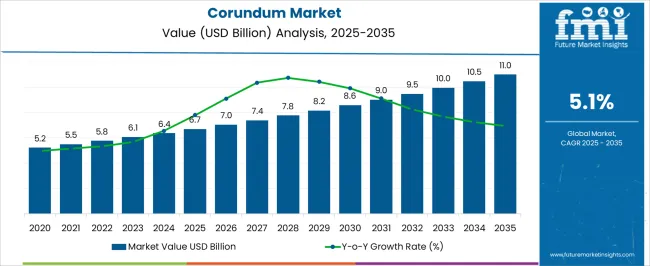
The corundum market was valued at USD 6.70 billion in 2025. Based on Future Market Insights' analysis, demand is estimated to reach USD 7.04 billion in 2026 and USD 11.58 billion by 2036. FMI projects a CAGR of 5.1% during the forecast period. The incremental opportunity from 2026 to 2036 stands at USD 4.54 billion. Sapphire holds 48.3% of demand by type in 2026, while abrasive applications account for 29.5% of consumption, as per FMI. Corundum is a crystalline form of aluminium oxide (Al2O3) that ranks 9 on the Mohs hardness scale, making it the second hardest natural mineral after diamond and a critical input for abrasive, refractory, and electronic substrate manufacturing.
Summary of Corundum Market
- Growth is pegged at a 5.1% CAGR over the 2026 to 2036 forecast window.
- As of 2025, the market was valued at USD 6.70 billion.
- Cumulative incremental value across the forecast stands at USD 4.54 billion.
- Sapphire leads by Type with 48.3% share in 2026.
- Abrasive leads by Application with 29.5% share in 2026.
- The market is a speciality mineral category bifurcated between natural gemstone extraction and synthetic production for industrial abrasive, refractory, and electronic substrate applications, where volume growth tracks steel production cycles, LED manufacturing expansion, and defence optics procurement.
- Among key countries, India at 6.8%, China at 6.3%, USA at 4.5%, Canada at 4.2%, UK at 3.9%, Germany at 3.7%, Japan at 3.4% CAGR respectively.
FMI analysts observe that the corundum market is bifurcated between natural corundum extraction for gemstone applications and synthetic corundum production for industrial use. Synthetic sapphire wafers are the fastest-growing demand segment, driven by LED substrate requirements, semiconductor insulating layers, and optical window applications in consumer electronics. Abrasive-grade corundum sustains the largest volume share because aluminium oxide grains are the default abrasive medium for grinding wheels, sandpaper, and blasting operations across metalworking, automotive, and construction industries. Refractory-grade corundum consumption is tied to steel and glass furnace lining replacement cycles, creating a stable baseline demand independent of new capacity construction.
India leads at 6.8% CAGR, driven by the expansion of steel and automotive manufacturing requiring abrasive and refractory-grade corundum supply. China follows at 6.3%, supported by domestic synthetic sapphire production capacity serving the LED and semiconductor industries. The United States registers 4.5% growth, anchored by defence optics procurement and industrial abrasive consumption. Canada tracks at 4.2%, the United Kingdom at 3.9%, Germany at 3.7%, and Japan at 3.4%, where mature industrial economies sustain consumption through refractory replacement cycles and precision abrasive applications.
Corundum Market Key Takeaways
| Metric | Details |
|---|---|
| Industry Size (2026) | USD 7.04 billion |
| Industry Value (2036) | USD 11.58 billion |
| CAGR (2026-2036) | 5.1% |
Source: Future Market Insights, 2026
Corundum Market Definition
Corundum is a crystalline form of aluminium oxide (Al2O3) occurring naturally as sapphire and ruby gemstones, and produced synthetically for industrial applications. The mineral's exceptional hardness, thermal stability, and chemical inertness make it a critical input for abrasive manufacturing, refractory linings, electronic substrates, and gemstone jewellery. End-use applications span abrasive products, jewellery, refractory materials, mineral processing, and electrical and electronics.
Corundum Market Inclusions
Market scope covers global and regional market sizes for corundum from 2026 to 2036. Segmentation spans type (sapphire, emery, ruby) and application (abrasive, jewellery, refractory, mineral, electrical and electronics, other applications). The analysis includes production capacity mapping, synthetic versus natural supply dynamics, and pricing trend assessments.
Corundum Market Exclusions
The scope excludes synthetic diamond abrasives and cubic boron nitride superabrasives. Aluminium metal and non-crystalline aluminium oxide powders are omitted. Downstream finished abrasive products (grinding wheels, sandpaper) are tracked at the material input level only.
Corundum Market Research Methodology
- Primary Research: Analysts engaged with procurement specialists, plant operators, and technology leads to map decision gates triggering purchases and upgrades.
- Desk Research: Data collection aggregated regulatory filings, government records, industry association publications, and company financial disclosures.
- Market-Sizing and Forecasting: Baseline values derive from bottom-up aggregation of shipment and consumption records, applying region-specific adoption curves.
- Data Validation and Update Cycle: Projections are tested against publicly reported guidance and cross-referenced with government statistical data.
Why is the Corundum Market Growing?
The corundum market is witnessing steady growth, supported by its critical applications in industrial and technological processes where high hardness, thermal stability, and chemical resistance are required. Increasing adoption of advanced materials for abrasives, cutting tools, electronics, and optical components is driving demand for high-purity corundum varieties. The market is further influenced by growth in sectors such as automotive, aerospace, construction, and electronics, which require durable materials capable of withstanding extreme conditions.
Innovations in processing technologies are enhancing the quality, uniformity, and performance of corundum products, enabling their integration into precision applications. Rising industrialization in emerging economies and growing investments in manufacturing infrastructure are contributing to increasing demand for corundum-based materials.
As manufacturers focus on improving product efficiency, reducing wear and maintenance costs, and supporting environmentally compliant production processes, the market is expected to experience sustained expansion Continuous development in synthetic corundum production and the increasing preference for high-purity grades for technical applications are also expected to reinforce long-term growth opportunities across global markets.
Segmental Analysis
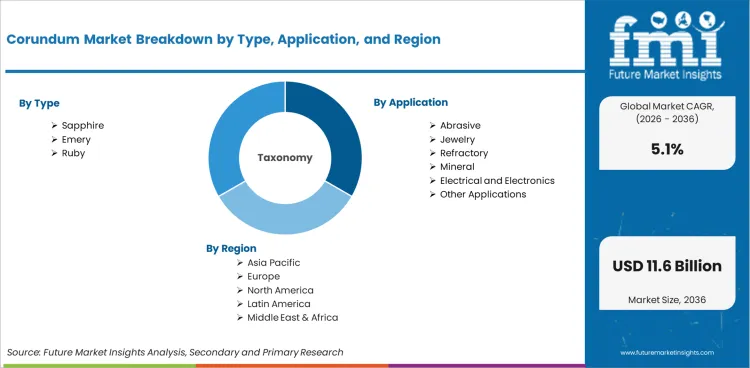
The corundum market is segmented by type, application, and geographic regions. By type, corundum market is divided into Sapphire, Emery, and Ruby. In terms of application, corundum market is classified into Abrasive, Jewelry, Refractory, Mineral, Electrical and Electronics, and Other Applications (Cutting Tools, Medical, and Others). Regionally, the corundum industry is classified into North America, Latin America, Western Europe, Eastern Europe, Balkan & Baltic Countries, Russia & Belarus, Central Asia, East Asia, South Asia & Pacific, and the Middle East & Africa.
Insights into the Sapphire Type Segment
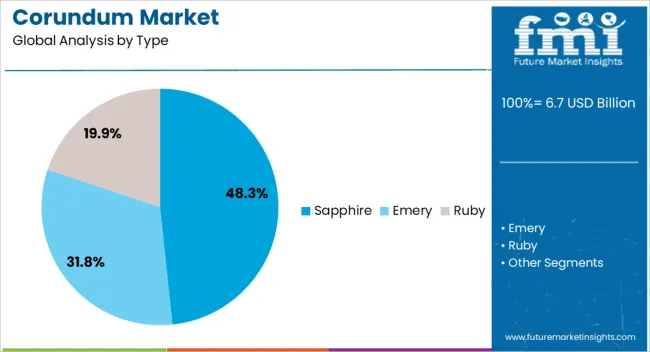
The sapphire type segment is projected to hold 48.3% of the corundum market revenue share in 2026, making it the leading product type. This dominance is being driven by its exceptional hardness, chemical stability, and optical clarity, which make it suitable for a wide range of high-performance industrial applications. The synthetic sapphire production process has enabled cost-effective scaling while maintaining consistent quality, supporting its growing adoption in electronics, optics, and precision engineering applications.
Its mechanical and thermal properties enhance wear resistance, extend product life, and reduce operational maintenance requirements, which is particularly critical in abrasive and high-precision applications. The segment’s performance in both conventional and advanced manufacturing processes has positioned it as the preferred material for industries seeking durability and efficiency.
Rising investments in sectors such as semiconductors, automotive, and electronics are also encouraging the integration of sapphire-based corundum, reinforcing its market leadership Additionally, the ability to produce customized grades tailored to specific technical requirements has strengthened its position as the dominant type segment globally.
Insights into the Abrasive Application Segment
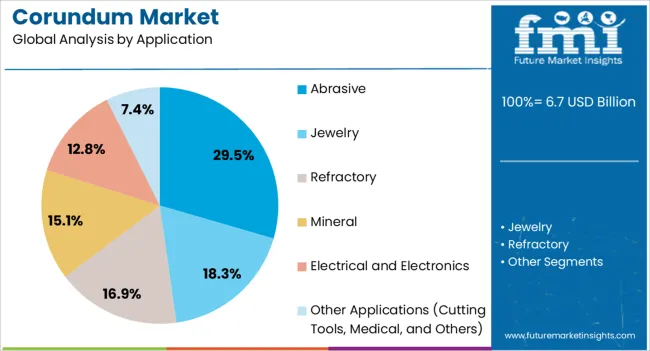
The abrasive application segment is expected to account for 29.5% of the corundum market revenue share in 2026, establishing itself as the leading application. This leadership is being reinforced by the increasing need for high-performance grinding, cutting, polishing, and finishing solutions across industries. Corundum’s exceptional hardness and durability allow it to deliver superior abrasion resistance, reduce tool wear, and enhance productivity in manufacturing and processing operations.
Demand growth is being driven by expanding industrialization in emerging markets, where high-quality abrasives are critical for maintaining production efficiency and ensuring product quality. The adoption of automated and precision machinery has further emphasized the importance of reliable abrasive materials that can sustain high loads and rotational speeds.
Corundum abrasives are also being preferred for eco-friendly production methods as they enable longer tool life and lower material waste Continuous improvements in synthetic corundum production and quality control are enhancing consistency and performance, further supporting the segment’s market share and reinforcing its leading position in the global corundum market.
Market Overview
Corundum Market Overview
Based on its chemical composition, corundum is nothing but aluminum oxide. When it is synthesized through various processes, For industrial applications, artificial corundum is manufactured synthetically with a small addition of colouring agents, which is later left for cooling and solidification.
This entire process of manufacturing artificial corundum is known as the Verneuil Process.
Corundum is a highly stable and hard mineral; second hardest mineral available in the world after diamond. Corundum can be made available in a variety of colours. The most commonly preferred types of corundum are Padparadscha (Pink and orange variety of Sapphire), Emery (Black), Star Ruby, Ruby (Pink or red), Blue Sapphire, Star Sapphire, and Green Sapphire.
Growing Applications of Artificial Corundum as Precious Stones to Drive the Market
While corundum is commonly used in a large variety of applications, its sales in the jewellery industry as precious stones account for a significant share in the global corundum market.
Corundum minerals are used in the manufacturing of various gemstones, and are emerging as among the gemstones that are highest in demand, after diamonds. This is among the biggest driving forces for the global market for corundum.
As mentioned earlier, the demand for corundum is not only high across the popular segments such as Blue Sapphires and Red Rubies, but rare gemstones such as padparadscha are also witnessing significantly high demand across the jewellery industry, mainly for their uncommon and unique colour.
This creates a great potential for leading stakeholders in the corundum market across the jewellery and precious stones industries.
Furthermore, non-gemstones manufactured using corundum are commonly used in various industrial applications, contributing to the growth of the global corundum market. For instance, Black Emery finds applications as an abrasive, which is mainly attributed to its natural hardness.
Brown corundum is also witnessing high demand as a deburring agent in various applications such as grinding, sand blasting, and plunge cutting, owing to its ability to smoothen and soften ragged edges.
Though it is not as hard as brown corundum, white corundum is used in abrasion applications, such as polishing glass, where high speed is required without producing more heat during friction. It is also used as a sharpening agent for cutting tools, in vitrified grinding wheels, as well as in the manufacturing of precision milling equipment that are used in similar applications.
Consequently, though the corundum market is mainly driven by its demand in the jewellery industry, its growing significance in industrial abrasion applications will also contribute to the growth of the market in the coming years.
Price Fluctuations of Jewellery-grade Corundum may Inhibit Exponential Growth of the Market
While the global market for corundum continues to witness positive growth due to its burgeoning demand as precious stones, the constant fluctuations in the prices of jewellery-grade corundum create roadblocks for market players in the industry. This is mainly attributed to the fluctuating demand and the dynamics of consumer markets.
Sapphires made from corundum, especially the ones in a colour other than red or blue, are highly volatile as consumer demand is unpredictable and highly dynamic. Thereby, this triggers constant fluctuations in the prices of fancy sapphire, and restricts market players from introducing stability in the prices of corundum.
In addition to this, another factor that impacts the prices of corundum is the political instability in some African countries such as the Republic of Madagascar. Such geopolitical factors often lead to unpredictable restrictions on the export of precious stones that are manufactured using corundum.
This ultimately contributes to the disruptions in the demand supply chain, which has a direct impact on the prices of corundum in the international markets. In the coming years, this may emerge as a hindrance for the growth of the corundum market.
The global market is moderately consolidated as the top 5 stakeholders have established a stronghold with the global footprint of their businesses.
- Henge Group
- Rau GmbH & Co. KG
- Swarovski Gemstones
- Mineralmühle Leun
- K.A. Refractories Co. Ltd.
- Zibo Jinjiyuan Abrasives Co.,Ltd
- Alteo Alumina
- Riken corundum Co. Ltd.
Region-wise Analysis
- North America (USA, Canada)
- Latin America (Mexico, Brazil)
- Europe (Germany, UK, France, Italy, Spain, Poland, Russia)
- East Asia (China, Japan, South Korea)
- South Asia (India, Thailand, Malaysia, Vietnam, Indonesia)
- Oceania (Australia, New Zealand)
- Middle East & Africa (GCC Countries, Turkey, Northern Africa, South Africa)
Analysis of Corundum Market By Key Countries
.webp "Top Country Growth Comparison Corundum Market Cagr (2026 2036)")
| Country | CAGR |
|---|---|
| China | 6.9% |
| India | 6.4% |
| Germany | 5.9% |
| France | 5.4% |
| UK | 4.8% |
| USA | 4.3% |
| Brazil | 3.8% |
Source: FMI analysis based on primary research and proprietary forecasting model
Country-wise Analysis
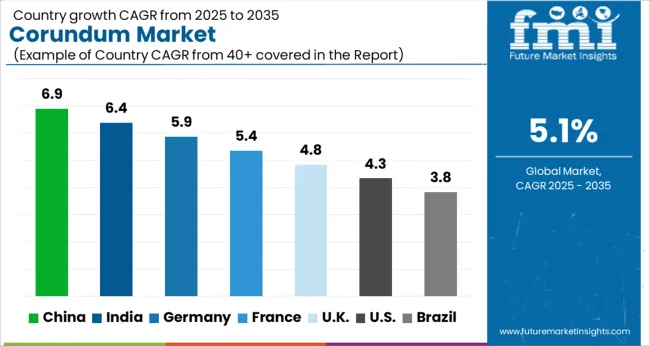
The Corundum Market is expected to register a CAGR of 5.1% during the forecast period, exhibiting varied country level momentum. China leads with the highest CAGR of 6.9%, followed by India at 6.4%. Developed markets such as Germany, France, and the UK continue to expand steadily, while the USA is likely to grow at consistent rates. Brazil posts the lowest CAGR at 3.8%, yet still underscores a broadly positive trajectory for the global Corundum Market. In 2024, Germany held a dominant revenue in the Western Europe market and is expected to grow with a CAGR of 5.9%. The USA Corundum Market is estimated to be valued at USD 2.5 billion in 2026 and is anticipated to reach a valuation of USD 3.9 billion by 2036. Sales are projected to rise at a CAGR of 4.3% over the forecast period between 2026 and 2036. While Japan and South Korea markets are estimated to be valued at USD 367.5 million and USD 230.2 million respectively in 2026.
Key Players in the Corundum Market
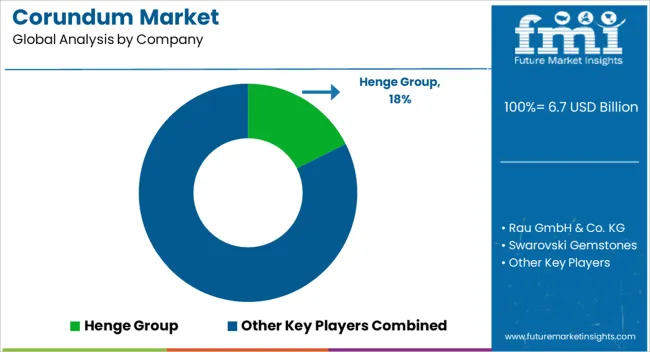
- Henge Group
- Rau GmbH & Co. KG
- Swarovski Gemstones
- Mineralmühle Leun
- K.A. Refractories Co. Ltd.
- Zibo Jinjiyuan Abrasives Co.,Ltd
- Alteo Alumina
- Riken corundum Co. Ltd.
Scope of the Report
| Metric | Value |
|---|---|
| Quantitative Units | USD 7.04 billion to USD 11.58 billion, at a CAGR of 5.1% |
| Market Definition | Corundum is a crystalline form of aluminium oxide (Al2O3) occurring naturally as sapphire and ruby gemstones, and produced synthetically for industrial applications. The mineral's exceptional hardness, thermal stability, and chemical inertness make it a critical input for abrasive manufacturing, refractory linings, electronic substrates, and gemstone jewellery. |
| Type Segmentation | Sapphire, Emery, Ruby |
| Application Segmentation | Abrasive, Jewelry, Refractory, Mineral, Electrical and Electronics, Other Applications |
| Regions Covered | North America, Latin America, Europe, East Asia, South Asia, Oceania, Middle East & Africa |
| Countries Covered | India, China, USA, Canada, UK, Germany, Japan, and 40 plus countries |
| Key Companies Profiled | Henge Group, Rau GmbH & Co. KG, Swarovski Gemstones, Mineralmuhle Leun, K.A. Refractories Co. Ltd., Zibo Jinjiyuan Abrasives Co., Ltd, Alteo Alumina, Riken Corundum Co. Ltd. |
| Forecast Period | 2026 to 2036 |
| Approach | Forecasting models apply a bottom-up methodology starting with installed base metrics and projecting adoption rates using region-specific demand curves. |
Corundum Market by Segments
By Type:
- Sapphire
- Emery
- Ruby
ByApplication:
- Abrasive
- Jewelry
- Refractory
- Mineral
- Electrical and Electronics
- Other Applications (Cutting Tools, Medical, and Others)
By Region:
- North America
- USA
- Canada
- Mexico
- Latin America
- Brazil
- Chile
- Rest of Latin America
- Western Europe
- Germany
- UK
- Italy
- Spain
- France
- Nordic
- BENELUX
- Rest of Western Europe
- Eastern Europe
- Russia
- Poland
- Hungary
- Balkan & Baltic
- Rest of Eastern Europe
- East Asia
- China
- Japan
- South Korea
- South Asia and Pacific
- India
- ASEAN
- Australia & New Zealand
- Rest of South Asia and Pacific
- Middle East & Africa
- Kingdom of Saudi Arabia
- Other GCC Countries
- Turkiye
- South Africa
- Other African Union
- Rest of Middle East & Africa
Bibliography
- 1. United States Geological Survey. (2025). Mineral Commodity Summaries: Abrasives. USGS.
- 2. International Aluminium Institute. (2025). Alumina Production and Trade Statistics 2024. IAI.
- 3. Ministry of Mines, Government of India. (2025). Indian Minerals Yearbook 2024. Government of India.
- 4. European Commission. (2024). Critical Raw Materials Act: Implementation Report. European Commission.
- 5. International Organization for Standardization. (2024). ISO 8486: Bonded Abrasives, Grain Sizes. ISO.
This bibliography is provided for reader reference. The full Future Market Insights report contains the complete reference list with primary research documentation.
Frequently Asked Questions
How large is the demand for Corundum in the global market in 2026?
Demand for Corundum in the global market is estimated to be valued at USD 7.04 billion in 2026.
What will be the market size of Corundum by 2036?
Market size for Corundum is projected to reach USD 11.58 billion by 2036.
What is the expected demand growth between 2026 and 2036?
Demand for Corundum is expected to grow at a CAGR of 5.1% between 2026 and 2036.
Which Type is poised to lead global sales by 2026?
Sapphire accounts for 48.3% share in 2026.
How is Application structured in 2026?
Abrasive holds 29.5% of segment share in 2026.
What is driving demand in India?
India is projected to grow at a CAGR of 6.8% during 2026 to 2036.
What is Corundum and what is it mainly used for?
Corundum is a crystalline form of aluminium oxide (Al2O3) occurring naturally as sapphire and ruby gemstones, and produced synthetically for industrial applications. The mineral's exceptional hardness, thermal stability, and chemical inertness make it a critical input for abrasive manufacturing, refractory linings, electronic substrates, and gemstone jewellery.
What is included in the scope of this report?
Market scope covers global and regional market sizes for corundum from 2026 to 2036. Segmentation spans type (sapphire, emery, ruby) and application (abrasive, jewellery, refractory, mineral, electrical and electronics, other applications).
Preview the report firsthand - request a free sample
Get SampleGet the brochure for pricing and purchase details.
Get PDFTable of Content
- Executive Summary
- Global Market Outlook
- Demand-side Trends
- Supply-side Trends
- Analysis and Recommendations
- Market Overview
- Market Coverage / Taxonomy
- Market Definition / Scope / Limitations
- Research Methodology
- Chapter Orientation
- Analytical Lens and Working Hypotheses
- Market Structure, Signals, and Trend Drivers
- Research Design and Evidence Framework
- Desk Research Programme (Secondary Evidence)
- Company Annual and Sustainability Reports
- Peer-reviewed Journals and Academic Literature
- Corporate Websites, Product Literature, and Technical Notes
- Earnings Decks and Investor Briefings
- Statutory Filings and Regulatory Disclosures
- Technical White Papers and Standards Notes
- Trade Journals, Industry Magazines, and Analyst Briefs
- Conference Proceedings, Webinars, and Seminar Materials
- Government Statistics Portals and Public Data Releases
- Press Releases and Reputable Media Coverage
- Specialist Newsletters and Curated Briefings
- Sector Databases and Reference Repositories
- FMI Internal Proprietary Databases and Historical Market Datasets
- Subscription Datasets and Paid Sources
- Social Channels, Communities, and Digital Listening Inputs
- Additional Desk Sources
- Expert Input and Fieldwork (Primary Evidence)
- Primary Modes
- Qualitative Interviews and Expert Elicitation
- Quantitative Surveys and Structured Data Capture
- Blended Approach
- Why Primary Evidence is Used
- Field Techniques
- Interviews
- Surveys
- Focus Groups
- Observational and In-context Research
- Social and Community Interactions
- Stakeholder Universe Engaged
- C-suite Leaders
- Board Members
- Presidents and Vice Presidents
- R&D and Innovation Heads
- Technical Specialists
- Domain Subject-matter Experts
- Scientists
- Physicians and Other Healthcare Professionals
- Governance, Ethics, and Data Stewardship
- Research Ethics
- Data Integrity and Handling
- Primary Modes
- Tooling, Models, and Reference Databases
- Desk Research Programme (Secondary Evidence)
- Data Engineering and Model Build
- Data Acquisition and Ingestion
- Cleaning, Normalisation, and Verification
- Synthesis, Triangulation, and Analysis
- Quality Assurance and Audit Trail
- Market Background
- Market Dynamics
- Drivers
- Restraints
- Opportunity
- Trends
- Scenario Forecast
- Demand in Optimistic Scenario
- Demand in Likely Scenario
- Demand in Conservative Scenario
- Opportunity Map Analysis
- Product Life Cycle Analysis
- Supply Chain Analysis
- Investment Feasibility Matrix
- Value Chain Analysis
- PESTLE and Porter’s Analysis
- Regulatory Landscape
- Regional Parent Market Outlook
- Production and Consumption Statistics
- Import and Export Statistics
- Market Dynamics
- Global Market Analysis 2021 to 2025 and Forecast, 2026 to 2036
- Historical Market Size Value (USD Million) Analysis, 2021 to 2025
- Current and Future Market Size Value (USD Million) Projections, 2026 to 2036
- Y-o-Y Growth Trend Analysis
- Absolute $ Opportunity Analysis
- Global Market Pricing Analysis 2021 to 2025 and Forecast 2026 to 2036
- Global Market Analysis 2021 to 2025 and Forecast 2026 to 2036, By Type
- Introduction / Key Findings
- Historical Market Size Value (USD Million) Analysis By Type , 2021 to 2025
- Current and Future Market Size Value (USD Million) Analysis and Forecast By Type , 2026 to 2036
- Sapphire
- Emery
- Ruby
- Sapphire
- Y-o-Y Growth Trend Analysis By Type , 2021 to 2025
- Absolute $ Opportunity Analysis By Type , 2026 to 2036
- Global Market Analysis 2021 to 2025 and Forecast 2026 to 2036, By Application
- Introduction / Key Findings
- Historical Market Size Value (USD Million) Analysis By Application, 2021 to 2025
- Current and Future Market Size Value (USD Million) Analysis and Forecast By Application, 2026 to 2036
- Abrasive
- Jewelry
- Refractory
- Mineral
- Electrical and Electronics
- Other Applications
- Abrasive
- Y-o-Y Growth Trend Analysis By Application, 2021 to 2025
- Absolute $ Opportunity Analysis By Application, 2026 to 2036
- Global Market Analysis 2021 to 2025 and Forecast 2026 to 2036, By Region
- Introduction
- Historical Market Size Value (USD Million) Analysis By Region, 2021 to 2025
- Current Market Size Value (USD Million) Analysis and Forecast By Region, 2026 to 2036
- North America
- Latin America
- Western Europe
- Eastern Europe
- East Asia
- South Asia and Pacific
- Middle East & Africa
- Market Attractiveness Analysis By Region
- North America Market Analysis 2021 to 2025 and Forecast 2026 to 2036, By Country
- Historical Market Size Value (USD Million) Trend Analysis By Market Taxonomy, 2021 to 2025
- Market Size Value (USD Million) Forecast By Market Taxonomy, 2026 to 2036
- By Country
- USA
- Canada
- Mexico
- By Type
- By Application
- By Country
- Market Attractiveness Analysis
- By Country
- By Type
- By Application
- Key Takeaways
- Latin America Market Analysis 2021 to 2025 and Forecast 2026 to 2036, By Country
- Historical Market Size Value (USD Million) Trend Analysis By Market Taxonomy, 2021 to 2025
- Market Size Value (USD Million) Forecast By Market Taxonomy, 2026 to 2036
- By Country
- Brazil
- Chile
- Rest of Latin America
- By Type
- By Application
- By Country
- Market Attractiveness Analysis
- By Country
- By Type
- By Application
- Key Takeaways
- Western Europe Market Analysis 2021 to 2025 and Forecast 2026 to 2036, By Country
- Historical Market Size Value (USD Million) Trend Analysis By Market Taxonomy, 2021 to 2025
- Market Size Value (USD Million) Forecast By Market Taxonomy, 2026 to 2036
- By Country
- Germany
- UK
- Italy
- Spain
- France
- Nordic
- BENELUX
- Rest of Western Europe
- By Type
- By Application
- By Country
- Market Attractiveness Analysis
- By Country
- By Type
- By Application
- Key Takeaways
- Eastern Europe Market Analysis 2021 to 2025 and Forecast 2026 to 2036, By Country
- Historical Market Size Value (USD Million) Trend Analysis By Market Taxonomy, 2021 to 2025
- Market Size Value (USD Million) Forecast By Market Taxonomy, 2026 to 2036
- By Country
- Russia
- Poland
- Hungary
- Balkan & Baltic
- Rest of Eastern Europe
- By Type
- By Application
- By Country
- Market Attractiveness Analysis
- By Country
- By Type
- By Application
- Key Takeaways
- East Asia Market Analysis 2021 to 2025 and Forecast 2026 to 2036, By Country
- Historical Market Size Value (USD Million) Trend Analysis By Market Taxonomy, 2021 to 2025
- Market Size Value (USD Million) Forecast By Market Taxonomy, 2026 to 2036
- By Country
- China
- Japan
- South Korea
- By Type
- By Application
- By Country
- Market Attractiveness Analysis
- By Country
- By Type
- By Application
- Key Takeaways
- South Asia and Pacific Market Analysis 2021 to 2025 and Forecast 2026 to 2036, By Country
- Historical Market Size Value (USD Million) Trend Analysis By Market Taxonomy, 2021 to 2025
- Market Size Value (USD Million) Forecast By Market Taxonomy, 2026 to 2036
- By Country
- India
- ASEAN
- Australia & New Zealand
- Rest of South Asia and Pacific
- By Type
- By Application
- By Country
- Market Attractiveness Analysis
- By Country
- By Type
- By Application
- Key Takeaways
- Middle East & Africa Market Analysis 2021 to 2025 and Forecast 2026 to 2036, By Country
- Historical Market Size Value (USD Million) Trend Analysis By Market Taxonomy, 2021 to 2025
- Market Size Value (USD Million) Forecast By Market Taxonomy, 2026 to 2036
- By Country
- Kingdom of Saudi Arabia
- Other GCC Countries
- Turkiye
- South Africa
- Other African Union
- Rest of Middle East & Africa
- By Type
- By Application
- By Country
- Market Attractiveness Analysis
- By Country
- By Type
- By Application
- Key Takeaways
- Key Countries Market Analysis
- USA
- Pricing Analysis
- Market Share Analysis, 2025
- By Type
- By Application
- Canada
- Pricing Analysis
- Market Share Analysis, 2025
- By Type
- By Application
- Mexico
- Pricing Analysis
- Market Share Analysis, 2025
- By Type
- By Application
- Brazil
- Pricing Analysis
- Market Share Analysis, 2025
- By Type
- By Application
- Chile
- Pricing Analysis
- Market Share Analysis, 2025
- By Type
- By Application
- Germany
- Pricing Analysis
- Market Share Analysis, 2025
- By Type
- By Application
- UK
- Pricing Analysis
- Market Share Analysis, 2025
- By Type
- By Application
- Italy
- Pricing Analysis
- Market Share Analysis, 2025
- By Type
- By Application
- Spain
- Pricing Analysis
- Market Share Analysis, 2025
- By Type
- By Application
- France
- Pricing Analysis
- Market Share Analysis, 2025
- By Type
- By Application
- India
- Pricing Analysis
- Market Share Analysis, 2025
- By Type
- By Application
- ASEAN
- Pricing Analysis
- Market Share Analysis, 2025
- By Type
- By Application
- Australia & New Zealand
- Pricing Analysis
- Market Share Analysis, 2025
- By Type
- By Application
- China
- Pricing Analysis
- Market Share Analysis, 2025
- By Type
- By Application
- Japan
- Pricing Analysis
- Market Share Analysis, 2025
- By Type
- By Application
- South Korea
- Pricing Analysis
- Market Share Analysis, 2025
- By Type
- By Application
- Russia
- Pricing Analysis
- Market Share Analysis, 2025
- By Type
- By Application
- Poland
- Pricing Analysis
- Market Share Analysis, 2025
- By Type
- By Application
- Hungary
- Pricing Analysis
- Market Share Analysis, 2025
- By Type
- By Application
- Kingdom of Saudi Arabia
- Pricing Analysis
- Market Share Analysis, 2025
- By Type
- By Application
- Turkiye
- Pricing Analysis
- Market Share Analysis, 2025
- By Type
- By Application
- South Africa
- Pricing Analysis
- Market Share Analysis, 2025
- By Type
- By Application
- USA
- Market Structure Analysis
- Competition Dashboard
- Competition Benchmarking
- Market Share Analysis of Top Players
- By Regional
- By Type
- By Application
- Competition Analysis
- Competition Deep Dive
- Henge Group
- Overview
- Product Portfolio
- Profitability by Market Segments (Product/Age /Sales Channel/Region)
- Sales Footprint
- Strategy Overview
- Marketing Strategy
- Product Strategy
- Channel Strategy
- Rau GmbH & Co. KG
- Swarovski Gemstones
- Mineralmühle Leun
- K.A. Refractories Co. Ltd.
- Zibo Jinjiyuan Abrasives Co.,Ltd
- Alteo Alumina
- Riken corundum Co. Ltd.
- Henge Group
- Competition Deep Dive
- Assumptions & Acronyms Used


