
- Market Size (2026)
- USD 378.7 Mn
- Forecast (2036)
- USD 504.0 Mn
- CAGR (2026 to 2036)
- 2.9%
How big is Glazes Market in 2026?
Assessed at USD 368.5 million in 2025 and progressing to USD 378.7 million in 2026, the glazes market valuation is on course to reach USD 504.0 million by 2036, supported by a forecast-period CAGR of 2.9%.
Visual shelf appeal in chilled patisserie cases and labor-saving automation on high-speed viennoiserie lines drive ingredient purchasing across the glazes market. Wholesale bakeries and supermarket in-store counters buy specialized glazes not merely as decorative sugar toppings but as functional moisture barriers that stop fruit tarts from shriveling and replace Salmonella-prone liquid egg wash on croissants. Chocolate and Dark Cocoa Glazes capture 27.6% of 2026 product type demand because indulgent dark mirror coatings and compound ganaches command higher unit prices with bakery glazing agents.
Per a September 2025 study in Gels on pectin-based nanoemulsion coatings, protective hydrocolloid fruit glazes restricted moisture weight loss to 7.50% across 18 days of chilled storage at 7 degrees Celsius. At the iba 2025 trade fair in May 2025, Puratos introduced new UHT plant-based glazing and patisserie finishing systems engineered for automated bakery lines. As documented in FMI research, volatile cocoa butter and fruit puree costs along with syneresis weeping during freeze-thaw distribution remain the primary commercial restraints on operating margins.
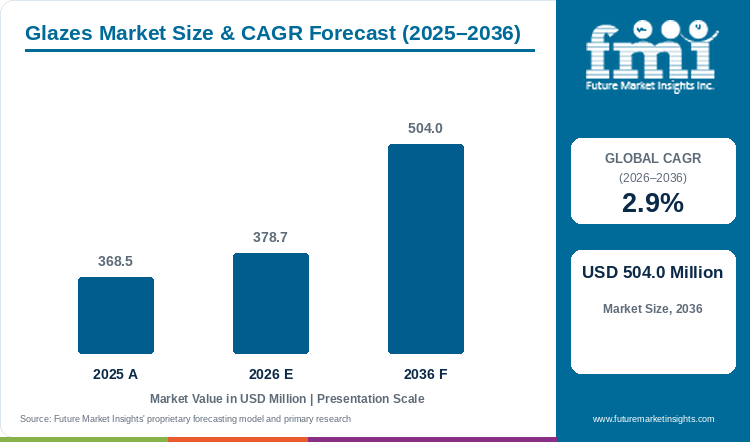
Key Market Trends & Insights
- By product type: Chocolate and Dark Cocoa Glazes hold an estimated 27.6% share in 2026 since pre-crystallized cocoa-fat dispersions provide mirror shine and clean knife slicing on refrigerated mousse cakes.
- By base formulation: Pectin-Based Gelling Glazes represent 36.4% in 2026 because amidated low-methoxyl citrus and apple pectins gel rapidly upon cooling while satisfying vegan and halal label charters.
- By application: Cakes Tortes and Fine Patisserie account for 40.1% in 2026 as supermarket in-store bakeries and artisan patisseries rely on high-gloss coatings to prevent fruit oxidation and sponge drying.
- By end-user sector: Industrial Commercial Bakeries secure 52.2% in 2026 owing to continuous rotary-disc and ultrasonic spray applicators that coat thousands of pastries and donuts per hour.
- By processing format: Ready-to-Use Cold Process Glazes command 56.5% in 2026 through zero-dilution thixotropic rheology that eliminates water-dosing errors and heating energy in commissary kitchens.
Regional Highlights
- Top national expansion: Brazil leads national growth projections at a 3.3% CAGR through 2036 under rapid supermarket padaria modernization and tropical fruit glaze adoption.
- Broader country progression: France tracks at a 3.1% CAGR ahead of the United Kingdom at 3.0% and the United States at 2.8%, where frozen bake-off viennoiserie and iced donut chains expand automated glazing.
Market Size & Forecast
Table 1: Market Size and Forecast for the Glazes Market (USD million and CAGR percentage), 2025 to 2036
| Metric | Value |
|---|---|
| 2025 Market Size | USD 368.5 million |
| Estimated Market Size in 2026 | USD 378.7 million |
| Projected Market Size by 2036 | USD 504.0 million |
| CAGR, 2026 to 2036 | 2.9% |
| Added Value, 2026 to 2036 | USD 125.3 million |
Commercial patisserie kitchens and frozen bake-off plants lose substantial retail value when poorly buffered glazes slide off vertical cake walls or bleed water into crisp pastry shells. Traditional scratch-boiled apricot jams require skilled pastry labor and frequently scorch or crystallize inside open kettles. According to a November 2025 study in Foods on pectin and gelatin confectionery gels, hydrocolloid gel matrices processed at 85 degrees Celsius and 85 degrees Brix maintain cohesive elasticity and protect natural bioactive pigments. Production managers therefore standardize on pre-buffered surface coating agents that spray cleanly through heated airless nozzles at 70 to 80 degrees Celsius.
Coated Bakery Tonnage and Glaze Application Sizing
Table 2: Coated Bakery Tonnage and Glaze Application Sizing for the Glazes Market (USD million and operational ranges), 2025 to 2036
| Metric | 2025 | 2026 | 2036 |
|---|---|---|---|
| Market size (USD million) | 368.5 | 378.7 | 504.0 |
| Coated commercial bakery & patisserie goods (million metric tons) | 1.82 to 2.05 | 1.87 to 2.11 | 2.48 to 2.79 |
| Finished bakery glaze & UHT shine volume (thousand metric tons) | 118.0 to 132.0 | 121.0 to 135.5 | 158.0 to 176.5 |
| Average formulated glaze price per metric ton (USD) | 2,790 to 3,120 | 2,800 to 3,130 | 2,855 to 3,190 |
Frozen dough and par-baked pastry manufacturers need specialized hydrocolloid and lipid rheology so surface coatings survive minus-40-degree-Celsius blast freezing without cracking. Standard high-water sugar icings form sharp ice crystals that puncture starch networks and turn gray or sticky once thawed at grocery bake-off counters. According to a March 2026 Food Chemistry investigation into baked-good emulsion gels, hydrocolloid-protein networks formulated at a 7 to 3 oil-to-water ratio achieved 89.5% oil-holding capacity and extended product shelf life by 1.6 to 1.9 times. Bakeries specifying high-methoxyl citrus pectin avoid post-thaw syneresis and preserve mirror gloss across multi-day chilled display.
Per Capita & Commercial Glazing Line Sizing
Table 3: Per Capita and Bakery Glazing Line Allocation Indicators for the Glazes Market (USD), 2025 to 2036
| Metric | 2025 | 2026 | 2036 |
|---|---|---|---|
| World population (million) | 8,200 | 8,300 | 9,000 |
| Market value per 1,000 people (USD) | 44.9 | 45.6 | 56.0 |
| Annual procurement per automated glazing line (USD thousand) | 19.8 to 22.8 | 20.2 to 23.3 | 26.1 to 30.1 |
| Vegan pectin & UHT egg-free glaze share (%) | 58.0% to 62.0% | 60.0% to 64.0% | 73.0% to 77.0% |
Table 4: Industrial Bakery & Channel Allocation Indicators for the Glazes Market (USD and percentages), 2026
| Metric | Value | Institutional Reference Basis |
|---|---|---|
| Market size, 2026 | USD 378.7 million | 2026 global valuation baseline |
| Commercial bakery & patisserie glazing lines global | 17,400 lines | Viennoiserie spray, cake mirror & donut waterfall lines |
| Annual glaze allocation per bakery line | USD 21,764.4 | Annualized glaze & UHT shine procurement |
| Industrial Commercial Bakeries value, 2026 | USD 197.7 million | 52.2% end-user sector allocation |
Analyst Perspective
"Commercial bakeries and supermarket patisserie commissaries do not buy glazes as decorative sugar syrups. They buy five-day moisture retention and freeze-thaw film stability with zero egg-allergen sanitation downtime, where spray-ready cold-process pectin and UHT vegan shine systems win automated viennoiserie and cake accounts."
- Nandini Roy Choudhury, Principal Consultant, Future Market Insights.
How is the Glazes Market segmented?
The glazes market is segmented by product type and base formulation with application, end-user sector, and processing format.
By product type: Chocolate and Dark Cocoa Glazes and Neutral Transparent Mirror Glazes, plus Fruit-Flavored Glazes Strawberry Apricot and Sugar and Icing Donut Glazes with Fat-Based White Glazes.
By base formulation: Pectin-Based Gelling Glazes and Gelatin-Based High-Gloss Glazes, plus Modified Starch-Based Glazes and Vegetable Fat-Based Coatings.
By application: Cakes Tortes and Fine Patisserie and Donuts and Morning Goods, plus Artisan Breads and Danish Pastries and Confectionery and Chocolate Enrobing.
By end-user sector: Industrial Commercial Bakeries and Artisan Patisseries and Bakery Chains, plus Foodservice HoReCa and Hotel Kitchens and In-Store Supermarket Bakeries.
By processing format: Ready-to-Use Cold Process Glazes and Hot-Process Sprayable Glazes, plus Dry Powdered Glaze Premixes and Concentrated UHT Liquid Glazes.
Why do Chocolate and Dark Cocoa Glazes lead the product type category?
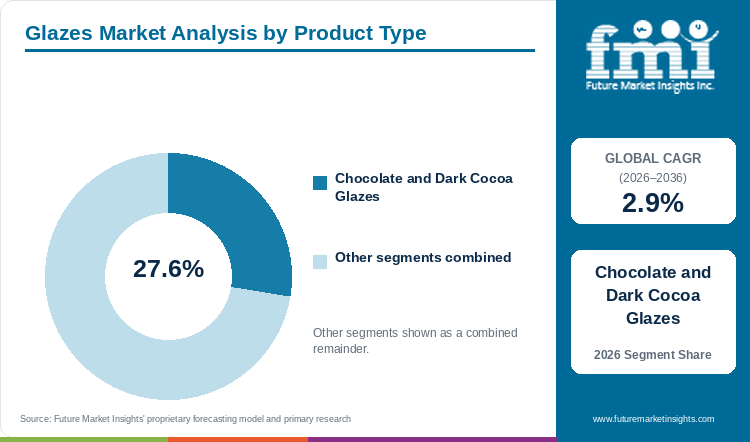
Chocolate and Dark Cocoa Glazes hold an estimated 27.6% of product type demand in 2026, anchored by premium cocoa solids and cut-stable mirror finishes on chilled cakes.
Table 5: Product Type Share for the Glazes Market (percentage share), 2026
| Product Type | Share (2026) |
|---|---|
| Chocolate and Dark Cocoa Glazes | 27.6% |
| Other Segments Combined | 72.4%* |
| Total | 100.0% |
Table 6: Product Type Leadership and Market Growth for the Glazes Market (segment and CAGR percentage), 2026 to 2036
| Metric | Value |
|---|---|
| Global CAGR (2026 to 2036) | 2.9% |
| Leading Segment | Chocolate and Dark Cocoa Glazes |
Chocolate and Dark Cocoa Glazes lead product value because higher raw cocoa solids and specialty vegetable or cocoa-butter fats carry a structural unit-price premium over clear sugar-pectin nappage. Patisserie chefs and industrial cake lines rely on soft-slicing dark cocoa mirror glazes paired with domestic fruit pectin hydrocolloids to coat entremets and celebration tortes without brittle shell cracking.
- Chocolate and Dark Cocoa Glazes hold 27.6% of product type value in 2026 as indulgent dark-cocoa visuals and elevated cocoa ingredient costs sustain value leadership.
- In May 2026, Puratos reported that 38.2% of its global cocoa volume was sourced through its Cacao-Trace fermentation program supporting 31,795 farmers while 37.3% of its fruit fillings and glazes came through Field to Fork.
What sustains Pectin-Based Gelling Glazes leadership in the base formulation segment?
Pectin-Based Gelling Glazes represent 36.4% of the base formulation category in 2026, supported by vegan label compliance and reversible sprayable rheology.
Amidated and high-methoxyl Pectin-Based Gelling Glazes form thermo-reversible transparent gels at pH 3.2 to 3.8 that set cleanly over fresh berries and laminated pastries without animal-derived ingredients. Unlike food-grade bloom gelatin, which requires kosher and vegetarian exemptions, citrus and apple pectin glazes satisfy universal clean-label retail specifications.
- Pectin-Based Gelling Glazes represent 36.4% of the base formulation segment in 2026 because sprayable shear-thinning pectin gels dominate automated pastry and fruit-tart finishing.
- Half-year financial disclosures from Tate and Lyle in November 2025 confirmed that combining CP Kelco citrus pectin and specialty gums broadened customer formulation wins across bakery fruit coatings.
How do Cakes Tortes and Fine Patisserie lead the application category?
Cakes Tortes and Fine Patisserie account for 40.1% of application volume in 2026, driven by thick mirror coating weights and showcase moisture protection.
Multi-layer mousse cakes and fruit flans plus chilled patisserie tortes require thick mirror or nappage coatings representing 8% to 15% of finished product weight to seal cut fruit and prevent sponge dehydration. High visual contrast in illuminated glass display counters makes high-gloss glazing essential for premium patisserie pricing with modified food starches.
- Cakes Tortes and Fine Patisserie account for 40.1% of application demand in 2026 because celebratory cakes and individual patisserie portions consume higher gram weights per unit than thin bread shines.
- In September 2025, food coating researchers reporting in Coatings demonstrated that cross-linked pectin and biopolymer confectionery coatings create high-gloss oxygen and moisture barriers that prevent fruit shriveling on chilled cakes.
Why do Industrial Commercial Bakeries lead the end-user sector category?
Industrial Commercial Bakeries secure 52.2% of end-user sector value in 2026, supported by automated spinning-disc viennoiserie sprayers and donut curtain coaters.
Large wholesale bake-off plants and packaged sweet-goods manufacturers run continuous waterfall curtain coaters and rotary-disc sprayers plus heated enrobing tunnels 24 hours a day. High-volume procurement of 1,000-liter intermediate bulk containers and aseptic bag-in-box UHT totes concentrates majority market volume inside automated factories.
- Industrial Commercial Bakeries secure 52.2% of end-user sector demand in 2026 as grocery retail chains outsource par-baked and frozen glazed pastries to centralized commissaries.
- Annual 2025 results released by Kerry Group in February 2026 documented EUR 6,760 million in revenue with 3 % Food volume expansion as commercial bakeries adopted functional preservation and glaze systems.
What gives Ready-to-Use Cold Process Glazes the leading position in processing format?
Ready-to-Use Cold Process Glazes command 56.5% of processing format share in 2026, anchored by zero-heating pail convenience in supermarket and artisan bakeries.
Pre-gelled Ready-to-Use Cold Process Glazes engineered with thixotropic hydrocolloids liquefy under spatula spreading or pump shear and immediately rebuild viscosity on the cake surface without heating. Elimination of 85-degree-Celsius boiling steps saves energy and prevents operator burn hazards plus avoids melting delicate whipped cream or mousse substrates.
- Ready-to-Use Cold Process Glazes command 56.5% of processing format value in 2026 because in-store supermarket bakeries and patisserie chains prioritize zero-prep labor efficiency.
- During May 2025 dsm-firmenich opened its Princeton Baking Innovation Center in New Jersey to formulate ready-to-use bakery glazes and enzyme systems with commercial bakers.
What are the drivers and restraints plus opportunities in the glazes market?
In the glazes market, UHT plant-based egg-wash replacement and freeze-thaw patisserie production are projected to drive adoption whereas high sugar declarations and cocoa cost volatility restrain margins and fiber-sweetened clean-label nappages unlock reformulation growth.
- Driver: Rapid industrial replacement of liquid egg wash with UHT plant-based shine glazes eliminates avian-influenza price spikes and salmonella sanitation downtime.
- Restraint: High sucrose content and cocoa-solid price volatility trigger nutritional front-of-pack sugar warnings and formulation cost pressure across sweet bakery glazes.
- Opportunity: Sugar-reduced fiber-syrup glazes and natural botanical color-flavor fruit nappages unlock clean-label positioning for health-conscious patisserie buyers.
Growth Analysis and Future Potential: Qualitative Demand Drivers
Recurrent avian influenza egg shortages and supermarket clean-label rules are accelerating the permanent replacement of liquid egg wash and synthetic azo-dyed gels across commercial bakeries. Plant managers running high-speed proof-and-bake croissant lines prefer aseptic UHT pea-protein and maltodextrin shines that brown evenly via Maillard reactions without clogging spray nozzles. Simultaneously, premium patisserie brands reformulate mirror glazes using alkalized cocoa liquor and natural fruit concentrates to command higher retail prices. Per a May 2026 review in Foods on bakery production enhancers, hydrocolloid and plant-protein surface modifiers improve crust gloss and moisture retention while eliminating egg allergens.
Risk Assessment of the Glazes Market: Operational and Formulation Friction
Osmotic moisture migration into crisp pastry crusts and sucrose crystallization during chilled or frozen storage remain the primary technical headaches restraining standard high-sugar glazes. When water activity differs sharply between a wet fruit nappage and a baked tart shell, unbound water migrates into the crust and turns flaky laminated dough soggy within hours. According to a February 2026 review in Foods on functional baking starches, starch cross-linking raises gelatinization temperatures by 5 to 15 degrees Celsius and reduces swelling power by 20% to 50% to prevent weeping under thermal and freeze-thaw stress. Formulators producing dark chocolate couverture must carefully balance glucose-to-sucrose ratios with amidated pectin or cross-linked starch to stop sugar graining.
Commercial Opportunity Analysis: Formulation Differentiation and Value-Add Formats
Glaze manufacturers unlock profitable growth by commercializing reduced-sugar fiber-syrup glazes and enzyme-modified hydrocolloid toppings that satisfy strict retail nutrition scores. Substitution of 30% to 50% of refined sugar with prebiotic soluble fibers or polydextrose allows donut and Danish bakers to meet UK HFSS and European Nutri-Score targets without losing wet surface shine on automated donut fillings. In May 2026, baking scientists reporting in Foods showed that targeted enzymatic hydrolysis modification of starch and hydrocolloid networks preserves film viscosity and sweetness perception in reduced-sugar baked goods. Supermarket in-store bakeries readily pay a formulation premium for low-sugar, vegan-certified pails that simplify clean-label ingredient declarations.
Glazes Market by Country (2026 to 2036)
FMI country modeling indicates that Brazil leads glazes expansion at a 3.3% CAGR through 2036, while Spain advances at a steady 2.2% pace.
Table 7: Country CAGR and Primary Growth Levers for the Glazes Market (CAGR percentage and operational drivers), 2026 to 2036
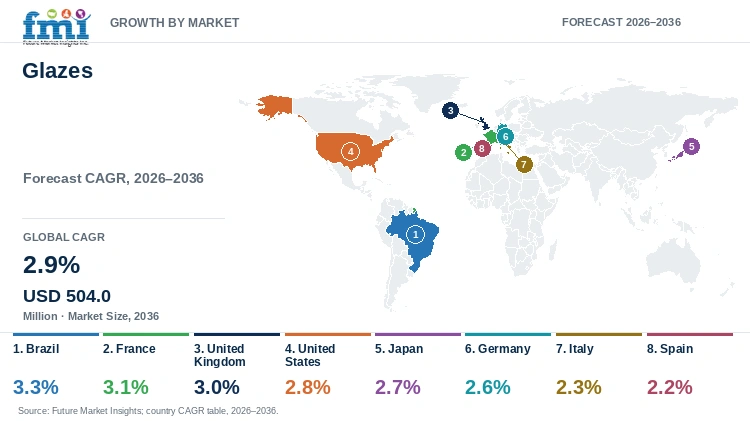
| Country | CAGR (2026 to 2036) | Primary Growth Lever |
|---|---|---|
| Brazil | 3.3% | Supermarket padaria expansion and tropical fruit and chocolate mirror glazes |
| France | 3.1% | Artisan patisserie fruit nappage and industrial UHT vegan croissant shines |
| United Kingdom | 3.0% | Vegan UHT bun and savory-pastry shines plus HFSS reduced-sugar donut icings |
| United States | 2.8% | High-speed waterfall donut glazing and cold-process supermarket cake coatings |
| Japan | 2.7% | Convenience-store chilled shortcake nappage and high-clarity agar-pectin gels |
| Germany | 2.6% | Industrial bake-off Plunder spraying and compound cocoa sheet-cake glazes |
| Italy | 2.3% | Festive panettone/colomba glazes and minus-18-degree pliable gelato-cake mirrors |
| Spain | 2.2% | Packaged bolleria moisture-barrier glazes and hotel-buffet patisserie finishing |
Source: Future Market Insights analysis
Brazil Glazes Market Outlook (2026 to 2036)
Brazil paces national expansion in the glazes market at a 3.3% CAGR from 2026 to 2036, supported by more than 70,000 commercial padarias and supermarket in-store patisserie counters. Unlike Northern European markets centered on neutral apricot nappage, bakeries in Brazil consume high volumes of ready-to-use chocolate ganache glazes and passionfruit mirror gels with cold-process cake toppings. Per the March 2026 United States Department of Agriculture FAS report BR2026-0011 on Brazil, national food manufacturing output reached BRL 1,160,000 million as grocery chains expanded self-service bakery counters. High ambient temperatures across urban centers in Brazil also accelerate adoption of heat-stable pectin and vegetable-fat glazes that resist melting during unrefrigerated transport.
Key takeaway: In Brazil, supermarket padaria modernization and tropical fruit and chocolate mirror glaze demand are projected to drive a leading 3.3% CAGR through 2036.
France Glazes Market Outlook (2026 to 2036)
Whereas Brazil scales tropical fruit and compound chocolate toppings, France sets the global technical benchmark for fine patisserie nappage and UHT viennoiserie shines at a 3.1% CAGR through 2036. Artisan boulangeries-patisseries and industrial frozen bake-off manufacturers across France specify apricot and neutral citrus-pectin glazes to protect fruit tarts and laminated croissants. Per the April 2026 United States Department of Agriculture FAS assessment for France, national food and drink manufacturing generated EUR 238,000 million in output with strong export demand for fine patisserie. Strict retail clean-label charters in France prohibiting artificial azo dyes and titanium dioxide compel glaze suppliers to formulate with natural acerola and hibiscus color extracts.
Key takeaway: In France, artisan patisserie fruit nappage traditions and industrial UHT vegan croissant glazes are expected to sustain a 3.1% CAGR through 2036.
United Kingdom Glazes Market Outlook (2026 to 2036)
In contrast to continental fruit-tart traditions, the United Kingdom concentrates glaze consumption inside high-speed hot-cross-bun and iced-donut bake-off lines, expanding at a 3.0% CAGR between 2026 and 2036. Major grocery supermarket chains and high-street bakery cafes in the United Kingdom require vegan-certified UHT protein-starch glazes to replace liquid egg wash across sausage rolls and brioche buns. Per the March 2026 United States Department of Agriculture FAS study for the United Kingdom, domestic food sector turnover surpassed GBP 115,000 million under strict High Fat, Salt and Sugar reformulation rules. Consequently, domestic glaze blenders in the United Kingdom actively engineer reduced-sugar pectin and fiber-enriched donut icings for retail bakeries.
Key takeaway: In the United Kingdom, vegan UHT savory-and-sweet bun glazes and HFSS-compliant reduced-sugar icings are forecast to support a 3.0% CAGR through 2036.
United States Glazes Market Outlook (2026 to 2036)
Unlike European patisserie markets dominated by pectin fruit nappage, demand in the United States centers on high-throughput donut waterfall glazes and frozen cinnamon-roll icings, advancing at a 2.8% CAGR through 2036. In-store supermarket bakeries and quick-service donut chains across the United States purchase 20-kilogram pails of ready-to-use cold glazes and slab-cut honey-glaze blocks that eliminate scratch-mixing labor. First-quarter 2026 earnings released by ADM in May 2026 showed USD 135 million in Nutrition operating profit, representing a 42% jump led by 39% Human Nutrition growth in bakery and flavor solutions. Clean-label grocery mandates in the United States also drive replacement of synthetic Red 40 and titanium dioxide whitener in cake mirror glazes.
Key takeaway: In the United States, automated wholesale donut glazing and labor-saving cold-process supermarket cake coatings are anticipated to maintain a 2.8% CAGR through 2036.
Japan Glazes Market Outlook (2026 to 2036)
Japan distinguishes itself through ultra-precise rheological standards for chilled convenience-store patisserie and seasonal strawberry shortcakes, advancing at a 2.7% CAGR from 2026 to 2036. National convenience-store commissaries and department-store basement patisseries in Japan specify crystal-clear agar-pectin nappage and low-sweetness chocolate mirror glazes with zero air-bubble defects on delicate sponge layers. Per the April 2026 United States Department of Agriculture FAS briefing JA2026-0012 on Japan, national processed food shipments stood at a strong valuation in 2025 as retailers expanded single-serve chilled desserts. Glaze formulators serving Japan engineer low-Brix and high-clarity gels that preserve fresh fruit turgor without masking delicate dairy cream flavors in chilled display cabinets.
Key takeaway: In Japan, convenience-store chilled dessert commissaries and high-clarity low-sweetness fruit nappage are estimated to sustain a 2.7% CAGR through 2036.
Germany Glazes Market Outlook (2026 to 2036)
Whereas Japan focuses on delicate chilled convenience desserts, Germany anchors continental Europe's largest industrial frozen bake-off and seasonal sheet-cake glazing sector at a 2.6% CAGR through 2036. Automated bakery plants in Germany consume sprayable hot-process pectin glazes and fat-based cocoa coatings across Obstkuchen fruit cakes and laminated Plunder pastries. Per the September 2026 United States Department of Agriculture FAS Retail Foods Annual publication on Germany, domestic bakery and grocery retailers continue to invest in automated bake-off stations and plant-based offerings. Discount grocery bake-off chains across Germany actively specify UHT egg-free shine glazes to ensure uniform golden crust appearance after daily store-level oven regeneration across retail branches.
Key takeaway: In Germany, industrial bake-off viennoiserie spraying and cocoa fat-glaze sheet-cake production are slated to support a 2.6% CAGR through 2036.
Italy Glazes Market Outlook (2026 to 2036)
Italy combines artisanal pasticceria consumption of apricot and gianduja mirror glazes with large-scale industrial festival cake production such as panettone and colomba, progressing at a 2.3% CAGR between 2026 and 2036. Industrial sweet-bakery groups in northern Italy apply almond-sugar macaron glazes and dark chocolate coatings plus pectin fruit gels across domestic and export pastry lines. Per the April 2026 United States Department of Agriculture FAS country profile IT2026-0001 on Italy, national food processing output reached EUR 193,000 million as export demand for authentic bakery and confectionery specialties expanded. Artisan gelato and pastry shops across Italy also adopt ready-to-use cold-process mirror glazes that remain pliable at minus-18-degree-Celsius display cabinet temperatures.
Key takeaway: In Italy, industrial festive cake glazing and minus-18-degree pliable gelato-patisserie mirror coatings are likely to maintain a 2.3% CAGR through 2036.
Spain Glazes Market Outlook (2026 to 2036)
Spain represents a mature Mediterranean bakery market where industrial sweet morning goods and hotel-buffet patisserie drive glaze demand at a 2.2% CAGR from 2026 to 2036. Wholesale producers of napolitanas and ensaimadas across Catalonia and Madrid apply sprayable pectin shines and compound cocoa coatings to preserve crumb softness during ambient grocery distribution. Per the March 2026 United States Department of Agriculture FAS review SP2026-0003 for Spain, hospitality tourism exceeding 94 million international arrivals continues to support hotel and restaurant bakery demand. Foodservice commissaries in Spain favor 5-kilogram pails of ready-to-use neutral and strawberry cold glazes for rapid buffet dessert finishing across coastal resorts across commercial supply chains.
Key takeaway: In Spain, packaged bolleria moisture-barrier glazing and hospitality tourism buffet patisserie demand are predicted to sustain a 2.2% CAGR through 2036.
Full report country CAGRs cover: North America; Latin America; Western Europe; Eastern Europe; East Asia; South Asia and Pacific; Middle East and Africa.
Who are the notable companies in the Glazes Market?
Puratos Group and Dawn Food Products Inc. with Bakels Group, Barry Callebaut AG, dsm-firmenich AG, Archer Daniels Midland Company, Cargill Incorporated, International Flavors and Fragrances Inc., Kerry Group plc, and Tate and Lyle plc are the notable companies in the glazes market.
Competitive positioning in the glazes industry separates integrated patisserie and bakery finishing specialists from global hydrocolloid and cocoa ingredient groups. Puratos Group and Dawn Food Products with Bakels Group and Barry Callebaut supply finished ready-to-use mirror glazes and UHT egg-wash replacements. dsm-firmenich and ADM with Cargill and IFF plus Kerry Group and Tate and Lyle engineer the underlying pectin and modified-starch plus cocoa systems.
- Dedicated Patisserie and Donut plus UHT Bakery Glaze Specialists: Puratos Group and Dawn Food Products Inc. with Bakels Group and Barry Callebaut AG manufacture finished sprayable pectin nappages and cold-process mirror glazes plus compound cocoa coatings.
- Global Hydrocolloid and Pectin Matrix Producers: dsm-firmenich AG and International Flavors and Fragrances with Kerry Group plc and Tate and Lyle plc produce amidated citrus pectins and gellan gums plus enzymatic sugar-reduction systems.
- Integrated Cocoa and Specialty Starch Suppliers: Archer Daniels Midland Company and Cargill Incorporated supply alkalized cocoa powders and specialty coating fats plus modified food starches for industrial glaze manufacturing.
Competitive Benchmarking: Glazes Market
Table 8: Competitive Benchmarking for the Glazes Market (qualitative capability ratings), 2026
| Company | Documented Glaze Portfolio | Spray & Rheology Support | Clean-Label Vegan Fit | Geographic Reach |
|---|---|---|---|---|
| Puratos Group | High | High | High | Global Sunset Glaze UHT shine and Miroir patisserie glazes; iba May 2025 |
| Dawn Food Products Inc. | High | High | High | North American and European donut icings, fruit glazes, and vegan shines |
| Bakels Group | High | High | High | Global Diamond Glaze mirror coatings and Truggle/vegan bun glazes |
| Barry Callebaut AG | High | High | Medium | Global Callebaut and Carma dark cocoa mirror glazes and compound coatings |
| Tate and Lyle plc | Medium | High | High | Global CP Kelco Genu pectin and Kelcogel gellan hydrocolloids; May 2026 results |
| Kerry Group plc | High | High | High | Global sweet bakery glazes, UHT shines, and preservation systems; Feb 2026 |
| dsm-firmenich AG | Medium | High | High | Global hydrocolloid and baking enzyme network; Princeton center May 2025 |
| International Flavors and Fragrances Inc. | Medium | High | High | Global Grindsted pectin, carrageenan, and bakery surface systems; May 2025 |
| Archer Daniels Midland Company | Medium | High | High | Global cocoa, natural botanical colors, and sweetening syrups; Feb 2026 |
| Cargill Incorporated | Medium | High | Medium | Global cocoa, chocolate coatings, pectins, and starches; European hub Mar 2026 |
Key Developments in the Glazes Market
- In October 2025, Puratos USA opened the first bakery glaze production facility in the United States dedicated solely to glaze manufacture, located in Pennsauken, New Jersey. The plant operates Ultra-High Temperature processing lines to produce Sunset Glaze — a plant-based, allergen-free egg wash alternative alongside a range of ready-to-use glaze products for industrial and artisan customers. The grand opening on October 27, 2025 featured live demonstrations of automated glaze spray systems and viscosity testing for commercial bakery partners, confirming a direct U.S. capacity investment in the glazes category [25].
- dsm-firmenich opened its Princeton Baking Innovation Center in Princeton, New Jersey in May 2025, establishing a facility dedicated to formulating ready-to-use bakery glazes and enzyme systems in direct collaboration with commercial bakers. The center enables co-development of glaze prototypes on industrial-scale equipment, reducing time from formulation to commercial launch for bakery coating applications [9].
- Half-year financial disclosures from Tate and Lyle in November 2025 confirmed that combining CP Kelco citrus pectin and specialty gums broadened customer formulation wins across bakery fruit coatings, with the pectin portfolio generating incremental volume in glaze and coating applications following the integration of CP Kelco into Tate and Lyle’s ingredient platform [6].
Key Players in the Glazes Market
Dedicated Patisserie and Donut plus UHT Bakery Glaze Specialists
- Puratos Group
- Dawn Food Products Inc.
- Bakels Group
- Barry Callebaut AG
Global Hydrocolloid and Pectin Matrix Producers
- dsm-firmenich AG
- International Flavors and Fragrances Inc.
- Kerry Group plc
- Tate and Lyle plc
Integrated Cocoa and Specialty Starch Suppliers
- Archer Daniels Midland Company
- Cargill Incorporated
Glazes Market - Report Scope
Table 9: Report Scope for the Glazes Market (coverage fields and definitions), 2026 to 2036
| Coverage field | Report scope |
|---|---|
| Market breakdown | Product Type; Base Formulation; Application; End-User Sector; Processing Format |
| Quantitative Units | USD Million |
| Market Definition | Includes commercial B2B supplier valuation from formulated sweet and savory bakery glazes (chocolate and cocoa mirror glazes, neutral and fruit-flavored pectin/agar nappages, waterfall and dip donut icings, and UHT plant-based egg-wash replacement shines). Category Scope Note: Excludes bulk unformulated granulated sugar, confectionery panned-tablet carnauba/shellac polishing waxes (E903/E904), ceramic pottery glazes, and culinary meat-roasting stocks. |
| Regions Covered | North America; Latin America; Western Europe; Eastern Europe; East Asia; South Asia and Pacific; Middle East and Africa |
| Countries Covered | Brazil, France, United Kingdom, United States, Japan, Germany, Italy, Spain, and additional countries in the full report |
| Key Companies Covered | dsm-firmenich AG, Archer Daniels Midland Company, Cargill Incorporated, International Flavors and Fragrances Inc., Kerry Group plc, Puratos Group, Dawn Food Products Inc., Barry Callebaut AG, Bakels Group, Tate and Lyle plc |
| Forecast Period | 2026 to 2036 |
| Approach | Primary and secondary research with top-down and bottom-up market triangulation. |
Glazes Market - Research Methodology
Table 10: Research Methodology for the Glazes Market (research methods and approach), 2026 edition
| Method | Approach |
|---|---|
| Primary Research | Structured interviews with industrial viennoiserie plant managers, patisserie R&D directors, automated spray-equipment engineers, and hydrocolloid formulators to validate gram-per-piece application weights and Brix specifications. |
| Secondary Research | Analysis of Food Hydrocolloids and Journal of Food Engineering rheology studies, USDA FAS Food Processing Ingredients Annual reports across eight countries, and corporate financial disclosures. |
| Market Sizing and Forecasting | Top-down global bakery and patisserie ingredients baselines reconciled against bottom-up finished glaze and UHT shine tonnage (121.0K to 135.5K MT in 2026) and average formulated metric-ton prices from 2026 to 2036. |
| Country Forecasting Model | Econometric country projections weight automated bake-off viennoiserie line installations, supermarket in-store patisserie counter growth, cage-free egg replacement rates, and sugar-reduction mandates across eight national markets. |
| Operational Benchmark Traceability | Coated bakery tonnage and glazing line allocation indicators in Tables 2, 3, and 4 trace to industrial spray application weights (1.5 to 4.0 g/piece), cake mirror coating ratios (8% to 15%), and USDA FAS bakery registries. |
| Data Triangulation and Validation | Valuation estimates isolate formulated B2B bakery and patisserie glazes while strictly excluding raw commodity sucrose, couverture chocolate blocks used for molding, and confectionery tablet-panning waxes. |
Glazes Market by Segments
Glazes Market segmented by Product Type:
- Chocolate and Dark Cocoa Glazes
- Neutral Transparent Mirror Glazes
- Fruit-Flavored Glazes Strawberry Apricot
- Sugar and Icing Donut Glazes
Glazes Market segmented by Base Formulation:
- Pectin-Based Gelling Glazes
- Gelatin-Based High-Gloss Glazes
- Modified Starch-Based Glazes
- Vegetable Fat-Based Coatings
Glazes Market segmented by Application:
- Cakes Tortes and Fine Patisserie
- Donuts and Morning Goods
- Artisan Breads and Danish Pastries
- Confectionery and Chocolate Enrobing
- Savory Pastries and Snack Goods
Glazes Market segmented by End-User Sector:
- Industrial Commercial Bakeries
- Artisan Patisseries and Bakery Chains
- Foodservice HoReCa and Hotel Kitchens
- In-Store Supermarket Bakeries
Glazes Market segmented by Processing Format:
- Ready-to-Use Cold Process Glazes
- Hot-Process Sprayable Glazes
- Dry Powdered Glaze Premixes
- Concentrated UHT Liquid Glazes
Glazes Market by Region
- North America
- United States
- Canada
- Latin America
- Brazil
- Mexico
- Argentina
- Chile
- Western Europe
- Germany
- France
- United Kingdom
- Italy
- Spain
- Benelux
- Nordics
- Eastern Europe
- Poland
- Czech Republic
- Romania
- Hungary
- East Asia
- China
- Japan
- South Korea
- South Asia and Pacific
- India
- ASEAN
- Australia and New Zealand
- Middle East and Africa
- GCC Countries
- South Africa
- Türkiye
- Israel
Research Sources and Bibliography
- [1] Hassan, M. et al. (2025, September 4). Application of Chitosan and Pectin-Based Nanoemulsion Coating for Preserving Fruit Quality. Gels, 11(9), Article 12411564 (PMC12411564).
- [2] Puratos Group. (2025, May 7). Puratos brings a trio of transformative innovations to iba 2025. Puratos Group Newsroom.
- [3] Silva, R. et al. (2025, November 18). Peanut skin bioactive extract on pectin and gelatin candies and gels. Foods, 14(22), Article 12701288 (PMC12701288).
- [4] Lin, J. et al. (2026, March 12). Functional cookies with improved flavor, digestibility and shelf life using emulsion gels. Food Chemistry, 468, Article 13312489 (PMC13312489).
- [5] Puratos Group. (2026, May 28). Puratos marks major sustainability milestone with carbon neutral operations and sustainable cocoa and fruit sourcing. Puratos Group Newsroom.
- [6] Tate and Lyle. (2025, November 6). Tate and Lyle PLC Results for the Six Months to 30 September 2025. Tate and Lyle PLC Investor Relations.
- [7] Nowak, A. et al. (2025, September 26). The State of the Art and Innovations in Active and Edible Coatings for Food and Confectionery. Coatings, 15(10), Article 12473381 (PMC12473381).
- [8] Kerry Group. (2026, February 17). Kerry Group Preliminary Statement of Results for the Year Ended 31 December 2025. Kerry Group plc News and Media.
- [9] dsm-firmenich. (2025, May 20). On the rise dsm-firmenich opens Princeton Baking Innovation Center in Princeton NJ. dsm-firmenich AG Press Releases.
- [10] Alibekova, Z. et al. (2026, May 11). Problems and Prospects of Using Enhancers in Bakery Production A Review. Foods, 15(10), Article 13159086 (PMC13159086).
- [11] Gomez, M. et al. (2026, February 19). Starch-Based Functional Ingredients in Baking A Review of Cross-Linking and Pregelatinized Starches. Foods, 15(4), Article 13210116 (PMC13210116).
- [12] Zhang, R. et al. (2026, May 1). Role of Enzymatic Hydrolysis-Induced Modification in Baked Food Systems. Foods, 15(9), Article 12185997 (PMC12185997).
- [13] USDA Foreign Agricultural Service. (2026, March 31). Brazil Food Processing Ingredients Annual Report BR2026-0011. U.S. Department of Agriculture.
- [14] USDA Foreign Agricultural Service. (2026, April 3). France Food Processing Ingredients Annual Report. U.S. Department of Agriculture.
- [15] USDA Foreign Agricultural Service. (2026, March 24). United Kingdom Food Processing Ingredients Annual Report. U.S. Department of Agriculture.
- [16] ADM. (2026, May 5). ADM Reports First Quarter 2026 Results. Archer Daniels Midland Company Newsroom.
- [17] USDA Foreign Agricultural Service. (2026, April 10). Japan Food Processing Ingredients Annual Report JA2026-0012. U.S. Department of Agriculture.
- [18] USDA Foreign Agricultural Service. (2026, September 15). Germany Retail Foods Annual Report. U.S. Department of Agriculture.
- [19] USDA Foreign Agricultural Service. (2026, April 2). Italy Food Processing Ingredients Annual Report IT2026-0001. U.S. Department of Agriculture.
- [20] USDA Foreign Agricultural Service. (2026, March 31). Spain Food Processing Ingredients Annual Report SP2026-0003. U.S. Department of Agriculture.
- [21] Cargill. (2026, September 17). Cargill Highlights Food Ingredient Solutions at Fi Asia 2026. Cargill, Incorporated Newsroom.
- [22] IFF. (2026, August 4). IFF Reports Second Quarter 2026 Results. International Flavors and Fragrances Inc. Investor Relations.
- [23] Novonesis. (2025, June 11). Novonesis launches Optiva LS Prime helping bakers cut up to 50 percent added sugar. Novonesis Media Releases.
- [24] Kerry Group. (2026, May 18). EFSA publishes positive scientific opinion on Kerrys Acrylerase for bakery and food applications. Kerry Group plc News and Media.
- [25] Puratos. (2025, October 28). Puratos Launches U.S. Bakery Glaze Facility to Power Innovation and Premiumization. Puratos USA News. https://www.puratos.us/en/news/puratos-launches-u-s--bakery-glaze-facility-to-power-innovation-0
This bibliography is provided for reader reference and is not exhaustive. The full report contains the complete reference list and detailed citations.
This Report Answers
- How large is the glazes market in 2026 and what is forecast for 2036?
- Which UHT egg-wash replacement and frozen patisserie stability pressures support demand for glazes?
- Why do Chocolate and Dark Cocoa Glazes lead the product type category?
- Why do Pectin-Based Gelling Glazes lead the base formulation category globally?
- How do growth rates differ across Brazil and France along with the United Kingdom and the United States?
- Which leading companies supply finished patisserie glazes versus pectin and cocoa base ingredients?
- What causes sugar crystallization or pastry crust sogginess in the glazes market?
- What should commercial bakeries evaluate before switching from liquid egg wash to UHT vegan glazes?
Table of Content
- Key Takeaways
- Market Size and CAGR
- Top Growth Driver
- Fastest Growing Segment
- Leading Region
- Key Companies
- Emerging Opportunities
- Executive Summary
- Global Market Outlook
- Demand-side Trends
- Supply-side Trends
- Technology Roadmap Analysis
- Analysis and Recommendations
- Analyst Perspective (What is happening? Why now? What should investors know?)
- Key Questions Answered
- How large is the market?
- What is the CAGR?
- What are key trends?
- Which region dominates?
- Who are the leaders?
Read More...
- Market Overview
- Market Coverage / Taxonomy
- Market Definition / Scope / Limitations
- Research Methodology
- Chapter Orientation
- Analytical Lens and Working Hypotheses
- Market Structure, Signals, and Trend Drivers
- Benchmarking and Cross-market Comparability
- Market Sizing, Forecasting, and Opportunity Mapping
- Research Design and Evidence Framework
- Desk Research Programme (Secondary Evidence)
- Expert Input and Fieldwork (Primary Evidence)
- Tooling, Models, and Reference Databases
- Data Engineering and Model Build
- Quality Assurance and Audit Trail
- Market Background
- Market Dynamics (Drivers, Restraints, Opportunity, Trends)
- Scenario Forecast (Optimistic, Likely, Conservative)
- Impact Analysis
- AI Impact
- Sustainability Impact
- Regulatory Impact
- Technology Impact
- Consumer / Buyer Analysis
- Purchase Drivers
- Adoption Barriers
- Buyer Journey
- Opportunity Map Analysis
- Product Life Cycle Analysis
- Supply Chain Analysis
- Investment Feasibility Matrix
- Value Chain Analysis
- PESTLE and Porter's Analysis
- Regulatory Landscape
- Regional Parent Market Outlook
- Production and Consumption Statistics
- Import and Export Statistics
- Global Market Analysis and Forecast, 2021 to 2036
- Historical Market Size Value (USD Million) Analysis, 2021 to 2025
- Current and Future Market Size Value (USD Million) Projections, 2026 to 2036
- Y-o-Y Growth Trend Analysis
- Absolute $ Opportunity Analysis
- Global Market Pricing Analysis, 2021 to 2036
- Global Market Analysis and Forecast, By Product Type, 2021 to 2036
- Introduction / Key Findings
- Historical Market Size Value (USD Million) Analysis By Product Type, 2021 to 2025
- Current and Future Market Size Value (USD Million) Analysis and Forecast By Product Type, 2026 to 2036
- Chocolate and Dark Cocoa Glazes
- Neutral Transparent Mirror Glazes
- Fruit-Flavored Glazes Strawberry Apricot
- Sugar and Icing Donut Glazes
- Y-o-Y Growth Trend Analysis By Product Type, 2021 to 2025
- Absolute $ Opportunity Analysis By Product Type, 2026 to 2036
- Global Market Analysis and Forecast, By Base Formulation, 2021 to 2036
- Introduction / Key Findings
- Historical Market Size Value (USD Million) Analysis By Base Formulation, 2021 to 2025
- Current and Future Market Size Value (USD Million) Analysis and Forecast By Base Formulation, 2026 to 2036
- Pectin-Based Gelling Glazes
- Gelatin-Based High-Gloss Glazes
- Modified Starch-Based Glazes
- Vegetable Fat-Based Coatings
- Y-o-Y Growth Trend Analysis By Base Formulation, 2021 to 2025
- Absolute $ Opportunity Analysis By Base Formulation, 2026 to 2036
- Global Market Analysis and Forecast, By Application, 2021 to 2036
- Introduction / Key Findings
- Historical Market Size Value (USD Million) Analysis By Application, 2021 to 2025
- Current and Future Market Size Value (USD Million) Analysis and Forecast By Application, 2026 to 2036
- Cakes Tortes and Fine Patisserie
- Donuts and Morning Goods
- Artisan Breads and Danish Pastries
- Confectionery and Chocolate Enrobing
- Savory Pastries and Snack Goods
- Y-o-Y Growth Trend Analysis By Application, 2021 to 2025
- Absolute $ Opportunity Analysis By Application, 2026 to 2036
- Global Market Analysis and Forecast, By End-User Sector, 2021 to 2036
- Introduction / Key Findings
- Historical Market Size Value (USD Million) Analysis By End-User Sector, 2021 to 2025
- Current and Future Market Size Value (USD Million) Analysis and Forecast By End-User Sector, 2026 to 2036
- Industrial Commercial Bakeries
- Artisan Patisseries and Bakery Chains
- Foodservice HoReCa and Hotel Kitchens
- In-Store Supermarket Bakeries
- Y-o-Y Growth Trend Analysis By End-User Sector, 2021 to 2025
- Absolute $ Opportunity Analysis By End-User Sector, 2026 to 2036
- Global Market Analysis and Forecast, By Processing Format, 2021 to 2036
- Introduction / Key Findings
- Historical Market Size Value (USD Million) Analysis By Processing Format, 2021 to 2025
- Current and Future Market Size Value (USD Million) Analysis and Forecast By Processing Format, 2026 to 2036
- Ready-to-Use Cold Process Glazes
- Hot-Process Sprayable Glazes
- Dry Powdered Glaze Premixes
- Concentrated UHT Liquid Glazes
- Y-o-Y Growth Trend Analysis By Processing Format, 2021 to 2025
- Absolute $ Opportunity Analysis By Processing Format, 2026 to 2036
- Global Market Analysis and Forecast, By Region, 2021 to 2036
- Introduction
- Historical Market Size Value (USD Million) Analysis By Region, 2021 to 2025
- Current Market Size Value (USD Million) Analysis and Forecast By Region, 2026 to 2036
- North America
- Latin America
- Western Europe
- Eastern Europe
- East Asia
- South Asia and Pacific
- Middle East and Africa
- Market Attractiveness Analysis By Region
- North America Market Analysis and Forecast, By Country, 2021 to 2036
- Historical Market Size Value (USD Million) Trend Analysis By Market Taxonomy, 2021 to 2025
- Market Size Value (USD Million) Forecast By Market Taxonomy, 2026 to 2036
- By Country
- United States
- Canada
- By Product Type
- By Base Formulation
- By Application
- By End-User Sector
- By Processing Format
- By Country
- Market Attractiveness Analysis
- By Country
- By Product Type
- By Base Formulation
- By Application
- By End-User Sector
- By Processing Format
- Key Takeaways
- Latin America Market Analysis and Forecast, By Country
- Historical Market Size Value (USD Million) Trend Analysis By Market Taxonomy, 2021 to 2025
- Market Size Value (USD Million) Forecast By Market Taxonomy, 2026 to 2036
- By Country
- Brazil
- Mexico
- Argentina
- Chile
- By Product Type
- By Base Formulation
- By Application
- By End-User Sector
- By Processing Format
- By Country
- Market Attractiveness Analysis
- By Country
- By Product Type
- By Base Formulation
- By Application
- By End-User Sector
- By Processing Format
- Key Takeaways
- Western Europe Market Analysis and Forecast, By Country
- Historical Market Size Value (USD Million) Trend Analysis By Market Taxonomy, 2021 to 2025
- Market Size Value (USD Million) Forecast By Market Taxonomy, 2026 to 2036
- By Country
- Germany
- France
- United Kingdom
- Italy
- Spain
- Benelux
- Nordics
- By Product Type
- By Base Formulation
- By Application
- By End-User Sector
- By Processing Format
- By Country
- Market Attractiveness Analysis
- By Country
- By Product Type
- By Base Formulation
- By Application
- By End-User Sector
- By Processing Format
- Key Takeaways
- Eastern Europe Market Analysis and Forecast, By Country
- Historical Market Size Value (USD Million) Trend Analysis By Market Taxonomy, 2021 to 2025
- Market Size Value (USD Million) Forecast By Market Taxonomy, 2026 to 2036
- By Country
- Poland
- Czech Republic
- Romania
- Hungary
- By Product Type
- By Base Formulation
- By Application
- By End-User Sector
- By Processing Format
- By Country
- Market Attractiveness Analysis
- By Country
- By Product Type
- By Base Formulation
- By Application
- By End-User Sector
- By Processing Format
- Key Takeaways
- East Asia Market Analysis and Forecast, By Country
- Historical Market Size Value (USD Million) Trend Analysis By Market Taxonomy, 2021 to 2025
- Market Size Value (USD Million) Forecast By Market Taxonomy, 2026 to 2036
- By Country
- China
- Japan
- South Korea
- By Product Type
- By Base Formulation
- By Application
- By End-User Sector
- By Processing Format
- By Country
- Market Attractiveness Analysis
- By Country
- By Product Type
- By Base Formulation
- By Application
- By End-User Sector
- By Processing Format
- Key Takeaways
- South Asia and Pacific Market Analysis and Forecast, By Country
- Historical Market Size Value (USD Million) Trend Analysis By Market Taxonomy, 2021 to 2025
- Market Size Value (USD Million) Forecast By Market Taxonomy, 2026 to 2036
- By Country
- India
- ASEAN
- Australia and New Zealand
- By Product Type
- By Base Formulation
- By Application
- By End-User Sector
- By Processing Format
- By Country
- Market Attractiveness Analysis
- By Country
- By Product Type
- By Base Formulation
- By Application
- By End-User Sector
- By Processing Format
- Key Takeaways
- Middle East and Africa Market Analysis and Forecast, By Country
- Historical Market Size Value (USD Million) Trend Analysis By Market Taxonomy, 2021 to 2025
- Market Size Value (USD Million) Forecast By Market Taxonomy, 2026 to 2036
- By Country
- GCC Countries
- South Africa
- Türkiye
- Israel
- By Product Type
- By Base Formulation
- By Application
- By End-User Sector
- By Processing Format
- By Country
- Market Attractiveness Analysis
- By Country
- By Product Type
- By Base Formulation
- By Application
- By End-User Sector
- By Processing Format
- Key Takeaways
- Key Countries Market Analysis
- United States
- Pricing Analysis
- Market Share Analysis, 2025
- By Product Type
- By Base Formulation
- By Application
- By End-User Sector
- By Processing Format
- Canada
- Pricing Analysis
- Market Share Analysis, 2025
- By Product Type
- By Base Formulation
- By Application
- By End-User Sector
- By Processing Format
- Mexico
- Pricing Analysis
- Market Share Analysis, 2025
- By Product Type
- By Base Formulation
- By Application
- By End-User Sector
- By Processing Format
- Brazil
- Pricing Analysis
- Market Share Analysis, 2025
- By Product Type
- By Base Formulation
- By Application
- By End-User Sector
- By Processing Format
- Chile
- Pricing Analysis
- Market Share Analysis, 2025
- By Product Type
- By Base Formulation
- By Application
- By End-User Sector
- By Processing Format
- Germany
- Pricing Analysis
- Market Share Analysis, 2025
- By Product Type
- By Base Formulation
- By Application
- By End-User Sector
- By Processing Format
- United Kingdom
- Pricing Analysis
- Market Share Analysis, 2025
- By Product Type
- By Base Formulation
- By Application
- By End-User Sector
- By Processing Format
- Italy
- Pricing Analysis
- Market Share Analysis, 2025
- By Product Type
- By Base Formulation
- By Application
- By End-User Sector
- By Processing Format
- Spain
- Pricing Analysis
- Market Share Analysis, 2025
- By Product Type
- By Base Formulation
- By Application
- By End-User Sector
- By Processing Format
- France
- Pricing Analysis
- Market Share Analysis, 2025
- By Product Type
- By Base Formulation
- By Application
- By End-User Sector
- By Processing Format
- India
- Pricing Analysis
- Market Share Analysis, 2025
- By Product Type
- By Base Formulation
- By Application
- By End-User Sector
- By Processing Format
- ASEAN
- Pricing Analysis
- Market Share Analysis, 2025
- By Product Type
- By Base Formulation
- By Application
- By End-User Sector
- By Processing Format
- Australia and New Zealand
- Pricing Analysis
- Market Share Analysis, 2025
- By Product Type
- By Base Formulation
- By Application
- By End-User Sector
- By Processing Format
- China
- Pricing Analysis
- Market Share Analysis, 2025
- By Product Type
- By Base Formulation
- By Application
- By End-User Sector
- By Processing Format
- Japan
- Pricing Analysis
- Market Share Analysis, 2025
- By Product Type
- By Base Formulation
- By Application
- By End-User Sector
- By Processing Format
- South Korea
- Pricing Analysis
- Market Share Analysis, 2025
- By Product Type
- By Base Formulation
- By Application
- By End-User Sector
- By Processing Format
- Poland
- Pricing Analysis
- Market Share Analysis, 2025
- By Product Type
- By Base Formulation
- By Application
- By End-User Sector
- By Processing Format
- Hungary
- Pricing Analysis
- Market Share Analysis, 2025
- By Product Type
- By Base Formulation
- By Application
- By End-User Sector
- By Processing Format
- Türkiye
- Pricing Analysis
- Market Share Analysis, 2025
- By Product Type
- By Base Formulation
- By Application
- By End-User Sector
- By Processing Format
- South Africa
- Pricing Analysis
- Market Share Analysis, 2025
- By Product Type
- By Base Formulation
- By Application
- By End-User Sector
- By Processing Format
- United States
- Market Structure Analysis
- Competition Dashboard
- Competition Benchmarking
- Market Share Analysis of Top Players
- By Regional
- By Product Type
- By Base Formulation
- By Application
- By End-User Sector
- By Processing Format
- Emerging Startups
- Innovation Benchmarking
- Competition Analysis
- Competition Deep Dive
- Puratos Group
- Overview
- Product Portfolio
- Profitability by Market Segments
- Sales Footprint
- Strategy Overview
- Marketing Strategy
- Product Strategy
- Channel Strategy
- Dawn Food Products Inc.
- Bakels Group
- Barry Callebaut AG
- Tate and Lyle plc
- Kerry Group plc
- dsm-firmenich AG
- International Flavors and Fragrances Inc.
- Archer Daniels Midland Company
- Cargill Incorporated
- Puratos Group
- Case Studies
- Success Stories
- Recent Developments
- Competition Deep Dive
- Assumptions & Acronyms Used
List of Tables
- Table 1: Global Market Value (USD Million) Forecast by Region, 2021 to 2036
- Table 2: Global Market Value (USD Million) Forecast by Product Type, 2021 to 2036
- Table 3: Global Market Value (USD Million) Forecast by Base Formulation, 2021 to 2036
- Table 4: Global Market Value (USD Million) Forecast by Application, 2021 to 2036
- Table 5: Global Market Value (USD Million) Forecast by End-User Sector, 2021 to 2036
- Table 6: Global Market Value (USD Million) Forecast by Processing Format, 2021 to 2036
- Table 7: North America Market Value (USD Million) Forecast by Country, 2021 to 2036
- Table 8: North America Market Value (USD Million) Forecast by Product Type, 2021 to 2036
- Table 9: North America Market Value (USD Million) Forecast by Base Formulation, 2021 to 2036
- Table 10: North America Market Value (USD Million) Forecast by Application, 2021 to 2036
- Table 11: North America Market Value (USD Million) Forecast by End-User Sector, 2021 to 2036
- Table 12: North America Market Value (USD Million) Forecast by Processing Format, 2021 to 2036
- Table 13: Latin America Market Value (USD Million) Forecast by Country, 2021 to 2036
- Table 14: Latin America Market Value (USD Million) Forecast by Product Type, 2021 to 2036
- Table 15: Latin America Market Value (USD Million) Forecast by Base Formulation, 2021 to 2036
- Table 16: Latin America Market Value (USD Million) Forecast by Application, 2021 to 2036
- Table 17: Latin America Market Value (USD Million) Forecast by End-User Sector, 2021 to 2036
- Table 18: Latin America Market Value (USD Million) Forecast by Processing Format, 2021 to 2036
- Table 19: Western Europe Market Value (USD Million) Forecast by Country, 2021 to 2036
- Table 20: Western Europe Market Value (USD Million) Forecast by Product Type, 2021 to 2036
- Table 21: Western Europe Market Value (USD Million) Forecast by Base Formulation, 2021 to 2036
- Table 22: Western Europe Market Value (USD Million) Forecast by Application, 2021 to 2036
- Table 23: Western Europe Market Value (USD Million) Forecast by End-User Sector, 2021 to 2036
- Table 24: Western Europe Market Value (USD Million) Forecast by Processing Format, 2021 to 2036
- Table 25: Eastern Europe Market Value (USD Million) Forecast by Country, 2021 to 2036
- Table 26: Eastern Europe Market Value (USD Million) Forecast by Product Type, 2021 to 2036
- Table 27: Eastern Europe Market Value (USD Million) Forecast by Base Formulation, 2021 to 2036
- Table 28: Eastern Europe Market Value (USD Million) Forecast by Application, 2021 to 2036
- Table 29: Eastern Europe Market Value (USD Million) Forecast by End-User Sector, 2021 to 2036
- Table 30: Eastern Europe Market Value (USD Million) Forecast by Processing Format, 2021 to 2036
- Table 31: East Asia Market Value (USD Million) Forecast by Country, 2021 to 2036
- Table 32: East Asia Market Value (USD Million) Forecast by Product Type, 2021 to 2036
- Table 33: East Asia Market Value (USD Million) Forecast by Base Formulation, 2021 to 2036
- Table 34: East Asia Market Value (USD Million) Forecast by Application, 2021 to 2036
- Table 35: East Asia Market Value (USD Million) Forecast by End-User Sector, 2021 to 2036
- Table 36: East Asia Market Value (USD Million) Forecast by Processing Format, 2021 to 2036
- Table 37: South Asia and Pacific Market Value (USD Million) Forecast by Country, 2021 to 2036
- Table 38: South Asia and Pacific Market Value (USD Million) Forecast by Product Type, 2021 to 2036
- Table 39: South Asia and Pacific Market Value (USD Million) Forecast by Base Formulation, 2021 to 2036
- Table 40: South Asia and Pacific Market Value (USD Million) Forecast by Application, 2021 to 2036
- Table 41: South Asia and Pacific Market Value (USD Million) Forecast by End-User Sector, 2021 to 2036
- Table 42: South Asia and Pacific Market Value (USD Million) Forecast by Processing Format, 2021 to 2036
- Table 43: Middle East and Africa Market Value (USD Million) Forecast by Country, 2021 to 2036
- Table 44: Middle East and Africa Market Value (USD Million) Forecast by Product Type, 2021 to 2036
- Table 45: Middle East and Africa Market Value (USD Million) Forecast by Base Formulation, 2021 to 2036
- Table 46: Middle East and Africa Market Value (USD Million) Forecast by Application, 2021 to 2036
- Table 47: Middle East and Africa Market Value (USD Million) Forecast by End-User Sector, 2021 to 2036
- Table 48: Middle East and Africa Market Value (USD Million) Forecast by Processing Format, 2021 to 2036
List of Figures
- Figure 1: Global Market Pricing Analysis
- Figure 2: Global Market Value (USD Million) Forecast 2021-2036
- Figure 3: Global Market Value Share and BPS Analysis by Product Type, 2026 and 2036
- Figure 4: Global Market Y-o-Y Growth Comparison by Product Type, 2026-2036
- Figure 5: Global Market Attractiveness Analysis by Product Type
- Figure 6: Global Market Value Share and BPS Analysis by Base Formulation, 2026 and 2036
- Figure 7: Global Market Y-o-Y Growth Comparison by Base Formulation, 2026-2036
- Figure 8: Global Market Attractiveness Analysis by Base Formulation
- Figure 9: Global Market Value Share and BPS Analysis by Application, 2026 and 2036
- Figure 10: Global Market Y-o-Y Growth Comparison by Application, 2026-2036
- Figure 11: Global Market Attractiveness Analysis by Application
- Figure 12: Global Market Value Share and BPS Analysis by End-User Sector, 2026 and 2036
- Figure 13: Global Market Y-o-Y Growth Comparison by End-User Sector, 2026-2036
- Figure 14: Global Market Attractiveness Analysis by End-User Sector
- Figure 15: Global Market Value Share and BPS Analysis by Processing Format, 2026 and 2036
- Figure 16: Global Market Y-o-Y Growth Comparison by Processing Format, 2026-2036
- Figure 17: Global Market Attractiveness Analysis by Processing Format
- Figure 18: Global Market Value (USD Million) Share and BPS Analysis by Region, 2026 and 2036
- Figure 19: Global Market Y-o-Y Growth Comparison by Region, 2026-2036
- Figure 20: Global Market Attractiveness Analysis by Region
- Figure 21: North America Market Incremental Dollar Opportunity, 2026-2036
- Figure 22: Latin America Market Incremental Dollar Opportunity, 2026-2036
- Figure 23: Western Europe Market Incremental Dollar Opportunity, 2026-2036
- Figure 24: Eastern Europe Market Incremental Dollar Opportunity, 2026-2036
- Figure 25: East Asia Market Incremental Dollar Opportunity, 2026-2036
- Figure 26: South Asia and Pacific Market Incremental Dollar Opportunity, 2026-2036
- Figure 27: Middle East and Africa Market Incremental Dollar Opportunity, 2026-2036
- Figure 28: North America Market Value Share and BPS Analysis by Country, 2026 and 2036
- Figure 29: North America Market Value Share and BPS Analysis by Product Type, 2026 and 2036
- Figure 30: North America Market Y-o-Y Growth Comparison by Product Type, 2026-2036
- Figure 31: North America Market Attractiveness Analysis by Product Type
- Figure 32: North America Market Value Share and BPS Analysis by Base Formulation, 2026 and 2036
- Figure 33: North America Market Y-o-Y Growth Comparison by Base Formulation, 2026-2036
- Figure 34: North America Market Attractiveness Analysis by Base Formulation
- Figure 35: North America Market Value Share and BPS Analysis by Application, 2026 and 2036
- Figure 36: North America Market Y-o-Y Growth Comparison by Application, 2026-2036
- Figure 37: North America Market Attractiveness Analysis by Application
- Figure 38: North America Market Value Share and BPS Analysis by End-User Sector, 2026 and 2036
- Figure 39: North America Market Y-o-Y Growth Comparison by End-User Sector, 2026-2036
- Figure 40: North America Market Attractiveness Analysis by End-User Sector
- Figure 41: North America Market Value Share and BPS Analysis by Processing Format, 2026 and 2036
- Figure 42: North America Market Y-o-Y Growth Comparison by Processing Format, 2026-2036
- Figure 43: North America Market Attractiveness Analysis by Processing Format
- Figure 44: Latin America Market Value Share and BPS Analysis by Country, 2026 and 2036
- Figure 45: Latin America Market Value Share and BPS Analysis by Product Type, 2026 and 2036
- Figure 46: Latin America Market Y-o-Y Growth Comparison by Product Type, 2026-2036
- Figure 47: Latin America Market Attractiveness Analysis by Product Type
- Figure 48: Latin America Market Value Share and BPS Analysis by Base Formulation, 2026 and 2036
- Figure 49: Latin America Market Y-o-Y Growth Comparison by Base Formulation, 2026-2036
- Figure 50: Latin America Market Attractiveness Analysis by Base Formulation
- Figure 51: Latin America Market Value Share and BPS Analysis by Application, 2026 and 2036
- Figure 52: Latin America Market Y-o-Y Growth Comparison by Application, 2026-2036
- Figure 53: Latin America Market Attractiveness Analysis by Application
- Figure 54: Latin America Market Value Share and BPS Analysis by End-User Sector, 2026 and 2036
- Figure 55: Latin America Market Y-o-Y Growth Comparison by End-User Sector, 2026-2036
- Figure 56: Latin America Market Attractiveness Analysis by End-User Sector
- Figure 57: Latin America Market Value Share and BPS Analysis by Processing Format, 2026 and 2036
- Figure 58: Latin America Market Y-o-Y Growth Comparison by Processing Format, 2026-2036
- Figure 59: Latin America Market Attractiveness Analysis by Processing Format
- Figure 60: Western Europe Market Value Share and BPS Analysis by Country, 2026 and 2036
- Figure 61: Western Europe Market Value Share and BPS Analysis by Product Type, 2026 and 2036
- Figure 62: Western Europe Market Y-o-Y Growth Comparison by Product Type, 2026-2036
- Figure 63: Western Europe Market Attractiveness Analysis by Product Type
- Figure 64: Western Europe Market Value Share and BPS Analysis by Base Formulation, 2026 and 2036
- Figure 65: Western Europe Market Y-o-Y Growth Comparison by Base Formulation, 2026-2036
- Figure 66: Western Europe Market Attractiveness Analysis by Base Formulation
- Figure 67: Western Europe Market Value Share and BPS Analysis by Application, 2026 and 2036
- Figure 68: Western Europe Market Y-o-Y Growth Comparison by Application, 2026-2036
- Figure 69: Western Europe Market Attractiveness Analysis by Application
- Figure 70: Western Europe Market Value Share and BPS Analysis by End-User Sector, 2026 and 2036
- Figure 71: Western Europe Market Y-o-Y Growth Comparison by End-User Sector, 2026-2036
- Figure 72: Western Europe Market Attractiveness Analysis by End-User Sector
- Figure 73: Western Europe Market Value Share and BPS Analysis by Processing Format, 2026 and 2036
- Figure 74: Western Europe Market Y-o-Y Growth Comparison by Processing Format, 2026-2036
- Figure 75: Western Europe Market Attractiveness Analysis by Processing Format
- Figure 76: Eastern Europe Market Value Share and BPS Analysis by Country, 2026 and 2036
- Figure 77: Eastern Europe Market Value Share and BPS Analysis by Product Type, 2026 and 2036
- Figure 78: Eastern Europe Market Y-o-Y Growth Comparison by Product Type, 2026-2036
- Figure 79: Eastern Europe Market Attractiveness Analysis by Product Type
- Figure 80: Eastern Europe Market Value Share and BPS Analysis by Base Formulation, 2026 and 2036
- Figure 81: Eastern Europe Market Y-o-Y Growth Comparison by Base Formulation, 2026-2036
- Figure 82: Eastern Europe Market Attractiveness Analysis by Base Formulation
- Figure 83: Eastern Europe Market Value Share and BPS Analysis by Application, 2026 and 2036
- Figure 84: Eastern Europe Market Y-o-Y Growth Comparison by Application, 2026-2036
- Figure 85: Eastern Europe Market Attractiveness Analysis by Application
- Figure 86: Eastern Europe Market Value Share and BPS Analysis by End-User Sector, 2026 and 2036
- Figure 87: Eastern Europe Market Y-o-Y Growth Comparison by End-User Sector, 2026-2036
- Figure 88: Eastern Europe Market Attractiveness Analysis by End-User Sector
- Figure 89: Eastern Europe Market Value Share and BPS Analysis by Processing Format, 2026 and 2036
- Figure 90: Eastern Europe Market Y-o-Y Growth Comparison by Processing Format, 2026-2036
- Figure 91: Eastern Europe Market Attractiveness Analysis by Processing Format
- Figure 92: East Asia Market Value Share and BPS Analysis by Country, 2026 and 2036
- Figure 93: East Asia Market Value Share and BPS Analysis by Product Type, 2026 and 2036
- Figure 94: East Asia Market Y-o-Y Growth Comparison by Product Type, 2026-2036
- Figure 95: East Asia Market Attractiveness Analysis by Product Type
- Figure 96: East Asia Market Value Share and BPS Analysis by Base Formulation, 2026 and 2036
- Figure 97: East Asia Market Y-o-Y Growth Comparison by Base Formulation, 2026-2036
- Figure 98: East Asia Market Attractiveness Analysis by Base Formulation
- Figure 99: East Asia Market Value Share and BPS Analysis by Application, 2026 and 2036
- Figure 100: East Asia Market Y-o-Y Growth Comparison by Application, 2026-2036
- Figure 101: East Asia Market Attractiveness Analysis by Application
- Figure 102: East Asia Market Value Share and BPS Analysis by End-User Sector, 2026 and 2036
- Figure 103: East Asia Market Y-o-Y Growth Comparison by End-User Sector, 2026-2036
- Figure 104: East Asia Market Attractiveness Analysis by End-User Sector
- Figure 105: East Asia Market Value Share and BPS Analysis by Processing Format, 2026 and 2036
- Figure 106: East Asia Market Y-o-Y Growth Comparison by Processing Format, 2026-2036
- Figure 107: East Asia Market Attractiveness Analysis by Processing Format
- Figure 108: South Asia and Pacific Market Value Share and BPS Analysis by Country, 2026 and 2036
- Figure 109: South Asia and Pacific Market Value Share and BPS Analysis by Product Type, 2026 and 2036
- Figure 110: South Asia and Pacific Market Y-o-Y Growth Comparison by Product Type, 2026-2036
- Figure 111: South Asia and Pacific Market Attractiveness Analysis by Product Type
- Figure 112: South Asia and Pacific Market Value Share and BPS Analysis by Base Formulation, 2026 and 2036
- Figure 113: South Asia and Pacific Market Y-o-Y Growth Comparison by Base Formulation, 2026-2036
- Figure 114: South Asia and Pacific Market Attractiveness Analysis by Base Formulation
- Figure 115: South Asia and Pacific Market Value Share and BPS Analysis by Application, 2026 and 2036
- Figure 116: South Asia and Pacific Market Y-o-Y Growth Comparison by Application, 2026-2036
- Figure 117: South Asia and Pacific Market Attractiveness Analysis by Application
- Figure 118: South Asia and Pacific Market Value Share and BPS Analysis by End-User Sector, 2026 and 2036
- Figure 119: South Asia and Pacific Market Y-o-Y Growth Comparison by End-User Sector, 2026-2036
- Figure 120: South Asia and Pacific Market Attractiveness Analysis by End-User Sector
- Figure 121: South Asia and Pacific Market Value Share and BPS Analysis by Processing Format, 2026 and 2036
- Figure 122: South Asia and Pacific Market Y-o-Y Growth Comparison by Processing Format, 2026-2036
- Figure 123: South Asia and Pacific Market Attractiveness Analysis by Processing Format
- Figure 124: Middle East and Africa Market Value Share and BPS Analysis by Country, 2026 and 2036
- Figure 125: Middle East and Africa Market Value Share and BPS Analysis by Product Type, 2026 and 2036
- Figure 126: Middle East and Africa Market Y-o-Y Growth Comparison by Product Type, 2026-2036
- Figure 127: Middle East and Africa Market Attractiveness Analysis by Product Type
- Figure 128: Middle East and Africa Market Value Share and BPS Analysis by Base Formulation, 2026 and 2036
- Figure 129: Middle East and Africa Market Y-o-Y Growth Comparison by Base Formulation, 2026-2036
- Figure 130: Middle East and Africa Market Attractiveness Analysis by Base Formulation
- Figure 131: Middle East and Africa Market Value Share and BPS Analysis by Application, 2026 and 2036
- Figure 132: Middle East and Africa Market Y-o-Y Growth Comparison by Application, 2026-2036
- Figure 133: Middle East and Africa Market Attractiveness Analysis by Application
- Figure 134: Middle East and Africa Market Value Share and BPS Analysis by End-User Sector, 2026 and 2036
- Figure 135: Middle East and Africa Market Y-o-Y Growth Comparison by End-User Sector, 2026-2036
- Figure 136: Middle East and Africa Market Attractiveness Analysis by End-User Sector
- Figure 137: Middle East and Africa Market Value Share and BPS Analysis by Processing Format, 2026 and 2036
- Figure 138: Middle East and Africa Market Y-o-Y Growth Comparison by Processing Format, 2026-2036
- Figure 139: Middle East and Africa Market Attractiveness Analysis by Processing Format
- Figure 140: Global Market - Tier Structure Analysis
- Figure 141: Global Market - Company Share Analysis
Frequently Asked Questions
How big is the Glazes Market in 2026, and what is forecast for 2036?
FMI estimates that the global glazes market size stood at USD 368.5 million in 2025 and reached USD 378.7 million in 2026. Overall industry valuation is projected to hit USD 504.0 million by 2036 as commercial bakeries adopt ready-to-use cold mirror glazes and UHT egg-free shines.
What is the CAGR for the Glazes Market from 2026 to 2036?
The glazes sector is forecast to expand at a 2.9% CAGR over the 2026 to 2036 window, adding USD 125.3 million in incremental value across industrial bakery and supermarket patisserie plus foodservice channels.
Which product type segment leads the Glazes Market?
Chocolate and Dark Cocoa Glazes hold 27.6% of product type demand in 2026 because high-gloss compound and couverture cocoa mirror coatings command premium unit pricing on celebration cakes and eclairs.
Which base formulation segment leads the Glazes Market?
Pectin-Based Gelling Glazes represent 36.4% of the base formulation category in 2026 as shear-thinning citrus and apple pectins enable vegan spray application and freeze-thaw clarity.
Which country has a notable growth outlook during the assessment period?
Brazil leads national expansion projections at a 3.3% CAGR through 2036, driven by supermarket padaria expansion and strong consumer demand for chocolate and tropical fruit cake glazes.
Who are the key players in the market?
Puratos Group and Dawn Food Products with Bakels Group and Barry Callebaut AG lead finished bakery glaze supply. dsm-firmenich AG and Tate and Lyle plc with International Flavors and Fragrances and Kerry Group plc plus Archer Daniels Midland Company and Cargill Incorporated lead hydrocolloid and cocoa base supply.
Preview the report firsthand - request a free sample
Get SampleGet the brochure for pricing and purchase details.
Get PDF
