
- Market Size (2026)
- USD 7.4 Bn
- Forecast (2036)
- USD 14.7 Bn
- CAGR (2026 to 2036)
- 7.1%
How big is Guarana Market in 2026?
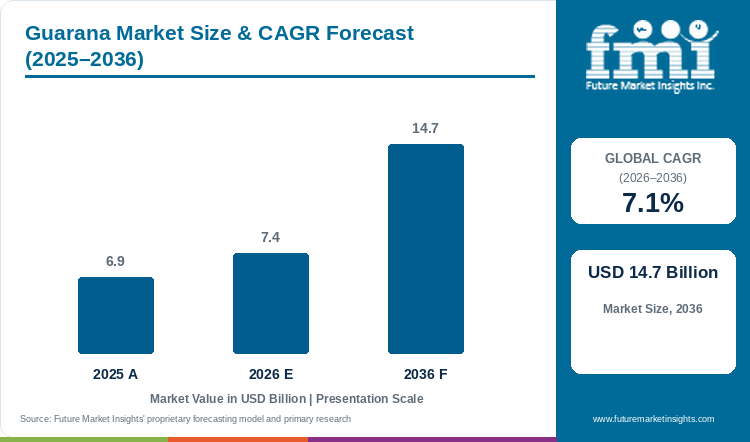
Assessed at USD 6.9 billion in 2025 and progressing to USD 7.4 billion in 2026, the guarana market valuation is on course to reach USD 14.7 billion by 2036, supported by a forecast-period CAGR of 7.1%.
Consumer preference for clean-label, plant-derived energy drinks is steadily shifting ingredient procurement away from synthetic caffeine across global beverage plants. The global guarana market stood at USD 6.9 billion in 2025 and reaches an estimated USD 7.4 billion in 2026. Global industry valuation is forecast by FMI to hit USD 14.7 billion by 2036, advancing at a 7.1% annual rate across the 2026 to 2036 decade. Liquid Guarana Extracts and Syrups capture a 56.4% share of 2026 product form value because pre-clarified syrups blend smoothly into clear sparkling cans without leaving dark sediment at the bottom. Demand for standardized botanical extracts is gaining momentum as sports-nutrition and functional drink brands seek measurable cognitive alertness without synthetic jitters. An August 2026 clinical trial in Sports (Basel) confirmed that a 300 mg dose of standardized 26% caffeine guarana extract delivers 78 mg of natural caffeine and sharpens reaction speed in athletes at p = 0.005 [2]. This sustained alertness profile gives guarana a strong commercial advantage over plant-based energy drink formulations that rely on artificial stimulants. However, when raw seed prices rise some low-cost traders dilute authentic seed powder with cheap synthetic caffeine, prompting buyers to adopt benchtop proton NMR testing validated in August 2026 with 100% sensitivity across 40 Maues seed lots [1]. In addition to quality testing costs, El Nino dry spells across Amazonas and Bahia farms tighten annual seed harvests and restrain faster market expansion through 2036.
Key Market Trends & Insights
- By product form: Liquid Guarana Extracts and Syrups hold an estimated 56.4% share in 2026 because clarified liquid concentrates pump directly into beverage mixing lines and reduce batch preparation time.
- By caffeine standardization: Standardized 10% to 22% Natural Caffeine extracts represent 52.8% in 2026 since uniform caffeine potency helps beverage brands stay within national label limits on retail cans.
- By cultivation method: Conventional Amazonian Cultivated supply secures 74.2% in 2026 owing to higher per-hectare seed yields across managed plantations in Bahia and Mato Grosso.
- By end-use application: Energy Drinks and Carbonated Soft Drinks account for 48.6% in 2026 as soft drink bottlers combine natural guarana caffeine with zero-sugar fruit and electrolyte bases.
- By distribution channel: Direct B2B Beverage and Nutraceutical Contracts command 61.8% in 2026 through multi-year volume agreements and batch purity verification.
Regional Highlights
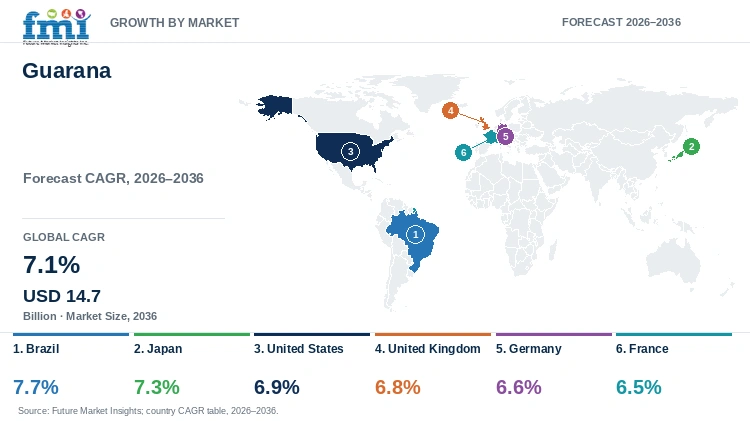
- Top national expansion: Brazil leads national growth projections at a 7.7% CAGR through 2036 under expanding disease-resistant seed farming and domestic carbonated soft drink bottling.
- Broader country progression: Japan tracks at a 7.3% CAGR ahead of the United States at 6.9% and the United Kingdom at 6.8%, while Germany records 6.6% and France reaches 6.5%.
Market Size & Forecast
Table 1: Market Size and Forecast for the Guarana Market (USD billion and CAGR percentage), 2025 to 2036
| Metric | Value |
|---|---|
| 2025 Market Size | USD 6.9 billion |
| Estimated Market Size in 2026 | USD 7.4 billion |
| Projected Market Size by 2036 | USD 14.7 billion |
| CAGR, 2026 to 2036 | 7.1% |
| Added Market Value, 2026 to 2036 | USD 7.3 billion |
Beverage manufacturers expanding their natural energy portfolios face a practical formulation challenge when working with raw guarana seeds. Unrefined seed powders contain high levels of natural plant tannins that create a bitter, astringent taste and form cloudy sediment in clear bottled waters. As a matter of fact, a March 2025 nutritional study in Nutrients documented that raw guarana seeds contain 3.6% to 5.8% natural caffeine with 13% to 16% tannins that slow down digestion and alter flavor [3]. To solve this bitterness issue and speed up beverage adoption, commercial extractors filter out excess tannins and blend clarified guarana syrups with standardized yerba mate extracts for a clean, smooth taste.
Processed Seed and Active-Caffeine Sizing
Table 2: Processed Seed and Active-Caffeine Sizing for the Guarana Market (USD billion, thousand metric tons, and USD per kilogram), 2025 to 2036
| Metric | 2025 | 2026 | 2036 |
|---|---|---|---|
| Market size (USD billion) | 6.9 | 7.4 | 14.7 |
| Processed commercial guarana seed & syrup base volume (thousand metric tons) | 142.0 to 156.0 | 151.0 to 166.0 | 285.0 to 312.0 |
| Standardized extract, syrup & powder output (thousand metric tons) | 64.5 to 71.2 | 68.8 to 76.0 | 132.0 to 146.0 |
| Average commercial guarana syrup & extract valuation per kilogram (USD) | 86.0 to 98.5 | 86.5 to 99.2 | 90.5 to 103.8 |
Operational note: Extract sizing applies standard 10% to 22% natural caffeine standardization yields against ANVISA 35 mg per 100 mL energy drink and 75 to 200 mg daily supplement dosing benchmarks.
Strong buyer demand for pre-workout sports powders and functional cosmetics has also increased the need for seasonal phytochemical standardization across Amazonian harvesting regions. Because rainfall and sunshine levels shift plant alkaloid and polyphenol synthesis between dry and rainy harvest months, unblended raw lots often vary in antioxidant strength. A March 2025 study in Pharmaceutics by researchers at EMBRAPA and the University of Brasilia confirmed that guarana harvests from Bahia carry higher caffeine and tannin concentrations, whereas Amazonas lots exhibit distinct cyanolipid and procyanidin profiles with two-year colloidal stability [13]. As a result, large supplement buyers require regional lot blending and frequently pair standardized guarana powders with concentrated green tea extracts in multi-ingredient energy blends.
Per Capita & Commercial Beverage Line Sizing
Table 3: Per Capita and Beverage Line Valuation Indicators for the Guarana Market (USD and percentage share), 2025 to 2036
| Metric | 2025 | 2026 | 2036 |
|---|---|---|---|
| World population (billion) | 8.2 | 8.3 | 9.0 |
| Market value per 1,000 people (USD) | 841.5 | 891.6 | 1,633.3 |
| Annual market value per functional beverage line (USD thousand) | 480.0 to 520.0 | 510.0 to 555.0 | 940.0 to 1,020.0 |
| Standardized above-10% caffeine extract share (%) | 71.0% to 75.0% | 72.5% to 76.5% | 79.0% to 83.0% |
Table 4: Industrial Bottling and Channel Valuation Indicators for the Guarana Market (USD billion and line count), 2026
| Metric | Value | Institutional Reference Basis |
|---|---|---|
| Market size, 2026 | USD 7.4 billion | 2026 global market valuation baseline |
| Commercial energy & functional bottling lines global | 13,800 lines | Carbonated energy and botanical soft drink lines |
| Market value per bottling line | USD 536,231.9 | Annualized guarana syrup and extract procurement valuation |
| Direct B2B contracts market value, 2026 | USD 4.6 billion | 61.8% distribution channel allocation |
Consumer shift toward zero-sugar beverages is creating new formulation requirements for ingredient suppliers. Without sugar to cover up bitter plant notes, beverage makers need debittered botanical extracts that still deliver a full 80 to 150 mg caffeine kick per can. To cater to this growing demand, in October 2025 Duas Rodas introduced its Fruittion Botanicals and MateActive natural extract lines at The Food Tech Summit in Mexico for customers across 70 countries [6]. Through such debittered liquid systems and complementary functional energy ingredients, beverage brands can launch sugar-free natural energy drinks without sacrificing taste.
Analyst Perspective
"Beverage and supplement procurement teams no longer buy guarana as raw crushed Amazonian seed, because they require NMR-verified natural caffeine standardization and cold-water clarity. Extractors that pair traceable Bahia and Amazonas smallholder drying ovens with low-tannin membrane filtration will lock in multi-year energy drink contracts through 2036."
- Nandini Roy Choudhury, Principal Consultant, Future Market Insights.
How is the guarana market segmented?
The guarana market is segmented by product form and caffeine standardization with cultivation method, end-use application and distribution channel. In 2026, Liquid Guarana Extracts and Syrups are projected at 56.4% and Standardized 10% to 22% Natural Caffeine at 52.8%, while Conventional Amazonian Cultivated holds 74.2%, Energy Drinks and Carbonated Soft Drinks reach 48.6% and Direct B2B Beverage and Nutraceutical Contracts command 61.8%.
By product form: Liquid Guarana Extracts and Syrups with Spray-Dried Guarana Seed Powder and Micronized Roasted Seed Paste.
By caffeine standardization: Standardized 10% to 22% Natural Caffeine with High-Potency Above 22% Caffeine Extracts and Low-Caffeine Tannin-Rich Extracts.
By cultivation method: Conventional Amazonian Cultivated and Certified Organic and Wild-Harvested.
By end-use application: Energy Drinks and Carbonated Soft Drinks with Dietary Supplements and Sports Pre-Workouts as well as Confectionery and Functional Snacks plus Cosmetics and Cellulite Topical Creams.
By distribution channel: Direct B2B Beverage and Nutraceutical Contracts with Specialty Ingredient Distributors and Retail Health and Online Stores.
Why do Liquid Guarana Extracts and Syrups lead the product form category?
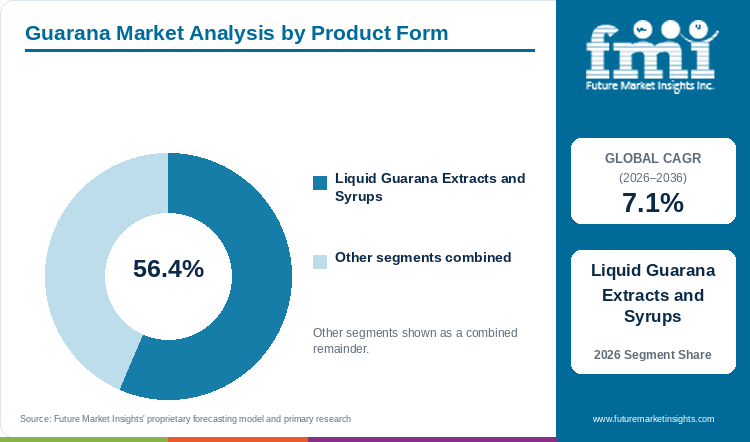
Liquid Guarana Extracts and Syrups hold an estimated 56.4% of product form demand in 2026, anchored by cold-water clarity and direct inline syrup dosing.
Table 5: Product Form Share for the Guarana Market (percentage share), 2026
| Product Form | Share (2026) |
|---|---|
| Liquid Guarana Extracts and Syrups | 56.4% |
| Other Segments Combined | 43.6%* |
| Total | 100.0% |
*Note: Balance product form categories (Spray-Dried Guarana Seed Powder and Micronized Roasted Seed Paste) make up the rest of 2026 global guarana consumption.
Table 6: Product Form Leadership and Market Growth for the Guarana Market (segment share and CAGR percentage), 2026 to 2036
| Metric | Value |
|---|---|
| Global CAGR (2026 to 2036) | 7.1% |
| Leading Segment | Liquid Guarana Extracts and Syrups (56.4% share in 2026) |
High-speed beverage bottling plants prioritize ingredients that dissolve instantly and do not clog mixing valves or pasteurization lines. Liquid guarana extracts and syrups have insoluble seed fibers and heavy tannins filtered out at the extraction mill, allowing bottlers to meter the liquid straight into syrup tanks. As a result, manufacturers producing clean-label energy supplements and functional waters prefer liquid extracts over dry powders to reduce mixing time and maintain crystal-clear beverage appearance.
- Liquid Guarana Extracts and Syrups hold 56.4% of product form value in 2026 because beverage syrup rooms pump liquid concentrates directly into batch tanks without dust-control hoods.
- In May 2026, Givaudan expanded its Sourcing4Good guarana program with 62 producer families in southern Bahia by installing mechanical seed-drying ovens that improve raw seed quality and extract clarity [7].
What sustains Standardized 10% to 22% Natural Caffeine leadership?
Standardized 10% to 22% Natural Caffeine grades represent 52.8% of the standardization category in 2026, supported by balanced alkaloid-to-polyphenol ratios and clean solubility.
Formulators making energy drinks and daily focus capsules need a reliable caffeine level in every kilogram of ingredient without stripping away the plant's natural antioxidants. Standardized 10% to 22% natural caffeine extracts hit the commercial sweet spot by giving buyers exact milligram dosing while keeping beneficial catechins intact. Brands developing standardized botanical supplements choose this mid-range standardization because pushing caffeine concentration above 22% requires heavier solvent processing that increases ingredient cost and bitterness.
- Standardized 10% to 22% Natural Caffeine accounts for 52.8% of standardization demand in 2026 as capsule and beverage plants balance active caffeine load against clean flavor.
- According to a February 2025 Toxicology Reports study, guarana powder administered at 300 mg per kg reduced liver stress markers by 24% to 44% due to its preserved catechin antioxidant content [4].
How does Conventional Amazonian Cultivated lead the cultivation method segment?
Conventional Amazonian Cultivated supply accounts for 74.2% of cultivation volume in 2026, driven by disease-resistant clonal cultivars across Bahia and Mato Grosso.
Wild-harvested guarana vines growing in deep forest areas suffer from fungal disease and produce very low seed yields per hectare. To meet rising global beverage orders at a stable price, commercial farms in Bahia and Mato Grosso cultivate disease-resistant clonal guarana bushes in open-sun plantations. This reliable harvest volume allows ingredient processors supplying formulated herbal nutraceuticals to sign multi-ton annual supply contracts without running out of raw seeds mid-year.
- Conventional Amazonian Cultivated harvests represent 74.2% of cultivation demand in 2026 because clonal plantations deliver four to six times the seed yield of wild forest vines.
- A March 2026 study in the Brazilian Journal of Biology evaluated 21 guarana genotypes across 12 fruit and seed traits in southern Bahia to help farmers select higher-yielding commercial plants [5].
Why do Energy Drinks and Carbonated Soft Drinks lead end-use applications?
Energy Drinks and Carbonated Soft Drinks secure 48.6% of application value in 2026, supported by global RTD energy can volume and guaraná soda consumption in Brazil.
Mass-market carbonated guaraná soft drinks in South America and clean-label energy cans in North America and Europe generate the largest recurring order volumes in the industry. Younger consumers are moving away from sugary sodas and artificial energy shots toward refreshing, plant-powered beverages that provide afternoon focus. Beverage innovation teams pairing guarana with ready-to-drink spirulina beverages are capturing this health-conscious demographic across supermarkets and convenience stores.
- Energy Drinks and Carbonated Soft Drinks secure 48.6% of end-use demand in 2026 as zero-sugar energy brands highlight natural Amazonian caffeine on front-of-pack labels.
- In October 2025, Givaudan Active Beauty also expanded personal care adoption by launching RitualEssenz Brazil COSMOS-approved guarana extract titrated at 9% to 11% caffeine for skin and scalp creams [8].
What gives Direct B2B Beverage and Nutraceutical Contracts the leading channel share?
Direct B2B Beverage and Nutraceutical Contracts command 61.8% of distribution channel share in 2026, anchored by custom aroma profiling and NMR authenticity testing.
Large beverage bottlers and contract supplement makers rarely buy guarana from spot-market brokers because unverified lots carry high risks of synthetic caffeine spiking and smoke contamination. Instead, major buyers sign direct annual contracts with primary extraction mills in Brazil and Europe that control farm sourcing and laboratory testing. These direct suppliers also bundle guarana extracts with natural food coloring systems to deliver complete, ready-to-bottled beverage bases.
- Direct B2B Beverage and Nutraceutical Contracts command 61.8% of channel value in 2026 because multi-year volume agreements protect beverage brands from seasonal seed price spikes.
- In October 2026, Symrise presented new clinical evidence for botanical wellness and convenient beverage stick-pack formulations at SupplySide Global 2026 to strengthen direct B2B partnerships [9].
What are the drivers, restraints, and opportunities in the guarana market?
In the guarana market, clean-label energy beverage reformulation and clinically validated cognitive alertness benefits drive adoption whereas Amazonian El Nino drought volatility restrains raw seed supply and low-field NMR authentication creates premium verified extract tiers.
- Driver: Clean-label functional beverage and pre-workout brands replace synthetic anhydrous caffeine with standardized natural guarana seed extracts.
- Restraint: Severe El Nino rainfall deficits and river transport bottlenecks in the Amazon Basin inflate raw roasted seed procurement costs.
- Opportunity: Benchtop proton NMR authentication and COSMOS-certified green fractionation open high-margin sports nutrition and topical cosmetic accounts.
Growth Analysis and Future Potential: Qualitative Demand Catalysts
Consumer migration from synthetic caffeine pills toward natural functional beverages is the primary catalyst driving global guarana demand. Office professionals and athletes want steady mental focus and physical stamina without the rapid heart rate and crash associated with artificial stimulants. In July 2024, sports-nutrition researchers writing in the Journal of the American Nutrition Association proved in a double-blind crossover trial across 27 soccer players that ingesting 3 grams of guarana seed powder 60 minutes before exercise measurably increased Yo-Yo Intermittent Recovery endurance distance compared with placebo at p = 0.01 [15]. In parallel, a July 2024 study in the Brazilian Journal of Medical and Biological Research demonstrated that 1,000 ug per mL of guarana extract enhanced cellular antioxidant potential and tissue viability without cytotoxicity [19]. Beverage makers are combining these clinically backed extracts with water-soluble anthocyanin pigments to launch eye-catching natural focus drinks.
Risk Assessment of the Guarana Market: Operational and Formulation Friction
Weather-related harvest swings in Brazil and dose-dependent formulation limits represent the main factors restraining guarana market growth. Because commercial guarana cultivation is concentrated in Amazonas and Bahia, extreme heat and irregular rainfall during El Nino cycles reduce flower pollination and berry yields across rural smallholder farms. On the formulation side, a June 2024 randomized crossover trial at the Georgia Institute of Technology published in Nutrients found that a low 500 mg dose of guarana seed extract delivering 130 mg caffeine improved perceived mental pep at p = 0.006 but required higher standardized alkaloid dosing to alter objective vagal modulation [14]. In addition, strict national regulatory caps such as ANVISA's 35 mg per 100 mL caffeine limit in energy drinks and 75 to 200 mg daily ceiling in supplements restrict how much extract formulators can include per serving.
Commercial Opportunity Analysis: Formulation Differentiation and Value-Add Formats
Ingredient suppliers are capturing higher profit margins by developing natural antimicrobial beverage preservatives and smoke-free instant-dissolve powders paired with topical beauty extracts. Traditional clay ovens used by small farmers often leave smoke odors in roasted seeds, prompting flavor houses to install clean mechanical drying units at origin. In December 2025, microbiologists publishing in Chemistry & Biodiversity reviewed Amazonian botanicals and confirmed that 81% of Paullinia cupana seed extracts exhibit bactericidal activity across 21 bacterial species [16]. Suppliers that pair these natural preservative and antioxidant properties with cold-water-soluble guarana syrups are capturing lucrative long-term contracts with clean-label beverage and dermo-cosmetic brands through 2036.
Guarana Market by Country (2026 to 2036)
FMI country modeling indicates that Brazil leads guarana market expansion at a 7.7% CAGR from 2026 to 2036, followed by Japan at 7.3% and the United States at 6.9%. The United Kingdom advances at 6.8%, whereas Germany records 6.6% and France progresses at 6.5%.
Table 7: Country CAGR and Primary Growth Levers for the Guarana Market (CAGR percentage), 2026 to 2036
| Country | CAGR (2026 to 2036) | Primary Growth Lever |
|---|---|---|
| Brazil | 7.7% | Domestic carbonated guaraná soft drink expansion and Bahia clonal seed breeding |
| Japan | 7.3% | Functional mental-alertness RTD beverages and e-sports supplement adoption |
| United States | 6.9% | Zero-sugar plant-based energy drinks and NMR-verified pre-workout powders |
| United Kingdom | 6.8% | Clean-label natural caffeine RTD waters and high-street sports nutrition |
| Germany | 6.6% | Phytopharmaceutical extract standardization and organic energy beverage bottling |
| France | 6.5% | COSMOS-certified topical caffeine cosmetics and botanical pharmacy supplements |
Source: Future Market Insights analysis
Brazil Guarana Market Outlook (2026 to 2036)
Brazil stands apart from every other national market because it functions as both the world's primary guarana seed producer and the largest consumer of mass-market guaraná soft drinks, driving a leading 7.7% CAGR through 2036. Unlike foreign buyers that purchase concentrated powders for supplements, domestic beverage plants process thousands of tons of liquid syrup for zero-sugar national sodas. An October 2026 USDA Foreign Agricultural Service assessment on Brazil noted that severe 2026 El Nino rainfall deficits across northern farming states forced agricultural processors to upgrade irrigation and drought-resilient crop management [10]. Domestic extractors are expanding clonal Bahia plantations to keep national soft drink syrups supplied year-round.
Key takeaway: In Brazil, clonal plantation upgrading in Bahia and domestic zero-sugar guaraná soft drink bottling anchor leading 7.7% annual growth.
Japan Guarana Market Outlook (2026 to 2036)
Demand in Japan is projected to advance at a 7.3% CAGR from 2026 to 2036, shaped by a unique consumer culture centered on convenience-store mental-focus shots and gaming supplements rather than sweet sodas. Office workers and e-sports players in Tokyo and Osaka seek low-calorie liquid vials and chewable tablets that combat afternoon fatigue without disturbing evening sleep. Visitor logs from the October 2026 USDA Tokyo attaché brief on FOODEX Japan showed that more than 72,000 commercial buyers prioritized functional wellness and single-serve beverage formats across 3,000 exhibition booths [11]. Domestic beverage formulators use debittered liquid guarana concentrates to deliver crisp, non-astringent energy shots for commuter rail kiosks across metropolitan Tokyo.
Key takeaway: In Japan, convenience-store mental-focus shots and e-sports tablet formulations propel 7.3% annual demand growth for debittered guarana extracts.
United States Guarana Market Outlook (2026 to 2036)
The United States guarana market is set to grow at a 6.9% CAGR between 2026 and 2036 as mainstream fitness consumers swap high-sugar synthetic energy cans for zero-sugar plant-based energy drinks and pre-workout stick-packs. Because retail chains in the United States enforce strict clean-label and dosing standards, supplement formulators calibrate natural caffeine levels carefully. In a January 2026 beverage innovation digest, Kerry Group highlighted rising consumer appetite across North America for functional botanical energy pairings with bright citrus and tropical flavor profiles [20]. Domestic sports-nutrition brands are pairing these natural flavor systems with 22% standardized guarana extracts to capture gym and grocery shelf space nationwide.
Key takeaway: In the United States, plant-based energy can reformulation and standardized pre-workout stick-pack launches sustain a 6.9% CAGR through 2036.
United Kingdom Guarana Market Outlook (2026 to 2036)
In the United Kingdom, supermarket restrictions on artificial high-caffeine drinks sold to young consumers are steering beverage brands toward natural botanical sparkling waters, supporting a 6.8% CAGR from 2026 to 2036. Shoppers in the UK favor low-calorie fruit infusions blended with guarana and green tea extracts for gentle daytime alertness. Retail findings in the November 2025 USDA London attaché report UK2025-0035 show that value-conscious shoppers and major grocery chains across England and Scotland are expanding private-label functional beverage and health-food assortments [21]. During February 2026, Kerry Group published results showing 3.5% beverage and food volume expansion driven by clean-label European beverage and nutritional drink reformulation across grocery accounts [12].
Key takeaway: In the United Kingdom, zero-sugar botanical energy waters and supermarket functional drink reformulation support 6.8% annual growth through 2036.
Germany Guarana Market Outlook (2026 to 2036)
Germany differs from other European markets because its domestic phytopharmaceutical extraction industry processes raw imported guarana seeds into pharmaceutical-grade concentrates, underpinning a 6.6% compound rate through 2036. Extraction mills in Germany import whole dried seeds from Brazil and apply gentle water-ethanol filtration to standardize caffeine and tannin levels for continental beverage and supplement brands. Organic trade data from USDA Berlin brief GM2026-0003 in January 2026 confirmed that record organic food demand across more than 2,200 specialized organic shops and national supermarket chains is accelerating clean-label botanical procurement [17]. Organic bio-soda bottlers across Germany pair certified organic guarana extracts with apple and berry juices for natural retail chains.
Key takeaway: In Germany, domestic botanical extraction engineering and record organic retail beverage demand underpin a 6.6% CAGR through 2036.
France Guarana Market Outlook (2026 to 2036)
Unlike northern European countries where energy cans dominate consumption, France achieves a 6.5% CAGR through 2036 largely through prestige dermo-cosmetic body creams and pharmacy slimming ampoules. Cosmetic formulators in France use standardized guarana caffeine in topical serums and shampoos to stimulate skin microcirculation and firm body contours. Plant audits in USDA Paris attaché brief FR2025-0004 from April 2025 documented that roughly 19,000 domestic food and botanical ingredient plants are expanding natural botanical procurement for domestic retail and export channels [18]. Pharmacy supplement and dermo-cosmetic laboratories across metropolitan France combine green-fractionated guarana extracts with marine collagen and polyphenols in premium daily vitality vials and organic capsules.
Key takeaway: In France, COSMOS-certified topical caffeine cosmetics and pharmacy botanical ampoules drive a 6.5% annual expansion rate.
Full report country CAGRs cover North America and Latin America with Western and Eastern Europe. Coverage also spans East Asia and South Asia and Pacific with the Middle East and Africa.
Who are the notable companies in the guarana market?
Ambev S.A. and Givaudan SA with Symrise AG, Duas Rodas Industrial, Prozyn Biosolutions, Finzelberg GmbH & Co. KG and Natural Amazon Herbs Producao de Extratos Ltda. are the notable companies in the guarana market.
Competitive positioning in the guarana industry separates vertically integrated beverage and botanical extraction leaders from specialized phytopharmaceutical refiners and Amazonian origin processors.
- Vertically Integrated Beverage and Botanical Leaders: Ambev S.A. with Givaudan SA and Symrise AG manage direct Amazonian and Bahia seed procurement programs with industrial extraction and aroma encapsulation lines.
- South America Standardized Extract and Bio-Ingredient Specialists: Duas Rodas Industrial and Prozyn Biosolutions engineer clarified liquid syrups and spray-dried guarana powders with enzymatic botanical processing solutions.
- Phytopharmaceutical and Amazonian Origin Extractors: Finzelberg GmbH & Co. KG and Natural Amazon Herbs Producao de Extratos Ltda. supply pharmacopoeial standardized extracts and traceable Maues and Bahia seed concentrates.
Competitive Benchmarking: Guarana Market
Table 8: Competitive Benchmarking for the Guarana Market (qualitative capability ratings and geographic reach)
| Company | Caffeine Standardization Capability | Beverage Solubility Engineering | Traceable Origin Sourcing | Geographic Reach |
|---|---|---|---|---|
| Ambev S.A. | High | High | High | Brazil and Latin America beverage bottling with Maues Amazonas agronomic network |
| Givaudan SA | High | High | High | Global botanical extraction network and Bahia Sourcing4Good smallholder program |
| Symrise AG | High | High | High | Global Diana Food and Amazonian botanical extraction and spray-drying facilities |
| Duas Rodas Industrial | High | High | High | Latin America and 70-country export network for Fruittion Botanicals extracts |
| Prozyn Biosolutions | Medium | High | Medium | Brazil and South America enzymatic beverage and botanical processing solutions |
| Finzelberg GmbH & Co. KG | High | Medium | High | European and global phytopharmaceutical standardized botanical extraction |
| Natural Amazon Herbs Producao de Extratos Ltda. | High | Medium | High | Brazil origin dry and fluid Amazonian guarana seed extraction for global B2B export |
Scoring basis: Caffeine Standardization Capability evaluates published specification ranges across 10% to above-22% natural caffeine grades, whereas Beverage Solubility Engineering rates tannin removal and cold-water clarity in carbonated cans. Traceable Origin Sourcing measures documented farm-level partnerships and synthetic caffeine adulteration screening across Amazonas and Bahia supply chains.
Key Developments in the Guarana Market
- Givaudan SA expanded its Sourcing4Good guarana sustainability initiative in southern Bahia in May 2026, equipping 62 smallholder farming families with hygienic seed-drying ovens and soil conservation training [7].
- Duas Rodas Industrial showcased its Fruittion Botanicals and standardized natural caffeine extract portfolio at The Food Tech Summit & Expo in October 2025, targeting zero-sugar beverage and pre-workout formulations across 70 countries [6].
- Givaudan Active Beauty launched its RitualEssenz Brazil botanical collection in October 2025, featuring a COSMOS-approved green-fractionated guarana extract standardized to 9% to 11% natural caffeine for topical skin and hair formulations [8].
- Symrise AG presented new clinical botanical wellness data and single-serve beverage stick-pack concepts at SupplySide Global in October 2026 to accelerate functional beverage and supplement co-development [9].
Key Players in the Guarana Market
Vertically Integrated Beverage and Botanical Leaders
- Ambev S.A.
- Givaudan SA
- Symrise AG
South America Standardized Extract and Bio-Ingredient Specialists
- Duas Rodas Industrial
- Prozyn Biosolutions
Phytopharmaceutical and Amazonian Origin Extractors
- Finzelberg GmbH & Co. KG
- Natural Amazon Herbs Producao de Extratos Ltda.
Guarana Market - Report Scope
Table 9: Report Scope for the Guarana Market (coverage fields and definitions), 2026 to 2036
| Coverage field | Report scope |
|---|---|
| Market breakdown | Product Form and Caffeine Standardization with Cultivation Method, End-Use Application and Distribution Channel |
| Quantitative Units | USD Billion |
| Market Definition | Commercial supplier valuation of processed Paullinia cupana ingredients including liquid guarana extracts and beverage syrups, spray-dried seed powders, and micronized roasted seed pastes standardized for natural caffeine and catechin content across beverage, supplement, and cosmetic formulators. |
| Regions Covered | North America and Latin America with Western Europe, Eastern Europe, East Asia, South Asia and Pacific and Middle East and Africa |
| Countries Covered | United States and Brazil with Germany, United Kingdom, Japan and France plus additional national markets |
| Key Companies Covered | Ambev S.A. and Givaudan SA with Symrise AG, Duas Rodas Industrial, Prozyn Biosolutions, Finzelberg GmbH & Co. KG and Natural Amazon Herbs Producao de Extratos Ltda. |
| Forecast Period | 2026 to 2036 |
| Approach | Primary and secondary research with top-down functional botanical baselines and bottom-up roasted seed extraction tonnage triangulation. |
Guarana Market - Research Methodology
Table 10: Research Methodology for the Guarana Market (research methods and approaches)
| Method | Approach |
|---|---|
| Primary Research | Structured interviews with guarana cooperative agronomists in Brazil and botanical extraction plant directors with beverage R&D chemists and nutraceutical quality managers to validate seed-to-extract conversion ratios. |
| Secondary Research | Analysis of USDA Foreign Agricultural Service GAIN agricultural reports and PubMed/PMC clinical and NMR chemometric studies with ANVISA regulatory limits and corporate filings. |
| Market Sizing and Forecasting | Top-down botanical energy beverage and supplement baselines reconciled against bottom-up processed Paullinia cupana seed and syrup base tonnage (151.0K to 166.0K MT in 2026) and standardized extract values per kilogram from 2026 to 2036. |
| Country Forecasting Model | Econometric national projections weight carbonated guaraná soft drink production and zero-sugar plant-based energy drink launches with topical caffeine cosmetic adoption across six priority countries. |
| Operational Benchmark Traceability | Processed seed and bottling line indicators in Tables 2, 3, and 4 trace to Journal of Agricultural and Food Chemistry NMR alkaloid assays and Sports (Basel) clinical dosing trials with USDA FAS trade reports. |
| Data Triangulation and Validation | Valuation estimates isolate B2B guarana extract, syrup, powder, and paste supply while strictly excluding finished retail energy drink bottle prices and synthetic caffeine adulterants. |
Guarana Market by Segments
Guarana Market segmented by Product Form:
- Liquid Guarana Extracts and Syrups
- Spray-Dried Guarana Seed Powder
- Micronized Roasted Seed Paste
Guarana Market segmented by Caffeine Standardization:
- Standardized 10% to 22% Natural Caffeine
- High-Potency Above 22% Caffeine Extracts
- Low-Caffeine Tannin-Rich Extracts
Guarana Market segmented by Cultivation Method:
- Conventional Amazonian Cultivated
- Certified Organic and Wild-Harvested
Guarana Market segmented by End-Use Application:
- Energy Drinks and Carbonated Soft Drinks
- Dietary Supplements and Sports Pre-Workouts
- Confectionery and Functional Snacks
- Cosmetics and Cellulite Topical Creams
Guarana Market segmented by Distribution Channel:
- Direct B2B Beverage and Nutraceutical Contracts
- Specialty Ingredient Distributors
- Retail Health and Online Stores
Guarana Market by Region
- North America
- United States
- Canada
- Latin America
- Brazil
- Mexico
- Argentina
- Chile
- Western Europe
- Germany
- France
- United Kingdom
- Italy
- Spain
- Benelux
- Nordics
- Eastern Europe
- Poland
- Czech Republic
- Romania
- Hungary
- East Asia
- China
- Japan
- South Korea
- South Asia and Pacific
- India
- ASEAN
- Australia and New Zealand
- Middle East and Africa
- GCC Countries
- South Africa
- Türkiye
- Israel
Research Sources and Bibliography
- [1] de Andrade, J. C., de Oliveira, P. L. C., Machado, M., de Oliveira, A. T., Santos, A. N. A., & Conte-Junior, C. A. (2026, August 10). Novel Analytical Workflow for Tracing Synthetic Caffeine Adulteration in Amazonian Guarana (Paullinia cupana) Using Low-Field 1H NMR Fingerprinting and Chemometrics. Journal of Agricultural and Food Chemistry, 74(32), 25744 to 25759 (PMCID PMC13495765).
- [2] Rekik, S., Fessi, M. S., Hidouri, S., Hagan, J. E., Jr., Ardelean, V. P., Geanta, V. A., Trabelsi, K., & Moalla, W. (2026, August 3). Acute Effects of Guarana (Paullinia cupana) Supplementation on Cognitive Performance, Technical Skills, and Physiological Responses in Amateur Soccer Players. Sports (Basel), 14(8), 329 (PMCID PMC13517124).
- [3] Amaritei, V., Buruiana, P. E., Filip, R., Filip, F., Lupaescu, A. V., Iavorschi, M., & Gheorghita, R. E. (2025, March 12). Effects of Guarana and Green Tea Consumption on Students' Intellectual Performances. Nutrients, 17(6), 1000 (PMCID PMC11945102).
- [4] Teixeira, C. D., Barbosa, P. O., Lima, W. G., Breguez, G. S., Fagundes, M. M. A., Costa, D. C., Magalhaes, C. L. B., Amaral, J. F., & de Souza, M. O. (2025, February 3). Preventive treatment with guarana powder (Paullinia cupana) mitigates acute paracetamol-induced hepatotoxicity by modulating oxidative stress. Toxicology Reports, 14, 101946 (PubMed PMID 39989980).
- [5] Bu Escobar, R. J., Lima, T. M., & Barbosa, R. M. (2026, March 9). Genetic variability among guarana (Paullinia cupana var. sorbilis (Mart.) Ducke) provenances to support breeding strategies. Brazilian Journal of Biology, 85, e296096 (PubMed PMID 41810625).
- [6] Duas Rodas. (2025, October 9). Duas Rodas showcases standardized natural yerba mate extracts at The Food Tech Summit & Expo 2025. Duas Rodas Industrial Newsroom.
- [7] Givaudan SA. (2026, May 23). Brazil: Cultivating a bright future for guarana. Givaudan Sourcing4Good Program.
- [8] Givaudan SA. (2025, October 9). RitualEssenz Brazil: Botanical extracts rooted in Brazilian diversity. Givaudan Active Beauty.
- [9] Symrise AG. (2026, October 21). Symrise presents new clinical evidence for skin and digestive health at SupplySide Global 2026. Symrise Corporate Newsroom.
- [10] USDA Foreign Agricultural Service. (2026, October 13). Brazil: Bracing for Impact as the 2026 El Nino Affects Agriculture in Brazil. U.S. Department of Agriculture GAIN Report BR2026-0040.
- [11] USDA Foreign Agricultural Service. (2026, October 20). Japan: FOODEX Japan 2026 Report. U.S. Department of Agriculture GAIN Report JA2026-0017.
- [12] Kerry Group. (2026, February 17). Kerry Group Preliminary Statement of Results for the year ended 31 December 2025. Kerry Group plc Media Releases.
- [13] Lima, A. K. O., Vieira, I. R. S., Souza, L. M. D. S., Florencio, I., da Silva, I. G. M., Chorilli, M., & Garcia, M. P. (2025, March 10). Green Synthesis of Silver Nanoparticles Using Paullinia cupana Kunth Leaf Extract Collected in Different Seasons: Biological Studies and Catalytic Properties. Pharmaceutics, 17(3), 356 (PMCID PMC11945093).
- [14] Talik, T. N., Penna, E. M., Hack, B. P., Harp, A., & Millard-Stafford, M. (2024, June 15). Effects of Acute Guarana (Paullinia cupana) Ingestion on Mental Performance and Vagal Modulation Compared to a Low Dose of Caffeine. Nutrients, 16(12), 1892 (PMCID PMC11206275).
- [15] Estrazulas, J. A., Dos Santos, F. P., Machado, A. J. T., Legnani, E., Bertuzzi, R., & Lima-Silva, A. E. (2024, July 3). Effects of Acute Ingestion of Guarana (Paullinia Cupana) on Soccer Player Performance: A Randomized, Cross-over, Placebo-Controlled Study. Journal of the American Nutrition Association, 43(8), 671 to 677 (PubMed PMID 38958672).
- [16] Totti de Lara, N. O., Polonio, J. C., & Golias, H. C. (2025, December 8). Antimicrobial Potential of Three Native Plant Species From the Brazilian Amazon: A Review. Chemistry & Biodiversity, 23(2), e01911 (PubMed PMID 41355715).
- [17] USDA Foreign Agricultural Service. (2026, January 29). Germany: Large Retail Chains Support Record Year for German Organic Sales. U.S. Department of Agriculture GAIN Report GM2026-0003.
- [18] USDA Foreign Agricultural Service. (2025, April 2). France: Food Processing Ingredients Annual. U.S. Department of Agriculture GAIN Report FR2025-0004.
- [19] Sirena, D. H., Araujo, A. B., da Silveira, A. B. T., Serafini, M. A., da Silva, M. M. F., Silveira, A. K., Filippi-Chiela, E., Moreira, J. C. F., & Paz, A. H. (2024, July 29). Guarana (Paullinia cupana) as a potential tool for mesenchymal stromal cells priming in regenerative medicine. Brazilian Journal of Medical and Biological Research, 57, e13286 (PMCID PMC11290817).
- [20] Kerry Group. (2026, January 12). Driving Flavour Innovation in 2026 with Taste Charts. Kerry Group Digest Insights.
- [21] USDA Foreign Agricultural Service. (2025, November 19). United Kingdom: Retail Foods Annual. U.S. Department of Agriculture GAIN Report UK2025-0035.
This bibliography is provided for reader reference and is not exhaustive. The full report contains the complete reference list and detailed citations.
This Report Answers
- How large is the guarana market in 2026 and what is forecast for 2036?
- Which clean-label beverage and sports nutrition pressures support demand for standardized guarana extracts?
- Why do Liquid Guarana Extracts and Syrups lead the product form category?
- Why does Standardized 10% to 22% Natural Caffeine lead the standardization segment globally?
- How do growth rates differ across Brazil and Japan compared with the United States and the United Kingdom?
- Which leading companies manage direct Amazonian seed sourcing versus specialized botanical extraction?
- What limits raw seed harvest stability or causes synthetic caffeine adulteration risks in the guarana market?
- What should beverage and supplement buyers evaluate when specifying NMR-authenticated guarana extracts?
Table of Content
Table of Content
- Key Takeaways
- Market Size and CAGR
- Top Growth Driver
- Fastest Growing Segment
- Leading Region
- Key Companies
- Emerging Opportunities
- Executive Summary
- Global Market Outlook
- Demand-side Trends
- Supply-side Trends
- Technology Roadmap Analysis
- Analysis and Recommendations
- Analyst Perspective (What is happening? Why now? What should investors know?)
- Key Questions Answered
- How large is the market?
- What is the CAGR?
- What are key trends?
- Which region dominates?
- Who are the leaders?
Read More...
- Market Overview
- Market Coverage / Taxonomy
- Market Definition / Scope / Limitations
- Research Methodology
- Chapter Orientation
- Analytical Lens and Working Hypotheses
- Market Structure, Signals, and Trend Drivers
- Benchmarking and Cross-market Comparability
- Market Sizing, Forecasting, and Opportunity Mapping
- Research Design and Evidence Framework
- Desk Research Programme (Secondary Evidence)
- Expert Input and Fieldwork (Primary Evidence)
- Tooling, Models, and Reference Databases
- Data Engineering and Model Build
- Quality Assurance and Audit Trail
- Market Background
- Market Dynamics (Drivers, Restraints, Opportunity, Trends)
- Scenario Forecast (Optimistic, Likely, Conservative)
- Impact Analysis
- AI Impact
- Sustainability Impact
- Regulatory Impact
- Technology Impact
- Consumer / Buyer Analysis
- Purchase Drivers
- Adoption Barriers
- Buyer Journey
- Opportunity Map Analysis
- Product Life Cycle Analysis
- Supply Chain Analysis
- Investment Feasibility Matrix
- Value Chain Analysis
- PESTLE and Porter's Analysis
- Regulatory Landscape
- Regional Parent Market Outlook
- Production and Consumption Statistics
- Import and Export Statistics
- Global Market Analysis and Forecast, 2021 to 2036
- Historical Market Size Value (USD Billion) Analysis, 2021 to 2025
- Current and Future Market Size Value (USD Billion) Projections, 2026 to 2036
- Y-o-Y Growth Trend Analysis
- Absolute $ Opportunity Analysis
- Global Market Pricing Analysis, 2021 to 2036
- Global Market Analysis and Forecast, By Product Form, 2021 to 2036
- Introduction / Key Findings
- Historical Market Size Value (USD Billion) Analysis By Product Form, 2021 to 2025
- Current and Future Market Size Value (USD Billion) Analysis and Forecast By Product Form, 2026 to 2036
- Liquid Guarana Extracts and Syrups
- Spray-Dried Guarana Seed Powder
- Micronized Roasted Seed Paste
- Y-o-Y Growth Trend Analysis By Product Form, 2021 to 2025
- Absolute $ Opportunity Analysis By Product Form, 2026 to 2036
- Global Market Analysis and Forecast, By Caffeine Standardization, 2021 to 2036
- Introduction / Key Findings
- Historical Market Size Value (USD Billion) Analysis By Caffeine Standardization, 2021 to 2025
- Current and Future Market Size Value (USD Billion) Analysis and Forecast By Caffeine Standardization, 2026 to 2036
- Standardized 10% to 22% Natural Caffeine
- High-Potency Above 22% Caffeine Extracts
- Low-Caffeine Tannin-Rich Extracts
- Y-o-Y Growth Trend Analysis By Caffeine Standardization, 2021 to 2025
- Absolute $ Opportunity Analysis By Caffeine Standardization, 2026 to 2036
- Global Market Analysis and Forecast, By Cultivation Method, 2021 to 2036
- Introduction / Key Findings
- Historical Market Size Value (USD Billion) Analysis By Cultivation Method, 2021 to 2025
- Current and Future Market Size Value (USD Billion) Analysis and Forecast By Cultivation Method, 2026 to 2036
- Conventional Amazonian Cultivated
- Certified Organic and Wild-Harvested
- Y-o-Y Growth Trend Analysis By Cultivation Method, 2021 to 2025
- Absolute $ Opportunity Analysis By Cultivation Method, 2026 to 2036
- Global Market Analysis and Forecast, By End-Use Application, 2021 to 2036
- Introduction / Key Findings
- Historical Market Size Value (USD Billion) Analysis By End-Use Application, 2021 to 2025
- Current and Future Market Size Value (USD Billion) Analysis and Forecast By End-Use Application, 2026 to 2036
- Energy Drinks and Carbonated Soft Drinks
- Dietary Supplements and Sports Pre-Workouts
- Confectionery and Functional Snacks
- Cosmetics and Cellulite Topical Creams
- Y-o-Y Growth Trend Analysis By End-Use Application, 2021 to 2025
- Absolute $ Opportunity Analysis By End-Use Application, 2026 to 2036
- Global Market Analysis and Forecast, By Distribution Channel, 2021 to 2036
- Introduction / Key Findings
- Historical Market Size Value (USD Billion) Analysis By Distribution Channel, 2021 to 2025
- Current and Future Market Size Value (USD Billion) Analysis and Forecast By Distribution Channel, 2026 to 2036
- Direct B2B Beverage and Nutraceutical Contracts
- Specialty Ingredient Distributors
- Retail Health and Online Stores
- Y-o-Y Growth Trend Analysis By Distribution Channel, 2021 to 2025
- Absolute $ Opportunity Analysis By Distribution Channel, 2026 to 2036
- Global Market Analysis and Forecast, By Region, 2021 to 2036
- Introduction
- Historical Market Size Value (USD Billion) Analysis By Region, 2021 to 2025
- Current Market Size Value (USD Billion) Analysis and Forecast By Region, 2026 to 2036
- North America
- Latin America
- Western Europe
- Eastern Europe
- East Asia
- South Asia and Pacific
- Middle East and Africa
- Market Attractiveness Analysis By Region
- North America Market Analysis and Forecast, By Country, 2021 to 2036
- Historical Market Size Value (USD Billion) Trend Analysis By Market Taxonomy, 2021 to 2025
- Market Size Value (USD Billion) Forecast By Market Taxonomy, 2026 to 2036
- By Country
- United States
- Canada
- By Product Form
- By Caffeine Standardization
- By Cultivation Method
- By End-Use Application
- By Distribution Channel
- By Country
- Market Attractiveness Analysis
- By Country
- By Product Form
- By Caffeine Standardization
- By Cultivation Method
- By End-Use Application
- By Distribution Channel
- Key Takeaways
- Latin America Market Analysis and Forecast, By Country
- Historical Market Size Value (USD Billion) Trend Analysis By Market Taxonomy, 2021 to 2025
- Market Size Value (USD Billion) Forecast By Market Taxonomy, 2026 to 2036
- By Country
- Brazil
- Mexico
- Argentina
- Chile
- By Product Form
- By Caffeine Standardization
- By Cultivation Method
- By End-Use Application
- By Distribution Channel
- By Country
- Market Attractiveness Analysis
- By Country
- By Product Form
- By Caffeine Standardization
- By Cultivation Method
- By End-Use Application
- By Distribution Channel
- Key Takeaways
- Western Europe Market Analysis and Forecast, By Country
- Historical Market Size Value (USD Billion) Trend Analysis By Market Taxonomy, 2021 to 2025
- Market Size Value (USD Billion) Forecast By Market Taxonomy, 2026 to 2036
- By Country
- Germany
- France
- United Kingdom
- Italy
- Spain
- Benelux
- Nordics
- By Product Form
- By Caffeine Standardization
- By Cultivation Method
- By End-Use Application
- By Distribution Channel
- By Country
- Market Attractiveness Analysis
- By Country
- By Product Form
- By Caffeine Standardization
- By Cultivation Method
- By End-Use Application
- By Distribution Channel
- Key Takeaways
- Eastern Europe Market Analysis and Forecast, By Country
- Historical Market Size Value (USD Billion) Trend Analysis By Market Taxonomy, 2021 to 2025
- Market Size Value (USD Billion) Forecast By Market Taxonomy, 2026 to 2036
- By Country
- Poland
- Czech Republic
- Romania
- Hungary
- By Product Form
- By Caffeine Standardization
- By Cultivation Method
- By End-Use Application
- By Distribution Channel
- By Country
- Market Attractiveness Analysis
- By Country
- By Product Form
- By Caffeine Standardization
- By Cultivation Method
- By End-Use Application
- By Distribution Channel
- Key Takeaways
- East Asia Market Analysis and Forecast, By Country
- Historical Market Size Value (USD Billion) Trend Analysis By Market Taxonomy, 2021 to 2025
- Market Size Value (USD Billion) Forecast By Market Taxonomy, 2026 to 2036
- By Country
- China
- Japan
- South Korea
- By Product Form
- By Caffeine Standardization
- By Cultivation Method
- By End-Use Application
- By Distribution Channel
- By Country
- Market Attractiveness Analysis
- By Country
- By Product Form
- By Caffeine Standardization
- By Cultivation Method
- By End-Use Application
- By Distribution Channel
- Key Takeaways
- South Asia and Pacific Market Analysis and Forecast, By Country
- Historical Market Size Value (USD Billion) Trend Analysis By Market Taxonomy, 2021 to 2025
- Market Size Value (USD Billion) Forecast By Market Taxonomy, 2026 to 2036
- By Country
- India
- ASEAN
- Australia and New Zealand
- By Product Form
- By Caffeine Standardization
- By Cultivation Method
- By End-Use Application
- By Distribution Channel
- By Country
- Market Attractiveness Analysis
- By Country
- By Product Form
- By Caffeine Standardization
- By Cultivation Method
- By End-Use Application
- By Distribution Channel
- Key Takeaways
- Middle East and Africa Market Analysis and Forecast, By Country
- Historical Market Size Value (USD Billion) Trend Analysis By Market Taxonomy, 2021 to 2025
- Market Size Value (USD Billion) Forecast By Market Taxonomy, 2026 to 2036
- By Country
- GCC Countries
- South Africa
- Türkiye
- Israel
- By Product Form
- By Caffeine Standardization
- By Cultivation Method
- By End-Use Application
- By Distribution Channel
- By Country
- Market Attractiveness Analysis
- By Country
- By Product Form
- By Caffeine Standardization
- By Cultivation Method
- By End-Use Application
- By Distribution Channel
- Key Takeaways
- Key Countries Market Analysis
- United States
- Pricing Analysis
- Market Share Analysis, 2025
- By Product Form
- By Caffeine Standardization
- By Cultivation Method
- By End-Use Application
- By Distribution Channel
- Canada
- Pricing Analysis
- Market Share Analysis, 2025
- By Product Form
- By Caffeine Standardization
- By Cultivation Method
- By End-Use Application
- By Distribution Channel
- Mexico
- Pricing Analysis
- Market Share Analysis, 2025
- By Product Form
- By Caffeine Standardization
- By Cultivation Method
- By End-Use Application
- By Distribution Channel
- Brazil
- Pricing Analysis
- Market Share Analysis, 2025
- By Product Form
- By Caffeine Standardization
- By Cultivation Method
- By End-Use Application
- By Distribution Channel
- Chile
- Pricing Analysis
- Market Share Analysis, 2025
- By Product Form
- By Caffeine Standardization
- By Cultivation Method
- By End-Use Application
- By Distribution Channel
- Germany
- Pricing Analysis
- Market Share Analysis, 2025
- By Product Form
- By Caffeine Standardization
- By Cultivation Method
- By End-Use Application
- By Distribution Channel
- United Kingdom
- Pricing Analysis
- Market Share Analysis, 2025
- By Product Form
- By Caffeine Standardization
- By Cultivation Method
- By End-Use Application
- By Distribution Channel
- Italy
- Pricing Analysis
- Market Share Analysis, 2025
- By Product Form
- By Caffeine Standardization
- By Cultivation Method
- By End-Use Application
- By Distribution Channel
- Spain
- Pricing Analysis
- Market Share Analysis, 2025
- By Product Form
- By Caffeine Standardization
- By Cultivation Method
- By End-Use Application
- By Distribution Channel
- France
- Pricing Analysis
- Market Share Analysis, 2025
- By Product Form
- By Caffeine Standardization
- By Cultivation Method
- By End-Use Application
- By Distribution Channel
- India
- Pricing Analysis
- Market Share Analysis, 2025
- By Product Form
- By Caffeine Standardization
- By Cultivation Method
- By End-Use Application
- By Distribution Channel
- ASEAN
- Pricing Analysis
- Market Share Analysis, 2025
- By Product Form
- By Caffeine Standardization
- By Cultivation Method
- By End-Use Application
- By Distribution Channel
- Australia and New Zealand
- Pricing Analysis
- Market Share Analysis, 2025
- By Product Form
- By Caffeine Standardization
- By Cultivation Method
- By End-Use Application
- By Distribution Channel
- China
- Pricing Analysis
- Market Share Analysis, 2025
- By Product Form
- By Caffeine Standardization
- By Cultivation Method
- By End-Use Application
- By Distribution Channel
- Japan
- Pricing Analysis
- Market Share Analysis, 2025
- By Product Form
- By Caffeine Standardization
- By Cultivation Method
- By End-Use Application
- By Distribution Channel
- South Korea
- Pricing Analysis
- Market Share Analysis, 2025
- By Product Form
- By Caffeine Standardization
- By Cultivation Method
- By End-Use Application
- By Distribution Channel
- Poland
- Pricing Analysis
- Market Share Analysis, 2025
- By Product Form
- By Caffeine Standardization
- By Cultivation Method
- By End-Use Application
- By Distribution Channel
- Hungary
- Pricing Analysis
- Market Share Analysis, 2025
- By Product Form
- By Caffeine Standardization
- By Cultivation Method
- By End-Use Application
- By Distribution Channel
- Türkiye
- Pricing Analysis
- Market Share Analysis, 2025
- By Product Form
- By Caffeine Standardization
- By Cultivation Method
- By End-Use Application
- By Distribution Channel
- South Africa
- Pricing Analysis
- Market Share Analysis, 2025
- By Product Form
- By Caffeine Standardization
- By Cultivation Method
- By End-Use Application
- By Distribution Channel
- United States
- Market Structure Analysis
- Competition Dashboard
- Competition Benchmarking
- Market Share Analysis of Top Players
- By Regional
- By Product Form
- By Caffeine Standardization
- By Cultivation Method
- By End-Use Application
- By Distribution Channel
- Emerging Startups
- Innovation Benchmarking
- Competition Analysis
- Competition Deep Dive
- Ambev S.A.
- Overview
- Product Portfolio
- Profitability by Market Segments
- Sales Footprint
- Strategy Overview
- Marketing Strategy
- Product Strategy
- Channel Strategy
- Givaudan SA
- Symrise AG
- Duas Rodas Industrial
- Prozyn Biosolutions
- Finzelberg GmbH & Co. KG
- Natural Amazon Herbs Producao de Extratos Ltda.
- Ambev S.A.
- Case Studies
- Success Stories
- Recent Developments
- Competition Deep Dive
- Assumptions & Acronyms Used
List of Tables
- Table 1: Global Market Value (USD Billion) Forecast by Region, 2021 to 2036
- Table 2: Global Market Value (USD Billion) Forecast by Product Form, 2021 to 2036
- Table 3: Global Market Value (USD Billion) Forecast by Caffeine Standardization, 2021 to 2036
- Table 4: Global Market Value (USD Billion) Forecast by Cultivation Method, 2021 to 2036
- Table 5: Global Market Value (USD Billion) Forecast by End-Use Application, 2021 to 2036
- Table 6: Global Market Value (USD Billion) Forecast by Distribution Channel, 2021 to 2036
- Table 7: North America Market Value (USD Billion) Forecast by Country, 2021 to 2036
- Table 8: North America Market Value (USD Billion) Forecast by Product Form, 2021 to 2036
- Table 9: North America Market Value (USD Billion) Forecast by Caffeine Standardization, 2021 to 2036
- Table 10: North America Market Value (USD Billion) Forecast by Cultivation Method, 2021 to 2036
- Table 11: North America Market Value (USD Billion) Forecast by End-Use Application, 2021 to 2036
- Table 12: North America Market Value (USD Billion) Forecast by Distribution Channel, 2021 to 2036
- Table 13: Latin America Market Value (USD Billion) Forecast by Country, 2021 to 2036
- Table 14: Latin America Market Value (USD Billion) Forecast by Product Form, 2021 to 2036
- Table 15: Latin America Market Value (USD Billion) Forecast by Caffeine Standardization, 2021 to 2036
- Table 16: Latin America Market Value (USD Billion) Forecast by Cultivation Method, 2021 to 2036
- Table 17: Latin America Market Value (USD Billion) Forecast by End-Use Application, 2021 to 2036
- Table 18: Latin America Market Value (USD Billion) Forecast by Distribution Channel, 2021 to 2036
- Table 19: Western Europe Market Value (USD Billion) Forecast by Country, 2021 to 2036
- Table 20: Western Europe Market Value (USD Billion) Forecast by Product Form, 2021 to 2036
- Table 21: Western Europe Market Value (USD Billion) Forecast by Caffeine Standardization, 2021 to 2036
- Table 22: Western Europe Market Value (USD Billion) Forecast by Cultivation Method, 2021 to 2036
- Table 23: Western Europe Market Value (USD Billion) Forecast by End-Use Application, 2021 to 2036
- Table 24: Western Europe Market Value (USD Billion) Forecast by Distribution Channel, 2021 to 2036
- Table 25: Eastern Europe Market Value (USD Billion) Forecast by Country, 2021 to 2036
- Table 26: Eastern Europe Market Value (USD Billion) Forecast by Product Form, 2021 to 2036
- Table 27: Eastern Europe Market Value (USD Billion) Forecast by Caffeine Standardization, 2021 to 2036
- Table 28: Eastern Europe Market Value (USD Billion) Forecast by Cultivation Method, 2021 to 2036
- Table 29: Eastern Europe Market Value (USD Billion) Forecast by End-Use Application, 2021 to 2036
- Table 30: Eastern Europe Market Value (USD Billion) Forecast by Distribution Channel, 2021 to 2036
- Table 31: East Asia Market Value (USD Billion) Forecast by Country, 2021 to 2036
- Table 32: East Asia Market Value (USD Billion) Forecast by Product Form, 2021 to 2036
- Table 33: East Asia Market Value (USD Billion) Forecast by Caffeine Standardization, 2021 to 2036
- Table 34: East Asia Market Value (USD Billion) Forecast by Cultivation Method, 2021 to 2036
- Table 35: East Asia Market Value (USD Billion) Forecast by End-Use Application, 2021 to 2036
- Table 36: East Asia Market Value (USD Billion) Forecast by Distribution Channel, 2021 to 2036
- Table 37: South Asia and Pacific Market Value (USD Billion) Forecast by Country, 2021 to 2036
- Table 38: South Asia and Pacific Market Value (USD Billion) Forecast by Product Form, 2021 to 2036
- Table 39: South Asia and Pacific Market Value (USD Billion) Forecast by Caffeine Standardization, 2021 to 2036
- Table 40: South Asia and Pacific Market Value (USD Billion) Forecast by Cultivation Method, 2021 to 2036
- Table 41: South Asia and Pacific Market Value (USD Billion) Forecast by End-Use Application, 2021 to 2036
- Table 42: South Asia and Pacific Market Value (USD Billion) Forecast by Distribution Channel, 2021 to 2036
- Table 43: Middle East and Africa Market Value (USD Billion) Forecast by Country, 2021 to 2036
- Table 44: Middle East and Africa Market Value (USD Billion) Forecast by Product Form, 2021 to 2036
- Table 45: Middle East and Africa Market Value (USD Billion) Forecast by Caffeine Standardization, 2021 to 2036
- Table 46: Middle East and Africa Market Value (USD Billion) Forecast by Cultivation Method, 2021 to 2036
- Table 47: Middle East and Africa Market Value (USD Billion) Forecast by End-Use Application, 2021 to 2036
- Table 48: Middle East and Africa Market Value (USD Billion) Forecast by Distribution Channel, 2021 to 2036
List of Figures
- Figure 1: Global Market Pricing Analysis
- Figure 2: Global Market Value (USD Billion) Forecast 2021-2036
- Figure 3: Global Market Value Share and BPS Analysis by Product Form, 2026 and 2036
- Figure 4: Global Market Y-o-Y Growth Comparison by Product Form, 2026-2036
- Figure 5: Global Market Attractiveness Analysis by Product Form
- Figure 6: Global Market Value Share and BPS Analysis by Caffeine Standardization, 2026 and 2036
- Figure 7: Global Market Y-o-Y Growth Comparison by Caffeine Standardization, 2026-2036
- Figure 8: Global Market Attractiveness Analysis by Caffeine Standardization
- Figure 9: Global Market Value Share and BPS Analysis by Cultivation Method, 2026 and 2036
- Figure 10: Global Market Y-o-Y Growth Comparison by Cultivation Method, 2026-2036
- Figure 11: Global Market Attractiveness Analysis by Cultivation Method
- Figure 12: Global Market Value Share and BPS Analysis by End-Use Application, 2026 and 2036
- Figure 13: Global Market Y-o-Y Growth Comparison by End-Use Application, 2026-2036
- Figure 14: Global Market Attractiveness Analysis by End-Use Application
- Figure 15: Global Market Value Share and BPS Analysis by Distribution Channel, 2026 and 2036
- Figure 16: Global Market Y-o-Y Growth Comparison by Distribution Channel, 2026-2036
- Figure 17: Global Market Attractiveness Analysis by Distribution Channel
- Figure 18: Global Market Value (USD Billion) Share and BPS Analysis by Region, 2026 and 2036
- Figure 19: Global Market Y-o-Y Growth Comparison by Region, 2026-2036
- Figure 20: Global Market Attractiveness Analysis by Region
- Figure 21: North America Market Incremental Dollar Opportunity, 2026-2036
- Figure 22: Latin America Market Incremental Dollar Opportunity, 2026-2036
- Figure 23: Western Europe Market Incremental Dollar Opportunity, 2026-2036
- Figure 24: Eastern Europe Market Incremental Dollar Opportunity, 2026-2036
- Figure 25: East Asia Market Incremental Dollar Opportunity, 2026-2036
- Figure 26: South Asia and Pacific Market Incremental Dollar Opportunity, 2026-2036
- Figure 27: Middle East and Africa Market Incremental Dollar Opportunity, 2026-2036
- Figure 28: North America Market Value Share and BPS Analysis by Country, 2026 and 2036
- Figure 29: North America Market Value Share and BPS Analysis by Product Form, 2026 and 2036
- Figure 30: North America Market Y-o-Y Growth Comparison by Product Form, 2026-2036
- Figure 31: North America Market Attractiveness Analysis by Product Form
- Figure 32: North America Market Value Share and BPS Analysis by Caffeine Standardization, 2026 and 2036
- Figure 33: North America Market Y-o-Y Growth Comparison by Caffeine Standardization, 2026-2036
- Figure 34: North America Market Attractiveness Analysis by Caffeine Standardization
- Figure 35: North America Market Value Share and BPS Analysis by Cultivation Method, 2026 and 2036
- Figure 36: North America Market Y-o-Y Growth Comparison by Cultivation Method, 2026-2036
- Figure 37: North America Market Attractiveness Analysis by Cultivation Method
- Figure 38: North America Market Value Share and BPS Analysis by End-Use Application, 2026 and 2036
- Figure 39: North America Market Y-o-Y Growth Comparison by End-Use Application, 2026-2036
- Figure 40: North America Market Attractiveness Analysis by End-Use Application
- Figure 41: North America Market Value Share and BPS Analysis by Distribution Channel, 2026 and 2036
- Figure 42: North America Market Y-o-Y Growth Comparison by Distribution Channel, 2026-2036
- Figure 43: North America Market Attractiveness Analysis by Distribution Channel
- Figure 44: Latin America Market Value Share and BPS Analysis by Country, 2026 and 2036
- Figure 45: Latin America Market Value Share and BPS Analysis by Product Form, 2026 and 2036
- Figure 46: Latin America Market Y-o-Y Growth Comparison by Product Form, 2026-2036
- Figure 47: Latin America Market Attractiveness Analysis by Product Form
- Figure 48: Latin America Market Value Share and BPS Analysis by Caffeine Standardization, 2026 and 2036
- Figure 49: Latin America Market Y-o-Y Growth Comparison by Caffeine Standardization, 2026-2036
- Figure 50: Latin America Market Attractiveness Analysis by Caffeine Standardization
- Figure 51: Latin America Market Value Share and BPS Analysis by Cultivation Method, 2026 and 2036
- Figure 52: Latin America Market Y-o-Y Growth Comparison by Cultivation Method, 2026-2036
- Figure 53: Latin America Market Attractiveness Analysis by Cultivation Method
- Figure 54: Latin America Market Value Share and BPS Analysis by End-Use Application, 2026 and 2036
- Figure 55: Latin America Market Y-o-Y Growth Comparison by End-Use Application, 2026-2036
- Figure 56: Latin America Market Attractiveness Analysis by End-Use Application
- Figure 57: Latin America Market Value Share and BPS Analysis by Distribution Channel, 2026 and 2036
- Figure 58: Latin America Market Y-o-Y Growth Comparison by Distribution Channel, 2026-2036
- Figure 59: Latin America Market Attractiveness Analysis by Distribution Channel
- Figure 60: Western Europe Market Value Share and BPS Analysis by Country, 2026 and 2036
- Figure 61: Western Europe Market Value Share and BPS Analysis by Product Form, 2026 and 2036
- Figure 62: Western Europe Market Y-o-Y Growth Comparison by Product Form, 2026-2036
- Figure 63: Western Europe Market Attractiveness Analysis by Product Form
- Figure 64: Western Europe Market Value Share and BPS Analysis by Caffeine Standardization, 2026 and 2036
- Figure 65: Western Europe Market Y-o-Y Growth Comparison by Caffeine Standardization, 2026-2036
- Figure 66: Western Europe Market Attractiveness Analysis by Caffeine Standardization
- Figure 67: Western Europe Market Value Share and BPS Analysis by Cultivation Method, 2026 and 2036
- Figure 68: Western Europe Market Y-o-Y Growth Comparison by Cultivation Method, 2026-2036
- Figure 69: Western Europe Market Attractiveness Analysis by Cultivation Method
- Figure 70: Western Europe Market Value Share and BPS Analysis by End-Use Application, 2026 and 2036
- Figure 71: Western Europe Market Y-o-Y Growth Comparison by End-Use Application, 2026-2036
- Figure 72: Western Europe Market Attractiveness Analysis by End-Use Application
- Figure 73: Western Europe Market Value Share and BPS Analysis by Distribution Channel, 2026 and 2036
- Figure 74: Western Europe Market Y-o-Y Growth Comparison by Distribution Channel, 2026-2036
- Figure 75: Western Europe Market Attractiveness Analysis by Distribution Channel
- Figure 76: Eastern Europe Market Value Share and BPS Analysis by Country, 2026 and 2036
- Figure 77: Eastern Europe Market Value Share and BPS Analysis by Product Form, 2026 and 2036
- Figure 78: Eastern Europe Market Y-o-Y Growth Comparison by Product Form, 2026-2036
- Figure 79: Eastern Europe Market Attractiveness Analysis by Product Form
- Figure 80: Eastern Europe Market Value Share and BPS Analysis by Caffeine Standardization, 2026 and 2036
- Figure 81: Eastern Europe Market Y-o-Y Growth Comparison by Caffeine Standardization, 2026-2036
- Figure 82: Eastern Europe Market Attractiveness Analysis by Caffeine Standardization
- Figure 83: Eastern Europe Market Value Share and BPS Analysis by Cultivation Method, 2026 and 2036
- Figure 84: Eastern Europe Market Y-o-Y Growth Comparison by Cultivation Method, 2026-2036
- Figure 85: Eastern Europe Market Attractiveness Analysis by Cultivation Method
- Figure 86: Eastern Europe Market Value Share and BPS Analysis by End-Use Application, 2026 and 2036
- Figure 87: Eastern Europe Market Y-o-Y Growth Comparison by End-Use Application, 2026-2036
- Figure 88: Eastern Europe Market Attractiveness Analysis by End-Use Application
- Figure 89: Eastern Europe Market Value Share and BPS Analysis by Distribution Channel, 2026 and 2036
- Figure 90: Eastern Europe Market Y-o-Y Growth Comparison by Distribution Channel, 2026-2036
- Figure 91: Eastern Europe Market Attractiveness Analysis by Distribution Channel
- Figure 92: East Asia Market Value Share and BPS Analysis by Country, 2026 and 2036
- Figure 93: East Asia Market Value Share and BPS Analysis by Product Form, 2026 and 2036
- Figure 94: East Asia Market Y-o-Y Growth Comparison by Product Form, 2026-2036
- Figure 95: East Asia Market Attractiveness Analysis by Product Form
- Figure 96: East Asia Market Value Share and BPS Analysis by Caffeine Standardization, 2026 and 2036
- Figure 97: East Asia Market Y-o-Y Growth Comparison by Caffeine Standardization, 2026-2036
- Figure 98: East Asia Market Attractiveness Analysis by Caffeine Standardization
- Figure 99: East Asia Market Value Share and BPS Analysis by Cultivation Method, 2026 and 2036
- Figure 100: East Asia Market Y-o-Y Growth Comparison by Cultivation Method, 2026-2036
- Figure 101: East Asia Market Attractiveness Analysis by Cultivation Method
- Figure 102: East Asia Market Value Share and BPS Analysis by End-Use Application, 2026 and 2036
- Figure 103: East Asia Market Y-o-Y Growth Comparison by End-Use Application, 2026-2036
- Figure 104: East Asia Market Attractiveness Analysis by End-Use Application
- Figure 105: East Asia Market Value Share and BPS Analysis by Distribution Channel, 2026 and 2036
- Figure 106: East Asia Market Y-o-Y Growth Comparison by Distribution Channel, 2026-2036
- Figure 107: East Asia Market Attractiveness Analysis by Distribution Channel
- Figure 108: South Asia and Pacific Market Value Share and BPS Analysis by Country, 2026 and 2036
- Figure 109: South Asia and Pacific Market Value Share and BPS Analysis by Product Form, 2026 and 2036
- Figure 110: South Asia and Pacific Market Y-o-Y Growth Comparison by Product Form, 2026-2036
- Figure 111: South Asia and Pacific Market Attractiveness Analysis by Product Form
- Figure 112: South Asia and Pacific Market Value Share and BPS Analysis by Caffeine Standardization, 2026 and 2036
- Figure 113: South Asia and Pacific Market Y-o-Y Growth Comparison by Caffeine Standardization, 2026-2036
- Figure 114: South Asia and Pacific Market Attractiveness Analysis by Caffeine Standardization
- Figure 115: South Asia and Pacific Market Value Share and BPS Analysis by Cultivation Method, 2026 and 2036
- Figure 116: South Asia and Pacific Market Y-o-Y Growth Comparison by Cultivation Method, 2026-2036
- Figure 117: South Asia and Pacific Market Attractiveness Analysis by Cultivation Method
- Figure 118: South Asia and Pacific Market Value Share and BPS Analysis by End-Use Application, 2026 and 2036
- Figure 119: South Asia and Pacific Market Y-o-Y Growth Comparison by End-Use Application, 2026-2036
- Figure 120: South Asia and Pacific Market Attractiveness Analysis by End-Use Application
- Figure 121: South Asia and Pacific Market Value Share and BPS Analysis by Distribution Channel, 2026 and 2036
- Figure 122: South Asia and Pacific Market Y-o-Y Growth Comparison by Distribution Channel, 2026-2036
- Figure 123: South Asia and Pacific Market Attractiveness Analysis by Distribution Channel
- Figure 124: Middle East and Africa Market Value Share and BPS Analysis by Country, 2026 and 2036
- Figure 125: Middle East and Africa Market Value Share and BPS Analysis by Product Form, 2026 and 2036
- Figure 126: Middle East and Africa Market Y-o-Y Growth Comparison by Product Form, 2026-2036
- Figure 127: Middle East and Africa Market Attractiveness Analysis by Product Form
- Figure 128: Middle East and Africa Market Value Share and BPS Analysis by Caffeine Standardization, 2026 and 2036
- Figure 129: Middle East and Africa Market Y-o-Y Growth Comparison by Caffeine Standardization, 2026-2036
- Figure 130: Middle East and Africa Market Attractiveness Analysis by Caffeine Standardization
- Figure 131: Middle East and Africa Market Value Share and BPS Analysis by Cultivation Method, 2026 and 2036
- Figure 132: Middle East and Africa Market Y-o-Y Growth Comparison by Cultivation Method, 2026-2036
- Figure 133: Middle East and Africa Market Attractiveness Analysis by Cultivation Method
- Figure 134: Middle East and Africa Market Value Share and BPS Analysis by End-Use Application, 2026 and 2036
- Figure 135: Middle East and Africa Market Y-o-Y Growth Comparison by End-Use Application, 2026-2036
- Figure 136: Middle East and Africa Market Attractiveness Analysis by End-Use Application
- Figure 137: Middle East and Africa Market Value Share and BPS Analysis by Distribution Channel, 2026 and 2036
- Figure 138: Middle East and Africa Market Y-o-Y Growth Comparison by Distribution Channel, 2026-2036
- Figure 139: Middle East and Africa Market Attractiveness Analysis by Distribution Channel
- Figure 140: Global Market - Tier Structure Analysis
- Figure 141: Global Market - Company Share Analysis
Frequently Asked Questions
How big is the guarana market in 2026, and what is forecast for 2036?
FMI estimates that the global guarana market size stood at USD 6.9 billion in 2025 and reached USD 7.4 billion in 2026. Overall industry valuation is projected to reach USD 14.7 billion by 2036 as functional beverage and pre-workout brands adopt natural botanical caffeine.
What is the CAGR for the guarana market from 2026 to 2036?
The guarana sector is projected to expand at a 7.1% CAGR over the 2026 to 2036 forecast window, generating USD 7.3 billion in incremental market value.
Which product form segment leads the guarana market?
Liquid Guarana Extracts and Syrups hold 56.4% of product form demand in 2026 because clarified fluid concentrates blend directly into carbonated soft drink and energy beverage tanks.
Which caffeine standardization segment leads the guarana market?
Standardized 10% to 22% Natural Caffeine extracts represent 52.8% of the standardization category in 2026 as beverage and capsule formulators balance reliable caffeine potency with clean solubility.
Which country has a notable growth outlook during the assessment period?
Brazil leads national expansion projections at a 7.7% CAGR through 2036, supported by high-yield clonal breeding in Bahia and domestic zero-sugar guaraná soft drink bottling.
Who are the key players in the market?
Ambev S.A. and Givaudan SA with Symrise AG and Duas Rodas Industrial as well as Prozyn Biosolutions and Finzelberg GmbH & Co. KG plus Natural Amazon Herbs Producao de Extratos Ltda. represent the core suppliers profiled.
Preview the report firsthand - request a free sample
Get SampleGet the brochure for pricing and purchase details.
Get PDF
