

- Market Size (2026)
- USD 1.5 Bn
- Forecast (2036)
- USD 2.5 Bn
- CAGR (2026 to 2036)
- 5.3%
How big is Leadscrew Market in 2026?
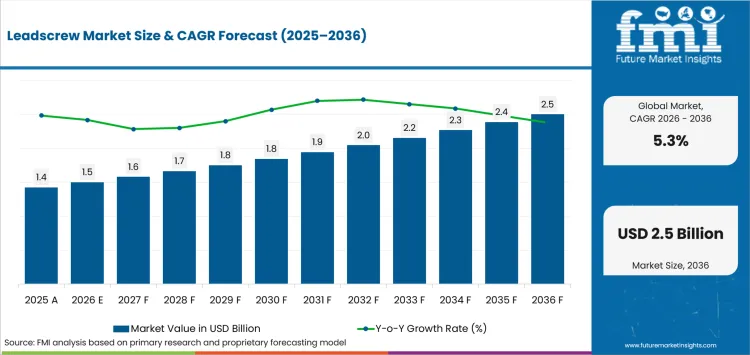
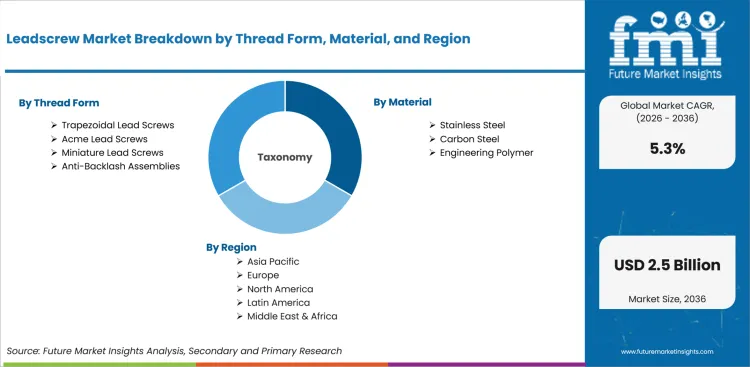
USD 1.5 billion in 2026 and USD 2.5 billion by 2036 at a 5.3% CAGR.
Leadscrew sales are projected to expand at 5.3% CAGR through 2036, increasing valuation from USD 1.5 billion in 2026 to USD 2.5 billion by 2036. Automated assembly cells need compact motion assemblies that convert motor torque into controlled travel without complex drive trains. The International Federation of Robotics recorded 542,000 industrial robot installations in 2024 across factory settings. Such installation activity gives configured motion needs inside industrial automation systems a practical operating base. Equipment designers use electric linear actuators for contained positioning tasks that reward simple interfaces and serviceable construction. Compact stepper motors provide practical drive options for short travel systems with predictable thrust requirements.
Key Takeaways of Leadscrew Market
- Compact automation modules need economical linear positioning with serviceable interfaces across recurring equipment programs and defined duty profiles.
- Trapezoidal lead screws are projected to account for 36.0% share in 2026 due to economical machining and replaceable nut configurations.
- By material, stainless steel is estimated to hold 42.0% share in 2026 owing to corrosion-sensitive equipment requiring compatible motion components.
- In 2026, linear actuators are forecast to capture 39.0% share, attributable to integrated motor and screw packages that reduce interface work.
- Sliding contact limits high-cycle precision duties because demanding profiles increase wear and backlash alongside heat.
- Thomson Industries, igus, AMETEK Haydon Kerk Pittman, Helix Linear Technologies, PBC Linear, Nook Industries, Oriental Motor, and Joyce/Dayton Corp. serve distinct configuration and duty-cycle roles across the market.
Analyst Perspective
“Industrial demand rewards motion assemblies that solve a defined travel and load problem without pushing sliding contact beyond its practical operating limit. Commercial success depends on clear thread geometry and nut pairing choices before a machine design reaches repeat production. Field replacement plans also require defined service responsibility across repeated production platforms operating under known duty conditions.”
- Nikhil Kaitwade, Principal Analyst, Future Market Insights
How is the Leadscrew market segmented?
The Leadscrew industry is segmented by thread form, material, diameter, application, end use and region.
The leadscrew market is organized by thread form and material alongside diameter, application, end use and regional availability because each dimension changes assembly selection for a defined equipment duty. Thread form separates trapezoidal and Acme designs from miniature or anti-backlash options for equipment programs with distinct load requirements. Material distinguishes stainless steel from carbon steel and engineering polymer options for environments with different corrosion conditions. Diameter captures package limits and stiffness requirements across compact actuator housings and associated support arrangements. Application identifies actuator uses and equipment classes that shape control integration, travel needs and practical service requirements. End use distinguishes the equipment sector purchasing each assembly and the operating environment affecting qualification. Regional analysis tracks availability and qualification conditions for factory automation controls systems across local equipment programs.
Why do trapezoidal lead screws shape demand within the thread form category?
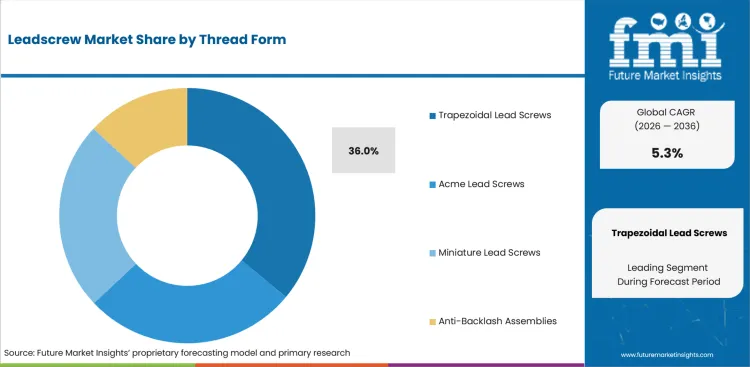
Trapezoidal thread forms transfer axial load through a profile that machine builders can machine and replace without oversized actuator packages. Engineers match the profile with nut material and end machining to control travel quality across moderate-duty adjustments.
- Based on thread form, trapezoidal lead screws are projected to account for 36.0% in 2026 due to economical machining and replaceable nut configurations.
- Machine builders select trapezoidal profiles for guarded adjustments and moderate-duty modules that need straightforward replacement paths. The choice reduces custom interface work and retains visible load assumptions during early mechanism reviews.
How does stainless steel influence material selection within the Leadscrew market?
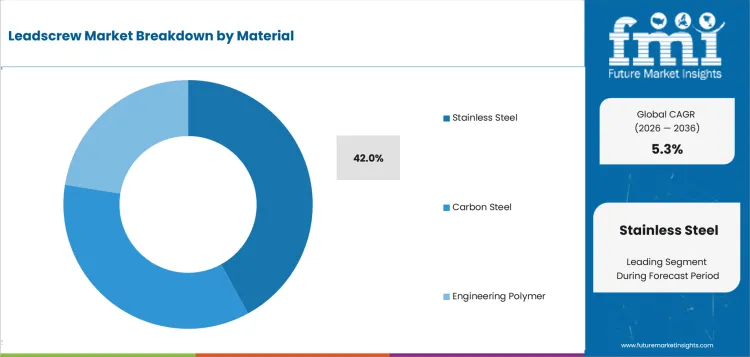
Stainless steel suits assemblies exposed to washdown fluids or process residue that could compromise untreated components. Engineers pair the material with suitable nuts and lubrication to maintain usable motion across cleaning-sensitive equipment.
- By material, stainless steel is forecast to represent 42.0% in 2026 driven by cleaning-sensitive equipment that requires corrosion-compatible assemblies.
- Equipment teams select stainless steel for applications that need material compatibility throughout cleaning and maintenance cycles. The choice addresses corrosion exposure, whereas nut pairing controls friction and replacement effort during regular equipment servicing.
What supports use of 8 to 16 mm assemblies within the diameter category?
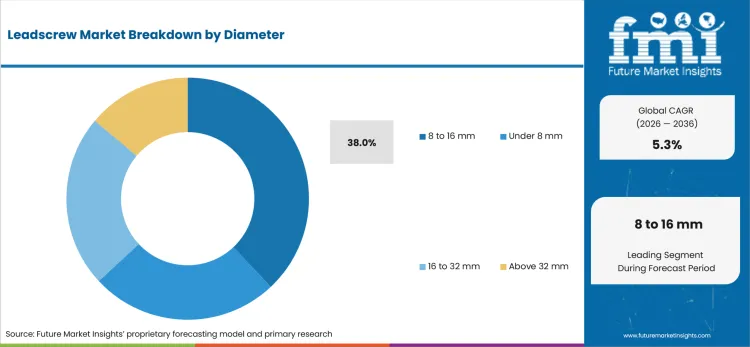
The 8 to 16 mm range fits compact modules that need more shaft stiffness than miniature screws without a larger motor envelope. Engineers reconcile guide support and preload with the mechanical package before selecting the range inside standard equipment programs.
- By diameter, the 8 to 16 mm range is estimated to hold 38.0% in 2026 owing to compact housings that need useful stiffness without larger motors.
- Equipment designers specify this diameter range for limited-travel fixtures that work under moderate loads and routine service access. Guarded layouts favor the range but unsupported spans can increase binding and accelerate wear during recurring production operations.
Why do linear actuators account for a substantial share of Leadscrew demand?
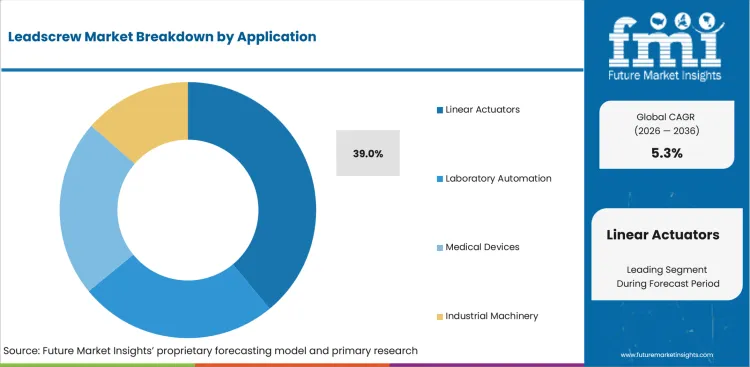
Linear actuators combine screws, motors, and supports inside a unit that shortens selection work for repeat machine platforms. Laboratory automation applications use compact motion modules where installation access and control integration guide final assembly choices.
- The linear actuators segment is likely to capture 39.0% share in 2026 attributable to packages that align motor and screw interfaces with required supports.
- Equipment builders favor configurable actuator platforms that match motor selection and stroke length before installation. Standardized packages reduce assembly effort and duty-cycle checks protect performance before production release across integrated machine stations.
How does industrial automation shape Leadscrew demand across end-use sectors?
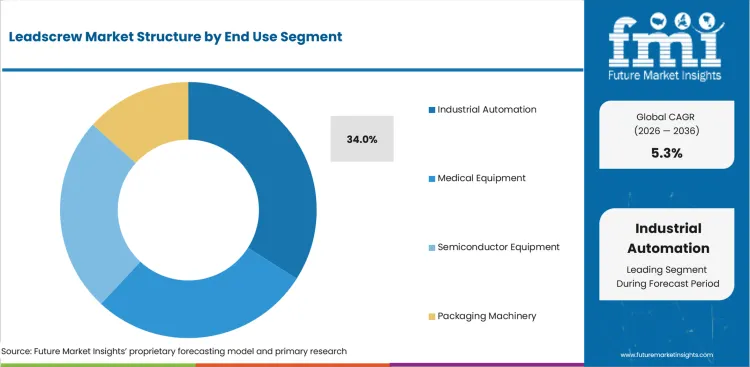
Industrial automation requires controlled low-to-medium-duty positioning across assembly cells and material-handling equipment within modern production modules. AMETEK described Haydon Kerk Pittman lead screw stepper actuators for compact semiconductor capital equipment applications in April 2025, which gives a practical example of enclosed screw-drive integration for sensitive equipment.
- In 2026, industrial automation is expected to lead the end-use category with 34.0% share because repeat machinery requires compact positioning across defined duties.
- Automation integrators assess screw assemblies against a complete motion stack rather than standalone component price. Documented mounting and feedback choices therefore separate reusable machinery designs from one-off component substitutions within recurring equipment programs.
What are the drivers, restraints and opportunities in the Leadscrew market?
Driver: Compact automation relies on economical linear positioning. Restraint: Sliding contact limits high-cycle precision duties. Opportunity: Configured assemblies reduce qualification uncertainty in controlled equipment.
- Driver: Compact automation platforms require straightforward linear motion across repeatable mechanical interfaces and practical service plans.
- Restraint: Sliding contact raises wear and heat alongside backlash in applications requiring sustained speed or demanding positional repeatability.
- Opportunity: Configured leadscrew assemblies support controlled equipment that needs compact travel with defined interfaces and documented qualification conditions.
Packaging machinery lines often require a motion component that fits constrained space and permits predictable replacement across repeated equipment programs. Equipment designers validate travel and guide conditions before standardizing a serviceable screw assembly for compact modules. The configuration decision must remain connected to load and guide requirements to prevent application failures during installation.
Sliding contact creates the central restraint for leadscrew selection in sustained high-speed or high-cycle duties. The risk becomes clearer for longer travel as Joyce/Dayton stated in March 2025 that ball screws suit continuous motion and heavier axial loads. Engineers need realistic cycle testing before approving a lower-cost sliding-contact design for persistent motion duties.
Robotic surgery test platforms need traceable actuator choices because a late mechanical change can disrupt an established test sequence. Thread geometry requires application-specific selection because mismatched pitch and nut interfaces can disrupt reliable lead-screw operation. Manufacturers that combine sizing guidance with service documentation can convert a component sale into a repeatable module specification.
Which country CAGRs are profiled in the Leadscrew market?
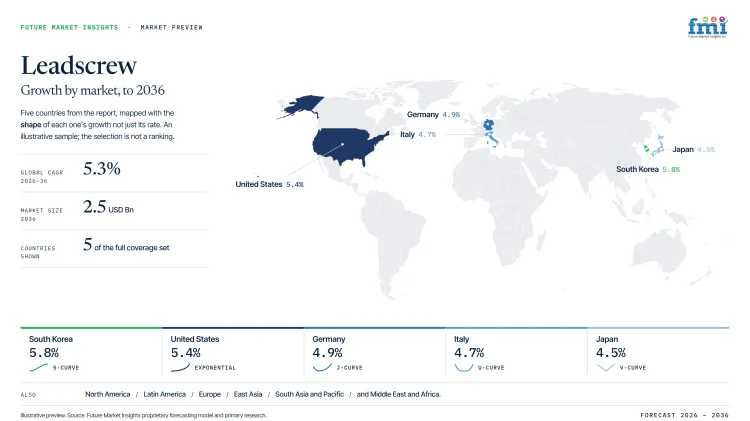
| Country | CAGR |
|---|---|
| South Korea | 5.8% |
| United States | 5.4% |
| Germany | 4.9% |
| Italy | 4.7% |
| Japan | 4.5% |
How do country-level CAGRs compare in the Leadscrew market?
The five forecasts remain within a 1.3 percentage-point band, indicating gradual variation across advanced manufacturing systems rather than separated national growth tiers. Narrower gaps reflect similar compact-positioning requirements across industrial robotics systems that depend on repeatable low-to-medium-duty component selection. Configuration and local service models shape purchasing differently across the displayed countries and associated equipment programs.
- South Korea edges past the United States because electronics equipment clusters combine high motion density with extensive design-in requirements.
- The United States remains above Germany across diverse industrial and medical equipment integrators requiring configurable motion assemblies.
- Germany trails the United States in the forecast, reflecting a mature replacement route that depends on industrial investment timing.
- Italy follows Germany closely because specialist machinery production supports tailored screw assemblies even as export exposure affects order release.
- Japan closes the displayed band as mature factory equipment favors documented qualifications instead of rapid supplier conversion.
Japan’s motion programs compare discrete screw assemblies against Japan electric linear actuators during selection, so similar CAGRs do not indicate identical component decisions. The full report provides country-level CAGR analysis across North America, Latin America, Europe, East Asia, South Asia, Oceania and the Middle East and Africa.
Country-wise Analysis
- South Korean electronics and materials plants operate inside dense automation clusters that require compact precision motion. South Korea is estimated to post 5.8% CAGR over the forecast period, underpinned by dense electronics programs requiring compact positioners during new equipment design. The International Federation of Robotics recorded 30,600 industrial robot installations in South Korea during 2024 across advanced factory settings. Dense equipment design activity supplies a clear local enabler for compact positioner integration across qualified factory modules. Lengthy design-in approvals remain a material friction for unfamiliar screw and nut combinations throughout local supplier qualification programs.
- United States machine integrators serve packaging and medical equipment across varied configuration requirements within regional production and service networks. The International Federation of Robotics reported 38,000 industrial robot installations across United States production sites during 2025. By 2036, the United States is projected to grow at 5.4% CAGR, attributable to diverse machinery programs requiring tailored travel and load configurations. Broad application coverage gives application engineers a commercial route for configured motion assemblies across defined industrial equipment programs. Dispersed commissioning resources can extend integration and replacement schedules across qualified multi-site equipment programs and local service networks.
- Germany’s export-oriented machinery base gives suppliers a local route for configured replacement and customized motion assemblies. Leadscrew sales in Germany are forecast to expand at 4.9% CAGR by 2036 as established machinery builders refresh selected production assets. The International Federation of Robotics recorded 26,982 industrial robot installations in Germany during 2024 across established production platforms, providing an enabler for qualified replacement motion assemblies. Cautious capital spending can postpone discretionary upgrades during uncertain export order cycles outside essential modernization programs.
- Italian specialist machinery producers apply compact mechanical motion across packaging and production equipment for export customers. Istat reported 2.4% growth in machinery and equipment investment during the first three quarters of 2025. Italy’s investment profile provides a direct local enabler for new assembly specification across specialist machinery replacement programs. The Italian leadscrew sector is projected to record 4.7% CAGR during the assessment period as specialist machinery builders specify compact motion during replacement programs. Trade-sensitive order books can slow broader capital-goods replacement plans across international shipment cycles during cyclical periods.
- Japanese factory equipment programs favor documented motion choices for qualified production cells and controlled manufacturing systems. The International Federation of Robotics recorded 44,500 industrial robot installations in Japan during 2024 across established factory settings. Japan’s leadscrew market outlook is anticipated to advance at 4.5% CAGR over the assessment period, supported by qualified factory equipment requiring documented component choices. Existing equipment replacement provides an enabler for configured motion assemblies across qualified factory modernization programs. Lengthy approvals remain a material friction for new suppliers entering mature industrial programs across existing factory programs.
Who are the notable companies in the Leadscrew market?
Notable companies include Thomson Industries, igus, AMETEK Haydon Kerk Pittman, Helix Linear Technologies, PBC Linear, Nook Industries, Oriental Motor, and Joyce/Dayton Corp.
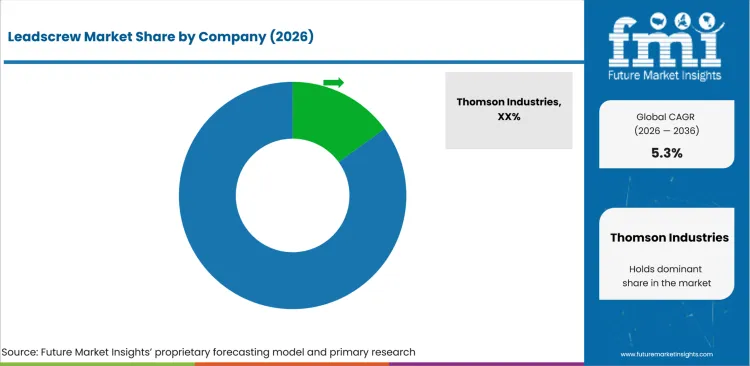
The leadscrew competitive outlook is fragmented between global motion-control groups that package screws with motors or guides and specialists that supply configurable screw-and-nut assemblies. Competition centers on thread accuracy with backlash control and material pairing because each assembly must match a specific equipment duty. Equipment builders assess travel and contamination exposure before a specialist can win recurring work within qualified machine programs. Service access and machining options shape selection across programs that need predictable replacement at the operating site. Entry remains practical for niche component producers, but sustained participation depends on repeatable manufacturing and responsive design support.
- Thomson Industries, igus and AMETEK Haydon Kerk Pittman combine lead screw systems with actuator or guided-motion integration for compact equipment designs.
- Helix Linear Technologies, PBC Linear and Nook Industries emphasize screw geometry with nut options and application-specific machining for defined mechanical duties.
- Oriental Motor and Joyce/Dayton connect lead-screw motion with motorized actuators or screw-jack platforms requiring clear duty-cycle evaluation.
Competitive Benchmarking: Leadscrew Market
| Company | Miniature Screw Range | Anti-Backlash Options | Actuator Integration | Geographic Reach |
|---|---|---|---|---|
| Thomson Industries | High | High | High | Global |
| igus | High | High | High | Global |
| AMETEK Haydon Kerk Pittman | High | High | High | Global |
| Helix Linear Technologies | High | High | Medium | North America |
| PBC Linear | High | High | High | North America |
| Nook Industries | Medium | High | Medium | North America |
| Oriental Motor | Medium | Medium | High | Global |
| Joyce/Dayton Corp. | Medium | Medium | Medium | North America |
Key Developments in the Leadscrew Market
- In January 2025, Thomson Industries enhanced its online lead screw selector with machining and end-support options for engineers evaluating compact screw assemblies.
- In February 2025, igus reported a United States handwriting robot using drylin guides and dryspin lead screws for compact repeat motion.
- In February 2025, Oriental Motor introduced a 30 mm actuator attachment with a lead screw and resin nut for compact precision motion.
- In April 2025, igus launched the drylin SLX-8060 linear axis with a dryspin lead screw drive for heavier-duty applications.
Key Players in the Leadscrew Market
Configurable Screw and Actuator Platforms
- Thomson Industries
- igus
- AMETEK Haydon Kerk Pittman
Precision Screw Specialists
- Helix Linear Technologies
- PBC Linear
- Nook Industries
Integrated Actuator and Screw-Jack Providers
- Oriental Motor
- Joyce/Dayton Corp.
Leadscrew Market - Report Scope
| Coverage field | Report scope |
|---|---|
| Market breakdown | By thread form, material, diameter, application, end use and region. |
| Quantitative Units | Revenue in USD Billion, CAGR in %. |
| Market Definition | The market covers mechanical leadscrew and nut assemblies, including integrated lead screw actuator packages, used for controlled linear motion. |
| Regions Covered | North America, Latin America, Europe, East Asia, South Asia and Pacific, and Middle East and Africa. |
| Countries Covered | South Korea, United States, Germany, Italy, and Japan. |
| Key Companies Profiled | Thomson Industries, igus, AMETEK Haydon Kerk Pittman, Helix Linear Technologies, PBC Linear, Nook Industries, Oriental Motor, and Joyce/Dayton Corp. |
| Forecast Period | 2026 to 2036. |
| Approach | Hybrid bottom-up and top-down market sizing supported by primary interviews and official desk research. |
Leadscrew Market - Research Methodology
| Method | Approach |
|---|---|
| Primary Research | FMI analysts gathered input from manufacturers, service providers, technology developers, distributors, end users, sourcing teams, and subject-matter experts. Interviews examined purchasing decisions, product or service evaluation, adoption barriers, approval requirements, pricing considerations, and expectations for technical or commercial support. Respondents were also asked what evidence is required before a trial, pilot, or initial order develops into regular purchasing. |
| Desk Research | Desk research covered government statistics, regulatory publications, trade data, industry associations, technical literature, standards, company filings, product information, and official corporate announcements. Sources were reviewed for relevance, publication date, geographic coverage, and consistency with the defined market scope. Claims relating to performance, applications, approvals, capacity, investment, and commercial activity were retained only when supported by credible public evidence. |
| Market Sizing and Forecasting | The market model combined the baseline value with historical performance, segment structure, pricing and volume indicators, adoption levels, company participation, and country-level demand conditions. Forecast assumptions considered economic activity, investment trends, regulatory developments, technology adoption, purchasing cycles, supply availability, and barriers to wider market use. Segment and regional estimates were reconciled before the final market total was calculated. |
| Data Validation | Estimates were checked against multiple independent indicators, including public data, company activity, trade patterns, industry developments, and findings from primary interviews. Validation also tested whether products, services, applications, and company revenues fell within the defined market boundaries. Adjacent categories, unsupported claims, overlapping revenues, and activities without direct market relevance were excluded to reduce double counting and maintain consistency across segments and countries. |
Leadscrew Market by Segments
Leadscrew Market segmented by Thread Form:
- Trapezoidal Lead Screws
- Acme Lead Screws
- Miniature Lead Screws
- Anti-Backlash Assemblies
Leadscrew Market segmented by Material:
- Stainless Steel
- Carbon Steel
- Engineering Polymer
Leadscrew Market segmented by Diameter:
- Under 8 mm
- 8 to 16 mm
- 16 to 32 mm
- Above 32 mm
Leadscrew Market segmented by Application:
- Linear Actuators
- Laboratory Automation
- Medical Devices
- Industrial Machinery
Leadscrew Market segmented by End Use:
- Industrial Automation
- Medical Equipment
- Semiconductor Equipment
- Packaging Machinery
Leadscrew Market by Region:
- North America
- United States
- Canada
- Latin America
- Brazil
- Mexico
- Rest of Latin America
- Europe
- Germany
- Italy
- France
- United Kingdom
- Rest of Europe
- East Asia
- China
- Japan
- South Korea
- South Asia and Pacific
- India
- ASEAN
- Australia and New Zealand
- Middle East and Africa
- GCC Countries
- South Africa
- Rest of Middle East and Africa
Research Sources and Bibliography
- AMETEK. (2025, April). Precision semiconductor technology for the modern world.
- igus. (2025, February 11). Greeting card handwriting robot with linear slides & lead screws.
- igus. (2025, April 16). igus introduces drylin® SLX linear axis with lead screw drive for heavy-duty, self-lubricating applications.
- International Federation of Robotics. (2025, September 25). Global robot demand in factories doubles over 10 years.
- International Federation of Robotics. (2026, June 18). US robot industry returns to double-digit growth.
- Istat. (2025, December 5). Italy’s economic outlook 2025–2026.
- Joyce/Dayton Corp.. (2025, March 3). Ball screws vs. lead screws: Which is right for your screw jack application?.
- Oriental Motor. (2025, February 20). 30 mm frame size stepper motor linear actuator for precision motion.
- Thomson Industries. (2025, January 10). Thomson Industries enhances online lead screw selector tool with machining and end support options.
This bibliography is provided for reader reference and is not exhaustive. The full report contains the complete reference list and detailed citations
This Report Answers
- How large is the Leadscrew market in 2026 and 2036?
- Which operating conditions support compact leadscrew assemblies?
- Which thread form accounts for the substantial share in 2026?
- How do material and diameter choices influence product selection?
- Which application shapes current Leadscrew demand?
- How do country growth rates differ across the profiled markets?
- Which companies serve the Leadscrew market?
- What limits returns from Leadscrew deployments?
- How should equipment builders compare configured motion options?
Frequently Asked Questions
How big is the leadscrew market in 2026?
The leadscrew market is valued at USD 1.5 billion in 2026. Sales are projected to expand at a 5.3% CAGR through 2036, reaching USD 2.5 billion. Compact automation modules drive demand for economical linear positioning, with industrial robot installation activity providing a strong operational base for configured motion assemblies.
What CAGR is projected for the leadscrew market, and what is the primary growth driver?
At 5.3% CAGR through 2036, the leadscrew market is projected to grow from USD 1.5 billion in 2026 to USD 2.5 billion. Compact automation platforms requiring straightforward linear motion across repeatable mechanical interfaces and practical service plans represent the primary driver of sustained demand growth.
Which thread form segment leads the leadscrew market by revenue share?
Trapezoidal lead screws account for 36.0% share in 2026, leading the thread form segment. Machine builders select trapezoidal profiles for guarded adjustments and moderate-duty modules due to economical machining and replaceable nut configurations that reduce custom interface work and retain visible load assumptions during mechanism reviews.
Which country is growing fastest in the Leadscrew Market?
South Korea is projected to post the highest CAGR of 5.8% through 2036 in the leadscrew market. Dense electronics and materials plants operating inside compact automation clusters drive strong demand for precision positioners. Extensive design-in requirements across advanced factory programs support sustained growth in configured motion assembly adoption.
Who are the key companies in the leadscrew market?
Key companies in the leadscrew market include Thomson Industries, igus, AMETEK Haydon Kerk Pittman, Helix Linear Technologies, PBC Linear, Nook Industries, Oriental Motor, and Joyce/Dayton Corp. Competition centers on thread accuracy, backlash control, and material pairing across configurable screw-and-nut assemblies for defined equipment duties.
Preview the report firsthand - request a free sample
Get SampleGet the brochure for pricing and purchase details.
Get PDFTable of Content
- Key Takeaways
- Market Size and CAGR
- Top Growth Driver
- Fastest Growing Segment
- Leading Region
- Key Companies
- Emerging Opportunities
- Executive Summary
- Global Market Outlook
- Demand-side Trends
- Supply-side Trends
- Technology Roadmap Analysis
- Analysis and Recommendations
- Analyst Perspective (What is happening? Why now? What should investors know?)
- Key Questions Answered
- How large is the market?
- What is the CAGR?
- What are key trends?
- Which region dominates?
- Who are the leaders?
- Market Overview
- Market Coverage / Taxonomy
- Market Definition / Scope / Limitations
- Research Methodology
- Chapter Orientation
- Analytical Lens and Working Hypotheses
- Market Structure, Signals, and Trend Drivers
- Benchmarking and Cross-market Comparability
- Market Sizing, Forecasting, and Opportunity Mapping
- Research Design and Evidence Framework
- Desk Research Programme (Secondary Evidence)
- Expert Input and Fieldwork (Primary Evidence)
- Tooling, Models, and Reference Databases
- Data Engineering and Model Build
- Quality Assurance and Audit Trail
- Market Background
- Market Dynamics (Drivers, Restraints, Opportunity, Trends)
- Scenario Forecast (Optimistic, Likely, Conservative)
- Impact Analysis
- AI Impact
- Sustainability Impact
- Regulatory Impact
- Technology Impact
- Consumer / Buyer Analysis
- Purchase Drivers
- Adoption Barriers
- Buyer Journey
- Opportunity Map Analysis
- Product Life Cycle Analysis
- Supply Chain Analysis
- Investment Feasibility Matrix
- Value Chain Analysis
- PESTLE and Porter's Analysis
- Regulatory Landscape
- Regional Parent Market Outlook
- Production and Consumption Statistics
- Import and Export Statistics
- Global Market Analysis and Forecast, 2021 to 2036
- Historical Market Size Value (USD Billion) Analysis, 2021 to 2025
- Current and Future Market Size Value (USD Billion) Projections, 2026 to 2036
- Y-o-Y Growth Trend Analysis
- Absolute $ Opportunity Analysis
- Global Market Pricing Analysis, 2021 to 2036
- Global Market Analysis and Forecast, By Thread Form, 2021 to 2036
- Introduction / Key Findings
- Historical Market Size Value (USD Billion) Analysis By Thread Form, 2021 to 2025
- Current and Future Market Size Value (USD Billion) Analysis and Forecast By Thread Form, 2026 to 2036
- Trapezoidal Lead Screws
- Acme Lead Screws
- Miniature Lead Screws
- Anti-Backlash Assemblies
- Trapezoidal Lead Screws
- Y-o-Y Growth Trend Analysis By Thread Form, 2021 to 2025
- Absolute $ Opportunity Analysis By Thread Form, 2026 to 2036
- Global Market Analysis and Forecast, By Material, 2021 to 2036
- Introduction / Key Findings
- Historical Market Size Value (USD Billion) Analysis By Material, 2021 to 2025
- Current and Future Market Size Value (USD Billion) Analysis and Forecast By Material, 2026 to 2036
- Stainless Steel
- Carbon Steel
- Engineering Polymer
- Stainless Steel
- Y-o-Y Growth Trend Analysis By Material, 2021 to 2025
- Absolute $ Opportunity Analysis By Material, 2026 to 2036
- Global Market Analysis and Forecast, By Diameter, 2021 to 2036
- Introduction / Key Findings
- Historical Market Size Value (USD Billion) Analysis By Diameter, 2021 to 2025
- Current and Future Market Size Value (USD Billion) Analysis and Forecast By Diameter, 2026 to 2036
- Under 8 mm
- 8 to 16 mm
- 16 to 32 mm
- Above 32 mm
- Under 8 mm
- Y-o-Y Growth Trend Analysis By Diameter, 2021 to 2025
- Absolute $ Opportunity Analysis By Diameter, 2026 to 2036
- Global Market Analysis and Forecast, By Application, 2021 to 2036
- Introduction / Key Findings
- Historical Market Size Value (USD Billion) Analysis By Application, 2021 to 2025
- Current and Future Market Size Value (USD Billion) Analysis and Forecast By Application, 2026 to 2036
- Linear Actuators
- Laboratory Automation
- Medical Devices
- Industrial Machinery
- Linear Actuators
- Y-o-Y Growth Trend Analysis By Application, 2021 to 2025
- Absolute $ Opportunity Analysis By Application, 2026 to 2036
- Global Market Analysis and Forecast, By End Use, 2021 to 2036
- Introduction / Key Findings
- Historical Market Size Value (USD Billion) Analysis By End Use, 2021 to 2025
- Current and Future Market Size Value (USD Billion) Analysis and Forecast By End Use, 2026 to 2036
- Industrial Automation
- Medical Equipment
- Semiconductor Equipment
- Packaging Machinery
- Industrial Automation
- Y-o-Y Growth Trend Analysis By End Use, 2021 to 2025
- Absolute $ Opportunity Analysis By End Use, 2026 to 2036
- Global Market Analysis and Forecast, By Region, 2021 to 2036
- Introduction
- Historical Market Size Value (USD Billion) Analysis By Region, 2021 to 2025
- Current Market Size Value (USD Billion) Analysis and Forecast By Region, 2026 to 2036
- North America
- Latin America
- Western Europe
- Eastern Europe
- East Asia
- South Asia and Pacific
- Middle East & Africa
- Market Attractiveness Analysis By Region
- North America Market Analysis and Forecast, By Country, 2021 to 2036
- Historical Market Size Value (USD Billion) Trend Analysis By Market Taxonomy, 2021 to 2025
- Market Size Value (USD Billion) Forecast By Market Taxonomy, 2026 to 2036
- By Country
- United States
- Canada
- By Thread Form
- By Material
- By Diameter
- By Application
- By End Use
- By Country
- Market Attractiveness Analysis
- By Country
- By Thread Form
- By Material
- By Diameter
- By Application
- By End Use
- Key Takeaways
- Latin America Market Analysis and Forecast, By Country
- Historical Market Size Value (USD Billion) Trend Analysis By Market Taxonomy, 2021 to 2025
- Market Size Value (USD Billion) Forecast By Market Taxonomy, 2026 to 2036
- By Country
- Brazil
- Mexico
- Chile
- Rest of Latin America
- By Thread Form
- By Material
- By Diameter
- By Application
- By End Use
- By Country
- Market Attractiveness Analysis
- By Country
- By Thread Form
- By Material
- By Diameter
- By Application
- By End Use
- Key Takeaways
- Western Europe Market Analysis and Forecast, By Country
- Historical Market Size Value (USD Billion) Trend Analysis By Market Taxonomy, 2021 to 2025
- Market Size Value (USD Billion) Forecast By Market Taxonomy, 2026 to 2036
- By Country
- Germany
- UK
- Italy
- Spain
- France
- Nordic
- BENELUX
- Rest of Western Europe
- By Thread Form
- By Material
- By Diameter
- By Application
- By End Use
- By Country
- Market Attractiveness Analysis
- By Country
- By Thread Form
- By Material
- By Diameter
- By Application
- By End Use
- Key Takeaways
- Eastern Europe Market Analysis and Forecast, By Country
- Historical Market Size Value (USD Billion) Trend Analysis By Market Taxonomy, 2021 to 2025
- Market Size Value (USD Billion) Forecast By Market Taxonomy, 2026 to 2036
- By Country
- Russia
- Poland
- Hungary
- Balkan & Baltic
- Rest of Eastern Europe
- By Thread Form
- By Material
- By Diameter
- By Application
- By End Use
- By Country
- Market Attractiveness Analysis
- By Country
- By Thread Form
- By Material
- By Diameter
- By Application
- By End Use
- Key Takeaways
- East Asia Market Analysis and Forecast, By Country
- Historical Market Size Value (USD Billion) Trend Analysis By Market Taxonomy, 2021 to 2025
- Market Size Value (USD Billion) Forecast By Market Taxonomy, 2026 to 2036
- By Country
- China
- Japan
- South Korea
- By Thread Form
- By Material
- By Diameter
- By Application
- By End Use
- By Country
- Market Attractiveness Analysis
- By Country
- By Thread Form
- By Material
- By Diameter
- By Application
- By End Use
- Key Takeaways
- South Asia and Pacific Market Analysis and Forecast, By Country
- Historical Market Size Value (USD Billion) Trend Analysis By Market Taxonomy, 2021 to 2025
- Market Size Value (USD Billion) Forecast By Market Taxonomy, 2026 to 2036
- By Country
- India
- ASEAN
- Australia & New Zealand
- Rest of South Asia and Pacific
- By Thread Form
- By Material
- By Diameter
- By Application
- By End Use
- By Country
- Market Attractiveness Analysis
- By Country
- By Thread Form
- By Material
- By Diameter
- By Application
- By End Use
- Key Takeaways
- Middle East & Africa Market Analysis and Forecast, By Country
- Historical Market Size Value (USD Billion) Trend Analysis By Market Taxonomy, 2021 to 2025
- Market Size Value (USD Billion) Forecast By Market Taxonomy, 2026 to 2036
- By Country
- Kingdom of Saudi Arabia
- Other GCC Countries
- Türkiye
- South Africa
- Other African Union
- Rest of Middle East & Africa
- By Thread Form
- By Material
- By Diameter
- By Application
- By End Use
- By Country
- Market Attractiveness Analysis
- By Country
- By Thread Form
- By Material
- By Diameter
- By Application
- By End Use
- Key Takeaways
- Key Countries Market Analysis
- South Korea
- Pricing Analysis
- Market Share Analysis, 2025
- By Thread Form
- By Material
- By Diameter
- By Application
- By End Use
- United States
- Pricing Analysis
- Market Share Analysis, 2025
- By Thread Form
- By Material
- By Diameter
- By Application
- By End Use
- Germany
- Pricing Analysis
- Market Share Analysis, 2025
- By Thread Form
- By Material
- By Diameter
- By Application
- By End Use
- Italy
- Pricing Analysis
- Market Share Analysis, 2025
- By Thread Form
- By Material
- By Diameter
- By Application
- By End Use
- Japan
- Pricing Analysis
- Market Share Analysis, 2025
- By Thread Form
- By Material
- By Diameter
- By Application
- By End Use
- South Korea
- Market Structure Analysis
- Competition Dashboard
- Competition Benchmarking
- Market Share Analysis of Top Players
- By Regional
- By Thread Form
- By Material
- By Diameter
- By Application
- By End Use
- Emerging Startups
- Innovation Benchmarking
- Competition Analysis
- Competition Deep Dive
- Thomson Industries
- Overview
- Product Portfolio
- Profitability by Market Segments
- Sales Footprint
- Strategy Overview
- Marketing Strategy
- Product Strategy
- Channel Strategy
- igus
- AMETEK Haydon Kerk Pittman
- Helix Linear Technologies
- PBC Linear
- Nook Industries
- Oriental Motor
- Joyce/Dayton Corp.
- Thomson Industries
- Case Studies
- Success Stories
- Recent Developments
- Competition Deep Dive
- Assumptions & Acronyms Used


