

- Industry Size (2026)
- USD 602.7 Mn
- Forecast (2036)
- USD 1606.4 Mn
- CAGR (2026 to 2036)
- 10.3%
Mesotherapy Market size, market forecast and outlook By FMI
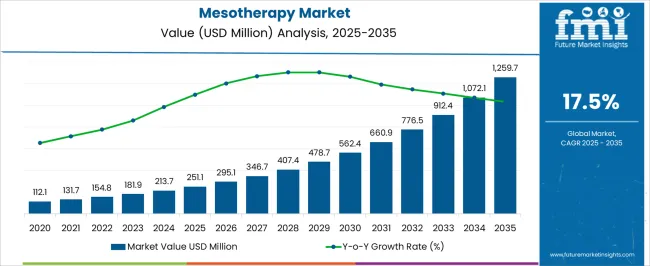
In 2026, the mesotherapy market was valued at USD 602.7 million. Based on Future Market Insights analysis, demand for mesotherapy is estimated to grow to USD 664.8 million in 2027 and USD 1,606.4 million by 2036. FMI projects a CAGR of 10.3% during the forecast period.
Absolute dollar growth of USD 1,003.7 million over the decade points to a scale-up category still benefiting from the wider migration toward minimally invasive aesthetics. This expansion is not being driven by surgery replacement alone. It is being supported by the way clinics position mesotherapy inside broader rejuvenation, skin-quality, and hair-restoration programs that depend on repeat visits and bundled protocols. Global aesthetics datasets continue to show a large and resilient base for non-surgical procedures, while USA procedure statistics also show injectables remaining dominant within minimally invasive cosmetic care.
Summary of Mesotherapy Market
- Mesotherapy Market Definition
- The industry covers products and systems used in mesotherapy, a minimally invasive microinjection technique applied in aesthetic medicine for skin rejuvenation, anti-ageing support, wrinkle treatment, acne and scar management, fat-focused body protocols, and hair-loss treatment pathways.
- Demand Drivers in the Market
- Clinics are expanding low-downtime aesthetic menus around procedures that can be repeated and bundled into maintenance programs.
- Injector familiarity and protocol consistency are supporting supplier retention more than marginal formulation differences.
- Hair and skin-quality indications are broadening revenue beyond purely anti-ageing facial use.
- Key Segments Analyzed in the FMI Report
- By Product Type: Mesotherapy Solutions Kits lead at 17.7% share in 2026, followed by Mesotherapy Fillers Kits at 17.4% share.
- By Indication: Facial Rejuvenation leads at 14.7% share in 2026, followed by Anti-ageing and Wrinkle Treatment at 13.6% each.
- Geography: China and Germany show the fastest growth at 11.7% CAGR, followed by India at 11.5% and the USA at 11.3%.
- Analyst Opinion at FMI
- Sabyasachi Ghosh, Principal Consultant at Future Market Insights, opines, “Adoption is being sustained less by one-time trial and more by repeat clinic utilization, where treatment familiarity, account training, and protocol consistency shape revenue durability.”
- Strategic Implications and Executive Takeaways
- Build portfolios around solution-led repeat protocols, because replenishment economics matter more than one-time product placement.
- Prioritize dermatology and cosmetic clinic channels, where treatment conversion, upselling, and patient retention are stronger than in hospital-led aesthetic settings.
- Use training and indication-specific education as account defense tools, since supplier switching remains constrained by injector familiarity and complication tolerance.
- Methodology
- As per FMI, sizing and splits were reconciled using supplier portfolio mapping and treatment-use concentration across facial, hair, and body-focused mesotherapy protocols.
- Segment shares were validated by linking product demand to repeat visit intensity, indication breadth, and the concentration of aesthetic procedures in clinic-led channels.
- Sensitivity checks were run across distribution channel mix and indication-level substitution to confirm revenue movement under realistic repeat-treatment adoption.
As Dr. Shikha Baghi, founder of Timeless Aesthetics and a facial aesthetics, PMU, and cosmetology expert, highlighted the role of regenerative hair therapies, “These advanced therapies are designed to stimulate dormant hair follicles, improve blood circulation and support natural hair regrowth-backed by clinical research and positive results.” She also noted that in-clinic treatment should be supported by internal wellness measures for longer-term recovery.” [1]
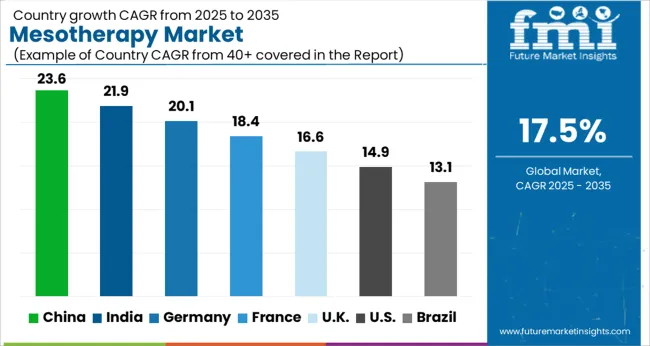
China (11.7% CAGR) and Germany (11.7% CAGR) are expected to lead growth, supported by strong non-surgical aesthetics demand and higher willingness to pay for physician-led appearance treatments. India (11.5% CAGR) and the USA (11.3% CAGR) are expected to expand through rising clinic density and wider acceptance of repeat facial and hair-focused protocols. The UK (10.7% CAGR) and Brazil (10.1% CAGR) should remain commercially attractive where cosmetic procedure culture is already entrenched. France (9.6% CAGR), Italy (9.9% CAGR), and Japan (9.8% CAGR) are expected to advance at a steadier pace, with growth tied more to premium treatment positioning and controlled practitioner uptake than to rapid volume acceleration.
Mesotherapy Market Definition
Mesotherapy is a minimally invasive method, which involves the multiple microinjections of specified material or a system into superficial layers of skin(s) and/or adjacent tissue for aesthetic appearance with either the cosmetic agent or lipolytic agents. These include mesotherapy fill kits, mesotherapy solution kits, mesotherapy chemical peels, anti-ageing masks, mesotherapy creams, mesotherapy spray and various types of devices used in professional treatments End users consist of hospitals, dermatology clinics, cosmetic clinics, and other controlled treatment paths, with online sales mostly providing product access but not a full substitute for treatment.
Mesotherapy Market Inclusions
Market size and forecast for 2026 to 2036 are included in the report, a regional market sizing is also provided along with the global numbers. The segment-level analysis will provide market size breakdown by product type, indication and distribution channel by country. CAGR comparison across leading markets is also discussed within the report. The inclusion entails prescription products as utilized in mesotherapy, clinic-attached therapeutic setups and some complementary formats offered under supervised aesthetic regimens.
It is also Coverage on adoption dynamics in medical aesthetics, such as the impact of repeat treatment economics, training-led supplier retention, protocol familiarity and clinic workflow integration on product selection. Education, indication-specific launches, and positioning for delivery by professionals all remain essential to commercial growth according to publicly available company disclosures from active mesotherapy suppliers.
Mesotherapy Market Exclusions
It does not include those entities that primarily do single-needle injection of dermal fillers for deep volumization or contouring outside mesotherapy protocols, products containing botulinum-toxin, surgical aesthetic procedures, generic skincare sold without procedural relevance and energy-based devices marketed independently from mesotherapy treatment pathways. It also does not include non-pharmaceutical cosmetic products that derive revenue from the application of injection-led or protocol-based mesotherapy use.
We maintain a focus on mesotherapy-related indications and delivery formats that serve clinical or clinic-adjacent aesthetic practice, where supplier selection is determined by treatment usability, protocol consistency, and professional channel acceptance rather than the wider demand found in beauty retail.
Mesotherapy Market research methodology
- Primary research: Interviews were conducted with dermatologists, aesthetic physicians, cosmetic clinic operators, distributors, and supplier-side commercial teams to validate product positioning, repeat-treatment demand, and channel concentration logic.
- Desk research: Publicly available scientific literature, procedure databases, company websites, and professional education materials were reviewed to benchmark mesotherapy usage, clinical debates, and portfolio structure.
- Market-sizing and forecasting: A hybrid model was applied using segment shares by product type, indication, and distribution channel, then reconciled through value build-up across repeat procedure intensity and country-level growth assumptions.
- Data validation and update cycle: Outputs were checked through consistency screening across segments, country CAGR hierarchy, and adoption logic tied to clinic-led treatment pathways.
Segmental Analysis
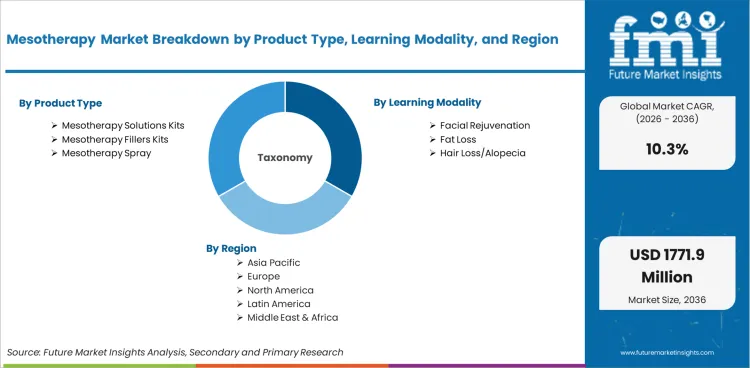
Mesotherapy Market Analysis by Product Type
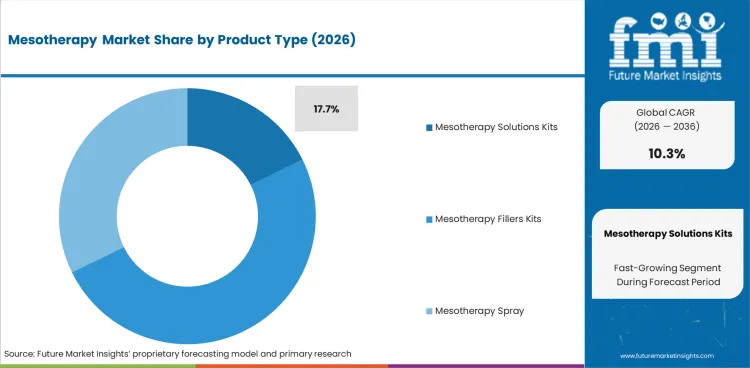
Based on FMI’s report, Mesotherapy Solutions Kits are estimated to hold 17.7% share in 2026, followed by Mesotherapy Fillers Kits at 17.4% share. Solution kits lead because they sit at the center of actual treatment delivery. Devices can support administration and adjunct products can improve program value, but the injectable or applied solution remains the core item tied directly to procedure frequency, regimen customization, and repeat clinic purchasing. That makes demand less dependent on one-time capex and more dependent on how often clinics standardize a protocol across patient cohorts. Public product positioning from mesotherapy suppliers also shows that indication-targeted solutions remain central to how companies commercialize skin revitalization and aesthetic maintenance.
- Protocol Core: In July 2023, the Kalbe has introduced the range of mesotherapy products in aesthetic treatment in Indonesia. [1] Solution kits are the main consumable within mesotherapy sessions, making them central to every repeat-treatment cycle.
- Replenishment Logic: Unlike devices, solutions are reordered in line with patient revisit frequency and treatment program continuity.
- Customization Advantage: Clinics can adapt solution selection across rejuvenation, pigmentation, hydration, and scalp-focused protocols more easily than with fixed-format products.
Mesotherapy Market Analysis by Learning Modality
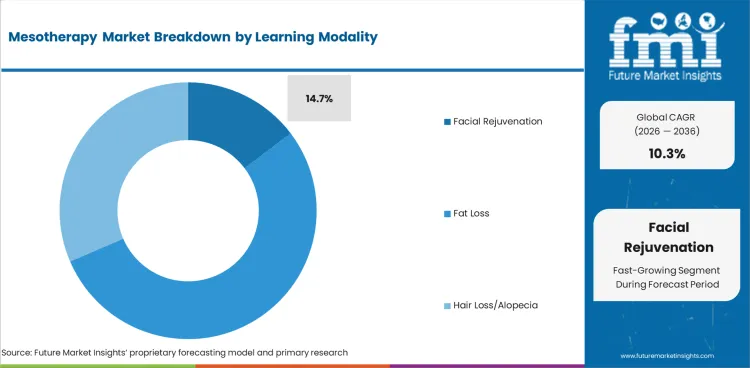
Facial Rejuvenation accounts for 14.7% share in 2026, followed by Anti-ageing and wrinkle treatment at 13.6% each, based on FMI’s report. Facial rejuvenation leads because it offers the broadest commercial entry point for mesotherapy. It reaches younger maintenance users, mid-age appearance management patients, and older consumers seeking low-downtime improvement in hydration, glow, and skin texture. It also fits naturally into combination treatment plans, which helps clinics generate recurring revenue without relying on a single indication alone. Clinical literature has repeatedly assessed mesotherapy within facial rejuvenation settings, even where efficacy findings are mixed, which reflects how central this use case remains to the category’s identity.
- Widest Patient Base: Facial rejuvenation serves prevention-led, maintenance-led, and correction-led users within one treatment umbrella. The American Academy of Facial Plastic and Reconstructive Surgery (AAFPRS) projected 19 percent increase in facial procedures nationwide (totaling an estimated 1.6 million procedures). [2]
- Combination Fit: It can be paired with peels, microneedling, skin boosters, and other non-surgical protocols inside the same clinic workflow.
- Premium Packaging: Glow, hydration, tone, and texture improvement are easier for clinics to package into repeat premium regimens than narrower episodic indications.
Mesotherapy Market Drivers, Restraints, and Opportunities
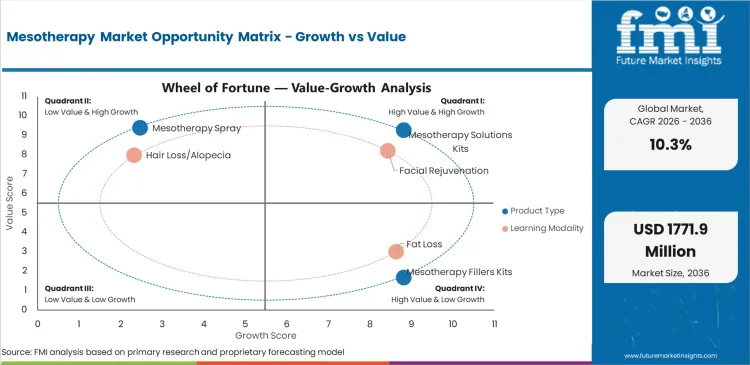
According to an analysis by Future Market Insights, mesotherapy is a beneficiary of this broader ascendance among minimally invasive aesthetics, but category growth has been tempered by clinical caution and variability in protocols. International and USA procedure datasets affirm that non-surgical injectables continue to be a sizeable and resilient category within aesthetic medicine, providing an attractive tailwind for adjacent treatment categories. However, mesotherapy is not the sort of standardized pharmaceutical procedure that scales. It is dependent upon quality of formulation, depth of injection, discipline of practitioner and the degree to which clinics integrate it into repeat-treatment pathways.
The factors behind the growth of mesotherapy are not merely the patients' desire to improve their appearance without losing too much time but the reality that clinics are able to include mesotherapy in their maintenance economy, whereby one and same patient can come again for subsequent procedures. What hinders further development in the field is the uneven level of evidence available on different indications, which leads some professionals to adopt a cautious approach and makes training credibility more valuable than advertising.
- Repeat-treatment expansion: clinic programs that rely on recurring visits rather than one-time procedure conversion are supporting Growth.
- Protocol and evidence restraint: Mixed efficacy evidence and variable administration standards continue to limit broader clinical standardization.
- Training-led monetization: Suppliers that convert education into account retention are better placed to hold share in a fragmented market.
Regional Analysis
Because of regional analysis, mesotherapy market is bifurcated into North America, Latin America, Europe and Asia across prominent procedure-intensive countries. Country-level demand signals are factors that shape a non-surgical procedure culture ranging from the density of clinics, to consumer willingness-to-pay for elective aesthetics, and supplier capacity to fuel physician-led treatment protocols. Global procedure metrics still display a significant installed base for aesthetic interventions, which will augur well for the growth of adjacent minimally invasive classes such as channeling and mesotherapy.
.webp "Top Country Growth Comparison Mesotherapy Market Cagr (2026 2036)")
| Country | CAGR |
|---|---|
| USA | 11.3% |
| Brazil | 10.1% |
| Germany | 11.7% |
| UK | 10.7% |
| France | 9.6% |
| Italy | 9.9% |
| China | 11.7% |
| Japan | 9.8% |
| India | 11.5% |
Source: Future Market Insights (FMI) analysis, based on proprietary forecasting model and primary research
North America Mesotherapy Market Analysis
North America is shaped by a mature self-pay aesthetics infrastructure where dermatologist offices, cosmetic clinics, and physician-supervised treatment chains drive demand. Commercial success in this region depends less on awareness creation and more on treatment positioning inside broader injectable and skin-health portfolios. The region is favorable because injectables remain a dominant share of minimally invasive procedure activity, giving clinics a commercial framework that supports repeat facial and scalp-focused offerings.
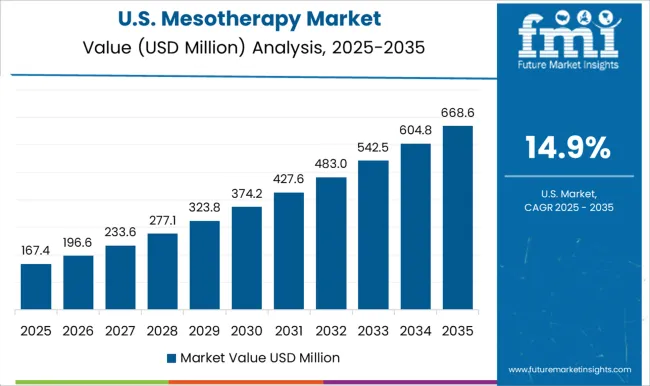
- United States: Mesotherapy in the USA is expected to expand at 11.3% CAGR through 2036, supported by dense clinic infrastructure, strong consumer familiarity with injectables, and wider commercialization of low-downtime rejuvenation protocols within dermatology and cosmetic practice.
FMI’s report includes a detailed analysis of North America, along with a country-wise assessment that includes the USA, Canada, and Mexico. Readers can also find regional trends, regulations, and market growth based on different segments and countries in the North America region.
East Asia Mesotherapy Market Analysis
Asia constitutes one of the most commercially pivotal growth corridors for mesotherapy specialist assistants, given that skin-quality positioning, clinic-led elective treatments and premium non-surgical aesthetics keeps broadening across city markets. China and India benefit from a growing provider network, significant growth in patient appetite for office-based procedure development; Japan is more selective, benefiting through premiumization and treatment quality discipline. The activity of public companies also reflects ongoing launches and training courses for professional aesthetics users across Asian markets.
- China: Mesotherapy in China is projected to rise at 11.7% CAGR through 2036, supported by strong urban aesthetics demand, expanding clinic capacity, and wider use of rejuvenation-focused injectable protocols.
- India: Mesotherapy in India is set to grow at 11.5% CAGR through 2036, supported by rapid cosmetic clinic expansion and greater uptake of non-surgical appearance treatments among urban consumers.
- Japan: Japan is expected to post 9.8% CAGR through 2036, with growth sustained by selective premium adoption and stronger emphasis on product quality and practitioner consistency.
The full report analyzes the mesotherapy market across East and South Asia from 2026 to 2036, covering pricing, growth drivers, and adoption patterns in China, Japan, India, and adjacent regional markets.
Latin America Mesotherapy Market Analysis
Latin America continues to be the most procedures-oriented region regarding aesthetics in the world, with commercial demand backed by a powerful beauty culture, an acceptance of self-pay treatment, and service concentration in urban areas. Access, local support and clinician training still determine which brands are adopted into standard clinic protocols, so distribution development is also needed for market reach. Brazil keeps being the main anchor market in Latin America.
- Brazil: Mesotherapy in Brazil is forecast to grow at 10.1% CAGR through 2036, driven by broad consumer acceptance of elective cosmetic care and continued use of clinic-based rejuvenation and body-focused treatment pathways.
The report consists of a detailed analysis for the market in Brazil, Argentina, and Rest of Latin America. Readers can find detailed information about pricing analysis and regional trends affecting growth in the Latin America region.
Europe Mesotherapy Market Analysis
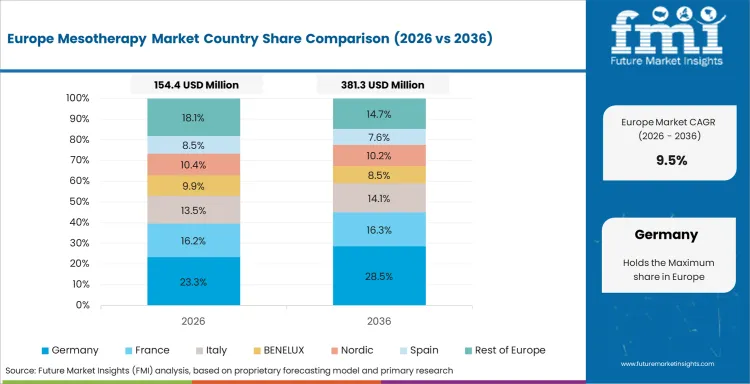
Europe remains strategically important because mesotherapy has historical roots in France and continues to hold relevance in physician-led aesthetic practice. Growth in the region is being shaped less by mass-market acceleration and more by premium treatment positioning, protocol refinement, and clinic-level account retention. Literature discussing monotherapy’s scientific debate and safety considerations also reflects Europe’s long-standing connection to the category.
- Germany: Germany is anticipated to expand at 11.7% CAGR through 2036, supported by strong non-surgical procedure demand and high willingness to adopt physician-supervised aesthetic treatments.
- United Kingdom: The UK is projected to rise at 10.7% CAGR through 2036, with growth tied to cosmetic clinic expansion and higher use of injectable-led facial maintenance programs.
FMI’s analysis of the mesotherapy market in Europe consists of country-wise assessment that includes Germany, Italy, France, the United Kingdom, Spain, Nordic countries, Benelux, and Rest of Europe. Readers can know various regulations and latest trends in the regional market.
Competitive aligners for market players
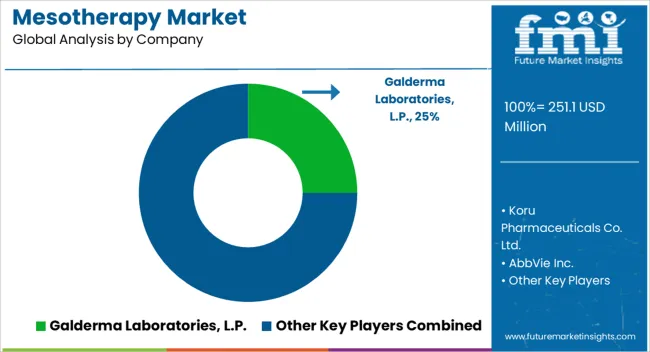
Market structure is fragmented, but practical competition focuses on suppliers capable of transposing product availability in clinical routine. Ingredient novelty alone does not commonly generate buyer retention within mesotherapy. It is established through account education, familiarity with the injector, and diminished treatment uncertainty. That will favor companies that make protocols easier to adopt, repeat and defend within dermatologist and cosmetic clinic workflows. Activity from active suppliers at the public-facing level suggests that activities, which continue to dominate, are webinars, participation in congresses, and indication-specific product positioning, which supports the view that training is functioning as a switching barrier.
Structural advantages at companies are typically the combination of portfolio breadth and professional channel presence. A broader set of offerings allows suppliers to better defend their accounts, as the clinics often prefer to rationalize sourcing across facial rejuvenation, glow, hydration, hair and adjunct treatment needs rather than testing a new vendor for each indication. However, that does not mean that innovation does not matter. It means incremental product innovation is only commercially relevant when integrated into the practitioner’s existing logic of treatment. In the absence of training support, stronger claims do not spontaneously transfer clinic-level selection.
Buyer concentration also reinforces clinic power. Dermatology clinics and cosmetic clinics together account for a large share of supervised treatment demand, which means suppliers, must compete inside account-based relationships rather than through broad consumer pull alone. Online sales expand access, but they do not remove clinician influence from treatment selection. Pricing power is therefore limited for easier-to-compare products, while better margins are sustained where suppliers combine professional trust, treatment usability, and education-backed account retention.
Recent Developments
The report includes full coverage of key trends from competitive benchmarking. Some of the recent developments covered in the reports:
- In July 2025, Koru Pharma promoted its “Get the Glow: modern mesotherapy for radiant skin” webinar focused on MESOHEAL Glow Series, reflecting an education-led push around professional skin rejuvenation protocols. [4]
- In 2025, Koru Pharma announced the launch of MESOHEAL Phlo, a skin booster combining hyaluronic acid and polynucleotides, aimed at hydration and regenerative aesthetic treatment positioning. [5]
- In October 2025, Wingderm’s Mesoskin device has surpassed 1.1 million procedures globally, highlighting strong adoption in non-invasive aesthetic care. Designed to enhance transdermal absorption of skincare ingredients, the technology supports scalable, patient-friendly skin and scalp treatments, reinforcing growing demand for minimally invasive, customizable aesthetic solutions across clinics and salons.
Key Players in Mesotherapy Market
- Laboratoires FILORGA SA
- INSTITUTE BCN
- mesoskinline
- Koru Pharmaceuticals Co., Ltd.
- Fusion Meso
- TOSKANI COSMETICS
- Dr. Korman Laboratories Ltd.
- Ostar Beauty Sci-Tech Co Ltd.
- Teoxane Laboratories
- Biologique Recherche
- Alumier Labs
- Dermaheal (Caregen)
- Rejuran (Huons Global)
- Innoaesthetics
- Derma Shine
- GUNTER & DUNN (G&D Medical)
- Lutronic Corporation
- BTL Aesthetics
- Alma Lasers (HERZLIYA)
- Croma‑Pharma GmbH
- Others
Scope of the Report
| Metric | Value |
|---|---|
| Quantitative units | US$ 602.7 million (2026) to US$ 1,606.4 million (2036), at a CAGR of 10.3% |
| Market definition | Mesotherapy is a minimally invasive method, which involves the multiple microinjections of specified material or a system into superficial layers of skin(s) and/or adjacent tissue for aesthetic appearance with either the cosmetic agent or lipolytic agents. These include mesotherapy fill kits, mesotherapy solution kits, mesotherapy chemical peels, anti-ageing masks, mesotherapy creams, mesotherapy spray and various types of devices used in professional treatments End users consist of hospitals, dermatology clinics, cosmetic clinics, and other controlled treatment paths, with online sales mostly providing product access but not a full substitute for treatment. |
| Product Type Segmentation | Mesotherapy Fillers Kits, Mesotherapy Solutions Kits, Mesotherapy Chemical Peels, Anti-ageing Masks, Mesotherapy Creams, Mesotherapy Spray, Mesotherapy Devices |
| Indication Segmentation | Anti-ageing, Facial Rejuvenation, Wrinkle Treatment, Stretch marks, Acne & Scar Treatment, Fat Loss, Hair Loss/Alopecia, Others |
| Distribution Channel Coverage | Hospitals, Dermatology Clinics, Cosmetic Clinics, Online Sales, Others |
| Regions covered | North America, Latin America, East Asia, South Asia, Western Europe, Eastern Europe, Middle East and Africa |
| Countries covered | United States, Canada, Mexico, Brazil, Argentina, Germany, France, United Kingdom, Italy, Spain, China, India, Japan, South Korea, Indonesia, Australia and 40 plus countries |
| Key companies profiled | Laboratoires FILORGA SA, INSTITUTE BCN, mesoskinline, Koru Pharmaceuticals Co., Ltd., Fusion Meso, TOSKANI COSMETICS, Dr. Korman Laboratories Ltd., Ostar Beauty Sci-Tech Co Ltd., Teoxane Laboratories, Biologique Recherche, Alumier Labs, Dermaheal (Caregen), Rejuran (Huons Global), Innoaesthetics, Derma Shine, GUNTER & DUNN (G&D Medical), Lutronic Corporation, BTL Aesthetics, Alma Lasers (HERZLIYA)
Croma‑Pharma GmbH |
| Forecast period | 2026 to 2036 |
| Approach | A hybrid top-down and bottom-up market modeling approach was used, validated through primary interviews with dental schools, simulation lab managers, and model suppliers, and further supported by product portfolio mapping and channel benchmarking, as per FMI. |
Mesotherapy Market Analysis by Segments
Product Type
- Mesotherapy Fillers Kits
- Mesotherapy Solutions Kits
- Mesotherapy Chemical Peels
- Anti-ageing Masks
- Mesotherapy Creams
- Mesotherapy Spray
- Mesotherapy Devices
Indication
- Anti-ageing
- Facial Rejuvenation
- Wrinkle Treatment
- Stretch marks
- Acne & Scar Treatment
- Fat Loss
- Hair Loss/Alopecia
- Others
Distribution Channel
- Hospitals
- Dermatology Clinics
- Cosmetic Clinics
- Online Sales
- Others
Region
- North America
- USA
- Canada
- Mexico
- Latin America
- Brazil
- Argentina
- Rest of Latin America
- East Asia
- China
- Japan
- South Korea
- South Asia & Pacific
- India
- ASEAN Countries
- Australia & New Zealand
- Rest of South Asia
- Western Europe
- Germany
- UK
- France
- Italy
- Spain
- BENELUX
- Nordic Countries
- Rest of Western Europe
- Eastern Europe
- Russia
- Hungary
- Poland
- Rest of Eastern Europe
- Middle East & Africa
- Saudi Arabia
- Türkiye
- South Africa
- Other African Union
- Rest of Middle East & Africa
Bibliography
- [1] Hindustan Times. Hair fall solutions: Doctors explain why it is happening and what you can do about it. Hindustan Times.
- [2] Kalbe. Kalbe introduces mesotherapy products in aesthetic treatment. Kalbe Corporate News.
- [3] American Academy of Facial Plastic and Reconstructive Surgery (AAFPRS). New trends in facial plastic surgery. AAFPRS Press Release.
- [4] Koru Pharma. Get the glow: Modern mesotherapy for radiant skin. Koru Pharma.
- [5] Koru Pharma. Mesoheal PHLO launch: Skin boosters with dual HA and polynucleotide. Koru Pharma.
This bibliography is provided for reader reference and is not exhaustive. The full report contains the complete reference list and detailed citations.
This report addresses
- Market intelligence to support structured strategic decision making across aesthetic treatment adoption, product positioning, and provider expansion strategies
- Market size estimation and 10-year revenue forecasts from 2026 to 2036 for mesotherapy treatment and product demand
- Growth opportunity mapping across product type, indication, distribution channel, and end-user demand pools
- Segment and regional revenue forecasts aligned to the stated taxonomy and covered geographies
- Competition strategy assessment including portfolio differentiation, treatment positioning, and channel coverage benchmarking
- Product and treatment tracking focused on injectable formulations, skin rejuvenation protocols, hair restoration applications, and clinical-use positioning
- Regulatory and practice environment impact analysis covering aesthetic treatment standards, product handling requirements, and provider-use considerations
- Market report delivery in PDF, Excel, PPT, and interactive dashboard formats for executive and operational use
Frequently Asked Questions
How large is the demand for mesotherapy in the global market in 2026?
Demand for mesotherapy in the global market is estimated to be valued at US$ 602.7 Mn in 2026, as per FMI.
What will be the market size of mesotherapy in the global market by 2036?
Market size for mesotherapy is projected to reach US$ 1,606.4 Mn by 2036.
What is the expected demand growth for mesotherapy in the global market between 2026 and 2036?
Demand for mesotherapy in the global market is expected to grow at a CAGR of 10.3% between 2026 and 2036.
Which product type is poised to lead global demand by 2026?
Mesotherapy solutions kits is expected to be the dominant product, capturing 17.7% share in 2026.
Which indication is expected to account for the largest share in 2026?
Facial rejuvenation is expected to hold the highest share at 14.7% in 2026.
Which distribution channel is expected to dominate the mix in 2026?
Dermatology clinics is expected to lead material use with 21.1% share in 2026.
Preview the report firsthand - request a free sample
Get SampleGet the brochure for pricing and purchase details.
Get PDFTable of Content
- Executive Summary
- Global Market Outlook
- Demand-side Trends
- Supply-side Trends
- Technology Roadmap Analysis
- Analysis and Recommendations
- Market Overview
- Market Coverage / Taxonomy
- Market Definition / Scope / Limitations
- Research Methodology
- Chapter Orientation
- Analytical Lens and Working Hypotheses
- Market Structure, Signals, and Trend Drivers
- Benchmarking and Cross-market Comparability
- Market Sizing, Forecasting, and Opportunity Mapping
- Research Design and Evidence Framework
- Desk Research Programme (Secondary Evidence)
- Company Annual and Sustainability Reports
- Peer-reviewed Journals and Academic Literature
- Corporate Websites, Product Literature, and Technical Notes
- Earnings Decks and Investor Briefings
- Statutory Filings and Regulatory Disclosures
- Technical White Papers and Standards Notes
- Trade Journals, Industry Magazines, and Analyst Briefs
- Conference Proceedings, Webinars, and Seminar Materials
- Government Statistics Portals and Public Data Releases
- Press Releases and Reputable Media Coverage
- Specialist Newsletters and Curated Briefings
- Sector Databases and Reference Repositories
- FMI Internal Proprietary Databases and Historical Market Datasets
- Subscription Datasets and Paid Sources
- Social Channels, Communities, and Digital Listening Inputs
- Additional Desk Sources
- Expert Input and Fieldwork (Primary Evidence)
- Primary Modes
- Qualitative Interviews and Expert Elicitation
- Quantitative Surveys and Structured Data Capture
- Blended Approach
- Why Primary Evidence is Used
- Field Techniques
- Interviews
- Surveys
- Focus Groups
- Observational and In-context Research
- Social and Community Interactions
- Stakeholder Universe Engaged
- C-suite Leaders
- Board Members
- Presidents and Vice Presidents
- R&D and Innovation Heads
- Technical Specialists
- Domain Subject-matter Experts
- Scientists
- Physicians and Other Healthcare Professionals
- Governance, Ethics, and Data Stewardship
- Research Ethics
- Data Integrity and Handling
- Primary Modes
- Tooling, Models, and Reference Databases
- Desk Research Programme (Secondary Evidence)
- Data Engineering and Model Build
- Data Acquisition and Ingestion
- Cleaning, Normalisation, and Verification
- Synthesis, Triangulation, and Analysis
- Quality Assurance and Audit Trail
- Market Background
- Market Dynamics
- Drivers
- Restraints
- Opportunity
- Trends
- Scenario Forecast
- Demand in Optimistic Scenario
- Demand in Likely Scenario
- Demand in Conservative Scenario
- Opportunity Map Analysis
- Product Life Cycle Analysis
- Supply Chain Analysis
- Investment Feasibility Matrix
- Value Chain Analysis
- PESTLE and Porter’s Analysis
- Regulatory Landscape
- Regional Parent Market Outlook
- Production and Consumption Statistics
- Import and Export Statistics
- Market Dynamics
- Global Market Analysis 2021 to 2025 and Forecast, 2026 to 2036
- Historical Market Size Value (USD Million) Analysis, 2021 to 2025
- Current and Future Market Size Value (USD Million) Projections, 2026 to 2036
- Y-o-Y Growth Trend Analysis
- Absolute $ Opportunity Analysis
- Global Market Pricing Analysis 2021 to 2025 and Forecast 2026 to 2036
- Global Market Analysis 2021 to 2025 and Forecast 2026 to 2036, By Product Type
- Introduction / Key Findings
- Historical Market Size Value (USD Million) Analysis By Product Type , 2021 to 2025
- Current and Future Market Size Value (USD Million) Analysis and Forecast By Product Type , 2026 to 2036
- Mesotherapy Solutions Kits
- Mesotherapy Fillers Kits
- Mesotherapy Spray
- Mesotherapy Solutions Kits
- Y-o-Y Growth Trend Analysis By Product Type , 2021 to 2025
- Absolute $ Opportunity Analysis By Product Type , 2026 to 2036
- Global Market Analysis 2021 to 2025 and Forecast 2026 to 2036, By Learning Modality
- Introduction / Key Findings
- Historical Market Size Value (USD Million) Analysis By Learning Modality, 2021 to 2025
- Current and Future Market Size Value (USD Million) Analysis and Forecast By Learning Modality, 2026 to 2036
- Facial Rejuvenation
- Fat Loss
- Hair Loss/Alopecia
- Facial Rejuvenation
- Y-o-Y Growth Trend Analysis By Learning Modality, 2021 to 2025
- Absolute $ Opportunity Analysis By Learning Modality, 2026 to 2036
- Global Market Analysis 2021 to 2025 and Forecast 2026 to 2036, By Region
- Introduction
- Historical Market Size Value (USD Million) Analysis By Region, 2021 to 2025
- Current Market Size Value (USD Million) Analysis and Forecast By Region, 2026 to 2036
- North America
- Latin America
- Western Europe
- Eastern Europe
- East Asia
- South Asia and Pacific
- Middle East & Africa
- Market Attractiveness Analysis By Region
- North America Market Analysis 2021 to 2025 and Forecast 2026 to 2036, By Country
- Historical Market Size Value (USD Million) Trend Analysis By Market Taxonomy, 2021 to 2025
- Market Size Value (USD Million) Forecast By Market Taxonomy, 2026 to 2036
- By Country
- USA
- Canada
- Mexico
- By Product Type
- By Learning Modality
- By Country
- Market Attractiveness Analysis
- By Country
- By Product Type
- By Learning Modality
- Key Takeaways
- Latin America Market Analysis 2021 to 2025 and Forecast 2026 to 2036, By Country
- Historical Market Size Value (USD Million) Trend Analysis By Market Taxonomy, 2021 to 2025
- Market Size Value (USD Million) Forecast By Market Taxonomy, 2026 to 2036
- By Country
- Brazil
- Chile
- Rest of Latin America
- By Product Type
- By Learning Modality
- By Country
- Market Attractiveness Analysis
- By Country
- By Product Type
- By Learning Modality
- Key Takeaways
- Western Europe Market Analysis 2021 to 2025 and Forecast 2026 to 2036, By Country
- Historical Market Size Value (USD Million) Trend Analysis By Market Taxonomy, 2021 to 2025
- Market Size Value (USD Million) Forecast By Market Taxonomy, 2026 to 2036
- By Country
- Germany
- UK
- Italy
- Spain
- France
- Nordic
- BENELUX
- Rest of Western Europe
- By Product Type
- By Learning Modality
- By Country
- Market Attractiveness Analysis
- By Country
- By Product Type
- By Learning Modality
- Key Takeaways
- Eastern Europe Market Analysis 2021 to 2025 and Forecast 2026 to 2036, By Country
- Historical Market Size Value (USD Million) Trend Analysis By Market Taxonomy, 2021 to 2025
- Market Size Value (USD Million) Forecast By Market Taxonomy, 2026 to 2036
- By Country
- Russia
- Poland
- Hungary
- Balkan & Baltic
- Rest of Eastern Europe
- By Product Type
- By Learning Modality
- By Country
- Market Attractiveness Analysis
- By Country
- By Product Type
- By Learning Modality
- Key Takeaways
- East Asia Market Analysis 2021 to 2025 and Forecast 2026 to 2036, By Country
- Historical Market Size Value (USD Million) Trend Analysis By Market Taxonomy, 2021 to 2025
- Market Size Value (USD Million) Forecast By Market Taxonomy, 2026 to 2036
- By Country
- China
- Japan
- South Korea
- By Product Type
- By Learning Modality
- By Country
- Market Attractiveness Analysis
- By Country
- By Product Type
- By Learning Modality
- Key Takeaways
- South Asia and Pacific Market Analysis 2021 to 2025 and Forecast 2026 to 2036, By Country
- Historical Market Size Value (USD Million) Trend Analysis By Market Taxonomy, 2021 to 2025
- Market Size Value (USD Million) Forecast By Market Taxonomy, 2026 to 2036
- By Country
- India
- ASEAN
- Australia & New Zealand
- Rest of South Asia and Pacific
- By Product Type
- By Learning Modality
- By Country
- Market Attractiveness Analysis
- By Country
- By Product Type
- By Learning Modality
- Key Takeaways
- Middle East & Africa Market Analysis 2021 to 2025 and Forecast 2026 to 2036, By Country
- Historical Market Size Value (USD Million) Trend Analysis By Market Taxonomy, 2021 to 2025
- Market Size Value (USD Million) Forecast By Market Taxonomy, 2026 to 2036
- By Country
- Kingdom of Saudi Arabia
- Other GCC Countries
- Turkiye
- South Africa
- Other African Union
- Rest of Middle East & Africa
- By Product Type
- By Learning Modality
- By Country
- Market Attractiveness Analysis
- By Country
- By Product Type
- By Learning Modality
- Key Takeaways
- Key Countries Market Analysis
- USA
- Pricing Analysis
- Market Share Analysis, 2025
- By Product Type
- By Learning Modality
- Canada
- Pricing Analysis
- Market Share Analysis, 2025
- By Product Type
- By Learning Modality
- Mexico
- Pricing Analysis
- Market Share Analysis, 2025
- By Product Type
- By Learning Modality
- Brazil
- Pricing Analysis
- Market Share Analysis, 2025
- By Product Type
- By Learning Modality
- Chile
- Pricing Analysis
- Market Share Analysis, 2025
- By Product Type
- By Learning Modality
- Germany
- Pricing Analysis
- Market Share Analysis, 2025
- By Product Type
- By Learning Modality
- UK
- Pricing Analysis
- Market Share Analysis, 2025
- By Product Type
- By Learning Modality
- Italy
- Pricing Analysis
- Market Share Analysis, 2025
- By Product Type
- By Learning Modality
- Spain
- Pricing Analysis
- Market Share Analysis, 2025
- By Product Type
- By Learning Modality
- France
- Pricing Analysis
- Market Share Analysis, 2025
- By Product Type
- By Learning Modality
- India
- Pricing Analysis
- Market Share Analysis, 2025
- By Product Type
- By Learning Modality
- ASEAN
- Pricing Analysis
- Market Share Analysis, 2025
- By Product Type
- By Learning Modality
- Australia & New Zealand
- Pricing Analysis
- Market Share Analysis, 2025
- By Product Type
- By Learning Modality
- China
- Pricing Analysis
- Market Share Analysis, 2025
- By Product Type
- By Learning Modality
- Japan
- Pricing Analysis
- Market Share Analysis, 2025
- By Product Type
- By Learning Modality
- South Korea
- Pricing Analysis
- Market Share Analysis, 2025
- By Product Type
- By Learning Modality
- Russia
- Pricing Analysis
- Market Share Analysis, 2025
- By Product Type
- By Learning Modality
- Poland
- Pricing Analysis
- Market Share Analysis, 2025
- By Product Type
- By Learning Modality
- Hungary
- Pricing Analysis
- Market Share Analysis, 2025
- By Product Type
- By Learning Modality
- Kingdom of Saudi Arabia
- Pricing Analysis
- Market Share Analysis, 2025
- By Product Type
- By Learning Modality
- Turkiye
- Pricing Analysis
- Market Share Analysis, 2025
- By Product Type
- By Learning Modality
- South Africa
- Pricing Analysis
- Market Share Analysis, 2025
- By Product Type
- By Learning Modality
- USA
- Market Structure Analysis
- Competition Dashboard
- Competition Benchmarking
- Market Share Analysis of Top Players
- By Regional
- By Product Type
- By Learning Modality
- Competition Analysis
- Competition Deep Dive
- Laboratoires FILORGA SA
- Overview
- Product Portfolio
- Profitability by Market Segments (Product/Age /Sales Channel/Region)
- Sales Footprint
- Strategy Overview
- Marketing Strategy
- Product Strategy
- Channel Strategy
- INSTITUTE BCN
- mesoskinline
- Koru Pharmaceuticals Co., Ltd.
- Fusion Meso
- TOSKANI COSMETICS
- Dr. Korman Laboratories Ltd.
- Laboratoires FILORGA SA
- Competition Deep Dive
- Assumptions & Acronyms Used


