

- Market Size (2026)
- USD 10.1 Bn
- Forecast (2036)
- USD 14.9 Bn
- CAGR (2026 to 2036)
- 4.0%
How big is Monoprotein Market in 2026?
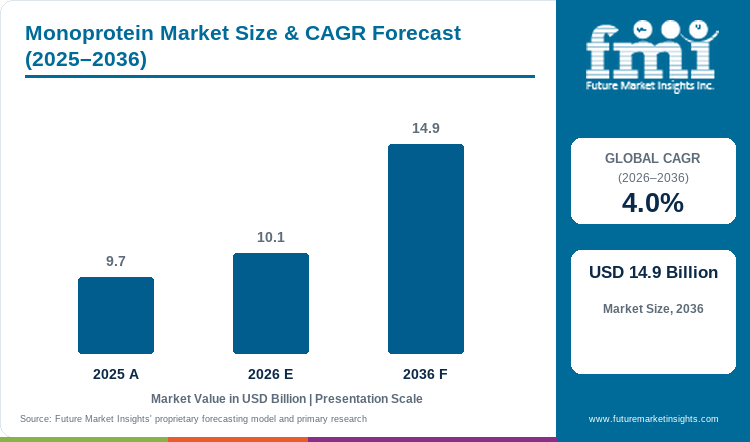
The monoprotein market is valued at USD 10.1 billion in 2026 and is projected to reach USD 14.9 billion by 2036, growing at a 4.0% CAGR.
Sales of monoprotein are estimated to rise at 4.0% CAGR through 2036. Market valuation increases from USD 9.7 billion in 2025 to USD 10.1 billion in 2026 and is estimated to reach USD 14.9 billion by 2036. Pet owners are using monoprotein food to control which animal proteins their dogs or cats eat during veterinary diet trials. Clear protein names are helping families follow the feeding plan without accidental protein changes. Merck updated its veterinary guidance on food allergy in August 2025. The guidance says elimination feeding followed by a controlled food challenge is the reliable way to confirm food allergy. The clinical process is making the named protein an important part of product selection. Brands are using accurate labels, stable recipes and dependable stock to help owners keep the same diet throughout the trial.
Country conditions are changing how owners find and keep using a monoprotein diet. South Korea has broad pet ownership and frequent veterinary care, so food-related health concerns are becoming part of routine pet care. In February 2026, South Korea's agriculture ministry reported that 29.2% of households kept a pet in 2025. Germany is relying more on physical pet stores, where owners are comparing protein labels and asking staff for help. U.S. owners are spending on pets but are watching pack prices as household budgets tighten. Brands are responding with different pack sizes, price points and sales channels in each country. Across all three countries, owners need to understand the protein source and find the selected food again during controlled feeding.
Key Takeaways of Monoprotein Market
- Pet owners are choosing one-protein food for diet trials, food intolerance and allergen control.
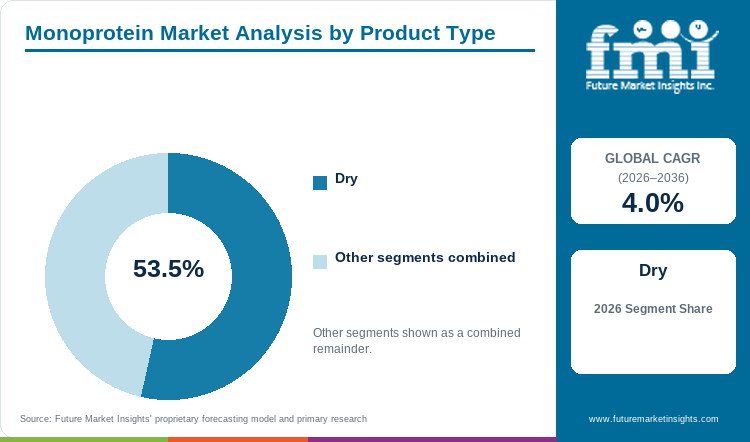
- By product type, dry is estimated to hold 53.5% in 2026. Measured portions are supporting regular daily feeding across common household routines.
- In 2026, dog is expected to lead pet type with 57.6% share. Larger daily feeding needs are increasing food volume across dog households.
- Store-based retailing is set to lead distribution channel with 86.9% share in 2026. Physical-store restocking is keeping selected food available during diet changes.
- Unclear labels and cross-contact risk are making controlled one-protein feeding harder during planned diet trials.
- Some of the key players in this market include Calysta, KnipBio, Deep Branch, String Bio, and Unibio.
Analyst Perspective
"Veterinary diet trials are creating demand for foods that keep one named protein easy to verify. Manufacturers are keeping recipes stable and stock dependable because owners need the same food throughout controlled feeding."
- Nandini Roy Choudhury, Principal Consultant, Future Market Insights.
How is the Monoprotein Market segmented?
The monoprotein market is segmented three ways: by Product Type, Pet Type, and Distribution Channel.
The monoprotein market uses three segment axes with region as the geographic split.
Product type covers dry, wet, and others.
Pet type covers dog and cat.
Distribution channel covers store-based retailing and online retailers.
What makes Dry central to the Product Type category?
Owners are using dry food for daily feeding because they can measure portions from common pack sizes. Stores are carrying dry packs without the handling needs of opened wet food. Producers are building complete diets around one animal protein and keeping feeding steps simple. The format is giving owners a practical option for controlled feeding through familiar retail stores.
- By product type, dry is estimated to hold 53.5% in 2026. Measured portions and common pack sizes are making dry food practical for regular feeding. Owners are keeping the same portioning routine across longer diet trials.
- In September 2025, the Pet Food Association of Japan reported year-over-year shipment value growth for dry dog food. Owners are continuing to spend on dry dog food in a mature pet-food category.
Why does Dog lead the Pet Type category?
Many dog households are using larger daily food volumes, which is supporting demand for dog-focused monoprotein food. Veterinarians are using monoprotein food during diet trials for suspected food reactions. Owners are controlling one named protein without making daily feeding difficult. Dog ranges are reaching buyers through pet shops and general retail stores.
- In 2026, dog is expected to lead pet type with 57.6% share. Larger daily feeding needs are supporting more food volume across common life stages. Brands are offering age-based pack sizes while keeping the animal protein easy to identify.
- In February 2026, South Korea's agriculture ministry reported higher monthly care costs for dogs than cats among pet-owning households. Dog households are carrying higher monthly pet-care costs than cat households in the same survey.
What keeps Store-Based Retailing central to the Distribution Channel category?
Store-based retail is giving buyers ready stock, shelf comparison and staff advice during food selection. Owners changing food for health reasons are comparing protein claims across wet-food options in the store. Physical stores are reducing the risk of running out during a controlled feeding period. Online channels are offering wider choice, but stores are providing immediate replacement if the selected food runs low.
- Store-based retailing is set to lead distribution channel with 86.9% share in 2026. Steady restocking and in-store label checks are helping owners manage planned diet changes. Owners are keeping the same selected food throughout controlled feeding periods.
- In April 2026, ZZF and IVH reported that German physical specialty and food stores generated more pet spending than online channels. Physical stores are keeping specialized diets visible to owners who want to compare labels and ingredients.
What are the drivers, restraints and opportunities in the Monoprotein Market?
In the monoprotein market, the key driver is veterinary diet trials that create a clear clinical use for foods built around one named protein source, the key restraint is strict feeding rules, cross-contact risk and household costs that make controlled diet trials harder to complete, and the key opportunity is clear labels, manufacturing controls that prevent unwanted protein mixing and tested new proteins that give buyers more trusted choices.
- Driver: Veterinary diet trials are creating a clear clinical use for foods built around one named protein source.
- Restraint: Strict feeding rules, cross-contact risk and household costs are making controlled diet trials harder to complete.
- Opportunity: Clear labels, manufacturing controls that prevent unwanted protein mixing and tested new proteins are giving buyers more trusted choices.
Veterinary diet trials make protein identity part of food selection
Veterinary diet trials are creating a clear role for monoprotein food for pets with suspected food reactions. Veterinarians are removing suspect proteins and using controlled food challenges to check whether signs return. In May 2026, a clinical review identified elimination diets followed by food challenge as the standard way to confirm food reactions. Protein identity is becoming part of the feeding plan instead of remaining a marketing claim. Owners are keeping treats and flavored medicines outside the planned diet during testing. Clear labels are helping veterinarians explain the allowed protein and helping families follow the same plan. Complete nutrition remains important because the trial food can become the pet's main daily meal. Simple directions are reducing feeding mistakes in homes with several caregivers. A complete diet with a clear label is giving veterinarians a practical option for longer trials.
Household feeding errors can break a controlled diet trial
Controlled feeding is requiring owners to prevent unplanned protein exposure throughout the trial. Shared treats and unplanned food changes are making controlled trials harder for families following one feeding plan. In May 2026, researchers reported wide differences in reaction dose and timing across food challenges involving affected dogs. Those differences are making feeding mistakes harder to interpret during the trial. Veterinarians are choosing hydrolyzed diets if families need tighter control over food proteins. Manufacturers are selecting pet-food ingredients that match the protein named on the pack. Stable recipes and steady stock are helping owners avoid unplanned food changes during the trial. A single feeding mistake can make the whole diet test harder to interpret.
Protein records can support new single-source ingredients
Monoprotein manufacturers are keeping records that verify protein identity instead of relying on a one-protein label alone. Korean feed rules set separate labeling requirements for dog and cat food. In September 2025, the agriculture ministry issued an amended feed standard for later application. The amended standard is making ingredient names and source records more important for each animal protein. Brands are linking raw material records with the finished recipe and package label. Fermentation proteins are widening ingredient choices as producers meet pet safety and nutrition requirements. These proteins are giving producers new options without adding another animal protein to the formula. Buyers need complete nutrition, acceptable taste and dependable stock during food changes. Lot records are helping brands test new proteins while keeping each trial formula traceable.
Which country CAGRs are covered in the Monoprotein Market?
Within the monoprotein market, the country CAGR table compares projected growth from 2026 to 2036 across South Korea, Japan, USA, Germany, and the UK.
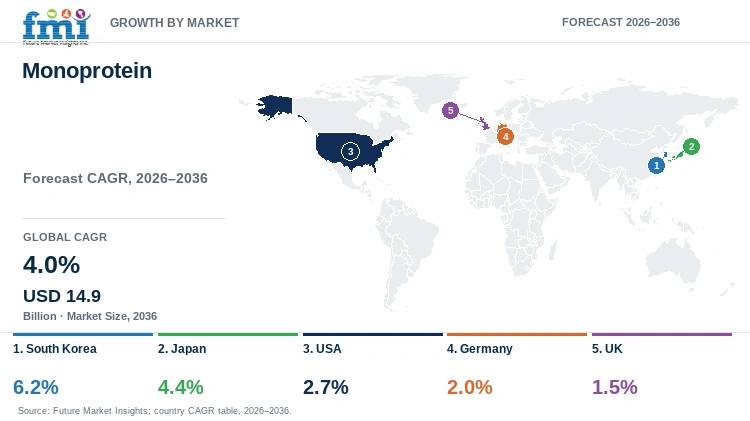
| Country | CAGR |
|---|---|
| South Korea | 6.2% |
| Japan | 4.4% |
| USA | 2.7% |
| Germany | 2.0% |
| UK | 1.5% |
How do country-level CAGRs compare in the monoprotein market?
Pet ownership, vet use, store access and household spending are creating different buying conditions across countries. South Korea's frequent vet visits are keeping food-related health concerns visible. Japan's mature pet-food market is supporting higher-value nutrition for pet owners. U.S. owners are weighing diet purpose against pack cost during longer feeding periods. Germany and the UK are relying on mature stores that are keeping special diets easy to find.
- South Korea's frequent vet visits are supporting special diets for owners managing suspected food reactions in companion animals.
- Japan's higher-value pet food demand is giving nutrition brands room to explain ingredient purpose and feeding quality.
- Across the USA, price-conscious owners are weighing diet benefits against pack cost during longer controlled feeding periods.
- Germany is relying on physical pet stores for label checks and staff guidance during special food selection.
- The UK's large dog and cat base is sustaining special diet demand across a mature pet-food category.
Pet owners across these five countries are following different buying and pet-care routines for special diets. These differences are changing how brands price, stock and explain monoprotein food in each country.
Country-wise Analysis
- By 2036, South Korea is projected to grow at 6.2% CAGR. Frequent veterinary care is keeping food-related health questions visible in pet-owning homes. In February 2026, the agriculture ministry reported that dogs were the most common pet among households that kept animals. The same national release reported frequent use of veterinary services. Regular vet contact is giving owners more chances to discuss food reactions and diet changes. Brands are supporting those conversations with clear protein names and simple feeding directions. Household pet costs remain a constraint during longer diet trials. Smaller packs and steady stock are making the feeding plan easier to maintain. Suppliers need to show clear value without asking families to change foods during the trial.
- By 2036, Japan is projected to grow at 4.4% CAGR. Its mature pet-food market is supporting higher-value diets for owners seeking special nutrition. In September 2025, the Pet Food Association reported higher shipment value for fiscal 2024. Total shipment volume fell during the same survey period in Japan. The association linked the value gain to higher-priced products and price changes. Specialized diets are gaining value without relying on more food volume. Monoprotein brands are explaining why one named protein helps the feeding plan. Buyers are comparing taste, life-stage fit and ingredient labels before paying more. Brands are keeping quality consistent across every pack sold to pet owners. Mature demand is leaving little room for vague product claims or unclear benefits.
- In the USA, monoprotein demand is predicted to rise at 2.7% CAGR through 2036. The large pet-owning base is giving brands access to many households that are considering diets with a clear purpose. In May 2026, APPA reported that 95 million U.S. households owned at least one pet in 2025. The same survey counted 71 million U.S. households that owned dogs. APPA reported that owners were becoming more price-conscious as household budgets tightened. A clear diet purpose must justify a higher price for monoprotein food. Retailers are offering pack sizes that reduce upfront spending during controlled feeding. Brands are supporting longer use by explaining the protein choice and keeping the same recipe available.
- Germany is estimated to post 2.0% CAGR through 2036 for monoprotein pet food. Demand is coming from existing pet households choosing different foods, not from rapid growth in pet ownership. In April 2026, ZZF and IVH reported that pets lived in 43% of German households during 2025. The same release said ready-made pet-food sales stayed close to the previous year. The mature base is giving monoprotein brands access to many buyers but is limiting how much demand can grow from new pet ownership. Physical stores are letting owners compare protein labels and ask staff for help. Brands are competing for existing food budgets through clear labels and reliable stock. Practical pack sizes are keeping special diets manageable for daily feeding. Buyers need a clear reason to pay more for the change.
- Monoprotein pet-food sales in the UK are forecast to expand at 1.5% CAGR by 2036. The large dog and cat population is keeping special diet needs visible in a mature market. In March 2026, UK Pet Food reported about 15.5 million dogs. The same release counted about 13.1 million cats across the country. UK Pet Food estimated that 62% of households owned at least one pet. Monoprotein brands need a clear reason for owners to leave familiar diets. Veterinary guidance and clear protein names are supporting that decision. Reliable stock is helping owners keep the same food through longer feeding periods. Price and convenience remain important because broad pet ownership does not guarantee a switch.
Who are the notable companies in the monoprotein market?
Notable companies in the monoprotein market include Calysta, KnipBio, Deep Branch, String Bio, and Unibio.
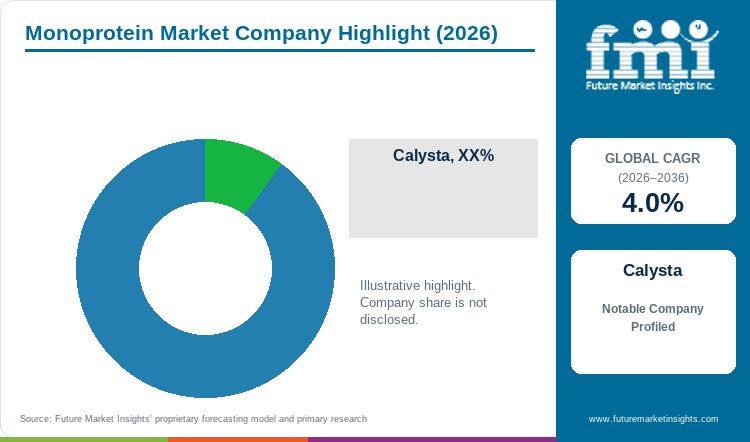
Calysta is giving buyers a finished dog-food example because commercial recipes already use FeedKind Pet. String Bio and Unibio are developing proteins made by fermentation for pet nutrition. Public records for KnipBio and Deep Branch are stronger inanimal feedthan in finished pet food. Buyers are seeing finished-food proof for Calysta and mainly ingredient or feed-testing proof for the other companies.
- Calysta is supplying FeedKind Pet for use in commercial dog food.
- String Bio and Unibio are developing feed proteins for pet and other animal-nutrition uses.
- KnipBio and Deep Branch are developing single-cell protein for aquafeed, meaning feed for farmed fish, and wider animal nutrition.
Competitive Benchmarking: Monoprotein Market
| Company | Pet-Food Market Readiness | Single-Cell Protein Validation | Scale-Up Evidence | Geographic Reach |
|---|---|---|---|---|
| Calysta | High | High | High | United States; Europe; pet approvals cited for EU, UK and Canada |
| KnipBio | Low | High | High | United States; public records document JUV in commercial fish-feed production. |
| Deep Branch | Medium | Medium | Medium | United Kingdom roots; Aerbio reports pet trials and Netherlands pilot activity |
| String Bio | Medium | High | High | India; PRO-DG targets pet and other animal nutrition, with evidence of commercial production. |
| Unibio | Medium | High | High | Denmark and Saudi Arabia; multiple feed registrations, while pet food is in development |
Key Developments in the Monoprotein Market
- In June 2026, Hill's Pet Nutrition announced Science Diet Single Protein Dog Food Rolls for U.S. pet specialty retailers. The steam-cooked, refrigerated recipes use one named animal protein and mark Hill's entry into the fresh dog food category.
- In July 2025, Zignature launched Select Cuts Kangaroo Formula dry dog food with kangaroo as the single animal protein. The product is giving buyers a dry-format option for daily feeding with one named animal protein.
- In February 2025, Calysta and Marsapet launched MicroBell, a complete dry dog food made with FeedKind Pet protein, available in European pet food stores and online. The launch gives Calysta direct finished-pet-food evidence for protein made by fermentation.
Key Players in the Monoprotein Market
Commercial pet-protein suppliers
- Calysta
Pet-food fermentation protein developers
- String Bio
- Unibio
Single-cell protein developers for animal feed
- KnipBio
- Deep Branch
Monoprotein Market - Report Scope
| Coverage field | Report scope |
|---|---|
| Market breakdown | Product Type, Pet Type, Distribution Channel |
| Quantitative Units | USD billion |
| Market Definition | Revenue covers monoprotein pet-food products sold within the specified dry, wet and others formats for dog and cat through store-based retailing and Online Retailers. Adjacent multi-protein pet foods, separately sold upstream protein ingredients and unrelated downstream services or accessories are excluded. |
| Regions Covered | North America, Latin America, Western Europe, Eastern Europe, East Asia, South Asia and Pacific, Middle East and Africa |
| Countries Covered | South Korea, Germany, USA, UK, Japan |
| Key Companies Covered | Calysta, KnipBio, Deep Branch, String Bio, Unibio |
| Forecast Period | 2026 to 2036 |
| Approach | Primary and secondary research with market triangulation. |
Monoprotein Market - Research Methodology
| Method | Approach |
|---|---|
| Primary Research | FMI analysts gathered input from manufacturers, service providers, technology developers, distributors, end users, procurement teams and subject-matter experts. Interviews examined purchasing decisions, product or service evaluation, adoption barriers, approval requirements, pricing considerations and expectations for technical or commercial support. Respondents were also asked what evidence is required before a trial, pilot, or initial order develops into regular purchasing. |
| Desk Research | Desk research covered government statistics, regulatory publications, trade data, industry associations, technical literature, standards, company filings, product information and official corporate announcements. Sources were reviewed for relevance, publication date, geographic coverage and consistency with the defined market scope. Claims relating to performance, applications, approvals, capacity, investment and commercial activity were retained only when supported by credible public evidence. |
| Market Sizing and Forecasting | The market model combined the baseline value with historical performance, segment structure, pricing and volume indicators, adoption levels, company participation and country-level demand conditions. Forecast assumptions considered economic activity, investment trends, regulatory developments, technology adoption, purchasing cycles, supply availability and barriers to wider market use. Segment and regional estimates were reconciled before the final market total was calculated. |
| Data Validation | Estimates were checked against multiple independent indicators, including public data, company activity, trade patterns, industry developments and findings from primary interviews. Validation also tested whether products, services, applications and company revenues fell within the defined market boundaries. Adjacent categories, unsupported claims, overlapping revenues and activities without direct market relevance were excluded to reduce double counting and maintain consistency across segments and countries. |
Monoprotein Market by Segments
Monoprotein Market segmented by Product Type:
- Dry
- Wet
- Others
Monoprotein Market segmented by Pet Type:
- Dog
- Cat
Monoprotein Market segmented by Distribution Channel:
- Store-Based Retailing
- Online Retailers
Monoprotein Market by Region:
- North America
- United States
- Canada
- Latin America
- Brazil
- Mexico
- Argentina
- Chile
- Western Europe
- Germany
- France
- United Kingdom
- Italy
- Spain
- Benelux
- Nordics
- Eastern Europe
- Poland
- Czech Republic
- Romania
- Hungary
- East Asia
- China
- Japan
- South Korea
- South Asia and Pacific
- India
- ASEAN
- Australia and New Zealand
- Middle East and Africa
- GCC Countries
- South Africa
- Türkiye
- Israel
Research Sources and Bibliography
- Merck Veterinary Manual (2025, August). Cutaneous Food Allergy in Animals.
- Udraite Vovk, L. and Mueller, R. S. (2026, May). Adverse Food Reactions in Dogs and Cats.
- Udraite Vovk, L., Widorn, L., Lehner, G., & Mueller, R. S. (2026, May 20). A prospective double-blinded study evaluating threshold doses of dietary allergens that trigger adverse food reactions in dogs, and time to flare after exposure.
- Ministry of Agriculture, Food and Rural Affairs, Republic of Korea (2026, February 12). One in Three Neighboring Households Lives with a Companion Animal.
- Ministry of Agriculture, Food and Rural Affairs, Republic of Korea. (2025, September 4). Standards and Specifications for Feeds, Notice No. 2025-93.
- Pet Food Association of Japan (2025, September). Results of the Fiscal 2024 Pet Food Industry Survey.
- ZZF / IVH (2026, April 23). Der Deutsche Heimtiermarkt 2025.
- UK Pet Food (2026, March 31). Britain’s dog ownership boom as 15.5 million dogs now live in UK homes.
- American Pet Products Association (2026, March 26). U.S. Pet Industry Reaches $158 Billion in 2025, Poised for Continued Growth in 2026.
- Monge (n.d.). Monoprotein Dog Food: Dry and Wet.
- Monge (n.d.). Monoprotein Cat Food: Dry and Wet.
- Calysta (2025, March 2). Marsapet Launches First Dog Food Featuring FeedKind Pet Protein.
- Calysta. (n.d.). Pets. Retrieved September 24, 2026.
- Hill's Pet Nutrition. (2026, June 30). Hill's Pet Nutrition Rolls Out Science Diet Single Protein Refrigerated Dog Food.
- Zignature. (2025, July 16). A Novel Approach to Dog Nutrition: Zignature Launches Select Cuts Kangaroo Formula.
- Pets Nature GmbH. (2025, April 30). Relaunch - Lucky Lou SuperMono mit neuen 125g Pouches.
- Natural Balance Pet Food. (2026, March). Natural Balance Launches New Solutions for Dogs and Cats at Global Pet Expo.
- Royal Canin. (2026, July 14). Royal Canin launches its first fresh therapeutic diet portfolio, available exclusively through veterinarians.
- String Bio (n.d.). Alternative protein products or solutions for animal nutrition.
- U.S. Food and Drug Administration (2018, August 9). GRAS Notice AGRN 26: KnipBio dried Methylobacterium extorquens biomass.
- Unibio. (2026). The Saudi Industrial Investment Group and Unibio to build the world's largest single-cell protein plant in Saudi Arabia.
- Aerbio. (2026). Press Release: Funding and strategic agreement support Proton scale-up and feed trials.
- Unibio (n.d.). Uniprotein.
- Unibio (n.d.). The Saudi Industrial Investment Group and Unibio to build the world’s largest single-cell protein plant in Saudi Arabia.
- Feed Strategy (2026, March 16). Saudi Industrial Investment Group, Unibio partner on world’s largest single-cell protein plant.
- Pets Nature GmbH. (2025, May 2). Premium Katzenfutter Lucky Lou erweitert Food Code Sortiment.
- Kakato. (2026, January 29). Kakato ONE Single Animal Protein Dry Food | Shining in Gold & Silver: A Fresh New Look.
- Alvar Pet. (2025, June 11). Update on Product Range Changes.
- Knip. (n.d.). Science: Why Knip? The science behind the JUV product.
- String Bio. (n.d.). String Bio - Smart Science Clean World.
The bibliography gives readers the main sources used in this article. The full report contains the complete reference list and detailed citations.
This Report Answers
- How large is the Monoprotein Market in 2026 and what is forecast for 2036?
- Which industry pressures support demand for monoprotein pet food?
- Why does dry lead product type?
- Why does dog lead pet type?
- How do country growth rates differ across the five covered countries?
- Which companies supply relevant protein and pet-food capabilities within this market?
- What limits use or supplier switching?
- What should buyers evaluate during selection of a monoprotein product?
Frequently Asked Questions
How big is the Monoprotein Market in 2026, and what is forecast for 2036?
The monoprotein market is valued at USD 10.1 billion in 2026 and is projected to reach USD 14.9 billion by 2036. Owners are choosing these foods for feeding plans that require one named protein.
What is the CAGR for the Monoprotein Market from 2026 to 2036?
The monoprotein market is projected to grow at a CAGR of 4.0% from 2026 to 2036. Veterinary diet trials and clear protein labels are supporting demand for simple feeding plans.
Which product type segment leads the monoprotein market?
The monoprotein market's Dry product type segment leads with 53.5% share in 2026. Measured portions are supporting regular feeding across common pack sizes and retail storage conditions.
Which pet type segment leads the monoprotein market?
The monoprotein market's Dog pet type segment leads with 57.6% share in 2026. Larger feeding needs are supporting frequent purchases across a broad dog-owning household base.
Which countries show notable growth rates in the monoprotein market?
The monoprotein market shows South Korea with 6.2% CAGR through 2036 within the five-country comparison, followed by Japan at 4.4% as higher-value pet food supports special nutrition choices.
Which companies are active in the Monoprotein Market?
Notable companies in the monoprotein market include Calysta, KnipBio, Deep Branch, String Bio, and Unibio, which are working across finished pet food, pet-nutrition proteins and broader animal-feed development. Public records show different stages, from commercial pet-food use to protein research and animal-feed applications.
Preview the report firsthand - request a free sample
Get SampleGet the brochure for pricing and purchase details.
Get PDFTable of Content
- Key Takeaways
- Market Size and CAGR
- Top Growth Driver
- Fastest Growing Segment
- Leading Region
- Key Companies
- Emerging Opportunities
- Executive Summary
- Global Market Outlook
- Demand-side Trends
- Supply-side Trends
- Technology Roadmap Analysis
- Analysis and Recommendations
- Analyst Perspective (What is happening? Why now? What should investors know?)
- Key Questions Answered
- How large is the market?
- What is the CAGR?
- What are key trends?
- Which region dominates?
- Who are the leaders?
- Market Overview
- Market Coverage / Taxonomy
- Market Definition / Scope / Limitations
- Research Methodology
- Chapter Orientation
- Analytical Lens and Working Hypotheses
- Market Structure, Signals, and Trend Drivers
- Benchmarking and Cross-market Comparability
- Market Sizing, Forecasting, and Opportunity Mapping
- Research Design and Evidence Framework
- Desk Research Programme (Secondary Evidence)
- Expert Input and Fieldwork (Primary Evidence)
- Tooling, Models, and Reference Databases
- Data Engineering and Model Build
- Quality Assurance and Audit Trail
- Market Background
- Market Dynamics (Drivers, Restraints, Opportunity, Trends)
- Scenario Forecast (Optimistic, Likely, Conservative)
- Impact Analysis
- AI Impact
- Sustainability Impact
- Regulatory Impact
- Technology Impact
- Consumer / Buyer Analysis
- Purchase Drivers
- Adoption Barriers
- Buyer Journey
- Opportunity Map Analysis
- Product Life Cycle Analysis
- Supply Chain Analysis
- Investment Feasibility Matrix
- Value Chain Analysis
- PESTLE and Porter's Analysis
- Regulatory Landscape
- Regional Parent Market Outlook
- Production and Consumption Statistics
- Import and Export Statistics
- Global Market Analysis and Forecast, 2021 to 2036
- Historical Market Size Value (USD Billion) Analysis, 2021 to 2025
- Current and Future Market Size Value (USD Billion) Projections, 2026 to 2036
- Y-o-Y Growth Trend Analysis
- Absolute $ Opportunity Analysis
- Global Market Pricing Analysis, 2021 to 2036
- Global Market Analysis and Forecast, By Product Type, 2021 to 2036
- Introduction / Key Findings
- Historical Market Size Value (USD Billion) Analysis By Product Type, 2021 to 2025
- Current and Future Market Size Value (USD Billion) Analysis and Forecast By Product Type, 2026 to 2036
- Dry
- Wet
- Others
- Y-o-Y Growth Trend Analysis By Product Type, 2021 to 2025
- Absolute $ Opportunity Analysis By Product Type, 2026 to 2036
- Global Market Analysis and Forecast, By Pet Type, 2021 to 2036
- Introduction / Key Findings
- Historical Market Size Value (USD Billion) Analysis By Pet Type, 2021 to 2025
- Current and Future Market Size Value (USD Billion) Analysis and Forecast By Pet Type, 2026 to 2036
- Dog
- Cat
- Y-o-Y Growth Trend Analysis By Pet Type, 2021 to 2025
- Absolute $ Opportunity Analysis By Pet Type, 2026 to 2036
- Global Market Analysis and Forecast, By Distribution Channel, 2021 to 2036
- Introduction / Key Findings
- Historical Market Size Value (USD Billion) Analysis By Distribution Channel, 2021 to 2025
- Current and Future Market Size Value (USD Billion) Analysis and Forecast By Distribution Channel, 2026 to 2036
- Store-Based Retailing
- Online Retailers
- Y-o-Y Growth Trend Analysis By Distribution Channel, 2021 to 2025
- Absolute $ Opportunity Analysis By Distribution Channel, 2026 to 2036
- Global Market Analysis and Forecast, By Region, 2021 to 2036
- Introduction
- Historical Market Size Value (USD Billion) Analysis By Region, 2021 to 2025
- Current Market Size Value (USD Billion) Analysis and Forecast By Region, 2026 to 2036
- North America
- Latin America
- Western Europe
- Eastern Europe
- East Asia
- South Asia and Pacific
- Middle East and Africa
- Market Attractiveness Analysis By Region
- North America Market Analysis and Forecast, By Country, 2021 to 2036
- Historical Market Size Value (USD Billion) Trend Analysis By Market Taxonomy, 2021 to 2025
- Market Size Value (USD Billion) Forecast By Market Taxonomy, 2026 to 2036
- By Country
- United States
- Canada
- By Product Type
- By Pet Type
- By Distribution Channel
- By Country
- Market Attractiveness Analysis
- By Country
- By Product Type
- By Pet Type
- By Distribution Channel
- Key Takeaways
- Latin America Market Analysis and Forecast, By Country
- Historical Market Size Value (USD Billion) Trend Analysis By Market Taxonomy, 2021 to 2025
- Market Size Value (USD Billion) Forecast By Market Taxonomy, 2026 to 2036
- By Country
- Brazil
- Mexico
- Argentina
- Chile
- By Product Type
- By Pet Type
- By Distribution Channel
- By Country
- Market Attractiveness Analysis
- By Country
- By Product Type
- By Pet Type
- By Distribution Channel
- Key Takeaways
- Western Europe Market Analysis and Forecast, By Country
- Historical Market Size Value (USD Billion) Trend Analysis By Market Taxonomy, 2021 to 2025
- Market Size Value (USD Billion) Forecast By Market Taxonomy, 2026 to 2036
- By Country
- Germany
- France
- United Kingdom
- Italy
- Spain
- Benelux
- Nordics
- By Product Type
- By Pet Type
- By Distribution Channel
- By Country
- Market Attractiveness Analysis
- By Country
- By Product Type
- By Pet Type
- By Distribution Channel
- Key Takeaways
- Eastern Europe Market Analysis and Forecast, By Country
- Historical Market Size Value (USD Billion) Trend Analysis By Market Taxonomy, 2021 to 2025
- Market Size Value (USD Billion) Forecast By Market Taxonomy, 2026 to 2036
- By Country
- Poland
- Czech Republic
- Romania
- Hungary
- By Product Type
- By Pet Type
- By Distribution Channel
- By Country
- Market Attractiveness Analysis
- By Country
- By Product Type
- By Pet Type
- By Distribution Channel
- Key Takeaways
- East Asia Market Analysis and Forecast, By Country
- Historical Market Size Value (USD Billion) Trend Analysis By Market Taxonomy, 2021 to 2025
- Market Size Value (USD Billion) Forecast By Market Taxonomy, 2026 to 2036
- By Country
- China
- Japan
- South Korea
- By Product Type
- By Pet Type
- By Distribution Channel
- By Country
- Market Attractiveness Analysis
- By Country
- By Product Type
- By Pet Type
- By Distribution Channel
- Key Takeaways
- South Asia and Pacific Market Analysis and Forecast, By Country
- Historical Market Size Value (USD Billion) Trend Analysis By Market Taxonomy, 2021 to 2025
- Market Size Value (USD Billion) Forecast By Market Taxonomy, 2026 to 2036
- By Country
- India
- ASEAN
- Australia and New Zealand
- By Product Type
- By Pet Type
- By Distribution Channel
- By Country
- Market Attractiveness Analysis
- By Country
- By Product Type
- By Pet Type
- By Distribution Channel
- Key Takeaways
- Middle East and Africa Market Analysis and Forecast, By Country
- Historical Market Size Value (USD Billion) Trend Analysis By Market Taxonomy, 2021 to 2025
- Market Size Value (USD Billion) Forecast By Market Taxonomy, 2026 to 2036
- By Country
- GCC Countries
- South Africa
- Türkiye
- Israel
- By Product Type
- By Pet Type
- By Distribution Channel
- By Country
- Market Attractiveness Analysis
- By Country
- By Product Type
- By Pet Type
- By Distribution Channel
- Key Takeaways
- Key Countries Market Analysis
- United States
- Pricing Analysis
- Market Share Analysis, 2025
- By Product Type
- By Pet Type
- By Distribution Channel
- Canada
- Pricing Analysis
- Market Share Analysis, 2025
- By Product Type
- By Pet Type
- By Distribution Channel
- Mexico
- Pricing Analysis
- Market Share Analysis, 2025
- By Product Type
- By Pet Type
- By Distribution Channel
- Brazil
- Pricing Analysis
- Market Share Analysis, 2025
- By Product Type
- By Pet Type
- By Distribution Channel
- Chile
- Pricing Analysis
- Market Share Analysis, 2025
- By Product Type
- By Pet Type
- By Distribution Channel
- Germany
- Pricing Analysis
- Market Share Analysis, 2025
- By Product Type
- By Pet Type
- By Distribution Channel
- United Kingdom
- Pricing Analysis
- Market Share Analysis, 2025
- By Product Type
- By Pet Type
- By Distribution Channel
- Italy
- Pricing Analysis
- Market Share Analysis, 2025
- By Product Type
- By Pet Type
- By Distribution Channel
- Spain
- Pricing Analysis
- Market Share Analysis, 2025
- By Product Type
- By Pet Type
- By Distribution Channel
- France
- Pricing Analysis
- Market Share Analysis, 2025
- By Product Type
- By Pet Type
- By Distribution Channel
- India
- Pricing Analysis
- Market Share Analysis, 2025
- By Product Type
- By Pet Type
- By Distribution Channel
- ASEAN
- Pricing Analysis
- Market Share Analysis, 2025
- By Product Type
- By Pet Type
- By Distribution Channel
- Australia and New Zealand
- Pricing Analysis
- Market Share Analysis, 2025
- By Product Type
- By Pet Type
- By Distribution Channel
- China
- Pricing Analysis
- Market Share Analysis, 2025
- By Product Type
- By Pet Type
- By Distribution Channel
- Japan
- Pricing Analysis
- Market Share Analysis, 2025
- By Product Type
- By Pet Type
- By Distribution Channel
- South Korea
- Pricing Analysis
- Market Share Analysis, 2025
- By Product Type
- By Pet Type
- By Distribution Channel
- Poland
- Pricing Analysis
- Market Share Analysis, 2025
- By Product Type
- By Pet Type
- By Distribution Channel
- Hungary
- Pricing Analysis
- Market Share Analysis, 2025
- By Product Type
- By Pet Type
- By Distribution Channel
- Türkiye
- Pricing Analysis
- Market Share Analysis, 2025
- By Product Type
- By Pet Type
- By Distribution Channel
- South Africa
- Pricing Analysis
- Market Share Analysis, 2025
- By Product Type
- By Pet Type
- By Distribution Channel
- United States
- Market Structure Analysis
- Competition Dashboard
- Competition Benchmarking
- Market Share Analysis of Top Players
- By Regional
- By Product Type
- By Pet Type
- By Distribution Channel
- Emerging Startups
- Innovation Benchmarking
- Competition Analysis
- Competition Deep Dive
- Calysta
- Overview
- Product Portfolio
- Profitability by Market Segments
- Sales Footprint
- Strategy Overview
- Marketing Strategy
- Product Strategy
- Channel Strategy
- KnipBio
- Deep Branch
- String Bio
- Unibio
- Calysta
- Case Studies
- Success Stories
- Recent Developments
- Competition Deep Dive
- Assumptions & Acronyms Used


