

- Industry Size (2026)
- USD 11.2 Bn
- Forecast (2036)
- USD 16.8 Bn
- CAGR (2026 to 2036)
- 4.1%
Oats Market Forecast and Outlook 2026 to 2036
The global oats market is forecasted to reach USD 11.2 billion in 2026 and expand to USD 16.8 billion by 2036, advancing at a CAGR of 4.1%. FMI estimates that this growth reflects a structural change in staple food consumption, where oats are moving from a traditional breakfast grain to a multifunctional ingredient aligned with health, sustainability, and plant-based nutrition trends. Rising consumer focus on heart health, digestive wellness, and clean-label diets is reinforcing steady demand across food and beverage categories.
Two converging forces are shaping market expansion. Increasing adoption of plant-based and flexitarian diets is driving oats into dairy alternatives, baked goods, and functional snacks. At the same time, heightened awareness of beta-glucan’s role in cholesterol management and glycemic control is strengthening oats’ position in preventive nutrition. These dynamics are broadening consumption beyond developed markets into urbanizing regions with growing health-conscious populations.
Quick Stats for Oats Market
- Oats Market Value (2026): USD 11.2 billion
- Oats Market Forecast Value (2036): USD 16.8 billion
- Oats Market Forecast CAGR (2026-2036): 4.1%
- Leading Product Type by Demand Share: Rolled oats
- Fastest-Growing Countries: India, USA, Germany, Canada, UK
- Top Players in Global Demand: Quaker Oats Company, General Mills Inc., Kellogg Company, Nestle S.A., Bob's Red Mill Natural Foods
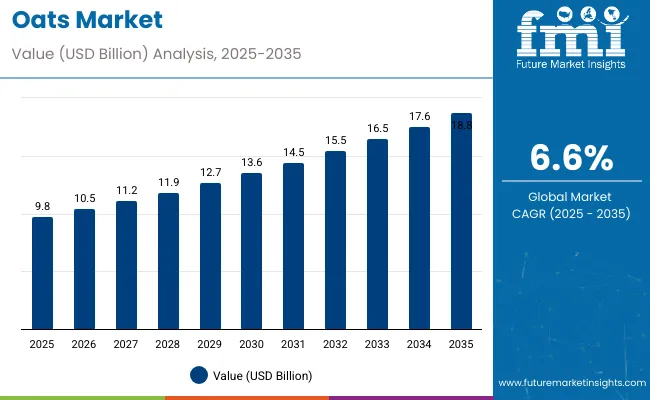
Key Takeaways, Market Size, and Forecast
| Metric | Value |
|---|---|
| Market Size (2026) | USD 11.2 Billion |
| Market Size (2036) | USD 16.8 Billion |
| CAGR (2026–2036) | 4.1% |
| Leading Product Type | Rolled Oats |
| Rolled Oats Share | 43.8% |
| Leading Application | Food Processing |
| Food Processing Share | 52.3% |
The value proposition of oats is evolving from bulk commodity supply toward differentiated, value-added formats. Demand is rising for gluten-free certified oats, organic variants, and minimally processed oat ingredients tailored for foodservice and industrial applications. Innovation is also visible in oat-based beverages, protein-enriched formulations, and specialty milling techniques that enhance texture, flavor, and nutritional retention.
Oats Market Key Takeaways
| Metric | Value |
|---|---|
| Market Value (2026) | USD 11.2 billion |
| Market Forecast Value (2036) | USD 16.8 billion |
| Forecast CAGR (2026-2036) | 4.1% |
Source: FMI analysis based on primary research and proprietary forecasting model
Key Shift in the Oats Market During 2026 to 2036
Based on Future Market Insights’ analysis, pre-2026, the oats market was primarily commodity-driven, centered on conventional uses such as breakfast cereals and basic food ingredients. Competition focused on price and yield, with limited differentiation in product functionality or value-added attributes.
By 2026, rising consumer demand for health-oriented foods and clearer regulatory standards for nutritional claims reshaped the category. Global guidelines for whole-grain labeling and functional benefits reduced ambiguous marketing and elevated products with substantiated health claims like heart health and glycemic control. This forced producers to shift from generic offerings to verified, health-aligned oat products.
Consumer engagement has also transformed and oats have gained traction as a dairy alternative. Traditional oats were purchased mainly for cost and familiarity. From 2026-2036, the market embraced digitally connected experiences where packaging and apps deliver personalized recipe suggestions, meal plans, and dietary insights linked to individual health goals. Oats became an interactive wellness ingredient rather than a passive pantry staple.
The production and supply chain model evolved as well. Previously, large uniform crop lots and standard processing dominated. In 2026-2036, precision agriculture, AI-assisted breeding for functional traits, and flexible processing lines enabled tailored oat varieties and formats that matched specific nutritional and sensory needs.
What are the Various Segments of the Oats Market?
Oats play a critical role in delivering nutritional value, dietary fiber, and consumer health benefits across food processing, breakfast cereals, and functional food applications. Adoption is influenced by protein content, processing requirements, cost considerations, and end-use performance criteria. Segmentation by product type, application, and distribution channel highlights how manufacturers select specific oat varieties to meet nutritional standards, cost targets, and consumer preferences across diverse food categories.
Which Product Type Holds the Largest Share in Oats?
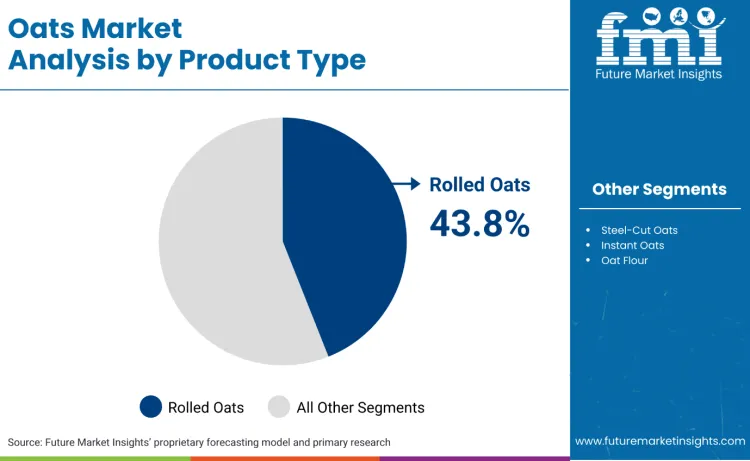
Rolled oats account for 43.8%, driven by extensive use in breakfast cereals, baking applications, and ready-to-eat products. Steel-cut oats hold 28.4%, supporting premium breakfast products and specialty food applications. Instant oats represent 19.2%, favored for convenience foods, quick preparation products, and busy consumer lifestyles. Oat flour contributes 8.6%, used in baking applications and gluten-free product formulations.
Key Points
- Rolled oats dominate breakfast and food processing applications.
- Steel-cut oats support premium and artisanal food markets.
- Product selection depends on processing requirements and consumer convenience needs.
How Do Application Requirements Influence Oats Selection?
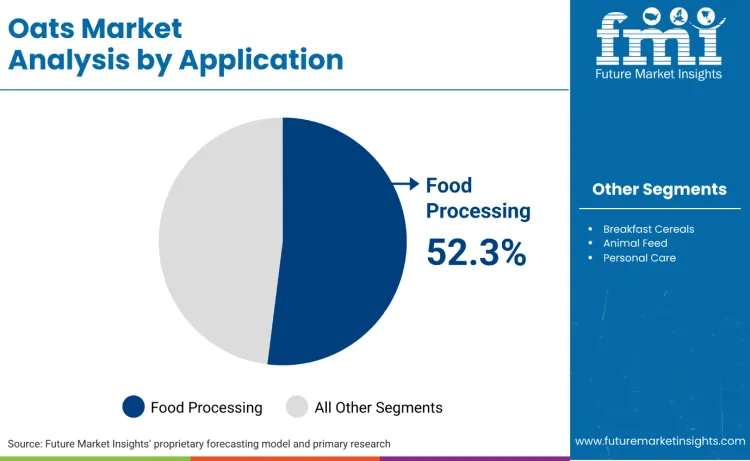
Food processing represents 52.3%, reflecting priority on applications requiring nutritional enhancement and texture improvement. Breakfast cereals account for 28.7%, suitable for ready-to-eat products requiring extended shelf-life and consumer appeal. Animal feed holds 12.4%, used for livestock nutrition and agricultural applications requiring bulk quantities. Personal care products contribute 4.8%, favored for skin care formulations and cosmetic applications. Other applications account for 1.8%.
Key Points
- Food processing remains the primary market segment.
- Breakfast cereals serve convenience and nutrition applications.
- Application selection depends on processing requirements and end-use specifications.
What are the Key Dynamics in the Oats Market?
Demand in the oats market arises from manufacturers seeking to improve nutritional profiles, reduce ingredient costs, and meet health-conscious consumer preferences in applications where alternative grains prove insufficient. Activity is notable in food processing facilities, breakfast cereal production lines, and health food manufacturing where oats address fiber requirements, protein needs, and cost efficiency standards. Product selection centers on nutritional properties, processing capabilities, and functional benefits that support food quality without compromising manufacturing efficiency.
How do Health Trends In Consumer Markets Affect Market Growth?
Market uptake grows where nutritional characteristics of oats are critical to product positioning. In food and beverage production, ingredients must maintain health benefits and functional properties to achieve wellness specifications and dietary compliance requirements. Large-scale food operations use oat-based platforms to ensure nutritional enhancement during processing, supporting health claims while maintaining cost-effective ingredient characteristics. Food manufacturers depend on consistent oat performance to deliver fiber content, protein levels, and functional capabilities comparable to established nutritional protocols. Operators evaluate performance under processing conditions and storage environments to ensure nutritional retention through various manufacturing scenarios. Selection reflects how well oats integrate with existing processing equipment, formulation systems, and quality standards common to modern food operations.
What Cost Constraints Influence Oats Demand?
Broader adoption is shaped by the complexity of commodity pricing and specialized processing facility requirements. Some applications experience cost constraints due to oat price fluctuations or supply availability limitations, requiring careful variety selection and supplier management strategies. Regional differences in processing infrastructure and storage systems affect where manufacturers can access cost-effective oats without triggering complex logistics challenges. Price considerations arise when nutritional requirements and processing capabilities are needed to balance ingredient performance, raw material costs, and total formulation expenses in operations requiring consistent quality specifications. Technology evaluation processes that assess processing capabilities and nutritional efficiency extend ingredient selection timelines, influencing decisions about which platforms to deploy across diverse manufacturing regions where cost requirements drive formulation approach decisions.
How Is the Oats Market Evolving Globally?
Global demand for oats is increasing as food and beverage companies expand production capacity while addressing consumer health consciousness, nutritional enhancement, and functional food application requirements. Growth reflects rising use of organic varieties, specialty processing methods, and nutrition-optimized formulations across food processing plants, cereal facilities, and health food production systems. Product selection focuses on nutritional properties, processing efficiency, and cost performance under various manufacturing scenarios. India records 6.2% CAGR, USA records 4.8% CAGR, Germany records 4.3% CAGR, Canada records 3.9% CAGR, and UK records 3.7% CAGR. Adoption remains driven by health requirements and nutritional benefits rather than volume expansion alone.
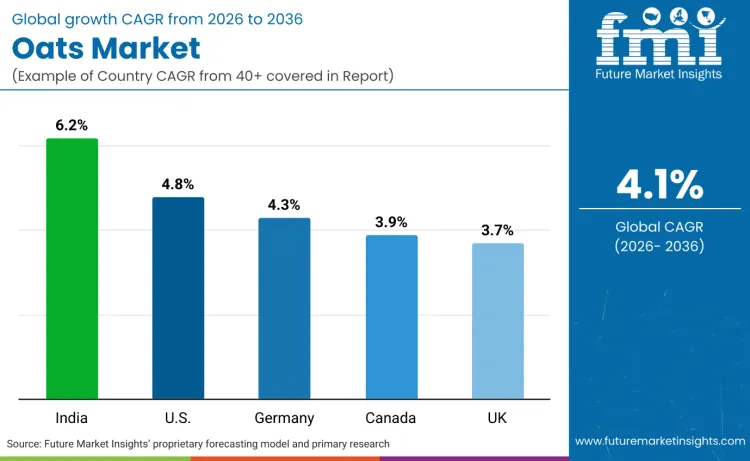
| Country | CAGR (2026-2036) |
|---|---|
| India | 6.2% |
| USA | 4.8% |
| Germany | 4.3% |
| Canada | 3.9% |
| UK | 3.7% |
Source: FMI analysis based on primary research and proprietary forecasting model
India: How is the "Desi-Flavored" Instant Oat Trend Capturing the Urban Morning?
India is the fastest-growing market in the Asia-Pacific region, primarily driven by the "Westernization" of breakfast habits among urban professionals. A key 2026 development is the massive success of savory, masala-flavored instant oats by brands like Saffola (Marico) and Quaker, which have localized the grain to suit the Indian palate. Additionally, the rise of e-commerce and quick-commerce (10-minute delivery) has made oats a staple in middle-class pantries. Reflecting this rapid cultural shift, the Indian oats market is set to grow at a 6.2% CAGR during the study period.
USA: Is "Oat Milk 2.0" Stabilizing the Mature Grain Market?
In the USA, the market is mature but revitalized by the Oat Milk 2.0 movement, which focuses on "barista-grade" sustainability and cleaner labels (no added oils or gums). A major 2026 driver is the FDA’s clarity on "Heart Healthy" labeling, which allows manufacturers to aggressively market beta-glucan fiber content for cholesterol management. Brands like Bob’s Red Mill and Oatly are also expanding into oat-based frozen desserts and creamers. Within this innovation-led environment, the USA oats market is projected to grow at a 4.8% CAGR during the study period.
Germany: Can the "Bio-Vegan" Standard Drive Premium Oat Growth?
Germany leads Europe in the demand for Organic (Bio) and non-GMO oats. A critical 2026 driver is the "Synbiotic" trend, where German manufacturers are blending oats with tailored probiotics to create "Gut-Health First" mueslis and porridges. The German market is also seeing a surge in oat-based meat alternatives, utilizing oat protein as a neutral, sustainable base for plant-based sausages. Consequently, the German oats market is expected to grow at a 4.3% CAGR during the study period, supported by a retail system that prioritizes sustainability.
Canada: Is the "Global Export Leader" Pushing for Value-Added Processing?
Canada is the world's largest exporter of oats, but in 2026, the strategy is shifting from exporting raw grains to domestic value-added processing. A major development is the investment in massive oat-fractionation facilities in the Prairies, which extract protein and fiber for the global ingredients market. As Canada strengthens its supply chain to the USA and Mexico, the Canadian oats market is set to grow at a 3.9% CAGR during the study period, driven largely by its role as the "backbone" of North American food security.
UK: How is "Sustainability-First" Farming Influencing Cereal Demand?
The UK oats market is characterized by a strong move toward locally sourced, sustainable grains. A key 2026 driver is the "Regenerative Agriculture" certification now appearing on premium oat brands, which appeals to eco-conscious British consumers. Furthermore, the popularity of "On-the-Go" oat pots in convenience retail (like Boots and Tesco) is sustaining growth among the commuting workforce. Supported by these retail and environmental trends, the UK oats market is set to grow at a 3.7% CAGR during the study period.
Who are the Major Players Active in the Oats Market?
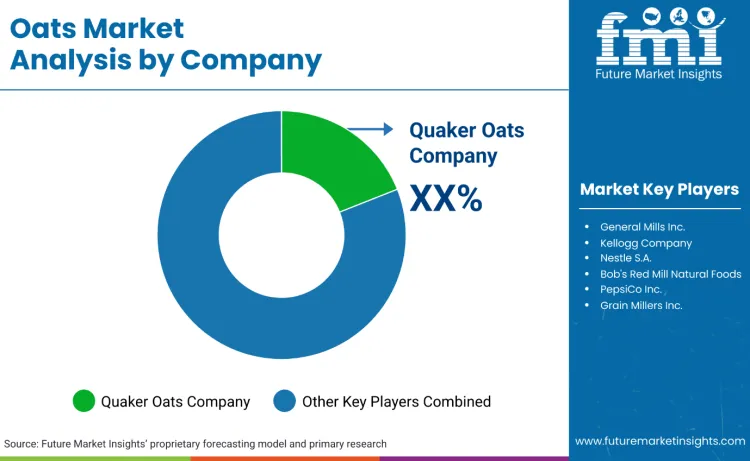
The oats market is defined by aggressive portfolio restructuring and a pivot toward functional, "gut-health" innovations. PepsiCo (Quaker Oats) has focused on supply chain resilience and localized innovation, notably launching its first fermented oatmeal product in late 2025 to integrate prebiotics and postbiotics into the breakfast category. The competitive landscape was fundamentally reshaped by two massive consolidations: Mars, Incorporated completed its acquisition of Kellanova in December 2025, absorbing global oat-based snacking brands like RXBAR, while The Ferrero Group finalized its acquisition of WK Kellogg Co to dominate the North American cereal segment.
Quaker Oats Company accounts for a leading position through integrated oat processing operations designed to deliver nutritional benefits, manufacturing reliability, and supply consistency capabilities. General Mills Inc. competes by combining breakfast cereal production with comprehensive ingredient sourcing supporting product development across diverse food applications. Kellogg Company supports demand through specialized breakfast platforms aligned with convenience and nutritional requirements. Nestle S.A. maintains relevance by supplying premium products enhancing consumer health and manufacturing performance potential. Bob's Red Mill Natural Foods participates with processing solutions emphasizing organic quality and specialty applications. Competitive differentiation centers on product quality, supply reliability, nutritional specifications, and depth of manufacturing collaboration.
Key Players in the Oats Market
- Quaker Oats Company
- General Mills Inc.
- Kellogg Company
- Nestle S.A.
- Bob's Red Mill Natural Foods
- PepsiCo Inc.
- Grain Millers Inc.
- Morning Foods Ltd.
- Blue Lake Milling
- Fazer Group
Scope of the Report
| Items | Values |
|---|---|
| Quantitative Units | USD billion |
| Product Type | Rolled Oats; Steel-Cut Oats; Instant Oats; Oat Flour; Others |
| Application | Food Processing; Breakfast Cereals; Animal Feed; Personal Care; Others |
| Distribution Channel | Supermarkets/Hypermarkets; Convenience Stores; Online Retail; Specialty Stores; Others |
| Regions Covered | Asia Pacific, Europe, North America, Latin America, Middle East & Africa |
| Countries Covered | India, USA, Germany, Canada, UK, and 40+ countries |
| Key Companies Profiled | Quaker Oats Company; General Mills Inc.; Kellogg Company; Nestle S.A.; Bob's Red Mill Natural Foods; Others |
| Additional Attributes | Dollar sales by product type, application, and distribution channel; performance in nutritional content and cost efficiency across food processing, breakfast cereals, and health food matrices; product quality improvement, processing efficiency enhancement, and health benefit under manufacturing operations; impact on nutritional enhancement, supply reliability, and cost management during production processes; compatibility with processing systems and quality control targets; procurement dynamics driven by food processing expansion, health trend programs, and long-term ingredient supply partnerships. |
Oats Market by Segment
Product Type:
- Rolled Oats
- Steel-Cut Oats
- Instant Oats
- Oat Flour
- Others
Application:
- Food Processing
- Breakfast Cereals
- Animal Feed
- Personal Care
- Others
Distribution Channel:
- Supermarkets/Hypermarkets
- Convenience Stores
- Online Retail
- Specialty Stores
- Others
Region:
- Asia Pacific
- China
- Japan
- South Korea
- India
- UK & New Zealand
- ASEAN
- Rest of Asia Pacific
- Europe
- Germany
- United Kingdom
- France
- Italy
- Spain
- Nordic
- BENELUX
- Rest of Europe
- North America
- USA
- Canada
- Mexico
- Latin America
- Brazil
- Chile
- Rest of Latin America
- Middle East & Africa
- Kingdom of Saudi Arabia
- Other GCC Countries
- Turkey
- South Africa
- Other African Union
- Rest of Middle East & Africa
Bibliography
- Cereal Grains Association. (2023). Quality Standards for Oats Processing: Technical Guidelines. CGA.
- International Food Science Institute. (2023). Nutritional Specifications for Oats Products: Health and Safety Requirements. IFSI.
- Association of Food Processing Technology. (2024). AFPT Guidelines for Oats Selection in Food Manufacturing (updated nutritional specifications for health and processing applications). AFPT.
- Johnson, M. K., et al. (2023). Nutritional property effects of oats processing on food enhancement efficiency: A comprehensive analysis of breakfast cereal and functional food applications. Journal of Cereal Science, 28, 65-81.
- Williams, D. R., et al. (2023). Third annual oats market report: Special focus on health benefits and cost efficiency in food processing applications. International Grain Review, 23, 18-35.
Frequently Asked Questions
How big is the oats market in 2026?
The global oats market is estimated to be valued at USD 11.2 billion in 2026.
What will be the size of the oats market in 2036?
The market size for the oats market is projected to reach USD 16.8 billion by 2036.
How much will the oats market grow between 2026 and 2036?
The oats market is expected to grow at a 4.1% CAGR between 2026 and 2036.
What are the key product types in the oats market?
The key product types in the oats market include rolled oats, steel-cut oats, instant oats, oat flour, and other specialized oat products.
Which application segment will contribute a significant share in the oats market in 2026?
In terms of application, the food processing segment is set to command a 52.3% share in the oats market in 2026.
Preview the report firsthand - request a free sample
Get SampleGet the brochure for pricing and purchase details.
Get PDFTable of Content
- Executive Summary
- Global Market Outlook
- Demand Side Trends
- Supply Side Trends
- Processing, Nutrition, and Product Innovation Roadmap
- Analysis and Strategic Recommendations
- Market Overview
- Market Coverage / Taxonomy
- Market Definition / Scope / Limitations
- Research Methodology
- Chapter Orientation
- Analytical Lens and Working Hypotheses
- Market Structure, Nutrition Drivers, and Consumption Signals
- Benchmarking and Cross-market Comparability
- Market Sizing, Forecasting, and Opportunity Mapping
- Research Design and Evidence Framework
- Desk Research Programme (Secondary Evidence)
- Company Annual Reports and Sustainability Disclosures
- Peer-reviewed Journals and Academic Literature
- Corporate Websites, Product Literature, and Technical Notes
- Earnings Calls and Investor Presentations
- Statutory Filings and Regulatory Publications
- Whole-grain and Health Claim Guidelines
- Trade Journals and Grain Industry Publications
- Conference Proceedings and Webinar Materials
- Government Agriculture and Nutrition Databases
- Press Releases and Reputable Media Coverage
- Sector Databases and Reference Repositories
- FMI Internal Knowledge Base and Historical Datasets
- Expert Input and Fieldwork (Primary Evidence)
- Primary Modes
- Qualitative Expert Interviews
- Quantitative Surveys
- Blended Research Approach
- Stakeholder Universe Engaged
- C-suite Executives
- Milling and Processing Heads
- Food Formulation Specialists
- Nutrition and Regulatory Affairs Leaders
- Procurement and Supply Chain Managers
- Governance, Ethics, and Data Stewardship
- Research Ethics
- Data Integrity and Handling
- Primary Modes
- Data Engineering and Model Build
- Data Acquisition and Ingestion
- Cleaning, Normalisation, and Verification
- Synthesis, Triangulation, and Analysis
- Quality Assurance and Audit Trail
- Desk Research Programme (Secondary Evidence)
- Market Background
- Market Dynamics
- Drivers
- Restraints
- Opportunities
- Trends
- Scenario Forecast
- Demand in Optimistic Scenario
- Demand in Likely Scenario
- Demand in Conservative Scenario
- Opportunity Map Analysis
- Product Life Cycle Analysis
- Value Chain Analysis
- Supply Chain and Milling Analysis
- Investment Feasibility Matrix
- PESTLE and Porter’s Five Forces Analysis
- Regulatory Landscape
- Regional Parent Market Outlook
- Market Dynamics
- Global Oats Market Analysis 2021 to 2025 and Forecast 2026 to 2036
- Historical Market Size Value (USD Billion), 2021 to 2025
- Current and Future Market Size Value (USD Billion), 2026 to 2036
- Y-o-Y Growth Trend Analysis
- Absolute $ Opportunity Analysis
- Global Oats Market Pricing Analysis 2021 to 2025 and Forecast 2026 to 2036
- Y-o-Y Growth Trend Analysis 2021 to 2025
- Absolute $ Opportunity Analysis 2026 to 2036
- Global Market Analysis 2021 to 2025 and Forecast 2026 to 2036, By Product Type
- Introduction / Key Findings
- Historical Market Size Value (USD Billion) Analysis, 2021 to 2025
- Market Size Value (USD Billion) Forecast, 2026 to 2036
- Rolled Oats
- Steel-cut Oats
- Instant Oats
- Oat Flour
- Others
- Global Market Analysis 2021 to 2025 and Forecast 2026 to 2036, By Application
- Introduction / Key Findings
- Historical Market Size Value (USD Billion) Analysis, 2021 to 2025
- Market Size Value (USD Billion) Forecast, 2026 to 2036
- Food Processing
- Breakfast Cereals
- Animal Feed
- Personal Care
- Others
- Global Market Analysis 2021 to 2025 and Forecast 2026 to 2036, By Distribution Channel
- Introduction / Key Findings
- Historical Market Size Value (USD Billion) Analysis, 2021 to 2025
- Market Size Value (USD Billion) Forecast, 2026 to 2036
- Supermarkets / Hypermarkets
- Convenience Stores
- Online Retail
- Specialty Stores
- Others
- Global Market Analysis 2021 to 2025 and Forecast 2026 to 2036, By Region
- Introduction
- Historical Market Size Value (USD Billion) Analysis By Region, 2021 to 2025
- Market Size Value (USD Billion) Forecast By Region, 2026 to 2036
- North America
- Latin America
- Europe
- Asia Pacific
- Middle East & Africa
- Market Attractiveness Analysis By Region
- Key Countries Market Analysis
- Market Structure Analysis
- Competition Dashboard
- Competition Benchmarking
- Market Share Analysis of Top Players
- Competition Analysis
- Competition Deep Dive
- Quaker Oats Company
- General Mills Inc.
- Kellogg Company
- Nestle S.A.
- Bob's Red Mill Natural Foods
- Competition Deep Dive
- Assumptions & Acronyms Used


