

- Market Size (2026)
- USD 187.2 Mn
- Forecast (2036)
- USD 364.4 Mn
- CAGR (2026 to 2036)
- 6.9%
How Big is the Phycocyanin Market in 2026?
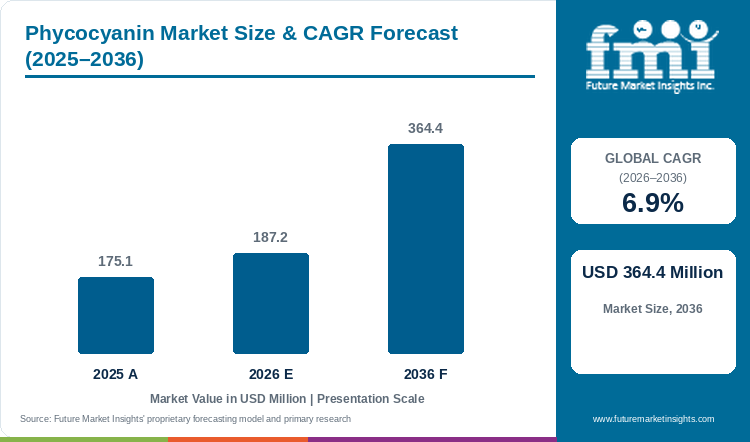
The phycocyanin market is valued at USD 187.2 million in 2026 and is projected to reach USD 364.4 million by 2036, growing at a 6.9% CAGR as per FMI synthetic survey
Phycocyanin market size stands at USD 187.2 Million in 2026, up from USD 175.1 Million in 2025, and FMI projects revenue of USD 364.4 Million by 2036 at a 6.9% CAGR. Oterra reported more than 10,000 food and beverage launches carrying blue color in 2025, against about 6,000 in 2021 [1]. Launch counts are climbing faster than the value growth expected for phycocyanin, so suppliers will see a rising number of small trial orders before volumes settle into contracted specifications.
Between 2026 and 2036 the phycocyanin category will widen by USD 177.2 Million, less than half the USD 418.0 Million that spirulina extracts will gain as that parent pool climbs from USD 530.0 Million to USD 948.0 Million at a 6.0% CAGR. Purified blue is set to grow faster than the parent pool because buyers pay for pigment strength and regulatory documentation, so extract producers will earn more per kilogram of biomass by moving output up the purity ladder.
Natural red and yellow come from several crops, as the paprika color and curcumin food color categories show, yet stable natural blue solutions remained limited in Europe in March 2026 [2]. Within the wider food colors market, this gap gives phycocyanin a degree of pricing insulation that red and yellow extracts lack, and analysts at FMI expect the premium to hold through 2036. Investment in heat-stable and acid-stable systems is the route by which producers will convert reformulation trials into repeat volume.
Key Takeaways
- Conventional phycocyanin will command 61.8% of revenue by nature in 2026.
- Powder will capture 93.4% of form revenue in 2026, and E18 will lead the grade category at 60.2%.
- The phycocyanin market features DIC Corporation, Sensient Technologies Corporation, GNT Group, Oterra A/S, and Givaudan Sense Colour among leading suppliers, with many more players profiled in the full study.
- Among countries, the USA will expand fastest at 8.3%, and France will post the slowest growth at 6.0% from a developed natural food base.
Analyst Perspective
“Acidic beverages and baked goods represent the next leg of phycocyanin revenue, because standard spirulina blue has served both applications poorly. Through 2036, suppliers combining controlled biomass with heat-stable and acid-stable formulations will convert the largest share of Blue 1 replacement projects in the USA.”
- Nandini Roy Choudhury, Principal Consultant, Future Market Insights
How is the Phycocyanin Market Segmented?
Phycocyanin demand is tracked across nature, form, grade, application and region, giving buyers and suppliers a view from biomass source to end use.
Nature covers conventional and organic phycocyanin.
Form covers powder and liquid.
Grade covers phycocyanin E18, phycocyanin E25, and phycocyanin E3.0.
Application covers food & beverage, nutraceuticals, aquaculture, cosmetics & personal care, and animal feed.
Why Does Conventional Lead the Phycocyanin Market by Nature?
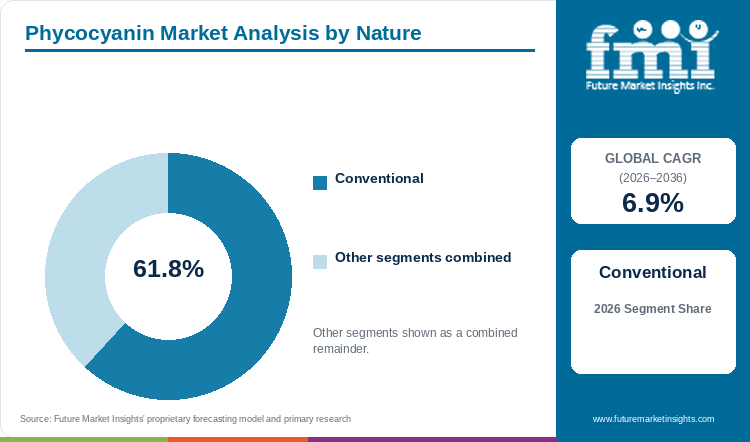
Conventional phycocyanin will account for 61.8% of nature market share in 2026, as scale cultivation keeps biomass cost low.
A color buyer reordering blue every quarter needs the same shade from every lot, and large cultivators running ponds and closed systems deliver that consistency at low biomass cost with steady extraction yields. Conventional material will hold 61.8% of nature revenue in 2026, according to FMI's estimates. Organic phycocyanin serves brands with certified claims, though certification adds audit steps that narrow the supplier pool and lengthen qualification.
- Scalable cultivation and lower qualification cost will keep conventional supply at 61.8% of nature revenue in 2026.
- Cyanotech reported fiscal second-quarter 2026 revenue of USD 6.976 million in November 2025, a 19.3% increase helped by higher bulk sales of Hawaii-grown microalgae [3].
Why Does Powder Lead the Phycocyanin Market by Form?
At 93.4%, powder will account for the highest market share by form in 2026.
Freight and storage costs favor dry pigment, since a color house shipping powder avoids paying to move water and can blend concentrate on demand. Liquid formats cut dissolution time and remove dust, so suppliers are introducing pumpable versions for beverage and dairy lines. Key challenges in liquid supply include tighter packaging and handling controls across the distribution chain, a cost that will keep liquids a minority format through 2036.
- Shipping efficiency and flexible dosing will give powder 93.4% of form revenue in 2026.
- In July 2026, Oterra introduced liquid versions of two natural blue powders, among them FruitMax Blue 1512 WS made from spirulina grown in Iceland [1].
Why Does Phycocyanin E18 Lead the Phycocyanin Market by Grade?
Phycocyanin E18 will hold 60.2% of grade market share in 2026 as the default general-purpose grade for food color buyers.
Grade choice comes down to cost per unit of color delivered, and E18 offers the lowest-risk balance for confectionery, dairy and beverage reformulation. Buyers needing more pigment per kilogram pay up for E25, and lines that cannot wait for powder to dissolve specify the liquid E3.0 grade. As Blue 1 replacement projects reach procurement, specifications are tightening around purity and color strength, a shift that will pull a growing slice of orders toward E25.
- E18 is set to represent 60.2% of grade revenue in 2026, supported by large output volumes and cost efficiency.
- In June 2026, Sun Chemical, part of the DIC Group, announced plans to present LINABLUE G1 spirulina extract at IFT FIRST 2026, citing purity and color strength gained through vertical integration [4].
Why Does Food & Beverage Lead the Phycocyanin Market by Application?
Food & beverage will lead applications with 83.7% of market share in 2026, carried by Blue 1 replacement in confectionery and drinks.
Brand owners replacing synthetic blue in candy, desserts and drinks have few naturally derived options, and that reformulation pressure keeps food & beverage at the head of phycocyanin demand. Confectionery led blue launches in a July 2026 industry review, ahead of supplements and bakery [5]. Expansion in jellies and gummies will hand extract suppliers a high-volume reformulation outlet for standard grades.
- Confectionery, dessert and beverage use will lift food & beverage to 83.7% of application revenue in 2026.
- In February 2026, the U.S. FDA widened permitted uses of spirulina extract as a color additive to foods generally, acting on a petition filed by GNT [6].
What are the Drivers, Restraints, and Opportunities in the Phycocyanin Market?
As per FMI's analysis, the U.S. shift away from synthetic dyes will drive sales, heat and pH sensitivity will slow conversion, and acid-stable and heat-stable blue systems will open a higher-value revenue pool till 2036.
- Driver: Food makers replacing Blue 1 need a naturally derived blue with regulatory clearance, and phycocyanin is set to remain the most widely approved option through 2036.
- Restraint: Color loss under heat, light and low pH raises application testing cost before reformulated products reach scale-up.
- Opportunity: Stabilized spirulina systems and acid-stable Galdieria blue carry phycocyanin into soft drinks, baked goods and other demanding formats.
Regulation is pulling phycocyanin demand forward faster than formulation chemistry can follow. In May 2025, the FDA approved galdieria extract blue, a phycocyanin color derived from the red alga Galdieria sulphuraria and submitted by Fermentalg, for beverages, candy and frostings [7]. A March 2026 notice postponed the effective date of the wider spirulina approval pending objections, leaving reformulation schedules exposed to approval timing [8]. On the formulation side, GNT reported that spirulina blue fades above 70°C and degrades in low-pH drinks and acidic confectionery, though freezing causes no damage [5]. Reformulation budgets will therefore flow toward heat-stable and acid-stable systems, and standard grades are set to compete mainly on price in frozen and dry-mix uses.
Which Country CAGRs are Profiled in the Phycocyanin Market?
| Country | CAGR, 2026 to 2036 |
|---|---|
| USA | 8.3% |
| Germany | 8.0% |
| Spain | 7.7% |
| Italy | 7.3% |
| Canada | 7.0% |
| UK | 6.7% |
| Russia | 6.4% |
| France | 6.0% |
How do Country-level CAGRs Compare in the Phycocyanin Market?
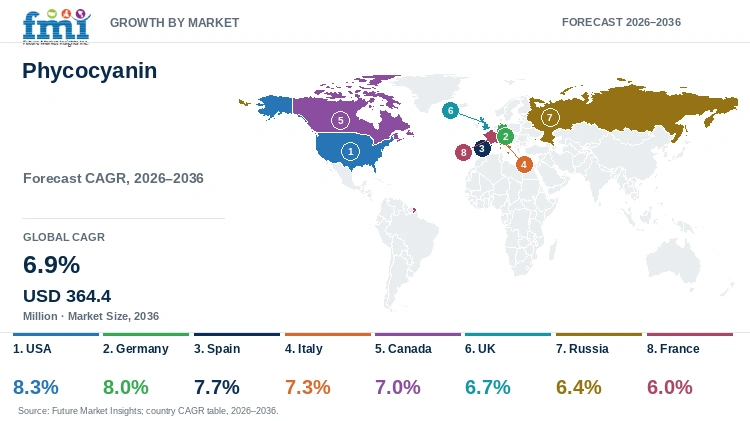
FMI's eight country forecasts sit within a 2.3 percentage-point band, from an 8.3% CAGR in the USA down to 6.0% in France, with Germany close to the top at 8.0%. A band this narrow suggests the same Blue 1 replacement cycle is moving through every profiled market, with regulation and organic food depth setting the order. Because these CAGRs measure pace alone, a slower country may still account for more revenue than a faster one.
- Germany's 8.0% outlook will rest on a large organic food base and dense microalgae production close to color buyers.
- Canada lists Spirulina Extract among permitted food colours for defined uses, a clearance that supports a 7.0% CAGR [9].
- Russian demand will stay selective at 6.4%, as pressure on beverage output narrows color budgets.
- In France, growth of 6.0% will come mostly from deeper product ranges inside a developed organic market.
Outside these eight markets, the complete study tracks growth for seven regions and over 30 individual countries and country groupings.
Country Outlook
- The FDA's February 2026 decision to widen spirulina extract use to foods generally gives the USA the strongest regulatory pull of any profiled country [6]. Sensient is adding 28,800 square feet of production space in St. Louis under a natural color plan of up to USD 250 million [10]. Steep tariffs are also pushing procurement teams to look beyond Chinese spirulina [5]. Domestic capacity paired with federal clearance will carry U.S. demand at an 8.3% CAGR, the fastest in the group.
- Spain's agriculture ministry reported organic product exports of EUR 3,884 million in 2024, a 27.5% rise on the prior year [11]. Food makers shipping certified products abroad will need colors cleared in each destination market, and that compliance burden is turning documented phycocyanin into a default choice for exporters. Demand in Spain is set to advance at a 7.7% CAGR through 2036.
- Italian demand will spread across a broad processing base, a pattern that suits color houses and distributors carrying wide catalogs. Istat reported EUR 89 billion of agri-food value added in 2025, and food, beverage and tobacco output grew 1.4% in volume that year [12]. Phycocyanin adoption in Italy is set to expand at a 7.3% CAGR through 2036.
- UK uptake of acid-stable blue will hinge on regulatory timing, since Givaudan said in May 2025 that petitions for Everzure Galdieria were pending in Europe and the UK [13]. Food manufacturing formed the largest division of UK manufacturers' product sales in 2025, at 22.9% of GBP 452.0 billion, according to the Office for National Statistics [14]. Phycocyanin growth in the UK is pegged at a 6.7% CAGR to 2036.
- France combines a mature organic market with a home-grown source of acid-stable blue. Agence BIO reported a EUR 13 billion organic market in 2025, up 3.6% from 2024 [15]. Fermentalg, based in Libourne, obtained a positive EFSA safety opinion for Galdieria blue in March 2026 [2]. Domestic access to acid-stable blue will help French formulators, though a mature base holds phycocyanin growth to 6.0%, the lowest of the eight profiled countries.
Who are the Notable Companies in the Phycocyanin Market?
Key companies in the market include DIC Corporation (Earthrise Nutritionals), Sensient Technologies Corporation, GNT Group, Oterra A/S, Givaudan Sense Colour, Fuqing King Dnarmsa Spirulina Co., Ltd., Parry Nutraceuticals (EID Parry), Cyanotech Corporation, Fermentalg, and Vaxa Technologies.
Supply concentration shapes competition more than brand reach, as FMI's review of the supplier base shows. Only a few producers met multinational quality standards at scale in July 2026, giving qualified cultivators firm pricing power [5]. Biomass ownership acts as the main entry barrier, and DIC reported in February 2026 that the Earthrise Nutritionals site in California covers about 420,000 square meters and supplies spirulina for water-extracted LINABLUE [16]. Color houses without cultivation compete on stabilization and application support, and fermentation and bioreactor entrants are building supply outside open ponds.
- Natural Color System Formulators: Sensient Technologies Corporation, GNT Group, Oterra A/S and Givaudan Sense Colour offer spirulina blue within broader natural color portfolios, backed by application support.
- Integrated Spirulina Cultivators and Extractors: DIC Corporation (Earthrise Nutritionals), Fuqing King Dnarmsa Spirulina Co., Ltd., Parry Nutraceuticals (EID Parry) and Cyanotech Corporation own cultivation assets and sell extract or biomass.
- Alternative-Source Blue Developers: Fermentalg and Vaxa Technologies generate phycocyanin feedstock through precision fermentation or closed bioreactor systems.
Competitive Benchmarking
| Company | Blue Extract Offering | Biomass Control | Stability Support | Geographic Reach |
|---|---|---|---|---|
| DIC Corporation (Earthrise Nutritionals) | High | High | Medium | USA, Japan and global color channels |
| Sensient Technologies Corporation | High | Low | High | North America and global |
| GNT Group | High | Medium | High | Europe and the USA |
| Oterra A/S | High | Medium | Medium | Europe, the Americas and Asia |
| Givaudan Sense Colour | High | Medium | High | Global |
| Fuqing King Dnarmsa Spirulina Co., Ltd. | High | High | Low | China and export markets |
| Parry Nutraceuticals (EID Parry) | Medium | High | Low | India and export markets |
| Cyanotech Corporation | Low | High | Low | Hawaii, USA and international |
| Fermentalg | High | Medium | High | France, USA and EU |
| Vaxa Technologies | Medium | High | Low | Iceland and Europe |
Scoring basis: Blue Extract Offering scores a documented commercial phycocyanin product, Biomass Control scores in-house cultivation or fermentation, and Stability Support scores heat-stable, acid-stable or application work. A High rating reflects broad documented capability, Medium reflects narrower capability, and Low reflects limited public documentation, based on an FMI review in September 2026.
Key Developments
- In May 2025, the U.S. FDA cleared galdieria extract blue, a Fermentalg submission marketed by Givaudan Sense Colour as Everzure Galdieria, offering the low-pH stability needed for soft drinks and candies [13] [7].
- In February 2026, acting on a GNT petition, the U.S. FDA extended spirulina extract color additive use to foods generally [6].
- In July 2026, Oterra brought out liquid forms of two natural blue colors, one being FruitMax Blue 1512 WS sourced from spirulina cultivated in Iceland [1].
Key Players
Natural Color System Formulators
- Sensient Technologies Corporation
- GNT Group
- Oterra A/S
- Givaudan Sense Colour
Integrated Spirulina Cultivators and Extractors
- DIC Corporation (Earthrise Nutritionals)
- Fuqing King Dnarmsa Spirulina Co., Ltd.
- Parry Nutraceuticals (EID Parry)
- Cyanotech Corporation
Alternative-Source Blue Developers
- Fermentalg
- Vaxa Technologies
Report Scope and Methodology
| Coverage field | Report scope |
|---|---|
| Market breakdown | 4 categories: Nature (Conventional, Organic), Form (Powder, Liquid), Grade (Phycocyanin E18, Phycocyanin E25, Phycocyanin E3.0), Application (Food & Beverage, Nutraceuticals, Aquaculture, Cosmetics & Personal Care, Animal Feed), and Region |
| Quantitative units | USD Million |
| Market definition | Revenue from phycocyanin sold within the stated Nature, Form, Grade and Application segmentation, including spirulina-derived and other algae-derived phycocyanin. The definition excludes finished-product revenue, whole spirulina biomass sold without extraction, substitute blue colorants and broader formulation or service revenue in bundled color systems. |
| Regions covered | North America, Latin America, Western Europe, Eastern Europe, East Asia, South Asia and Pacific, Middle East and Africa |
| Countries covered | More than 30 countries and country groups, including the USA, Germany, Spain, Italy, Canada, the UK, Russia, and France |
| Key companies profiled | Notable companies among the many players covered include DIC Corporation (Earthrise Nutritionals), Sensient Technologies Corporation, GNT Group, Oterra A/S, Givaudan Sense Colour, Fuqing King Dnarmsa Spirulina Co., Ltd., Parry Nutraceuticals (EID Parry), Cyanotech Corporation, Fermentalg, and Vaxa Technologies |
| Forecast period | 2026 to 2036 |
| Approach | The study applies a hybrid bottom-up and top-down sizing framework that reconciles phycocyanin volumes by grade, pricing by color value and supplier revenue signals with food color reformulation and spirulina supply indicators. |
Research Methodology
| Method | Approach |
|---|---|
| Primary research | The primary-research framework engages spirulina cultivators, extract producers, color houses, food and beverage formulators, distributors and regulatory specialists to test purchase drivers, stability requirements, pricing and repeat-purchase conditions. |
| Desk research | The analysis reviews regulator notices, government statistics, company announcements, financial filings and product information. Sources retained are those defining demand, approvals, supplier roles or country conditions inside the market boundary. |
| Market sizing and forecasting | The sizing framework combines the baseline value with segment structure, price and volume indicators by grade, company participation and country-level food processing. Forecasts consider color approvals, reformulation timelines, stabilization technology and biomass supply. |
| Data validation | Estimates are checked against public data, company activity and interview findings. Whole spirulina biomass, finished supplements, substitute colorants, overlapping revenues and unsupported claims are excluded before final reconciliation. |
Phycocyanin Market by Segments
Phycocyanin Market Segmented by Nature
- Conventional
- Organic
Phycocyanin Market Segmented by Form
- Powder
- Liquid
Phycocyanin Market Segmented by Grade
- Phycocyanin E18
- Phycocyanin E25
- Phycocyanin E3.0
Phycocyanin Market Segmented by Application
- Food & Beverage
- Nutraceuticals
- Aquaculture
- Cosmetics & Personal Care
- Animal Feed
Phycocyanin Market Segmented by Region
- North America
- Latin America
- Western Europe
- Eastern Europe
- East Asia
- South Asia and Pacific
- Middle East and Africa
Research Sources and Bibliography
- [1] Oterra (2026, July 7). Oterra launches liquid natural blue colors to give food and beverage brands a broader, brighter choice.
- [2] Protein Production Technology (2026, March 16). Blue breakthrough: Fermentalg wins EFSA green light for Galdieria Blue as Givaudan prepares European rollout.
- [3] Cyanotech Corporation (2025, November 10). Cyanotech Reports Financial Results for the Second Quarter of Fiscal 2026.
- [4] Sun Chemical (2026, June 15). Sun Chemical to showcase natural color innovations at IFT FIRST 2026.
- [5] Food Ingredients First (2026, July 28). Spirulina blue gains ground in F&B despite stability, supply and regulatory challenges.
- [6] Food and Drink Technology (2026, February 6). FDA greenlights spirulina extract for all foods following GNT petition.
- [7] U.S. Department of Health and Human Services (2025, May 9). FDA Approves Three New Natural Food Color Additives.
- [8] Sensient Food Colors (2026, March). Spirulina Approval Expanded by U.S. FDA.
- [9] Health Canada (2025, October 20). List of Permitted Food Colours.
- [10] Food Dive (2026, April 20). Sensient invests $250M to expand natural food dye production.
- [11] Ministry of Agriculture, Fisheries and Food, Spain (2025, December 29). La producción ecológica bate un récord de exportaciones, con un saldo de 3.102 millones de euros en 2024.
- [12] Istat (2026, June 12). Economic accounts for agriculture, Year 2025.
- [13] Givaudan (2025, May 9). US FDA approves new, natural Everzure Galdieria expanding Givaudan's portfolio of blue colours.
- [14] Office for National Statistics (2026, July 24). UK manufacturers' sales by product: 2025.
- [15] Agence BIO (2026, June 16). Les chiffres clés.
- [16] DIC Corporation (2026, February 18). LINABLUE Wonder: Delivering Safe, Reliable, Consistent Natural Blue Food Colorant Phycocyanin, Extracted from Spirulina.
This bibliography is provided for reader reference and is not exhaustive. The full report contains the complete reference list and detailed citations.
This Report Answers
- What value will the Phycocyanin Market reach in 2026, and how large will revenue become by 2036?
- Which U.S. color approvals and reformulation timelines are set to sustain phycocyanin demand?
- What keeps conventional phycocyanin ahead of organic supply in the Nature category during 2026?
- Why does powder stay the dominant supply form for phycocyanin?
- Why is Phycocyanin E18 the leading grade, and at what point will buyers shift toward higher-purity material?
- In what ways will growth pace vary among the USA, Germany, Spain, Italy, Canada, the UK, Russia, and France till 2036?
- What value uplift will heat-stable spirulina systems and acid-stable Galdieria blue bring to phycocyanin sales?
- How far will heat, light and pH sensitivity delay conversion from synthetic blue?
- Which checks should food manufacturers complete before approving a new phycocyanin supplier?
Frequently Asked Questions
How Big Is the Phycocyanin Market Expected to Be in 2026?
FMI values phycocyanin sales at USD 187.2 Million in 2026, compared with USD 175.1 Million in 2025. As food makers swap synthetic blue for naturally derived color, revenue is forecast to climb to USD 364.4 Million by 2036.
What Is the CAGR of the Phycocyanin Market from 2026 to 2036?
Phycocyanin growth will run at a 6.9% CAGR between 2026 and 2036. Conversion of Blue 1 formulations will drive the pace, and stabilized grades are opening beverages and baked goods to natural blue.
Which Nature Segment Holds the Largest Share of the Phycocyanin Market?
Conventional supply will capture 61.8% of revenue by nature in 2026. Scalable cultivation and lower certification cost will keep conventional material ahead of organic phycocyanin.
Which Form Leads the Phycocyanin Market?
Powder is projected to take 93.4% of form revenue in 2026, as FMI's analysis indicates. Dry material will remain the default for color houses, with liquids gaining ground in beverage and dairy lines.
Which Country Is Expected to Grow Fastest in the Phycocyanin Market?
The USA is forecast to post the quickest phycocyanin growth, an 8.3% CAGR till 2036, with Germany next at 8.0%. France occupies the lowest position of the eight country forecasts at 6.0%.
What Notable Restraint Affects the Phycocyanin Market?
Color loss under heat, light and low pH represents the main restraint on phycocyanin adoption. Buyers will run application trials before conversion, which lengthens development cycles and favors suppliers offering technical support.
Which Are the Key Companies in the Phycocyanin Market?
Notable companies include DIC Corporation (Earthrise Nutritionals), Sensient Technologies Corporation, GNT Group, Oterra A/S, Givaudan Sense Colour, Fuqing King Dnarmsa Spirulina Co., Ltd., Parry Nutraceuticals (EID Parry), Cyanotech Corporation, Fermentalg, and Vaxa Technologies. Each profiled company sits in one of three strategic cohorts defined in the study.
Preview the report firsthand - request a free sample
Get SampleGet the brochure for pricing and purchase details.
Get PDFTable of Content
- Key Takeaways
- Market Size and CAGR
- Top Growth Driver
- Fastest Growing Segment
- Leading Region
- Key Companies
- Emerging Opportunities
- Executive Summary
- Global Market Outlook
- Demand-side Trends
- Supply-side Trends
- Technology Roadmap Analysis
- Analysis and Recommendations
- Analyst Perspective (What is happening? Why now? What should investors know?)
- Key Questions Answered
- How large is the market?
- What is the CAGR?
- What are key trends?
- Which region dominates?
- Who are the leaders?
- Market Overview
- Market Coverage / Taxonomy
- Market Definition / Scope / Limitations
- Research Methodology
- Chapter Orientation
- Analytical Lens and Working Hypotheses
- Market Structure, Signals, and Trend Drivers
- Benchmarking and Cross-market Comparability
- Market Sizing, Forecasting, and Opportunity Mapping
- Research Design and Evidence Framework
- Desk Research Programme (Secondary Evidence)
- Expert Input and Fieldwork (Primary Evidence)
- Tooling, Models, and Reference Databases
- Data Engineering and Model Build
- Quality Assurance and Audit Trail
- Market Background
- Market Dynamics (Drivers, Restraints, Opportunity, Trends)
- Scenario Forecast (Optimistic, Likely, Conservative)
- Impact Analysis
- AI Impact
- Sustainability Impact
- Regulatory Impact
- Technology Impact
- Consumer / Buyer Analysis
- Purchase Drivers
- Adoption Barriers
- Buyer Journey
- Opportunity Map Analysis
- Product Life Cycle Analysis
- Supply Chain Analysis
- Investment Feasibility Matrix
- Value Chain Analysis
- PESTLE and Porter's Analysis
- Regulatory Landscape
- Regional Parent Market Outlook
- Production and Consumption Statistics
- Import and Export Statistics
- Global Market Analysis and Forecast, 2021 to 2036
- Historical Market Size Value (USD Million) Analysis, 2021 to 2025
- Current and Future Market Size Value (USD Million) Projections, 2026 to 2036
- Y-o-Y Growth Trend Analysis
- Absolute $ Opportunity Analysis
- Global Market Pricing Analysis, 2021 to 2036
- Global Market Analysis and Forecast, By Nature, 2021 to 2036
- Introduction / Key Findings
- Historical Market Size Value (USD Million) Analysis By Nature, 2021 to 2025
- Current and Future Market Size Value (USD Million) Analysis and Forecast By Nature, 2026 to 2036
- Conventional
- Organic
- Y-o-Y Growth Trend Analysis By Nature, 2021 to 2025
- Absolute $ Opportunity Analysis By Nature, 2026 to 2036
- Global Market Analysis and Forecast, By Form, 2021 to 2036
- Introduction / Key Findings
- Historical Market Size Value (USD Million) Analysis By Form, 2021 to 2025
- Current and Future Market Size Value (USD Million) Analysis and Forecast By Form, 2026 to 2036
- Powder
- Liquid
- Y-o-Y Growth Trend Analysis By Form, 2021 to 2025
- Absolute $ Opportunity Analysis By Form, 2026 to 2036
- Global Market Analysis and Forecast, By Grade, 2021 to 2036
- Introduction / Key Findings
- Historical Market Size Value (USD Million) Analysis By Grade, 2021 to 2025
- Current and Future Market Size Value (USD Million) Analysis and Forecast By Grade, 2026 to 2036
- Phycocyanin E18
- Phycocyanin E25
- Phycocyanin E3.0
- Y-o-Y Growth Trend Analysis By Grade, 2021 to 2025
- Absolute $ Opportunity Analysis By Grade, 2026 to 2036
- Global Market Analysis and Forecast, By Application, 2021 to 2036
- Introduction / Key Findings
- Historical Market Size Value (USD Million) Analysis By Application, 2021 to 2025
- Current and Future Market Size Value (USD Million) Analysis and Forecast By Application, 2026 to 2036
- Food & Beverage
- Nutraceuticals
- Aquaculture
- Cosmetics & Personal Care
- Animal Feed
- Y-o-Y Growth Trend Analysis By Application, 2021 to 2025
- Absolute $ Opportunity Analysis By Application, 2026 to 2036
- Global Market Analysis and Forecast, By Region, 2021 to 2036
- Introduction
- Historical Market Size Value (USD Million) Analysis By Region, 2021 to 2025
- Current Market Size Value (USD Million) Analysis and Forecast By Region, 2026 to 2036
- North America
- Latin America
- Western Europe
- Eastern Europe
- East Asia
- South Asia and Pacific
- Middle East and Africa
- Market Attractiveness Analysis By Region
- North America Market Analysis and Forecast, By Country, 2021 to 2036
- Historical Market Size Value (USD Million) Trend Analysis By Market Taxonomy, 2021 to 2025
- Market Size Value (USD Million) Forecast By Market Taxonomy, 2026 to 2036
- By Country
- By Nature
- By Form
- By Grade
- By Application
- Market Attractiveness Analysis
- By Country
- By Nature
- By Form
- By Grade
- By Application
- Key Takeaways
- Latin America Market Analysis and Forecast, By Country
- Historical Market Size Value (USD Million) Trend Analysis By Market Taxonomy, 2021 to 2025
- Market Size Value (USD Million) Forecast By Market Taxonomy, 2026 to 2036
- By Country
- By Nature
- By Form
- By Grade
- By Application
- Market Attractiveness Analysis
- By Country
- By Nature
- By Form
- By Grade
- By Application
- Key Takeaways
- Western Europe Market Analysis and Forecast, By Country
- Historical Market Size Value (USD Million) Trend Analysis By Market Taxonomy, 2021 to 2025
- Market Size Value (USD Million) Forecast By Market Taxonomy, 2026 to 2036
- By Country
- By Nature
- By Form
- By Grade
- By Application
- Market Attractiveness Analysis
- By Country
- By Nature
- By Form
- By Grade
- By Application
- Key Takeaways
- Eastern Europe Market Analysis and Forecast, By Country
- Historical Market Size Value (USD Million) Trend Analysis By Market Taxonomy, 2021 to 2025
- Market Size Value (USD Million) Forecast By Market Taxonomy, 2026 to 2036
- By Country
- By Nature
- By Form
- By Grade
- By Application
- Market Attractiveness Analysis
- By Country
- By Nature
- By Form
- By Grade
- By Application
- Key Takeaways
- East Asia Market Analysis and Forecast, By Country
- Historical Market Size Value (USD Million) Trend Analysis By Market Taxonomy, 2021 to 2025
- Market Size Value (USD Million) Forecast By Market Taxonomy, 2026 to 2036
- By Country
- By Nature
- By Form
- By Grade
- By Application
- Market Attractiveness Analysis
- By Country
- By Nature
- By Form
- By Grade
- By Application
- Key Takeaways
- South Asia and Pacific Market Analysis and Forecast, By Country
- Historical Market Size Value (USD Million) Trend Analysis By Market Taxonomy, 2021 to 2025
- Market Size Value (USD Million) Forecast By Market Taxonomy, 2026 to 2036
- By Country
- By Nature
- By Form
- By Grade
- By Application
- Market Attractiveness Analysis
- By Country
- By Nature
- By Form
- By Grade
- By Application
- Key Takeaways
- Middle East and Africa Market Analysis and Forecast, By Country
- Historical Market Size Value (USD Million) Trend Analysis By Market Taxonomy, 2021 to 2025
- Market Size Value (USD Million) Forecast By Market Taxonomy, 2026 to 2036
- By Country
- By Nature
- By Form
- By Grade
- By Application
- Market Attractiveness Analysis
- By Country
- By Nature
- By Form
- By Grade
- By Application
- Key Takeaways
- Key Countries Market Analysis
- USA
- Pricing Analysis
- Market Share Analysis, 2025
- By Nature
- By Form
- By Grade
- By Application
- Germany
- Pricing Analysis
- Market Share Analysis, 2025
- By Nature
- By Form
- By Grade
- By Application
- Spain
- Pricing Analysis
- Market Share Analysis, 2025
- By Nature
- By Form
- By Grade
- By Application
- Italy
- Pricing Analysis
- Market Share Analysis, 2025
- By Nature
- By Form
- By Grade
- By Application
- Canada
- Pricing Analysis
- Market Share Analysis, 2025
- By Nature
- By Form
- By Grade
- By Application
- UK
- Pricing Analysis
- Market Share Analysis, 2025
- By Nature
- By Form
- By Grade
- By Application
- Russia
- Pricing Analysis
- Market Share Analysis, 2025
- By Nature
- By Form
- By Grade
- By Application
- France
- Pricing Analysis
- Market Share Analysis, 2025
- By Nature
- By Form
- By Grade
- By Application
- USA
- Market Structure Analysis
- Competition Dashboard
- Competition Benchmarking
- Market Share Analysis of Top Players
- By Regional
- By Nature
- By Form
- By Grade
- By Application
- Emerging Startups
- Innovation Benchmarking
- Competition Analysis
- Competition Deep Dive
- DIC Corporation (Earthrise Nutritionals)
- Overview
- Product Portfolio
- Profitability by Market Segments
- Sales Footprint
- Strategy Overview
- Marketing Strategy
- Product Strategy
- Channel Strategy
- Sensient Technologies Corporation
- GNT Group
- Oterra A/S
- Givaudan Sense Colour
- Fuqing King Dnarmsa Spirulina Co., Ltd.
- Parry Nutraceuticals (EID Parry)
- Cyanotech Corporation
- Fermentalg
- Vaxa Technologies
- DIC Corporation (Earthrise Nutritionals)
- Case Studies
- Success Stories
- Recent Developments
- Competition Deep Dive
- Assumptions & Acronyms Used


