

- Market Size (2026)
- USD 2.7 Bn
- Forecast (2036)
- USD 5.7 Bn
- CAGR (2026 to 2036)
- 7.8%
How big is Protease Market in 2026?
USD 2.7 billion in 2026 and USD 5.7 billion by 2036 at a 7.8% CAGR.
Demand in the protease market is expected to rise from USD 2.7 billion in 2026 to reach USD 5.7 billion by 2036 at a 7.8% CAGR. Processors repeat purchases once activity is proven on the plant's own substrate under production conditions. Kerry stated in March 2026 that its 2025 program introduced enzyme innovations and expanded customer innovation centers in key markets. That work puts enzyme engineering closer to production-scale testing during formulation changes.
Country structure changes the technical service needed to turn validated protease into a routine food or feed purchase. Defra's July 2026 statistics counted about 24,880 small and medium food-and-drink manufacturers operating in the UK during 2025. A fragmented production base spreads application questions among smaller plants and raises the support cost for short trials. South Korean qualification places more weight on code conformity and local documentation, so the commercial service burden differs even at similar growth rates.
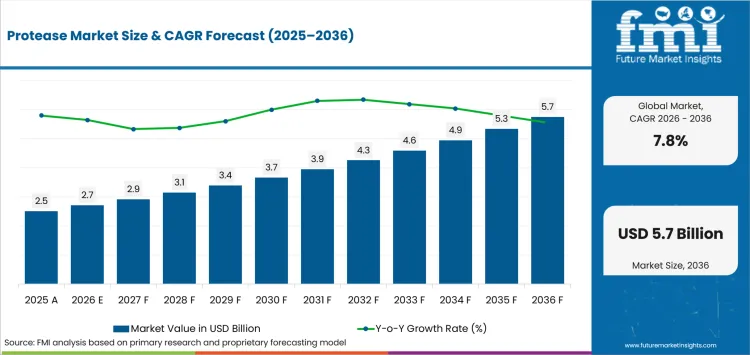
Key Takeaways of Protease Market
- Demand concentrates in applications requiring measurable protein modification, and production trials confirm repeatable activity for routine purchasing.
- In 2026, liquid is expected to lead the form category with 59.3% share because metered addition fits plants that require controlled dosing without dry-enzyme dust.
- Based on product type, microbial protease is projected to account for 35.8% in 2026 due to fermentation scale and controlled production-strain selection.
- By end use application, bakery & confectionery is estimated to hold 17.1% in 2026 owing to protease use in dough relaxation and gluten control.
- Qualification slows if substrate variation or worker-exposure controls require additional trials for a routine customer specification.
- Some of the key players in this market include Novonesis, International Flavors & Fragrances Inc. (IFF), BASF SE, AB Enzymes GmbH, Biocatalysts Ltd, Kerry Group plc, Sunson Industry Group Co., Ltd., and Amano Enzyme Inc.
Analyst Perspective
"Protease economics depend on usable activity at the target pH and temperature plus the plant work needed to reach a stable dose. Offers earn repeat business when application data and handling guidance let processors approve that dose without repeated reformulation trials."
- Nandini Roy Choudhury, Principal Consultant, Future Market Insights
How is the Protease Market segmented?
The protease market is segmented by form, product type, end use application and region.
Form includes liquid and powder & granule products. Product type includes microbial, plant, alkaline, neutral, animal, acid stable, other proteases including ficin and bromelain, and keratinases. End use application covers bakery & confectionery, dairy products, brewing, meat products and processing, personal care products, cheese making and processing, animal nutrition, and pharmaceutical products. Region covers North America, Latin America, Western Europe, Eastern Europe, East Asia, South Asia and Pacific, and Middle East and Africa.
Why does Bakery & confectionery lead the End use Application category?
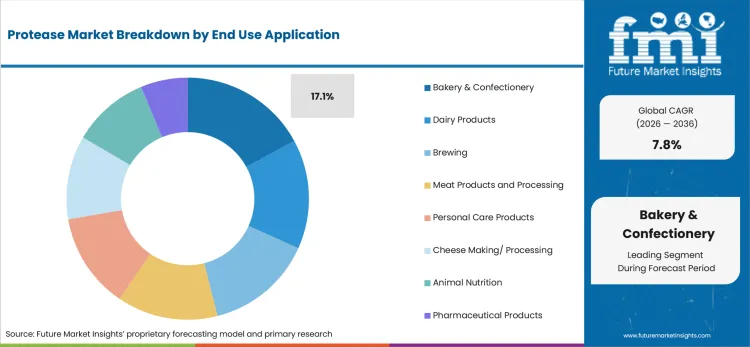
Bakery & confectionery processors use protease to relax gluten when flour strength or line speed makes dough difficult to machine during continuous production. Excessive hydrolysis weakens dough structure, so bakery proteases are evaluated against each flour system and line condition during qualification.
- Bakery & confectionery is projected to hold 17.1% share in 2026 owing to proteolysis changing dough extensibility on high-speed commercial bakery lines.
- USDA NASS reported in August 2025 that second-quarter wheat flour production reached 103 million hundredweight in commercial flour mills. The production base gives bakery operations a large processing route and makes dose repeatability commercially relevant at mill-linked production scale.
Why does Liquid lead the Form category?
Liquid protease fits industrial enzyme programs that meter preparations through pumps into process streams after other ingredients are already mixed. The format limits dry-enzyme handling during repeat batches, although storage stability and formulation compatibility still require confirmation.
- By form, liquid is estimated to hold 59.3% in 2026 owing to controlled metering that supports repeat addition rates in pump-fed processing batches.
- BASF expanded its liquid enzyme range in July 2025 and retained Lavergy Pro proteases within the portfolio. The expansion gives formulators working with liquid detergent enzymes a broader set for systems that pair protease with other enzyme types at commercial scale.
Why does Microbial lead the Product type category?
Microbial protease uses characterized production strains under controlled fermentation, then commercial batches are standardized for activity. The route suits feed enzyme programs requiring defined activity and documented strain identity for routine inclusion in regulated feed programs.
- Microbial is forecast to represent 35.8% of product type demand in 2026 driven by fermentation scale and controlled production-strain selection.
- In 2025 the FSA and Food Standards Scotland documented a reviewed protease produced by Bacillus subtilis CBS 148232 through fermentation. Regulators found the revised production-strain evidence sufficient for the submitted safety assessment of that feed additive.
What are the drivers, restraints and opportunities in the Protease Market?
Defined protein modification supports demand because verified process gains justify repeat use, whereas qualification and handling requirements keep application support central to conversion.
- Driver: Verified protein-hydrolysis gains justify repeat purchasing once a preparation performs at a defined dose under commercial processing conditions.
- Restraint: Worker-exposure controls and substrate-specific validation can lengthen plant approval despite activity already established in laboratory testing.
- Opportunity: Dedicated application teams can shorten scale-up work by aligning samples, dose studies and operating guidance with the customer process.
Feed formulators purchase protease once digestion gains are tied to a defined inclusion rate in a commercial ration. A 2025 FSA and Food Standards Scotland assessment found potential efficacy for a reviewed protease system at 4,000 protease units per kilogram of feed in growing poultry. The dose finding gives animal feed additives a measurable adoption route and lets nutrition teams compare protease performance for routine purchasing decisions.
Protease qualification must address worker exposure as well as process performance. Enzyme proteins can present handling risks during plant use. A 2025 FSA and Food Standards Scotland assessment classified Syncra SWI 201 TPT as a respiratory and skin sensitiser with likely inhalation exposure. Plants need exposure controls plus activity evidence for routine use, which can extend switching despite a proven target process result.
Application support reduces the scale-up work a processor must fund and raises the commercial value of specialist enzyme supply. In February 2025 Biocatalysts reorganized its food, baking and beverage enzyme business into a dedicated unit with improved warehousing in Europe and the United States. Faster samples and focused baking enzyme systems support can shorten customer qualification and shift competition away from unit price alone.
Which country CAGRs are profiled in the Protease Market?
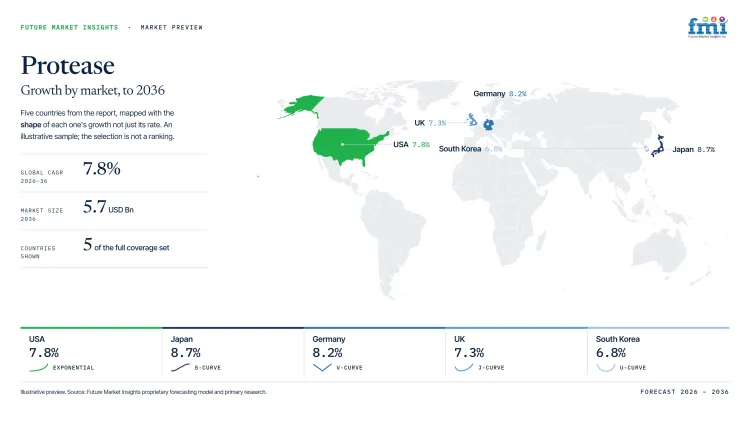
| Country | CAGR |
|---|---|
| Japan | 8.7% |
| Germany | 8.2% |
| USA | 7.8% |
| UK | 7.3% |
| South Korea | 6.8% |
How do country-level CAGRs compare in the Protease Market?
The profiled CAGRs span 6.8% to 8.7%, leaving a 1.9 percentage-point range. Japan and Germany form the upper pair above 8%. The USA tracks the global forecast closely. The UK and South Korea form the lower pair. Growth spacing is narrow enough that qualification conditions matter more than the headline gap alone.
- Japanese detergent formulators prioritize cold-wash stability during early protease screening.
- German plants compare replacement enzymes against existing batch-control requirements.
- US distribution breadth speeds samples despite varied approval protocols between food and feed plants.
- UK manufacturer fragmentation favors shorter validation programs with clear dosing guidance.
- South Korean accounts reward exact specification matching during imported-enzyme screening.
Similar CAGRs can produce different economics because trial scale and approval work vary by country. The full report provides country-level CAGR analysis across North America, Latin America, Europe, East Asia, South Asia, Oceania and the Middle East and Africa.
Country-wise Analysis
- Japan enters enzyme qualification through a large wheat-processing base whose 2025 output reached 1.022 million tonnes according to MAFF data covering 229,500 hectares. Japan's protease outlook is anticipated to advance at 8.7% CAGR over the assessment period, tied to bakery processors working with detailed flour specifications and formal ingredient review. Domestic flour throughput gives bakery teams enough production volume for focused plant trials and lets application specialists test dose-response behavior under commercial line conditions. Imported microbial preparations still require strain and use documentation for recipe changes, so companies with localized dossiers can move through review with fewer clarification cycles.
- German flour and feed plants enter enzyme trials with mature quality systems and strict attention to cost-per-batch changes during formulation approval. Federal agricultural statistics recorded a final 2025 grain harvest of 45.3 million tonnes, which was 16.1% above 2024 and expanded domestic material available for commercial processing. The German protease sector is projected to record 8.2% CAGR during the assessment period, given processing scale and technical validation resources inside large plants. Existing quality procedures make trials easier to organize. A new protease still needs compliant use evidence and measurable operating savings for any accepted formulation change in routine production.
- US poultry integrators test protease against commercial feed volumes large enough to reveal whether a laboratory dose survives normal pelleting and ration variability. USDA NASS counted 9.40 billion broilers produced during 2025 and recorded a 1% increase from the previous year. Broiler volume gives nutrition teams frequent production runs for comparing enzyme activity, but each operator retains its own diet specifications and approval rules. Protease demand in the USA is forecast to rise at 7.8% CAGR over the forecast period, supported by large feed and food plants with established formulation systems. Field support therefore determines if a successful test becomes a routine specification instead of stopping at one site.
- UK food processors entered 2026 with tight cost scrutiny as reformulation time competed with other technical work inside smaller manufacturing teams. The UK is estimated to post 7.3% CAGR over the forecast period, helped by formal safety review and established specialist food-and-feed technical channels. Defra reported in July 2026 that food inflation ended 2025 at 4.5% compared with 3.6% for all consumer items. Higher food inflation keeps plant economics visible during trials, although the country's dense distribution network can move qualified enzymes into local testing quickly. Short programs with clear process economics therefore fit smaller processors better than lengthy trials that consume limited formulation time.
- South Korean processors enter enzyme trials through a code-based specification system that requires documentary accuracy for commercial recipe changes. Local formulators can screen preparations efficiently once identity and use conditions match the required code entries, but imported products still need Korean-language technical support. Protease sales in South Korea are forecast to expand at 6.8% CAGR by 2036, attributable to processors that value clearly specified enzyme identity during early approval. MFDS revised the Food Additives Code on November 26, 2025 and added names plus international identifiers to specifications for 39 enzyme preparations. The clearer naming reduces ambiguity during initial checks and gives locally responsive enzyme companies an advantage during repeat qualification cycles.
Who are the notable companies in the Protease Market?
Novonesis, International Flavors & Fragrances Inc. (IFF), BASF SE, AB Enzymes GmbH, Biocatalysts Ltd, Kerry Group plc, Sunson Industry Group Co., Ltd., and Amano Enzyme Inc.
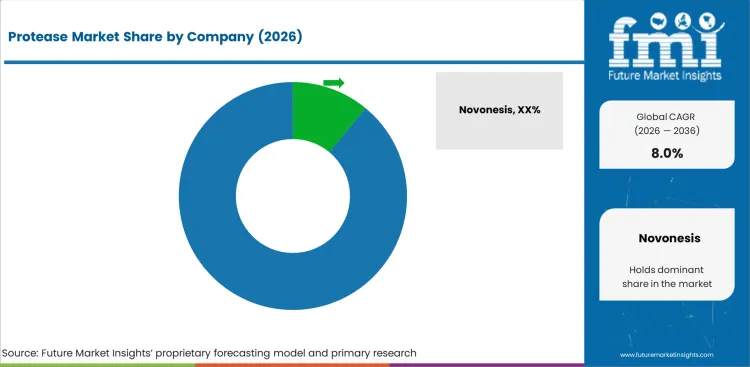
Protease competition splits between global bioscience groups and application-focused enzyme manufacturers. Novonesis and IFF operate global enzyme platforms with fermentation scale plus regional application teams. AB Enzymes and Biocatalysts focus more heavily on customer trials. BASF and Kerry work from broader ingredient businesses, and Kerry also supports dairy enzyme programs requiring plant-scale application work. Sunson and Amano provide specialist manufacturing coverage. Entry barriers come from fermentation control, local application support and regulatory documentation instead of corporate size alone.
- Novonesis, IFF and BASF operate broad enzyme portfolios with production and application resources serving several customer industries.
- AB Enzymes and Biocatalysts focus on food-processing routes that use brewing enzymes and require trials close to operating conditions for routine plant approval.
- Kerry, Sunson and Amano provide food and nutrition enzyme coverage for protein hydrolysates that require protease profiles matched to substrate composition and target peptide range.
Competitive Benchmarking: Protease Market
| Company | Application Breadth | Application Support | Production Control | Geographic Reach |
|---|---|---|---|---|
| Novonesis | High | High | High | Global |
| International Flavors & Fragrances Inc. (IFF) | High | High | High | Global |
| BASF SE | Medium | High | High | Global |
| AB Enzymes GmbH | Medium | High | High | Europe, Americas and Asia |
| Biocatalysts Ltd | High | High | High | Europe and North America |
| Kerry Group plc | High | High | High | Global |
| Sunson Industry Group Co., Ltd. | High | Medium | High | China-based production with 40 export countries |
| Amano Enzyme Inc. | Medium | High | High | Asia, Europe and North America |
Scoring basis: High application breadth requires official evidence for at least three relevant end-use groups, Medium requires two groups and Low identifies one verified group. High application support requires multiple laboratories or application centers, Medium requires one dedicated facility and Low requires a documented distributor-led support model. High production control requires owned fermentation or enzyme manufacturing, Medium requires narrower owned production and Low applies only if official evidence confirms outsourcing.
Key Developments in the Protease Market
- In June 2026, AB Enzymes GmbH opened a new office and baking laboratory in the Brazilian city of Curitiba to expand regional application testing and customer support.
- In March 2026, International Flavors & Fragrances Inc. (IFF) opened a fermentation-based enzyme hub in Argentina and a household-care application laboratory in Brazil.
- In October 2025, Biocatalysts Ltd entered an exclusive distribution agreement with IMCD for nutraceutical enzymes in major European markets.
Key Players in the Protease Market
Bioscience and Enzyme Platforms
- Novonesis
- International Flavors & Fragrances Inc. (IFF)
- BASF SE
- AB Enzymes GmbH
Food and Application-Focused Specialists
- Biocatalysts Ltd
- Kerry Group plc
Specialty Enzyme Manufacturers
- Sunson Industry Group Co., Ltd.
- Amano Enzyme Inc.
Protease Market - Report Scope
| Coverage field | Report scope |
|---|---|
| Market breakdown | By form, product type, end use application and region. |
| Quantitative Units | USD Billion. |
| Market Definition | Commercial protease enzyme preparations sold for food, feed, household-care and related industrial protein-hydrolysis applications within the defined taxonomy. |
| Regions Covered | North America, Latin America, Europe, East Asia, South Asia and Pacific, and Middle East and Africa. |
| Countries Covered | Japan, Germany, USA, UK, South Korea, and 20+ countries included in the full report. |
| Key Companies Profiled | Novonesis, International Flavors & Fragrances Inc. (IFF), BASF SE, AB Enzymes GmbH, Biocatalysts Ltd, Kerry Group plc, Sunson Industry Group Co., Ltd., and Amano Enzyme Inc. |
| Forecast Period | 2026 to 2036. |
| Approach | Primary and secondary research with market triangulation. |
Protease Market - Research Methodology
| Method | Approach |
|---|---|
| Primary Research | FMI analysts gathered input from manufacturers, service providers, technology developers, distributors, end users, procurement teams, and subject-matter experts. Interviews examined purchasing decisions, product or service evaluation, adoption barriers, approval requirements, pricing considerations, and expectations for technical or commercial support. Respondents were also asked what evidence is required before a trial, pilot, or initial order develops into regular purchasing. |
| Desk Research | Desk research covered government statistics, regulatory publications, trade data, industry associations, technical literature, standards, company filings, product information, and official corporate announcements. Sources were reviewed for relevance, publication date, geographic coverage, and consistency with the defined market scope. Claims relating to performance, applications, approvals, capacity, investment, and commercial activity were retained only when supported by credible public evidence. |
| Market Sizing and Forecasting | The market model combined the baseline value with historical performance, segment structure, pricing and volume indicators, adoption levels, company participation, and country-level demand conditions. Forecast assumptions considered economic activity, investment trends, regulatory developments, technology adoption, purchasing cycles, supply availability, and barriers to wider market use. Segment and regional estimates were reconciled before the final market total was calculated. |
| Data Validation | Estimates were checked against multiple independent indicators, including public data, company activity, trade patterns, industry developments, and findings from primary interviews. Validation also tested whether products, services, applications, and company revenues fell within the defined market boundaries. Adjacent categories, unsupported claims, overlapping revenues, and activities without direct market relevance were excluded to reduce double counting and maintain consistency across segments and countries. |
Protease Market by Segments
By Form
- liquid
- powder & granule
By Product Type
- microbial
- plant
- alkaline
- neutral
- animal
- acid stable
- others (including ficin and bromelain)
- keratinases
By End Use Application
- bakery & confectionery
- dairy products
- brewing
- meat products and processing
- personal care products
- cheese making and processing
- animal nutrition
- pharmaceutical products
Protease Market by Region:
- North America
- United States
- Canada
- Latin America
- Brazil
- Mexico
- Chile
- Rest of Latin America
- Western Europe
- Germany
- United Kingdom
- Italy
- Spain
- France
- Nordics
- Benelux
- Rest of Western Europe
- Eastern Europe
- Russia
- Poland
- Hungary
- Balkan and Baltic States
- Rest of Eastern Europe
- East Asia
- China
- Japan
- South Korea
- South Asia and Pacific
- India
- ASEAN
- Australia and New Zealand
- Rest of South Asia and Pacific
- Middle East and Africa
- Kingdom of Saudi Arabia
- Other GCC Countries
- Türkiye
- South Africa
- Other African Union Countries
- Rest of Middle East and Africa
Research Sources and Bibliography
- Kerry Group. (2026, March 19). Kerry publishes 2025 Annual Report: A year defined by impact, innovation and purpose.
- Department for Environment, Food & Rural Affairs. (2026, July 29). Food statistics in your pocket.
- BASF SE. (2025, July 10). BASF expands liquid enzyme portfolio for home care and industrial and institutional cleaning.
- Food Standards Agency & Food Standards Scotland. (2025). Assessment on the safety and efficacy of Axtra XAP 104 TPT for all growing poultry species (RP2115).
- USA Department of Agriculture, National Agricultural Statistics Service. (2025, August 1). Flour Milling Products.
- Food Standards Agency & Food Standards Scotland. (2025). Assessment on the safety and efficacy of Syncra SWI 201 TPT for pigs for fattening and other growing porcine species (RP2274).
- Biocatalysts Ltd. (2025, February 13). Biocatalysts Food, Baking & Beverage further optimising customer experience and operating efficiency.
- Ministry of Agriculture, Forestry and Fisheries of Japan. (2025, November 28). Area planted and harvest volume of wheat and barley crops in 2025.
- Federal Ministry of Agriculture, Food and Regional Identity. (2025). Results of the 2025 grain harvest. Retrieved August 28, 2026.
- USA Department of Agriculture, National Agricultural Statistics Service. (2026, April 30). Poultry - Production and Value 2025 Summary.
- Ministry of Food and Drug Safety, Republic of Korea. (2025, November 26). Complete revision of Standards and Specifications for Food Additives, Notice No. 2025-76.
- International Flavors & Fragrances Inc. (2026, February 27). Annual report on Form 10-K for the fiscal year ended December 31, 2025.
- AB Enzymes GmbH. (2026). Who we are.
- BRAIN Biotech Group. (2026). Production, blending and distribution sites for enzymes and ingredients.
- Sunson Industry Group Co., Ltd. (2026). About us.
- Amano Enzyme Inc. (2026). About Amano Enzyme.
- AB Enzymes GmbH. (2026, June 1). AB Enzymes opens new office and baking lab in Curitiba, Brazil.
- International Flavors & Fragrances Inc. (2026, March 10). IFF expands Latin American footprint with new enzyme hub and Brazil application lab.
- Biocatalysts Ltd. (2025, October 13). BRAINBiocatalysts partners with IMCD to expand enzyme-based dietary solutions across Europe.
- Novonesis. (2025, June 2). Deal to acquire dsm-firmenich’s share of the Feed Enzyme Alliance is completed.
- BASF SE. (2025, October 1). BASF evaluates strategic options for feed enzyme business.
- Amano Enzyme Inc. (2026, March 24). Amano Enzyme announces marketing partnership with Nature’s IQ across South Africa.
- Novonesis. (2025, March 31). Novonesis launches an unmatched protease portfolio for swift and efficient stain removal.
- BASF SE. (2025, October 21). BASF and IFF announce strategic collaboration to drive next-generation enzyme and polymer innovation.
- Sunson Industry Group Co., Ltd. (2026, May 15). Sunson & ECNU Patent Breakthrough: Engineered Thermostable Pepsin for High-Temp Feed & Food Processing.
- AB Enzymes GmbH. (2026, May 12). AB Enzymes strengthens presence in Mexico, Central America & the Caribbean.
- International Flavors & Fragrances Inc. (2025, August 13). IFF Launches POWERFRESH® ACE 2000, a Bread Fresh-Keeping Solution That 'Aces' the Shelf-Life Test.
- Kerry Group. (2026, April 20). Kerry opens expanded biotechnology manufacturing hub in Ireland to meet growing global demand for lactase enzymes.
- BRAIN Biotech Group. (2025, May 20). BRAIN Biotech announces buy-out of minorities, new continental European production site, and expansion of its Baking Application Center.
- dsm-firmenich. (2025, March 20). dsm-firmenich launches Maxiren®EVO: A revolutionary coagulant enzyme for enhanced cheese texture, taste, yield, and functionality.
This bibliography is provided for reader reference and is not exhaustive. The full report contains the complete reference list and detailed citations.
This Report Answers
- What is the protease market size in 2026 and what value is forecast for 2036?
- Which operating conditions support repeat protease purchasing in food, feed and industrial processing?
- Why does liquid hold the leading position in the form category?
- How does microbial protease influence production and regulatory qualification choices?
- Why does bakery & confectionery hold the leading position in end use application?
- How do protease growth rates compare in Japan, Germany, USA, UK and South Korea?
- Which companies provide broad enzyme platforms and which focus on application-led protease programs?
- What qualification and handling conditions can slow protease adoption?
Frequently Asked Questions
How big is the protease market in 2026?
The protease market is valued at USD 2.7 billion in 2026 and is projected to reach USD 5.7 billion by 2036. Repeat demand develops once processors verify protease activity under their own operating conditions.
What is the CAGR of the protease market from 2026 to 2036?
The protease market is projected to grow at a CAGR of 7.8% between 2026 and 2036. Expansion is tied to repeat enzyme use in food, feed and industrial applications following process-specific qualification.
Which form leads the protease market?
The liquid segment is expected to hold 59.3% of the protease market in 2026, driven by controlled metering in pump-fed processing systems. The format also reduces dry-enzyme handling during repeat production batches in plants using metered liquid dosing.
Which product type leads the protease market?
The microbial segment is projected to account for 35.8% of the protease market in 2026, supported by scalable fermentation and controlled production strains. Strain documentation also gives regulated food and feed applications a clearer qualification route.
Which end use application leads the protease market?
The bakery & confectionery segment is estimated to hold 17.1% of the protease market in 2026, attributable to protease use in dough relaxation and gluten control. Commercial dosing must preserve finished-product structure during efforts to improve machinability.
How much value will the protease market add between 2026 and 2036?
The protease market is expected to add USD 3.0 billion in value between 2026 and 2036. Growth depends on turning successful plant trials into repeat specifications in food, feed and industrial enzyme programs.
Which countries are projected to record the highest growth in the protease market?
Japan is projected to grow at 8.7% CAGR, followed by Germany at 8.2% and the USA at 7.8% through 2036. Their growth paths differ as local processing scale and qualification requirements vary by country.
Which companies are active in the protease market?
Key companies operating in the protease market include Novonesis, International Flavors & Fragrances Inc. (IFF), BASF SE, AB Enzymes GmbH, Biocatalysts Ltd, Kerry Group plc, Sunson Industry Group Co., Ltd., and Amano Enzyme Inc. Their positions differ through fermentation ownership, application support and regional customer coverage in core applications.
Preview the report firsthand - request a free sample
Get SampleGet the brochure for pricing and purchase details.
Get PDFTable of Content
- Key Takeaways
- Market Size and CAGR
- Top Growth Driver
- Fastest Growing Segment
- Leading Region
- Key Companies
- Emerging Opportunities
- Executive Summary
- Global Market Outlook
- Demand-side Trends
- Supply-side Trends
- Technology Roadmap Analysis
- Analysis and Recommendations
- Analyst Perspective (What is happening? Why now? What should investors know?)
- Key Questions Answered
- How large is the market?
- What is the CAGR?
- What are key trends?
- Which region dominates?
- Who are the leaders?
- Market Overview
- Market Coverage / Taxonomy
- Market Definition / Scope / Limitations
- Research Methodology
- Chapter Orientation
- Analytical Lens and Working Hypotheses
- Market Structure, Signals, and Trend Drivers
- Benchmarking and Cross-market Comparability
- Market Sizing, Forecasting, and Opportunity Mapping
- Research Design and Evidence Framework
- Desk Research Programme (Secondary Evidence)
- Expert Input and Fieldwork (Primary Evidence)
- Tooling, Models, and Reference Databases
- Data Engineering and Model Build
- Quality Assurance and Audit Trail
- Market Background
- Market Dynamics (Drivers, Restraints, Opportunity, Trends)
- Scenario Forecast (Optimistic, Likely, Conservative)
- Impact Analysis
- AI Impact
- Sustainability Impact
- Regulatory Impact
- Technology Impact
- Consumer / Buyer Analysis
- Purchase Drivers
- Adoption Barriers
- Buyer Journey
- Opportunity Map Analysis
- Product Life Cycle Analysis
- Supply Chain Analysis
- Investment Feasibility Matrix
- Value Chain Analysis
- PESTLE and Porter's Analysis
- Regulatory Landscape
- Regional Parent Market Outlook
- Production and Consumption Statistics
- Import and Export Statistics
- Global Market Analysis and Forecast, 2021 to 2036
- Historical Market Size Value (USD Billion) Analysis, 2021 to 2025
- Current and Future Market Size Value (USD Billion) Projections, 2026 to 2036
- Y-o-Y Growth Trend Analysis
- Absolute $ Opportunity Analysis
- Global Market Pricing Analysis, 2021 to 2036
- Global Market Analysis and Forecast, By Form, 2021 to 2036
- Introduction / Key Findings
- Historical Market Size Value (USD Billion) Analysis By Form, 2021 to 2025
- Current and Future Market Size Value (USD Billion) Analysis and Forecast By Form, 2026 to 2036
- Liquid
- Powder & Granule
- Liquid
- Y-o-Y Growth Trend Analysis By Form, 2021 to 2025
- Absolute $ Opportunity Analysis By Form, 2026 to 2036
- Global Market Analysis and Forecast, By Product Type, 2021 to 2036
- Introduction / Key Findings
- Historical Market Size Value (USD Billion) Analysis By Product Type, 2021 to 2025
- Current and Future Market Size Value (USD Billion) Analysis and Forecast By Product Type, 2026 to 2036
- Microbial
- Plant
- Alkaline
- Neutral
- Animal
- Acid stable
- Others (Ficin, Bromelain, etc.)
- Keratinases
- Microbial
- Y-o-Y Growth Trend Analysis By Product Type, 2021 to 2025
- Absolute $ Opportunity Analysis By Product Type, 2026 to 2036
- Global Market Analysis and Forecast, By End Use Application, 2021 to 2036
- Introduction / Key Findings
- Historical Market Size Value (USD Billion) Analysis By End Use Application, 2021 to 2025
- Current and Future Market Size Value (USD Billion) Analysis and Forecast By End Use Application, 2026 to 2036
- Bakery & Confectionery
- Dairy Products
- Brewing
- Meat Products and Processing
- Personal Care Products
- Cheese Making/ Processing
- Animal Nutrition
- Pharmaceutical Products
- Bakery & Confectionery
- Y-o-Y Growth Trend Analysis By End Use Application, 2021 to 2025
- Absolute $ Opportunity Analysis By End Use Application, 2026 to 2036
- Global Market Analysis and Forecast, By Region, 2021 to 2036
- Introduction
- Historical Market Size Value (USD Billion) Analysis By Region, 2021 to 2025
- Current Market Size Value (USD Billion) Analysis and Forecast By Region, 2026 to 2036
- North America
- Latin America
- Western Europe
- Eastern Europe
- East Asia
- South Asia and Pacific
- Middle East & Africa
- Market Attractiveness Analysis By Region
- North America Market Analysis and Forecast, By Country, 2021 to 2036
- Historical Market Size Value (USD Billion) Trend Analysis By Market Taxonomy, 2021 to 2025
- Market Size Value (USD Billion) Forecast By Market Taxonomy, 2026 to 2036
- By Country
- USA
- Canada
- By Form
- By Product Type
- By End Use Application
- By Country
- Market Attractiveness Analysis
- By Country
- By Form
- By Product Type
- By End Use Application
- Key Takeaways
- Latin America Market Analysis and Forecast, By Country
- Historical Market Size Value (USD Billion) Trend Analysis By Market Taxonomy, 2021 to 2025
- Market Size Value (USD Billion) Forecast By Market Taxonomy, 2026 to 2036
- By Country
- Brazil
- Mexico
- Chile
- Rest of Latin America
- By Form
- By Product Type
- By End Use Application
- By Country
- Market Attractiveness Analysis
- By Country
- By Form
- By Product Type
- By End Use Application
- Key Takeaways
- Western Europe Market Analysis and Forecast, By Country
- Historical Market Size Value (USD Billion) Trend Analysis By Market Taxonomy, 2021 to 2025
- Market Size Value (USD Billion) Forecast By Market Taxonomy, 2026 to 2036
- By Country
- Germany
- UK
- Italy
- Spain
- France
- Nordic
- BENELUX
- Rest of Western Europe
- By Form
- By Product Type
- By End Use Application
- By Country
- Market Attractiveness Analysis
- By Country
- By Form
- By Product Type
- By End Use Application
- Key Takeaways
- Eastern Europe Market Analysis and Forecast, By Country
- Historical Market Size Value (USD Billion) Trend Analysis By Market Taxonomy, 2021 to 2025
- Market Size Value (USD Billion) Forecast By Market Taxonomy, 2026 to 2036
- By Country
- Russia
- Poland
- Hungary
- Balkan & Baltic
- Rest of Eastern Europe
- By Form
- By Product Type
- By End Use Application
- By Country
- Market Attractiveness Analysis
- By Country
- By Form
- By Product Type
- By End Use Application
- Key Takeaways
- East Asia Market Analysis and Forecast, By Country
- Historical Market Size Value (USD Billion) Trend Analysis By Market Taxonomy, 2021 to 2025
- Market Size Value (USD Billion) Forecast By Market Taxonomy, 2026 to 2036
- By Country
- China
- Japan
- South Korea
- By Form
- By Product Type
- By End Use Application
- By Country
- Market Attractiveness Analysis
- By Country
- By Form
- By Product Type
- By End Use Application
- Key Takeaways
- South Asia and Pacific Market Analysis and Forecast, By Country
- Historical Market Size Value (USD Billion) Trend Analysis By Market Taxonomy, 2021 to 2025
- Market Size Value (USD Billion) Forecast By Market Taxonomy, 2026 to 2036
- By Country
- India
- ASEAN
- Australia & New Zealand
- Rest of South Asia and Pacific
- By Form
- By Product Type
- By End Use Application
- By Country
- Market Attractiveness Analysis
- By Country
- By Form
- By Product Type
- By End Use Application
- Key Takeaways
- Middle East & Africa Market Analysis and Forecast, By Country
- Historical Market Size Value (USD Billion) Trend Analysis By Market Taxonomy, 2021 to 2025
- Market Size Value (USD Billion) Forecast By Market Taxonomy, 2026 to 2036
- By Country
- Kingdom of Saudi Arabia
- Other GCC Countries
- Türkiye
- South Africa
- Other African Union
- Rest of Middle East & Africa
- By Form
- By Product Type
- By End Use Application
- By Country
- Market Attractiveness Analysis
- By Country
- By Form
- By Product Type
- By End Use Application
- Key Takeaways
- Key Countries Market Analysis
- USA
- Pricing Analysis
- Market Share Analysis, 2025
- By Form
- By Product Type
- By End Use Application
- Canada
- Pricing Analysis
- Market Share Analysis, 2025
- By Form
- By Product Type
- By End Use Application
- Mexico
- Pricing Analysis
- Market Share Analysis, 2025
- By Form
- By Product Type
- By End Use Application
- Brazil
- Pricing Analysis
- Market Share Analysis, 2025
- By Form
- By Product Type
- By End Use Application
- Chile
- Pricing Analysis
- Market Share Analysis, 2025
- By Form
- By Product Type
- By End Use Application
- Germany
- Pricing Analysis
- Market Share Analysis, 2025
- By Form
- By Product Type
- By End Use Application
- UK
- Pricing Analysis
- Market Share Analysis, 2025
- By Form
- By Product Type
- By End Use Application
- Italy
- Pricing Analysis
- Market Share Analysis, 2025
- By Form
- By Product Type
- By End Use Application
- Spain
- Pricing Analysis
- Market Share Analysis, 2025
- By Form
- By Product Type
- By End Use Application
- France
- Pricing Analysis
- Market Share Analysis, 2025
- By Form
- By Product Type
- By End Use Application
- India
- Pricing Analysis
- Market Share Analysis, 2025
- By Form
- By Product Type
- By End Use Application
- ASEAN
- Pricing Analysis
- Market Share Analysis, 2025
- By Form
- By Product Type
- By End Use Application
- Australia & New Zealand
- Pricing Analysis
- Market Share Analysis, 2025
- By Form
- By Product Type
- By End Use Application
- China
- Pricing Analysis
- Market Share Analysis, 2025
- By Form
- By Product Type
- By End Use Application
- Japan
- Pricing Analysis
- Market Share Analysis, 2025
- By Form
- By Product Type
- By End Use Application
- South Korea
- Pricing Analysis
- Market Share Analysis, 2025
- By Form
- By Product Type
- By End Use Application
- Russia
- Pricing Analysis
- Market Share Analysis, 2025
- By Form
- By Product Type
- By End Use Application
- Poland
- Pricing Analysis
- Market Share Analysis, 2025
- By Form
- By Product Type
- By End Use Application
- Hungary
- Pricing Analysis
- Market Share Analysis, 2025
- By Form
- By Product Type
- By End Use Application
- Kingdom of Saudi Arabia
- Pricing Analysis
- Market Share Analysis, 2025
- By Form
- By Product Type
- By End Use Application
- Türkiye
- Pricing Analysis
- Market Share Analysis, 2025
- By Form
- By Product Type
- By End Use Application
- South Africa
- Pricing Analysis
- Market Share Analysis, 2025
- By Form
- By Product Type
- By End Use Application
- USA
- Market Structure Analysis
- Competition Dashboard
- Competition Benchmarking
- Market Share Analysis of Top Players
- By Regional
- By Form
- By Product Type
- By End Use Application
- Emerging Startups
- Innovation Benchmarking
- Competition Analysis
- Competition Deep Dive
- Balchem Corporation
- Overview
- Product Portfolio
- Profitability by Market Segments
- Sales Footprint
- Strategy Overview
- Marketing Strategy
- Product Strategy
- Channel Strategy
- DSM-Firmenich
- AAK AB
- Archer Daniels Midland Company
- Cargill, Incorporated
- Givaudan SA
- Tate & Lyle PLC
- Angel Yeast Co., Ltd.
- Balchem Corporation
- Case Studies
- Success Stories
- Recent Developments
- Competition Deep Dive
- Assumptions & Acronyms Used


