

- Industry Size (2026)
- USD 3.92 Bn
- Forecast (2036)
- USD 9.20 Bn
- CAGR (2026 to 2036)
- 8.90%
Repeater Market size, market forecast and outlook by FMI
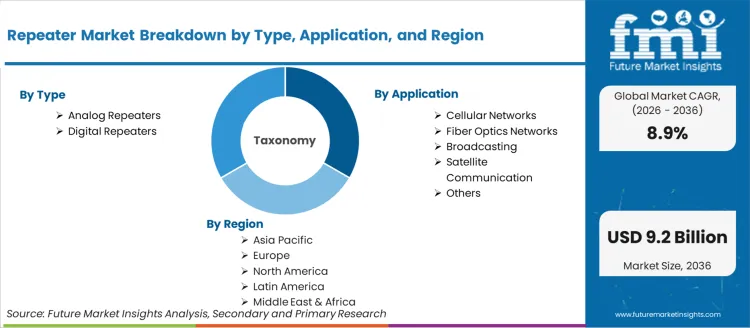
The repeater market was valued at USD 3.60 billion in 2025, projected to reach USD 3.92 billion in 2026, and is forecast to expand to USD 9.20 billion by 2036 at a 8.90% CAGR. Based on Future Market Insights analysis, the market is set to add an incremental opportunity worth USD 5.28 billion over the forecast period. As per FMI, the market landscape for repeater is being reshaped by evolving specifications, regional deployment acceleration, and shifting competitive dynamics.
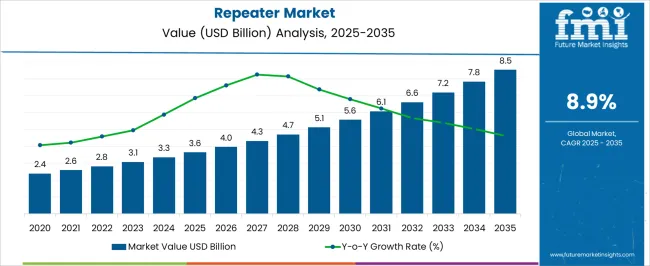
Three forces are expanding the repeater market beyond traditional cellular coverage extension. First, 5G frequency characteristics create more coverage gaps per unit area than 4G networks, structurally increasing the number of repeater devices required per square kilometer of served territory and making repeaters an essential complement to small cell densification strategies. Second, smart repeater technology with beam management and interference cancellation capabilities is enabling deployment in environments where traditional analog repeaters would create oscillation and interference problems, expanding the addressable installation base. Third, the convergence of cellular and Wi-Fi coverage requirements in enterprise environments is driving multi-technology repeater solutions that extend both cellular and Wi-Fi signals through shared infrastructure, reducing per-building deployment cost compared to separate single-technology systems.
Across tracked geographies, India sets the pace at 13.40% CAGR.
Summary of Repeater Market
- Repeater Market definition
- The repeater market encompasses signal amplification and retransmission devices used to extend the coverage range and improve signal quality of cellular, radio, Wi-Fi, and fiber-optic communication networks, including analog repeaters, digital repeaters, and optical amplifiers deployed across cellular network densification, enterprise in-building coverage, public safety communications, and industrial wireless connectivity applications.
- Demand drivers in the market
- 5G network densification requirements are driving cellular repeater deployment in urban environments where millimeter-wave and mid-band signals attenuate rapidly around buildings and terrain features, creating coverage gaps that repeaters can address at lower cost than additional base station installations.
- Enterprise in-building wireless coverage mandates from building codes and tenant expectations are expanding repeater procurement as commercial property developers must guarantee cellular signal quality throughout occupied floor space as a standard building service.
- Public safety communication network modernization programs are specifying digital repeaters for FirstNet, TETRA, and P25 radio systems where reliable coverage in tunnels, underground facilities, and high-rise stairwells is a life-safety requirement.
- Key segments analyzed in the FMI report
- Analog Repeaters type: 51.9% share in 2026, reflecting established procurement patterns and market positioning.
- Cellular Networks application: 39.8% share in 2026, driven by end-use requirements in the primary channels.
- India: 13.40% compound growth, supported by domestic investment and rising adoption.
- Analyst opinion at FMI
- The repeater market is structurally linked to cellular network generation transitions because each new generation operates at higher frequencies with shorter propagation distances, mathematically increasing the number of coverage gap locations that require repeater intervention. FMI analysts observe that the smart repeater category with active beam management is the fastest-growing segment because it solves the interference and isolation challenges that limited traditional repeater deployment density. The competitive positioning advantage belongs to manufacturers that integrate repeater hardware with network management software providing remote monitoring and configuration, because mobile operators increasingly require centralized visibility into repeater fleet performance.
- Strategic implications / executive takeaways
- Mobile operators should integrate smart repeater deployment planning into 5G network design from the outset rather than treating repeaters as post-deployment gap-fillers, because proactive placement reduces the total cost of achieving coverage targets.
- Enterprise building developers must specify in-building cellular repeater infrastructure during construction rather than retrofit, because post-construction repeater installation costs 3x to 5x more than integrated deployment during the building fit-out phase.
- Repeater manufacturers should develop cloud-managed fleet monitoring platforms that provide operators with centralized visibility into repeater performance, fault detection, and remote configuration to reduce field maintenance truck rolls.
Repeater Market key takeaways
| Metric | Details |
|---|---|
| Industry Size (2026) | USD 3.92 billion |
| Industry Value (2036) | USD 9.20 billion |
| CAGR (2026 to 2036) | 8.90% |
Source: Future Market Insights, 2026
Repeater Market definition
Repeaters represent the network infrastructure component category where received signals are amplified, filtered, and retransmitted to extend communication coverage beyond the range of primary base stations or access points. These devices operate across cellular, land mobile radio, Wi-Fi, and optical fiber transmission systems to fill coverage gaps and improve signal quality in areas where direct base station coverage is insufficient.
Repeater Market inclusions
Market scope includes all commercially traded repeaters segmented by type (analog repeaters, digital repeaters, optical repeaters), application (cellular networks, enterprise in-building, public safety, industrial, transportation), and end user (networking and IT, telecommunications, government, enterprise). Revenue sizing spans the 2026 to 2036 forecast period.
Repeater Market exclusions
The scope excludes base station equipment, small cells with independent baseband processing, distributed antenna systems (DAS) headend equipment, and Wi-Fi mesh networking devices. Signal boosters marketed as consumer-grade products below commercial specification thresholds are outside the defined boundary.
Repeater Market research methodology
- Primary research: FMI analysts conducted interviews with procurement directors, technical specialists, and market participants across key repeater organizations to map decision gates and market dynamics.
- Desk research: Data collection aggregated regulatory filings, trade association publications, standards body documentation, and company annual reports to establish verifiable baseline parameters.
- Market sizing and forecasting: Baseline values derive from a bottom-up aggregation of repeater transaction volumes, applying region-specific adoption curves and pricing indices to project demand through 2036.
- Data validation and update cycle: Projections are tested against publicly reported deployment statistics, industry data, and company financial disclosures on a quarterly refresh schedule.
Key Drivers Accelerating Demand for Repeaters
- Growing demand for high-speed data connections
- Expansion of 5G infrastructure
- Rapid urbanization increases repetitive planning
- The proliferation of IoT is increasing the need for stronger signals
- Broadband network expansion boosts sales of repeaters
Emerging Opportunities in the Repeater Market
- Expansion of satellite communication networks
- The repeater industry grows as data traffic increases
- Wireless connectivity increases market capacity reproduction
- Increased contact in rural areas increases the frequency of adoption
- Integration of smart homes for market growth
Factors Restraining the Demand for Repeater Devices
- Increased competition is squeezing the market value of remanufacturers
- Improving technology is essential for stress reconstructors
- Regulatory barriers prevent further market expansion for repeaters
- Security concerns threaten repetitive uses
- Increased manufacturing costs impact repeater affordability
Analysis of Top Countries Manufacturing, Certifying, and Operating Repeater Devices
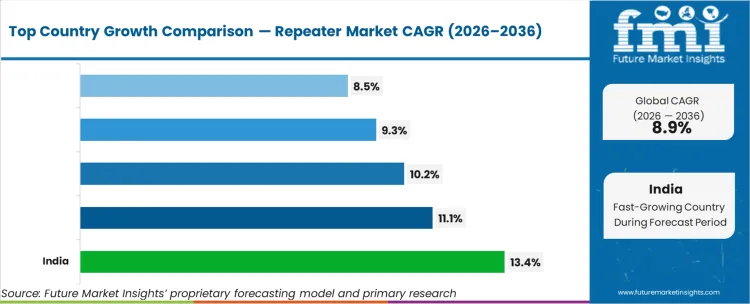
| Countries | CAGR (2026 to 2036) |
|---|---|
| United States | 7.8% |
| Brazil | 6.1% |
| India | 13.4% |
| Japan | 11.2% |
| Germany | 8.8% |
Extensive Investments in Telecommunications Infrastructure in the United States
The repeater market in the United States is expected to develop at a CAGR of 7.8% through 2036.
- The United States leads the global market due to the high adoption of advanced communication technologies and huge investments in telecommunications infrastructure.
- This dominance is attributed to the country’s continued commitment to being at the forefront of technological development, ensuring a robust and efficient communications network.
- Leveraging advanced technology and capital investments in infrastructure allows the repeater industry to grow in the United States.
Expansion of Mobile Network Coverage to Rural Areas in Brazil Spurs Market Growth
The repeater market in Brazil is estimated to develop at a CAGR of 6.1% from 2026 to 2036.
- Brazil’s repeater sector is growing exponentially as its mobile network coverage in rural areas expands.
- This expansion addresses the communication challenges in remote areas, creating a greater demand for signaling and repeater systems to enhance nationwide advanced communications.
Focus on Indoor Coverage Solutions Propels Growth in India's Repeater Market
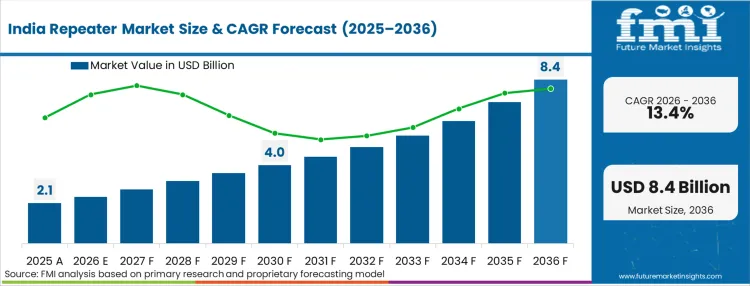
Sales of repeaters in India are likely to exhibit a CAGR of 13.4% from 2026 to 2036.
- Sales of repeaters in India are booming, driven by its rapidly expanding mobile network.
- India is actively addressing connectivity challenges in remote areas in line with its digital inclusion policies.
- This increased demand for signal amplification solutions reflects India's commitment to extend the benefits of connectivity to all parts of the country.
Urbanization and Population Density Contribute to Market Expansion of Repeaters in Japan
The demand for repeaters in Japan is estimated to accelerate at a CAGR of 11.2% during the forecast period.
- Japan's repeater market has grown with the country's unwavering focus on technological innovation.
- Continued adoption of advanced communication solutions, coupled with the need for effective signal amplification, is surging Japan's lead in the global market, exhibiting its perseverance to continue its prominence in sophisticated technology.
- Japan's growth in the remanufacturing market is driven by its commitment to technological innovation and efficient communication solutions.
Integration of 5G Technology Boosts Repeater Adoption in Germany
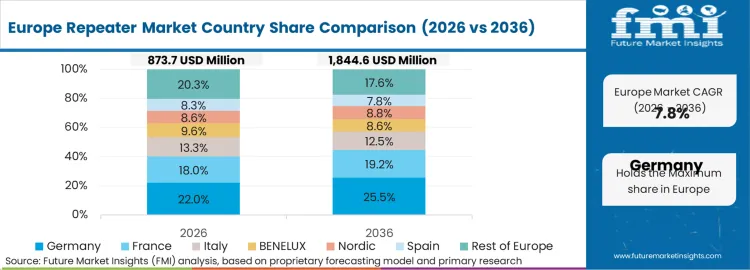
The repeater market in Germany is expected to reach a value of USD 8.5 million by 2036. Sales of repeaters in Germany are anticipated to expand at a CAGR of 8.8% through 2036.
- Germany stands out for its strong presence in the global market. Technological advancements drive growth in the telecommunications industry.
- Germany's massive demand for reliable signal reinforcement solutions in urban and rural areas positions it as a key driver of innovation and efficiency in the market.
- Germany's preeminence in the repeater sector is due to its technological advancements and high demand for signal amplification solutions.
Repeater Industry Analysis by Top Investment Segments
Widespread Adoption of Digital Repeaters for Seamless Commercial Operations
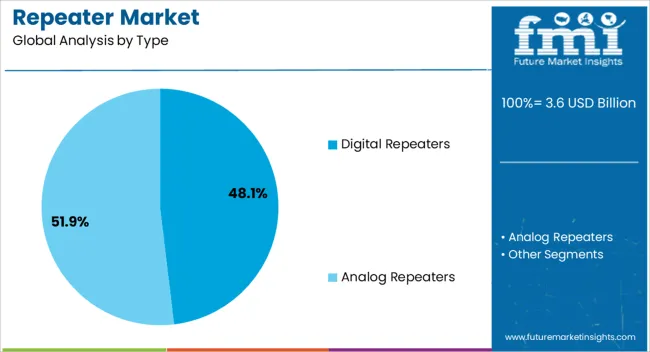
| Top Type | Digital Repeaters |
|---|---|
| Market Share in 2026 | 48.1% |
- The digital repeaters segment is estimated to acquire a market share of 48.1% in 2026.
- The versatility of digital repeaters in adjusting to changing communication protocols and the digitalization trend highlights their critical role in determining the future of dependable and effective business communication infrastructure.
- Digital repeaters are the best option because of their higher efficiency and quicker data transfer speeds. These meet businesses' demands for responsive and efficient communication networks.
- The widespread adoption of digital repeaters is attributed to their optimal spectrum usage and multi-channel capability, which maximizes network capacity for seamless commercial operations.
Higher Dependency of Customers on Cellular Networks
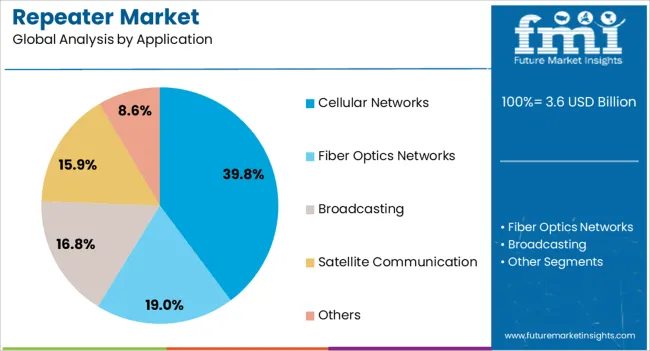
| Top Application | Cellular Networks |
|---|---|
| Market Share in 2026 | 39.8% |
- The cellular network segment is likely to garner a market share of 39.8% in 2026.
- The demand for cellular networks is anticipated to rise as 5G technology develops, and more sophisticated repeaters are needed to provide faster data speeds and lower latency.
- Cellular networks are likely to continue to command the repeater industry as customers depend increasingly on mobile devices for various jobs, making it a lucrative sector for vendors to target.
- Cellular repeaters are deployed to improve signal strength and coverage due to rapid urbanization and the development of network coverage in remote locations.
Networking and IT Sector Drives Higher Demand for Repeaters
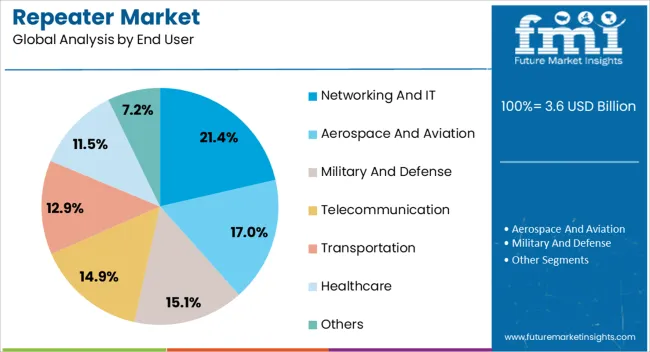
| Top End User | Networking and IT |
|---|---|
| Market Share in 2026 | 21.4% |
- The networking and IT segment is anticipated to acquire a market share of 21.4% in 2026.
- Modern corporate operations rely heavily on networking and IT infrastructure, which is why the demand for repeater solutions that are dependable and effective is high.
- The networking and IT sector leads repeater sales due to the need for increased bandwidth and enhanced network performance in various IT applications.
- The key factor promoting the segment’s growth is its adaptability to improve signal strength and data transmission capabilities, which is in line with the goals of the networking and IT sectors.
Leading Suppliers in the Repeater Sector
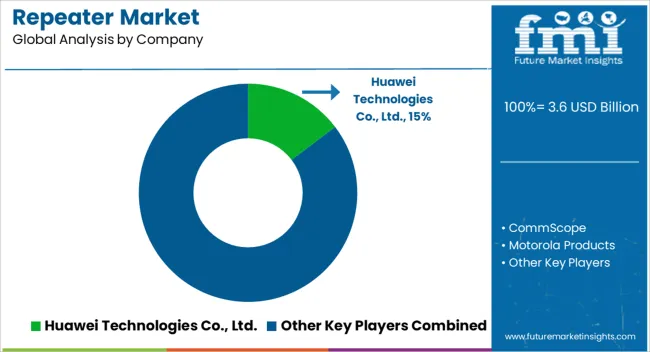
Numerous repeater manufacturers hold an important position in the market because of their capabilities and industry contributions. CommScope, Motorola Products, and Huawei Technologies Co., Ltd. are notable leaders in the industry that continuously push the boundaries of innovation and establish benchmarks for dependability. They frequently drive technological innovation, influencing the path the market takes.
Bird Technologies, Rohde and Schwarz, and Kathrein SE all have important roles in meeting consumers' various needs by utilizing their skills and competencies. Their dedication to excellence and productivity guarantees their continued relevance in a cut-throat marketplace.
By providing cutting-edge technologies and extending the options accessible to customers, ZTE Corporation, Telewave, Inc., and Cel-Fi by Nextivity enhance the competitive landscape. They are expected to react effectively to shifting consumer needs and market conditions due to their flexibility and agility.
To complete the list of major repeater vendors, TX RX Systems, Inc., Westell Technologies, Inc., and Cisco Systems, Inc. each provide unique capabilities and market insights. In a rapidly changing sector, their continuous investment in research and development guarantees that they want to be competitive.
The industry is propelled forward by the combined efforts of these repeater producers as they negotiate the opportunities and hurdles present in the market, leading to advances.
Scope of the report
| Metric | Value |
|---|---|
| Quantitative Units | USD 3.92 billion to USD 9.20 billion, at a CAGR of 8.90% |
| Market Definition | The repeater market encompasses signal amplification and retransmission devices used to extend the coverage range and improve signal quality of cellular, radio, Wi-Fi, and fiber-optic communication networks, including analog repeaters, digital repeaters, and optical amplifiers deployed across cellular network densification, enterprise in-building coverage, public safety communications, and industrial wireless connectivity applications. |
| Segmentation | Type (Analog Repeaters), Application (Cellular Networks), End User (Networking and IT) |
| Regions Covered | North America, Latin America, Europe, East Asia, South Asia, Oceania, Middle East and Africa |
| Countries Covered | India, China, USA, Canada, UK, Germany, Japan, and 40 plus countries |
| Key Companies Profiled | Huawei Technologies Co., Ltd., Ericsson, CommScope, Corning, SOLiD, Westell Technologies, Wilson Electronics, SureCall, Comba Telecom, Zinwave |
| Forecast Period | 2026 to 2036 |
| Approach | Hybrid bottom-up and top-down methodology starting with verified repeater transaction data, projecting adoption velocity across segments and regions. |
Top Segments Studied in the Repeater Market
By Type:
- Analog Repeaters
- Digital Repeaters
By Application:
- Cellular Networks
- Fiber Optics Networks
- Broadcasting
- Satellite Communication
- Others
By End User:
- Aerospace and Aviation
- Military and Defense
- Telecommunication
- Networking and IT
- Transportation
- Healthcare
- Others
By Region:
- North America
- Latin America
- East Asia
- South Asia and Pacific
- Western Europe
- Eastern Europe
- Middle East and Africa
Bibliography
- 1. International Telecommunication Union. (2024). ITU-R Recommendations: Radio Signal Repeater Technical Standards. ITU.
- 2. 3rd Generation Partnership Project. (2024). 3GPP TR 38.809: NR Repeater Technical Study. 3GPP.
- 3. Federal Communications Commission. (2024). 47 CFR Part 20: Signal Booster and Repeater Regulations. U.S. FCC.
- 4. European Telecommunications Standards Institute. (2024). ETSI EN 301 908: IMT Cellular Networks, Repeater Requirements. ETSI.
- 5. GSMA. (2024). The Mobile Economy 2024: Network Densification Assessment. GSMA.
- 6. Organisation for Economic Co-operation and Development. (2024). OECD Broadband Portal: Mobile Network Coverage Statistics. OECD.
This bibliography is provided for reader reference. The full FMI report contains the complete reference list with primary research documentation.
Frequently Asked Questions
How large is the demand for Repeater in the global market in 2026?
Demand for repeater in the global market is estimated to be valued at USD 3.92 billion in 2026.
What will be the market size of Repeater by 2036?
Market size for repeater is projected to reach USD 9.20 billion by 2036.
What is the expected demand growth for Repeater between 2026 and 2036?
Demand for repeater is expected to grow at a CAGR of 8.90% between 2026 and 2036.
Which Type is poised to lead global demand by 2026?
Analog Repeaters accounts for 51.9% in 2026, reflecting established procurement patterns.
How is Cellular Networks driving Repeater adoption?
Cellular Networks represents 39.8% of segment demand as end-use requirements favor this category.
What is driving demand in India?
India registers a 13.40% CAGR through 2036, propelled by domestic investment and rising adoption.
What does Repeater Market definition mean in this report?
The repeater market encompasses signal amplification and retransmission devices used to extend the coverage range and improve signal quality of cellular, radio, Wi-Fi, and fiber-optic communication networks, including analog repeaters, digital repeaters, and optical amplifiers deployed across cellular network densification, enterprise in-building coverage, public safety communications, and industrial wireless connectivity applications.
How does FMI build and validate the Repeater forecast?
Forecasting models apply a hybrid bottom-up methodology starting with verified transaction data, cross-validated against publicly reported statistics and company financial disclosures.
Preview the report firsthand - request a free sample
Get SampleGet the brochure for pricing and purchase details.
Get PDFTable of Content
- Executive Summary
- Global Market Outlook
- Demand-side Trends
- Supply-side Trends
- Technology Roadmap Analysis
- Analysis and Recommendations
- Market Overview
- Market Coverage / Taxonomy
- Market Definition / Scope / Limitations
- Research Methodology
- Chapter Orientation
- Analytical Lens and Working Hypotheses
- Market Structure, Signals, and Trend Drivers
- Benchmarking and Cross-market Comparability
- Market Sizing, Forecasting, and Opportunity Mapping
- Research Design and Evidence Framework
- Desk Research Programme (Secondary Evidence)
- Company Annual and Sustainability Reports
- Peer-reviewed Journals and Academic Literature
- Corporate Websites, Product Literature, and Technical Notes
- Earnings Decks and Investor Briefings
- Statutory Filings and Regulatory Disclosures
- Technical White Papers and Standards Notes
- Trade Journals, Industry Magazines, and Analyst Briefs
- Conference Proceedings, Webinars, and Seminar Materials
- Government Statistics Portals and Public Data Releases
- Press Releases and Reputable Media Coverage
- Specialist Newsletters and Curated Briefings
- Sector Databases and Reference Repositories
- FMI Internal Proprietary Databases and Historical Market Datasets
- Subscription Datasets and Paid Sources
- Social Channels, Communities, and Digital Listening Inputs
- Additional Desk Sources
- Expert Input and Fieldwork (Primary Evidence)
- Primary Modes
- Qualitative Interviews and Expert Elicitation
- Quantitative Surveys and Structured Data Capture
- Blended Approach
- Why Primary Evidence is Used
- Field Techniques
- Interviews
- Surveys
- Focus Groups
- Observational and In-context Research
- Social and Community Interactions
- Stakeholder Universe Engaged
- C-suite Leaders
- Board Members
- Presidents and Vice Presidents
- R&D and Innovation Heads
- Technical Specialists
- Domain Subject-matter Experts
- Scientists
- Physicians and Other Healthcare Professionals
- Governance, Ethics, and Data Stewardship
- Research Ethics
- Data Integrity and Handling
- Primary Modes
- Tooling, Models, and Reference Databases
- Desk Research Programme (Secondary Evidence)
- Data Engineering and Model Build
- Data Acquisition and Ingestion
- Cleaning, Normalisation, and Verification
- Synthesis, Triangulation, and Analysis
- Quality Assurance and Audit Trail
- Market Background
- Market Dynamics
- Drivers
- Restraints
- Opportunity
- Trends
- Scenario Forecast
- Demand in Optimistic Scenario
- Demand in Likely Scenario
- Demand in Conservative Scenario
- Opportunity Map Analysis
- Product Life Cycle Analysis
- Supply Chain Analysis
- Investment Feasibility Matrix
- Value Chain Analysis
- PESTLE and Porter’s Analysis
- Regulatory Landscape
- Regional Parent Market Outlook
- Production and Consumption Statistics
- Import and Export Statistics
- Market Dynamics
- Global Market Analysis 2021 to 2025 and Forecast, 2026 to 2036
- Historical Market Size Value (USD Million) Analysis, 2021 to 2025
- Current and Future Market Size Value (USD Million) Projections, 2026 to 2036
- Y-o-Y Growth Trend Analysis
- Absolute $ Opportunity Analysis
- Global Market Pricing Analysis 2021 to 2025 and Forecast 2026 to 2036
- Global Market Analysis 2021 to 2025 and Forecast 2026 to 2036, By Type
- Introduction / Key Findings
- Historical Market Size Value (USD Million) Analysis By Type , 2021 to 2025
- Current and Future Market Size Value (USD Million) Analysis and Forecast By Type , 2026 to 2036
- Analog Repeaters
- Digital Repeaters
- Analog Repeaters
- Y-o-Y Growth Trend Analysis By Type , 2021 to 2025
- Absolute $ Opportunity Analysis By Type , 2026 to 2036
- Global Market Analysis 2021 to 2025 and Forecast 2026 to 2036, By Application
- Introduction / Key Findings
- Historical Market Size Value (USD Million) Analysis By Application, 2021 to 2025
- Current and Future Market Size Value (USD Million) Analysis and Forecast By Application, 2026 to 2036
- Cellular Networks
- Fiber Optics Networks
- Broadcasting
- Satellite Communication
- Others
- Cellular Networks
- Y-o-Y Growth Trend Analysis By Application, 2021 to 2025
- Absolute $ Opportunity Analysis By Application, 2026 to 2036
- Global Market Analysis 2021 to 2025 and Forecast 2026 to 2036, By End User
- Introduction / Key Findings
- Historical Market Size Value (USD Million) Analysis By End User, 2021 to 2025
- Current and Future Market Size Value (USD Million) Analysis and Forecast By End User, 2026 to 2036
- Networking and IT
- Aerospace and Aviation
- Military and Defense
- Telecommunication
- Transportation
- Healthcare
- Others
- Networking and IT
- Y-o-Y Growth Trend Analysis By End User, 2021 to 2025
- Absolute $ Opportunity Analysis By End User, 2026 to 2036
- Global Market Analysis 2021 to 2025 and Forecast 2026 to 2036, By Company
- Introduction / Key Findings
- Historical Market Size Value (USD Million) Analysis By Company, 2021 to 2025
- Current and Future Market Size Value (USD Million) Analysis and Forecast By Company, 2026 to 2036
- Huawei Technologies Co., Ltd.
- Motorola products
- CommScope
- Kathrein SE
- Rohde and Schwarz
- Bird Technologies
- ZTE Corporation
- Telewave, Inc.
- Cel-Fi by Nextivity
- TX RX Systems, Inc.
- Westell Technologies, Inc.
- Y-o-Y Growth Trend Analysis By Company, 2021 to 2025
- Absolute $ Opportunity Analysis By Company, 2026 to 2036
- Huawei Technologies Co., Ltd.
- Global Market Analysis 2021 to 2025 and Forecast 2026 to 2036, By Region
- Introduction
- Historical Market Size Value (USD Million) Analysis By Region, 2021 to 2025
- Current Market Size Value (USD Million) Analysis and Forecast By Region, 2026 to 2036
- North America
- Latin America
- Western Europe
- Eastern Europe
- East Asia
- South Asia and Pacific
- Middle East & Africa
- Market Attractiveness Analysis By Region
- North America Market Analysis 2021 to 2025 and Forecast 2026 to 2036, By Country
- Historical Market Size Value (USD Million) Trend Analysis By Market Taxonomy, 2021 to 2025
- Market Size Value (USD Million) Forecast By Market Taxonomy, 2026 to 2036
- By Country
- USA
- Canada
- Mexico
- By Type
- By Application
- By End User
- By Company
- By Country
- Market Attractiveness Analysis
- By Country
- By Type
- By Application
- By End User
- By Company
- Key Takeaways
- Latin America Market Analysis 2021 to 2025 and Forecast 2026 to 2036, By Country
- Historical Market Size Value (USD Million) Trend Analysis By Market Taxonomy, 2021 to 2025
- Market Size Value (USD Million) Forecast By Market Taxonomy, 2026 to 2036
- By Country
- Brazil
- Chile
- Rest of Latin America
- By Type
- By Application
- By End User
- By Company
- By Country
- Market Attractiveness Analysis
- By Country
- By Type
- By Application
- By End User
- By Company
- Key Takeaways
- Western Europe Market Analysis 2021 to 2025 and Forecast 2026 to 2036, By Country
- Historical Market Size Value (USD Million) Trend Analysis By Market Taxonomy, 2021 to 2025
- Market Size Value (USD Million) Forecast By Market Taxonomy, 2026 to 2036
- By Country
- Germany
- UK
- Italy
- Spain
- France
- Nordic
- BENELUX
- Rest of Western Europe
- By Type
- By Application
- By End User
- By Company
- By Country
- Market Attractiveness Analysis
- By Country
- By Type
- By Application
- By End User
- By Company
- Key Takeaways
- Eastern Europe Market Analysis 2021 to 2025 and Forecast 2026 to 2036, By Country
- Historical Market Size Value (USD Million) Trend Analysis By Market Taxonomy, 2021 to 2025
- Market Size Value (USD Million) Forecast By Market Taxonomy, 2026 to 2036
- By Country
- Russia
- Poland
- Hungary
- Balkan & Baltic
- Rest of Eastern Europe
- By Type
- By Application
- By End User
- By Company
- By Country
- Market Attractiveness Analysis
- By Country
- By Type
- By Application
- By End User
- By Company
- Key Takeaways
- East Asia Market Analysis 2021 to 2025 and Forecast 2026 to 2036, By Country
- Historical Market Size Value (USD Million) Trend Analysis By Market Taxonomy, 2021 to 2025
- Market Size Value (USD Million) Forecast By Market Taxonomy, 2026 to 2036
- By Country
- China
- Japan
- South Korea
- By Type
- By Application
- By End User
- By Company
- By Country
- Market Attractiveness Analysis
- By Country
- By Type
- By Application
- By End User
- By Company
- Key Takeaways
- South Asia and Pacific Market Analysis 2021 to 2025 and Forecast 2026 to 2036, By Country
- Historical Market Size Value (USD Million) Trend Analysis By Market Taxonomy, 2021 to 2025
- Market Size Value (USD Million) Forecast By Market Taxonomy, 2026 to 2036
- By Country
- India
- ASEAN
- Australia & New Zealand
- Rest of South Asia and Pacific
- By Type
- By Application
- By End User
- By Company
- By Country
- Market Attractiveness Analysis
- By Country
- By Type
- By Application
- By End User
- By Company
- Key Takeaways
- Middle East & Africa Market Analysis 2021 to 2025 and Forecast 2026 to 2036, By Country
- Historical Market Size Value (USD Million) Trend Analysis By Market Taxonomy, 2021 to 2025
- Market Size Value (USD Million) Forecast By Market Taxonomy, 2026 to 2036
- By Country
- Kingdom of Saudi Arabia
- Other GCC Countries
- Turkiye
- South Africa
- Other African Union
- Rest of Middle East & Africa
- By Type
- By Application
- By End User
- By Company
- By Country
- Market Attractiveness Analysis
- By Country
- By Type
- By Application
- By End User
- By Company
- Key Takeaways
- Key Countries Market Analysis
- USA
- Pricing Analysis
- Market Share Analysis, 2025
- By Type
- By Application
- By End User
- By Company
- Canada
- Pricing Analysis
- Market Share Analysis, 2025
- By Type
- By Application
- By End User
- By Company
- Mexico
- Pricing Analysis
- Market Share Analysis, 2025
- By Type
- By Application
- By End User
- By Company
- Brazil
- Pricing Analysis
- Market Share Analysis, 2025
- By Type
- By Application
- By End User
- By Company
- Chile
- Pricing Analysis
- Market Share Analysis, 2025
- By Type
- By Application
- By End User
- By Company
- Germany
- Pricing Analysis
- Market Share Analysis, 2025
- By Type
- By Application
- By End User
- By Company
- UK
- Pricing Analysis
- Market Share Analysis, 2025
- By Type
- By Application
- By End User
- By Company
- Italy
- Pricing Analysis
- Market Share Analysis, 2025
- By Type
- By Application
- By End User
- By Company
- Spain
- Pricing Analysis
- Market Share Analysis, 2025
- By Type
- By Application
- By End User
- By Company
- France
- Pricing Analysis
- Market Share Analysis, 2025
- By Type
- By Application
- By End User
- By Company
- India
- Pricing Analysis
- Market Share Analysis, 2025
- By Type
- By Application
- By End User
- By Company
- ASEAN
- Pricing Analysis
- Market Share Analysis, 2025
- By Type
- By Application
- By End User
- By Company
- Australia & New Zealand
- Pricing Analysis
- Market Share Analysis, 2025
- By Type
- By Application
- By End User
- By Company
- China
- Pricing Analysis
- Market Share Analysis, 2025
- By Type
- By Application
- By End User
- By Company
- Japan
- Pricing Analysis
- Market Share Analysis, 2025
- By Type
- By Application
- By End User
- By Company
- South Korea
- Pricing Analysis
- Market Share Analysis, 2025
- By Type
- By Application
- By End User
- By Company
- Russia
- Pricing Analysis
- Market Share Analysis, 2025
- By Type
- By Application
- By End User
- By Company
- Poland
- Pricing Analysis
- Market Share Analysis, 2025
- By Type
- By Application
- By End User
- By Company
- Hungary
- Pricing Analysis
- Market Share Analysis, 2025
- By Type
- By Application
- By End User
- By Company
- Kingdom of Saudi Arabia
- Pricing Analysis
- Market Share Analysis, 2025
- By Type
- By Application
- By End User
- By Company
- Turkiye
- Pricing Analysis
- Market Share Analysis, 2025
- By Type
- By Application
- By End User
- By Company
- South Africa
- Pricing Analysis
- Market Share Analysis, 2025
- By Type
- By Application
- By End User
- By Company
- USA
- Market Structure Analysis
- Competition Dashboard
- Competition Benchmarking
- Market Share Analysis of Top Players
- By Regional
- By Type
- By Application
- By End User
- By Company
- Competition Analysis
- Competition Deep Dive
- Competition Deep Dive
- Assumptions & Acronyms Used


