

- Industry Size (2026)
- USD 10.20 Bn
- Forecast (2036)
- USD 23.06 Bn
- CAGR (2026 to 2036)
- 8.50%
Superalloys Market size, market forecast and outlook by FMI
The superalloys market was valued at USD 9.40 billion in 2025, projected to reach USD 10.20 billion in 2026, and is forecast to expand to USD 23.06 billion by 2036 at a 8.50% CAGR. Based on Future Market Insights analysis, the market is set to add an incremental opportunity worth USD 12.86 billion over the forecast period. As per FMI, the procurement landscape for superalloys is being reshaped by evolving specification requirements, regional capacity investments, and shifting end-use demand patterns across established and emerging buyer segments.
Three forces are simultaneously expanding the superalloy demand base. First, the commercial aerospace production rate recovery is pulling nickel-based superalloy consumption upward as narrow-body and wide-body engine delivery schedules accelerate toward pre-pandemic levels, and each new-technology engine requires more superalloy weight than the model it replaces. Second, the energy transition is paradoxically increasing gas turbine demand because natural gas peaking plants serve as backup capacity for intermittent renewable generation, and each turbine hot section contains tonnes of cobalt-based and nickel-based superalloy castings and forgings. Third, defense budget increases across NATO members and Indo-Pacific allies are funding new fighter engine and naval propulsion programs that consume superalloys in quantities protected by long-term procurement contracts insulated from commercial market cycles.
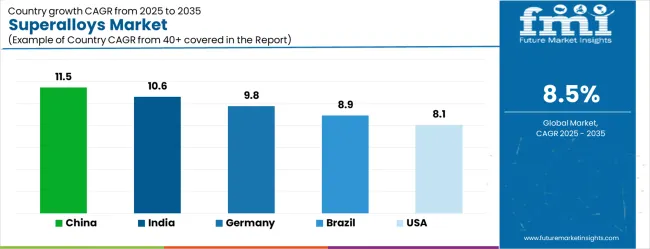
Across tracked geographies, China sets the pace at 11.50% CAGR. India follows at 10.60%. Germany follows at 9.80%. Brazil follows at 8.90%. USA follows at 8.10%. UK follows at 7.20%. Japan follows at 6.40%.
Summary of Superalloys Market
- Superalloys Market definition
- Superalloys are high-performance metallic alloys based on nickel, cobalt, or iron matrices, engineered to maintain mechanical strength, creep resistance, and oxidation stability at operating temperatures exceeding 650 degrees Celsius, used in aerospace turbine engines, power generation gas turbines, oil and gas equipment, and industrial process applications.
- Demand drivers in the market
- Next-generation commercial and military turbine engine programs are increasing superalloy content per engine as turbine inlet temperatures rise to improve fuel efficiency, directly expanding nickel-based and cobalt-based alloy consumption per unit produced.
- Oil and gas operators are specifying superalloy components for deepwater subsea equipment and high-pressure, high-temperature wellhead systems where conventional alloy grades cannot maintain mechanical integrity under combined corrosion and stress conditions.
- Power generation gas turbine fleet expansion across Asia and the Middle East is creating sustained replacement demand for superalloy hot-section components operating on maintenance-driven overhaul schedules tied to fired hours and start cycles.
- Key segments analyzed in the FMI report
- Nickel-Based Superalloys base material: 41.3% share in 2026, reflecting established procurement specifications and supply chain infrastructure favoring this variant.
- Aerospace applications: 38.7% share in 2026, driven by end-use requirements in the primary application channels.
- China: 11.50% compound growth, supported by domestic capacity expansion and rising consumption.
- Analyst opinion at FMI
- The superalloys market is capacity-constrained at the melt stage: fewer than a dozen vacuum arc remelting facilities globally can produce aerospace-qualified superalloy ingot, and lead times already stretch beyond 52 weeks for popular nickel-based grades. This bottleneck is structural, not cyclical, because new melt capacity requires three to five years of investment and qualification before producing specification-grade material. Engine OEMs that have secured long-term supply agreements with primary melters hold a procurement advantage that competitors relying on spot allocation cannot replicate. The risk for downstream forging houses is raw material access, not end-demand.
- Strategic implications / executive takeaways
- Aerospace Tier 1 forging operations must lock in multi-year superalloy ingot supply contracts with qualified melters now, because capacity additions will not match the combined pull of commercial, military, and energy turbine programs within the forecast period.
- Oil and gas equipment manufacturers should evaluate superalloy inventory pre-positioning strategies for deepwater project timelines where material lead times exceed equipment delivery schedules.
- Power generation OEMs targeting Asia Pacific and Middle East markets should establish regional superalloy component finishing and heat treatment capabilities to reduce logistics lead times for turbine overhaul kits.
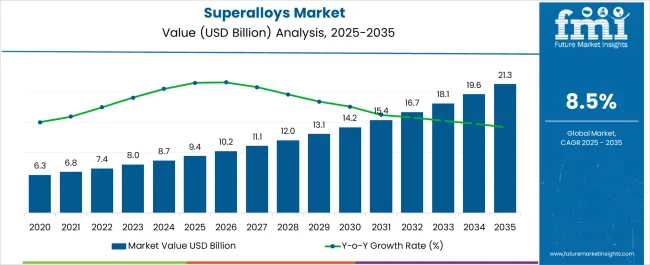
Superalloys Market key takeaways
| Metric | Details |
|---|---|
| Industry Size (2026) | USD 10.20 billion |
| Industry Value (2036) | USD 23.06 billion |
| CAGR (2026 to 2036) | 8.50% |
Source: Future Market Insights, 2026
Superalloys Market definition
Superalloys represent a class of precipitation-hardened or solid-solution-strengthened metallic materials designed for sustained service in extreme temperature, stress, and corrosive environments. These alloys are manufactured through vacuum induction melting, vacuum arc remelting, and powder metallurgy routes to achieve the microstructural integrity required for safety-critical rotating and static components in turbine engines and high-temperature industrial equipment.
Superalloys Market inclusions
Market scope includes all commercially traded superalloys segmented by base material (nickel-based, iron-based, cobalt-based) and application (aerospace, automotive, oil and gas, industrial). Revenue sizing spans the 2026 to 2036 forecast period with regional and country-level assessments.
Superalloys Market exclusions
The scope excludes standard stainless steels, titanium alloys, refractory metals (tungsten, molybdenum, tantalum), and high-entropy alloys still in research-stage development. Superalloy scrap and recycling service revenues are outside the defined boundary unless remelted into specification-grade ingot.
Superalloys Market research methodology
- Primary research: FMI analysts conducted interviews with procurement directors, engineering leads, and supply chain managers across key superalloys manufacturing and end-use organizations to map decision gates and sourcing specifications.
- Desk research: Data collection phases aggregated regulatory filings, trade association publications, standards body documentation, and company annual reports to establish verifiable baseline parameters.
- Market sizing and forecasting: Baseline values derive from a bottom-up aggregation of superalloys transaction volumes, applying region-specific adoption curves and pricing indices to project forward demand through 2036.
- Data validation and update cycle: Projections are tested against publicly reported procurement volumes, trade flow statistics, and company financial disclosures on a quarterly refresh schedule.
Why is the Superalloys Market Growing?
The Superalloys market is experiencing consistent growth, driven by rising demand across high-performance industries such as aerospace, power generation, automotive, and marine. Superalloys are valued for their exceptional mechanical strength, resistance to thermal creep deformation, surface stability, and corrosion resistance, making them indispensable in extreme operating environments. Increasing adoption of advanced turbine engines and next-generation aircraft technologies is significantly boosting demand, particularly for alloys capable of withstanding high temperatures.
The transition toward cleaner energy sources and the rising use of gas turbines in power plants are also fueling expansion. Moreover, growing investments in defense modernization and space exploration programs are opening new opportunities for superalloy applications.
Rapid technological advancements in materials science, including additive manufacturing techniques, are further enabling the production of customized, high-precision components with improved efficiency With industries increasingly focused on performance optimization, lightweighting, and sustainability, the demand for superalloys is expected to rise steadily, positioning the market for strong long-term growth across multiple geographies and end-use sectors.
Segmental Analysis
The superalloys market is segmented by base material, applications, and geographic regions. By base material, superalloys market is divided into Nickel-Based Superalloys, Iron-Based Superalloys, and Cobalt-Based Superalloys. In terms of applications, superalloys market is classified into Aerospace, Automotive, Oil And Gas, and Industrial. Regionally, the superalloys industry is classified into North America, Latin America, Western Europe, Eastern Europe, Balkan & Baltic Countries, Russia & Belarus, Central Asia, East Asia, South Asia & Pacific, and the Middle East & Africa.
Insights into the Nickel-Based Superalloys Base Material Segment
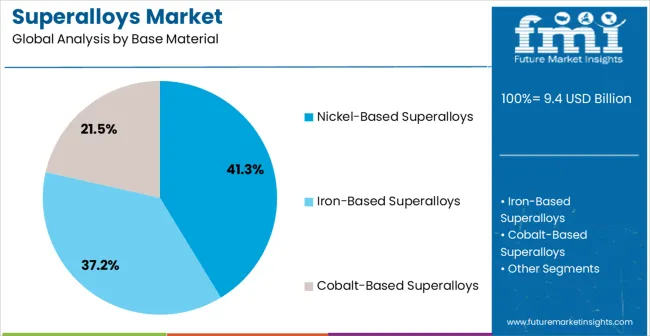
The nickel-based superalloys segment is projected to hold 41.3% of the market revenue in 2026, making it the leading base material. This dominance is primarily attributed to the superior mechanical properties of nickel alloys, including outstanding resistance to heat, corrosion, and oxidation, which make them highly suitable for critical applications. Nickel-based alloys are extensively used in gas turbines, jet engines, and industrial machinery, where operational conditions demand maximum durability and reliability.
The ability to maintain strength and stability at temperatures exceeding 1000°C has reinforced their preference in aerospace propulsion systems and power generation. Additionally, advancements in powder metallurgy and additive manufacturing are further improving the performance and design flexibility of nickel-based alloys.
Their proven efficiency in reducing fuel consumption and enhancing turbine life cycle is creating significant cost benefits for operators With aerospace and energy sectors continuously investing in high-performance materials, the nickel-based superalloys segment is expected to retain its leadership, supported by innovation and increasing global demand.
Insights into the Aerospace Application Segment
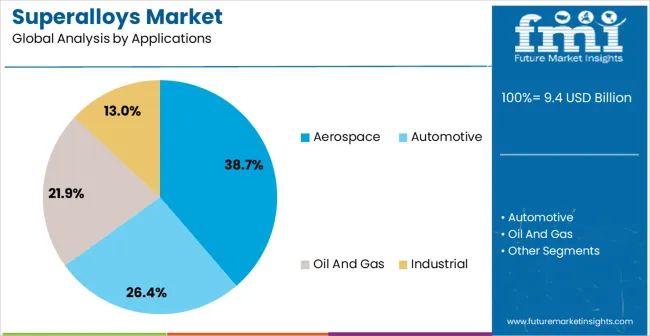
The aerospace segment is expected to account for 38.7% of the Superalloys market revenue in 2026, establishing it as the largest application area. Growth in this segment is being driven by the increasing production of commercial aircraft, military jets, and spacecraft, which rely heavily on superalloys for their ability to endure extreme pressure and high-temperature conditions. Critical aerospace components such as turbine blades, discs, and combustion chambers are extensively manufactured from superalloys to ensure safety, efficiency, and extended service life.
Rising global air traffic, coupled with investments in fuel-efficient next-generation aircraft, is further fueling demand. Moreover, the increasing focus on sustainability and emission reduction is prompting aerospace manufacturers to adopt lightweight yet durable materials, reinforcing the role of superalloys in modern aviation.
The expansion of space exploration and satellite programs also supports long-term opportunities in this segment With continuous innovation in aerospace engineering and growing defense budgets worldwide, the aerospace application segment is expected to maintain its dominance, underpinning sustained market expansion.
Market Overview
Superalloys Market Overview
Superalloys or high performance alloys are the metallic alloys that possess high strength, significant surface stability, corrosion resistance and creep resistance at high temperature. Superalloys are generally utilized in products and applications operating at high pressure, radiation, force and temperature under the impact of corrosive media.
They have austenitic face-centered cubic (FCC) crystal with alloying element of cobalt, iron or nickel as a base. Presently, there is escalation in demand of superalloys due to its high-strength that can resist creeping and high temperature in various applications like aerospace and aircraft.
Superalloys are used in various application such as aerospace, oil and gas, industrial and gas turbine. Combustion chambers, shafts, blades of aircraft gas turbine, turbocharger and exhaust valve of reciprocating engines, bolts, fans and pumps of chemical and petrochemical industries, rocket engine parts of space vehicles, bolts, blades of steam turbine power plants are some of the prominent end-use products / applications where superalloys are extensively used.
Furthermore, superalloys are widely used in automotive sector due to their capability to retain its strength at higher temperature. Additionally, due to their light weight, it helps in improving the fuel efficiency of automotive as well as aircraft. Superalloys can be nickel-based, iron-based and cobalt-based.
Among these, the nickel based superalloys are highly preferred in aerospace sector as it can resist physical stress and extremely high temperatures, which in turn helps to maintain high surface stability. Industrial nickel-based superalloys contain alloying elements such as aluminum, chromium, titanium, tungsten, niobium, tantalum, cobalt etc. Some of the key players in the market are focused on development of cost effective light weight superalloys.
Analysis of Superalloys Market By Key Countries
.webp "Top Country Growth Comparison Superalloys Market Cagr (2026 2036)")
| Country | CAGR |
|---|---|
| China | 11.5% |
| India | 10.6% |
| Germany | 9.8% |
| Brazil | 8.9% |
| USA | 8.1% |
| UK | 7.2% |
| Japan | 6.4% |
Country-wise Analysis
The Superalloys Market is expected to register a CAGR of 8.5% during the forecast period, exhibiting varied country level momentum. China leads with the highest CAGR of 11.5%, followed by India at 10.6%. Developed markets such as Germany, France, and the UK continue to expand steadily, while the USA is likely to grow at consistent rates. Japan posts the lowest CAGR at 6.4%, yet still underscores a broadly positive trajectory for the global Superalloys Market. In 2024, Germany held a dominant revenue in the Western Europe market and is expected to grow with a CAGR of 9.8%. The USA Superalloys Market is estimated to be valued at USD 3.4 billion in 2026 and is anticipated to reach a valuation of USD 3.4 billion by 2036. Sales are projected to rise at a CAGR of 0.0% over the forecast period between 2026 and 2036. While Japan and South Korea markets are estimated to be valued at USD 491.8 million and USD 243.9 million respectively in 2026.
Key Players in the Superalloys Market
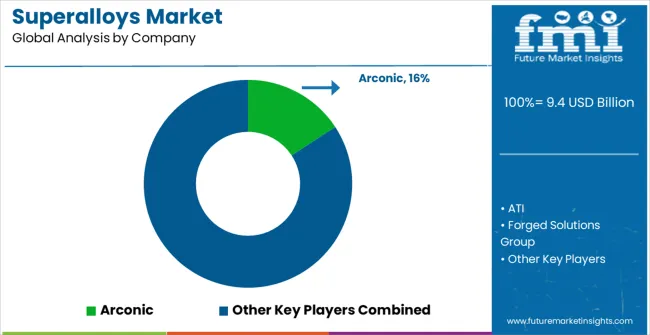
- Arconic
- ATI
- Forged Solutions Group
- Chromalloy Gas Turbine LLC
- HAYNES INTERNATIONAL.
- Beijing International Aeronautical Materials Corporation
- Carpenter Technology Corporation
- CANNON-MUSKEGON
- Hitchiner Manufacturing
- Doncasters Group
Scope of the report
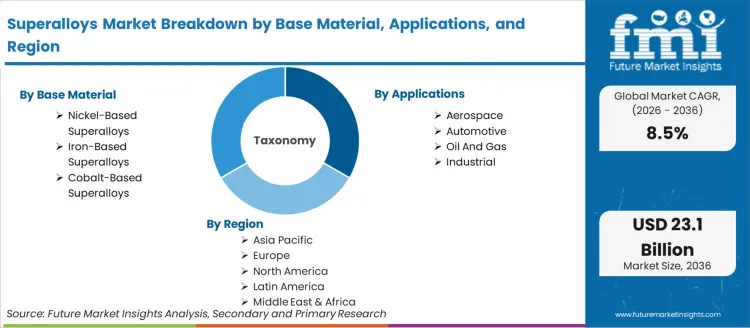
| Metric | Value |
|---|---|
| Quantitative Units | USD 10.20 billion to USD 23.06 billion, at a CAGR of 8.50% |
| Market Definition | Superalloys are high-performance metallic alloys based on nickel, cobalt, or iron matrices, engineered to maintain mechanical strength, creep resistance, and oxidation stability at operating temperatures exceeding 650 degrees Celsius, used in aerospace turbine engines, power generation gas turbines, oil and gas equipment, and industrial process applications. |
| Segmentation | Base Material (Nickel-Based Superalloys, Iron-Based Superalloys, Cobalt-Based Superalloys), Applications (Aerospace, Automotive, Oil And Gas, Industrial) |
| Regions Covered | North America, Latin America, Europe, East Asia, South Asia, Oceania, Middle East and Africa |
| Countries Covered | India, China, USA, Canada, UK, Germany, Japan, and 40 plus countries |
| Key Companies Profiled | Arconic, ATI, Forged Solutions Group, Chromalloy Gas Turbine LLC, HAYNES INTERNATIONAL, Beijing International Aeronautical Materials Corporation, Carpenter Technology Corporation, CANNON-MUSKEGON, Hitchiner Manufacturing, Doncasters Group |
| Forecast Period | 2026 to 2036 |
| Approach | Forecasting models apply a hybrid bottom-up and top-down methodology starting with verified superalloys transaction data and projecting adoption velocity across defined segments and regions. |
Superalloys Market by Segments
Base Material:
- Nickel-Based Superalloys
- Iron-Based Superalloys
- Cobalt-Based Superalloys
Applications:
- Aerospace
- Automotive
- Oil And Gas
- Industrial
Region:
- North America
- USA
- Canada
- Mexico
- Latin America
- Brazil
- Chile
- Rest of Latin America
- Western Europe
- Germany
- UK
- Italy
- Spain
- France
- Nordic
- BENELUX
- Rest of Western Europe
- Eastern Europe
- Russia
- Poland
- Hungary
- Balkan & Baltic
- Rest of Eastern Europe
- East Asia
- China
- Japan
- South Korea
- South Asia and Pacific
- India
- ASEAN
- Australia & New Zealand
- Rest of South Asia and Pacific
- Middle East & Africa
- Kingdom of Saudi Arabia
- Other GCC Countries
- Turkiye
- South Africa
- Other African Union
- Rest of Middle East & Africa
Bibliography
- International Air Transport Association. (2024). IATA Industry Statistics and Data: Fleet Forecast. IATA.
- United States Department of Defense. (2024). Industrial Base Assessment: Strategic and Critical Materials. U.S. DoD.
- International Energy Agency. (2024). World Energy Outlook 2024: Gas Turbine Capacity Projections. IEA.
- European Union Aviation Safety Agency. (2024). Annual Safety Review: Engine Certification Statistics. EASA.
- SAE International. (2024). AMS Specifications for Nickel and Cobalt Alloys. SAE.
- Organisation for Economic Co-operation and Development. (2024). Steel and Raw Materials Committee: Specialty Metals Review. OECD.
This bibliography is provided for reader reference. The full FMI report contains the complete reference list with primary research documentation.
This report addresses
- Market sizing and quantitative forecast metrics detailing the precise expenditure on superalloys across major industry verticals through 2036.
- Segmentation analysis mapping the adoption velocity of specific base material variants and evaluating the structural drivers behind preference shifts.
- Regional deployment intelligence comparing growth trajectories across Asia Pacific, Europe, North America, Latin America, and Middle East and Africa.
- Regulatory compliance assessment analyzing how evolving standards and certification mandates shape procurement specifications across target geographies.
- Competitive posture evaluation tracking consolidation activity, capacity investments, and strategic partnerships among leading market participants.
- Capital project strategic guidance defining the procurement parameters and supply chain configurations required for superalloys sourcing through the forecast period.
- Supply chain vulnerability analysis identifying concentration risks, raw material dependencies, and logistics bottlenecks affecting cost structures.
- Custom data delivery formats encompassing interactive dashboards, raw Excel datasets, and comprehensive PDF narrative reports.
Frequently Asked Questions
How large is the demand for Superalloys in the global market in 2026?
Demand for superalloys in the global market is estimated to be valued at USD 10.20 billion in 2026.
What will be the market size of Superalloys in the global market by 2036?
Market size for superalloys is projected to reach USD 23.06 billion by 2036.
What is the expected demand growth for Superalloys in the global market between 2026 and 2036?
Demand for superalloys is expected to grow at a CAGR of 8.50% between 2026 and 2036.
Which Base Material is poised to lead global sales by 2026?
Nickel-Based Superalloys accounts for 41.3% in 2026, reflecting established procurement specifications and supply chain readiness across primary buyer channels.
How is Aerospace driving Superalloys adoption in 2026?
Aerospace represents 38.7% of segment demand as end-use requirements continue to favor this category.
What is driving demand in China?
China registers a 11.50% CAGR through 2036, propelled by domestic capacity expansion and rising end-use consumption.
What does Superalloys Market definition mean in this report?
Superalloys are high-performance metallic alloys based on nickel, cobalt, or iron matrices, engineered to maintain mechanical strength, creep resistance, and oxidation stability at operating temperatures exceeding 650 degrees Celsius, used in aerospace turbine engines, power generation gas turbines, oil and gas equipment, and industrial process applications.
How does FMI build and validate the Superalloys forecast?
Forecasting models apply a hybrid bottom-up methodology starting with verified transaction data, cross-validated against publicly reported procurement volumes and company financial disclosures on a quarterly refresh schedule.
Preview the report firsthand - request a free sample
Get SampleGet the brochure for pricing and purchase details.
Get PDFTable of Content
- Executive Summary
- Global Market Outlook
- Demand-side Trends
- Supply-side Trends
- Technology Roadmap Analysis
- Analysis and Recommendations
- Market Overview
- Market Coverage / Taxonomy
- Market Definition / Scope / Limitations
- Research Methodology
- Chapter Orientation
- Analytical Lens and Working Hypotheses
- Market Structure, Signals, and Trend Drivers
- Benchmarking and Cross-market Comparability
- Market Sizing, Forecasting, and Opportunity Mapping
- Research Design and Evidence Framework
- Desk Research Programme (Secondary Evidence)
- Company Annual and Sustainability Reports
- Peer-reviewed Journals and Academic Literature
- Corporate Websites, Product Literature, and Technical Notes
- Earnings Decks and Investor Briefings
- Statutory Filings and Regulatory Disclosures
- Technical White Papers and Standards Notes
- Trade Journals, Industry Magazines, and Analyst Briefs
- Conference Proceedings, Webinars, and Seminar Materials
- Government Statistics Portals and Public Data Releases
- Press Releases and Reputable Media Coverage
- Specialist Newsletters and Curated Briefings
- Sector Databases and Reference Repositories
- FMI Internal Proprietary Databases and Historical Market Datasets
- Subscription Datasets and Paid Sources
- Social Channels, Communities, and Digital Listening Inputs
- Additional Desk Sources
- Expert Input and Fieldwork (Primary Evidence)
- Primary Modes
- Qualitative Interviews and Expert Elicitation
- Quantitative Surveys and Structured Data Capture
- Blended Approach
- Why Primary Evidence is Used
- Field Techniques
- Interviews
- Surveys
- Focus Groups
- Observational and In-context Research
- Social and Community Interactions
- Stakeholder Universe Engaged
- C-suite Leaders
- Board Members
- Presidents and Vice Presidents
- R&D and Innovation Heads
- Technical Specialists
- Domain Subject-matter Experts
- Scientists
- Physicians and Other Healthcare Professionals
- Governance, Ethics, and Data Stewardship
- Research Ethics
- Data Integrity and Handling
- Primary Modes
- Tooling, Models, and Reference Databases
- Desk Research Programme (Secondary Evidence)
- Data Engineering and Model Build
- Data Acquisition and Ingestion
- Cleaning, Normalisation, and Verification
- Synthesis, Triangulation, and Analysis
- Quality Assurance and Audit Trail
- Market Background
- Market Dynamics
- Drivers
- Restraints
- Opportunity
- Trends
- Scenario Forecast
- Demand in Optimistic Scenario
- Demand in Likely Scenario
- Demand in Conservative Scenario
- Opportunity Map Analysis
- Product Life Cycle Analysis
- Supply Chain Analysis
- Investment Feasibility Matrix
- Value Chain Analysis
- PESTLE and Porter’s Analysis
- Regulatory Landscape
- Regional Parent Market Outlook
- Production and Consumption Statistics
- Import and Export Statistics
- Market Dynamics
- Global Market Analysis 2021 to 2025 and Forecast, 2026 to 2036
- Historical Market Size Value (USD Million) Analysis, 2021 to 2025
- Current and Future Market Size Value (USD Million) Projections, 2026 to 2036
- Y-o-Y Growth Trend Analysis
- Absolute $ Opportunity Analysis
- Global Market Pricing Analysis 2021 to 2025 and Forecast 2026 to 2036
- Global Market Analysis 2021 to 2025 and Forecast 2026 to 2036, By Base Material
- Introduction / Key Findings
- Historical Market Size Value (USD Million) Analysis By Base Material , 2021 to 2025
- Current and Future Market Size Value (USD Million) Analysis and Forecast By Base Material , 2026 to 2036
- Nickel-Based Superalloys
- Iron-Based Superalloys
- Cobalt-Based Superalloys
- Nickel-Based Superalloys
- Y-o-Y Growth Trend Analysis By Base Material , 2021 to 2025
- Absolute $ Opportunity Analysis By Base Material , 2026 to 2036
- Global Market Analysis 2021 to 2025 and Forecast 2026 to 2036, By Applications
- Introduction / Key Findings
- Historical Market Size Value (USD Million) Analysis By Applications, 2021 to 2025
- Current and Future Market Size Value (USD Million) Analysis and Forecast By Applications, 2026 to 2036
- Aerospace
- Automotive
- Oil And Gas
- Industrial
- Aerospace
- Y-o-Y Growth Trend Analysis By Applications, 2021 to 2025
- Absolute $ Opportunity Analysis By Applications, 2026 to 2036
- Global Market Analysis 2021 to 2025 and Forecast 2026 to 2036, By Region
- Introduction
- Historical Market Size Value (USD Million) Analysis By Region, 2021 to 2025
- Current Market Size Value (USD Million) Analysis and Forecast By Region, 2026 to 2036
- North America
- Latin America
- Western Europe
- Eastern Europe
- East Asia
- South Asia and Pacific
- Middle East & Africa
- Market Attractiveness Analysis By Region
- North America Market Analysis 2021 to 2025 and Forecast 2026 to 2036, By Country
- Historical Market Size Value (USD Million) Trend Analysis By Market Taxonomy, 2021 to 2025
- Market Size Value (USD Million) Forecast By Market Taxonomy, 2026 to 2036
- By Country
- USA
- Canada
- Mexico
- By Base Material
- By Applications
- By Country
- Market Attractiveness Analysis
- By Country
- By Base Material
- By Applications
- Key Takeaways
- Latin America Market Analysis 2021 to 2025 and Forecast 2026 to 2036, By Country
- Historical Market Size Value (USD Million) Trend Analysis By Market Taxonomy, 2021 to 2025
- Market Size Value (USD Million) Forecast By Market Taxonomy, 2026 to 2036
- By Country
- Brazil
- Chile
- Rest of Latin America
- By Base Material
- By Applications
- By Country
- Market Attractiveness Analysis
- By Country
- By Base Material
- By Applications
- Key Takeaways
- Western Europe Market Analysis 2021 to 2025 and Forecast 2026 to 2036, By Country
- Historical Market Size Value (USD Million) Trend Analysis By Market Taxonomy, 2021 to 2025
- Market Size Value (USD Million) Forecast By Market Taxonomy, 2026 to 2036
- By Country
- Germany
- UK
- Italy
- Spain
- France
- Nordic
- BENELUX
- Rest of Western Europe
- By Base Material
- By Applications
- By Country
- Market Attractiveness Analysis
- By Country
- By Base Material
- By Applications
- Key Takeaways
- Eastern Europe Market Analysis 2021 to 2025 and Forecast 2026 to 2036, By Country
- Historical Market Size Value (USD Million) Trend Analysis By Market Taxonomy, 2021 to 2025
- Market Size Value (USD Million) Forecast By Market Taxonomy, 2026 to 2036
- By Country
- Russia
- Poland
- Hungary
- Balkan & Baltic
- Rest of Eastern Europe
- By Base Material
- By Applications
- By Country
- Market Attractiveness Analysis
- By Country
- By Base Material
- By Applications
- Key Takeaways
- East Asia Market Analysis 2021 to 2025 and Forecast 2026 to 2036, By Country
- Historical Market Size Value (USD Million) Trend Analysis By Market Taxonomy, 2021 to 2025
- Market Size Value (USD Million) Forecast By Market Taxonomy, 2026 to 2036
- By Country
- China
- Japan
- South Korea
- By Base Material
- By Applications
- By Country
- Market Attractiveness Analysis
- By Country
- By Base Material
- By Applications
- Key Takeaways
- South Asia and Pacific Market Analysis 2021 to 2025 and Forecast 2026 to 2036, By Country
- Historical Market Size Value (USD Million) Trend Analysis By Market Taxonomy, 2021 to 2025
- Market Size Value (USD Million) Forecast By Market Taxonomy, 2026 to 2036
- By Country
- India
- ASEAN
- Australia & New Zealand
- Rest of South Asia and Pacific
- By Base Material
- By Applications
- By Country
- Market Attractiveness Analysis
- By Country
- By Base Material
- By Applications
- Key Takeaways
- Middle East & Africa Market Analysis 2021 to 2025 and Forecast 2026 to 2036, By Country
- Historical Market Size Value (USD Million) Trend Analysis By Market Taxonomy, 2021 to 2025
- Market Size Value (USD Million) Forecast By Market Taxonomy, 2026 to 2036
- By Country
- Kingdom of Saudi Arabia
- Other GCC Countries
- Turkiye
- South Africa
- Other African Union
- Rest of Middle East & Africa
- By Base Material
- By Applications
- By Country
- Market Attractiveness Analysis
- By Country
- By Base Material
- By Applications
- Key Takeaways
- Key Countries Market Analysis
- USA
- Pricing Analysis
- Market Share Analysis, 2025
- By Base Material
- By Applications
- Canada
- Pricing Analysis
- Market Share Analysis, 2025
- By Base Material
- By Applications
- Mexico
- Pricing Analysis
- Market Share Analysis, 2025
- By Base Material
- By Applications
- Brazil
- Pricing Analysis
- Market Share Analysis, 2025
- By Base Material
- By Applications
- Chile
- Pricing Analysis
- Market Share Analysis, 2025
- By Base Material
- By Applications
- Germany
- Pricing Analysis
- Market Share Analysis, 2025
- By Base Material
- By Applications
- UK
- Pricing Analysis
- Market Share Analysis, 2025
- By Base Material
- By Applications
- Italy
- Pricing Analysis
- Market Share Analysis, 2025
- By Base Material
- By Applications
- Spain
- Pricing Analysis
- Market Share Analysis, 2025
- By Base Material
- By Applications
- France
- Pricing Analysis
- Market Share Analysis, 2025
- By Base Material
- By Applications
- India
- Pricing Analysis
- Market Share Analysis, 2025
- By Base Material
- By Applications
- ASEAN
- Pricing Analysis
- Market Share Analysis, 2025
- By Base Material
- By Applications
- Australia & New Zealand
- Pricing Analysis
- Market Share Analysis, 2025
- By Base Material
- By Applications
- China
- Pricing Analysis
- Market Share Analysis, 2025
- By Base Material
- By Applications
- Japan
- Pricing Analysis
- Market Share Analysis, 2025
- By Base Material
- By Applications
- South Korea
- Pricing Analysis
- Market Share Analysis, 2025
- By Base Material
- By Applications
- Russia
- Pricing Analysis
- Market Share Analysis, 2025
- By Base Material
- By Applications
- Poland
- Pricing Analysis
- Market Share Analysis, 2025
- By Base Material
- By Applications
- Hungary
- Pricing Analysis
- Market Share Analysis, 2025
- By Base Material
- By Applications
- Kingdom of Saudi Arabia
- Pricing Analysis
- Market Share Analysis, 2025
- By Base Material
- By Applications
- Turkiye
- Pricing Analysis
- Market Share Analysis, 2025
- By Base Material
- By Applications
- South Africa
- Pricing Analysis
- Market Share Analysis, 2025
- By Base Material
- By Applications
- USA
- Market Structure Analysis
- Competition Dashboard
- Competition Benchmarking
- Market Share Analysis of Top Players
- By Regional
- By Base Material
- By Applications
- Competition Analysis
- Competition Deep Dive
- Arconic
- Overview
- Product Portfolio
- Profitability by Market Segments (Product/Age /Sales Channel/Region)
- Sales Footprint
- Strategy Overview
- Marketing Strategy
- Product Strategy
- Channel Strategy
- ATI
- Forged Solutions Group
- Chromalloy Gas Turbine LLC
- HAYNES INTERNATIONAL
- Beijing International Aeronautical Materials Corporation
- Carpenter Technology Corporation
- CANNON-MUSKEGON
- Hitchiner Manufacturing
- Doncasters Group
- Arconic
- Competition Deep Dive
- Assumptions & Acronyms Used


