

- Market Size (2026)
- USD 12.4 Bn
- Forecast (2036)
- USD 66.7 Bn
- CAGR (2026 to 2036)
- 18.3%
Teleradiology Market Size, Market Forecast and Outlook By FMI
Teleradiology market reached a value of USD 10.5 billion in 2025 and is expected to reach USD 12.4 billion by the end of 2026. The market is projected to advance at a CAGR of 18.3% from 2026 to 2036 and is poised to surpass USD 66.7 billion by 2036. Real-time reporting is expected to account for a 58.0% service type share, and hospital-based teleradiology is expected to lead the delivery model segment with a 56.0% share.
Radiology departments are under pressure as scan volumes keep rising and local reporting teams cannot always keep pace. RCR’s June 2025 workforce census reported a 29% UK consultant clinical radiologist shortfall and a need for 1,953 more consultants in September 2024. Hospitals use teleradiology as planned reporting capacity for night cover and urgent cases. FDA’s January 2025 AI guidance raises the bar for AI-assisted reporting, since software used in clinical workflows needs lifecycle documentation for safety and effectiveness review.
Service providers using AI triage need strong records and governance before hospitals rely on automated case sorting. Sectra’s March 2024 Homerton public-cloud milestone is relevant, as the trust delivers around 250,000 imaging reports each year. Cloud-based imaging gives hospitals a practical way to connect radiologists across locations. Teleradiology providers with workforce depth and governed AI tools are better positioned for long-term hospital contracts. Secure cloud access improves their position during hospital service evaluations and contract renewal discussion cycles.
Summary of the Teleradiology Market
- Demand and Growth Drivers
- Hospitals use teleradiology for night coverage and urgent scan review when local radiology teams are unavailable.
- Imaging centers rely on contracted reporting to keep CT and MRI reads moving without expanding full-time radiologist teams.
- Cloud-based image access helps hospitals route PACS worklists to remote specialists with fewer delays in report delivery.
- Product and Segment View
- Real time reporting is projected to account for 58.0% of service type demand in 2026 as hospitals prioritize faster reads for urgent cases.
- Hospital based teleradiology is expected to hold 56.0% share in 2026, supported by hospital preference for controlled reporting workflows and secure image access.
- Computed tomography carries strong modality value since emergency departments need rapid interpretation for cross-sectional scans.
- Geography and Competitive Outlook
- China is expected to record a CAGR of 22.1% through 2036, with large hospital networks adding remote reporting capacity.
- Brazil is projected to expand at 20.5% CAGR from 2026 to 2036, as specialist access gaps raise reliance on remote interpretation.
- Companies combining imaging workflow platforms with subspecialty reporting coverage are strengthening their market position during the forecast period.
- Analyst Opinion
- Anurag Sharma, Principal Consultant for the Healthcare domain at FMI, says, “Teleradiology is becoming an operating layer for hospitals needing faster image interpretation without full night staffing. Hospital teams need dependable CT reads with secure image transfer. Radiologist networks and radiology information system (RIS) integration reduce reporting delays and subspecialty coverage protects clinical confidence.”
- Teleradiology Market Value Analysis
- Teleradiology Market is moving from basic image transfer into structured remote reporting across hospital imaging workflows.
- Adoption is driven by emergency CT reading needs across hospitals using computed tomography for acute cases.
- Demand benefits from deeper use of medical imaging software across cloud viewing and report delivery.
- Hospital networks use real-time reporting to reduce delays across stroke and trauma imaging pathways.
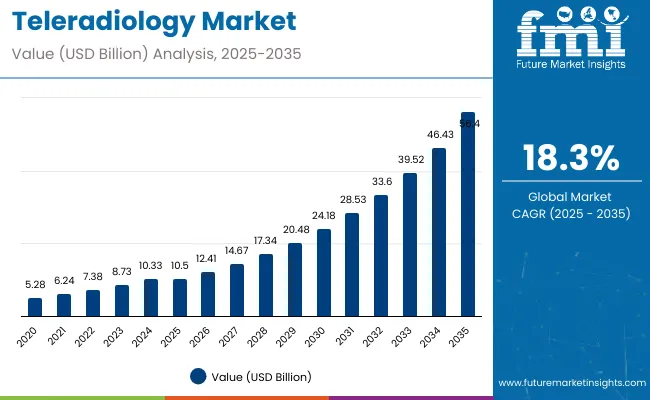
Key Takeaways, Market Size, and Forecast
| Metric | Value |
|---|---|
| Market Size (2025) | USD 10.5 Billion |
| Market Size (2036) | USD 66.7 Billion |
| CAGR (2026–2036) | 18.3% |
| Incremental Opportunity (2026–2036) | USD 54.3 Billion |
| Leading Service Type (2026) | Real Time Reporting |
| Real Time Reporting Share (2026) | 58.0% |
| Leading End Users | Hospital-Based Teleradiology (56.0%), Computed Tomography (38.0%) |
| Fastest-Growing Country | China |
| China CAGR | 22.1% |
| 2nd Fastest-Growing Country | Brazil |
| Brazil CAGR | 20.5% |
Teleradiology Market Definition
Teleradiology Market includes remote diagnostic image interpretation services provided by radiologists outside the imaging location. These services assess CT scans, MRI scans, X-rays, ultrasound studies, nuclear scans, and mammography images. Scope includes real time reporting, store and forward reporting, hospital network services, and independent remote reading. Imaging equipment sales, general teleconsultation, patient scheduling tools, and non-radiology diagnosis are outside the scope.
Teleradiology Market Inclusions
Market scope covers all commercially traded teleradiology services categorized by product, including CT scan reporting, X-ray reporting, MRI scan reporting, ultrasound reporting, nuclear imaging, and mammography services. Coverage includes organ focus areas such as brain imaging, lung imaging, heart imaging, liver imaging, bone imaging, and abdominal imaging. Revenue scope covers 2026 to 2036. The key participants include teleradiology service providers, hospital radiology departments, imaging centers, radiologists, PACS and RIS platform vendors, healthcare IT providers, diagnostic network operators, independent reporting firms, cloud imaging companies, and regulatory bodies.
Teleradiology Market Exclusions
Scope does not include scanner manufacturing, radiology education software, general telemedicine visits, image storage without reporting, or non-diagnostic file sharing services.
Teleradiology Market Research Methodology
- Primary Research: Reviewed inputs from hospital radiology leaders, imaging center operators, remote reporting providers, platform vendors, and healthcare IT channel participants.
- Desk Research: Combined data from diagnostic imaging references, company service portfolios, hospital workflow systems, and regulatory guidance covering digital health records.
- Market sizing and forecasting: Added reporting volumes across modalities and service models from the bottom up, with pricing checks across key countries.
- Data validation: Cross-checked every three months against hospital imaging demand, radiologist capacity conditions, and provider service coverage.
Why is the Teleradiology Market Growing?
- Hospitals are using remote reporting earlier in emergency workflows to reduce scan-to-report delays.
- Imaging centers need specialist reading partners as CT and MRI studies carry higher clinical complexity.
- Providers are using vendor neutral archive systems to share images across multiple hospital sites.
Hospital radiology departments need outside reading capacity as scan volumes strain local teams. England’s clinical radiology workforce had a 30% shortfall in 2024, which means hospitals lacked enough radiologists for current demand. Workforce imbalance raises service value for remote reporting providers able to cover nights and urgent work. Hospitals using teleradiology can protect reporting continuity without carrying full internal staffing cost.
Imaging networks rely on reliable access between scanner rooms and reporting teams. NHS Digital notes its monthly diagnostics collection covers 15 key diagnostic tests and procedures, with data used to measure waiting time performance. Monthly reporting discipline keeps diagnostic delays visible for hospital managers and commissioners. Teleradiology providers benefit when their service can shorten reporting queues across measured diagnostic pathways.
Market Segmentation Analysis
- CT Scan reporting services are projected to account for 28.7% of product revenue in 2026, led by emergency imaging and rapid case review needs.
- Brain imaging is projected to represent 30.0% of organ focus share for 2026 as stroke detection and tumor assessment require faster specialist interpretation.
- Computed tomography is forecast to hold 38.0% of modality use in 2026, supported by its central role in acute hospital workflows.
- Real time reporting is expected to account for 58.0% of service type volume during 2026 as urgent review needs push hospitals toward immediate radiologist access.
- Hospital based teleradiology is projected to command 56.0% of delivery model share in 2026, reflecting hospital preference for controlled reporting systems and clinical oversight.
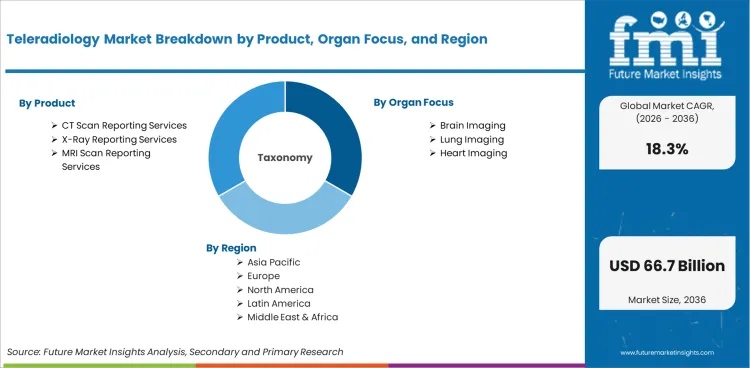
The market for teleradiology is divided into five primary segment groups based on product, organ focus, modality, service type, and delivery model. Product includes CT scan reporting services, x-ray reporting services, MRI scan reporting services, ultrasound reporting services, nuclear imaging services, and mammography services. Organ focus includes brain imaging, lung imaging, heart imaging, liver imaging, bone imaging, and abdominal imaging. Modality includes computed tomography, magnetic resonance imaging, x-ray imaging, Ultrasound imaging, and nuclear medicine. Service type includes real time reporting and store and forward reporting. Delivery model includes hospital based teleradiology and independent teleradiology providers.
Insights into Teleradiology Market by Product
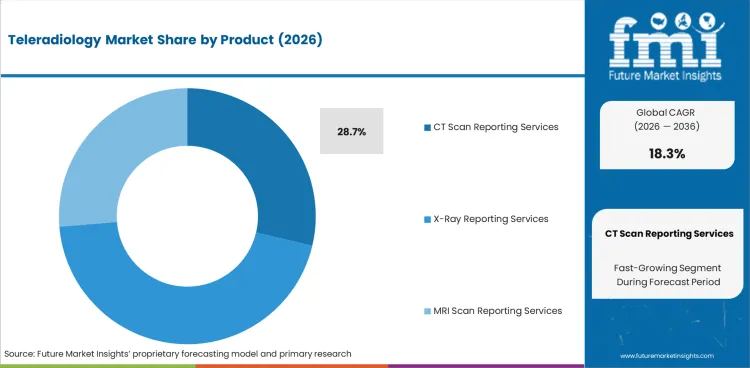
- In 2026, CT scan reporting services are expected to make up 28.7% of the product segment. CT reads support emergency workflows where trauma and critical care cases need fast interpretation.
- X-ray and MRI reporting services address routine and specialist imaging needs. Their value improves in outpatient networks and cases requiring deeper clinical review.
Insights into Teleradiology Market by Organ Focus
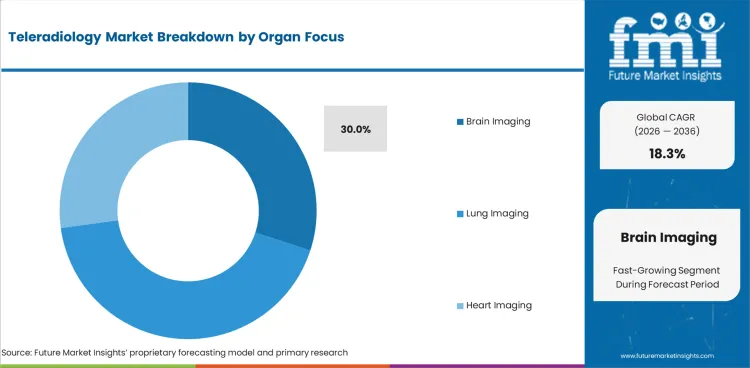
- Brain imaging is projected to account for 30.0% of the organ focus segment in 2026. Stroke detection and brain tumor review require rapid radiology input across hospital networks.
- Lung and heart imaging favor selected specialist reporting needs. Their demand improves in respiratory care and cardiac diagnostics requiring structured image interpretation.
Insights into Teleradiology Market by Modality
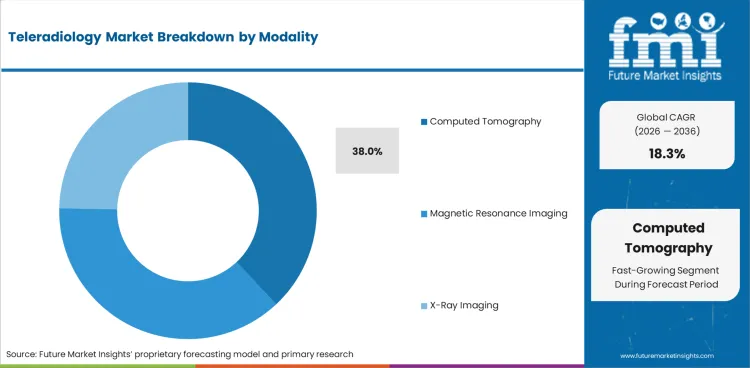
- In 2026, computed tomography is expected to account for 38.0% of modality demand. CT studies create high reporting volumes across emergency departments and acute care systems.
- MRI and X-ray modalities serve different reporting needs. MRI supports complex soft-tissue review, and X-ray reporting covers high-volume routine imaging.
Insights into Teleradiology Market by Service Type
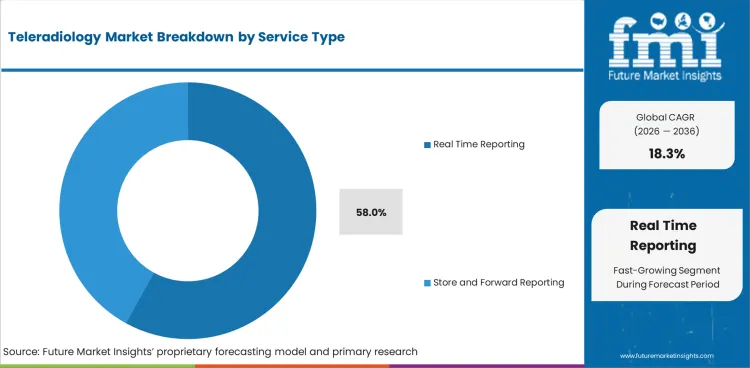
- Real time reporting is projected to represent 58.0% share in 2026. Hospitals need immediate radiologist availability for urgent scans and critical case escalation.
- Store and forward reporting favors routine image review. Its value improves in lower-acuity cases and batch reporting workflows across imaging centers.
Insights into Teleradiology Market by Delivery Model
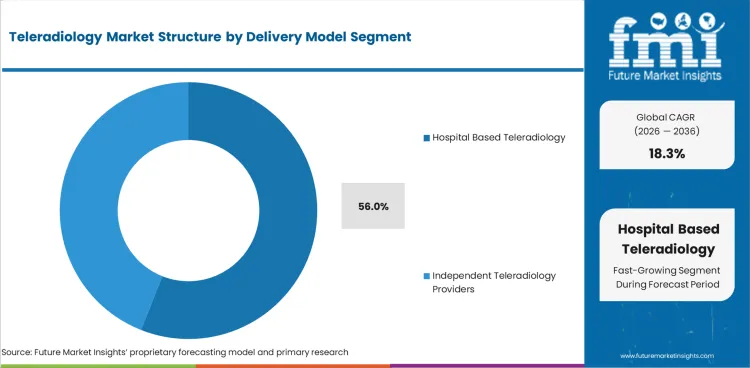
- Hospital-based teleradiology is projected to hold 56.0% of the delivery model segment in 2026. Hospital networks prefer controlled reporting workflows for image access and clinical coordination.
- Independent teleradiology providers enhance overflow and after-hours reporting needs. Their role improves where hospitals need flexible coverage without expanding internal radiology teams.
Teleradiology Market Drivers, Restraints, and Opportunities
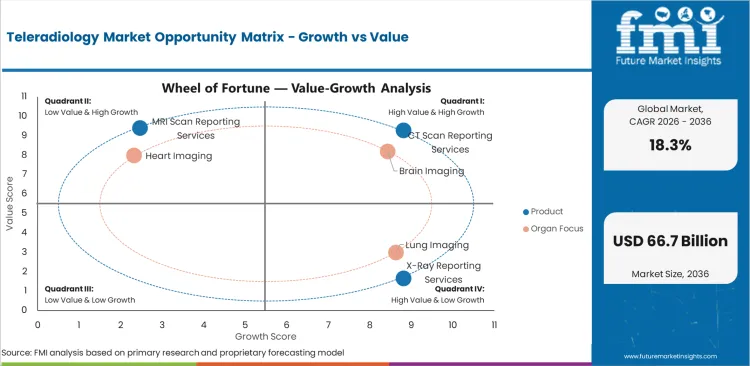
- Emergency CT reading pressure is creating structured demand for remote radiology coverage across higher-acuity hospital programs.
- Data security requirements increase cost pressure for smaller service providers with limited platform investment capacity.
- AI triage tools improve service opportunity through faster worklist sorting and AI radiology worklist orchestration adoption.
Teleradiology services keep growing as hospitals need faster image reporting and reliable radiologist coverage outside regular working hours. Data security requirements and limited radiologist availability can slow broader adoption across smaller imaging networks. Teleradiology expansion continues through real-time reporting and hospital-based workflows across urgent imaging service contracts globally. Cloud-connected PACS platforms strengthen remote image access and faster report delivery for hospital networks across care sites.
Medicare Fee Schedule Reset Supports Read Pricing
Medicare reimbursement is giving teleradiology vendors a firmer reference point for 2026 price discussions, especially where hospital contracts benchmark remote interpretation to professional-component economics. In October 2025, CMS finalized CY 2026 Physician Fee Schedule changes effective January 1, 2026; the qualifying APM conversion factor moved to $33.57 from $32.35, a $1.22 increase or 3.77%, and the nonqualifying APM factor moved to $33.40 from $32.35, a $1.05 increase or 3.26%.
This does not automatically lift every per-read fee. It strengthens supplier arguments for repricing night coverage where labor availability remains tight and operational demands continue to rise. It reinforces the need for backlog clearing and subspecialty reads, especially when service level penalties become increasingly costly for providers.
Imaging Volume Is Protecting Per-Read Economics
Teleradiology price movement is being shaped by volume instead of only fee-schedule updates. In March 2026, MedPAC reported that imaging units of service per fee-for-service Medicare beneficiary increased 3.3% from 2023 to 2024, and allowed charges for imaging increased 4.0%; imaging represented 10.7% of 2024 allowed charges. For remote-reading providers, this combination holds importance as higher scan flow can improve radiologist utilization and platform absorption.
It can give large health systems leverage to demand tiered per-read rates. Vendors with reliable turnaround time coverage should avoid volume discounts that fail to reflect varying acuity mix across different diagnostic services. They should ensure pricing accounts for emergency coverage and subspecialty staffing costs, which often require higher expertise and resource allocation.
Analysis of Teleradiology Market By Key Countries
.webp "Top Country Growth Comparison Teleradiology Market Cagr (2026 2036)")
| Country | CAGR |
|---|---|
| China | 22.1% |
| Brazil | 20.5% |
| France | 17.8% |
| UK | 17.2% |
| Japan | 16.9% |
| USA | 15.8% |
| Germany | 15.4% |
Source: Future Market Insights, 2026.
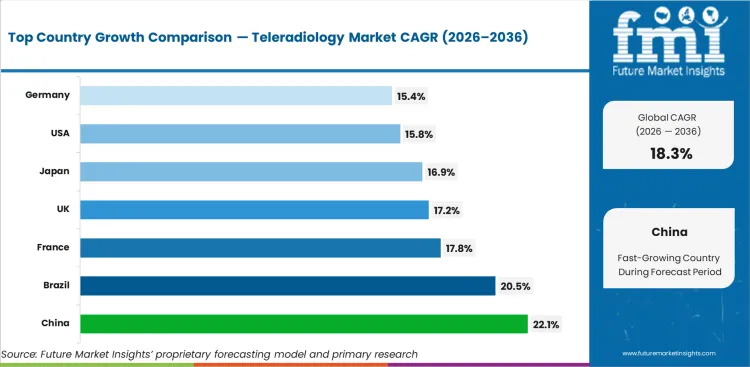
Teleradiology Market CAGR Analysis By Country
- China records the fastest outlook at 22.1% CAGR through 2036 as hospital groups widen remote diagnostic access.
- Brazil is projected at 20.5% CAGR during the forecast period as specialist shortages make contracted remote reporting more important.
- France reaches 17.8% CAGR by 2036 as organized imaging networks create stronger need for subspecialty reads.
- Backlog pressure places the UK at 17.2% CAGR through 2036 amid radiologist staffing limits in public hospitals.
- Japan is forecast at 16.9% CAGR as high scanner availability increases the need for efficient report routing.
- Established imaging networks place the USA at 15.8% CAGR with independent radiology groups adding contracted reporting depth.
- Germany records 15.4% CAGR as mature hospital systems adopt controlled remote reading workflows across regional networks.
Demand for teleradiology services is forecast to rise at 18.3% CAGR from 2026 to 2036. Country-level analysis covers the major markets contributing to this forecast, with the key markets listed below.
Demand Outlook for Teleradiology Market in China
Teleradiology industry in China is projected to record a CAGR of 22.1% through 2036. China had 4.95 million community-level health workers in August 2024, including 1.1 million rural village doctors. The care network increases demand for China teleradiology services as lower-tier facilities need specialist image interpretation. Remote reporting providers can gain from hospitals seeking faster reads across dispersed care points.
- Lower-tier care facilities raises demand for central radiology reading networks.
- Urban hospitals need remote overflow support for CT and MRI reporting loads.
- Domestic platforms with secure routing can improve reading access across provincial systems.
Sales Analysis of Teleradiology Market in Brazil
The teleradiology sector in Brazil is expected to expand at a CAGR of 20.5% during the assessment period. Brazil needs an estimated 30,000 MRI examinations per million inhabitants according to a 2024 radiology study. The imaging requirement boosts demand for Brazil teleradiology services as specialist reading capacity varies across public and private networks. Providers with Portuguese reporting depth can improve service access outside large cities.
- Regional access gaps enhance contracted reporting for MRI and CT studies.
- Private imaging chains need standardized reporting across multiple centers.
- Strong turnaround systems help service providers handle overflow from urban hospitals.
Demand Outlook for Teleradiology Market in France
The France teleradiology industry is forecast to grow at a CAGR of 17.8% by 2036. OECD reported France had 44 diagnostic imaging scanners per million people in 2025 across CT systems and MRI units. The same figure covered PET scanners used across hospitals and specialist diagnostic imaging networks. The imaging base favors demand for France teleradiology services across hospitals needing specialist coverage. Providers connected with magnetic resonance imaging (MRI) workflows can address complex case review.
- Hospital groups use remote reads to balance reporting loads across regions.
- Brain and lung imaging enhance demand for specialist review pathways.
- Structured reporting helps care teams act on urgent imaging results.
Opportunity Analysis of Teleradiology Market in the United Kingdom
The UK teleradiology segment is poised to advance at 17.2% CAGR over the forecast years. Between October 2024 and September 2025, an average of 500,563 people waited for a CT or MRI scan each month in England. Backlog pressure raises demand for UK teleradiology services as hospitals seek faster reporting and scheduling relief. Service providers with strong clinical governance can assist public and private imaging groups.
- NHS imaging pressure enhances remote reporting for backlog reduction.
- Hospital networks need secure access across multiple reporting locations.
- Medical X-ray detectors adoption adds digital image flow across routine care.
Future Outlook for Teleradiology Market in Japan
Japan teleradiology industry is expected to post 16.9% CAGR through 2036. OECD reported Japan had 184 diagnostic imaging scanners per million people in 2025 across CT systems and MRI units. The same figure included PET scanners used across hospitals and specialist diagnostic imaging networks. High equipment density favors demand for Japan’s teleradiology services, as scan output requires efficient reading coordination. Providers with specialist coverage can help hospitals manage routine and urgent reporting loads.
- High scanner density creates steady demand for remote interpretation.
- Older patient groups increase imaging review needs across hospital networks.
- Magnetic resonance imaging coils upgrades can raise complexity in specialist reading.
Demand Outlook for Teleradiology Market in the United States
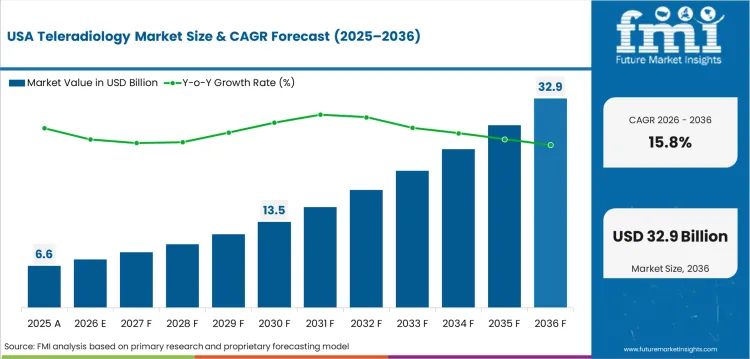
The USA teleradiology industry is projected to expand at 15.8% CAGR through 2036. The United States has a well-developed diagnostic imaging base across emergency departments and outpatient care networks. This equipment depth leads to steady demand for teleradiology services as hospitals and imaging centers seek dependable remote reporting coverage. Independent radiology groups and hospital systems both use contracted reads for coverage stability.
- Emergency departments use remote reads for night and weekend coverage.
- Independent groups add capacity through subspecialty reporting contracts.
- X-ray system installations enhance routine image reporting volume across outpatient sites.
In-depth Analysis of Teleradiology Market in Germany
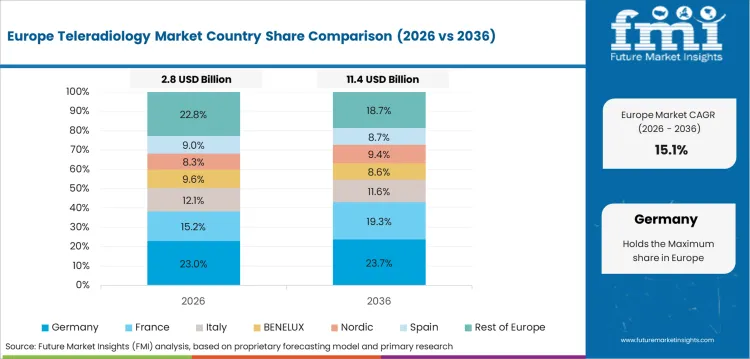
The teleradiology segment in Germany is expected to post 15.4% CAGR through 2036. Germany has a mature diagnostic imaging base with strong availability across hospital and specialist care networks. This infrastructure creates steady demand for teleradiology services as regional hospitals look for dependable remote reporting and faster image interpretation. Providers with tight turnaround discipline can gain from hospital groups seeking reliable coverage.
- Mature hospital infrastructure lifts organized remote reading services.
- Regional providers need reporting consistency across connected care sites.
- Single-photon emission computed tomography workflows raise specialist interpretation needs in nuclear imaging.
Competitive Landscape and Strategic Positioning
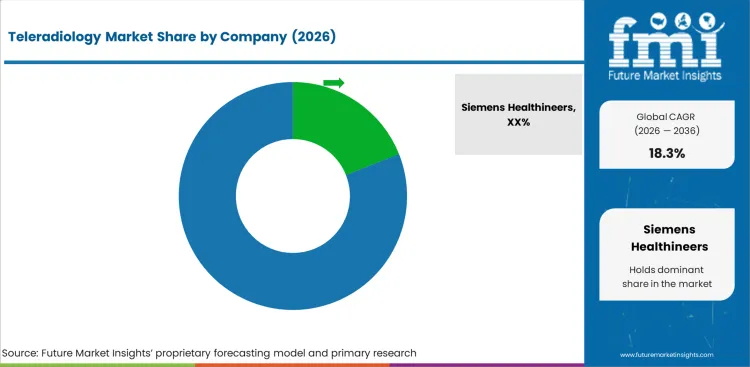
Teleradiology Market Analysis By Company
- Siemens Healthineers competes from a broad imaging platform base and strong access to hospital workflow contracts.
- Agfa HealthCare and Novarad leverage enterprise image management systems built for hospital reporting networks.
- Specialist providers focus on faster turnaround commitments and subspecialty reading coverage for complex case review.
Competition spans imaging platform vendors and specialist reporting providers across hospital networks seeking dependable remote reading coverage. Siemens Healthineers holds a strong position through imaging platforms and clinical workflow tools used across hospital systems. Agfa HealthCare and Novarad serve hospitals through enterprise image management and integrated reporting systems. ONRAD and StatRad emphasize radiologist coverage and firm turnaround commitments. Teleradiology Solutions adds service depth through remote reading scale and specialist reporting access.
Competitive barriers include radiologist availability and cybersecurity expectations across hospital IT systems. Integration cost affects provider selection as hospitals need secure image access and report delivery. Stronger competitors will combine fast worklist routing with reliable night coverage across long service contracts. Providers with broader molecular imaging and CT expertise are better placed to reduce coordination burden for clinical teams.
Key Companies in the Teleradiology Market
Key global companies leading Teleradiology Market include:
- Siemens Healthineers, Agfa HealthCare, and Novarad Corporation have strong imaging workflow infrastructure for hospital network service delivery.
- Teleradiology Solutions and TeleDiagnostic Solutions Pvt. Ltd. serve imaging centers through reporting platforms and remote reading operations.
- ONRAD Inc., StatRad (I-MED Radiology), Pediatrix Medical Group / vRad, and Oracle Health hold specialist positions across emergency coverage and clinical information systems.[P1]
Competitive Benchmarking: Teleradiology Market
| Company | Reporting Workflow Depth | Platform Integration Strength | Hospital Network Reach | Geographic Footprint |
|---|---|---|---|---|
| Siemens Healthineers | High | Strong | Strong | Global presence across over 70 countries, with strong coverage in North America, Europe, China, India, and other major healthcare markets. |
| Agfa HealthCare | High | Strong | Strong | Global enterprise imaging footprint, with 1,000+ Enterprise Imaging sites worldwide and offices across multiple regions. |
| Novarad Corporation | High | Strong | Moderate | USA-based company with global imaging software reach, including over 1,000 customized solutions delivered worldwide. |
| Teleradiology Solutions | High | Moderate | Strong | India-headquartered provider with international reach across India, the USA, and selected overseas client markets. |
| ONRAD Inc. | High | Moderate | Moderate | USA-focused footprint, with services across 30+ states and operations based in Phoenix, Arizona and Riverside, California. |
| StatRad (I-MED Radiology) | High | Moderate | Moderate | USA-focused provider based in San Diego, serving radiology groups through after-hours and emergency teleradiology coverage. |
| TeleDiagnostic Solutions Pvt. Ltd. | Medium | Moderate | Moderate | India-based provider headquartered in Pune, with service focus across Indian diagnostic and remote reporting needs. |
| Pediatrix Medical Group / vRad | Medium | Moderate | Strong | Legacy USA nationwide radiology footprint, with teleradiology coverage historically serving patients across all 50 states. |
| Oracle Health | Medium | Strong | Strong | Global healthcare IT footprint through Oracle Health and Oracle’s international enterprise software presence across major regions. |
Source: Future Market Insights, 2026.
Key Developments in Teleradiology Market
- In July 2024, I-MED Radiology acquired StatRad, the United States’ second-largest teleradiology service provider, marking I-MED’s entry into the USA market. The deal strengthens I-MED’s remote reporting capacity through StatRad’s cloud-based platform, over 90 USA-based radiologists, and high-volume scan interpretation network.
- In November 2024, Apollo Radiology International acquired InHealth Limited’s UK radiology reporting division, expanding its global teleradiology footprint and strengthening reporting support for NHS diagnostic networks. The company stated the combined operation is projected to report over 2 million scans annually across 24 countries serving over 200 healthcare organizations.
Key Players in the Teleradiology Market
Major Global Players:
- Siemens Healthineers
- Oracle Health
- GE HealthCare
- Agfa HealthCare
- Novarad Corporation
- Pediatrix Medical Group / vRad
Specialist Players:
- ONRAD Inc.
- Teleradiology Solutions
- StatRad (I-MED Radiology)
- TeleDiagnostic Solutions Pvt. Ltd.
Report Scope and Coverage
Teleradiology Market Breakdown By Product, Organ Focus, Modality, Service Type, Delivery Model, And Region
| Parameter | Details |
|---|---|
| Quantitative Units | USD 12.4 billion to USD 66.7 billion, at a CAGR of 18.3% |
| Market Definition | Teleradiology Market encompasses remote radiologist interpretation and reporting of diagnostic images across hospital and independent networks. |
| Regions Covered | North America, Latin America, Europe, East Asia, South Asia and Pacific, Middle East and Africa |
| Countries Covered | USA, UK, Germany, China, Brazil, France, Japan, South Korea, and 30 plus countries |
| Key Companies Profiled | Siemens Healthineers, Agfa HealthCare, Novarad Corporation, ONRAD Inc., StatRad (I-MED Radiology), and Teleradiology Solutions |
| Forecast Period | 2026 to 2036 |
| Approach | Hybrid bottom-up and top-down methodology starting with reporting demand and verified modality use patterns. |
Teleradiology Market by Segments
Teleradiology Market Segmented by Product:
- CT Scan Reporting Services
- X-Ray Reporting Services
- MRI Scan Reporting Services
- Ultrasound Reporting Services
- Nuclear Imaging Services
- Mammography Services
Teleradiology Market Segmented by Organ Focus:
- Brain Imaging
- Lung Imaging
- Heart Imaging
- Liver Imaging
- Bone Imaging
- Abdominal Imaging
Teleradiology Market Segmented by Modality:
- Computed Tomography
- Magnetic Resonance Imaging
- X-Ray Imaging
- Ultrasound Imaging
- Nuclear Medicine
Teleradiology Market Segmented by Service Type:
- Real Time Reporting
- Store and Forward Reporting
Teleradiology Market Segmented by Delivery Model:
- Hospital Based Teleradiology
- Independent Teleradiology Providers
Teleradiology Market by Region:
- North America
- USA
- Canada
- Mexico
- Latin America
- Brazil
- Chile
- Rest of Latin America
- Europe
- Germany
- UK
- Italy
- Spain
- France
- Rest of Europe
- East Asia
- China
- Japan
- South Korea
- South Asia and Pacific
- India
- ASEAN
- Australia & New Zealand
- Rest of South Asia and Pacific
- Middle East and Africa
- Saudi Arabia
- Other GCC Countries
- South Africa
Research Sources and Bibliography
- Royal College of Radiologists. (2025, June 5). Clinical radiology workforce census 2024. Royal College of Radiologists.
- USA Food and Drug Administration. (2025, January 7). Artificial intelligence-enabled device software functions: Lifecycle management and marketing submission recommendations. USA Food and Drug Administration. Artificial Intelligence-Enabled Device Software Functions: Lifecycle Management and Marketing Submission Recommendations | FDA
- Sectra. (2024, March 12). An NHS first for public cloud: Homerton Healthcare in the UK achieves milestone with Sectra imaging technology | Sectra Group
- Centers for Medicare & Medicaid Services. (2025, October 31). Calendar Year (CY) 2026 Medicare Physician Fee Schedule Final Rule (CMS-1832-F) | CMS
- Medicare Payment Advisory Commission. (2026, March). Physician and other health professional services: Assessing payment adequacy and updating payments. In Report to the Congress: Medicare Payment Policy.
- I-MED Radiology Network. (2024, July 2). I-MED Radiology acquires teleradiology provider, StatRad, and enters the US market.
- Apollo Radiology International. (2024, November 18). Apollo Radiology International acquires InHealth Limited (UK)’s reporting division. Apollo Radiology
- OECD. (2025, November 13). Health at a Glance 2025: Diagnostic technologies. OECD Publishing.
- NHS Digital. (2026, May 13). Diagnostics Waiting Times and Activity DM01.
- Royal College of Radiologists. (2025, December 1). Nearly half of NHS trusts missing test waiting time target as backlogs grow. RCR.
- National Health Commission of China. (2024, August 9). China has 1.1 million rural village doctors. NHC.
- Alencar, C. A. C., Oliveira, D. C., Teixeira, A. B. M., Lemos, L. M. G., Quesado, R. C. S., Santos, I. M. A., & Lins, C. F. (2024). Computed tomography and magnetic resonance imaging in Brazil. Radiologia Brasileira.
- GE HealthCare. (2026, March 18). GE HealthCare completes Intelerad acquisition. GE HealthCare.
- RamSoft. (2024, June 27). RamSoft and RADPAIR announce integration of AI-driven radiology reporting. RamSoft.
- OECD. (2025, November 13). Health at a glance 2025: Japan. OECD Publishing.
- OECD. (2025, November 13). Health at a glance 2025: France. OECD Publishing.
This Report Answers
- • What is the current and future size of Teleradiology Market across hospital and independent reporting networks?
- • How fast is Teleradiology Market expected to expand between 2026 and 2036?
- • Which service type is expected to lead market demand by 2026 across urgent reporting workflows?
- • Which delivery model is expected to account for highest demand by 2026 across hospital networks?
- • What factors are driving demand for teleradiology services across global diagnostic imaging systems?
- • How are radiologist shortages influencing adoption of outsourced remote reporting services?
- • Why are hospital-based delivery models the main demand base for teleradiology services?
- • How are cloud platforms creating demand for integrated remote reporting and image transfer?
- • Which countries are projected to record faster expansion through 2036 across teleradiology demand?
- • What is driving market expansion in China and Brazil across remote diagnostic access?
- • Who are the key companies active in teleradiology market across platforms and services?
- • How does FMI estimate and validate Teleradiology Market forecast across modality workflows?
Frequently Asked Questions
What is the global market demand for teleradiology in 2026?
In 2026, the global market for teleradiology services is expected to be worth USD 12.4 billion.
How big will the market for teleradiology be in 2036?
By 2036, the market for teleradiology services is expected to be worth USD 66.7 billion.
How much is demand for teleradiology expected to expand between 2026 and 2036?
Between 2026 and 2036, demand for teleradiology services is expected to expand at a CAGR of 18.3%.
Which service type segment is likely to be the best seller globally by 2026?
Real time reporting will make up 58.0% of the service type segment in 2026.
What is causing demand to rise in China?
China teleradiology market is projected to record 22.1% CAGR through 2036, supported by hospital network expansion and remote diagnostic access.
What is causing demand to rise in Brazil?
Brazil teleradiology market is projected to expand at 20.5% CAGR through 2036, supported by specialist access gaps and outsourced reporting needs.
How does the report define Teleradiology Market?
Teleradiology market includes remote radiologist reporting services used to interpret diagnostic images outside the imaging location.
How does FMI make Teleradiology forecast and check it?
Forecasting models use a hybrid bottom-up and top-down approach, starting with service demand and checking it against modality use patterns.
Preview the report firsthand - request a free sample
Get SampleGet the brochure for pricing and purchase details.
Get PDFTable of Content
- Executive Summary
- Global Market Outlook
- Demand-side Trends
- Supply-side Trends
- Technology Roadmap Analysis
- Analysis and Recommendations
- Market Overview
- Market Coverage / Taxonomy
- Market Definition / Scope / Limitations
- Research Methodology
- Chapter Orientation
- Analytical Lens and Working Hypotheses
- Market Structure, Signals, and Trend Drivers
- Benchmarking and Cross-market Comparability
- Market Sizing, Forecasting, and Opportunity Mapping
- Research Design and Evidence Framework
- Desk Research Programme (Secondary Evidence)
- Company Annual and Sustainability Reports
- Peer-reviewed Journals and Academic Literature
- Corporate Websites, Product Literature, and Technical Notes
- Earnings Decks and Investor Briefings
- Statutory Filings and Regulatory Disclosures
- Technical White Papers and Standards Notes
- Trade Journals, Industry Magazines, and Analyst Briefs
- Conference Proceedings, Webinars, and Seminar Materials
- Government Statistics Portals and Public Data Releases
- Press Releases and Reputable Media Coverage
- Specialist Newsletters and Curated Briefings
- Sector Databases and Reference Repositories
- FMI Internal Proprietary Databases and Historical Market Datasets
- Subscription Datasets and Paid Sources
- Social Channels, Communities, and Digital Listening Inputs
- Additional Desk Sources
- Expert Input and Fieldwork (Primary Evidence)
- Primary Modes
- Qualitative Interviews and Expert Elicitation
- Quantitative Surveys and Structured Data Capture
- Blended Approach
- Why Primary Evidence is Used
- Field Techniques
- Interviews
- Surveys
- Focus Groups
- Observational and In-context Research
- Social and Community Interactions
- Stakeholder Universe Engaged
- C-suite Leaders
- Board Members
- Presidents and Vice Presidents
- R&D and Innovation Heads
- Technical Specialists
- Domain Subject-matter Experts
- Scientists
- Physicians and Other Healthcare Professionals
- Governance, Ethics, and Data Stewardship
- Research Ethics
- Data Integrity and Handling
- Primary Modes
- Tooling, Models, and Reference Databases
- Desk Research Programme (Secondary Evidence)
- Data Engineering and Model Build
- Data Acquisition and Ingestion
- Cleaning, Normalisation, and Verification
- Synthesis, Triangulation, and Analysis
- Quality Assurance and Audit Trail
- Market Background
- Market Dynamics
- Drivers
- Restraints
- Opportunity
- Trends
- Scenario Forecast
- Demand in Optimistic Scenario
- Demand in Likely Scenario
- Demand in Conservative Scenario
- Opportunity Map Analysis
- Product Life Cycle Analysis
- Supply Chain Analysis
- Investment Feasibility Matrix
- Value Chain Analysis
- PESTLE and Porter’s Analysis
- Regulatory Landscape
- Regional Parent Market Outlook
- Production and Consumption Statistics
- Import and Export Statistics
- Market Dynamics
- Global Market Analysis 2021 to 2025 and Forecast, 2026 to 2036
- Historical Market Size Value (USD Million) Analysis, 2021 to 2025
- Current and Future Market Size Value (USD Million) Projections, 2026 to 2036
- Y-o-Y Growth Trend Analysis
- Absolute $ Opportunity Analysis
- Global Market Pricing Analysis 2021 to 2025 and Forecast 2026 to 2036
- Global Market Analysis 2021 to 2025 and Forecast 2026 to 2036, By Product
- Introduction / Key Findings
- Historical Market Size Value (USD Million) Analysis By Product , 2021 to 2025
- Current and Future Market Size Value (USD Million) Analysis and Forecast By Product , 2026 to 2036
- CT Scan Reporting Services
- X-Ray Reporting Services
- MRI Scan Reporting Services
- CT Scan Reporting Services
- Y-o-Y Growth Trend Analysis By Product , 2021 to 2025
- Absolute $ Opportunity Analysis By Product , 2026 to 2036
- Global Market Analysis 2021 to 2025 and Forecast 2026 to 2036, By Organ Focus
- Introduction / Key Findings
- Historical Market Size Value (USD Million) Analysis By Organ Focus, 2021 to 2025
- Current and Future Market Size Value (USD Million) Analysis and Forecast By Organ Focus, 2026 to 2036
- Brain Imaging
- Lung Imaging
- Heart Imaging
- Brain Imaging
- Y-o-Y Growth Trend Analysis By Organ Focus, 2021 to 2025
- Absolute $ Opportunity Analysis By Organ Focus, 2026 to 2036
- Global Market Analysis 2021 to 2025 and Forecast 2026 to 2036, By Modality
- Introduction / Key Findings
- Historical Market Size Value (USD Million) Analysis By Modality, 2021 to 2025
- Current and Future Market Size Value (USD Million) Analysis and Forecast By Modality, 2026 to 2036
- Computed Tomography
- Magnetic Resonance Imaging
- X-Ray Imaging
- Computed Tomography
- Y-o-Y Growth Trend Analysis By Modality, 2021 to 2025
- Absolute $ Opportunity Analysis By Modality, 2026 to 2036
- Global Market Analysis 2021 to 2025 and Forecast 2026 to 2036, By Service Type
- Introduction / Key Findings
- Historical Market Size Value (USD Million) Analysis By Service Type, 2021 to 2025
- Current and Future Market Size Value (USD Million) Analysis and Forecast By Service Type, 2026 to 2036
- Real Time Reporting
- Store and Forward Reporting
- Real Time Reporting
- Y-o-Y Growth Trend Analysis By Service Type, 2021 to 2025
- Absolute $ Opportunity Analysis By Service Type, 2026 to 2036
- Global Market Analysis 2021 to 2025 and Forecast 2026 to 2036, By Delivery Model
- Introduction / Key Findings
- Historical Market Size Value (USD Million) Analysis By Delivery Model, 2021 to 2025
- Current and Future Market Size Value (USD Million) Analysis and Forecast By Delivery Model, 2026 to 2036
- Hospital Based Teleradiology
- Independent Teleradiology Providers
- Hospital Based Teleradiology
- Y-o-Y Growth Trend Analysis By Delivery Model, 2021 to 2025
- Absolute $ Opportunity Analysis By Delivery Model, 2026 to 2036
- Global Market Analysis 2021 to 2025 and Forecast 2026 to 2036, By Region
- Introduction
- Historical Market Size Value (USD Million) Analysis By Region, 2021 to 2025
- Current Market Size Value (USD Million) Analysis and Forecast By Region, 2026 to 2036
- North America
- Latin America
- Western Europe
- Eastern Europe
- East Asia
- South Asia and Pacific
- Middle East & Africa
- Market Attractiveness Analysis By Region
- North America Market Analysis 2021 to 2025 and Forecast 2026 to 2036, By Country
- Historical Market Size Value (USD Million) Trend Analysis By Market Taxonomy, 2021 to 2025
- Market Size Value (USD Million) Forecast By Market Taxonomy, 2026 to 2036
- By Country
- USA
- Canada
- Mexico
- By Product
- By Organ Focus
- By Modality
- By Service Type
- By Delivery Model
- By Country
- Market Attractiveness Analysis
- By Country
- By Product
- By Organ Focus
- By Modality
- By Service Type
- By Delivery Model
- Key Takeaways
- Latin America Market Analysis 2021 to 2025 and Forecast 2026 to 2036, By Country
- Historical Market Size Value (USD Million) Trend Analysis By Market Taxonomy, 2021 to 2025
- Market Size Value (USD Million) Forecast By Market Taxonomy, 2026 to 2036
- By Country
- Brazil
- Chile
- Rest of Latin America
- By Product
- By Organ Focus
- By Modality
- By Service Type
- By Delivery Model
- By Country
- Market Attractiveness Analysis
- By Country
- By Product
- By Organ Focus
- By Modality
- By Service Type
- By Delivery Model
- Key Takeaways
- Western Europe Market Analysis 2021 to 2025 and Forecast 2026 to 2036, By Country
- Historical Market Size Value (USD Million) Trend Analysis By Market Taxonomy, 2021 to 2025
- Market Size Value (USD Million) Forecast By Market Taxonomy, 2026 to 2036
- By Country
- Germany
- UK
- Italy
- Spain
- France
- Nordic
- BENELUX
- Rest of Western Europe
- By Product
- By Organ Focus
- By Modality
- By Service Type
- By Delivery Model
- By Country
- Market Attractiveness Analysis
- By Country
- By Product
- By Organ Focus
- By Modality
- By Service Type
- By Delivery Model
- Key Takeaways
- Eastern Europe Market Analysis 2021 to 2025 and Forecast 2026 to 2036, By Country
- Historical Market Size Value (USD Million) Trend Analysis By Market Taxonomy, 2021 to 2025
- Market Size Value (USD Million) Forecast By Market Taxonomy, 2026 to 2036
- By Country
- Russia
- Poland
- Hungary
- Balkan & Baltic
- Rest of Eastern Europe
- By Product
- By Organ Focus
- By Modality
- By Service Type
- By Delivery Model
- By Country
- Market Attractiveness Analysis
- By Country
- By Product
- By Organ Focus
- By Modality
- By Service Type
- By Delivery Model
- Key Takeaways
- East Asia Market Analysis 2021 to 2025 and Forecast 2026 to 2036, By Country
- Historical Market Size Value (USD Million) Trend Analysis By Market Taxonomy, 2021 to 2025
- Market Size Value (USD Million) Forecast By Market Taxonomy, 2026 to 2036
- By Country
- China
- Japan
- South Korea
- By Product
- By Organ Focus
- By Modality
- By Service Type
- By Delivery Model
- By Country
- Market Attractiveness Analysis
- By Country
- By Product
- By Organ Focus
- By Modality
- By Service Type
- By Delivery Model
- Key Takeaways
- South Asia and Pacific Market Analysis 2021 to 2025 and Forecast 2026 to 2036, By Country
- Historical Market Size Value (USD Million) Trend Analysis By Market Taxonomy, 2021 to 2025
- Market Size Value (USD Million) Forecast By Market Taxonomy, 2026 to 2036
- By Country
- India
- ASEAN
- Australia & New Zealand
- Rest of South Asia and Pacific
- By Product
- By Organ Focus
- By Modality
- By Service Type
- By Delivery Model
- By Country
- Market Attractiveness Analysis
- By Country
- By Product
- By Organ Focus
- By Modality
- By Service Type
- By Delivery Model
- Key Takeaways
- Middle East & Africa Market Analysis 2021 to 2025 and Forecast 2026 to 2036, By Country
- Historical Market Size Value (USD Million) Trend Analysis By Market Taxonomy, 2021 to 2025
- Market Size Value (USD Million) Forecast By Market Taxonomy, 2026 to 2036
- By Country
- Kingdom of Saudi Arabia
- Other GCC Countries
- Turkiye
- South Africa
- Other African Union
- Rest of Middle East & Africa
- By Product
- By Organ Focus
- By Modality
- By Service Type
- By Delivery Model
- By Country
- Market Attractiveness Analysis
- By Country
- By Product
- By Organ Focus
- By Modality
- By Service Type
- By Delivery Model
- Key Takeaways
- Key Countries Market Analysis
- USA
- Pricing Analysis
- Market Share Analysis, 2025
- By Product
- By Organ Focus
- By Modality
- By Service Type
- By Delivery Model
- Canada
- Pricing Analysis
- Market Share Analysis, 2025
- By Product
- By Organ Focus
- By Modality
- By Service Type
- By Delivery Model
- Mexico
- Pricing Analysis
- Market Share Analysis, 2025
- By Product
- By Organ Focus
- By Modality
- By Service Type
- By Delivery Model
- Brazil
- Pricing Analysis
- Market Share Analysis, 2025
- By Product
- By Organ Focus
- By Modality
- By Service Type
- By Delivery Model
- Chile
- Pricing Analysis
- Market Share Analysis, 2025
- By Product
- By Organ Focus
- By Modality
- By Service Type
- By Delivery Model
- Germany
- Pricing Analysis
- Market Share Analysis, 2025
- By Product
- By Organ Focus
- By Modality
- By Service Type
- By Delivery Model
- UK
- Pricing Analysis
- Market Share Analysis, 2025
- By Product
- By Organ Focus
- By Modality
- By Service Type
- By Delivery Model
- Italy
- Pricing Analysis
- Market Share Analysis, 2025
- By Product
- By Organ Focus
- By Modality
- By Service Type
- By Delivery Model
- Spain
- Pricing Analysis
- Market Share Analysis, 2025
- By Product
- By Organ Focus
- By Modality
- By Service Type
- By Delivery Model
- France
- Pricing Analysis
- Market Share Analysis, 2025
- By Product
- By Organ Focus
- By Modality
- By Service Type
- By Delivery Model
- India
- Pricing Analysis
- Market Share Analysis, 2025
- By Product
- By Organ Focus
- By Modality
- By Service Type
- By Delivery Model
- ASEAN
- Pricing Analysis
- Market Share Analysis, 2025
- By Product
- By Organ Focus
- By Modality
- By Service Type
- By Delivery Model
- Australia & New Zealand
- Pricing Analysis
- Market Share Analysis, 2025
- By Product
- By Organ Focus
- By Modality
- By Service Type
- By Delivery Model
- China
- Pricing Analysis
- Market Share Analysis, 2025
- By Product
- By Organ Focus
- By Modality
- By Service Type
- By Delivery Model
- Japan
- Pricing Analysis
- Market Share Analysis, 2025
- By Product
- By Organ Focus
- By Modality
- By Service Type
- By Delivery Model
- South Korea
- Pricing Analysis
- Market Share Analysis, 2025
- By Product
- By Organ Focus
- By Modality
- By Service Type
- By Delivery Model
- Russia
- Pricing Analysis
- Market Share Analysis, 2025
- By Product
- By Organ Focus
- By Modality
- By Service Type
- By Delivery Model
- Poland
- Pricing Analysis
- Market Share Analysis, 2025
- By Product
- By Organ Focus
- By Modality
- By Service Type
- By Delivery Model
- Hungary
- Pricing Analysis
- Market Share Analysis, 2025
- By Product
- By Organ Focus
- By Modality
- By Service Type
- By Delivery Model
- Kingdom of Saudi Arabia
- Pricing Analysis
- Market Share Analysis, 2025
- By Product
- By Organ Focus
- By Modality
- By Service Type
- By Delivery Model
- Turkiye
- Pricing Analysis
- Market Share Analysis, 2025
- By Product
- By Organ Focus
- By Modality
- By Service Type
- By Delivery Model
- South Africa
- Pricing Analysis
- Market Share Analysis, 2025
- By Product
- By Organ Focus
- By Modality
- By Service Type
- By Delivery Model
- USA
- Market Structure Analysis
- Competition Dashboard
- Competition Benchmarking
- Market Share Analysis of Top Players
- By Regional
- By Product
- By Organ Focus
- By Modality
- By Service Type
- By Delivery Model
- Competition Analysis
- Competition Deep Dive
- Siemens Healthineers
- Overview
- Product Portfolio
- Profitability by Market Segments (Product/Age /Sales Channel/Region)
- Sales Footprint
- Strategy Overview
- Marketing Strategy
- Product Strategy
- Channel Strategy
- Oracle Health
- GE HealthCare
- Agfa HealthCare
- Novarad Corporation
- Pediatrix Medical Group / vRad
- McKesson fit weak now.
- Siemens Healthineers
- Competition Deep Dive
- Assumptions & Acronyms Used


