

- Industry Size (2026)
- USD 19.85 Bn
- Forecast (2036)
- USD 34.2 Bn
- CAGR (2026 to 2036)
- 5.6%
Expandable Polystyrene Market Size, Market Forecast and Outlook By FMI
In 2025, the expandable polystyrene market was valued at USD 18.8 billion. Based on Future Market Insights' analysis, demand for expandable polystyrene is estimated to grow to USD 19.85 billion in 2026 and USD 34.2 billion by 2036. FMI projects a CAGR of 5.6% during the forecast period.
An absolute dollar growth of USD 14.35 billion between 2026 and 2036 reflects application diversification rather than volume only commodity expansion. Growth depends on increased conversion from traditional packaging materials to expandable polystyrene in protective packaging for electronics and perishables, alongside accelerated adoption in building insulation for energy efficient construction. As per FMI, polystyrene manufacturers are capturing value not from incremental resin sales alone but from engineering complexity embedded in grey EPS formulations with enhanced thermal performance, flame retardant grades for construction applications, and customized packaging solutions that define modern material utilization.
Summary of the Expandable Polystyrene Market
- Market Definition
- The market comprises thermoplastic resin containing expanding agent for manufacturing lightweight foam products through steam molding, serving packaging, construction, and specialized applications.
- Demand Drivers
- Rising ecommerce activity and global logistics expansion requiring protective packaging solutions.
- Infrastructure investment and green building adoption driving construction insulation demand.
- Material advantages including lightweight properties, thermal efficiency, and recyclability.
- Key Segments Analyzed
- Product: White EPS leads with 61.3% share, offering broad compatibility, cost-effectiveness, and established manufacturing infrastructure.
- Application: Packaging dominates at 34.9% share, driven by ecommerce and food industry requirements.
- Region: Asia-Pacific leads production and consumption, with China and India as primary growth engines.
- Analyst Opinion at FMI
- Nikhil Kaitwade, Principal Consultant for Chemicals & Materials at Future Market Insights, comments: "This updated report captures a market where EPS value is shifting from commodity packaging toward high performance construction applications. Manufacturers developing grey EPS formulations with enhanced insulation properties are securing competitive advantage as building energy codes tighten globally. The strategic imperative for producers is sustainability integration, demonstrating circular economy credentials through recycling infrastructure investment and reduced carbon footprint across the product lifecycle."
- Strategic Implications/Executive Takeaways
- Invest in grey EPS production capacity to capture growing construction insulation demand driven by energy efficiency regulations.
- Develop recycling partnerships and collection infrastructure to address sustainability requirements and material circularity.
- Expand packaging applications through customized molding solutions for high value electronics and perishable goods logistics.
- Methodology
- Built on primary interviews with EPS manufacturers and industry distributors.
- Benchmarked against construction activity data and packaging consumption patterns.
- Validated using trade data and internal peer review as per FMI modeling standards.
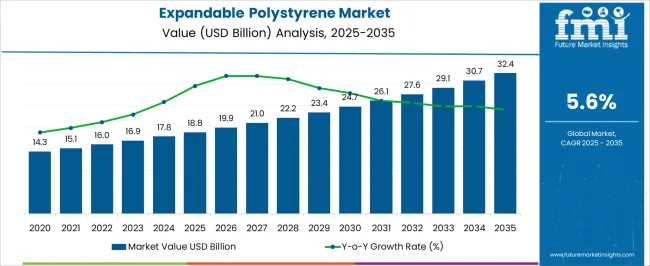
This performance reflects accelerating demand for lightweight, durable, and thermally efficient materials across packaging, construction, and automotive sectors. Asia Pacific leads global expansion driven by rapid infrastructure development and manufacturing growth. Europe follows supported by stringent building energy efficiency regulations. North America maintains steady growth through ecommerce logistics expansion and construction activity.
Building and construction, together with packaging, contribute 95% market share of the global expandable polystyrene market, with both segments driving sustained demand. Expandable polystyrene has an added advantage over molded pulp, as molded pulp requires natural gas in the drying process and weighs more, resulting in increased packaging and transportation costs. EPS meets most sustainable packaging criteria and emits less greenhouse gases compared to molded pulp.
Expandable Polystyrene Market Definition
The expandable polystyrene market encompasses the global production and supply of thermoplastic resin containing an expanding agent, used to manufacture lightweight foam products through steam molding processes. Core product types include white EPS for general purpose packaging and insulation applications, and grey EPS containing graphite or other additives for enhanced thermal performance in construction. Applications span protective packaging for electronics, appliances, and food products; building insulation for walls, roofs, and floors; automotive components; and specialized uses in horticulture, aerospace, and medical supplies.
Market Inclusions
The report includes global and regional market size estimates in value terms, with a forecast period from 2026 to 2036. It provides segmentation by Product, Application, and Region. The analysis incorporates manufacturing technology trends, sustainability initiatives, regulatory compliance strategies, and performance benchmarking across EPS applications. Regional demand dynamics, country level growth rates, and competitive positioning are also evaluated as per FMI methodology.
Market Exclusions
The scope excludes other polystyrene forms including high impact polystyrene, general purpose polystyrene, and extruded polystyrene foam. It also excludes expanded polypropylene and polyethylene foam materials that compete in similar applications but represent distinct polymer chemistries.
Research Methodology
- Primary Research: Interviews were conducted with expandable polystyrene manufacturers, construction material distributors, packaging converters, sustainability consultants, and industry trade association representatives.
- Desk Research: Public company filings, construction industry reports, packaging market analysis, regulatory documentation, and technical literature were reviewed.
- Market Sizing and Forecasting: A hybrid top down and bottom up model was constructed, reconstructing demand from construction activity levels, packaging consumption patterns, and EPS penetration rates across applications.
- Data Validation and Update Cycle: Outputs were subjected to variance testing against production capacity data, trade flow benchmarking, and structured internal review prior to publication.
Expandable Polystyrene Market Drivers, Restraints, and Opportunities
Future Market Insights analysis indicates the market has historically existed as a packaging dominated category with significant construction sector exposure. Its baseline scale is anchored in global manufacturing activity, ecommerce growth, and infrastructure investment. As per FMI, the market's valuation is increasingly influenced by building energy efficiency regulations and sustainability initiatives that favor EPS for its thermal performance and recyclability.
FMI analysts observe a clear stratification between white EPS optimized for general purpose packaging and grey EPS engineered for high performance construction insulation. Standard white grades face pressure where competition from alternative materials intensifies, while growth concentrates in specialized formulations where thermal efficiency, flame retardancy, and customized properties justify premium pricing.
- Ecommerce Expansion and Logistics Growth: Rising ecommerce activity and global logistics expansion are accelerating the use of expandable polystyrene in protective packaging for electronics, consumer goods, and perishable products. According to the United Nations Conference on Trade and Development, global ecommerce sales reached approximately $27 trillion in 2023, with continued growth driving demand for protective packaging materials. EPS's excellent cushioning and thermal insulation properties ensure product safety during shipping and handling, critical for high value and temperaturesensitive items. The material's adaptability for custom molding and ability to reduce transportation costs through low density reinforce its preference in packaging applications.
- Infrastructure Investment and Construction Activity: According to the International Energy Agency, global buildings sector energy intensity improvement must accelerate from 1% per year to 2.5% per year by 2030 to meet net zero targets, driving demand for high performance insulation materials including EPS. With major market economies such as China and India witnessing a major surge in infrastructure investment, the expandable polystyrene market is set to grow at an accelerated pace. EPS has been the prime choice for construction of green buildings, enhancing building durability and finding application in insulating closed cavity walls and floor insulation. The International Monetary Fund projects that emerging and developing Asia will maintain growth of approximately 5% annually, supporting continued construction activity across the region.
- Sustainability Advantages over Alternatives: According to the United Nations Environment Programme, the global plastics industry faces increasing pressure to reduce greenhouse gas emissions and improve circularity, with recycling rates needing to quadruple by 2050 to meet sustainability goals. EPS meets most sustainable packaging criteria and emits less greenhouse gases compared to molded pulp, which requires natural gas in the drying process and weighs more, increasing packaging and transportation costs. The material is environment friendly as it does not involve any halogen during its production process. Governments and companies are shifting packaging markets toward EPS based on these environmental benefits.
- Food and Beverage Industry Demand: The rise in demand for processed foods is increasing expandable polystyrene demand in the food and beverages industry, which accounts for the largest market share in the global EPS market. EPS provides excellent insulation for temperature sensitive food products during transport and storage, maintaining cold chain integrity. The Food and Agriculture Organization projects continued growth in global food processing and logistics, supporting packaging demand across developing economies.
- Competition from Alternative Materials: Though the EPS market is promising, major restraining factors include availability of high performance substitutes including polypropylene and polyethylene. These alternative materials compete in packaging and certain construction applications, requiring EPS manufacturers to emphasize unique value propositions including thermal efficiency, cost effectiveness, and recyclability. According to the International Energy Agency, chemical recycling technologies remain at relatively low technology readiness levels, limiting near term circularity improvements.
Expandable Polystyrene Market Analysis by Product
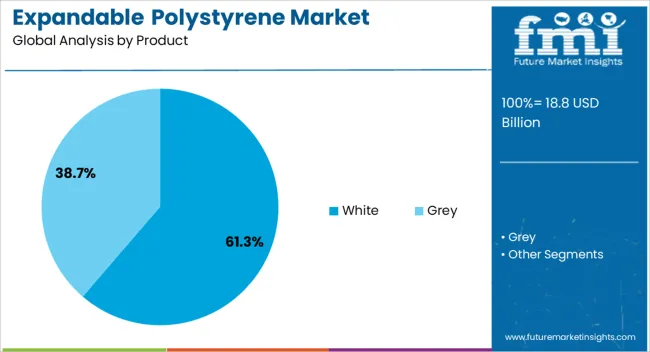
Based on FMI's expandable polystyrene market report, the white product segment is projected to hold 61.3% of market revenue share in 2025, positioning it as the leading product type. This dominance is supported by its broad compatibility with diverse applications, high availability, and cost effectiveness. Its lightweight nature, combined with excellent cushioning and impact resistance, makes it a preferred choice for packaging sensitive and fragile items.
The high visibility and purity of white EPS enable efficient processing for molding, cutting, and shaping, allowing manufacturers to produce customized products at scale. Consistent material performance and adaptability to both industrial and commercial processes have reinforced adoption in multiple sectors.
Grey EPS represents the faster growing product segment, incorporating graphite or other additives to enhance thermal insulation properties. Grey EPS is particularly valued in construction applications where superior insulation performance justifies higher material costs, contributing to building energy efficiency and green certification compliance.
Expandable Polystyrene Market Analysis by Application
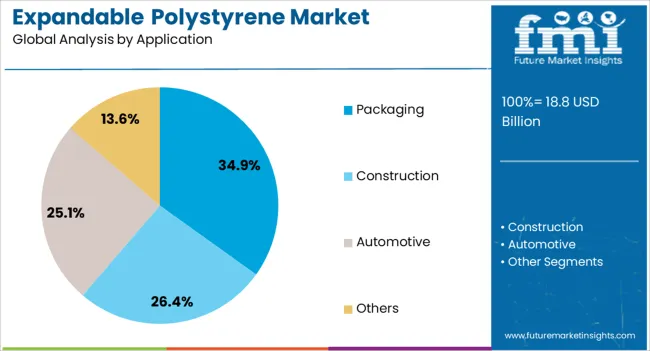
The packaging application segment is anticipated to account for 34.9% of expandable polystyrene market revenue share in 2025, establishing it as the leading application area. Its growth is driven by the need for cost efficient, lightweight, and protective materials for transporting fragile and high value goods. EPS's excellent cushioning and thermal insulation properties ensure product safety during shipping and handling, critical for electronics, food, and consumer products. Rising ecommerce activity and global logistics expansion are further accelerating demand, particularly in regions with high shipment volumes and export oriented manufacturing.
Construction represents the second largest application segment, with EPS used for insulating floors, roofs, walls, and infill for mass civil engineering projects. Building and construction, together with packaging, contribute 95% market share of the global EPS market. Automotive applications utilize EPS for lightweight components contributing to vehicle fuel efficiency. Other applications include horticulture containers, aerospace components, and medical supplies packaging.
Regional Analysis
The expandable polystyrene market is segmented geographically across North America, Europe, Asia Pacific, Latin America, and Middle East & Africa. Growth dynamics differ based on construction activity levels, manufacturing output, and regulatory frameworks. The following table presents the projected CAGRs for key countries from 2026 to 2036.
| Countries | CAGR (2026 to 2036) |
|---|---|
| USA | 4.2% |
| Germany | 3.8% |
| UK | 3.2% |
| France | 3.5% |
| China | 5.8% |
| Japan | 3.1% |
| South Korea | 4.5% |
Source: Future Market Insights (FMI) analysis, based on proprietary forecasting model and primary research
India is projected to exhibit the highest CAGR of 6.2% during the forecast period, driven by heavy infrastructure investment and rapid urbanization. China follows closely with a CAGR of 5.8%, supported by its dominant electronics manufacturing sector and food and beverage industry growth.
South Korea is expected to grow at a CAGR of 4.5%, while the United States projects a CAGR of 4.2%. Germany, France, the United Kingdom, and Japan show more mature market growth with CAGRs of 3.8%, 3.5%, 3.2%, and 3.1% respectively.
Asia Pacific Market Analysis
Asia Pacific stands as the global leader in production and consumption in the EPS market, with almost half of total global production happening in the region and 45% consumed in emerging economies such as India and China. According to the International Energy Agency, Asia accounts for more than half of global buildings sector energy demand, with rapid urbanization driving construction activity and insulation material requirements.
The region benefits from easy procurement of low cost labour and accessibility of economical raw materials, increasing EPS production and bolstering foreign investments. Rising government proposals to improve public infrastructure and increasing cash intensive commercial and non-residential construction further drive market development. India's projected CAGR of 6.2% leads the region, followed by China at 5.8% and South Korea at 4.5%.
- China: China will be the most preferred destination primarily due to rising demand of packaging in the food and beverages and electronics industry. China and India are global leaders in maritime trade, boosting the packaging industry. China alone accounts for 37% of the global EPS market in terms of volume. As China has a strong hold in the electronics segment and is a major exporter of electronic devices, the EPS market is set to flourish, achieving a CAGR of 5.8% over the forecast period.
FMI's analysis of the expandable polystyrene market in Asia Pacific consists of country wise assessment including China, India, Japan, South Korea, Malaysia, and Philippines. Readers can find production capacity tracking, trade flow analysis, and demand modeling.
- India: India will be a major market for EPS primarily due to heavy infrastructure investment across various industry verticals. The International Monetary Fund projects India's economy to grow at approximately 6.5% annually, with strong performance in services and manufacturing supporting continued construction activity. The country's maritime trade leadership boosts packaging industry demand, contributing to its leading regional CAGR of 6.2%.
Europe Market Analysis
Europe will witness a surge in the market due to rising demand from pharmaceutical industries and stringent building energy efficiency regulations driving construction insulation adoption. According to the International Energy Agency, the European Union's Renovation Wave strategy aims to double annual energy renovation rates by 2030, creating sustained demand for insulation materials including EPS. Germany leads the region with a CAGR of 3.8%, followed by France at 3.5% and the UK at 3.2%.
North America Market Analysis
North America has reached its saturation point in the global EPS market, with market growth expected to be stagnant in coming years. The region maintains steady demand from ecommerce logistics and construction sectors but faces competition from alternative materials and mature market dynamics.
Recent acquisitions, such as Atlas Roofing's procurement of ACH Foam Technologies, aim to enhance product portfolios and bolster positions in the North American market. The United States projects a CAGR of 4.2% during the forecast period, driven by ongoing ecommerce growth and construction activity.
Latin America Market Analysis
Latin America will be a preferred destination mainly due to infrastructure investment driving construction demand for EPS insulation and packaging applications. Brazil leads regional consumption with growing manufacturing sector requirements. The International Monetary Fund projects continued growth across Latin American economies, supporting construction materials demand.
Competitive Landscape for Market Players
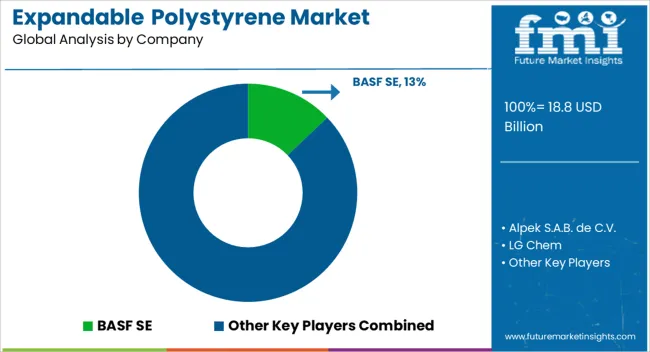
Global chemical companies with extensive polymer portfolios and specialized EPS manufacturers serving regional markets characterize the expandable polystyrene market. Leading firms are differentiating through product innovation, sustainability initiatives, and strategic acquisitions.
BASF SE leads as a premier global chemical company with comprehensive EPS product lines serving packaging and construction applications across all major regions. Alpek S.A.B. de C.V. maintains strong position in Americas through integrated polyester and polystyrene operations. LG Chem and KANEKA CORPORATION lead Asian markets with advanced EPS technologies and extensive production capacity.
SIBUR drives Russian and Eastern European market development. SUNPOR and Synthos specialize in EPS with strong European presence. TotalEnergies leverages integrated energy and chemical operations for competitive advantage. Supreme Petrochem Ltd leads Indian market with extensive domestic production.
NOVA Chemicals and Epsilyte LLC serve North American markets. Ravago and Knauf Industries focus on distribution and downstream conversion. Versalis S.p.A. operates as Eni's chemical subsidiary with European focus. SABIC maintains global presence with diversified polymer portfolio.
Buyer behavior in this market reflects long term supply relationships with large volume packaging manufacturers and construction material distributors. Specification decisions depend on material performance, pricing, and sustainability credentials.
Recent Developments
- Atlas Roofing - Acquisition (2025): Atlas Roofing procured ACH Foam Technologies, a leading company manufacturing molded polystyrene solutions in facilities spanning North America, enhancing product portfolio and bolstering North American position.
- BEWiSynbra - Acquisition (January 2025): BEWiSynbra acquired Ruukin EPS, a Finnish producer of insulation material, aiming to gather coverage in Finland and consequently offer expanded services.
Key Players in the Expandable Polystyrene Market
- BASF SE
- Alpek S.A.B. de C.V.
- LG Chem
- KANEKA CORPORATION
- SIBUR
- SUNPOR
- Synthos
- TotalEnergies
- Supreme Petrochem Ltd
- NOVA Chemicals
- Epsilyte LLC
- Ravago
- Knauf Industries
- Versalis S.p.A.
- SABIC
- Taita Chemical Co., Ltd.
Scope of Report
| Metric | Value |
|---|---|
| Quantitative Units | USD 19.85 billion (2026) to USD 34.2 billion (2036), at a CAGR of 5.6% |
| Market Definition | The expandable polystyrene market comprises thermoplastic resin containing expanding agent for manufacturing lightweight foam products. |
| Product Segmentation | White, Grey |
| Application Segmentation | Packaging, Construction, Automotive, Others |
| Region Segmentation | North America, Latin America, Europe, AsiaPacific, Middle East & Africa |
| Key Countries Covered | United States, Canada, Mexico, Brazil, Germany, France, United Kingdom, Italy, Spain, China, India, Japan, South Korea, Malaysia, Philippines, and 40+ countries |
| Key Companies Profiled | BASF SE, Alpek S.A.B. de C.V., LG Chem, KANEKA CORPORATION, SIBUR, SUNPOR, Synthos, TotalEnergies, Supreme Petrochem Ltd, NOVA Chemicals, Epsilyte LLC, Ravago, Knauf Industries, Versalis S.p.A., SABIC, Taita Chemical Co., Ltd. |
| Forecast Period | 2026 to 2036 |
| Approach | Hybrid topdown and bottomup market modeling validated through primary interviews with EPS manufacturers and industry distributors, supported by construction activity data and packaging consumption analysis |
Expandable Polystyrene Market Analysis by Segments
Product
- White
- Grey
Application
- Packaging
- Construction
- Automotive
- Others
Region
- North America
- Latin America
- Europe
- Asia Pacific
- Middle East & Africa
Bibliography
- United Nations Conference on Trade and Development. (2025). Global Ecommerce Report 2025. UNCTAD.
- World Bank. (2025). World Development Indicators: Digital Economy and Trade. World Bank Group.
- International Energy Agency. (2025). Net Zero Roadmap: A Global Pathway to Keep the 1.5°C Goal in Reach. IEA Publications.
- International Monetary Fund. (2025). World Economic Outlook: April 2025. IMF.
- United Nations Environment Programme. (2025). Global Plastics Outlook: Policy Scenarios to 2060. UNEP.
- Food and Agriculture Organization. (2025). The State of Food and Agriculture 2025. FAO.
- International Energy Agency. (2025). Chemical Recycling: Technology Status and Policy Recommendations. IEA.
- Asian Development Bank. (2025). Infrastructure Investment Outlook Asia 2025. ADB.
- Chemical Week. (2025, January 15). BEWiSynbra Acquires Ruukin EPS to Expand Nordic Presence. Chemical Week.
- European Expanded Polystyrene Manufacturers Association. (2025). EPS Sustainability and Recycling Report. EUMEPS.
- Japan Expanded Polystyrene Association. (2025). JEPSA Annual Report 2025. JEPSA.
- American Chemistry Council. (2025). Plastics Industry Producers' Statistics Group Report. ACC.
This Report Addresses
- Market intelligence to enable structured strategic decision making across expandable polystyrene manufacturers, construction material distributors, packaging converters, and chemical industry investors.
- Market size estimation and 10year revenue forecasts from 2026 to 2036, including validated CAGR and absolute dollar opportunity sizing.
- Growth opportunity mapping across Product, Application, and regional demand pockets, with emphasis on grey EPS adoption in construction and white EPS dominance in packaging.
- Segment and regional forecasting covering white and grey EPS formulations, alongside application specific demand trajectories across packaging, construction, and automotive sectors.
- Competition strategy assessment, including product innovation investment, sustainability initiative development, and acquisition strategies shaping market consolidation.
- Material and technology tracking focused on enhanced thermal performance formulations, flame retardant grades, and recycling infrastructure development.
- Regulatory policy analysis covering building energy efficiency codes, packaging sustainability requirements, and circular economy initiatives influencing EPS specifications.
- Report delivery in PDF, Excel, and presentation ready formats to support executive planning, product development alignment, and competitive benchmarking.
Frequently Asked Questions
How large is the demand for expandable polystyrene in the global market in 2026?
Demand for expandable polystyrene is estimated to be valued at USD 19.85 billion in 2026.
What will be the market size of expandable polystyrene in the global market by 2036?
Market size for expandable polystyrene is projected to reach USD 34.2 billion by 2036.
What is the expected demand growth for expandable polystyrene between 2026 and 2036?
Demand for expandable polystyrene is expected to grow at a 5.6% CAGR between 2026 and 2036.
Which product segment is poised to lead global sales?
White EPS leads with 61.3% share, offering broad compatibility, cost effectiveness, and established manufacturing infrastructure across packaging and construction applications.
Which application segment accounts for the largest market share?
Packaging dominates at 34.9% share, driven by ecommerce growth, food industry demand, and protective packaging requirements for electronics and consumer goods.
Which region leads global production and consumption of expandable polystyrene?
Asia Pacific leads with almost half of total global production, with 45% consumed in emerging economies such as India and China, driven by infrastructure investment and manufacturing growth.
What are the projected CAGRs for key countries in the expandable polystyrene market?
India leads with a projected CAGR of 6.2%, followed by China at 5.8%, South Korea at 4.5%, the USA at 4.2%, Germany at 3.8%, France at 3.5%, the UK at 3.2%, and Japan at 3.1% over the 20252035 forecast period.
What is the China market outlook in this report?
China accounts for 37% of global EPS market volume, driven by strong electronics manufacturing, food and beverage industry demand, and maritime trade leadership boosting packaging requirements, with a projected CAGR of 5.8%.
What is driving demand in India?
Heavy infrastructure investment, maritime trade leadership boosting packaging, rising disposable incomes, and strong economic growth are supporting India's market growth, reflected in its leading regional CAGR of 6.2%.
What are the primary drivers for expandable polystyrene demand?
Ecommerce expansion requiring protective packaging, infrastructure investment driving construction insulation demand, food and beverage industry requirements for temperature controlled transport, and sustainability advantages over alternative materials are primary demand drivers.
What challenges face the expandable polystyrene market?
Competition from high performance substitutes including polypropylene and polyethylene, market saturation in mature regions such as North America, and sustainability pressures requiring recycling infrastructure investment present ongoing challenges.
What defines expandable polystyrene as part of this market?
Expandable polystyrene is included as thermoplastic resin containing expanding agent for manufacturing lightweight foam products through steam molding, serving packaging, construction, and specialized applications.
What is included in the scope of this expandable polystyrene market report?
Scope includes market sizing and forecasting for 2026 to 2036, segmentation by product, application, and region, along with competitive assessment and country wide outlook.
What is excluded from the scope of this report?
The scope excludes other polystyrene forms including high impact polystyrene, general purpose polystyrene, and extruded polystyrene foam, as well as competing materials such as expanded polypropylene and polyethylene foam.
Preview the report firsthand - request a free sample
Get SampleGet the brochure for pricing and purchase details.
Get PDFTable of Content
- Executive Summary
- Global Market Outlook
- Demand-side Trends
- Supply-side Trends
- Technology Roadmap Analysis
- Analysis and Recommendations
- Market Overview
- Market Coverage / Taxonomy
- Market Definition / Scope / Limitations
- Research Methodology
- Chapter Orientation
- Analytical Lens and Working Hypotheses
- Market Structure, Signals, and Trend Drivers
- Benchmarking and Cross-market Comparability
- Market Sizing, Forecasting, and Opportunity Mapping
- Research Design and Evidence Framework
- Desk Research Programme (Secondary Evidence)
- Company Annual and Sustainability Reports
- Peer-reviewed Journals and Academic Literature
- Corporate Websites, Product Literature, and Technical Notes
- Earnings Decks and Investor Briefings
- Statutory Filings and Regulatory Disclosures
- Technical White Papers and Standards Notes
- Trade Journals, Industry Magazines, and Analyst Briefs
- Conference Proceedings, Webinars, and Seminar Materials
- Government Statistics Portals and Public Data Releases
- Press Releases and Reputable Media Coverage
- Specialist Newsletters and Curated Briefings
- Sector Databases and Reference Repositories
- FMI Internal Proprietary Databases and Historical Market Datasets
- Subscription Datasets and Paid Sources
- Social Channels, Communities, and Digital Listening Inputs
- Additional Desk Sources
- Expert Input and Fieldwork (Primary Evidence)
- Primary Modes
- Qualitative Interviews and Expert Elicitation
- Quantitative Surveys and Structured Data Capture
- Blended Approach
- Why Primary Evidence is Used
- Field Techniques
- Interviews
- Surveys
- Focus Groups
- Observational and In-context Research
- Social and Community Interactions
- Stakeholder Universe Engaged
- C-suite Leaders
- Board Members
- Presidents and Vice Presidents
- R&D and Innovation Heads
- Technical Specialists
- Domain Subject-matter Experts
- Scientists
- Physicians and Other Healthcare Professionals
- Governance, Ethics, and Data Stewardship
- Research Ethics
- Data Integrity and Handling
- Primary Modes
- Tooling, Models, and Reference Databases
- Desk Research Programme (Secondary Evidence)
- Data Engineering and Model Build
- Data Acquisition and Ingestion
- Cleaning, Normalisation, and Verification
- Synthesis, Triangulation, and Analysis
- Quality Assurance and Audit Trail
- Market Background
- Market Dynamics
- Drivers
- Restraints
- Opportunity
- Trends
- Scenario Forecast
- Demand in Optimistic Scenario
- Demand in Likely Scenario
- Demand in Conservative Scenario
- Opportunity Map Analysis
- Product Life Cycle Analysis
- Supply Chain Analysis
- Investment Feasibility Matrix
- Value Chain Analysis
- PESTLE and Porter’s Analysis
- Regulatory Landscape
- Regional Parent Market Outlook
- Production and Consumption Statistics
- Import and Export Statistics
- Market Dynamics
- Global Market Analysis 2021 to 2025 and Forecast, 2026 to 2036
- Historical Market Size Value (USD Million) Analysis, 2021 to 2025
- Current and Future Market Size Value (USD Million) Projections, 2026 to 2036
- Y-o-Y Growth Trend Analysis
- Absolute $ Opportunity Analysis
- Global Market Pricing Analysis 2021 to 2025 and Forecast 2026 to 2036
- Global Market Analysis 2021 to 2025 and Forecast 2026 to 2036, By Product
- Introduction / Key Findings
- Historical Market Size Value (USD Million) Analysis By Product , 2021 to 2025
- Current and Future Market Size Value (USD Million) Analysis and Forecast By Product , 2026 to 2036
- White EPS
- Grey
- White EPS
- Y-o-Y Growth Trend Analysis By Product , 2021 to 2025
- Absolute $ Opportunity Analysis By Product , 2026 to 2036
- Global Market Analysis 2021 to 2025 and Forecast 2026 to 2036, By Application
- Introduction / Key Findings
- Historical Market Size Value (USD Million) Analysis By Application, 2021 to 2025
- Current and Future Market Size Value (USD Million) Analysis and Forecast By Application, 2026 to 2036
- Packaging
- Construction
- Automotive
- Others
- Packaging
- Y-o-Y Growth Trend Analysis By Application, 2021 to 2025
- Absolute $ Opportunity Analysis By Application, 2026 to 2036
- Global Market Analysis 2021 to 2025 and Forecast 2026 to 2036, By Region
- Introduction
- Historical Market Size Value (USD Million) Analysis By Region, 2021 to 2025
- Current Market Size Value (USD Million) Analysis and Forecast By Region, 2026 to 2036
- North America
- Latin America
- Western Europe
- Eastern Europe
- East Asia
- South Asia and Pacific
- Middle East & Africa
- Market Attractiveness Analysis By Region
- North America Market Analysis 2021 to 2025 and Forecast 2026 to 2036, By Country
- Historical Market Size Value (USD Million) Trend Analysis By Market Taxonomy, 2021 to 2025
- Market Size Value (USD Million) Forecast By Market Taxonomy, 2026 to 2036
- By Country
- USA
- Canada
- Mexico
- By Product
- By Application
- By Country
- Market Attractiveness Analysis
- By Country
- By Product
- By Application
- Key Takeaways
- Latin America Market Analysis 2021 to 2025 and Forecast 2026 to 2036, By Country
- Historical Market Size Value (USD Million) Trend Analysis By Market Taxonomy, 2021 to 2025
- Market Size Value (USD Million) Forecast By Market Taxonomy, 2026 to 2036
- By Country
- Brazil
- Chile
- Rest of Latin America
- By Product
- By Application
- By Country
- Market Attractiveness Analysis
- By Country
- By Product
- By Application
- Key Takeaways
- Western Europe Market Analysis 2021 to 2025 and Forecast 2026 to 2036, By Country
- Historical Market Size Value (USD Million) Trend Analysis By Market Taxonomy, 2021 to 2025
- Market Size Value (USD Million) Forecast By Market Taxonomy, 2026 to 2036
- By Country
- Germany
- UK
- Italy
- Spain
- France
- Nordic
- BENELUX
- Rest of Western Europe
- By Product
- By Application
- By Country
- Market Attractiveness Analysis
- By Country
- By Product
- By Application
- Key Takeaways
- Eastern Europe Market Analysis 2021 to 2025 and Forecast 2026 to 2036, By Country
- Historical Market Size Value (USD Million) Trend Analysis By Market Taxonomy, 2021 to 2025
- Market Size Value (USD Million) Forecast By Market Taxonomy, 2026 to 2036
- By Country
- Russia
- Poland
- Hungary
- Balkan & Baltic
- Rest of Eastern Europe
- By Product
- By Application
- By Country
- Market Attractiveness Analysis
- By Country
- By Product
- By Application
- Key Takeaways
- East Asia Market Analysis 2021 to 2025 and Forecast 2026 to 2036, By Country
- Historical Market Size Value (USD Million) Trend Analysis By Market Taxonomy, 2021 to 2025
- Market Size Value (USD Million) Forecast By Market Taxonomy, 2026 to 2036
- By Country
- China
- Japan
- South Korea
- By Product
- By Application
- By Country
- Market Attractiveness Analysis
- By Country
- By Product
- By Application
- Key Takeaways
- South Asia and Pacific Market Analysis 2021 to 2025 and Forecast 2026 to 2036, By Country
- Historical Market Size Value (USD Million) Trend Analysis By Market Taxonomy, 2021 to 2025
- Market Size Value (USD Million) Forecast By Market Taxonomy, 2026 to 2036
- By Country
- India
- ASEAN
- Australia & New Zealand
- Rest of South Asia and Pacific
- By Product
- By Application
- By Country
- Market Attractiveness Analysis
- By Country
- By Product
- By Application
- Key Takeaways
- Middle East & Africa Market Analysis 2021 to 2025 and Forecast 2026 to 2036, By Country
- Historical Market Size Value (USD Million) Trend Analysis By Market Taxonomy, 2021 to 2025
- Market Size Value (USD Million) Forecast By Market Taxonomy, 2026 to 2036
- By Country
- Kingdom of Saudi Arabia
- Other GCC Countries
- Turkiye
- South Africa
- Other African Union
- Rest of Middle East & Africa
- By Product
- By Application
- By Country
- Market Attractiveness Analysis
- By Country
- By Product
- By Application
- Key Takeaways
- Key Countries Market Analysis
- USA
- Pricing Analysis
- Market Share Analysis, 2025
- By Product
- By Application
- Canada
- Pricing Analysis
- Market Share Analysis, 2025
- By Product
- By Application
- Mexico
- Pricing Analysis
- Market Share Analysis, 2025
- By Product
- By Application
- Brazil
- Pricing Analysis
- Market Share Analysis, 2025
- By Product
- By Application
- Chile
- Pricing Analysis
- Market Share Analysis, 2025
- By Product
- By Application
- Germany
- Pricing Analysis
- Market Share Analysis, 2025
- By Product
- By Application
- UK
- Pricing Analysis
- Market Share Analysis, 2025
- By Product
- By Application
- Italy
- Pricing Analysis
- Market Share Analysis, 2025
- By Product
- By Application
- Spain
- Pricing Analysis
- Market Share Analysis, 2025
- By Product
- By Application
- France
- Pricing Analysis
- Market Share Analysis, 2025
- By Product
- By Application
- India
- Pricing Analysis
- Market Share Analysis, 2025
- By Product
- By Application
- ASEAN
- Pricing Analysis
- Market Share Analysis, 2025
- By Product
- By Application
- Australia & New Zealand
- Pricing Analysis
- Market Share Analysis, 2025
- By Product
- By Application
- China
- Pricing Analysis
- Market Share Analysis, 2025
- By Product
- By Application
- Japan
- Pricing Analysis
- Market Share Analysis, 2025
- By Product
- By Application
- South Korea
- Pricing Analysis
- Market Share Analysis, 2025
- By Product
- By Application
- Russia
- Pricing Analysis
- Market Share Analysis, 2025
- By Product
- By Application
- Poland
- Pricing Analysis
- Market Share Analysis, 2025
- By Product
- By Application
- Hungary
- Pricing Analysis
- Market Share Analysis, 2025
- By Product
- By Application
- Kingdom of Saudi Arabia
- Pricing Analysis
- Market Share Analysis, 2025
- By Product
- By Application
- Turkiye
- Pricing Analysis
- Market Share Analysis, 2025
- By Product
- By Application
- South Africa
- Pricing Analysis
- Market Share Analysis, 2025
- By Product
- By Application
- USA
- Market Structure Analysis
- Competition Dashboard
- Competition Benchmarking
- Market Share Analysis of Top Players
- By Regional
- By Product
- By Application
- Competition Analysis
- Competition Deep Dive
- BASF SE
- Overview
- Product Portfolio
- Profitability by Market Segments (Product/Age /Sales Channel/Region)
- Sales Footprint
- Strategy Overview
- Marketing Strategy
- Product Strategy
- Channel Strategy
- Alpek S.A.B. de C.V.
- LG Chem
- KANEKA CORPORATION
- SIBUR
- SUNPOR
- Synthos
- BASF SE
- Competition Deep Dive
- Assumptions & Acronyms Used


