Introduction
In market research, the integrity of historical data is essential for accurate analysis and strategic planning. However, historical data is not static; it often requires adjustments, known as historical data resets or restatements. These revisions are driven by methodological advancements, structural market shifts, and evolving data standards. This document provides a detailed exploration of the reasons for historical data revisions, the methodology of base year benchmarking, and the impact these resets have on market forecasting.
PART I
Reasons for Historical Data Revision
Why Historical Data Gets Revised
The revision of historical data ensures that past market trends remain relevant and comparable with current analyses. These revisions are typically driven by several key categories of factors.
As the discipline of market research evolves, new tools and techniques often necessitate the adjustment of older datasets to maintain consistency.
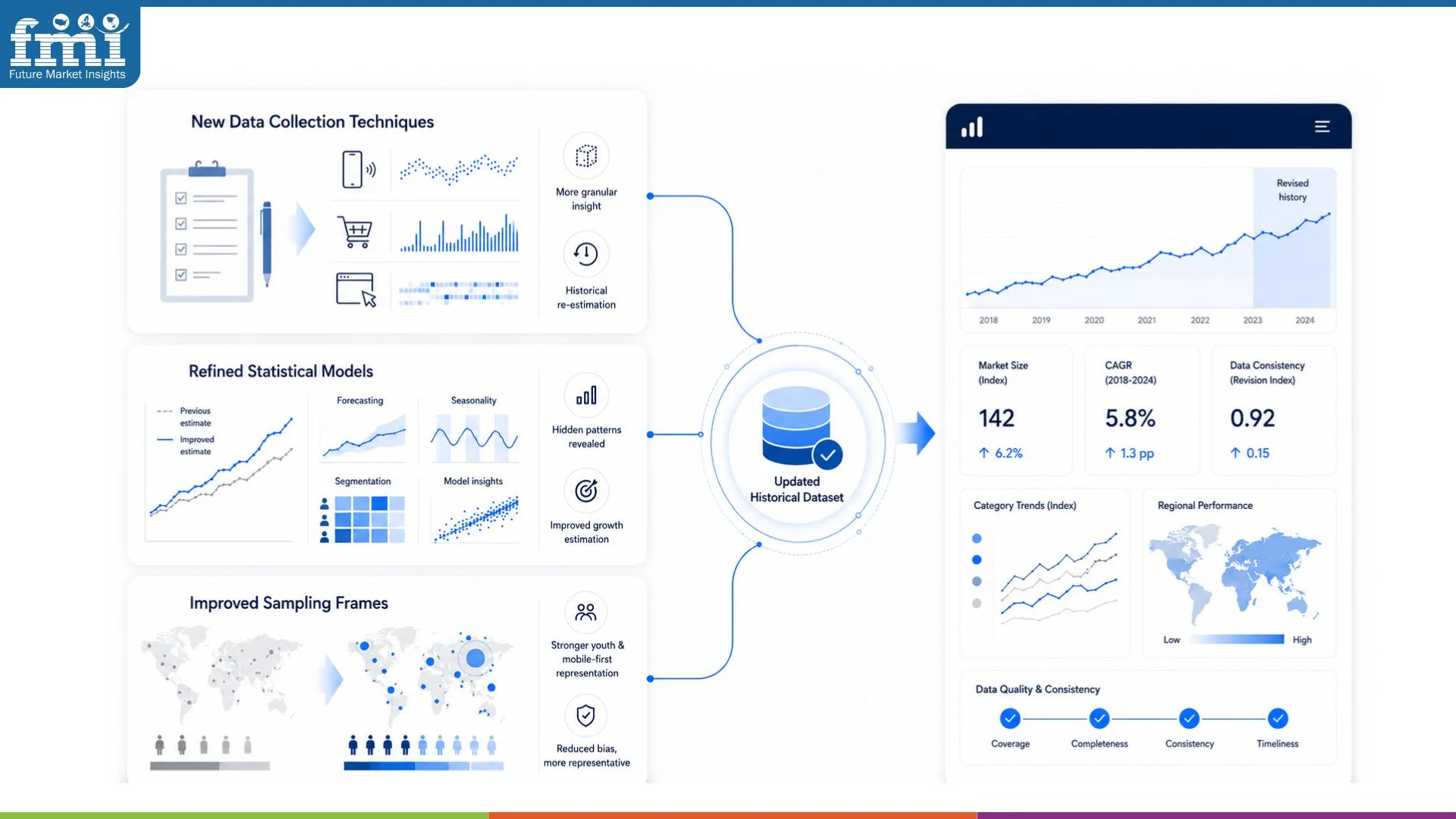
- New Data Collection Techniques : Shifting from traditional surveys to passive data collection provides more granular insights. Historical data may be re-estimated to align with these new, more accurate data streams. For example, a market for consumer electronics might revise its historical sales figures to incorporate data from online marketplaces, which were not previously tracked.
- Refined Statistical Models : Sophisticated econometric models and enhanced segmentation algorithms can reveal previously unobserved patterns, leading to a retrospective re-evaluation of historical market sizes and growth rates. For instance, a new model might better account for seasonal variations, leading to a restatement of quarterly historical data.
- Improved Sampling Frames : Updates to sampling designs to reflect current demographics or consumer behavior require historical data to be revised to maintain representativeness and reduce bias over time. An example would be adjusting historical data to reflect a more accurate representation of younger demographics in a mobile-first market.
Markets are dynamic, and structural shifts often require historical data to be restated to reflect the new reality.
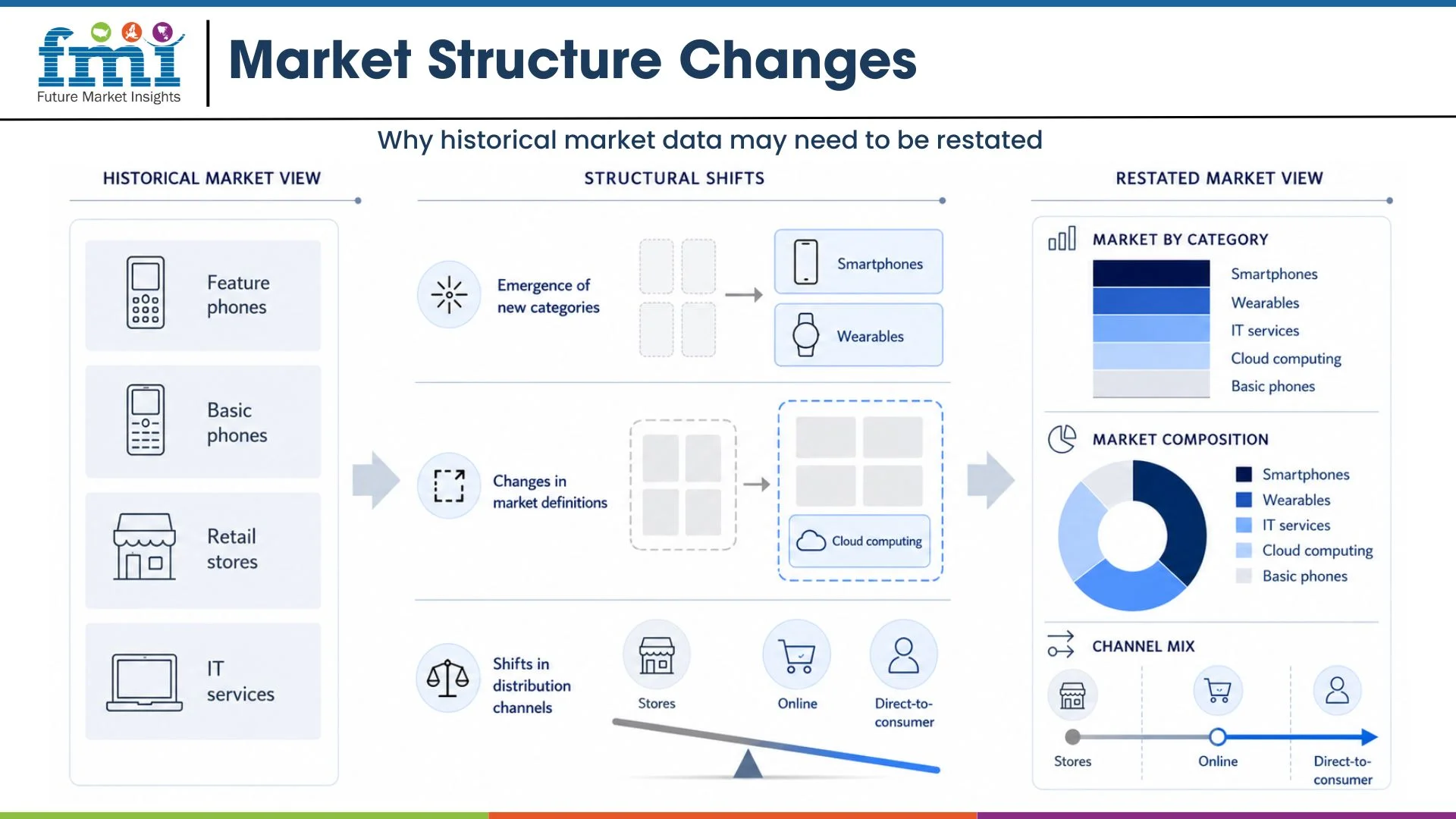
- Emergence or Disappearance of Categories : The introduction of new product categories (e.g., wearable technology) or the obsolescence of old ones alters the market landscape. Historical data is often revised to incorporate these categories retrospectively or to align with updated taxonomies. For example, the market for "mobile phones" was restated to include "smartphones" as a distinct, dominant category.
- Changes in Market Definitions : Industry convergence (e.g., telecommunications and media) can redefine market boundaries. Historical data must be revised to ensure that market size and growth are consistently measured across different periods. For instance, the definition of "IT services" might be expanded to include cloud computing, requiring a historical restatement of the entire IT services market.
- Shifts in Distribution Channels : The rise of e-commerce or direct-to-consumer models impacts how data is interpreted, requiring historical revisions to accurately reflect the changing landscape of product delivery. An example is the retail sector revising historical sales data to properly account for the growing share of online sales versus brick-and-mortar.
Currency exchange rates play a critical role in data comparability.
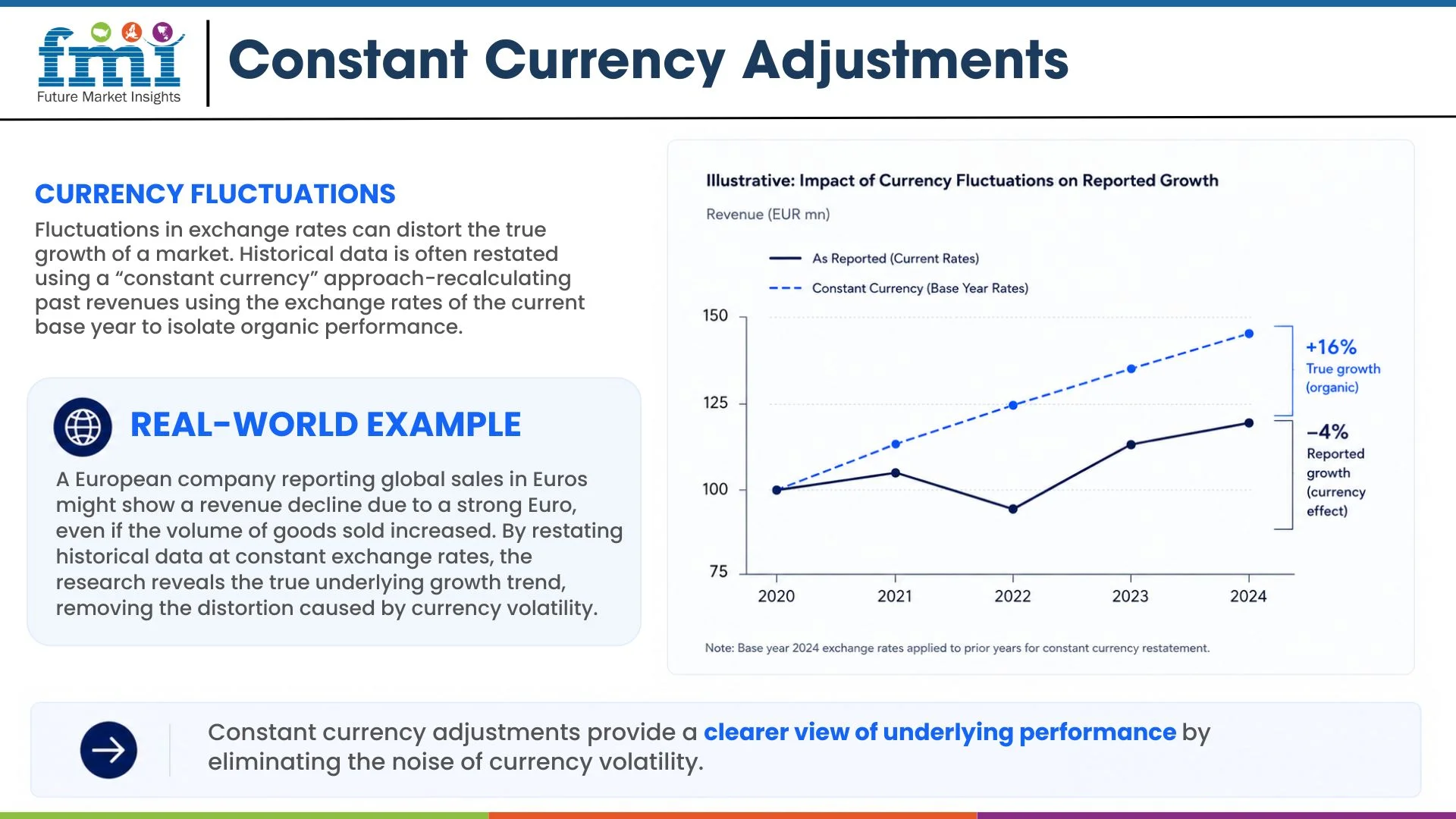
- Constant Currency Adjustments : When analyzing historical data across multiple years, fluctuations in exchange rates can distort the true growth of a market. To provide a clear picture of organic performance, historical data is often restated using a "constant currency" approach. This involves recalculating past revenues using the exchange rates of the current base year.
The expansion of a market forecast's scope to include new geographical regions necessitates a historical data reset.
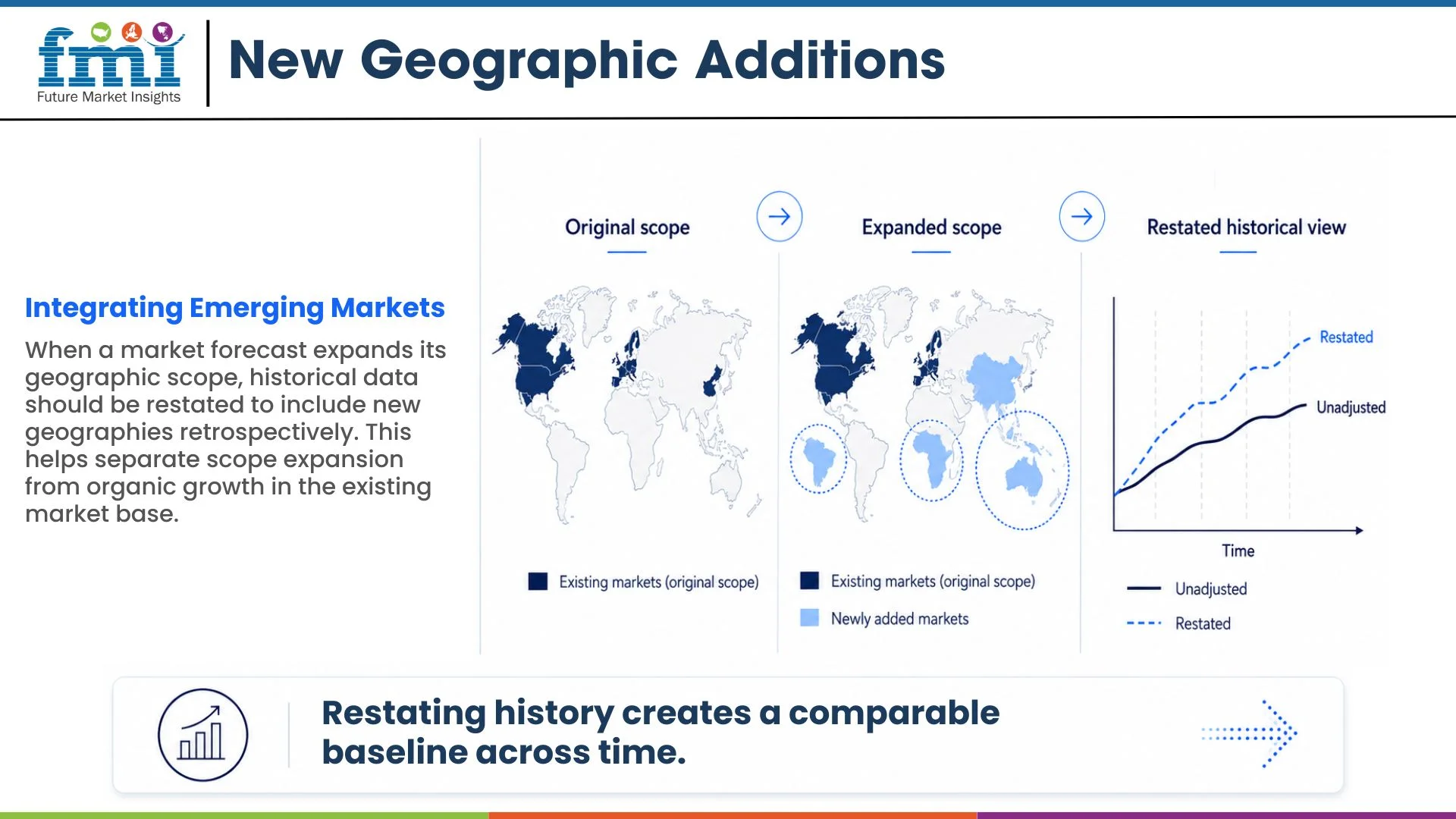
- Integrating Emerging Markets : As companies expand globally, market research must incorporate data from newly entered regions. To ensure that the growth attributed to these new additions is not conflated with organic growth in existing markets, historical data must be restated to include the new geographies retrospectively.
The rapid integration of new technologies into existing products or services often requires a re-evaluation of historical data.
- Technological Convergence : When a new technology fundamentally changes the nature of a product, historical data may need to be revised to reflect this evolution. This ensures that the market size accurately captures the value added by the new technology.
Revisions can also stem from changes in underlying data sources or the adoption of new industry standards.
- New or Improved Data Sources : Access to more comprehensive data allows for the refinement and restatement of historical estimates derived from less precise sources.
- Regulatory and Industry Standards : New standards for data reporting or classification may require firms to revise historical datasets to ensure compliance and maintain industry-wide comparability.
PART II
Base Year Benchmarking
Base Year Benchmarking & Reset Methodologies
Base year benchmarking establishes a stable reference point for measuring market growth and performance. When historical data is reset, the base year must be carefully adjusted.
The Role of the Base Year
A base year serves as the foundation for calculating growth rates and market share changes. It provides a consistent reference point for tracking long-term trends and facilitating comparability across regions and categories. In forecasting, a robust base year is critical, as inaccuracies at this foundational level can propagate through the entire forecast model.
Methodologies for Managing Resets
Managing base year resets requires a systematic approach to ensure transparency and accuracy.
- Retrospective Application : New methodologies are applied retrospectively to historical data, including the base year, to create a consistent time series where all data points are generated using the same logic.
- Pro Forma Adjustments for M&A : For mergers and acquisitions, historical data is recalculated as if the transaction had occurred in the base year. This allows for a "like-for-like" comparison, distinguishing organic growth from growth driven by M&A.
- Materiality Thresholds : Firms often use materiality thresholds (e.g., a 5% change) to determine when a full base year reset is necessary, focusing resources on adjustments that significantly impact market interpretation.
- Documentation and Transparency : Every reset must be accompanied by comprehensive documentation explaining the reasons, methodologies, and impact on previously reported figures to maintain stakeholder confidence.
PART III
Impact on Market Forecasting
The Impact on Market Forecasting
Historical data resets alter the foundation of market forecasts, influencing predictive models and strategic outlooks.
Recalibration of Growth Trajectories
Forecast models extrapolate future performance based on past trajectories. Resets help in:
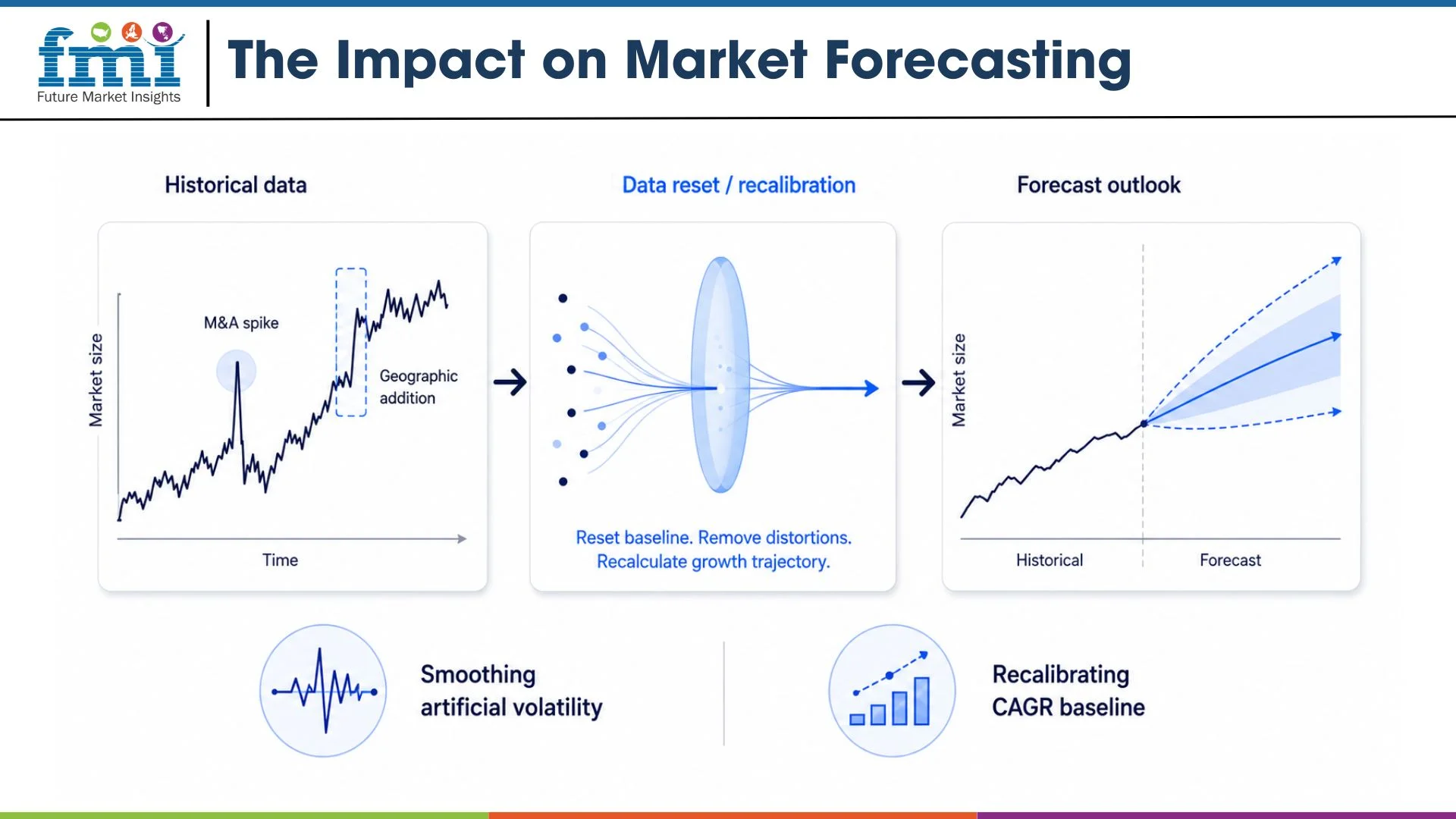
- Smoothing Artificial Volatility : By restating data to account for structural anomalies like M&A or new geographic additions, forecasters can reveal the true underlying organic growth rate, leading to more realistic projections.
- Adjusting CAGR Baselines : Since CAGR is sensitive to starting and ending values, a reset that alters the base year value necessitates a complete recalculation of the forecast to reflect the new historical reality.
Impact on Predictive Modeling
Advanced algorithms "learn" from historical patterns, so changing the training data through a reset has direct consequences.
- Re-training Algorithmic Models : Predictive algorithms must be re-trained on the restated dataset to ensure that identified patterns and variable weightings remain accurate.
- Shift in Variable Significance : Changes in taxonomy or data sources can alter which macroeconomic indicators or market drivers are most predictive for the newly defined market structure.
Strategic Implications
The adjustments made during a reset cascade into the strategic insights derived from the forecast.
- Market Maturity and Saturation : A reset that increases the historical market size might suggest the market is closer to saturation, leading to a forecast of slower future growth and a shift in strategic focus.
- Competitive Dynamics : Restating historical data for M&A activity alters the perceived market share of key players, changing predictions about their future organic competitiveness.
FUTURE OUTLOOK
Key Research Pointers
Key Market Research Pointers for Future Outlooks
To provide a unique perspective on the future of this field, consider these evidence-based insights:
FAQs
What are historical data resets in market research?
Historical data resets are revisions made to previously reported market data so that older figures remain comparable with current market definitions, data sources, methodologies, and forecasting models. These resets help analysts maintain a consistent time series when market structures, geographies, currencies, or data collection methods change.
Why is historical market data revised?
Historical market data is revised when older estimates no longer reflect the current market reality. Common reasons include improved research methods, new product categories, changes in market definitions, currency fluctuations, geographic expansion, technology integration, and updated reporting standards.
How do methodological improvements affect historical data?
Methodological improvements can change historical market estimates by introducing better data collection, refined statistical models, and improved sampling frames. For example, if a market begins using online marketplace data that was not tracked earlier, historical sales figures may be recalculated to create a more accurate and comparable dataset.
Why do market structure changes require data restatement?
Market structure changes require data restatement because new categories, obsolete segments, changed market definitions, and new distribution channels can alter how a market is measured. Without restatement, growth may appear artificially high or low because the historical baseline no longer matches the current market scope.
What is constant currency adjustment in market forecasting?
Constant currency adjustment is a method used to remove the effect of exchange-rate fluctuations from historical market data. It recalculates past revenues using the exchange rates of the current base year so analysts can assess true organic growth instead of currency-driven changes.
Why does adding new geographies require a historical data reset?
Adding new geographies requires a historical data reset because the newly added regions must be included retrospectively in earlier years. This prevents the forecast from showing an artificial growth spike in the year the new geography is added and keeps market growth comparable across the full time series.
How do historical data resets affect market forecasts?
Historical data resets affect market forecasts by changing the base year, growth trajectory, CAGR calculation, and inputs used in predictive models. A reset can smooth artificial volatility, adjust the baseline for future projections, change variable significance, and alter strategic interpretations such as market maturity or competitive positioning.