

- Market Size (2026)
- USD 22.4 Bn
- Forecast (2036)
- USD 44.3 Bn
- CAGR (2026 to 2036)
- 7.1%
Adult Diapers Market Size, Market Forecast and Outlook By FMI
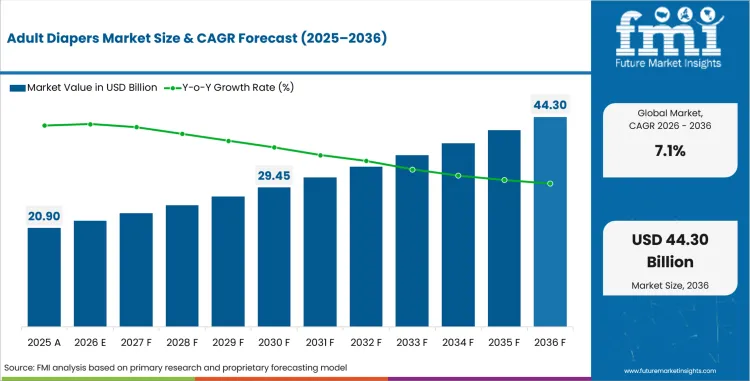
Adult diapers market was valued at USD 20.9 billion in 2025 and is expected to reach USD 22.4 billion in 2026. Revenue is forecast to rise to USD 44.3 billion by 2036 at 7.1% CAGR during the forecast period. Pants and pull-up style products are anticipated to hold 46.8% of style demand in 2026. Reusable diapers are expected to account for 41.6% of product type demand in 2026.
Key Takeaways, Market Size, and Forecast
| Metric | Value |
|---|---|
| Market Size (2025) | USD 20.9 Billion |
| Market Size (2036) | USD 44.3 Billion |
| CAGR | 7.1% |
| Incremental Opportunity (2026–2036) | USD 21.9 Billion |
| Leading Style (2026) | Pants And Pull-Up Style Products |
| Pants And Pull-Up Style Products Share (2026) | 46.8% |
| Leading Product Type (2026) | Reusable Diapers |
| Reusable Diapers Share (2026) | 41.6% |
| Leading Product Type (2026) | Non-Woven Fabric |
| Non-Woven Fabric Share (2026) | 52.0% |
| Fastest-Growing Country | United States |
| United States CAGR | 8.0% |
| 2nd Fastest-Growing Country | Germany |
| Germany CAGR | 7.5% |
Summary of the Adult Diapers Market
- Demand and Growth Drivers
- Aging populations are expected to raise routine need for adult diapers across home care and long-term care facilities.
- Repeat purchase behavior is projected to become more stable as users prefer discreet delivery and monthly pack sizes.
- Hospitals and care homes are anticipated to place more emphasis on skin comfort when leakage and rash issues raise labor time.
- E-commerce is expected to help users reorder privately and reduce the social barrier attached to incontinence products.
- Product and Segment View
- Pants and pull-up styles account for 46.8% share in 2026 since active users prefer underwear-like protection.
- Reusable diapers account for 41.6% product type share with long-use buyers comparing lifetime cost and wash cycles.
- Non-woven fabric keeps a high role because softness and fluid spread affect repeat buying.
- Heavy absorbency formats serve bed care and night use where caregivers need fewer changes per shift.
- Geography and Competitive Outlook
- The demand for adult diapers in the United States is anticipated to rise at a 8.0% CAGR through 2036.
- Germany is expected to expand at 7.5% CAGR through 2036 as reimbursement routines support product selection.
- China remains a large volume country due to its aging base and care channel expansion.
- Suppliers with soft topsheets and reliable leak guards are better placed for repeat users and care institutions.
- Analyst Opinion
- Ronak Shah, Principal Consultant for Consumer Products at FMI says, “Adult diapers are no longer bought only as a medical fallback. Users and caregivers want products that feel less clinical and fit under daily clothing. Brands that balance comfort with repeat supply are expected to have a clearer route to long-term accounts.”
- Adult Diapers Market Value Analysis
- Skin-safe topsheets and thinner absorbent cores are expected to raise unit value where buyers pay for comfort and longer wear time.
- Online subscriptions are projected to widen the addressable buyer base by reaching active users who prefer private repeat delivery.
- Post-surgery home recovery is anticipated to add application volume as temporary mobility loss increases short-term adult diaper use.
- Smaller trial packs are expected to reduce adoption friction by helping families test size and absorbency before monthly buying.
- Reusable formats remain constrained by washing effort and hygiene handling in facilities where staff time is closely managed.
Adult diaper buying is becoming more evidence-led because care teams need fewer leaks and easier changes. In March 2024, ISO 16021:2024 set evaluation around user and caregiver views with diaries for wear time and absorbed urine mass. Leakage severity is part of the same evaluation logic. For manufacturers, that shifts product proof from a lab-only claim to field evidence that supports tenders and repeat use.
Format strategy is also moving toward pants because users want easier wear and more discretion. In March 2026, HARTMANN reported EUR 785.8 million in Incontinence Management sales and 2.8% organic sales growth. The company linked pants momentum to relaunches and absorbent underwear, which gives suppliers a clearer reason to rebalance portfolios away from basic tape products. Channel planning is becoming more precise. In December 2025, Essity separated incontinence products into Health Care and Retail buckets with 12% and 8% shares of 9M 2025 net sales. That split supports different pack sizes and service models for institutions and self-pay consumers
Adult Diapers Market Definition
The adult diapers market covers absorbent products designed for adults who manage urine leakage or bowel incontinence. Scope includes products worn by active users and people needing caregiver support. The market includes reusable and disposable adult diapers used at home, in hospitals and in long-term care facilities. Revenue covers finished adult diaper products sold through retail, institutional and online channels.
Adult Diapers Market Inclusions
Market inclusions cover reusable diapers and disposable diapers. Style coverage includes pants and pull-up products. Pad style and flat style formats are included when sold for adult use. Material coverage includes non-woven fabric and cotton. Micro fabric and fluff pulp are included when used in adult diaper construction. End use includes home care and hospitals. Long-term care facilities are included as institutional buyers. Sales channel includes pharmacies and online stores. Institutional supply and supermarkets complete the route to market.
Adult Diapers Market Exclusions
Scope excludes baby diapers and feminine hygiene pads. Disposable underpads are excluded unless sold as part of an adult diaper system. Catheters and bladder liners are excluded from market value. Skin creams and cleansing wipes are outside revenue scope unless bundled in a care kit with diapers. Smart moisture sensors are counted only when sold inside an adult diaper product.
Adult Diapers Market Research Methodology
- Primary Research: Extensive interviews and surveys with caregivers and distributors were conducted across key adult hygiene markets to capture real‑world purchasing behavior and demand trends.
- Secondary Research: Data from healthcare institutions, government population databases, and company product portfolios were systematically reviewed to validate industry benchmarks and market dynamics.
- Market Estimation and Forecasting: Market size was derived using adult diaper revenue data combined with demographic aging indicators, supported by cross‑verification through multiple analytical models.
- Data Validation and Triangulation: Final forecasts were validated by comparing product segmentation, distribution channels, and recent product launches across leading adult care manufacturers.
Why is the Adult Diapers Market Growing?
- Home care routines are estimated to raise repeat purchase need where families manage incontinence outside hospitals.
- Care homes are expected to buy products that reduce leakage and keep skin dry during longer shift cycles.
- Active adults are anticipated to prefer thinner pants style products when they need protection during work or travel.
- Private e-commerce delivery is projected to reduce the social barrier linked with first-time buying.
Adult diaper use is projected to rise as aging shifts more care work into homes and care facilities. The United States Census Bureau reported in June 2025 that the USA population aged 65 and older increased 3.1% to 61.2 million from 2023 to 2024. This older base is expected to increase the number of users who need incontinence care products over longer periods. Suppliers are likely to gain repeat orders when fit and skin comfort lower the chance of brand switching.
Buying behavior is likely to change inside pharmacies and online stores. Users compare pack count and waist fit before they repeat a purchase. Absorbency claims become more influential when buyers shift from trial packs to monthly replenishment. Brands that position incontinence care products around daily routine are expected to move beyond a hospital-only image. Discreet packaging and monthly replenishment are projected to create a clearer channel advantage. Diaper packaging machines adoption is likely to affect pack count and subscription handling as replenishment formats become more standardized.
Market Segmentation Analysis
- Reusable diapers are expected to account for 41.6% of product type demand in 2026 with long-use buyers comparing lifetime cost.
- Pants and pull-up style products are anticipated to hold 46.8% of style demand in 2026 since active users prefer easier wear.
- Non-woven fabric is estimated to hold 52.0% of material type use in 2026 because softness affects repeat purchase.
- Heavy absorbency formats are forecast to account for 39.0% of absorbency demand in 2026 with night use and bed care supporting uptake.
- Home care is projected to represent 56.0% of end-use demand in 2026 where families manage routine care at home.
- Pharmacies and medical stores are expected to hold 33.0% of sales channel value in 2026 as many users want guided selection.
The market is divided into seven primary segment groups based on product type and style. Material type and absorbency level explain how buyers choose comfort and protection. End use and sales channel show where repeat purchase happens. Region completes the adult diapers market structure. The broader diapers sector offers the parent category context for adult diaper planning.
Insights into Adult Diapers Market by Product Type
- With an estimated 41.6% of product type revenue in 2026, reusable diapers are anticipated to lead where washing access lowers long-use cost.
- Disposable incontinence products are expected to retain a large role in hospitals and travel use. Buyers choose them when staff time and disposal routines are important than wash cycles.
Insights into Adult Diapers Market by Style
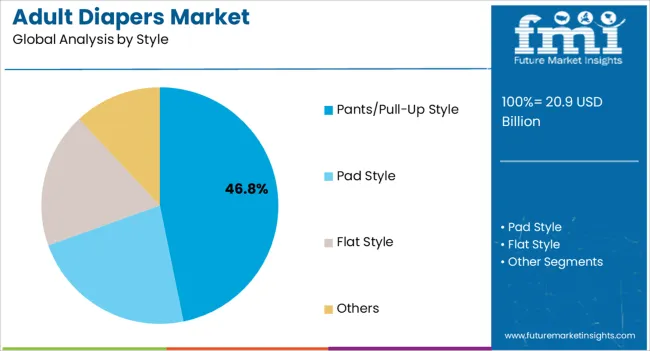
- By style categories, pants and pull-up products are expected to dominate with 46.8% share in 2026 since active users prefer easier self-management.
- Pad style and flat style formats are expected to serve users who need caregiver help. Institutional buyers often select these formats for bed care and planned changes.
Insights into Adult Diapers Market by Material Type
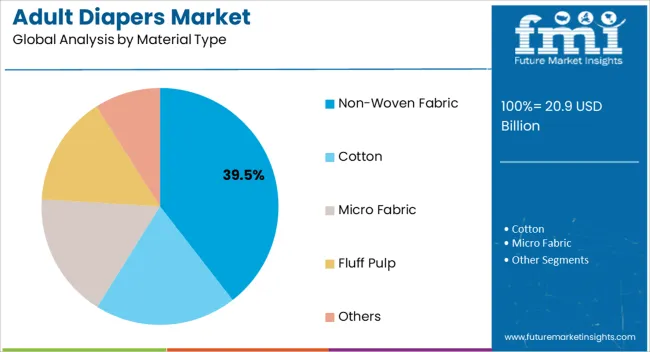
- Skin contact time is projected to push non-woven fabric to a 52.0% share across material type use in 2026.
- Cotton and micro fabric are expected to serve comfort-led users. Superabsorbent polymer inputs remain adjacent to absorbent core planning where thinner products need higher fluid hold.
Insights into Adult Diapers Market by Absorbency Level
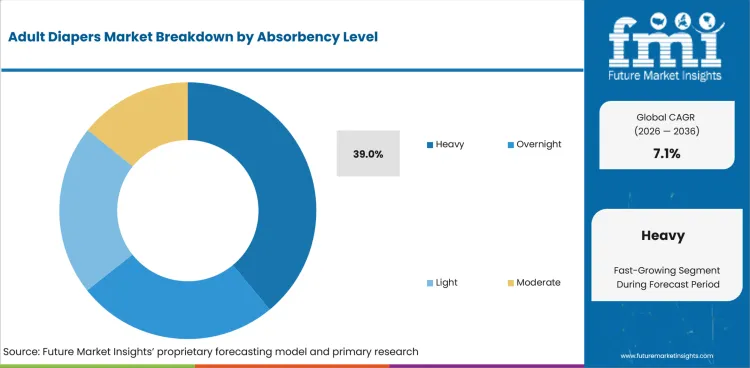
- Night care needs mean heavy absorbency is forecast to hold 39.0% of absorbency level volume in 2026.
- Light and moderate absorbency products are expected to serve mobile users who need thinner protection. Their sales depend on fit and pack privacy.
Insights into Adult Diapers Market by End Use
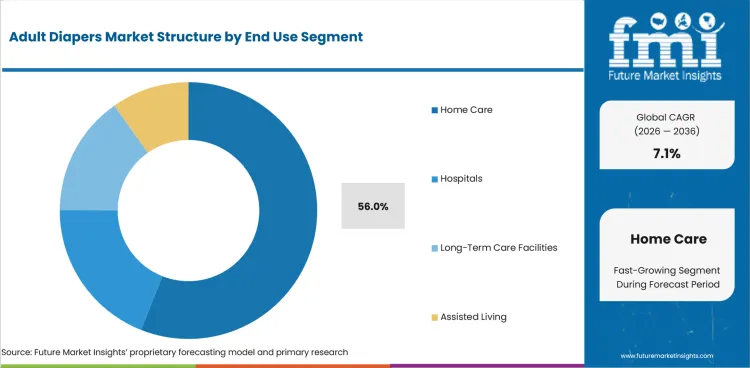
- Home care accounts for 56.0% of end-use revenue in 2026 reflecting family management of routine incontinence outside institutions.
- Long-term care facilities are bought in bulk and judge products by leakage control. Hospitals focus on patient handling and skin protection.
Insights into Adult Diapers Market by Sales Channel
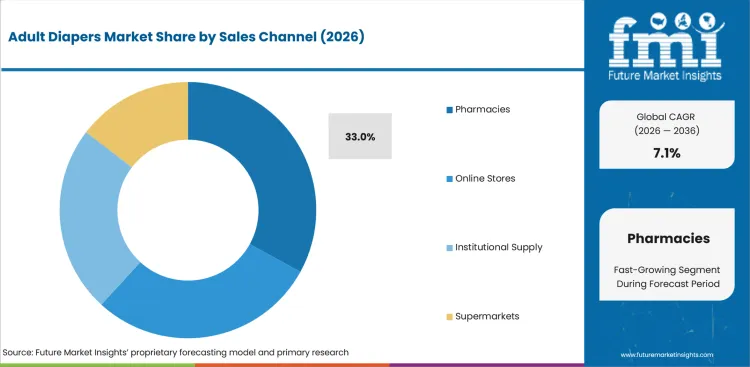
- Pharmacies and medical stores are anticipated to account for 33.0% of sales channel value in 2026, as assisted product selection remains useful.
- Online stores are projected to expand share through private delivery and subscription packs. Institutional supply keeps a role where care homes buy standardized sizes.
Adult Diapers Market Drivers, Restraints, and Opportunities
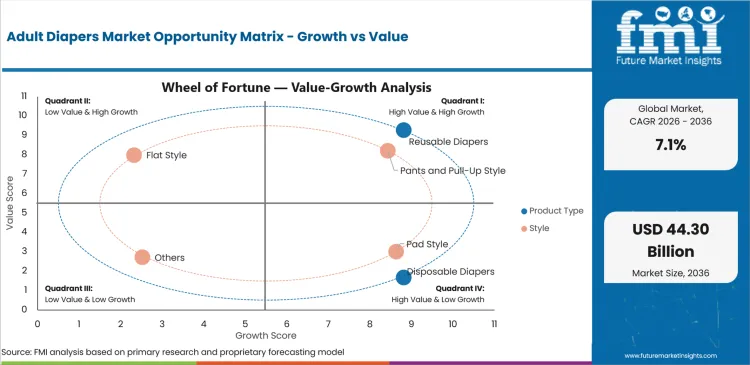
- Aging care routines support demand as more users need daily absorbent protection at home.
- Skin irritation and leakage risk can slow repeat use when product fit is poor.
- Recycling and reusable pathways create opportunities for suppliers able to reduce waste handling concerns.
Aging Care Raises Daily Need
Elderly in home settings often need products that support routine care instead of short-term medical use. Caregivers require products that match mobility level and daily change frequency. The National Institute of Diabetes and Digestive and Kidney Diseases reported in April 2024 that annual urinary incontinence incidence among people aged 65 and older averaged 290 per 10,000 persons during 2015 to 2021. Adult diaper planning is therefore expected to move closer to long-term care routines. Suppliers need size ranges and absorbency tiers that help users manage different leakage levels. Bladder liners remain adjacent products for users managing lighter leakage before full diaper adoption.
Skin Fit Limits Repeat Purchase
Product fit is anticipated to limit repeat purchase when waist edges or topsheet feel causes irritation during long wear. Care buyers usually compare skin comfort with leakage control before standardizing products across shifts. Ontex launched its Sensitive adult incontinence range in February 2026 for healthcare institutions across Europe. The launch linked skin protection with product renewal in institutional channels. Thin absorbent cores are expected to help users avoid bulk under clothing. Poor fit can turn a trial order into a one-time purchase despite adequate absorbency. Suppliers still need clear sizing and breathable materials to reduce switching. Incontinence skincare products remain relevant when moisture exposure raises irritation concerns during extended wear.
Recycling Routes Open Upgrade Paths
Waste handling is expected to become a clearer product planning issue as adult diaper volumes rise in care systems. Reusable incontinence products and recycling trials can reduce pressure where disposal cost is closely watched. Unicharm stated in December 2025 that it was developing a dry cleaning method for used disposable diaper recycling. The company said the approach uses about one-fiftieth of the water needed by conventional methods. Such work is expected to support premium positioning for suppliers that can link absorbency with lower waste impact. Adoption depends on hygiene proof and local collection systems.
Analysis of Adult Diapers Market by Key Countries
.webp "Top Country Growth Comparison Adult Diapers Market Cagr (2026 2036)")
| Country | CAGR |
|---|---|
| United States | 8.0% |
| Germany | 7.5% |
| China | 7.1% |
| India | 7.0% |
| South Korea | 6.9% |
| United Kingdom | 6.4% |
| Japan | 6.0% |
Source: Future Market Insights. Country rates for South Korea and United Kingdom are FMI estimates derived from aging and channel indicators.
Adult Diapers Market CAGR Analysis by Country
- The United States is projected to record 8.0% CAGR through 2036 with online replenishment and aging care supporting repeat orders.
- Germany is expected to expand at 7.5% CAGR through 2036 since reimbursement routines guide incontinence product buying.
- China is forecast to grow at 7.1% CAGR through 2036 given that aged population scale raises volume needs.
- India is anticipated to advance at 7.0% CAGR through 2036 where home care buying widens from a smaller base.
- South Korea is projected to rise at 6.9% CAGR through 2036 reflecting super-aged demographics and care product acceptance.
- The United Kingdom is forecast at 6.4% CAGR through 2036 supported by pharmacy access and older population care.
- Japan is expected to post 6.0% CAGR through 2036 on the back of high elder care product familiarity.
Demand Outlook for Adult Diapers Market in the United States
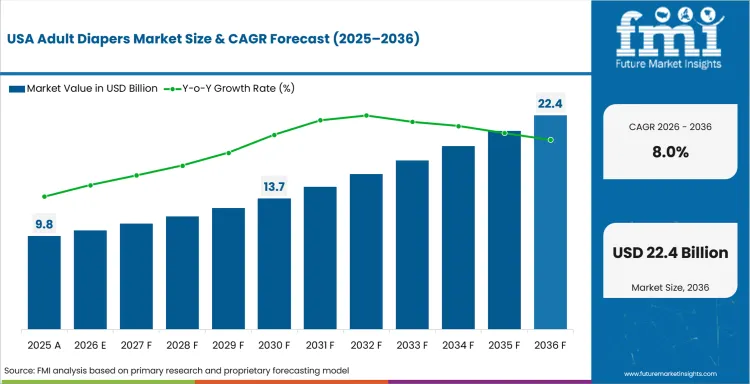
USA home care buyers are expected to evaluate privacy and delivery control before choosing monthly adult diaper packs. The United States Census Bureau reported in June 2025 that older adults outnumbered children in 11 states in 2024. The United States is projected to record 8.0% CAGR through 2036 with older users and caregivers relying on repeat delivery. Suppliers gain when they pair absorbency claims with quiet packaging and subscription control.
- Retail pharmacies remain useful for first-time sizing and caregiver advice.
- Online packs help active users reorder without store visits.
- Institutional buyers need dependable leakage control for bed care and night use.
Sales Analysis of Adult Diapers Market in China
China’s elder care volume is expected to hold a large position in East Asia through 2036. The National Bureau of Statistics of China reported in February 2026 that people aged 65 and above reached 223.65 million in 2025. China is forecast to grow at 7.1% CAGR through 2036 as elder care demand and e-commerce access move together. Local brands can gain share by offering reliable waist fit at mid-price points.
- Urban online channels make discreet replenishment easier for families.
- Local manufacturing helps suppliers control pack size and price.
- Care facilities need products that reduce change frequency during night shifts.
Demand Outlook for Adult Diapers Market in India
India’s care mix is expected to shift toward home-managed incontinence routines at a rate that affects pack-size planning. The Press Information Bureau of India reported in October 2025 that the 60 plus population is projected to reach 230 million by 2036. India is expected to advance at 7.0% CAGR through 2036 as adult hygiene use widens from a smaller base. Wider pharmacy reach can raise volume if brands keep pack sizes affordable.
- Small packs help families test fit before committing to monthly buying.
- Hospitals create trial points for adult diapers after surgery and mobility loss.
- Domestic non-woven supply can lower input cost for local converters.
Opportunity Analysis of Adult Diapers Market in Germany
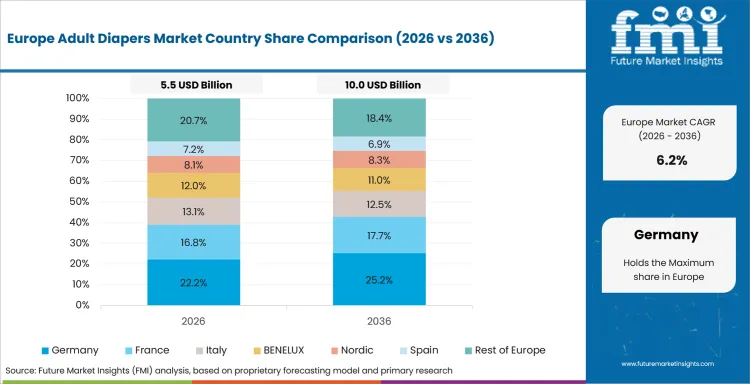
Suppliers in Germany are expected to benefit from reimbursement-linked selection as care home programs become more standardized. The Federal Statistical Office of Germany stated in December 2025 that one quarter of the population is expected to be 67 or older by 2035. Germany is expected to expand at 7.5% CAGR through 2036 as care homes and reimbursement routines support product use. Suppliers need clear skin-health proof to win long-term care orders.
- Care homes compare leakage control with staff time per change.
- Pharmacy channels support reimbursement-led product selection.
- Reusable formats gain attention where waste handling costs are watched.
Future Outlook for Adult Diapers Market in Japan
Japan’s long-term care policy base is expected to reshape product sourcing through the forecast period. The Cabinet Office reported in June 2025 that people aged 65 and above reached 36.24 million and 29.3% of Japan’s population in 2024. Japan is expected to post 6.0% CAGR through 2036 as the market already has high elder care product familiarity. Suppliers can gain from thinner cores and facility care formats.
- Care facilities need high absorbency products that reduce night checks.
- Retail users prefer discreet pants styles for daily movement.
- Smart diapers can help reduce caregiver burden in facilities.
Sales Analysis of Adult Diapers Market in South Korea
The institutional care base in South Korea is anticipated to grow as super-aged demographics raise assistance needs. Ministry of the Interior and Safety data reported in January 2026 placed the 65 plus population at 10.84 million in 2025. Older residents accounted for 21.21% of the total population in the same data. South Korea is projected to rise at 6.9% CAGR through 2036 as care product use moves with aging intensity.
- Urban retail channels give brands fast access to repeat users.
- Care homes need absorbency claims that hold during longer shifts.
- Local consumers compare softness and discretion before repeat buying.
Future Outlook for Adult Diapers Market in the United Kingdom
The United Kingdom’s pharmacy role as a care access hub means buyers need steady adult diaper availability. The House of Commons Library stated in July 2024 that people aged 65 and above made up 19.0% of the population in 2022. The United Kingdom is forecast at 6.4% CAGR through 2036 as older age groups expand and routine care use rises. Suppliers need plain packaging and reliable pharmacy availability.
- Home users need products that balance comfort with monthly cost.
- Care facilities compare leakage control with patient handling time.
- Online channels help users repeat orders with more privacy.
Competitive Landscape and Strategic Positioning
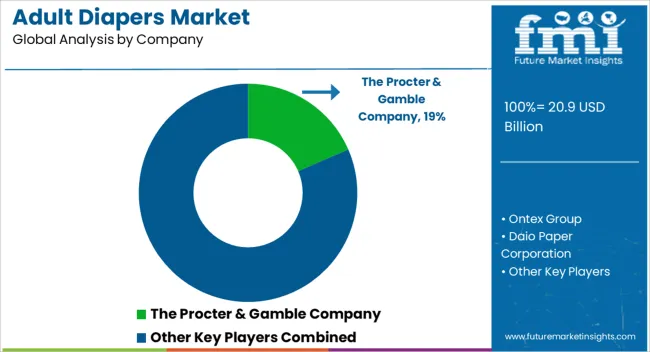
- Competition in the industry is influenced by absorbent core design and skin contact comfort.
- Brand trust is important factor because users buy the same size and format repeatedly.
- Retail depth helps first-time buyers find the right fit before subscription use.
- Care institutions shortlist suppliers that can supply stable packs and clear product claims.
- Entry barriers include absorbency testing and soft material sourcing.
Key players such as Kimberly‑Clark, Essity, and Ontex compete by leveraging strong brand equity, product performance, and extensive distribution networks across both retail and institutional channels. Their competitive positioning is reinforced through continuous investments in absorbent core innovation and user‑centric product design that supports repeat usage. In September 2025, Essity initiated the installation of a new TENA production line for incontinence pads at its Valls facility in Spain, strengthening its manufacturing capacity and supply reliability for care institutions.
Product design is projected to move toward thin cores and better fluid spread. The supply base for non-woven fabric is also important because diaper topsheets need softness at high run speeds. Superabsorbent input choice is expected to affect whether products can stay thin while holding more liquid. Scale converters keep an advantage over small regional brands.
Key Companies in the Adult Diapers Market
- Global Consumer Care Leaders: Kimberly-Clark Corporation and The Procter & Gamble Company hold broad retail reach through Depend and Always Discreet.
- Institutional and Care Specialists: Ontex Group and Essity AB serve care homes and medical channels through adult incontinence ranges.
- Asia Hygiene Suppliers: Unicharm Corporation and Daio Paper Corporation hold depth in Japan and East Asia.
- Private Label and Distribution Players: First Quality Enterprises and Medline Industries support contract supply and care channel coverage.
Competitive Benchmarking: Adult Diapers Market
| Company | Absorbent Core Depth | Care Channel Reach | Retail Brand Pull | Geographic Footprint |
|---|---|---|---|---|
| Kimberly-Clark Corporation | High | High | High | Global with North America depth |
| The Procter & Gamble Company | High | Medium | High | Global with retail strength |
| Essity AB | High | High | Medium | Europe led with TENA depth |
| Ontex Group | High | High | Medium | Europe and healthcare channels |
| Unicharm Corporation | High | Medium | High | Japan and Asia depth |
| Daio Paper Corporation | High | Medium | Medium | Japan centered hygiene base |
| Medline Industries Inc. | Medium | High | Low | Institutional supply depth |
Source: Future Market Insights competitive analysis, 2026.
Key Developments in Adult Diapers Market
- In June 2025, Ontex launched the iD Discreet incontinence range for healthcare partners across Europe.
- In September 2025, Essity started installing a new TENA production line for incontinence pads at its Valls facility in Spain.
- In December 2025, Kimberly-Clark Professional made complimentary Depend products available at Acrisure Stadium through an in-stadium bladder leak support initiative.
- In December 2025, Medline entered a Prime Vendor agreement with Tender Loving Care Management and included FitRight Navigator for incontinence product selection and sizing.
- In April 2026, Daio Paper launched Attento Night One-Piece Secure Pants with six-time absorption for adult night care.
Key Players in the Adult Diapers Market
Major Global Players
- Kimberly-Clark Corporation
- The Procter & Gamble Company
- Essity AB
- Ontex Group
- Unicharm Corporation
- Daio Paper Corporation
Specialist and Regional Players
- Medline Industries Inc.
- First Quality Enterprises Inc.
- Paul Hartmann AG
- Abena Holding A/S
Report Scope and Coverage
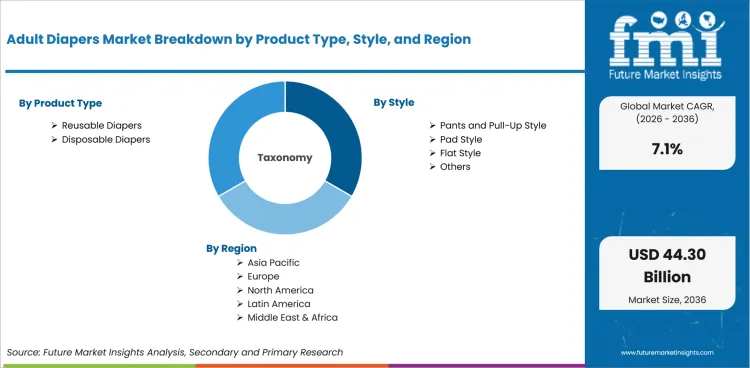
| Parameter | Details |
|---|---|
| Quantitative Units | USD 22.4 billion to USD 44.3 billion at 7.1% CAGR |
| Market Definition | Adult absorbent diapers used for incontinence care across home and institutional settings |
| Segments Covered | Product type, style, material type, absorbency level, end use, sales channel and region |
| Product Type | Reusable diapers and disposable diapers |
| Style | Pants and pull-up, pad style, flat style and others |
| Material Type | Non-woven fabric, cotton, micro fabric, fluff pulp and others |
| Absorbency Level | Light, moderate, heavy and overnight |
| End Use | Home care, hospitals, long-term care facilities and assisted living |
| Sales Channel | Pharmacies, online stores, institutional supply and supermarkets |
| Regions Covered | North America, Europe, East Asia, South Asia, Latin America, Middle East and Africa |
| Countries Covered | United States, Germany, China, India, South Korea, United Kingdom and Japan |
| Key Companies Profiled | Kimberly-Clark Corporation, The Procter & Gamble Company, Essity AB, Ontex Group, Unicharm Corporation and Medline Industries Inc. |
| Forecast Period | 2026 to 2036 |
| Approach | Hybrid bottom-up and top-down method using channel review, aging indicators, product portfolios and official company activity |
Source: Future Market Insights.
Adult Diapers Market Breakdown by Product Type, Style, Material Type, Absorbency Level, End Use, Sales Channel, and Region
Adult Diapers Market Segmented by Product Type
- Reusable Diapers
- Disposable Diapers
Adult Diapers Market Segmented by Style
- Pants and Pull-Up Style
- Pad Style
- Flat Style
- Others
Adult Diapers Market Segmented by Material Type
- Non-Woven Fabric
- Cotton
- Micro Fabric
- Fluff Pulp
- Others
Adult Diapers Market Segmented by Absorbency Level
- Light
- Moderate
- Heavy
- Overnight
Adult Diapers Market Segmented by End Use
- Home Care
- Hospitals
- Long-Term Care Facilities
- Assisted Living
Adult Diapers Market Segmented by Sales Channel
- Pharmacies
- Online Stores
- Institutional Supply
- Supermarkets
Adult Diapers Market by Region
- North America
- Europe
- East Asia
- South Asia
- Latin America
- Middle East and Africa
Research Sources and Bibliography
- National Institute of Diabetes and Digestive and Kidney Diseases. (2024, April 26). Urologic Diseases in America: Annual Data Report 2024 - Urinary Incontinence. USA Department of Health and Human Services.
- United States Census Bureau. (2025, June 26). Older Adults Outnumber Children in 11 States and Nearly Half of U.S. Counties. United States Census Bureau.
- National Bureau of Statistics of China. (2026, February 28). Statistical communique of the People’s Republic of China on the 2025 national economic and social development. National Bureau of Statistics of China.
- Press Information Bureau of India. (2025, October 3). Rising share of elderly population in India. Ministry of Social Justice and Empowerment.
- Federal Statistical Office of Germany. (2025, December 11). One person in four will be 67 or older in 2035. Destatis.
- Cabinet Office of Japan. (2025, June 5). Annual report on the ageing society FY2025. Government of Japan.
- Ministry of the Interior and Safety. (2026, January 4). Resident registration population data on Korea aged 65 and older. Ministry of the Interior and Safety.
- House of Commons Library. (2024, July 16). UK age structure: Statistics and policy. UK Parliament.
- Ontex Group. (2026, February 5). Ontex launches Sensitive adult incontinence range for healthcare institutions in Europe. Ontex Group.
- Ontex Group. (2025, June 17). Ontex launches discreet incontinence range to European healthcare partners. Ontex Group.
- Essity AB. (2025, September). Essity around the world - September 2025. Essity AB.
- Kimberly-Clark Professional. (2025, December 15). Depend to tackle bladder leaks with first-of-its-kind in-stadium initiative at Acrisure Stadium. Kimberly-Clark Professional.
- Medline Industries. (2025, December 10). Tender Loving Care Management selects Medline as Prime Vendor. Medline Industries.
- Daio Paper Corporation. (2026, March 31). Attento Night One-Piece Secure Pants without pads for continuous comfort with six-time absorption. Daio Paper Corporation.
- Unicharm Corporation. (2025, December 9). Unicharm begins developing used disposable diaper recycling by dry cleaning method. Unicharm Corporation.
Research Sources and Bibliography
- National Institute of Diabetes and Digestive and Kidney Diseases. (2024, April 26). Urologic Diseases in America: Annual Data Report 2024 - Urinary Incontinence. USA Department of Health and Human Services.
- United States Census Bureau. (2025, June 26). Older Adults Outnumber Children in 11 States and Nearly Half of USA Counties. United States Census Bureau.
- National Bureau of Statistics of China. (2026, February 28). Statistical communique of the People’s Republic of China on the 2025 national economic and social development. National Bureau of Statistics of China.
- Press Information Bureau of India. (2025, October 3). Rising share of elderly population in India. Ministry of Social Justice and Empowerment.
- Federal Statistical Office of Germany. (2025, December 11). One person in four will be 67 or older in 2035. Destatis.
- Cabinet Office of Japan. (2025, June 5). Annual report on the ageing society FY2025. Government of Japan.
- Ministry of the Interior and Safety. (2026, January 4). Resident registration population data on Korea aged 65 and older. Ministry of the Interior and Safety.
- House of Commons Library. (2024, July 16). UK age structure: Statistics and policy. UK Parliament.
- Ontex Group. (2026, February 5). Ontex launches Sensitive adult incontinence range for healthcare institutions in Europe. Ontex Group.
- Ontex Group. (2025, June 17). Ontex launches discreet incontinence range to European healthcare partners. Ontex Group.
- Essity AB. (2025, September). Essity around the world - September 2025. Essity AB.
- Kimberly-Clark Professional. (2025, December 15). Depend to tackle bladder leaks with first-of-its-kind in-stadium initiative at Acrisure Stadium. Kimberly-Clark Professional.
- Medline Industries. (2025, December 10). Tender Loving Care Management selects Medline as Prime Vendor. Medline Industries.
- Daio Paper Corporation. (2026, March 31). Attento Night One-Piece Secure Pants without pads for continuous comfort with six-time absorption. Daio Paper Corporation.
- Unicharm Corporation. (2025, December 9). Unicharm begins developing used disposable diaper recycling by dry cleaning method. Unicharm Corporation.
Frequently Asked Questions
How big is the Adult Diapers Market in 2026?
The Adult Diapers Market is estimated to be valued at USD 22.4 billion in 2026 based on FMI analysis.
What value is expected for the Adult Diapers Market by 2036?
The Adult Diapers Market is projected to reach USD 44.3 billion by 2036 as repeat use expands across care settings.
What CAGR is expected for the Adult Diapers Market?
The Adult Diapers Market is forecast to expand at 7.1% CAGR between 2026 and 2036.
Which style leads the Adult Diapers Market in 2026?
Pants and pull-up style products are expected to account for 46.8% of style demand in 2026.
Which product type leads the Adult Diapers Market?
Reusable diapers are projected to hold 41.6% of product type demand in 2026 as long-use buyers compare cost per use.
Which country records the fastest listed Adult Diapers Market outlook?
The United States is projected to record 8.0% CAGR through 2036 with aging and repeat online replenishment support.
Which companies are active in the Adult Diapers Market?
Kimberly-Clark, Procter & Gamble, Essity, Ontex and Unicharm are active across retail and institutional adult incontinence channels.
What is included in Adult Diapers Market scope?
Scope includes reusable and disposable adult diapers sold through retail, institutional and online channels for home and care settings.
Preview the report firsthand - request a free sample
Get SampleGet the brochure for pricing and purchase details.
Get PDFTable of Content
- Executive Summary
- Global Market Outlook
- Demand-side Trends
- Supply-side Trends
- Technology Roadmap Analysis
- Analysis and Recommendations
- Market Overview
- Market Coverage / Taxonomy
- Market Definition / Scope / Limitations
- Research Methodology
- Chapter Orientation
- Analytical Lens and Working Hypotheses
- Market Structure, Signals, and Trend Drivers
- Benchmarking and Cross-market Comparability
- Market Sizing, Forecasting, and Opportunity Mapping
- Research Design and Evidence Framework
- Desk Research Programme (Secondary Evidence)
- Company Annual and Sustainability Reports
- Peer-reviewed Journals and Academic Literature
- Corporate Websites, Product Literature, and Technical Notes
- Earnings Decks and Investor Briefings
- Statutory Filings and Regulatory Disclosures
- Technical White Papers and Standards Notes
- Trade Journals, Industry Magazines, and Analyst Briefs
- Conference Proceedings, Webinars, and Seminar Materials
- Government Statistics Portals and Public Data Releases
- Press Releases and Reputable Media Coverage
- Specialist Newsletters and Curated Briefings
- Sector Databases and Reference Repositories
- FMI Internal Proprietary Databases and Historical Market Datasets
- Subscription Datasets and Paid Sources
- Social Channels, Communities, and Digital Listening Inputs
- Additional Desk Sources
- Expert Input and Fieldwork (Primary Evidence)
- Primary Modes
- Qualitative Interviews and Expert Elicitation
- Quantitative Surveys and Structured Data Capture
- Blended Approach
- Why Primary Evidence is Used
- Field Techniques
- Interviews
- Surveys
- Focus Groups
- Observational and In-context Research
- Social and Community Interactions
- Stakeholder Universe Engaged
- C-suite Leaders
- Board Members
- Presidents and Vice Presidents
- R&D and Innovation Heads
- Technical Specialists
- Domain Subject-matter Experts
- Scientists
- Physicians and Other Healthcare Professionals
- Governance, Ethics, and Data Stewardship
- Research Ethics
- Data Integrity and Handling
- Primary Modes
- Tooling, Models, and Reference Databases
- Desk Research Programme (Secondary Evidence)
- Data Engineering and Model Build
- Data Acquisition and Ingestion
- Cleaning, Normalisation, and Verification
- Synthesis, Triangulation, and Analysis
- Quality Assurance and Audit Trail
- Market Background
- Market Dynamics
- Drivers
- Restraints
- Opportunity
- Trends
- Scenario Forecast
- Demand in Optimistic Scenario
- Demand in Likely Scenario
- Demand in Conservative Scenario
- Opportunity Map Analysis
- Product Life Cycle Analysis
- Supply Chain Analysis
- Investment Feasibility Matrix
- Value Chain Analysis
- PESTLE and Porter’s Analysis
- Regulatory Landscape
- Regional Parent Market Outlook
- Production and Consumption Statistics
- Import and Export Statistics
- Market Dynamics
- Global Market Analysis 2021 to 2025 and Forecast, 2026 to 2036
- Historical Market Size Value (USD Million) Analysis, 2021 to 2025
- Current and Future Market Size Value (USD Million) Projections, 2026 to 2036
- Y-o-Y Growth Trend Analysis
- Absolute $ Opportunity Analysis
- Global Market Pricing Analysis 2021 to 2025 and Forecast 2026 to 2036
- Global Market Analysis 2021 to 2025 and Forecast 2026 to 2036, By Product Type
- Introduction / Key Findings
- Historical Market Size Value (USD Million) Analysis By Product Type , 2021 to 2025
- Current and Future Market Size Value (USD Million) Analysis and Forecast By Product Type , 2026 to 2036
- Reusable Diapers
- Disposable Diapers
- Reusable Diapers
- Y-o-Y Growth Trend Analysis By Product Type , 2021 to 2025
- Absolute $ Opportunity Analysis By Product Type , 2026 to 2036
- Global Market Analysis 2021 to 2025 and Forecast 2026 to 2036, By Style
- Introduction / Key Findings
- Historical Market Size Value (USD Million) Analysis By Style, 2021 to 2025
- Current and Future Market Size Value (USD Million) Analysis and Forecast By Style, 2026 to 2036
- Pants and Pull-Up Style
- Pad Style
- Flat Style
- Others
- Pants and Pull-Up Style
- Y-o-Y Growth Trend Analysis By Style, 2021 to 2025
- Absolute $ Opportunity Analysis By Style, 2026 to 2036
- Global Market Analysis 2021 to 2025 and Forecast 2026 to 2036, By Material Type
- Introduction / Key Findings
- Historical Market Size Value (USD Million) Analysis By Material Type, 2021 to 2025
- Current and Future Market Size Value (USD Million) Analysis and Forecast By Material Type, 2026 to 2036
- Non-Woven Fabric
- Cotton
- Micro Fabric
- Fluff Pulp
- Others
- Non-Woven Fabric
- Y-o-Y Growth Trend Analysis By Material Type, 2021 to 2025
- Absolute $ Opportunity Analysis By Material Type, 2026 to 2036
- Global Market Analysis 2021 to 2025 and Forecast 2026 to 2036, By Absorbency Level
- Introduction / Key Findings
- Historical Market Size Value (USD Million) Analysis By Absorbency Level, 2021 to 2025
- Current and Future Market Size Value (USD Million) Analysis and Forecast By Absorbency Level, 2026 to 2036
- Heavy
- Overnight
- Light
- Moderate
- Heavy
- Y-o-Y Growth Trend Analysis By Absorbency Level, 2021 to 2025
- Absolute $ Opportunity Analysis By Absorbency Level, 2026 to 2036
- Global Market Analysis 2021 to 2025 and Forecast 2026 to 2036, By End Use
- Introduction / Key Findings
- Historical Market Size Value (USD Million) Analysis By End Use, 2021 to 2025
- Current and Future Market Size Value (USD Million) Analysis and Forecast By End Use, 2026 to 2036
- Home Care
- Hospitals
- Long-Term Care Facilities
- Assisted Living
- Home Care
- Y-o-Y Growth Trend Analysis By End Use, 2021 to 2025
- Absolute $ Opportunity Analysis By End Use, 2026 to 2036
- Global Market Analysis 2021 to 2025 and Forecast 2026 to 2036, By Sales Channel
- Introduction / Key Findings
- Historical Market Size Value (USD Million) Analysis By Sales Channel, 2021 to 2025
- Current and Future Market Size Value (USD Million) Analysis and Forecast By Sales Channel, 2026 to 2036
- Pharmacies
- Online Stores
- Institutional Supply
- Supermarkets
- Pharmacies
- Y-o-Y Growth Trend Analysis By Sales Channel, 2021 to 2025
- Absolute $ Opportunity Analysis By Sales Channel, 2026 to 2036
- Global Market Analysis 2021 to 2025 and Forecast 2026 to 2036, By Region
- Introduction
- Historical Market Size Value (USD Million) Analysis By Region, 2021 to 2025
- Current Market Size Value (USD Million) Analysis and Forecast By Region, 2026 to 2036
- North America
- Latin America
- Western Europe
- Eastern Europe
- East Asia
- South Asia and Pacific
- Middle East & Africa
- Market Attractiveness Analysis By Region
- North America Market Analysis 2021 to 2025 and Forecast 2026 to 2036, By Country
- Historical Market Size Value (USD Million) Trend Analysis By Market Taxonomy, 2021 to 2025
- Market Size Value (USD Million) Forecast By Market Taxonomy, 2026 to 2036
- By Country
- USA
- Canada
- Mexico
- By Product Type
- By Style
- By Material Type
- By Absorbency Level
- By End Use
- By Sales Channel
- By Country
- Market Attractiveness Analysis
- By Country
- By Product Type
- By Style
- By Material Type
- By Absorbency Level
- By End Use
- By Sales Channel
- Key Takeaways
- Latin America Market Analysis 2021 to 2025 and Forecast 2026 to 2036, By Country
- Historical Market Size Value (USD Million) Trend Analysis By Market Taxonomy, 2021 to 2025
- Market Size Value (USD Million) Forecast By Market Taxonomy, 2026 to 2036
- By Country
- Brazil
- Chile
- Rest of Latin America
- By Product Type
- By Style
- By Material Type
- By Absorbency Level
- By End Use
- By Sales Channel
- By Country
- Market Attractiveness Analysis
- By Country
- By Product Type
- By Style
- By Material Type
- By Absorbency Level
- By End Use
- By Sales Channel
- Key Takeaways
- Western Europe Market Analysis 2021 to 2025 and Forecast 2026 to 2036, By Country
- Historical Market Size Value (USD Million) Trend Analysis By Market Taxonomy, 2021 to 2025
- Market Size Value (USD Million) Forecast By Market Taxonomy, 2026 to 2036
- By Country
- Germany
- UK
- Italy
- Spain
- France
- Nordic
- BENELUX
- Rest of Western Europe
- By Product Type
- By Style
- By Material Type
- By Absorbency Level
- By End Use
- By Sales Channel
- By Country
- Market Attractiveness Analysis
- By Country
- By Product Type
- By Style
- By Material Type
- By Absorbency Level
- By End Use
- By Sales Channel
- Key Takeaways
- Eastern Europe Market Analysis 2021 to 2025 and Forecast 2026 to 2036, By Country
- Historical Market Size Value (USD Million) Trend Analysis By Market Taxonomy, 2021 to 2025
- Market Size Value (USD Million) Forecast By Market Taxonomy, 2026 to 2036
- By Country
- Russia
- Poland
- Hungary
- Balkan & Baltic
- Rest of Eastern Europe
- By Product Type
- By Style
- By Material Type
- By Absorbency Level
- By End Use
- By Sales Channel
- By Country
- Market Attractiveness Analysis
- By Country
- By Product Type
- By Style
- By Material Type
- By Absorbency Level
- By End Use
- By Sales Channel
- Key Takeaways
- East Asia Market Analysis 2021 to 2025 and Forecast 2026 to 2036, By Country
- Historical Market Size Value (USD Million) Trend Analysis By Market Taxonomy, 2021 to 2025
- Market Size Value (USD Million) Forecast By Market Taxonomy, 2026 to 2036
- By Country
- China
- Japan
- South Korea
- By Product Type
- By Style
- By Material Type
- By Absorbency Level
- By End Use
- By Sales Channel
- By Country
- Market Attractiveness Analysis
- By Country
- By Product Type
- By Style
- By Material Type
- By Absorbency Level
- By End Use
- By Sales Channel
- Key Takeaways
- South Asia and Pacific Market Analysis 2021 to 2025 and Forecast 2026 to 2036, By Country
- Historical Market Size Value (USD Million) Trend Analysis By Market Taxonomy, 2021 to 2025
- Market Size Value (USD Million) Forecast By Market Taxonomy, 2026 to 2036
- By Country
- India
- ASEAN
- Australia & New Zealand
- Rest of South Asia and Pacific
- By Product Type
- By Style
- By Material Type
- By Absorbency Level
- By End Use
- By Sales Channel
- By Country
- Market Attractiveness Analysis
- By Country
- By Product Type
- By Style
- By Material Type
- By Absorbency Level
- By End Use
- By Sales Channel
- Key Takeaways
- Middle East & Africa Market Analysis 2021 to 2025 and Forecast 2026 to 2036, By Country
- Historical Market Size Value (USD Million) Trend Analysis By Market Taxonomy, 2021 to 2025
- Market Size Value (USD Million) Forecast By Market Taxonomy, 2026 to 2036
- By Country
- Kingdom of Saudi Arabia
- Other GCC Countries
- Turkiye
- South Africa
- Other African Union
- Rest of Middle East & Africa
- By Product Type
- By Style
- By Material Type
- By Absorbency Level
- By End Use
- By Sales Channel
- By Country
- Market Attractiveness Analysis
- By Country
- By Product Type
- By Style
- By Material Type
- By Absorbency Level
- By End Use
- By Sales Channel
- Key Takeaways
- Key Countries Market Analysis
- USA
- Pricing Analysis
- Market Share Analysis, 2025
- By Product Type
- By Style
- By Material Type
- By Absorbency Level
- By End Use
- By Sales Channel
- Canada
- Pricing Analysis
- Market Share Analysis, 2025
- By Product Type
- By Style
- By Material Type
- By Absorbency Level
- By End Use
- By Sales Channel
- Mexico
- Pricing Analysis
- Market Share Analysis, 2025
- By Product Type
- By Style
- By Material Type
- By Absorbency Level
- By End Use
- By Sales Channel
- Brazil
- Pricing Analysis
- Market Share Analysis, 2025
- By Product Type
- By Style
- By Material Type
- By Absorbency Level
- By End Use
- By Sales Channel
- Chile
- Pricing Analysis
- Market Share Analysis, 2025
- By Product Type
- By Style
- By Material Type
- By Absorbency Level
- By End Use
- By Sales Channel
- Germany
- Pricing Analysis
- Market Share Analysis, 2025
- By Product Type
- By Style
- By Material Type
- By Absorbency Level
- By End Use
- By Sales Channel
- UK
- Pricing Analysis
- Market Share Analysis, 2025
- By Product Type
- By Style
- By Material Type
- By Absorbency Level
- By End Use
- By Sales Channel
- Italy
- Pricing Analysis
- Market Share Analysis, 2025
- By Product Type
- By Style
- By Material Type
- By Absorbency Level
- By End Use
- By Sales Channel
- Spain
- Pricing Analysis
- Market Share Analysis, 2025
- By Product Type
- By Style
- By Material Type
- By Absorbency Level
- By End Use
- By Sales Channel
- France
- Pricing Analysis
- Market Share Analysis, 2025
- By Product Type
- By Style
- By Material Type
- By Absorbency Level
- By End Use
- By Sales Channel
- India
- Pricing Analysis
- Market Share Analysis, 2025
- By Product Type
- By Style
- By Material Type
- By Absorbency Level
- By End Use
- By Sales Channel
- ASEAN
- Pricing Analysis
- Market Share Analysis, 2025
- By Product Type
- By Style
- By Material Type
- By Absorbency Level
- By End Use
- By Sales Channel
- Australia & New Zealand
- Pricing Analysis
- Market Share Analysis, 2025
- By Product Type
- By Style
- By Material Type
- By Absorbency Level
- By End Use
- By Sales Channel
- China
- Pricing Analysis
- Market Share Analysis, 2025
- By Product Type
- By Style
- By Material Type
- By Absorbency Level
- By End Use
- By Sales Channel
- Japan
- Pricing Analysis
- Market Share Analysis, 2025
- By Product Type
- By Style
- By Material Type
- By Absorbency Level
- By End Use
- By Sales Channel
- South Korea
- Pricing Analysis
- Market Share Analysis, 2025
- By Product Type
- By Style
- By Material Type
- By Absorbency Level
- By End Use
- By Sales Channel
- Russia
- Pricing Analysis
- Market Share Analysis, 2025
- By Product Type
- By Style
- By Material Type
- By Absorbency Level
- By End Use
- By Sales Channel
- Poland
- Pricing Analysis
- Market Share Analysis, 2025
- By Product Type
- By Style
- By Material Type
- By Absorbency Level
- By End Use
- By Sales Channel
- Hungary
- Pricing Analysis
- Market Share Analysis, 2025
- By Product Type
- By Style
- By Material Type
- By Absorbency Level
- By End Use
- By Sales Channel
- Kingdom of Saudi Arabia
- Pricing Analysis
- Market Share Analysis, 2025
- By Product Type
- By Style
- By Material Type
- By Absorbency Level
- By End Use
- By Sales Channel
- Turkiye
- Pricing Analysis
- Market Share Analysis, 2025
- By Product Type
- By Style
- By Material Type
- By Absorbency Level
- By End Use
- By Sales Channel
- South Africa
- Pricing Analysis
- Market Share Analysis, 2025
- By Product Type
- By Style
- By Material Type
- By Absorbency Level
- By End Use
- By Sales Channel
- USA
- Market Structure Analysis
- Competition Dashboard
- Competition Benchmarking
- Market Share Analysis of Top Players
- By Regional
- By Product Type
- By Style
- By Material Type
- By Absorbency Level
- By End Use
- By Sales Channel
- Competition Analysis
- Competition Deep Dive
- Kimberly-Clark Corporation
- Overview
- Product Portfolio
- Profitability by Market Segments (Product/Age /Sales Channel/Region)
- Sales Footprint
- Strategy Overview
- Marketing Strategy
- Product Strategy
- Channel Strategy
- The Procter & Gamble Company
- Essity AB
- Ontex Group
- Unicharm Corporation
- Daio Paper Corporation
- Medline Industries Inc.
- Kimberly-Clark Corporation
- Competition Deep Dive
- Assumptions & Acronyms Used


