

- Industry Size (2026)
- USD 54.8 Bn
- Forecast (2036)
- USD 103.7 Bn
- CAGR (2026 to 2036)
- 6.6%
Older Adults Health Supplements Market Size, Market Forecast and Outlook By FMI
The Older Adults Health Supplements market was valued at USD 51.4 billion in 2025, projected to reach USD 54.8 billion in 2026, and is forecast to expand to USD 103.7 billion by 2036 at a 6.6% CAGR. The global ageing population demographic represents one of the most structurally durable demand drivers in the health supplement category. Adults aged 60 and above are the fastest-growing demographic in Japan, Germany, China, and the United States, and this cohort demonstrates above-average supplement expenditure as part of a preventive health strategy that prioritises bone health, cardiovascular function, cognitive maintenance, and immune resilience. Supplement formats, flavour profiles, and delivery mechanisms are progressively adapting to the physical and sensory preferences of older adult consumers.
Absolute dollar growth of USD 147.5 billion across the forecast period reflects a market that benefits from both demographic expansion and increasing per-capita supplement spend among older adults as digital health engagement and preventive care awareness increase. FMI is of the opinion that the Online Retailer sales channel, commanding 38.6% of Sales Channel demand in 2026, will continue to gain share as older adult digital commerce adoption accelerates and subscription-based supplement delivery models designed for the senior consumer segment mature in North America, Europe, and East Asia. Pill form retains 44.2% of Form segment demand in 2026, though powder and liquid formats are recording faster growth rates as swallowing difficulty and palatability preferences among very elderly consumers drive product adaptation.
Summary of Older Adults Health Supplements Market
- Older Adults Health Supplements Market Definition
- The Older Adults Health Supplements market covers dietary supplements formulated and marketed for consumers aged 55 and above, addressing bone health, cognitive function, cardiovascular support, immune resilience, and joint health across pill, powder, liquid, and energy bar delivery formats.
- Demand Drivers in the Market
- Rapid growth in the global population aged 60 and above, particularly in Japan, China, Germany, and India, directly expands the addressable market for supplements targeting age-related nutritional requirements.
- Healthcare professional endorsement of vitamin D, calcium, omega-3, and B-complex supplementation protocols for older adults in preventive medicine contexts creates a sustained referral-driven purchase behaviour that supports premium supplement pricing.
- Online retail platform investment in senior-focused supplement subscription services, ease-of-use interface design, and home delivery logistics is lowering access barriers and increasing supplement purchase frequency among older adult consumers.
- Key Segments Analyzed in the FMI Report
- Conventional Nature holds 72.0% of Nature segment demand in 2026, reflecting price sensitivity among fixed-income older adult consumers and the limited availability of organic-certified formulations across the full supplement active ingredient portfolio.
- Pills account for 44.2% of Form segment demand in 2026, representing the default delivery format for vitamin, mineral, and omega-3 supplement categories most consumed by older adult consumers.
- Online Retailers command 38.6% of Sales Channel demand in 2026, as subscription-based supplement delivery models generate recurring revenue and older adult digital commerce adoption increases across North America, Europe, and East Asia.
- Analyst Opinion at FMI
- Nandini Roy Choudhury, Principal Consultant for Food & Beverage industry growth through 2036 is most heavily influenced by the speed at which supplement brands adapt product formats to address the physiological realities of very elderly consumers, specifically swallowing difficulty, taste sensitivity decline, and polypharmacy supplement-drug interaction concerns. Brands that invest in liquid and powder format development supported by geriatric pharmacist-endorsed interaction databases will differentiate from pill-dominant portfolios as the average age of the senior supplement consumer cohort increases.
- Strategic Implications / Executive Takeaways
- Supplement brands should develop liquid and dissolvable powder format extensions of their senior product lines with pharmacy-endorsed supplement-drug interaction guidance to address the fastest-growing very elderly consumer segment.
- Online retail operators serving the older adult segment should implement subscription health assessment tools that prompt periodic supplement regimen reviews aligned with ageing nutritional guideline updates, increasing consumer engagement and reducing subscription churn.
- Manufacturers targeting the Japan and Germany senior supplement markets should establish healthcare professional engagement programmes with geriatricians and pharmacists, as physician recommendation remains the highest-weight purchase influence for older adult supplement adoption in both markets.
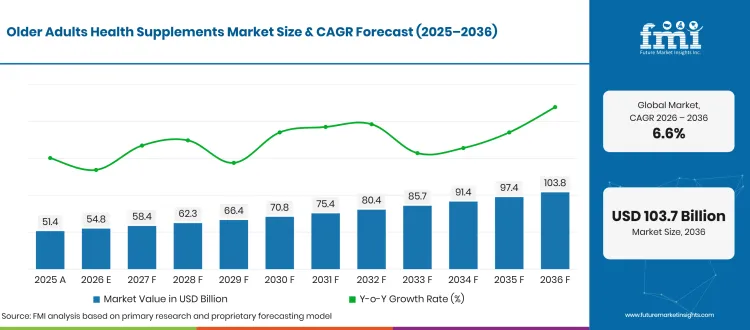
Older Adults Health Supplements Market Key Takeaways
| Metric | Details |
|---|---|
| Industry Size (2026) | USD 54.8 Billion |
| Industry Value (2036) | USD 103.7 Billion |
| CAGR (2026-2036) | 6.6% |
| Source | Future Market Insights, 2026 |
As per FMI, India registers the fastest country-level CAGR at 5.5% through 2036, driven by a rapidly ageing population, rising middle-class disposable income, and growing awareness of supplement-based preventive health among older urban consumers. Japan follows at 5.1%, anchored by the world's largest proportion of adults over 65 and a mature functional food and supplement retail infrastructure that serves senior consumers through pharmacy and home delivery channels. China records 4.5% growth, supported by an ageing population, expanding domestic supplement manufacturing, and government health policy emphasis on active ageing. Germany advances at 4.7%, driven by healthcare professional recommendation of supplements in preventive medicine contexts and pharmacy-channel engagement with older adult consumers. The United States grows at 4.3%, reflecting a large and commercially mature older adult supplement segment.
Older Adults Health Supplements Market Definition
The Older Adults Health Supplements market encompasses dietary supplement products specifically formulated and marketed for consumers aged 55 and above, addressing the nutritional gap and health maintenance requirements characteristic of older adult physiology. Products include vitamin and mineral complexes, omega-3 and omega-6 fatty acid supplements, joint health compounds, cognitive support formulations, bone density maintenance products, and cardiovascular health supplements in pill, powder, liquid, and energy bar delivery formats.
Older Adults Health Supplements Market Inclusions
Market scope covers global and regional revenue estimates for health supplements targeting older adult consumers across all nature types, delivery forms, flavour variants, and sales channels. The forecast period spans 2026 to 2036, with country-level CAGR analysis. Ageing population demographic projections, digital commerce channel adoption rates among seniors, and healthcare professional referral patterns are incorporated as supplementary analytical dimensions.
Older Adults Health Supplements Market Exclusions
General dietary supplements without specific older adult formulation or marketing positioning are excluded from this market segment. Prescription pharmaceutical products prescribed to older adults for age-related conditions, medical foods reimbursed through healthcare systems, and meal replacement products without supplement active ingredient positioning fall outside the defined scope.
Older Adults Health Supplements Market Research Methodology
- Primary Research: Primary Research: FMI analysts conducted interviews with geriatric nutrition specialists, pharmacy category managers serving senior consumer segments, and digital health platform operators with older adult user bases across Japan, the United States, Germany, India, and China.
- Desk Research: Desk Research: WHO healthy ageing framework reports, national census data on population age structure projections, geriatric medicine dietary reference intake guidelines, and digital commerce adoption statistics for consumers over 60 were reviewed.
- Market-Sizing and Forecasting: Market-Sizing and Forecasting: A bottom-up model aggregates supplement retail sales data by product category and demographic targeting classification, weighted against per-capita supplement expenditure benchmarks from primary research and national household expenditure surveys.
- Data Validation and Update Cycle: Data Validation and Update Cycle: Projections were cross-validated against national ageing population statistics, pharmaceutical supplement channel sales data, and e-commerce platform transaction volume disclosures.
Key Industry Highlights
Role of Scientific Innovation in Enhancing Health Supplements for Older Adults
Scientific advancements are playing a crucial role in significantly increasing the older adults' health supplement retail space.
Additionally, innovations and introduction of new ingredients along with formulations upgrade made for the specific nutritional needs of the older generation are driving business growth, which ensures these supplements meet the specific health requirements of the aging population. This scientific improvement supports the development of high-quality, targeted health solutions.
Flavor Innovations Boosting Consumption of Health Supplements among Older Adults
Innovation in flavour profile enhances the appeal of health supplements for aging populations by making them more palatable and enjoyable. Introducing diverse flavors such as orange, lemon, chocolate, raspberry or strawberry encourages regular consumption. These options cover the various taste preferences and especially benefit those sensitive to the taste of unflavored products.
Convenience and Precision: The Appeal of Pills and Energy Bars
Pills and energy bars remain the most preferred and popular choice when it comes to choosing the form of Older Adults Health Supplements. Consumers like the ease of including these forms in their daily routine without needing to mix or measure them.
This is especially captivating for those consumers who seek straightforward and hassle-free health solutions. Moreover, these forms ensure consistent dosage to consumers for consuming the exact amount of nutrients needed, which enhances efficacy and safety.
2021 to 2025 Global Older Adults Health Supplements Sales Analysis Compared to Demand Forecasts for 2026 to 2036
Global Older Adults Health Supplements sales increased at a CAGR of 4.2% from 2021 to 2025. For the next ten years (2026 to 2036), projections are that expenditure on Older Adults Health Supplements will rise at 6.6% CAGR
The frequency of chronic diseases among older adults, including arthritis, osteoporosis, cardiovascular diseases, and cognitive decline, is driving the growing demand for health supplements made for specific health conditions and functionalities. Omega-3 fatty acids, glucosamine, calcium, and vitamins D and B12 are frequently utilized to manage or prevent these conditions.
As older adults are seeking ways to maintain their health and alleviate symptoms associated with these chronic ailments, the use of supplements becomes increasingly integral. This demand is fueled by the desire for proactive health management and the potential to mitigate the impact of age-related health challenges, contributing to the overall growth of the older adults health supplements industry.
By highlighting the specific health benefits and quality-of-life improvements offered by these products, companies are capturing the attention and trust of older consumers. This targeted approach promotes more awareness and acceptance of health supplements within the older demographic, resulting in heightened demand and increased sales.
The line-up of marketing efforts with the unique concerns and preferences of older adults strengthens brand loyalty encourages a positive perception of these supplements and contributes to the sales of it.
Market Concentration
Tier 1 companies comprise market leaders with market revenue of above USD 100 million capturing a significant market share of 15% to 20% in the global sphere. These business leaders are characterized by high production capacity and a wide product portfolio.
These trade leaders are distinguished by their extensive expertise in manufacturing and reconditioning across multiple packaging formats and a broad geographical reach, underpinned by a robust consumer base.
They provide a wide range of series including reconditioning, recycling, and manufacturing utilizing the latest technology and meeting the regulatory standards providing the highest quality. Prominent companies within tier 1 include Bayer AG, Biocare Copenhagen A/S, SNU Biocare, Nestle (Nutren), and Pharma Nord Inc.
Tier 2 companies include mid-size players with revenue of USD 50 to 100 million having a presence in specific regions and highly influencing the local retail space. These are characterized by a strong presence overseas and strong consumer base knowledge. These industry players have good technology and ensure regulatory compliance but may not have advanced technology and wide global reach.
Prominent companies in tier 2 range includes Epax Norway AS, Validus Pharmaceuticals, Otsuka Pharmaceutical Co., Ltd., Healthy Life Pharma Private Limited, Saipro Biotech Private Limited., V.R.Industries Pvt. Ltd, and Nutra Healthcare
Tier 3 includes the majority of small-scale companies operating at the local presence and serving niche demand having revenue below USD 50 million. These companies are notably oriented towards fulfilling local marketplace demands and are consequently classified within the tier 3 share segment.
They are small-scale players and have limited geographical reach. Tier 3, within this context, is recognized as an unorganized field, denoting a sector characterized by a lack of extensive structure and formalization when compared to organized competitors.
Country-wise Insights
The following table shows the estimated growth rates of the top three sales domains. Japan and India are set to exhibit high Older Adults Health Supplements consumption, recording CAGRs of 5.1% and 5.5%, respectively, through 2034.
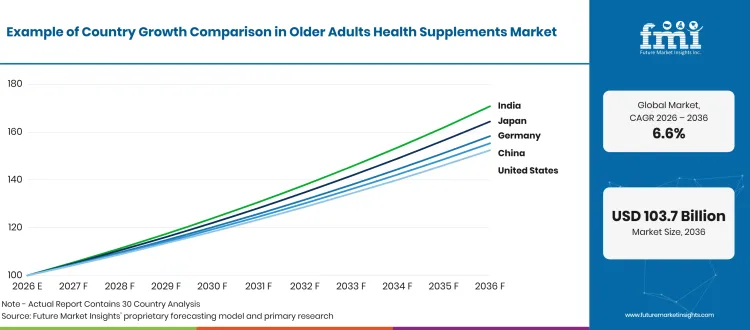
| Countries | CAGR 2024 to 2034 |
|---|---|
| United States | 4.3% |
| Germany | 4.7% |
| Japan | 5.1% |
| China | 4.5% |
| India | 5.5% |
Source: FMI analysis based on primary research and proprietary forecasting model
United States to Retain Dominance in Older Adults Health Supplements Sales
The ecosystem for Older Adults Health Supplements in the United States is projected to exhibit a CAGR of 4.3% during the assessment period. By 2034, revenue from the sales of Older Adults Health Supplements in the country is expected to reach USD 4.6 billion.
Recommendations from the physician play an important role in driving the demand for older adult health supplements in the United States. Healthcare providers frequently include supplements in the health plans of older patients, emphasizing their importance for overall well-being.
This endorsement not only enhances the credibility of supplements but also causes a sense of necessity among older adults, who trust their physicians' expertise. As a result, patients are more inclined to incorporate supplements into their daily routines, contributing to increased demand in the territory.
Demand Outlook for Older Adults Health Supplements in Germany
Older Adults Health Supplements demand in Germany is calculated to rise at a value CAGR of 4.7% during the forecast period (2024 to 2034). By 2034, Germany is expected to account for 17.8% of Older Adults Health Supplements sales in Europe.
Germany is the largest economy in Europe and home to a vast health-conscious population. As such, it has a rising consumer base for supplements aimed at promoting overall well-being. A robust regulatory framework ensures product safety and quality standards in the country, instilling confidence among consumers in efficacy and reliability.
The widespread availability of various retail channels, including pharmacies, health food stores, and online platforms, enhances product accessibility and convenience for consumers across the country.
Government support is the rising popularity of older adults health supplements in Japan
Consumption of Older Adults Health Supplements in Japan is projected to increase at a value CAGR of 5.1% over the next ten years. By 2034, the domain size is forecasted to reach USD 1.8 billion, with Japan expected to account for an industry share of 14.8% in East Asia.
Government support in Japan is promoting the acceptance and adoption of supplements among older adults by promoting their role in preventive healthcare and healthy aging initiatives. With a focus on proactive health management, government endorsements give credibility to supplements, which encourages their uptake among the aging population.
This support highlights the importance of supplements in maintaining wellness and fits well with cultural values of longevity. As a result, older adults are more inclined to include supplements in their daily routines, contributing to increased demand.
Category-Wise Insights
Popularity of Pills Lies in Ease of Consumption
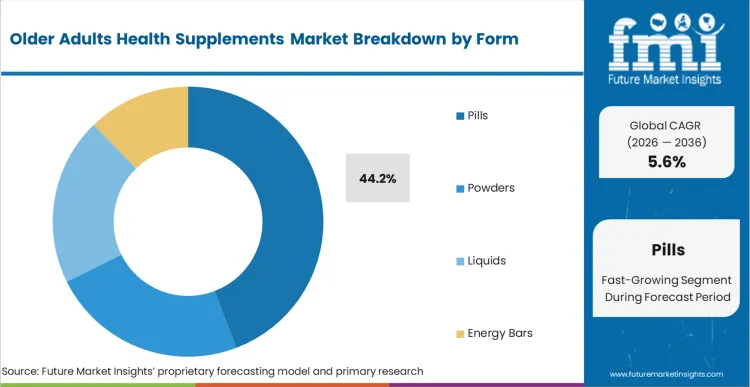
| Segment | Pills (Form) |
|---|---|
| Value Share (2024) | 44.2% |
Sales of Older Adults Health Supplements tablets are projected to register a CAGR of 4.7% from 2024 to 2034. The higher use of pills lies in the simplicity of their consumption; in other delivery formats, they mostly require measuring, mixing, or preparation. Pills offer a straightforward and effortless way to incorporate Older Adults Health Supplements into one’s daily routine.
They are often used to encapsulate ingredients with strong taste or odor, such as herbs and botanicals that are commonly found in Older Adults Health Supplements. Pills also help in precise dosage control as the amount of active ingredients in each tablet can be accurately measured and standardized.
All in all, pills provide consumers with the confidence that they are receiving the correct amount of supplement each time, enhancing their overall satisfaction and trust in the product.
Online Retailers are Leading Older Adults Health Supplements Sales
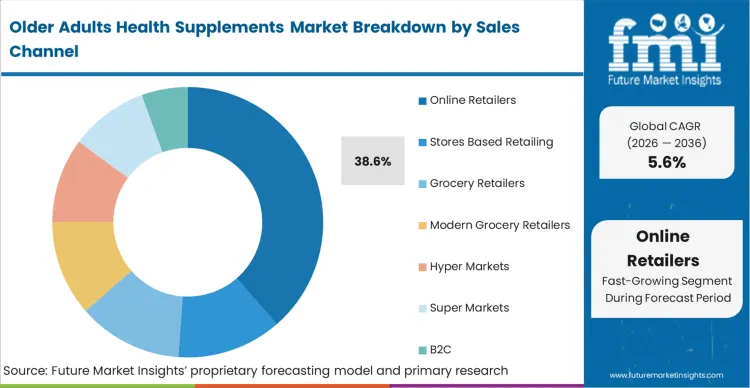
| Segment | Online Retailers (Sale Channel) |
|---|---|
| Value Share (2024) | 38.6% |
The rapidly growing popularity of online retailers is linked to the easy availability of products on these platforms. The online retailers segment is anticipated to advance at 5.4% CAGR during the projection period.
Online retailers provide consumers with easy access to a wide range of products as compared to traditional retailers. These offer convenience and accessibility to consumers, allowing them to browse and purchase from a wide range of Older Adults Health Supplements from the comfort of their home.
This diverse selection option allows consumers to explore different brands, formulations, and price points, empowering them to make informed choices that best suit their needs and preferences. Convenient delivery options, including home delivery and express shipping, make it easy for consumers to receive their supplements on time.
Competition Outlook
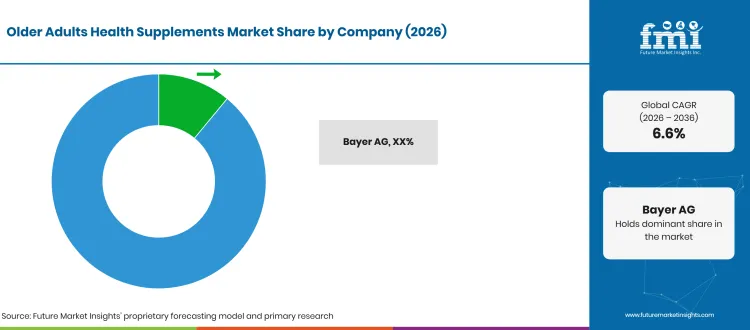
The Older Adults Health Supplements territory encompasses a diverse and dynamic competitive landscape. Leading Older Adults Health Supplements manufacturing companies are focusing on research and development, sustainable sourcing, and new formulations. They are also emphasizing environment-friendly practices and product certifications to satisfy the increasing demand for natural and sustainable ingredients.
Manufacturers are also looking to preserve their demand space position by focusing on product quality, innovation, and matching varied customer preferences.
Leading Older Adults Health Supplements Brands
- Bayer AG
- Pharma Nord Inc.
- Epax Norway AS
- Validus Pharmaceuticals
- Lexicare Pharma Private Limited
- Biocare Copenhagen A/S
- Bright Food (Group) Co., Ltd
- Otsuka Pharmaceutical Co.,Ltd.
- Healthy Life Pharma Private Limited
- SNU Biocare
- Saipro Biotech Private Limited.
- V.R.Industries Pvt. Ltd
- Nutra Healthcare
- Nestle (Nutren)
- Others
Scope of the Report
| Metric | Value |
|---|---|
| Quantitative Units | USD 54.8 Billion to USD 103.7 Billion, at a CAGR of 6.6% |
| Market Definition | Dietary supplements formulated and marketed for consumers aged 55 and above addressing bone health, cognitive function, cardiovascular support, immune resilience, and joint health. |
| Nature Segmentation | Conventional, Organic |
| Form Segmentation | Pills, Powders, Liquids, Energy Bars |
| Flavor Segmentation | Chocolate, Lemon, Cherry, Raspberry, Orange, Strawberry |
| Sales Channel | Online Retailers, Stores Based Retailing, Grocery Retailers, Modern Grocery Retailers, Hyper Markets, Super Markets, B2C |
| Regions Covered | North America, Latin America, Europe, East Asia, South Asia, Oceania, Middle East & Africa |
| Countries Covered | United States, Germany, Japan, China, India, and 40 plus countries |
| Key Companies Profiled | Bayer AG, Pharma Nord Inc., Epax Norway AS, Validus Pharmaceuticals, Lexicare Pharma Private Limited, Biocare Copenhagen A/S, Bright Food (Group) Co. Ltd, Otsuka Pharmaceutical Co. Ltd., Healthy Life Pharma Private Limited, SNU Biocare |
| Forecast Period | 2026 to 2036 |
| Approach | Bottom-up aggregation of supplement retail sales by product category and demographic targeting, weighted against per-capita expenditure benchmarks from primary research and household surveys |
Key Segments of the Report
By Nature:
As per nature, the ecosystem has been categorized into organic and conventional
By Form:
This segment is further categorized into pills, powders, liquids, and energy bars.
By Flavor:
This segment is further categorized into Orange, Lemon, Cherry, Raspberry, Chocolate, and Strawberry
By Sales Channel:
Different sales channels include B2C, Stores Based Retailing, Grocery Retailers, Modern grocery retailers, Hyper Markets, Super Markets, and Online Retailing
By Region:
Industry analysis has been carried out in key countries of North America, Latin America, Europe, East Asia, South Asia, Oceania, and the Middle East & Africa.
Frequently Asked Questions
How large is the Older Adults Health Supplements market in 2026?
The Older Adults Health Supplements market is estimated at USD 54.8 billion in 2026.
What will the Older Adults Health Supplements market reach by 2036?
The Older Adults Health Supplements market is projected to reach USD 103.7 billion by 2036.
What CAGR is projected?
The Older Adults Health Supplements market is expected to grow at a CAGR of 6.6% from 2026 to 2036.
Which Nature segment leads in 2026?
Conventional Nature holds 72.0% of Nature segment demand in 2026, reflecting price sensitivity among fixed-income older adult consumers and limited organic supplement certification availability.
Which Form is most used in 2026?
Pills account for 44.2% of Form segment demand in 2026, representing the default delivery format for the vitamin, mineral, and omega-3 categories most consumed by older adults.
Which Sales Channel leads in 2026?
Online Retailers command 38.6% of Sales Channel demand in 2026, driven by subscription supplement delivery model adoption and increasing older adult digital commerce engagement.
Which country grows fastest?
India is projected to grow at a 5.5% CAGR through 2036, supported by a rapidly ageing population, rising middle-class incomes, and growing preventive health supplement awareness among urban older adults.
What is excluded from this report?
General-purpose dietary supplements without senior-specific positioning, prescription pharmaceuticals, reimbursed medical foods, and meal replacement products without supplement active ingredient positioning are excluded.
How does FMI forecast this market?
FMI applies a bottom-up model aggregating supplement retail sales by product category and demographic targeting, cross-validated against per-capita supplement expenditure benchmarks from primary research and national household expenditure surveys.
Preview the report firsthand - request a free sample
Get SampleGet the brochure for pricing and purchase details.
Get PDFTable of Content
- Executive Summary
- Global Market Outlook
- Demand-side Trends
- Supply-side Trends
- Technology Roadmap Analysis
- Analysis and Recommendations
- Market Overview
- Market Coverage / Taxonomy
- Market Definition / Scope / Limitations
- Research Methodology
- Chapter Orientation
- Analytical Lens and Working Hypotheses
- Market Structure, Signals, and Trend Drivers
- Benchmarking and Cross-market Comparability
- Market Sizing, Forecasting, and Opportunity Mapping
- Research Design and Evidence Framework
- Desk Research Programme (Secondary Evidence)
- Company Annual and Sustainability Reports
- Peer-reviewed Journals and Academic Literature
- Corporate Websites, Product Literature, and Technical Notes
- Earnings Decks and Investor Briefings
- Statutory Filings and Regulatory Disclosures
- Technical White Papers and Standards Notes
- Trade Journals, Industry Magazines, and Analyst Briefs
- Conference Proceedings, Webinars, and Seminar Materials
- Government Statistics Portals and Public Data Releases
- Press Releases and Reputable Media Coverage
- Specialist Newsletters and Curated Briefings
- Sector Databases and Reference Repositories
- FMI Internal Proprietary Databases and Historical Market Datasets
- Subscription Datasets and Paid Sources
- Social Channels, Communities, and Digital Listening Inputs
- Additional Desk Sources
- Expert Input and Fieldwork (Primary Evidence)
- Primary Modes
- Qualitative Interviews and Expert Elicitation
- Quantitative Surveys and Structured Data Capture
- Blended Approach
- Why Primary Evidence is Used
- Field Techniques
- Interviews
- Surveys
- Focus Groups
- Observational and In-context Research
- Social and Community Interactions
- Stakeholder Universe Engaged
- C-suite Leaders
- Board Members
- Presidents and Vice Presidents
- R&D and Innovation Heads
- Technical Specialists
- Domain Subject-matter Experts
- Scientists
- Physicians and Other Healthcare Professionals
- Governance, Ethics, and Data Stewardship
- Research Ethics
- Data Integrity and Handling
- Primary Modes
- Tooling, Models, and Reference Databases
- Desk Research Programme (Secondary Evidence)
- Data Engineering and Model Build
- Data Acquisition and Ingestion
- Cleaning, Normalisation, and Verification
- Synthesis, Triangulation, and Analysis
- Quality Assurance and Audit Trail
- Market Background
- Market Dynamics
- Drivers
- Restraints
- Opportunity
- Trends
- Scenario Forecast
- Demand in Optimistic Scenario
- Demand in Likely Scenario
- Demand in Conservative Scenario
- Opportunity Map Analysis
- Product Life Cycle Analysis
- Supply Chain Analysis
- Investment Feasibility Matrix
- Value Chain Analysis
- PESTLE and Porter’s Analysis
- Regulatory Landscape
- Regional Parent Market Outlook
- Production and Consumption Statistics
- Import and Export Statistics
- Market Dynamics
- Global Market Analysis 2021 to 2025 and Forecast, 2026 to 2036
- Historical Market Size Value (USD Million) Analysis, 2021 to 2025
- Current and Future Market Size Value (USD Million) Projections, 2026 to 2036
- Y-o-Y Growth Trend Analysis
- Absolute $ Opportunity Analysis
- Global Market Pricing Analysis 2021 to 2025 and Forecast 2026 to 2036
- Global Market Analysis 2021 to 2025 and Forecast 2026 to 2036, By Nature
- Introduction / Key Findings
- Historical Market Size Value (USD Million) Analysis By Nature , 2021 to 2025
- Current and Future Market Size Value (USD Million) Analysis and Forecast By Nature , 2026 to 2036
- Conventional
- Organic
- Conventional
- Y-o-Y Growth Trend Analysis By Nature , 2021 to 2025
- Absolute $ Opportunity Analysis By Nature , 2026 to 2036
- Global Market Analysis 2021 to 2025 and Forecast 2026 to 2036, By Form
- Introduction / Key Findings
- Historical Market Size Value (USD Million) Analysis By Form, 2021 to 2025
- Current and Future Market Size Value (USD Million) Analysis and Forecast By Form, 2026 to 2036
- Pills
- Powders
- Liquids
- Energy Bars
- Pills
- Y-o-Y Growth Trend Analysis By Form, 2021 to 2025
- Absolute $ Opportunity Analysis By Form, 2026 to 2036
- Global Market Analysis 2021 to 2025 and Forecast 2026 to 2036, By Flavor
- Introduction / Key Findings
- Historical Market Size Value (USD Million) Analysis By Flavor, 2021 to 2025
- Current and Future Market Size Value (USD Million) Analysis and Forecast By Flavor, 2026 to 2036
- Chocolate
- Lemon
- Cherry
- Raspberry
- Orange
- Strawberry
- Chocolate
- Y-o-Y Growth Trend Analysis By Flavor, 2021 to 2025
- Absolute $ Opportunity Analysis By Flavor, 2026 to 2036
- Global Market Analysis 2021 to 2025 and Forecast 2026 to 2036, By Sales Channel
- Introduction / Key Findings
- Historical Market Size Value (USD Million) Analysis By Sales Channel, 2021 to 2025
- Current and Future Market Size Value (USD Million) Analysis and Forecast By Sales Channel, 2026 to 2036
- Online Retailers
- Stores Based Retailing
- Grocery Retailers
- Modern Grocery Retailers
- Hyper Markets
- Super Markets
- B2C
- Online Retailers
- Y-o-Y Growth Trend Analysis By Sales Channel, 2021 to 2025
- Absolute $ Opportunity Analysis By Sales Channel, 2026 to 2036
- Global Market Analysis 2021 to 2025 and Forecast 2026 to 2036, By Region
- Introduction
- Historical Market Size Value (USD Million) Analysis By Region, 2021 to 2025
- Current Market Size Value (USD Million) Analysis and Forecast By Region, 2026 to 2036
- North America
- Latin America
- Western Europe
- Eastern Europe
- East Asia
- South Asia and Pacific
- Middle East & Africa
- Market Attractiveness Analysis By Region
- North America Market Analysis 2021 to 2025 and Forecast 2026 to 2036, By Country
- Historical Market Size Value (USD Million) Trend Analysis By Market Taxonomy, 2021 to 2025
- Market Size Value (USD Million) Forecast By Market Taxonomy, 2026 to 2036
- By Country
- USA
- Canada
- Mexico
- By Nature
- By Form
- By Flavor
- By Sales Channel
- By Country
- Market Attractiveness Analysis
- By Country
- By Nature
- By Form
- By Flavor
- By Sales Channel
- Key Takeaways
- Latin America Market Analysis 2021 to 2025 and Forecast 2026 to 2036, By Country
- Historical Market Size Value (USD Million) Trend Analysis By Market Taxonomy, 2021 to 2025
- Market Size Value (USD Million) Forecast By Market Taxonomy, 2026 to 2036
- By Country
- Brazil
- Chile
- Rest of Latin America
- By Nature
- By Form
- By Flavor
- By Sales Channel
- By Country
- Market Attractiveness Analysis
- By Country
- By Nature
- By Form
- By Flavor
- By Sales Channel
- Key Takeaways
- Western Europe Market Analysis 2021 to 2025 and Forecast 2026 to 2036, By Country
- Historical Market Size Value (USD Million) Trend Analysis By Market Taxonomy, 2021 to 2025
- Market Size Value (USD Million) Forecast By Market Taxonomy, 2026 to 2036
- By Country
- Germany
- UK
- Italy
- Spain
- France
- Nordic
- BENELUX
- Rest of Western Europe
- By Nature
- By Form
- By Flavor
- By Sales Channel
- By Country
- Market Attractiveness Analysis
- By Country
- By Nature
- By Form
- By Flavor
- By Sales Channel
- Key Takeaways
- Eastern Europe Market Analysis 2021 to 2025 and Forecast 2026 to 2036, By Country
- Historical Market Size Value (USD Million) Trend Analysis By Market Taxonomy, 2021 to 2025
- Market Size Value (USD Million) Forecast By Market Taxonomy, 2026 to 2036
- By Country
- Russia
- Poland
- Hungary
- Balkan & Baltic
- Rest of Eastern Europe
- By Nature
- By Form
- By Flavor
- By Sales Channel
- By Country
- Market Attractiveness Analysis
- By Country
- By Nature
- By Form
- By Flavor
- By Sales Channel
- Key Takeaways
- East Asia Market Analysis 2021 to 2025 and Forecast 2026 to 2036, By Country
- Historical Market Size Value (USD Million) Trend Analysis By Market Taxonomy, 2021 to 2025
- Market Size Value (USD Million) Forecast By Market Taxonomy, 2026 to 2036
- By Country
- China
- Japan
- South Korea
- By Nature
- By Form
- By Flavor
- By Sales Channel
- By Country
- Market Attractiveness Analysis
- By Country
- By Nature
- By Form
- By Flavor
- By Sales Channel
- Key Takeaways
- South Asia and Pacific Market Analysis 2021 to 2025 and Forecast 2026 to 2036, By Country
- Historical Market Size Value (USD Million) Trend Analysis By Market Taxonomy, 2021 to 2025
- Market Size Value (USD Million) Forecast By Market Taxonomy, 2026 to 2036
- By Country
- India
- ASEAN
- Australia & New Zealand
- Rest of South Asia and Pacific
- By Nature
- By Form
- By Flavor
- By Sales Channel
- By Country
- Market Attractiveness Analysis
- By Country
- By Nature
- By Form
- By Flavor
- By Sales Channel
- Key Takeaways
- Middle East & Africa Market Analysis 2021 to 2025 and Forecast 2026 to 2036, By Country
- Historical Market Size Value (USD Million) Trend Analysis By Market Taxonomy, 2021 to 2025
- Market Size Value (USD Million) Forecast By Market Taxonomy, 2026 to 2036
- By Country
- Kingdom of Saudi Arabia
- Other GCC Countries
- Turkiye
- South Africa
- Other African Union
- Rest of Middle East & Africa
- By Nature
- By Form
- By Flavor
- By Sales Channel
- By Country
- Market Attractiveness Analysis
- By Country
- By Nature
- By Form
- By Flavor
- By Sales Channel
- Key Takeaways
- Key Countries Market Analysis
- USA
- Pricing Analysis
- Market Share Analysis, 2025
- By Nature
- By Form
- By Flavor
- By Sales Channel
- Canada
- Pricing Analysis
- Market Share Analysis, 2025
- By Nature
- By Form
- By Flavor
- By Sales Channel
- Mexico
- Pricing Analysis
- Market Share Analysis, 2025
- By Nature
- By Form
- By Flavor
- By Sales Channel
- Brazil
- Pricing Analysis
- Market Share Analysis, 2025
- By Nature
- By Form
- By Flavor
- By Sales Channel
- Chile
- Pricing Analysis
- Market Share Analysis, 2025
- By Nature
- By Form
- By Flavor
- By Sales Channel
- Germany
- Pricing Analysis
- Market Share Analysis, 2025
- By Nature
- By Form
- By Flavor
- By Sales Channel
- UK
- Pricing Analysis
- Market Share Analysis, 2025
- By Nature
- By Form
- By Flavor
- By Sales Channel
- Italy
- Pricing Analysis
- Market Share Analysis, 2025
- By Nature
- By Form
- By Flavor
- By Sales Channel
- Spain
- Pricing Analysis
- Market Share Analysis, 2025
- By Nature
- By Form
- By Flavor
- By Sales Channel
- France
- Pricing Analysis
- Market Share Analysis, 2025
- By Nature
- By Form
- By Flavor
- By Sales Channel
- India
- Pricing Analysis
- Market Share Analysis, 2025
- By Nature
- By Form
- By Flavor
- By Sales Channel
- ASEAN
- Pricing Analysis
- Market Share Analysis, 2025
- By Nature
- By Form
- By Flavor
- By Sales Channel
- Australia & New Zealand
- Pricing Analysis
- Market Share Analysis, 2025
- By Nature
- By Form
- By Flavor
- By Sales Channel
- China
- Pricing Analysis
- Market Share Analysis, 2025
- By Nature
- By Form
- By Flavor
- By Sales Channel
- Japan
- Pricing Analysis
- Market Share Analysis, 2025
- By Nature
- By Form
- By Flavor
- By Sales Channel
- South Korea
- Pricing Analysis
- Market Share Analysis, 2025
- By Nature
- By Form
- By Flavor
- By Sales Channel
- Russia
- Pricing Analysis
- Market Share Analysis, 2025
- By Nature
- By Form
- By Flavor
- By Sales Channel
- Poland
- Pricing Analysis
- Market Share Analysis, 2025
- By Nature
- By Form
- By Flavor
- By Sales Channel
- Hungary
- Pricing Analysis
- Market Share Analysis, 2025
- By Nature
- By Form
- By Flavor
- By Sales Channel
- Kingdom of Saudi Arabia
- Pricing Analysis
- Market Share Analysis, 2025
- By Nature
- By Form
- By Flavor
- By Sales Channel
- Turkiye
- Pricing Analysis
- Market Share Analysis, 2025
- By Nature
- By Form
- By Flavor
- By Sales Channel
- South Africa
- Pricing Analysis
- Market Share Analysis, 2025
- By Nature
- By Form
- By Flavor
- By Sales Channel
- USA
- Market Structure Analysis
- Competition Dashboard
- Competition Benchmarking
- Market Share Analysis of Top Players
- By Regional
- By Nature
- By Form
- By Flavor
- By Sales Channel
- Competition Analysis
- Competition Deep Dive
- Bayer AG
- Overview
- Product Portfolio
- Profitability by Market Segments (Product/Age /Sales Channel/Region)
- Sales Footprint
- Strategy Overview
- Marketing Strategy
- Product Strategy
- Channel Strategy
- Pharma Nord Inc.
- Epax Norway AS
- Validus Pharmaceuticals
- Lexicare Pharma Private Limited
- Biocare Copenhagen A/S
- Bright Food (Group) Co., Ltd
- Otsuka Pharmaceutical Co.,Ltd.
- Healthy Life Pharma Private Limited
- SNU Biocare
- Saipro Biotech Private Limited.
- V.R.Industries Pvt. Ltd
- Nutra Healthcare
- Nestle (Nutren)
- Others
- Bayer AG
- Competition Deep Dive
- Assumptions & Acronyms Used


