

- Market Size (2026)
- USD 301.7 Mn
- Forecast (2036)
- USD 715.6 Mn
- CAGR (2026 to 2036)
- 9.0%
How big is Agave Nectar Market in 2026?
USD 301.7 million in 2026 and USD 715.6 million by 2036 at a 9.0% CAGR.
Demand for agave nectar is projected to rise at a 9.0% CAGR by 2036, advancing from USD 276.8 million in 2025 to USD 301.7 million in 2026, and driving industry valuation to USD 715.6 million during the forecast period. Mexican export promotion is giving this growth a practical route because agave syrup already enters international food channels under its own product identity. Mexico’s Agriculture Secretariat reported on March 15 2026 that agave syrup appeared among products with strong recent sales increases during FOODEX Japan. Origin records and suitable pack formats can move a sampled sweetener into routine retail or formulation orders that generate repeat business.
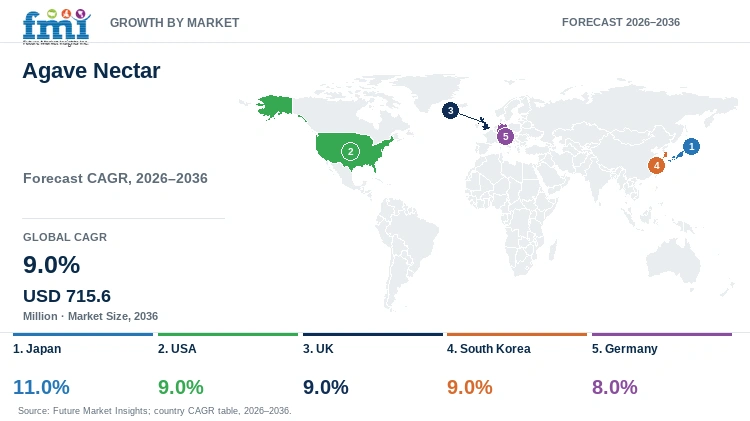
Country growth is not uniform because import rules and reformulation pressure change the commercial route for the same liquid sweetener. Japan is projected at 11.0% CAGR compared with Germany at 8.0% during 2026 to 2036. Japan’s Ministry of Agriculture lists Mexican agave syrup as a dedicated 2026 tariff-allocation item under the Japan-Mexico economic partnership framework. That defined import route gives Japanese buyers a clearer transaction mechanism for Mexican syrup. The three-point CAGR spread describes different commercialization conditions instead of different current market sizes.
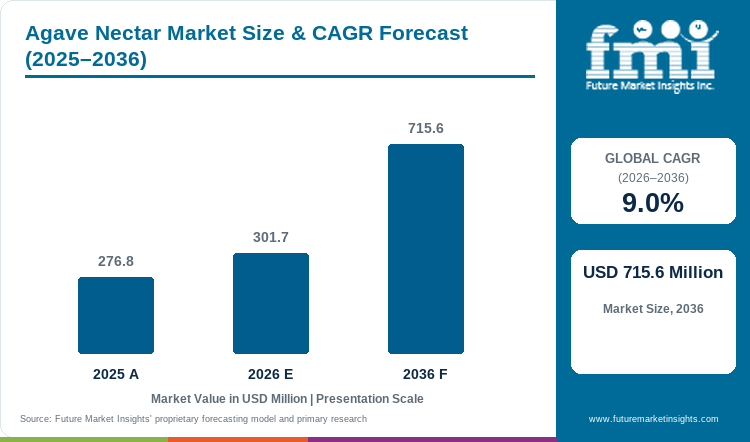
Key Takeaways of Agave Nectar Market
- Demand rises where one liquid sweetener can serve household use and formulated food applications without changing handling systems.
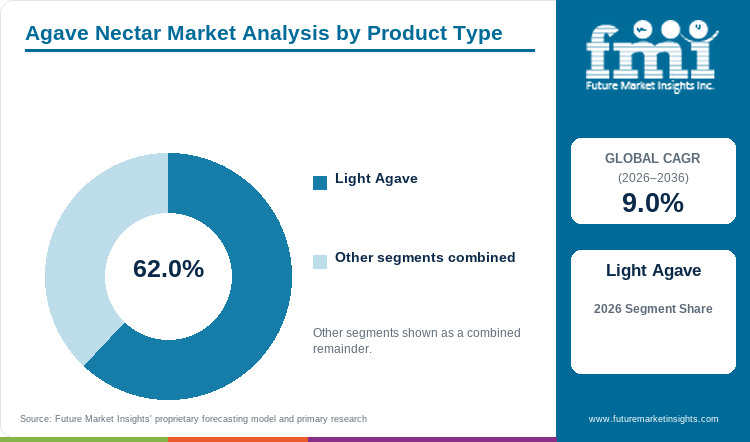
- Light agave is projected to account for 62.0% of product type revenue in 2026, driven by its milder sensory profile and broad recipe compatibility.
- Conventional agave is likely to capture 56.0% of nature revenue in 2026, attributable to demand for base sweetness without organic certification.
- Origin documentation and recognized certification give suppliers a practical route to distinguish agave if sweetness alone does not secure an order.
- Added-sugar rules can narrow agave use in reformulation projects that require substantial reductions in calories or declared sugars.
- Some of the key players in this market include Wholesome Sweeteners, Inc., NOW Health Group, Inc. dba NOW Foods, Madhava Natural Sweeteners, Sustainable Agave Ltd dba The Sustainable Agave Company, Brass Products Ltd dba Brass Products, Lot 49, LLC dba Box 7 Imports, Essex Food Ingredients, Tate & Lyle PLC, Ingredion Incorporated, and Cargill, Incorporated.
Analyst Perspective
“Agave nectar earns repeat orders when suppliers match sweetness with verifiable origin and the pack format required by the application. The main trade-off is straightforward: buyers accept a caloric syrup where flavor or sourcing value outweighs the pressure to remove added sugar.”
- Nandini Roy Choudhury, Principal Consultant, Future Market Insights
How is the agave nectar market segmented?
The agave nectar market is segmented by Product Type, Nature and Region.
Product type includes light agave and dark agave alongside raw agave as separate revenue categories. Nature separates conventional agave from organic agave according to certification status applied to the finished syrup. Region follows the standard global hierarchy used in the report taxonomy and geographic coverage fields.
How does light agave fit recipes that require sweetness without a stronger agave note?
Light agave serves recipes where sweetness must remain easy to dose without adding a pronounced cooked flavor. FOODEX Japan’s 2026 guide lists agave syrup for beverages and bakery products plus dairy and foodservice applications. Those placements fit the same purchase logic seen in adjacent naturally derived sweeteners because liquid handling and a recognizable plant origin can matter together during formulation. Food developers can use the liquid format in tabletop packs and production batches without changing the underlying sweetening function. Suppliers still need origin records and pack sizes that fit each account before a sampled syrup can move into repeat purchasing.
- Light agave is projected to hold 62.0% of product type revenue in 2026, supported by its mild profile and wider recipe compatibility.
- FOODEX Japan lists retail and bulk agave syrup formats from 330 grams through one tonne which supports both consumer packs and ingredient orders.
What keeps conventional agave relevant when organic certification changes the buying route?
Conventional agave serves buyers that need the syrup’s sweetness and handling performance without an organic claim on the finished product. Organic labeling adds a separate certification route under USDA rules updated in June 2026. The distinction resembles the choice inside the broader nutritive sweetener category where source claims can alter documentation requirements without changing the core caloric sweetening function. The purchase decision therefore separates basic sweetness performance from the additional documentation needed for an organic claim. Conventional syrup can move through standard ingredient approval while organic syrup needs verified certifier records before the pack carries the claim. Buyers compare that added documentation requirement with any price premium attached to organic positioning in the finished product.
- The nature category is forecast to be led by conventional agave at 56.0% share in 2026, owing to demand for the base sweetening function without organic certification.
- USDA guidance requires certified-organic content and certifier identification for qualifying organic labels which adds documentation that conventional syrup does not carry.
What are the drivers, restraints and opportunities in the Agave Nectar Market?
Multi-application liquid use supports demand while added-sugar pressure narrows some formulations and documented origin creates a qualification route.
- Driver: Liquid agave serves direct sweetening and formulated products without requiring a different physical format for each channel.
- Restraint: Nutrition rules expose syrup-derived added sugar and can disqualify agave from projects centered on deeper sugar reduction.
- Opportunity: Verified Mexican origin and organic credentials can support differentiated offers where buyers need traceable ingredient documentation.
Liquid Format Keeps Multiple Applications Commercially Accessible
Retail and bulk formats let one liquid specification serve both consumer packs and production-scale orders. Suppliers can therefore serve formulation work in the beverage ingredients category and packaged sweetener demand with the same core liquid product. FOODEX Japan’s 2026 guide places agave syrup in beverage and bakery applications plus dairy and foodservice uses. The guide also lists retail packs and bulk formats that support household and ingredient purchasing routes. Appropriate pack sizes and channel documentation remain necessary before buyers convert a trial into routine orders.
Added-Sugar Disclosure Narrows Some Reformulation Briefs
FDA guidance published in 2026 classifies sugars from syrups as added sugars and requires their contribution on Nutrition Facts labels. Agave remains a poor fit for formulations that target large reductions in declared added sugar. The pressure is strongest when brands compare caloric syrup with sugar substitutes that provide sweetness with fewer calories. Agave still fits recipes where its flavor or liquid handling has a clear product function. Food developers need to decide whether that function justifies the label contribution before commercial approval.
Origin and Certification Can Convert Ingredient Interest into Qualified Supply
USDA labeling guidance updated in June 2026 requires certified organic products to meet defined composition and certifier-identification rules. Agave suppliers that carry recognized certification can use that documentation during retail or ingredient qualification. The same commercial logic appears in clean-label ingredients where documented source and label eligibility influence supplier choice. Value comes from reducing verification work instead of adding another unproven marketing claim during qualification.
Which country CAGRs are profiled in the Agave Nectar Market?
| Country | CAGR |
|---|---|
| Japan | 11.0% |
| USA | 9.0% |
| UK | 9.0% |
| South Korea | 9.0% |
| Germany | 8.0% |
How do country-level CAGRs compare in the Agave Nectar Market?
Japan forms the upper end of the profiled range at 11.0% while Germany is modeled at 8.0%. The USA and UK join South Korea in a 9.0% middle band for the same forecast period. These rates compare forecast movement instead of present country size because trade access and food reformulation conditions differ by jurisdiction.
- Japan's defined trade route for Mexican agave syrup reduces import ambiguity and gives specialty-food buyers a clearer route to qualify eligible shipments.
- Across the USA, agave moves through branded retail and formulated-food channels which gives suppliers more than one route to repeat purchasing.
- UK food developers can retain agave in bakery and foodservice applications while beverage reformulation faces tighter sugar thresholds that change recipe economics.
- South Korea's wider nutrition labeling raises scrutiny of sugar declarations and rewards suppliers that provide accurate data before brands finalize claims and pack design.
- Germany's specialty-food and organic channels support differentiated agave offers while national sugar-reduction targets keep caloric sweeteners under active formulation review.
Comparable growth rates can still produce different entry conditions because each country changes how agave is imported or labeled. The full report provides country-level CAGR analysis across North America, Latin America, Western Europe, Eastern Europe, East Asia, South Asia and Pacific, and the Middle East and Africa.
Country-wise Analysis
- Japan gives Mexican agave syrup a defined import route within its 2026 tariff-allocation framework. Agave nectar demand in Japan is projected to expand at 11.0% CAGR through 2036, reinforced by formal trade treatment that reduces ambiguity for eligible shipments. The Consumer Affairs Agency published front-of-pack nutrition guidance in February 2026 that makes nutrient information easier to compare on packaged foods. Importers therefore need sweetness performance and label-ready nutrition data before a syrup moves beyond trial orders. Prepared Japanese documentation improves competitiveness for suppliers in the broader specialty sweeteners category before commercial sampling begins.
- USA buyers already encounter agave as both a packaged sweetener and a formulation ingredient in natural-food channels. The USA agave nectar sector is forecast to grow at 9.0% CAGR from 2026 to 2036, due to repeat purchasing through branded retail and formulation channels. FDA guidance published in 2026 states that sugars from syrups count as added sugars on Nutrition Facts labels. Formulators therefore compare agave with stevia systems when projects require materially lower declared sugar on finished labels. Agave remains viable where flavor and liquid handling justify the added-sugar contribution and certifications meet retailer qualification requirements. Retail and ingredient suppliers need different pack sizes even when the underlying syrup specification stays constant.
- UK demand separates direct sweetening applications from beverages that face a tightening fiscal threshold for added sugar. Agave nectar sales in the UK are anticipated to record 9.0% CAGR through 2036, aided by bakery and foodservice uses outside levy-sensitive beverages. The Finance Bill 2026 technical consultation published by HMRC on July 13, 2026 formalizes the Budget 2025 announcement lowering the Soft Drinks Industry Levy threshold to 4.5 grams of added sugar per 100 milliliters from January 2028. That adjustment widens the range of beverage formulations where agave's caloric load requires direct comparison against lower-sugar alternatives.Suppliers need application guidance that identifies uses where agave’s sensory contribution warrants its sugar load.
- South Korea is widening nutrition disclosure for packaged foods which makes sugar content more visible during product comparison. South Korean agave nectar demand is predicted to advance at 9.0% CAGR through 2036, influenced by specialty formulations that retain origin value despite broader nutrition disclosure. The Korea Disease Control and Prevention Agency states that mandatory nutrition labeling expands from 182 to 259 processed-food categories from 2026 and includes sugars among nine required nutrients. Suppliers selling to brands that also use functional food ingredients must provide accurate nutrition data before claims or pack design are finalized. Growth remains conditional on agave contributing enough flavor or origin value to justify its caloric content.
- Germany combines a mature specialty-food channel with active national work to reduce sugar in processed foods. Agave nectar demand in Germany is expected to maintain 8.0% CAGR through 2036, shaped by specialty uses where origin and organic positioning remain relevant despite sugar-reduction targets. The Max Rubner-Institut published July 2025 targets proposing a 15% sugar reduction in cola drinks and 10% in selected fine bakery products. The targets increase pressure to reformulate sweetness while natural food flavors can help preserve sensory character as sugar levels fall. Agave suppliers need applications where sensory value and traceable sourcing survive that reformulation test. German suppliers therefore need clear application evidence before using organic origin as a substitute for reformulation performance.
Who are the notable companies in the Agave Nectar Market?
Wholesome Sweeteners, Inc., NOW Health Group, Inc. dba NOW Foods, Madhava Natural Sweeteners, Sustainable Agave Ltd dba The Sustainable Agave Company, Brass Products Ltd dba Brass Products, Lot 49, LLC dba Box 7 Imports, Essex Food Ingredients, Tate & Lyle PLC, Ingredion Incorporated, and Cargill, Incorporated are notable companies within the agave nectar competitive set.
Competition separates direct agave suppliers from larger sweetener platforms that influence substitution decisions in formulated foods. Wholesome Sweeteners and NOW Health Group sell branded agave products alongside Madhava Natural Sweeteners in current retail channels. Sustainable Agave and Brass Products hold agave-syrup certifications that support direct handling within defined organic programs. Box 7 Imports and Essex Food Ingredients have certified agave-syrup handling records that support importer and ingredient-distribution roles. Tate & Lyle and Ingredion both operate immediate-family sweetener platforms whose portfolios address the same reformulation decisions as agave nectar. Note that Ingredion announced a recommended all-cash acquisition of Tate & Lyle in June 2026, with shareholder approval received in July 2026 and completion expected in the second half of 2027, subject to regulatory and court conditions. Cargill represents a third immediate-family competitor through its stevia and broader sugar-reduction systems rather than a verified agave portfolio.
- Direct branded agave suppliers include Wholesome Sweeteners and NOW Health Group alongside Madhava Natural Sweeteners in current retail channels.
- Certified agave-syrup specialists include Sustainable Agave and Brass Products alongside Box 7 Imports and Essex Food Ingredients in current records.
- Broader sweetener competitors include Tate & Lyle, Ingredion and Cargill because their sugar-reduction portfolios can replace agave in selected formulations.
Competitive Benchmarking: Agave Nectar Market
| Company | Exact Agave Route | Certification and Origin Evidence | Formulation Breadth | Geographic Reach |
|---|---|---|---|---|
| Wholesome Sweeteners, Inc. | High | High | Medium | United States retail with Mexican agave sourcing |
| NOW Health Group, Inc. dba NOW Foods | High | High | Medium | United States, Canada and international retail |
| Madhava Natural Sweeteners | High | Medium | Medium | United States branded retail and foodservice use |
| Sustainable Agave Ltd dba The Sustainable Agave Company | Medium | High | Low | Mexico-based certified agave supply |
| Brass Products Ltd dba Brass Products | Medium | High | Low | Canada and United States certified trade |
| Lot 49, LLC dba Box 7 Imports | Medium | High | Medium | United States organic importing and ingredient purchasing |
| Essex Food Ingredients | Medium | High | High | North American ingredient distribution with equivalence programs |
| Tate & Lyle PLC | Low | Low | High | Global sweetening and formulation platform |
| Ingredion Incorporated | Low | Low | High | Global ingredient and sugar-reduction platform |
| Cargill, Incorporated | Low | Low | High | Global food ingredient and sweetener platform |
Scoring basis: High exact-agave evidence requires a current branded offer or direct agave-syrup route. Medium identifies certified handling or narrower direct participation and Low identifies only immediate-family sweetener competition. Certification ratings follow current agave-specific organic status and origin evidence that is visible in official records. Formulation breadth reflects the number of verified sweetening or ingredient routes relevant to food and beverage formulation.
Key Developments in the Agave Nectar Market
- In May 2026, Wholesome Sweeteners shipped Organic Agave Nectar with Hot Chili Peppers as a flavored extension of its certified agave line.
- In December 2025, Sustainable Agave Ltd received CCOF USDA NOP and Handling certification with agave syrup listed inside the certified scope.
- In December 2025, Brass Products Ltd received CCOF Handling and USDA NOP certification plus US/Canada Equivalence for agave syrup trade.
Key Players in the Agave Nectar Market
Branded Agave Nectar Suppliers
- Wholesome Sweeteners, Inc.
- NOW Health Group, Inc. dba NOW Foods
- Madhava Natural Sweeteners
Certified Agave Syrup Supply and Handling
- Sustainable Agave Ltd dba The Sustainable Agave Company
- Brass Products Ltd dba Brass Products
- Lot 49, LLC dba Box 7 Imports
- Essex Food Ingredients
Broader Sweetener and Reformulation Platforms
- Tate & Lyle PLC
- Ingredion Incorporated
- Cargill, Incorporated
Agave Nectar Market - Report Scope
| Coverage field | Report scope |
|---|---|
| Market breakdown | By product type, nature and region. |
| Quantitative Units | USD million. |
| Market Definition | Revenue includes agave nectar or agave syrup sold in light, dark or raw formats across conventional and organic categories. Downstream finished-product revenue, agave inulin, tequila, mezcal and substitute sweeteners are excluded. |
| Regions Covered | North America, Latin America, Western Europe, Eastern Europe, East Asia, South Asia and Pacific, and Middle East and Africa. |
| Countries Covered | Japan, USA, UK, South Korea, Germany, and 20+ countries included in the full report. |
| Key Companies Profiled | Wholesome Sweeteners, Inc., NOW Health Group, Inc. dba NOW Foods, Madhava Natural Sweeteners, Sustainable Agave Ltd dba The Sustainable Agave Company, Brass Products Ltd dba Brass Products, Lot 49, LLC dba Box 7 Imports, Essex Food Ingredients, Tate & Lyle PLC, Ingredion Incorporated, and Cargill, Incorporated. |
| Forecast Period | 2026 to 2036. |
| Approach | Primary and secondary research with market triangulation. |
Agave Nectar Market - Research Methodology
| Method | Approach |
|---|---|
| Primary Research | Primary research inputs are reflected only where they are already embedded in the supplied FMI market model. No standalone interview claim is used as evidence in this article. Reader-facing external claims rely on the public sources listed in the bibliography and on the verified market model. |
| Desk Research | Desk research covered government statistics, regulatory publications, trade and certification records, recognized organizations, company filings, and official corporate announcements. Sources were checked for publication date, geographic coverage, and fit with the defined agave nectar scope. Product pages were used only to confirm current capability and not to prove dated company actions. |
| Market Sizing and Forecasting | The market model uses the supplied 2026 baseline, 2036 forecast value, segment structure, and country growth assumptions. The displayed 9.0% CAGR reconciles the 2026 and 2036 values over ten forecast intervals. Segment and country figures remain consistent with the supplied model throughout the article. |
| Data Validation | Final estimates were checked against the supplied value ledger and public evidence for market scope, country mechanisms, and company activity. Validation excludes substitute-sweetener revenue from the agave nectar total while retaining immediate-family competitors only for clearly labeled substitution analysis. Country evidence must match national scale before it supports a country mechanism. |
Agave Nectar Market by Segments
Agave Nectar Market segmented by Product Type:
- Light Agave
- Dark Agave
- Raw Agave
Agave Nectar Market segmented by Nature:
- Conventional
- Organic
Agave Nectar Market by Region:
- North America
- United States
- Canada
- Latin America
- Brazil
- Mexico
- Chile
- Rest of Latin America
- Western Europe
- Germany
- United Kingdom
- Italy
- Spain
- France
- Nordics
- Benelux
- Rest of Western Europe
- Eastern Europe
- Russia
- Poland
- Hungary
- Balkan and Baltic States
- Rest of Eastern Europe
- East Asia
- China
- Japan
- South Korea
- South Asia and Pacific
- India
- ASEAN
- Australia and New Zealand
- Rest of South Asia and Pacific
- Middle East and Africa
- Kingdom of Saudi Arabia
- Other GCC Countries
- Türkiye
- South Africa
- Other African Union Countries
- Rest of Middle East and Africa
Research Sources and Bibliography
- Secretaría de Agricultura y Desarrollo Rural. (2026, March 15). En Foodex 2026 de Japón, reafirma AGRICULTURA compromiso de diversificar mercados.
- Ministry of Agriculture, Forestry and Fisheries. (2026).
- Japan Management Association. (2026, March 10). AGAVE SYRUP - Online Guidebook | FOODEX JAPAN 2026.
- U.S. Department of Agriculture, Agricultural Marketing Service. (2026, June). Labeling requirements for the U.S. organic market.
- U.S. Food and Drug Administration. (2026). Added Sugars on the Nutrition Facts Label.
- Consumer Affairs Agency, Government of Japan. (2026, February 26).
- Korea Disease Control and Prevention Agency. (2025, August 1; updated 2026, May 27).
- HM Revenue & Customs. (2026, July 13). Soft Drink Industry Levy changes.
- Max Rubner-Institut. (2025, July 2). Reduktionsziele für Zucker, Fett und Salz.
- Tate & Lyle PLC. (2025, October 31). One year on: How our stevia Reb M partnership with Manus is benefiting customers.
- QSR Magazine. (2025, June 24). Fuego Tortilla Grill Launches New Watermelon Margarita.
- Wholesome Sweeteners. (2026). FAQ: Wholesome Infusions first ship date 5/4/2026.
- CCOF. (2026, September 10). Essex Food Ingredients.
- Tate & Lyle PLC. (2026, May 18). Tate & Lyle expands collaboration with BioHarvest to accelerate next-generation sweetener innovation.
- Cargill. (2025, September 26). Cargill’s EverSweet stevia sweetener named a finalist in the 2025 Global Good Awards Game Changing Innovation of the Year.
- Regenerative Organic Alliance. (n.d.). Wholesome. Retrieved September 17, 2026.
- Quality Assurance International. (2026, February 23). Official QAI Product Certification Listing: NOW Health Group, Inc. dba NOW Foods.
- CCOF. (2025, December 18). Sustainable Agave Ltd dba The Sustainable Agave Company.
- CCOF. (2025, December 18). Brass Products Ltd dba Brass Products.
- CCOF. (2025, January 7). Lot 49, LLC dba Box 7 Imports.
- Madhava Foods. (n.d.). Organic Agave. Retrieved September 17, 2026.
- Tate & Lyle PLC. (2026, February 23). Introducing Yume™: A new standard for sweetness.
- Ingredion Incorporated. (2025, April 29). PureCircle by Ingredion Achieves Farm Sustainability Assessment Silver Performance Level for 100% of Stevia Supply.
- Tate & Lyle PLC. (2026, July 28). Recommended cash acquisition of Tate & Lyle PLC by Ingredion Incorporated - Results of Shareholder Meetings.
This bibliography is provided for reader reference and is not exhaustive. The full report contains the complete reference list and detailed citations
This Report Answers
- How large is the agave nectar market in 2026 and 2036?
- Which operating conditions convert agave syrup interest into repeat commercial orders?
- Why does light agave hold 62.0% of product type revenue?
- Why does conventional agave account for 56.0% of nature revenue?
- How do added-sugar rules change agave use in formulated foods?
- How do country growth conditions differ across the five profiled markets?
- Which companies supply agave directly or compete through substitute sweetener platforms?
- Which recent certifications and sweetener developments affect competitive qualification decisions?
Frequently Asked Questions
How big is the Agave Nectar Market in 2026?
The agave nectar market is valued at USD 301.7 million in 2026 and is projected to reach USD 715.6 million by 2036. Growth depends on repeat orders from retail sweetener and formulated-food applications that accept the product’s caloric sweetness profile.
What is the CAGR of the Agave Nectar Market from 2026 to 2036?
The agave nectar market is projected to grow at 9.0% CAGR between 2026 and 2036. Liquid-format versatility and documented origin support expansion in applications where caloric sweetness remains acceptable.
Which product type segment accounts for 62.0% of 2026 revenue?
The light agave segment is expected to hold 62.0% of product type revenue in 2026. Its mild flavor favors wider use in beverages and foods that do not need stronger cooked agave notes.
How much value is the Agave Nectar Market expected to add between 2026 and 2036?
The agave nectar market is expected to add USD 413.9 million in value between 2026 and 2036. The additional value depends on recurring retail and formulation orders that convert sampled agave into repeat commercial volume.
What CAGR is projected for Japan within the profiled country set?
Japan is projected to record 11.0% CAGR from 2026 to 2036 within the profiled country set. A defined import route for Mexican agave syrup gives eligible shipments a clearer commercial path.
Which companies are active in the Agave Nectar Market?
Key companies relevant to the agave nectar market include Wholesome Sweeteners, Inc., NOW Health Group, Inc. dba NOW Foods, Madhava Natural Sweeteners, Sustainable Agave Ltd dba The Sustainable Agave Company, Brass Products Ltd dba Brass Products, Lot 49, LLC dba Box 7 Imports, Essex Food Ingredients, Tate & Lyle PLC, Ingredion Incorporated, and Cargill, Incorporated. The set combines direct agave suppliers with broader sweetener platforms that influence substitution and reformulation decisions.
Preview the report firsthand - request a free sample
Get SampleGet the brochure for pricing and purchase details.
Get PDFTable of Content
- Key Takeaways
- Market Size and CAGR
- Top Growth Driver
- Fastest Growing Segment
- Leading Region
- Key Companies
- Emerging Opportunities
- Executive Summary
- Global Market Outlook
- Demand-side Trends
- Supply-side Trends
- Technology Roadmap Analysis
- Analysis and Recommendations
- Analyst Perspective (What is happening? Why now? What should investors know?)
- Key Questions Answered
- How large is the market?
- What is the CAGR?
- What are key trends?
- Which region dominates?
- Who are the leaders?
- Market Overview
- Market Coverage / Taxonomy
- Market Definition / Scope / Limitations
- Research Methodology
- Chapter Orientation
- Analytical Lens and Working Hypotheses
- Market Structure, Signals, and Trend Drivers
- Benchmarking and Cross-market Comparability
- Market Sizing, Forecasting, and Opportunity Mapping
- Research Design and Evidence Framework
- Desk Research Programme (Secondary Evidence)
- Expert Input and Fieldwork (Primary Evidence)
- Tooling, Models, and Reference Databases
- Data Engineering and Model Build
- Quality Assurance and Audit Trail
- Market Background
- Market Dynamics (Drivers, Restraints, Opportunity, Trends)
- Scenario Forecast (Optimistic, Likely, Conservative)
- Impact Analysis
- AI Impact
- Sustainability Impact
- Regulatory Impact
- Technology Impact
- Consumer / Buyer Analysis
- Purchase Drivers
- Adoption Barriers
- Buyer Journey
- Opportunity Map Analysis
- Product Life Cycle Analysis
- Supply Chain Analysis
- Investment Feasibility Matrix
- Value Chain Analysis
- PESTLE and Porter's Analysis
- Regulatory Landscape
- Regional Parent Market Outlook
- Production and Consumption Statistics
- Import and Export Statistics
- Global Market Analysis and Forecast, 2021 to 2036
- Historical Market Size Value (USD Million) Analysis, 2021 to 2025
- Current and Future Market Size Value (USD Million) Projections, 2026 to 2036
- Y-o-Y Growth Trend Analysis
- Absolute $ Opportunity Analysis
- Global Market Pricing Analysis, 2021 to 2036
- Global Market Analysis and Forecast, By Product Type, 2021 to 2036
- Introduction / Key Findings
- Historical Market Size Value (USD Million) Analysis By Product Type, 2021 to 2025
- Current and Future Market Size Value (USD Million) Analysis and Forecast By Product Type, 2026 to 2036
- Light Agave
- Dark Agave
- Raw Agave
- Y-o-Y Growth Trend Analysis By Product Type, 2021 to 2025
- Absolute $ Opportunity Analysis By Product Type, 2026 to 2036
- Global Market Analysis and Forecast, By Nature, 2021 to 2036
- Introduction / Key Findings
- Historical Market Size Value (USD Million) Analysis By Nature, 2021 to 2025
- Current and Future Market Size Value (USD Million) Analysis and Forecast By Nature, 2026 to 2036
- Conventional
- Organic
- Y-o-Y Growth Trend Analysis By Nature, 2021 to 2025
- Absolute $ Opportunity Analysis By Nature, 2026 to 2036
- Global Market Analysis and Forecast, By Region, 2021 to 2036
- Introduction
- Historical Market Size Value (USD Million) Analysis By Region, 2021 to 2025
- Current Market Size Value (USD Million) Analysis and Forecast By Region, 2026 to 2036
- North America
- Latin America
- Western Europe
- Eastern Europe
- East Asia
- South Asia and Pacific
- Middle East and Africa
- Market Attractiveness Analysis By Region
- North America Market Analysis and Forecast, By Country, 2021 to 2036
- Historical Market Size Value (USD Million) Trend Analysis By Market Taxonomy, 2021 to 2025
- Market Size Value (USD Million) Forecast By Market Taxonomy, 2026 to 2036
- By Country
- United States
- Canada
- By Product Type
- By Nature
- By Country
- Market Attractiveness Analysis
- By Country
- By Product Type
- By Nature
- Key Takeaways
- Latin America Market Analysis and Forecast, By Country
- Historical Market Size Value (USD Million) Trend Analysis By Market Taxonomy, 2021 to 2025
- Market Size Value (USD Million) Forecast By Market Taxonomy, 2026 to 2036
- By Country
- Brazil
- Mexico
- Chile
- Rest of Latin America
- By Product Type
- By Nature
- By Country
- Market Attractiveness Analysis
- By Country
- By Product Type
- By Nature
- Key Takeaways
- Western Europe Market Analysis and Forecast, By Country
- Historical Market Size Value (USD Million) Trend Analysis By Market Taxonomy, 2021 to 2025
- Market Size Value (USD Million) Forecast By Market Taxonomy, 2026 to 2036
- By Country
- Germany
- United Kingdom
- Italy
- Spain
- France
- Nordics
- Benelux
- Rest of Western Europe
- By Product Type
- By Nature
- By Country
- Market Attractiveness Analysis
- By Country
- By Product Type
- By Nature
- Key Takeaways
- Eastern Europe Market Analysis and Forecast, By Country
- Historical Market Size Value (USD Million) Trend Analysis By Market Taxonomy, 2021 to 2025
- Market Size Value (USD Million) Forecast By Market Taxonomy, 2026 to 2036
- By Country
- Russia
- Poland
- Hungary
- Balkan and Baltic States
- Rest of Eastern Europe
- By Product Type
- By Nature
- By Country
- Market Attractiveness Analysis
- By Country
- By Product Type
- By Nature
- Key Takeaways
- East Asia Market Analysis and Forecast, By Country
- Historical Market Size Value (USD Million) Trend Analysis By Market Taxonomy, 2021 to 2025
- Market Size Value (USD Million) Forecast By Market Taxonomy, 2026 to 2036
- By Country
- China
- Japan
- South Korea
- By Product Type
- By Nature
- By Country
- Market Attractiveness Analysis
- By Country
- By Product Type
- By Nature
- Key Takeaways
- South Asia and Pacific Market Analysis and Forecast, By Country
- Historical Market Size Value (USD Million) Trend Analysis By Market Taxonomy, 2021 to 2025
- Market Size Value (USD Million) Forecast By Market Taxonomy, 2026 to 2036
- By Country
- India
- ASEAN
- Australia and New Zealand
- Rest of South Asia and Pacific
- By Product Type
- By Nature
- By Country
- Market Attractiveness Analysis
- By Country
- By Product Type
- By Nature
- Key Takeaways
- Middle East and Africa Market Analysis and Forecast, By Country
- Historical Market Size Value (USD Million) Trend Analysis By Market Taxonomy, 2021 to 2025
- Market Size Value (USD Million) Forecast By Market Taxonomy, 2026 to 2036
- By Country
- Kingdom of Saudi Arabia
- Other GCC Countries
- Türkiye
- South Africa
- Other African Union Countries
- Rest of Middle East and Africa
- By Product Type
- By Nature
- By Country
- Market Attractiveness Analysis
- By Country
- By Product Type
- By Nature
- Key Takeaways
- Key Countries Market Analysis
- United States
- Pricing Analysis
- Market Share Analysis, 2025
- By Product Type
- By Nature
- Canada
- Pricing Analysis
- Market Share Analysis, 2025
- By Product Type
- By Nature
- Mexico
- Pricing Analysis
- Market Share Analysis, 2025
- By Product Type
- By Nature
- Brazil
- Pricing Analysis
- Market Share Analysis, 2025
- By Product Type
- By Nature
- Chile
- Pricing Analysis
- Market Share Analysis, 2025
- By Product Type
- By Nature
- Germany
- Pricing Analysis
- Market Share Analysis, 2025
- By Product Type
- By Nature
- United Kingdom
- Pricing Analysis
- Market Share Analysis, 2025
- By Product Type
- By Nature
- Italy
- Pricing Analysis
- Market Share Analysis, 2025
- By Product Type
- By Nature
- Spain
- Pricing Analysis
- Market Share Analysis, 2025
- By Product Type
- By Nature
- France
- Pricing Analysis
- Market Share Analysis, 2025
- By Product Type
- By Nature
- India
- Pricing Analysis
- Market Share Analysis, 2025
- By Product Type
- By Nature
- ASEAN
- Pricing Analysis
- Market Share Analysis, 2025
- By Product Type
- By Nature
- Australia and New Zealand
- Pricing Analysis
- Market Share Analysis, 2025
- By Product Type
- By Nature
- China
- Pricing Analysis
- Market Share Analysis, 2025
- By Product Type
- By Nature
- Japan
- Pricing Analysis
- Market Share Analysis, 2025
- By Product Type
- By Nature
- South Korea
- Pricing Analysis
- Market Share Analysis, 2025
- By Product Type
- By Nature
- Russia
- Pricing Analysis
- Market Share Analysis, 2025
- By Product Type
- By Nature
- Poland
- Pricing Analysis
- Market Share Analysis, 2025
- By Product Type
- By Nature
- Hungary
- Pricing Analysis
- Market Share Analysis, 2025
- By Product Type
- By Nature
- Kingdom of Saudi Arabia
- Pricing Analysis
- Market Share Analysis, 2025
- By Product Type
- By Nature
- Türkiye
- Pricing Analysis
- Market Share Analysis, 2025
- By Product Type
- By Nature
- South Africa
- Pricing Analysis
- Market Share Analysis, 2025
- By Product Type
- By Nature
- United States
- Market Structure Analysis
- Competition Dashboard
- Competition Benchmarking
- Market Share Analysis of Top Players
- By Regional
- By Product Type
- By Nature
- Emerging Startups
- Innovation Benchmarking
- Competition Analysis
- Competition Deep Dive
- Wholesome Sweeteners, Inc.
- Overview
- Product Portfolio
- Profitability by Market Segments
- Sales Footprint
- Strategy Overview
- Marketing Strategy
- Product Strategy
- Channel Strategy
- NOW Health Group, Inc. dba NOW Foods
- Madhava Natural Sweeteners
- Sustainable Agave Ltd dba The Sustainable Agave Company
- Brass Products Ltd dba Brass Products
- Lot 49, LLC dba Box 7 Imports
- Essex Food Ingredients
- Tate & Lyle PLC
- Ingredion Incorporated
- Cargill, Incorporated
- Wholesome Sweeteners, Inc.
- Case Studies
- Success Stories
- Recent Developments
- Competition Deep Dive
- Assumptions & Acronyms Used


