

- Industry Size (2026)
- USD 1.44 Bn
- Forecast (2036)
- USD 1.94 Bn
- CAGR (2026 to 2036)
- 3.0%
Barometer Market Size, Market Forecast and Outlook By FMI
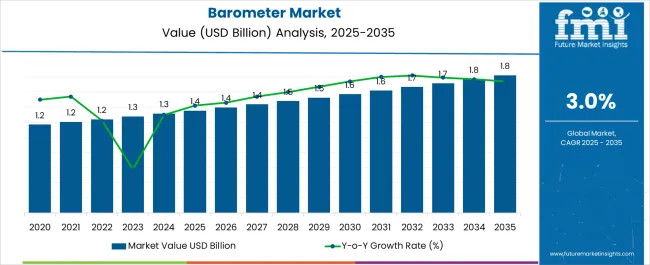
The barometer market was valued at USD 1.40 billion in 2025, projected to reach USD 1.44 billion in 2026, and is forecast to expand to USD 1.94 billion by 2036 at a 3.0% CAGR. Meteorological station modernization programs and aviation safety compliance mandates across multiple jurisdictions sustain procurement cycles for calibrated pressure measurement instruments. Industrial process monitoring in pharmaceutical manufacturing and food processing drives demand for high-accuracy digital barometric sensors integrated with facility automation systems. Consumer weather station adoption in mature markets adds a baseline volume channel, while marine navigation safety standards in coastal economies create recurring replacement demand.
Summary of Barometer Market
- Market Snapshot
- The barometer market is valued at USD 1.40 billion in 2025 and is projected to reach USD 1.94 billion by 2036.
- The industry is expected to grow at a 3.0% CAGR from 2026 to 2036, creating an incremental opportunity of USD 0.50 billion.
- The market spans professional, industrial, and consumer measurement categories where calibration accuracy, digital integration capability, and compliance with meteorological and aviation standards define competitive positioning.
- Demand and Growth Drivers
- Demand is supported by meteorological network modernization programs requiring calibrated atmospheric pressure instruments that comply with updated national weather service standards.
- MEMS-based digital pressure sensors are replacing legacy analog instruments in new installations, raising average selling prices while reducing total unit counts per facility.
- Marine navigation safety standards and aviation altimeter certification requirements in coastal and island economies create recurring calibration and replacement procurement cycles.
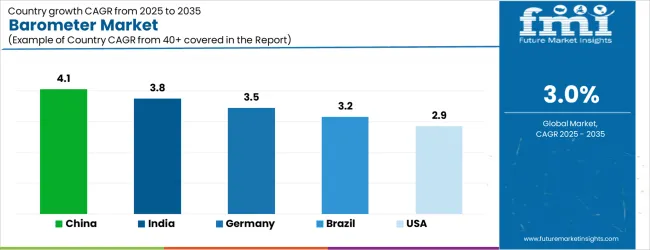
- As per FMI, among countries tracked, China leads at 4.1% CAGR, followed by India at 3.8%, Germany at 3.5%, Brazil at 3.2%, and USA at 2.9%.
- Product and Segment View
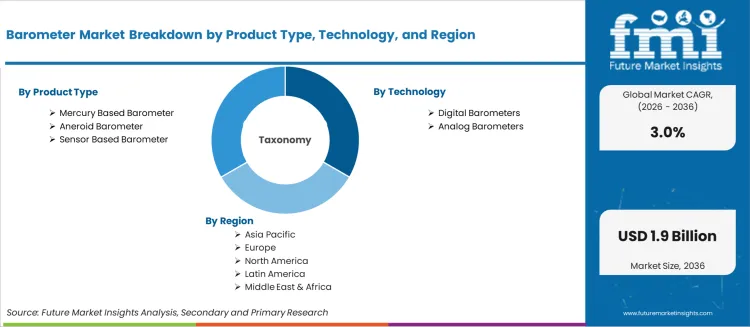
- The market includes mercury-based, aneroid, and sensor-based barometers spanning digital and analog technology platforms for professional, industrial, and consumer applications.
- Applications span meteorology and weather forecasting, laboratory research, aerospace altitude measurement, marine navigation, personal weather monitoring, and industrial process control.
- Based on FMI's barometer market report, Mercury Based Barometer leads by Product Type with 40.0% share in 2026.
- Digital Barometers leads by Technology with 55.0% share in 2026.
- The scope includes market scope includes mercury-based, aneroid, and sensor-based barometers across digital and analog technology platforms. coverage spans global and re. Excluded are the scope excludes general-purpose pressure transducers not calibrated for atmospheric measurement, weather radar systems, and satellite-based atmospheric sensing platforms.
- Geography and Competitive Outlook
- China and India are the fastest-growing markets, while Japan and UK remain mature demand bases with replacement-cycle purchasing patterns.
- Competition is shaped by manufacturing scale, distribution networks, and compliance capabilities, with key players including Honeywell International Inc., Vaisala Oyj, Fortive Corporation (Setra Systems), Mensor LP, OMEGA Engineering Inc..
- Analyst Opinion at FMI
- Nikhil Kaitwade, Principal Consultant for Industrial Automation at FMI, opines: 'In my analysis, I have observed that the barometer market is undergoing a generational technology transition where digital sensor platforms are displacing analog instruments in new installations while legacy applications retain demand for calibration-grade mercury and aneroid devices. Facility operators who specify MEMS-based digital barometers with network integration capabilities will capture operational efficiency gains that analog devices cannot provide. Equipment specifiers who delay this transition will face increasing maintenance costs and declining parts availability for legacy instruments.'
- Strategic Implications / Executive Takeaways
- Instrument manufacturers must develop MEMS-based digital platforms with network output capabilities to qualify for next-generation meteorological and aviation procurement specifications.
- Facility operations teams should specify digital barometers with automated calibration features to reduce the maintenance burden associated with legacy analog instrument fleets.
- Marine equipment suppliers must align product certifications with updated coastal navigation safety standards to access replacement procurement cycles in regulated maritime jurisdictions.
Barometer Market Key Takeaways
| Metric | Details |
|---|---|
| Industry Size (2026) | USD 1.44 billion |
| Industry Value (2036) | USD 1.94 billion |
| CAGR (2026-2036) | 3.0% |
Source: Future Market Insights, 2026
Based on FMI analysis, the barometer market is transitioning from legacy analog instruments toward sensor-based digital platforms that integrate with automated weather networks and industrial control systems. Aneroid and mercury-based devices continue to serve calibration reference and marine navigation applications, but new installations increasingly specify MEMS-based pressure sensors with digital output capabilities. This technology shift raises the average selling price per unit while reducing the total installed unit count in applications where a single digital sensor replaces multiple analog gauges.
Country-level growth trajectories vary based on local regulatory frameworks and industrial maturity. China leads the expansion at 4.1% CAGR, followed by India at 3.8%, Germany at 3.5%, Brazil at 3.2%, USA at 2.9%, UK at 2.6%, Japan at 2.3%. Mature markets such as Japan and UK continue to generate steady replacement demand while China and India benefit from expanding capacity and industrial investment.
Barometer Market Key Takeaways
Power in the barometer value chain concentrates at the MEMS sensor manufacturer level, where a small number of semiconductor fabricators produce the pressure sensing elements used in digital barometers. Instrument assemblers who lack in-house sensor fabrication capability depend on these suppliers for their core component, which limits their ability to differentiate on measurement performance.
Pricing asymmetry separates the consumer weather station segment, where barometer modules are low-cost commodity components, from professional meteorological and aviation reference instruments, where calibration certification and traceability requirements support price premiums of ten to fifty times above consumer-grade devices.
Sourcing fragility in this market reflects dependence on MEMS fabrication capacity, which is shared with other pressure sensing applications in automotive, medical, and industrial sectors. Demand surges in these adjacent markets can create allocation constraints for barometer-specific sensor supply.
Brand and compliance risks center on calibration certification. Professional barometers must carry national metrology institute traceability, and loss of calibration accreditation eliminates a manufacturer from the professional and aviation procurement markets. Consumer brands face reputational risk from accuracy claims that fail independent testing.
Geographic leverage is asymmetric. China and India represent the highest growth rates driven by meteorological infrastructure expansion and aviation sector growth. North America and Europe generate steady replacement demand through established weather networks and aviation systems. Japan maintains a technology leadership position in MEMS sensor fabrication. Marine-focused economies in Southeast Asia and Oceania create niche demand tied to coastal navigation safety standards.
For C-suite executives, the barometer market is a technology transition story where digital platforms are replacing analog instruments at a higher per-unit price point but lower total unit volume. The strategic opportunity is in the professional and industrial segments where calibration certification creates customer lock-in, while the consumer segment remains a volume play with thin margins.
Barometer Market Definition
Barometers are pressure measurement instruments used to determine atmospheric pressure for meteorological observation, aviation safety, marine navigation, laboratory research, and industrial process control. Product types include mercury-based barometers, aneroid barometers, and sensor-based digital barometers utilizing MEMS and piezoresistive technologies. Technology platforms divide into digital and analog configurations serving professional, industrial, and consumer applications.
Barometer Market Inclusions
Market scope includes mercury-based, aneroid, and sensor-based barometers across digital and analog technology platforms. Coverage spans global and regional market sizes, forecast period 2026 to 2036, segmentation by product type, technology, end-use industry, and geography.
Barometer Market Exclusions
The scope excludes general-purpose pressure transducers not calibrated for atmospheric measurement, weather radar systems, and satellite-based atmospheric sensing platforms. Hygrometers, thermometers, and multi-function weather instruments where barometric measurement is a secondary feature are omitted from the valuation.
Barometer Market Research Methodology
- Primary Research: Analysts engaged with procurement managers, manufacturing engineers, and supply chain directors to map the decision triggers driving product upgrades and supplier qualification cycles in the barometer space.
- Desk Research: Data collection aggregated regulatory filings, trade statistics, industry standards ratification schedules, and publicly available financial disclosures from leading participants.
- Market-Sizing and Forecasting: Baseline values derive from a bottom-up aggregation of production volumes and trade flows, applying region-specific adoption curves to project future demand velocity.
- Data Validation and Update Cycle: Projections are tested against publicly reported capital expenditure guidance and production capacity announcements from leading industry participants.
Why is the Barometer Market Growing?
Market Overview:
The Barometer market is witnessing steady growth due to the increasing demand for precise atmospheric pressure measurement across multiple sectors including meteorology, research, industrial applications, and smart weather monitoring systems. The market’s growth has been influenced by rising adoption of digital technologies, increasing environmental monitoring requirements, and advancements in sensor-based measurement systems that provide higher accuracy, durability, and user convenience.
Traditional mercury-based barometers continue to maintain relevance due to their proven precision and long-term reliability in laboratory and field applications. The market is further supported by expanding end-use industries that rely on accurate pressure readings for predictive weather analysis, scientific research, and industrial safety protocols.
Future growth opportunities are expected to be shaped by innovations in compact and portable devices, integration with IoT-enabled weather monitoring systems, and increasing awareness about climate patterns that necessitate real-time atmospheric data With global attention on climate change and technological modernization, barometers are positioned to maintain strong relevance and growth in both traditional and digital forms.
Barometer Market Drivers, Restraints, Opportunities
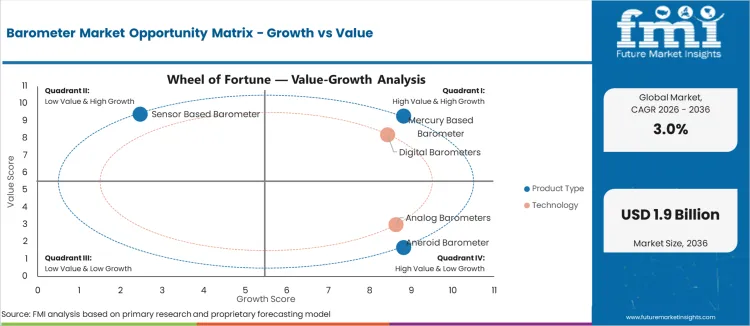
Future Market Insights analysis identifies the barometer market as a mature instrumentation category with growth driven by technology platform transition rather than new application discovery. The market exists at its current valuation because atmospheric pressure measurement remains a mandatory input for meteorological forecasting, aviation safety, and industrial process control, none of which can substitute alternative sensing modalities for barometric data.
The core shift in this market is the replacement of analog measurement instruments with digital sensor platforms that deliver higher accuracy, automated data output, and network integration. This transition does not increase the total number of installed barometric measurement points but raises the per-unit value through technology upgrade. Mercury-based and aneroid instruments retain relevance in calibration reference and marine applications where their long-term stability and independence from electronic power supply provide functional advantages that digital instruments have not fully replicated.
- Weather network modernization: National meteorological agencies in Asia Pacific and Latin America are deploying automated surface observation systems that require digital barometric sensors with network data output. These modernization programs replace manual observation stations with sensor networks, creating a one-time procurement pulse followed by recurring calibration and replacement demand.
- Aviation altimeter compliance: International Civil Aviation Organization annex requirements mandate certified barometric pressure reference instruments at airports and along air navigation corridors. Expanding commercial aviation routes in India, China, and Southeast Asia create new installation requirements for airport barometric reference systems that comply with ICAO accuracy standards.
- Industrial process integration: Pharmaceutical manufacturing facilities and food processing plants integrate barometric pressure monitoring into process control systems to maintain environmental conditions that meet GMP and food safety standards. FMI analysts note this application channel specifies digital sensors with automated logging and alarm capabilities that analog instruments cannot provide.
Segmental Analysis
The barometer market is segmented by product type, technology, end use industry, and geographic regions. By product type, barometer market is divided into Mercury Based Barometer, Aneroid Barometer, and Sensor Based Barometer. In terms of technology, barometer market is classified into Digital Barometers and Analog Barometers. Based on end use industry, barometer market is segmented into Barometers For Metrology & Weather, Barometers For Laboratory & Research, Barometers For Aerospace, Barometers For Marine, Barometers For Personal Use, and Barometers For Other Industrial Applications. Regionally, the barometer industry is classified into North America, Latin America, Western Europe, Eastern Europe, Balkan & Baltic Countries, Russia & Belarus, Central Asia, East Asia, South Asia & Pacific, and the Middle East & Africa.
Insights into the Mercury Based Barometer Segment
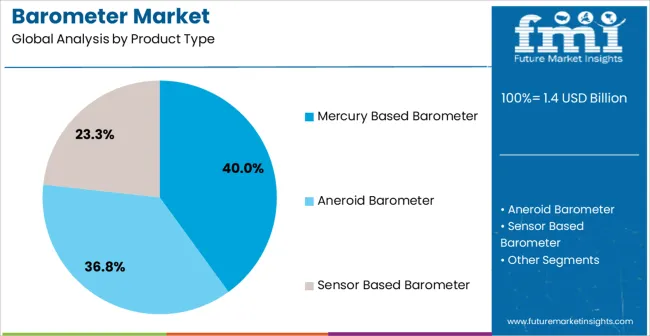
The Mercury Based Barometer product type is expected to hold 40.00% of the overall Barometer market revenue share in 2026, establishing it as a leading product type. This prominence is being attributed to the segment’s long-standing accuracy, robustness, and suitability for laboratory and precision weather measurement applications. Mercury barometers provide a highly reliable and consistent method for pressure measurement, which is critical in scientific experiments and meteorological research.
Adoption has been encouraged by the historical trust in mercury-based systems, their proven calibration stability over long periods, and minimal sensitivity to environmental fluctuations. The segment has benefited from steady demand in research institutions and industrial applications where precise measurement is non-negotiable.
Future growth is expected to be supported by markets that continue to value the unmatched precision of mercury barometers, especially in settings where software and electronic alternatives are either unavailable or unsuitable The combination of reliability, scientific credibility, and measurement accuracy has helped maintain the leading market position of mercury-based barometers.
Insights into the Digital Barometers Segment
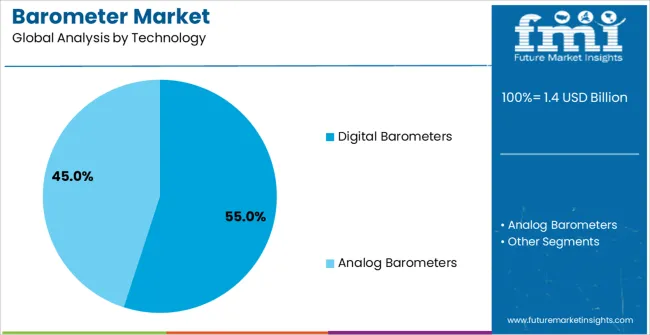
The Digital Barometers technology segment is projected to account for 55.00% of the Barometer market revenue in 2026, making it the dominant technology type. Growth in this segment is being driven by the rising preference for compact, lightweight, and portable devices that integrate easily with modern digital systems and IoT-enabled platforms.
Digital barometers provide real-time data, improved user interfaces, and additional functionalities such as trend analysis, remote monitoring, and automated alerts, which have increased adoption in both commercial and consumer applications. The segment has expanded rapidly due to growing environmental monitoring, weather forecasting, and smart device integration.
Furthermore, digital barometers offer ease of use, minimal maintenance requirements, and the ability to interface with other electronic devices, making them attractive for educational, research, and commercial purposes The trend towards digital transformation across industrial and environmental monitoring applications continues to reinforce the position of digital barometers as the leading technology segment in the market.
Insights into the Barometers for Metrology and Weather Segment
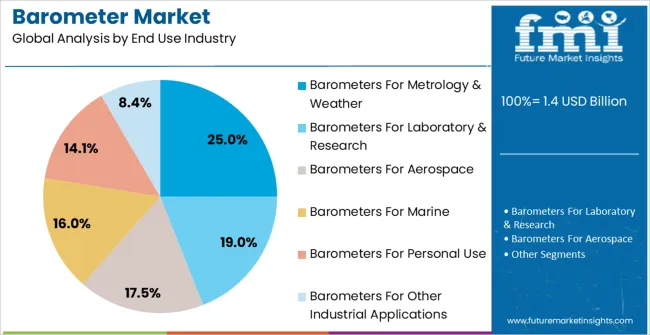
The Barometers for Metrology and Weather end-use industry segment is anticipated to hold 25.00% of the total Barometer market revenue in 2026, emerging as a significant contributor to market growth. The prominence of this segment is being driven by the increasing reliance on accurate atmospheric pressure measurements in meteorology, climate research, and predictive weather analytics. Adoption has been facilitated by the growing need for precise data in government and private meteorological departments, academic institutions, and research laboratories.
The segment has benefited from technological advancements that enhance measurement precision, data logging, and calibration capabilities. Additionally, demand has been supported by expanding applications in environmental monitoring, aviation, and scientific experiments where accuracy and reliability are critical.
As climate change and extreme weather events gain global attention, the requirement for dependable atmospheric data continues to rise, further bolstering the segment’s market position Investments in high-accuracy instruments and modernized weather stations are expected to sustain the growth of barometers used for metrology and weather monitoring.
Analysis of Barometer Market By Key Countries
.webp "Top Country Growth Comparison Barometer Market Cagr (2026 2036)")
| Country | CAGR |
|---|---|
| China | 4.1% |
| India | 3.8% |
| Germany | 3.5% |
| Brazil | 3.2% |
| USA | 2.9% |
| UK | 2.6% |
| Japan | 2.3% |
Source: FMI analysis based on primary research and proprietary forecasting model
Country-wise Analysis
The Barometer Market is expected to register a CAGR of 3.0% during the forecast period, exhibiting varied country level momentum. China leads with the highest CAGR of 4.1%, followed by India at 3.8%. Developed markets such as Germany, France, and the UK continue to expand steadily, while the USA is likely to grow at consistent rates. Japan posts the lowest CAGR at 2.3%, yet still underscores a broadly positive trajectory for the global Barometer Market. In 2024, Germany held a dominant revenue in the Western Europe market and is expected to grow with a CAGR of 3.5%. The USA Barometer Market is estimated to be valued at USD 469.0 million in 2026 and is anticipated to reach a valuation of USD 469.0 million by 2036. Sales are projected to rise at a CAGR of 0.0% over the forecast period between 2026 and 2036. While Japan and South Korea markets are estimated to be valued at USD 72.6 million and USD 40.8 million respectively in 2026.
Key Players in the Barometer Market

- Honeywell International Inc.
- Vaisala Oyj
- Fortive Corporation (Setra Systems)
- Mensor LP
- OMEGA Engineering Inc.
- Ametek Inc.
- BarometerShop.com
- Fischer Precision Spindles GmbH
- Dwyer Instruments Inc.
- Keller America Inc.
- Testo SE & Co. KGaA
- BOSCH Sensortec GmbH
- Renke Control Technology Co. Ltd.
- PCE Instruments
- Micro-Epsilon Messtechnik GmbH & Co. KG
- Biral Ltd.
- General Tools & Instruments LLC
- Kaizen Imperial
Scope of the Report
| Metric | Value |
|---|---|
| Quantitative Units | USD 1.44 billion to USD 1.94 billion, at a CAGR of 3.0% |
| Market Definition | Barometers are pressure measurement instruments used to determine atmospheric pressure for meteorological observation, aviation safety, marine navigation, laboratory research, and industrial process control. Product types include mercury-based barometers, aneroid barometers, and sensor-based digital barometers utilizing MEMS and piezoresistive technologies. Technology platforms divide into digital and analog configurations serving professional, industrial, and consumer applications. |
| Segmentation | Product Type: Mercury Based Barometer, Aneroid Barometer, Sensor Based Barometer; Technology: Digital Barometers, Analog Barometers; End Use Industry: Barometers For Metrology & Weather, Barometers For Laboratory & Research, Barometers For Aerospace, Barometers For Marine, Barometers For Personal Use, Barometers For Other Industrial Applications |
| Regions Covered | North America, Latin America, Europe, East Asia, South Asia, Oceania, Middle East & Africa |
| Countries Covered | China, India, Germany, Brazil, USA, UK, Japan, and 40 plus countries |
| Key Companies Profiled | Honeywell International Inc., Vaisala Oyj, Fortive Corporation (Setra Systems), Mensor LP, OMEGA Engineering Inc., Ametek Inc., BarometerShop.com, Fischer Precision Spindles GmbH, Dwyer Instruments Inc., Keller America Inc., Testo SE & Co. KGaA, BOSCH Sensortec GmbH, Renke Control Technology Co. Ltd., PCE Instruments, Micro-Epsilon Messtechnik GmbH & Co. KG, Biral Ltd., General Tools & Instruments LLC, Kaizen Imperial |
| Forecast Period | 2026 to 2036 |
| Approach | Forecasting models apply a bottom-up methodology starting with global installed base metrics and projecting conversion rates to specialized applications. Cross-validation uses publicly reported expenditure guidance from leading industry participants. |
Barometer Market by Segments
Product Type:
- Mercury Based Barometer
- Aneroid Barometer
- Sensor Based Barometer
Technology:
- Digital Barometers
- Analog Barometers
End Use Industry:
- Barometers For Metrology & Weather
- Barometers For Laboratory & Research
- Barometers For Aerospace
- Barometers For Marine
- Barometers For Personal Use
- Barometers For Other Industrial Applications
Region:
- North America
- USA
- Canada
- Mexico
- Latin America
- Brazil
- Chile
- Rest of Latin America
- Western Europe
- Germany
- UK
- Italy
- Spain
- France
- Nordic
- BENELUX
- Rest of Western Europe
- Eastern Europe
- Russia
- Poland
- Hungary
- Balkan & Baltic
- Rest of Eastern Europe
- East Asia
- China
- Japan
- South Korea
- South Asia and Pacific
- India
- ASEAN
- Australia & New Zealand
- Rest of South Asia and Pacific
- Middle East & Africa
- Kingdom of Saudi Arabia
- Other GCC Countries
- Turkiye
- South Africa
- Other African Union
- Rest of Middle East & Africa
Bibliography
- 1. World Meteorological Organization. (2024). Guide to instruments and methods of observation (WMO-No. 8, 2024 update). WMO.
- 2. International Civil Aviation Organization. (2024). Annex 3: Meteorological service for international air navigation. ICAO.
- 3. International Organization for Standardization. (2023). ISO 17025:2017 General requirements for the competence of testing and calibration laboratories (reaffirmed 2023). ISO.
- 4. National Institute of Standards and Technology. (2024). NIST barometric pressure measurement calibration standards. NIST.
- 5. International Maritime Organization. (2024). International Convention for the Safety of Life at Sea (SOLAS), Chapter V: Safety of navigation. IMO.
- 6. India Meteorological Department. (2024). Automated weather station network modernization plan. IMD.
This bibliography is provided for reader reference. The full Future Market Insights report contains the complete reference list with primary research documentation.
Frequently Asked Questions
How large is the demand for Barometer in the global market in 2026?
Demand for barometer in the global market is estimated to be valued at USD 1.44 billion in 2026.
What will be the market size of Barometer in the global market by 2036?
Market size for barometer is projected to reach USD 1.94 billion by 2036.
What is the expected demand growth for Barometer in the global market between 2026 and 2036?
Demand for barometer is expected to grow at a CAGR of 3.0% between 2026 and 2036.
Which Product Type is poised to lead global sales by 2026?
Mercury Based Barometer accounts for 40.0% in 2026 based on laboratory and calibration reference applications where mercury column precision remains the traceability standard for national metrology institutes.
How is the role of Digital Barometers in driving Barometer adoption in 2026?
Digital Barometers holds 55.0% of Technology share in 2026, driven by new-installation specifications that mandate automated data output, network connectivity, and integration with facility management systems.
What is driving demand in China?
China leads growth at 4.1% CAGR, supported by meteorological station network expansion and industrial facility automation programs requiring calibrated digital pressure instruments.
What is India's growth outlook in this report?
India is projected to grow at a CAGR of 3.8% during 2026 to 2036.
What is Barometer Market and what is it mainly used for?
Barometers are pressure measurement instruments used to determine atmospheric pressure for meteorological observation, aviation safety, marine navigation, laboratory research, and industrial process control. Product types include mercury-based barometers, aneroid barometers, and sensor-based digital barometers utilizing MEMS and piezoresistive technologies.
Preview the report firsthand - request a free sample
Get SampleGet the brochure for pricing and purchase details.
Get PDFTable of Content
- Executive Summary
- Global Market Outlook
- Demand-side Trends
- Supply-side Trends
- Technology Roadmap Analysis
- Analysis and Recommendations
- Market Overview
- Market Coverage / Taxonomy
- Market Definition / Scope / Limitations
- Research Methodology
- Chapter Orientation
- Analytical Lens and Working Hypotheses
- Market Structure, Signals, and Trend Drivers
- Benchmarking and Cross-market Comparability
- Market Sizing, Forecasting, and Opportunity Mapping
- Research Design and Evidence Framework
- Desk Research Programme (Secondary Evidence)
- Company Annual and Sustainability Reports
- Peer-reviewed Journals and Academic Literature
- Corporate Websites, Product Literature, and Technical Notes
- Earnings Decks and Investor Briefings
- Statutory Filings and Regulatory Disclosures
- Technical White Papers and Standards Notes
- Trade Journals, Industry Magazines, and Analyst Briefs
- Conference Proceedings, Webinars, and Seminar Materials
- Government Statistics Portals and Public Data Releases
- Press Releases and Reputable Media Coverage
- Specialist Newsletters and Curated Briefings
- Sector Databases and Reference Repositories
- FMI Internal Proprietary Databases and Historical Market Datasets
- Subscription Datasets and Paid Sources
- Social Channels, Communities, and Digital Listening Inputs
- Additional Desk Sources
- Expert Input and Fieldwork (Primary Evidence)
- Primary Modes
- Qualitative Interviews and Expert Elicitation
- Quantitative Surveys and Structured Data Capture
- Blended Approach
- Why Primary Evidence is Used
- Field Techniques
- Interviews
- Surveys
- Focus Groups
- Observational and In-context Research
- Social and Community Interactions
- Stakeholder Universe Engaged
- C-suite Leaders
- Board Members
- Presidents and Vice Presidents
- R&D and Innovation Heads
- Technical Specialists
- Domain Subject-matter Experts
- Scientists
- Physicians and Other Healthcare Professionals
- Governance, Ethics, and Data Stewardship
- Research Ethics
- Data Integrity and Handling
- Primary Modes
- Tooling, Models, and Reference Databases
- Desk Research Programme (Secondary Evidence)
- Data Engineering and Model Build
- Data Acquisition and Ingestion
- Cleaning, Normalisation, and Verification
- Synthesis, Triangulation, and Analysis
- Quality Assurance and Audit Trail
- Market Background
- Market Dynamics
- Drivers
- Restraints
- Opportunity
- Trends
- Scenario Forecast
- Demand in Optimistic Scenario
- Demand in Likely Scenario
- Demand in Conservative Scenario
- Opportunity Map Analysis
- Product Life Cycle Analysis
- Supply Chain Analysis
- Investment Feasibility Matrix
- Value Chain Analysis
- PESTLE and Porter’s Analysis
- Regulatory Landscape
- Regional Parent Market Outlook
- Production and Consumption Statistics
- Import and Export Statistics
- Market Dynamics
- Global Market Analysis 2021 to 2025 and Forecast, 2026 to 2036
- Historical Market Size Value (USD Million) Analysis, 2021 to 2025
- Current and Future Market Size Value (USD Million) Projections, 2026 to 2036
- Y-o-Y Growth Trend Analysis
- Absolute $ Opportunity Analysis
- Global Market Pricing Analysis 2021 to 2025 and Forecast 2026 to 2036
- Global Market Analysis 2021 to 2025 and Forecast 2026 to 2036, By Product Type
- Introduction / Key Findings
- Historical Market Size Value (USD Million) Analysis By Product Type , 2021 to 2025
- Current and Future Market Size Value (USD Million) Analysis and Forecast By Product Type , 2026 to 2036
- Mercury Based Barometer
- Aneroid Barometer
- Sensor Based Barometer
- Mercury Based Barometer
- Y-o-Y Growth Trend Analysis By Product Type , 2021 to 2025
- Absolute $ Opportunity Analysis By Product Type , 2026 to 2036
- Global Market Analysis 2021 to 2025 and Forecast 2026 to 2036, By Technology
- Introduction / Key Findings
- Historical Market Size Value (USD Million) Analysis By Technology, 2021 to 2025
- Current and Future Market Size Value (USD Million) Analysis and Forecast By Technology, 2026 to 2036
- Digital Barometers
- Analog Barometers
- Digital Barometers
- Y-o-Y Growth Trend Analysis By Technology, 2021 to 2025
- Absolute $ Opportunity Analysis By Technology, 2026 to 2036
- Global Market Analysis 2021 to 2025 and Forecast 2026 to 2036, By End Use Industry
- Introduction / Key Findings
- Historical Market Size Value (USD Million) Analysis By End Use Industry, 2021 to 2025
- Current and Future Market Size Value (USD Million) Analysis and Forecast By End Use Industry, 2026 to 2036
- Barometers For Metrology & Weather
- Barometers For Laboratory & Research
- Barometers For Aerospace
- Barometers For Marine
- Barometers For Personal Use
- Barometers For Other Industrial Applications
- Barometers For Metrology & Weather
- Y-o-Y Growth Trend Analysis By End Use Industry, 2021 to 2025
- Absolute $ Opportunity Analysis By End Use Industry, 2026 to 2036
- Global Market Analysis 2021 to 2025 and Forecast 2026 to 2036, By Region
- Introduction
- Historical Market Size Value (USD Million) Analysis By Region, 2021 to 2025
- Current Market Size Value (USD Million) Analysis and Forecast By Region, 2026 to 2036
- North America
- Latin America
- Western Europe
- Eastern Europe
- East Asia
- South Asia and Pacific
- Middle East & Africa
- Market Attractiveness Analysis By Region
- North America Market Analysis 2021 to 2025 and Forecast 2026 to 2036, By Country
- Historical Market Size Value (USD Million) Trend Analysis By Market Taxonomy, 2021 to 2025
- Market Size Value (USD Million) Forecast By Market Taxonomy, 2026 to 2036
- By Country
- USA
- Canada
- Mexico
- By Product Type
- By Technology
- By End Use Industry
- By Country
- Market Attractiveness Analysis
- By Country
- By Product Type
- By Technology
- By End Use Industry
- Key Takeaways
- Latin America Market Analysis 2021 to 2025 and Forecast 2026 to 2036, By Country
- Historical Market Size Value (USD Million) Trend Analysis By Market Taxonomy, 2021 to 2025
- Market Size Value (USD Million) Forecast By Market Taxonomy, 2026 to 2036
- By Country
- Brazil
- Chile
- Rest of Latin America
- By Product Type
- By Technology
- By End Use Industry
- By Country
- Market Attractiveness Analysis
- By Country
- By Product Type
- By Technology
- By End Use Industry
- Key Takeaways
- Western Europe Market Analysis 2021 to 2025 and Forecast 2026 to 2036, By Country
- Historical Market Size Value (USD Million) Trend Analysis By Market Taxonomy, 2021 to 2025
- Market Size Value (USD Million) Forecast By Market Taxonomy, 2026 to 2036
- By Country
- Germany
- UK
- Italy
- Spain
- France
- Nordic
- BENELUX
- Rest of Western Europe
- By Product Type
- By Technology
- By End Use Industry
- By Country
- Market Attractiveness Analysis
- By Country
- By Product Type
- By Technology
- By End Use Industry
- Key Takeaways
- Eastern Europe Market Analysis 2021 to 2025 and Forecast 2026 to 2036, By Country
- Historical Market Size Value (USD Million) Trend Analysis By Market Taxonomy, 2021 to 2025
- Market Size Value (USD Million) Forecast By Market Taxonomy, 2026 to 2036
- By Country
- Russia
- Poland
- Hungary
- Balkan & Baltic
- Rest of Eastern Europe
- By Product Type
- By Technology
- By End Use Industry
- By Country
- Market Attractiveness Analysis
- By Country
- By Product Type
- By Technology
- By End Use Industry
- Key Takeaways
- East Asia Market Analysis 2021 to 2025 and Forecast 2026 to 2036, By Country
- Historical Market Size Value (USD Million) Trend Analysis By Market Taxonomy, 2021 to 2025
- Market Size Value (USD Million) Forecast By Market Taxonomy, 2026 to 2036
- By Country
- China
- Japan
- South Korea
- By Product Type
- By Technology
- By End Use Industry
- By Country
- Market Attractiveness Analysis
- By Country
- By Product Type
- By Technology
- By End Use Industry
- Key Takeaways
- South Asia and Pacific Market Analysis 2021 to 2025 and Forecast 2026 to 2036, By Country
- Historical Market Size Value (USD Million) Trend Analysis By Market Taxonomy, 2021 to 2025
- Market Size Value (USD Million) Forecast By Market Taxonomy, 2026 to 2036
- By Country
- India
- ASEAN
- Australia & New Zealand
- Rest of South Asia and Pacific
- By Product Type
- By Technology
- By End Use Industry
- By Country
- Market Attractiveness Analysis
- By Country
- By Product Type
- By Technology
- By End Use Industry
- Key Takeaways
- Middle East & Africa Market Analysis 2021 to 2025 and Forecast 2026 to 2036, By Country
- Historical Market Size Value (USD Million) Trend Analysis By Market Taxonomy, 2021 to 2025
- Market Size Value (USD Million) Forecast By Market Taxonomy, 2026 to 2036
- By Country
- Kingdom of Saudi Arabia
- Other GCC Countries
- Turkiye
- South Africa
- Other African Union
- Rest of Middle East & Africa
- By Product Type
- By Technology
- By End Use Industry
- By Country
- Market Attractiveness Analysis
- By Country
- By Product Type
- By Technology
- By End Use Industry
- Key Takeaways
- Key Countries Market Analysis
- USA
- Pricing Analysis
- Market Share Analysis, 2025
- By Product Type
- By Technology
- By End Use Industry
- Canada
- Pricing Analysis
- Market Share Analysis, 2025
- By Product Type
- By Technology
- By End Use Industry
- Mexico
- Pricing Analysis
- Market Share Analysis, 2025
- By Product Type
- By Technology
- By End Use Industry
- Brazil
- Pricing Analysis
- Market Share Analysis, 2025
- By Product Type
- By Technology
- By End Use Industry
- Chile
- Pricing Analysis
- Market Share Analysis, 2025
- By Product Type
- By Technology
- By End Use Industry
- Germany
- Pricing Analysis
- Market Share Analysis, 2025
- By Product Type
- By Technology
- By End Use Industry
- UK
- Pricing Analysis
- Market Share Analysis, 2025
- By Product Type
- By Technology
- By End Use Industry
- Italy
- Pricing Analysis
- Market Share Analysis, 2025
- By Product Type
- By Technology
- By End Use Industry
- Spain
- Pricing Analysis
- Market Share Analysis, 2025
- By Product Type
- By Technology
- By End Use Industry
- France
- Pricing Analysis
- Market Share Analysis, 2025
- By Product Type
- By Technology
- By End Use Industry
- India
- Pricing Analysis
- Market Share Analysis, 2025
- By Product Type
- By Technology
- By End Use Industry
- ASEAN
- Pricing Analysis
- Market Share Analysis, 2025
- By Product Type
- By Technology
- By End Use Industry
- Australia & New Zealand
- Pricing Analysis
- Market Share Analysis, 2025
- By Product Type
- By Technology
- By End Use Industry
- China
- Pricing Analysis
- Market Share Analysis, 2025
- By Product Type
- By Technology
- By End Use Industry
- Japan
- Pricing Analysis
- Market Share Analysis, 2025
- By Product Type
- By Technology
- By End Use Industry
- South Korea
- Pricing Analysis
- Market Share Analysis, 2025
- By Product Type
- By Technology
- By End Use Industry
- Russia
- Pricing Analysis
- Market Share Analysis, 2025
- By Product Type
- By Technology
- By End Use Industry
- Poland
- Pricing Analysis
- Market Share Analysis, 2025
- By Product Type
- By Technology
- By End Use Industry
- Hungary
- Pricing Analysis
- Market Share Analysis, 2025
- By Product Type
- By Technology
- By End Use Industry
- Kingdom of Saudi Arabia
- Pricing Analysis
- Market Share Analysis, 2025
- By Product Type
- By Technology
- By End Use Industry
- Turkiye
- Pricing Analysis
- Market Share Analysis, 2025
- By Product Type
- By Technology
- By End Use Industry
- South Africa
- Pricing Analysis
- Market Share Analysis, 2025
- By Product Type
- By Technology
- By End Use Industry
- USA
- Market Structure Analysis
- Competition Dashboard
- Competition Benchmarking
- Market Share Analysis of Top Players
- By Regional
- By Product Type
- By Technology
- By End Use Industry
- Competition Analysis
- Competition Deep Dive
- Honeywell International Inc.
- Overview
- Product Portfolio
- Profitability by Market Segments (Product/Age /Sales Channel/Region)
- Sales Footprint
- Strategy Overview
- Marketing Strategy
- Product Strategy
- Channel Strategy
- Vaisala Oyj
- Fortive Corporation (Setra Systems)
- Mensor LP
- OMEGA Engineering Inc.
- Ametek Inc.
- BarometerShop.com
- Fischer Precision Spindles GmbH
- Dwyer Instruments Inc.
- Keller America Inc.
- Testo SE & Co. KGaA
- BOSCH Sensortec GmbH
- Renke Control Technology Co. Ltd.
- PCE Instruments
- Micro-Epsilon Messtechnik GmbH & Co. KG
- Biral Ltd.
- General Tools & Instruments LLC
- Kaizen Imperial
- Honeywell International Inc.
- Competition Deep Dive
- Assumptions & Acronyms Used


